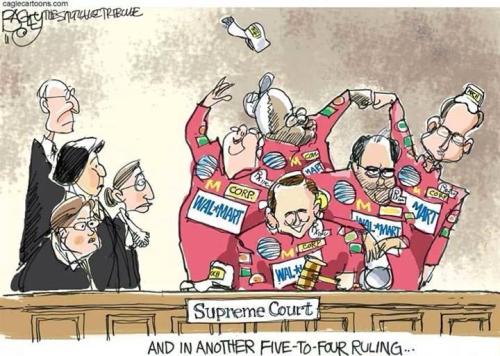
Showing posts with label SCOTUS. Show all posts

Monday, March 30, 2015

“A malign force in American history”: Why you should be terrified of the Supreme Court

Monday, Mar 30, 2015

Ridiculous theories, destructive effects and evil tragedies are SCOTUS trademarks, expert Ian Millhiser tells Salon 

Elias Isquith

Throughout his years as a national politician and in the White House, President Barack Obama has had many antagonists and foes: John McCain, Mitch McConnell, Mitt Romney, Eric Cantor and John Boehner come to mind. But despite their greater public profile, one could argue that none of these men have been quite as formidable a source of opposition and frustration as the five conservative justices on the Supreme Court.

Indeed, the closest Obama’s signature achievement, the Affordable Care Act, ever came to destruction was not in the House or in the Senate. It was behind the closed doors of the justices’ chambers, where it survived in 2012 by just one vote, and where, due to King v. Burwell, the latest case against Obamacare, it finds itself imperiled once again. The greatest threat to the Obama agenda, in other words, has manifested in the form of a purposefully opaque institution, and in the persons of five unelected conservative men.

Unsurprisingly, this state of affairs has led many a liberal or even moderate Democrat to pull their hair and grind their teeth out of aggravation. And when compared to the Supreme Court of the 1950s, 1960s and early 1970s, which most progressives think of as a source of comfort and power for society’s downtrodden, the Roberts court looks anomalous indeed. But what if it’s the mid-20th century court, and not that of today, which stands as the exception to the rule? What if the Roberts court is more in keeping with U.S. history than liberals tend to think?

That’s the argument that Ian Millhiser, a senior fellow at the Center for American Progress Action Fund and the editor of Think Progress Justice, makes in his new book, “Injustices: The Supreme Court’s History of Comforting the Comfortable and Afflicting the Afflicted.” As Millhiser sees it, the Supreme Court has spent most of its existence standing athwart history, yelling, Stop! From gutting the civil rights acts of the post-Civil War era to attacking business regulations to weakening protections for children, minorities and immigrants, the court Millhiser describes has much more often than not worked to return power to those in society who need it least, and abuse it most.

Recently, Salon spoke over the phone with Millhiser to discuss his new book as well as his thoughts on the Obamacare case currently in front of the court, the legitimacy of the institution, and why the next presidential election will have such a large impact on whether the court of the foreseeable future is one that fights progress, or acts as its shepherd. Our conversation is below and has been edited for clarity and length.

The Supreme Court has been a source of controversy for a long, long time. But what was it in particular that you wanted to get across with this book?

The notion that the Supreme Court has been a malign force in American history is by no means a new one. It dominated President [Franklin Delano] Roosevelt’s rhetoric on the Supreme Court; it was the reason why many of the liberal justices on the Supreme Court were reluctant to to vote the right way on Brown v. Board of Education, because they were so fearful of judicial power that they were afraid to exercise it. It’s only fairly recently that liberals have come to think of the Supreme Court as something we shouldn’t view with extraordinary trepidation.

I wrote this book in large part because I think people — and not just liberals, not just people who think we should have things like child labor laws and Medicare — have lost an important understanding of our history. Meanwhile, people who want to dismantle a lot of the progress of the 20th century are busy building an alternative mythology about the Supreme Court that is very harmful and that we have not yet been effective in countering.

You mentioned how conservatives like to claim or imply that the Constitution prescribes a libertarian government. Why is that narrative mistaken?

The conservative mythology I keep referring to is basically a mythology of original sin. Their narrative is that government is something that the Constitution was very skeptical of and everyone understood this until Franklin Delano Roosevelt came along and tried to pack the court with up to 15 Justices in order to break the back of this understanding of the Constitution. That moment where the court gave in and allowed the New Deal to exist, that is the original sin in the conservative narrative.

The reality could not be more different. The reality is that George Washington, in the midst of the Revolutionary War, was tossing off angry letters saying that Congress didn’t have enough power to act and he wasn’t going to win this war if they didn’t have a more responsive national government. He and others pushed for a more expansive role of government. At the Constitutional Convention, the framers passed a resolution saying that a national government has to have full powers to do everything that the states are not competent enough to do on their own — and one thing the states aren’t capable of doing on their own is regulating a national economy.

Let’s move away from history for a moment to talk about the present court. Granting that the court, historically, has much more often been an enemy of progress rather than a friend, where would you rank the current Roberts Court?

I think what the Roberts Court is going to be remembered as is a transitional court. The Roberts Court is really bad; Citizens United is terrible, and striking down the Voting Rights Act is terrible. But compared to what has come from most of the Supreme Court’s history, it’s actually a lot better.

There are two things at play right now that are going to impact the future of the Supreme Court. At the last national conference of the Federalist Society, a very influential conservative legal group, there was a panel on rolling back anti-discrimination laws and repealing the minimum wage. This is the place where lawsuits like attacks on the Affordable Care Act, like Hobby Lobby, etc., are incubated and where conservative lawyers get together and refine their ideas before they get their friends on the Supreme Court to turn them into law.

The Federalist Society, which is going to have a tremendous impact on who the next Republican president nominates for the Supreme Court, is raring for a return to the bad old days, to the era where the Supreme Court viewed its job as engaging in wholesale skepticism of business regulation. If they succeeded in getting the ear of the next president — and they did have the ear of President George W. Bush and previous Republican presidents — we’re going to be in for a wild ride.

Why else do you see this court as being transitional?

The second thing to keep in mind is that there are four justices right now over the age of 76: Justices Scalia, Kennedy, Ginsburg and Breyer are all in their late 70s or early 80s. When the next president is sworn in, there will be three sitting justices in their 80s — assuming none of them leave before then— so there’s a very real chance that the next president of the United States could replace four justices.

There’s already a fifth justice on the Supreme Court, Clarence Thomas, who has said that he agrees with [the pre-New Deal court's worldview] and the legal argument that was used to attack the Civil Rights Act of 1964; so if he got his way, we probably couldn’t have a ban on whites-only water fountains. Right now, the fact that there’s one justice who embraces this radical anti-government vision doesn’t seem all that scary. But if four more get up there, we could be on the bridge to the 19th century right now.

At the same time, if those four justices are replaced by someone who thinks more or less the same way our current president thinks, then we could have, for the first time in my lifetime and for the second time in the Supreme Court’s history, a court that is very much interested in letting individual rights flourish, in letting voting rights flourish, and in allowing our democracy to function without having ideological justices second-guessing the decision that are made by the people and their representatives.

One question that occurs to me now, and which has been in the discourse about the court for the past few years, is the idea of “legitimacy.” If the current court ends up tarnishing the institution’s legitimacy, that might affect how the next court can operate. But legitimacy is pretty vague concept. Do you think it’s real? Or is it one of those messy ideas we use without adequate interrogation?

That’s a very timely question because there’s this King v. Burwell case in front of the Supreme Court seeking to gut the Affordable Care Act. If that case prevails, an estimated 10,000 people are going to die every year who otherwise would have lived. In addition to that, the legal theory they would use to gut Obamacare is not a bit of a joke; it’s a huge joke; it’s a ridiculous theory. People are very much talking right now about this question of whether we even want the Supreme Court to have this kind of power and whether they are truly legitimate if, based on such a ridiculous legal theory, they could produce such an evil result.

How unprecedented is it that people are talking about the court this way?

The one other time when you saw serious talk about that question come up was during the Roosevelt administration, when you had this huge national crisis, the Great Depression, going on. Roosevelt was doing everything he could think of to restore economic order, and the Supreme Court kept striking it down. In the midst of that tragedy, not only were there serious questions about the court’s legitimacy, but Roosevelt went so far as to propose adding Justices to the Court in an effort, basically, to neutralize it.

Do you think that kind of pressure works? That the court is less radical if it feels like it’s being closely observed and will come in for significant criticism if it’s seen as overstepping its bounds?

I do think it’s the case that at least certain members of the court in the past have become reluctant to do things that are both immoral … when they realize that people are looking over their shoulder — and that people are more likely to look over their shoulder when the results they would produce are particularly tragic.

That’s why I want people to be aware of the consequences. I want people to be terrified of the Supreme Court because we’ve seen over and over again throughout history that when they go off the rails, the results are absolutely disastrous for ordinary Americans.

How do you feel about proposals for reforms to the Supreme Court, like changing it so justices don’t serve in perpetuity but have fixed term limits? Do you think that’s a workable solution? Or is it not really adequate to the task?

I don’t think term limits are going to solve the problem, even if we manage to get them through; I think there is sort of a backhanded way to do it without a Constitutional amendment, but it would take a really long time. The fact remains that Justice Scalia is the longest-serving member of the court and he’s pretty terrible; but Justice Alito hasn’t been there very long, relatively speaking, and he’s even worse. I don’t think there’s a correlation between the tenure of the Justice and whether they’re a good or a bad Justice.

One of the main things you focus on in the book is that Supreme Court decisions have real-world consequences for regular people — and they’ve often been bad. What do you think of the argument raised by some, perhaps most prominently Dahlia Lithwick, that the court would be more likely to understand the human stakes if it weren’t comprised of so many law school all-stars, and had more politicians, as used to happen, instead?

I love Dahlia Lithwick; she may be the single best writer in the Supreme Court issues space. I disagree with her on this point, though. The reason why is because the court has almost always been terrible; it was terrible when you had brilliant scholarly and very dastardly men like Stephen Field leading the charge to dismantle the regulatory state, and it’s been really terrible when you had ignorant bigots like James Clark McReynolds.

Friday, April 11, 2014

Rigging the Electoral System for the Rich

Wednesday, April 9, 2014 by OtherWords
Either through electoral channels or a constitutional amendment, the American people must fight back against Supreme Court rulings like Citizens United and McCutcheon.
by Marge Baker


A poll conducted late last year found that more than seven in ten voters think our election system is “biased in favor of the candidate with the most money.

While nothing about this number is surprising — except, perhaps, that it’s not even higher — it does reveal the depth of cynicism characterizing Americans’ perceptions of our political system. We believe, correctly, that the system is rigged for the rich.
Especially in the wake of this month’s McCutcheon v. FEC Supreme Court decision that allowed our country’s wealthiest to dump even more money directly into our elections, it’s easy to feel overwhelmed by the enormity of America’s money in politics problem.

But as always, the biggest dangers create the biggest opportunities for change. With the McCutcheon ruling, the Supreme Court added fuel to an already awakened giant — a nationwide movement to reclaim our democracy that’s gaining steam like never before.

More than 150 events took place in 41 states and the District of Columbia the day the ruling came out, with activists pushing for a full range of long and short-term solutions.

A stream of rally photos showed thousands of committed citizens who are rejecting cynicism and pushing for change.

Of course, one avenue toward reducing the extent to which money is distorting politics is the courts themselves. When we cast our ballots in the last presidential elections, some of us were thinking about the connection between who we elect as president and the outcomes of campaign finance cases decided by the Supreme Court.

But not everyone recognizes that there’s a direct link. When you vote for a president, or for a senator, you’re not only electing those people for their term of office; in many ways, their most lasting legacy is who they will nominate and who gets confirmed to sit on our nation’s judiciary.

A change in the composition of the Supreme Court could have massive implications for our democracy. Both Citizens United v. FEC, the infamous case that opened the door to unlimited corporate political spending, and this month’s McCutcheon v. FEC were decided 5-4 with strong dissents. Some sitting justices have spoken out against Citizens United since it was decided.

It’s important for voters to know that our democracy was upended by a single vote. Justices Breyer and Ginsburg went out of their way to issue a separate statement in a 2012 Montana corporate spending case calling into question whether “in light of the huge sums currently deployed to buy candidates’ allegiance, Citizens United should continue to hold sway.”

As we elect new presidents who appoint new justices – and elect new senators who confirm or reject them – we can help turn the tide back toward restoring the constitutional power of the American people to impose reasonable limits on money in politics, a power demolished by the arch-conservatives on the Roberts Court.

Another equally important and parallel change effort we should be supporting is the push for a constitutional amendment to overturn Supreme Court decisions like Citizens United and McCutcheon. Constitutional amendments are, and should be rare — reserved for the direst circumstances.

But with the power of regulating our elections and protecting our democracy stripped away from “We the People,” this is one of those moments. Everyday Americans and elected officials across the country agree: More than 16 states and 500 towns and cities have already gone on record in support of an amendment that would overturn these cases.

And 149 Members of the House and Senate are now on record in support of constitutional remedies. Such an amendment would establish an important bulwark against future right-wing Supreme Courts.

Whether by changing the court or changing the Constitution, the decisions that have gutted our campaign finance laws have got to go. Our democracy is too valuable to be undermined by a court interested in protecting wealthy special interests at the expense of the rest of us.

Monday, April 7, 2014

How We Can Fight Back Against the Supreme Court


Let me start by quoting two great men and a crook that died the other day.

"The issue today is the same as it has been throughout all history, whether man shall be allowed to govern himself or be ruled by a small elite." -- Thomas Jefferson

When asked if his payments to politicians had worked,  


Charles Keating replied, "I want to say in the most forceful way I can: I certainly hope so."

When asked outside of Independence Hall if we have a republic or a monarchy, Benjamin Franklin replied, "A republic, if you can keep it."

Well, here we are, aren't we? Right at the point where we are about to find out whether we can keep it or not. The Supreme Court has decided that a small amount of people will get to control our entire political system. Which politician or political party can resist hundreds of millions of dollars put in at once? Maybe one person can resist, maybe one party can resist for a small period of time, but eventually they will succumb.

In Congressional races, 95 percent of the time the person with more money wins. It doesn't matter if they are a Republican or Democrat, conservative or liberal. It doesn't matter what their ideas are or what their ideology is. It doesn't matter what they think at all. You have more money and you will win 19 out of 20 times.

Justice Anthony Kennedy destroyed our republic. We knew Alito, Scalia, Roberts and Thomas were corporate robots. We knew they were going to say disingenuously that corporations or billionaires pouring in millions into our politicians' pockets wouldn't lead to corruption. What an unbelievable joke. But it turns out that Kennedy was the biggest joke of all. He claims that millions in campaign donations won't even result in the appearance of corruption. Can anyone with a shred of intelligence honestly believe that?

So, it was nice while it lasted. Democracy at the national level is dead now. We have replaced it with an open auction. This will not at some future date lead to a worst case scenario. We're already living in that scenario.

You don't have to worry about the top 1 percent. Now, the 0.00024 percent of the country who donate over a $100,000 to politicians will rule us all. Because even the federal limit of $123,200 per election cycle has now been eliminated by the McCutcheon decision. They can now spend unlimited money "contributing" to our politicians.

So, how do we escape this worst case scenario? Congress is corrupt and the Supreme Court is even worse. Luckily, there is one thing above them -- the constitution. Every generation of Americans has amended the constitution so that we may have a more perfect union. Except one. Us.

We must get money out of politics. We must amend.

At The Young Turks, we already knew how bad the situation was because every political story we covered had the same exact answer -- find which side has more money and you'll know who is going to win. So, I founded Wolf PAC, which has only one, unstoppable mission -- amend the constitution to get the corrupting influence of money out of politics. We're not interested in awareness -- we're already quite aware of how screwed we are. We're not interested in consciousness raising or being a respected institution inside Washington, DC. We're interested in results!

I didn't pick the name Wolf PAC by accident. I picked it so we could be super aggressive. I don't want to negotiate with the power brokers in Washington; I want to tear them down. The lobbyists, the special interests, the donors and the politicians who cater to them are what's wrong with our country. They robbed us of our representative government. It's time we stood up and took it back. Let's over turn their apple cart.

Our founding fathers were geniuses. They put a certain provision in the constitution because they knew that a day like this would come. We have never had to use it yet. But we have threatened it many times and that threat has been incredibly effective just as many times. The clause is Article V of the constitution and it says that you don't necessarily need 2/3 of Congress to propose an amendment. You can have 2/3 of the states circumvent a corrupted Washington and propose a convention to get the same amendment. You don't need Washington at all. 34 states propose a convention for this specific issue. 38 states ratify that amendment. And we have our democracy back.

Now, this is the point in the movie when you say -- but that's impossible. The suffragist movement got women the right to vote when they couldn't vote in the first place. Now, that was impossible. And they still got it done.

In fact, four out of the last ten amendments were proposed by Congress because of the threat of an imminent convention. We can make these guys bend to our will. They're not supposed to be the boss of us. We are supposed to live in a democracy where we control our own fate. We are supposed to be the home of liberty. And we can be that again.

Let me tell you what we've done so far without anyone noticing. We have introduced a resolution calling for this convention in ten states and have over 100 state legislators sponsoring and supporting these resolutions all across the country. We have an army of 13,000 volunteers. We are legion and we are coming.

Tell me again what isn't possible.

We were told in Vermont that we had a zero percent chance of getting this resolution passed in the state Senate. That was a week before we got it passed 28-2. How did we turn the impossible into the inevitable? How did we get true bipartisanship on this issue? Well, we have over 90 percent of the American people on our side. Republicans, Democrats, libertarians and independents all agree on only one thing -- our national politicians are bought. When the bills are introduced we get a natural avalanche of support. At the state level, an army of citizens turn out to be hard to resist.

In one of the states where we had success, our volunteers got a politician to do something he didn't want to do. The pressure of angry, concerned citizens clearly switched his position. One of those volunteers wrote me an email afterward and said, "It feels so good to get the power back."

We have gone for so long without being able to affect the course of our government, we have gone so long feeling powerless that we have forgotten what our birthright is. We are born free men and women in this country. If we rise up together, we can be that again.

Join us. Join the fight. Get up, let's get them back!

Thursday, April 3, 2014

SCOTUS Strikes Down Political Spending Limits for Rich Donors

The US govt is corrupt in every branch, every level. Wealth owns everyone and everything. Democracy--game over....


The New Citizens United
 Wednesday, 02 April 2014
By Mike Ludwig, Truthout


Demonstrations were held across the country Wednesday as the Supreme Court continued chipping away at federal campaign finance reforms with a 5-4 ruling striking down the federal cap on the total amount of money an individual donor can spend supporting candidates and political parties during a two-year election cycle.

The ruling, which split the high court along ideological lines, eliminates the aggregate the cap on the total amount of money an individual can donate to candidates and party fundraising committees during an election season, which was set at $123,200 for 2013 and 2014. That cap was so high that only a several hundred mega-rich donors reached it during the last election cycle.

Campaign finance watchdogs now estimate that a single wealthy donor could spread up to $3.6 million among candidates, party committees and some political action groups affiliated with a single party during a single election cycle. A single donor could theoretically spend twice that amount by supporting candidates and committees from both parties, according to the Sunlight Foundation.

Conservatives are hailing the ruling as a victory for free speech. Liberals and progressives say the ruling will only increase the corrupting influence that ultra-rich donors can have on politicians, dealing yet another fundamental blow to the legitimacy of American democracy. Activists organized about 140 demonstrations and events in 38 states to protest the ruling and call for legislative action.

The ruling is not as sweeping as the Supreme Court's infamous 2010 Citizens United decision, which removed caps on the amount of money that corporations and unions can spend influencing federal elections and unleashed a tidal wave of corporate campaign cash that made the 2012 elections by far the most expensive in history.

But the ruling - one of several rulings under Chief Justice John Roberts that have eroded federal and state campaign finance laws in recent years - surely will increase the ability of rich Americans to impact elections.

The ruling also could inflate the power of joint fundraising committees, which take large donations from donors and funnel the cash to candidates and party committees with full knowledge of who signed the original check.

"Eliminating these limits will now allow a single politician to solicit, and a single donor to give, up to $3.6 million through the use of joint fundraising committees," said Michael Walden, president of the Brennan Center for Justice. "Following the Citizens United decision, this will further inundate a political system already flush with cash, marginalize average voters, and elevate those who can afford to buy political access."

Wednesday's ruling in McCutcheon vs. Federal Election Commission does not touch limits on the amount of money an individual can give to a single federal candidate, which currently is set at $2,600.

Free Speech or Plutocracy?

The majority opinion, delivered by Roberts, claims these limits on individual donations will keep political corruption in check. The Roberts opinion, which was supported by the court's conservative justices, argues that the cap on the total amount and individual can spend during an election cycle can prevent a donor from giving to as many candidates as he or she chooses, which violates free speech rights under the First Amendment.

Like the Citizens United ruling, the majority opinion views political speech and the money spent by wealthy donors to support candidates and influence elections as one and the same.

"Contributing money to a candidate is an exercise of an individual’s right to participate in the electoral process through both political expression and political association," Roberts wrote for the majority. " ... The Government may no more restrict how many candidates or causes a donor may support than it may tell a newspaper how many candidates it may endorse."

Writing for the four dissenting justices on the liberal side of the bench, Justice Stephen Breyer argued that the ruling created a "loophole" allowing rich donors to donate millions to candidates and parties, and, coupled with the Citizens United ruling, "eviscerates our Nation’s campaign finance laws, leaving a remnant incapable of dealing with the grave problems of democratic legitimacy that those laws were intended to resolve."

The case was brought before the court by the national Republican Party and Shaun McCutcheon; a wealthy businessman from Alabama who argued the cap on aggregate donations violated his First Amendment rights by prevented him from donating to Republican candidates he wanted to support in recent elections.

"Today, the court made clear that restraints on the political speech of those whose views you don't like must fail; free speech is the right of all Americans and not a revocable grant from the government of the day," said Dan Backer, the lead political counsel for McCutcheon and the Republican Party.

Campaign finance reformers, however, said the ruling is not a victory for free speech. It's a victory for the plutocracy.

"No matter what five Supreme Court justices say, the First Amendment was never intended to provide a giant megaphone for the wealthiest to use to shout down the rest of us," said Robert Weissman, president of Public Citizen, a progressive watchdog group that supports campaign finance reforms. "Our only hope of overturning this McCutcheon travesty - along with Citizens United - is if millions of Americans band together in saying 'Enough!' to plutocracy."

Growing Grass-Roots Momentum

For several years, a broad grass-roots movement has pushed to overturn Citizens United, either through legislation or amending the Constitution to declare that money spent influencing elections is not the same as free speech. Activists also are pushing for federal legislation that would amplify the impact of small political donations made by average Americans.

Jonah Minkoff-Zern, an activist with Public Citizen who helped organize protests in response to the McCutcheon decision, said the ruling would only spark more grassroots momentum.

"The rallies are a way for us to say, this is not going to be a dark day in history but a day of organizing hope and a call for change," Minkoff-Zern told Truthout.

In recent years, lawmakers in at least 16 states have passed resolutions calling for a constitutional amendment to overturn Citizens United. Minkhoff-Zern said at least 150 members of Congress have signed on in support of similar resolutions.

Tuesday, October 8, 2013

This Court Decision Could Create Corporate Sugar Daddies For Politicians


Who has more money for campaign donations, the average American or the average corporation?


Shaya Tayefe Mohajer, Take Part


Now that corporations are people, the U.S. Supreme Court is deciding if the super-rich can become sugar daddies for politicians, capable of making unlimited donations directly to candidates.

In McCutcheon v. Federal Election Commission, Shaun McCutcheon and the Republican National Committee are challenging the government's right to put any limits at all on campaign contributions. A ruling in their favor would go beyond the Citizens United ruling and remove limits from the amount that can be donated in a federal election directly to a candidate.

The campaign finance mayhem began in 2010 when the high court's Citizens United decision allowed corporations to have the same rights to free expression as people, namely, the right to give political donations.

Now, since corporations are people, they want to be best buddies with politicians, and could get the opportunity to do so if Republicans get their way in a new case that will be argued before the Supreme Court on Tuesday.

No limits. A candidate could literally be showered with millions of dollars by a corporation.

How likely is the court to take that route?

UCLA Law Professor Adam Winkler believes it's very likely to happen, because the court has been hostile to campaign finance laws since Chief Justice John Roberts took charge.

"This Supreme Court has struck down every campaign finance law that has come before it," Winkler said.

That's something considering every campaign season sets new records on campaign donations received, and there's more and more spending in federal politics every election cycle.

"Citizens United freed up a lot of corporations and unions, but many have still stayed on the sidelines. This would allow wealthy individuals to just give to candidate after candidate after candidate," said Winkler.

In effect, that would allow corporations to use the constitutional rights of people to the umpteenth exponent.

That's because very few people can match the buying power of a corporation when it comes to expendable income.

So, doesn't allowing corporations the right of free expression mean that businesses will have a bigger bullhorn in American democracy than people do?

Yes, it does.

Saturday, October 5, 2013

Democracy vs. 'Wealthocracy': People Rally Against 'Next Citizens United'

Friday, October 4, 2013 by Common Dreams
Ruling in favor of big-money donors in McCutcheon v. Federal Election Commission would be 'absolute perversion of the First Amendment'
- Jacob Chamberlain, staff writer

Starting next week, the U.S. Supreme Court will begin oral arguments in a case many are calling "the next Citizens United" for its potential to vastly enhance the power of money in politics beyond its already lethal hold.

Shaun McCutcheon v. Federal Election Commission will begin court hearings on Tuesday. In the case, republican donor Shaun McCutcheon is challenging current campaign donation rules that limit individual donors to $123,000 in total spending on federal candidates and political parties during any two-year federal election cycle, known as aggregate campaign limits.

“In McCutcheon, the Supreme Court will decide whether to double down on Citizens United to transform further our democracy – rule by the people – into a wealthocracy.” - Robert Weissman, Public Citizen

This amount is not enough for McCutcheon nor fellow plaintiff, the Republican National Committee (RNC). Neither was the 2010 Citizens United ruling, which gave corporations and other groups the freedom to spend as much as they want on political messaging campaigns, as long as they do not donate directly to candidates.

"With McCutcheon, the attack on our democracy continues," writes Marge Baker for OtherWords, "this time through a potential gutting of one of the last remaining pillars of our campaign finance legal structure, aggregate campaign contribution limits."

The effects of this new potential world of campaign funding would look like "the system of legalized bribery that existed prior to the Watergate campaign finance scandals," warns Fred Wertheimer of the group Democracy 21.

“In McCutcheon, the Supreme Court will decide whether to double down on Citizens United to transform further our democracy – rule by the people – into a wealthocracy,” said Robert Weissman, President of Public Citizen. “We can only hope that this is one step too far for the Supreme Court. But we shouldn’t have to hope, and we shouldn’t have to live with a campaign finance system already corroded by Citizens United and other harmful court decisions. That McCutcheon is even being considered by the Court highlights the imperative of a constitutional amendment to protect our democracy.”

"...we need to amend our Constitution to stop the distortions of big money in our elections and restore the primacy of the people in our democracy." - Lisa Graves, Center for Media and Democracy

If McCutcheon and the RNC are victorious, it will be the first time in history that the U.S. Supreme court determines a direct contribution limit unconstitutional.

"The case is a continuation of the attack on our democracy by wealthy interests," reads a statement by People for the American way, who along with eight other groups are helping organize a national call for a constitutional amendment to reverse Citizens United and forever limit individual and corporate campaign contribution spending. "Plaintiffs challenging aggregate limits should clearly lose this case under current Supreme Court precedent, but the fact that the Court has agreed to hear their arguments at all underscores the need for amending the Constitution to restore the American people’s ability to limit corporate and special interest influence on elections and to promote a democracy of, by and for the people," the group writes.

“The Supreme Court should not repeat the grave mistakes of its disastrous Citizens United ruling in the McCutcheon case by giving the richest few even more disproportionate influence over our democracy,” said Lisa Graves, Executive Director of the Center for Media and Democracy. “The notion that anyone’s ‘speech’ rights are burdened because he can’t give more than $123,200 in campaign contributions is an absolute perversion of the First Amendment, and the fact that the high court would even consider such a claim demonstrates that we need to amend our Constitution to stop the distortions of big money in our elections and restore the primacy of the people in our democracy.”

And a bevy of pro-democracy groups and activists have decided to stand up next Tuesday while the court begins its hearings and make their voices heard outside on the steps of the Supreme Court. A rally outside the court on First St NE, Washington, DC will take place October 8th at 9:30 am.

Friday, August 17, 2012

Corporations Can't Pledge Allegiance


by Frances Moore Lappé
 
Outcries against the Supreme Court's Citizens United decision, extending corporations' 1st Amendment rights, point to many advantages giving corporations the edge over natural persons: "Limited liability" protects company owners from personal responsibility for business debts; and corporations are virtually immortal -- a big advantage. Mostly, though, critics point out the obvious: that a corporation's resources -- Exxon Mobil earns $1,300 per second -- typically dwarf those of ordinary mortals.

But whatever one's stand on "free speech rights" for corporations, what seems inarguable is that once the Court -- notably in its 1976 Buckley v. Valeo decision -- began conflating spending and speech corporations and the wealthiest among us have been the big winners. Their vast resources enable them to morph into ear-shattering bullhorns drowning out regular citizens.

And, from this thought, I'm compelled to ask the "tree falling in the forest" question: Do I still have free speech if no one even knows I'm speaking because a tiny minority of "corporate voices" can produce a cacophony so loud that it cancels out the sound of mine?

Put another way, without any recognition of a right to be heard, does our 1st Amendment lose its power to protect the interchange of ideas -- foundational to democracy -- and permit instead the transformation of public discourse into a one-way gusher from the most powerful?

Earlier Courts took this danger seriously. In 1969, for example, in a decision written by moderate justice Byron White, the Supreme Court noted in Red Lion Broadcasting Co. v. FCC that: "It is the purpose of the 1st Amendment to preserve an uninhibited marketplace of ideas in which truth will ultimately prevail, rather than to countenance monopolization of that market..."

To me -- and, I believe, our Founders -- democracy depends, moreover, on citizens' right not just to be heard but a corollary, a right to hear diverse points of view necessary to make informed choices. In 1787 Thomas Jefferson wrote that "[T]he basis of our governments...[is] the opinion of the people..." and stressed therefore that we must "give them full information of their affairs thro' the channel of the public papers, & to contrive those papers should penetrate the whole mass of the people..."

Jefferson believed so strongly in the importance of a citizenry informed by diverse views that he continued: "[I]f it left to me to decide whether we should have a government without newspapers or newspapers without a government, I should not hesitate a moment to prefer the latter. But I should mean that every man should receive those papers & be capable of reading them."

Today, remaining true to Jefferson's insight, many Americans appropriately assail China and other totalitarian regimes for denying precisely such freedom of access to information.
If, in our Founders' vision, a Republic depended on the capacity of educated citizens for reasoned consideration over public matters, then surely "spending as speech" is a body blow to our Republic.

And there's more to weigh here, for just as corporations are not natural persons, neither are they, nor can they be, citizens.

By their legal structure, corporations have no loyalty to our country. Between 2009 and 2011, for example, thirty-five big U.S.-based multinational companies, including Wal-Mart Stores, International Paper Co., and Honeywell International Inc., added jobs much faster than others. But nearly three-fourths were overseas, noted the Wall Street Journal last spring. Additionally, "at least 60 percent" of U.S. corporate cash stockpiles are now held abroad.

Corporations' loyalty is not to the American worker or to the broader community but to shareholders, wherever they be.

So of course corporations cannot pledge allegiance to the United States of America. With the exception of the several hundred firms now incorporated as "Benefit Corporations," legally obligated to serve the community's wellbeing, corporations' charters commit them to the opposite: to narrow self-seeking.

Thus, while most Americans recoil at the idea of "corporate personhood" because of the obvious power corporations enjoy compared to living-breathing mortals, just as important may be their differing responsibilities. And, I don't mean only the obvious, that citizens but not corporations are obliged to vote and required to serve on a jury and respond to a military draft. I mean something broader: Our Founders envisioned a Republic of citizens committed to, and capable, of participating in self-government.

They emphasized that such self-government could only work as we humans, flawed as we are, cultivate certain Republican "virtues" -- especially the capacity to consider not merely one's own personal gain but to protect democracy itself.

They grasped that self-government could only survive as long as we citizens --in step with the Founders' wisdom in creating a federal structure of countervailing powers -- work to keep concentrated power in check. Jefferson put the danger colorfully: "If once they [citizens] become inattentive to the public affairs, you and I, and Congress, and Assemblies, judges and governors shall all become wolves."

Thus, what the Supreme Court betrays in its 2010 Citizens United's decision, and previous rulings affording corporations personhood rights, is our Founders' concept of citizenship, and thus democratic self-government itself.

Surely, given today's crises from poverty to climate chaos, we can't wait for a constitutional amendment to put corporations in their place. We must build toward that goal, I agree, but we must work for change we can effect now.

As citizens We have power to begin to check the political power of corporations -- holding elected officials accountable for requiring transparency regarding a corporation's political spending by passing the DISCLOSE Act and the Shareholder Protection Act. We can vote for those committed to creating a system of citizen and/or public-funded elections so that candidates can win public office without depending on corporate coffers.

For our rights as citizens to hear diverse views, we can also call for a reinstatement of the Fairness Doctrine, in place from 1949 to 1987, that obliged those holding licenses to public airwaves to "operate in the public interest and to afford reasonable opportunity for the discussion of conflicting views of issues of public importance."

In so doing, we will be reviving the very best in the never-finished journey of our Republic. Claiming our first responsibility as citizens seeking the common good, we can refuse to allow our voices to be drowned out by private entities seeking only the corporate good.

Sunday, July 15, 2012

The Selling of American Democracy: The Perfect Storm


by Robert Reich

Who’s buying our democracy? Wall Street financiers, the Koch brothers, and casino magnates Sheldon Adelson and Steve Wynn. 

And they’re doing much of it in secret.

It’s a perfect storm:

The greatest concentration of wealth in more than a century — courtesy “trickle-down” economics, Reagan and Bush tax cuts, and the demise of organized labor.

Combined with…

Unlimited political contributions — courtesy of Republican-appointed Justices Roberts, Scalia, Alito, Thomas, and Kennedy, in one of the dumbest decisions in Supreme Court history, Citizens United vs. Federal Election Commission, along with lower-court rulings that have expanded it.

Combined with…

Complete secrecy about who’s contributing how much to whom — courtesy of a loophole in the tax laws that allows so-called non-profit “social welfare” organizations to accept the unlimited contributions for hard-hitting political ads.

Put them all together and our democracy is being sold down the drain.

With a more equitable and traditional distribution of wealth, far more Americans would have a fair chance of influencing politics. As the great jurist Louis Brandeis once said, “we can have a democracy or we can have great wealth in the hands of a comparative few, but we cannot have both.”

Alternatively, inequality wouldn’t be as much of a problem if we had strict laws limiting political spending or, at the very least, disclosing who was contributing what.

But we have an almost unprecedented concentration of wealth and unlimited political spending and secrecy. 

I’m not letting Democrats off the hook. Democratic candidates are still too dependent on Wall Street casino moguls and real casino magnates (Steve Wynn has been a major contributor to Harry Reid, for example). George Soros and a few others have poured big bucks into Democratic coffers. So have a handful of trade unions. 

But make no mistake. Compared to what the GOP is doing this year, Democrats are conducting a high-school bake sale. The mega-selling of American democracy is a Republican invention, and Romney and the GOP are its major beneficiaries.

And the losers aren’t just Democrats. They’re the American people. 

You need to make a ruckus. Don’t fall into the seductive trap of cynicism. That’s what the sellers of American democracy are counting on. If you give up on our system of government, they win everything.

This coming Monday, for example, the Senate has scheduled a cloture vote on the DISCLOSE ACT, which would at least require that outfits like the Chamber of Commerce and Karl Rove’s “Crossroads GPS” disclose who’s contributing what. Contact your senators, and have your friends and relatives in other states — especially those with Republican senators (who have been united in their opposition to disclosure) — contact theirs. If the DISCLOSE ACT is voted down, hold accountable those senators (and, when and if it gets to the House, those House members) who are selling out our democracy for the sake of their own personal ambitions.

Saturday, June 30, 2012

Supreme Court Leaves Romney in the Cold


by Robert Scheer
Mitt Romney is an idiot or, even worse, is pretending to be one. His tantrum of a response on Thursday to the Supreme Court’s health care decision was pure playground: As president I will own the ball, and the game will be played by rules that leave me a winner.

That game has already been called in a decision written by the top-ranking conservative jurist, and shorn of the constitutional objection; Barack Obama’s health care plan now will be judged by its practical outcomes. Romney’s promise that “I will act to repeal Obamacare” from “my first day as president of the United States” is a prescription of destructive gridlock for a program already well under way. 

By immediately committing to reverse a health care reform based on the very program he implemented as governor of Massachusetts, Romney has gone to war with himself. Obviously, neither he nor his advisers has yet grasped that the decision written by Chief Justice John Roberts has changed the terms of the debate.

The issue is no longer one of states’ rights. That would have been the case if the court had relied on the Constitution’s commerce clause, leaving Romney to argue that it was legal for his state to have required a mandate but is illegal for the feds to do so. However, the court decision, based as it is on the right of the government to raise taxes to pay for a public need, makes the states’ rights claim irrelevant. 

The issue faced by the court was the same on the federal level as it was on the state level; if the public, through its government, must ultimately bear the cost of caring for the uninsured—as would be so in any society possessed of even a modicum of shared social responsibility—then it can vote to levy taxes to finance that effort.

Why did Massachusetts under Romneycare have a right to tax to pay for mandated health care but the federal government would have no such right? All the Obama campaign needs to do is play that video clip from April 12, 2006, when Romney signed into law a Massachusetts mandate, justifying his tax penalty on those who failed to comply by saying it would help “hundreds of thousands of people ... have healthier and happier lives.” President Obama could claim correctly that he added 30 million Americans, not blessed to be living in Massachusetts, to the healthy and happy category.

Clearly the Romney campaign staff was not prepared for what it must now view as Justice Roberts’ betrayal. Based on the oral proceedings of the court, Romney’s aides felt assured that Justice Anthony Kennedy would join his four conservative colleagues in voting to reverse the law.

“My guess is that they’re not sleeping real well at the White House tonight,” Romney chortled the day before the ruling. With egg on his face the morning after, a subdued Romney, standing behind a podium sign promising to “Repeal and Replace Obamacare,” committed to sinking into a political swamp of winless contradictions.

The danger for Romney is in the word “replace,” for there is no way he will persuade even a Republican-dominated Congress to get rid of the obviously popular requirements of the new law, now declared constitutional. While the mandatory aspect—pay for insurance or pay a fine—remains unpopular, not so the programs that expand medical coverage to the uninsured. Three-quarters of those polled by The Associated Press said they wanted Congress, instead of sticking with the status quo, to come up with a new plan if the court threw this one out.

Romney’s devil is now in the details. What exactly in this massive overhaul, much of it widely popular although costly, would he shed? The court already has limited federal pressure on the states to increase assistance to the poor. Bereft of that handy demagogues’ argument, Romney and his fellow critics are left with eviscerating programs that assist the struggling middle class through obviously fairer access to heath care than has been provided previously by the insurance industry.

If Romney now dares to oppose the popular items in the bill, such as requirements for the insurance companies to cover young adult children or people with pre-existing medical conditions, he is finished as a candidate before he begins. And if it is the universal coverage mandate that he would eliminate, he is left with the government stepping in to fund the good stuff, and that is what the Republican right derides as socialized medicine.

This is the petard that now hoists Romney.

Thursday, June 28, 2012

A Bigger, Better Supreme Court: The Case for Reform


A string of key decisions decided by 5-4 split effectively makes it a 'court of one'. It's time to debate a less dysfunctional future

by Jonathan Turley
 
This week, the country awaits the blockbuster ruling of the supreme court on the future of national healthcare in the United States. Citizens have waited anxiously every Monday morning for weeks for the next pronouncement – whether on immigration, free speech or, now, healthcare – to be handed down from the highest court. It has left many uneasy about the hold that such a small number of unelected jurists have on the nation.

Chief Justice John Roberts (centre, front row) poses with fellow justices,
(from left) Anthony Kennedy, John Paul Stevens, Antonin Scalia, Clarence Thomas;
(back row) Samuel Alito, Ruth Bader Ginsburg, Stephen Breyer, and Sonia Sotomayor.
(Photograph: Mandel Ngan/AFP/Getty Images)

Once again, many important decisions were the result of a court of one – 5-4 decisions, with "swing Justice" Anthony Kennedy deciding the issue for the nation. Healthcare is just one of a litany of cases that are reshaping the country in an image dictated often by just five members of the court. This has included sweeping changes in the political process from the Bush v Gore decision in 2000 (where the supreme court effectively chose the next president), to the Citizen's United case (where the court struck down campaign finance limits for corporations).

Also expected on Thursday is the decision in a free speech case, which many civil libertarians fear could deliver a huge blow to free speech in the United States. It is also expected to be a close vote.

While I support national healthcare, I have long opposed Obamacare on federalism grounds – denying states their constitutionally protected authority over such matters. Most experts are now predicting that the conservatives will likely carry the day in striking down critical parts of the law, or the law in its entirety. Despite being on the expected winning side of that particular case, I still believe that it is wrong for such a small group of jurists to make the decision for the country as a whole. In my view, the supreme court is demonstrably and dangerously too small.

Over ten years ago, I proposed a reform of the supreme court that would expand it to 19 members. A review of high courts around the world shows that most large nations have larger courts that avoid the concentration of power in the hands of so few jurists: Germany has 16, Japan 15, the United Kingdom 12, India 31, and Israel 15. Some use far greater numbers of justices who are divided among different divisions, like the 74 jurists in the Spanish high court or the 124 judges and deputy judges in France.

Again, while these systems have important structural differences, they do not have the concentration of power that characterizes the US supreme court. Canada does have a court that is the same size as the US supreme court, but the court has a mandatory retirement age of 75 that guarantees a higher turn over rate.

In drafting the US Constitution, the framers relied heavily on historical and contemporary models in other countries. So, today, a review of the function of larger courts around the world offers a better model for the modern court. The larger size of these courts does not produce administrative problems, while they allow greater diversity in experience and viewpoints.

The constitution itself does not specify the number of justices, and that number has actually fluctuated through the years. The nine-member court is a product not of some profound debate or study, but of pure happenstance. In fact, when the court first convened in 1790 in New York, at the Royal Exchange Building, it had six members. After that time, the size of the court expanded and shrank – largely with the number of federal circuits. Since justices once "rode circuit" and actually sat as judges in lower courts, Congress would add a justice when it added a circuit – or reduce the court with the elimination of a circuit. Thus, when a 10th circuit was added in 1863, a 10th justice was added at the same time. In 1869, the court happened to have nine members for the nine circuits. That is how we ended up with this size of a court.

Ever since the supreme court rested at nine members, we have repeatedly had problems of 5-4 splits, with one or two swing justices dictating the outcome of cases. With the increasing longevity of justices, such divisions have become stagnant and bitter. We often find ourselves captive to the idiosyncratic views of a couple of justices' views on privacy, or federalism, or free speech.

A national poll this month showed the public overwhelmingly opposed to how the court functions. Only 44% of citizens approved of how the court operates and 60% believe that "appointing supreme court justices for life is a bad thing because it gives them too much power."

The current controversy could not come at a more symbolic moment. This year is the 75th anniversary of the famous "court packing" effort of Franklin Delano Roosevelt. As today, the country in 1937 was in the midst of a profound economic crisis, and Roosevelt was saddled with four conservative justices – known as "the Four Horsemen" – who opposed his New Deal legislation. Roosevelt decided to introduce a bill to allow him to appoint up to six additional justices on the court. The crisis was averted when Roberts voted to support a critical New Deal case and "Horseman" Justice Willis Van Devanter retired – the famous "switch in time that saved nine" moment for the court. Roosevelt, though, may have had the right idea, for the wrong reason.

We can certainly debate the optimal number for the court, but we should finally have that debate after over 200 years. I believe a 19-member court would be ideal – roughly the average size of a circuit court. Appellate circuits are often divided between liberal and conservative judges. Yet, it is rare that one or two of those judges are consistently the swing votes on all issues when they sit "en banc" (or as a whole).

While appellate courts generally sit in three-judge panels, they sit as an en banc court in cases of great significance – the highest level of appeal short of the supreme court itself. In such cases, they function well as a whole and show greater diversity of opinion and experience. More importantly, the power of the judges themselves is diluted by the number. Experience has shown that a 19-member court is small enough to be manageable and would not present a significant burden in terms of confirmations.

Just because we settled on nine arbitrarily does not mean that any number is as good as any other. It is not enough to simply retort "why not 29 or 99?" One could just as easily ask "why not three or six?" The point is that we trying to decide on the best size for the court and should be able to look at other models objectively.

Both the recent polls and proposed reforms reflect a common concern that nine people should not wield such concentrated and sclerotic power. Even if we were to accept an elite court of just nine, these would not be the nine justices that most legal experts would choose. While clearly intelligent people, most justices are selected for their confirmability – a process that tends to favor formula nominees with a narrow range of experience and a short paper trail. The irony is that, because there are so few positions, confirmation fights have become increasingly bitter, so presidents have become increasingly risk-adverse. The result is that nominees are selected because they have never said or written anything remotely provocative – or even interesting. The chances that we could have again a Louis Brandeis or Joseph Story on the supreme court in the current system would be, at best, accidental.

If Congress ordered the proposed expansion, we'd get to a bench of 19 gradually, with no president allowed to appoint more than two new justices in a term. Once fully staffed, the court would have a more regular turnover. This would allow a broader range of diversity and more consistent opportunity for each president to add members to the court.

The expansion of the court might also allow Congress to force justices to return to the worthwhile practice of sitting on lower courts for periods of time. One of the greatest complaints heard from lawyers and judges alike is that justices are out-of-touch with the reality of legal practice and judging. A 19-member court would allow two members to sit on an appellate court each year by designation – and so actually be forced to apply the rulings that the court sends down to lower courts. Every five years, justices would be expected to sit as trial or appellate judges. The remaining 17 justices would sit each year to rule on cases.

Our experience with larger courts, both domestically and internationally, suggests that there is a better model for our highest court. Our respect for the court as an institution should not blind us to its flaws. It is time to reform – and expand – the US supreme court.

Supreme Court Upholds “Obamacare”

(Mitt Romney, the bill's original author, says, "No Comment...")
Today's ruling was a win for the Obama administration, and will likely lead to a fundraising bonanza for corporate front-groups opposed to the law.
By Joshua Holland, AlterNet
June 28, 2012


The Supreme Court made conservative heads explode and lots of legal experts look clueless today when Chief Justice John Roberts joined the court's moderate wing to uphold ObamaCare in its entirety – with a few twists (most legal observers had predicted that if Roberts upholds, Justice Anthony Kennedy would as well, but Kennedy voted to strike down the entire law). It was a historic win for Congressional Democrats and the Obama administration.

Both CNN and Fox "News" had 'Dewey Defeats Truman!' moments when they reported, immediately after the ruling was handed down, that the mandate had been struck down as unconstitutional. (An Associated Press editor later sent around a memo telling AP staff to "stop taunting" their competitors who'd blown the call.)

That was based on a partial read. The majority effectively upheld the controversial mandate requiring people to carry coverage or pay a modest penalty, but Roberts wrote that it couldn't be sustained under the Constitution's Commerce Clause because, in his view, Congress can regulate economic activity, but not inactivity. Rather, he ruled that the penalty for not carrying insurance was kosher under Congress's taxation powers.

This was probably a bone thrown to 'states rights' conservatives, and will prevent Antonin Scalia from giving him dirty looks for the rest of his tenure. It also means the government cannot force you to buy broccoli. Justices Kagan, Ginsberg, Sotomayor and Breyer maintained that the mandate was sustainable under the Commerce Clause.

Lyle Denniston of SCOTUSBlog writes that it's “not immediately clear whether the Court’s approach will produce as large a pool of new customers” because “the ACA’s key provision now amounts to an invitation to buy insurance, rather than an order to do so, with a not-very-big tax penalty for going without.”

But functionally, Roberts' distinction probably doesn't mean much. Despite the media's intense focus on the mandate, it never represented a terribly onerous burden on those who refused to carry health insurance – the penalty, after all, was pretty small and many poorer Americans were exempted from the requirement (according to the Congressional Budget Office, the mandate will impact only 16 percent of Americans). At the same time, it was easily demagogued as tyrannical, so you had a lot of fear factor without a lot of compulsion. That's still true – it may be an invitation rather than an order, but the not-very-big-penalty remains the same.

It's possible that the Roberts' chosen path of “splitting the baby,” as they say, will have some impact on the federal government's ability to regulate interstate commerce in other areas, but the outcome again doesn't seem that significant as the Congress is unlikely to regulate other kinds of “inactivity” – ObamaCare isn't an everyday regulation.

The other half of the decision related to the expansion of Medicaid eligibility for people making up to 133 percent of the federal poverty line. Here the justices, in a decision split in several ways, found that: the government could offer the states a boatload of money to cover their poor and uninsured; it could place conditions on that pile of cash; but it can't threaten to withhold all of a state's existing Medicaid money if it refuses to go along with the program.

It is entirely possible that governors of some red states will reject the funds out of spite, and based on that perverse Ayn Rand theology that has infused the GOP. That would essentially screw some poor people in conservative strongholds, resulting in fewer people getting Medicaid than the ten million that had previously been projected. But, historically, red state governors tend to go the hypocrisy route – condemning federal meddling and loudly decrying creeping socialism while they quietly pocket the dough. In any event, if states do opt out of the program in order to punish poor people for the crime of being poor, that move will likely come with a high political cost.

Ultimately, today's ruling was an enormous victory for the Obama administration, and will likely lead to a fundraising bonanza for conservative politicians and corporate front-groups opposed to the law. The ruling is also a credit to John Roberts, who, it appears, simply couldn't find it within himself to strike down a law that Congress had spent a year crafting, and that an overwhelming majority of constitutional scholars believed to be a valid exercise of Congressional power.

Republicans vowed to fight harder to repeal the health-care reforms in their entirety, promising to tell the American people what they would replace it with at some point down the road.

Meanwhile, Buzzfeed reports that dozens of patriotic Americans are vowing to flee to Canada – with it's tax-payer funded universal health-care system because “the United States is entirely too socialist.” At the time of this writing, there are no reports yet of Canadian authorities moving to shut down their Southern border.

Saturday, June 23, 2012

High Court Produces a Politics Of, By and For Corporations


Though all political eyes and ears await an upcoming decision by the US Supreme Court on the Affordable Care Act, likely to be handed down next week, a new study released on Thursday suggests that many Americans, while awaiting one decision or another, are missing a larger trend pervading the Robert's court. The report, released by the Constitution Accountability Center, found that in every case before the court this term, the majority has found in favor of the position taken by the US Chamber of Commerce, a conservative lobbying group.

This trend, in which the Chamber has scored seven consecutive victories, bolsters arguments made by many observers who note that the Supreme Court in recent years has taken decidedly favorable positions for business interests while siding against the arguments of consumer advocates, labor unions, and the public interest.

The Nation's John Nichols, responding to Thursday's SCOTUS decision that will now require public-employee unions to get specific permission from employees in workplaces they represent for special assessments before making political campaign expenditures, said the pattern of corporate interests winning out over the interests of "real human beings" is quite clear.

"The Court-ordered shift creates an incredible bureaucratic nightmare for organizations that represent hundreds of thousands of workers," contends Nichols. "And," he adds,"It was entirely unnecessary, as key unions have indicated that they would be willing not just to maintain their “opt-out” clauses but to refund special assessment money to any member or represented nonmember who might object to a political initiative."

Writing the dissenting for the opinion was Justice Stephen Breyer who was joined only by Justice Kagan in opposing the majority. “The debate about public unions’ collective bargaining rights is currently intense,” Breyer wrote. “The question of how a nonmember indicates a desire not to pay constitutes an important part of this debate.… There is no good reason for this court suddenly to enter the debate, much less now to decide that the Constitution resolves it.”

If both history and legal precedent are being written at the Supreme Court, the tale seems to be that big business has a court quite willing to take its side in arguments. For many, the more troubling development is the manner in which the court has gone out of its way to make life that much harder for those who seek to put the reigns on corporate power.

*  *  *

Huffington Post: Supreme Court: U.S. Chamber Of Commerce Undefeated This Term
The U.S. Chamber of Commerce is undefeated at the Supreme Court this term, continuing to improve its success in securing business-friendly judgments since Chief Justice John Roberts took the bench in 2005.
The Constitutional Accountability Center, a left-leaning think tank and law firm, reported its findings on Thursday, noting that this term, which began in October and will likely conclude by the end of June, could be the chamber's "first 'perfect' term before the Supreme Court since at least 1994."
This term's "string of seven straight victories brings the chamber’s overall win/loss rate before the Roberts Court up to 68 percent (60 of 88 cases)," wrote Neal Weare, the center's litigation counsel and Supreme Court fellow. That success rate is significantly higher than during comparable periods of personnel stability under the past two chief justices, William Rehnquist and Warren Burger. From 1994 to 2005, when Rehnquist was chief justice, the chamber succeeded in 56 percent of the cases it backed. The business lobby had a 43 percent success rate from 1981 to 1986 during the final years of Chief Justice Warren Burger's tenure.
The chamber, a pro-business lobbying group that supports conservative candidates and causes, formed its modern litigation strategy in 1971, when corporate attorney Lewis Powell wrote a memorandum that urged the group to aggressively pursue its interests in courts, citing the liberal American Civil Liberties Union's success as a model. "Under our constitutional system, especially with an activist-minded Supreme Court, the judiciary may be the most important instrument for social, economic and political change," Powell wrote. Then-President Richard Nixon nominated Powell that same year to the Supreme Court, where he wrote the opinion that the Roberts Court relied upon in the Citizens United decision to allow unlimited corporate spending in political campaigns.
The health care cases, likely to be decided next week, may yet spoil the chamber's perfect season. The chamber took no position on the individual mandate's constitutionality, but did urge the justices to strike down the entire law if they decide to void the mandate. That position, however, found little support among the justices during oral argument in March.
Still, not even a loss in the Supreme Court's highest profile case of the term, if not the decade, would do much to dent the chamber's high rate of success at the Roberts Court.
*  *  *

John Nichols: High Court Produces a Politics Of, By and For Corporations
The most politically partisan—and politically activist—Supreme Court in modern American history has already assumed that, when it comes to electioneering, corporations have pretty much the same rights as human beings. Indeed, the High Court’s Citizens United ruling has given corporations unprecedented flexibility to act on their own behalf to influence election campaigns and results.
Yet, the same Court has now said that groups of actual human beings—trade unions that have organized public-sector workers—must sacrifice their flexibility in order to meet standards never before demanded of labor organizations.
Do we detect a pattern here?
Of course.
That pattern was on stark display in Thursday’s Supreme Court decision to require that public-employee unions get specific permission from employees in workplaces they represent for special assessments that are used to advance political agendas. This high court swipe at the ability of working people to make their voices heard in the political life of communities, states and the nation won't get the attention that will be accorded the Supreme Court's equally politicized ruling on the Affordable Care Act.
But there's a good argument to be made that, by further skewing the Democratic process that was so badly warped by the 2010 Citizens United ruling, the court has done even greater damage to the long-term prospects for renewing the republic.
The damage is contained in a structural shift that will make unions -- and potentially other membership-based organizations -- less flexible and functional in the political fights of the future.

Thursday, June 21, 2012

SCOTUS Rules on Mandatory Minimum Sentencing for Crack and Nudity & Profanity Fines Meted by FCC

Older convictions subject to new crack sentencing guidelines
By Stephen C. Webster - RAW Story
Thursday, June 21, 2012

In a 5-4 decision (PDF) on Thursday, the U.S. Supreme Court ruled that reduced sentences for crack cocaine, approved by Congress in 2010, must be applied to individuals with pending legal cases at the time of its passage if they had not yet been sentenced.

The nation’s top judges took up the Fair Sentencing Act (FSA) after two Chicago men were given mandatory minimum sentences as required by Congress in the 1980s, when a crack “epidemic” was sweeping the nation. Then, Congress set the sentence for simple possession of a single gram of crack to a minimum of five years, whereas someone found with less than 100 grams of powder cocaine wouldn’t face nearly the same sentence.

Due to the popularity of crack in low-income, urban communities, the harsh sentencing laws saw a wildly inordinate number of African-Americans jailed for much longer than white offenders caught with the more expensive powder cocaine. Crack and cocaine are the same drug in different forms, but crack is thought to be more addictive because it is commonly smoked, rather than snorted, producing a stronger and faster high.

Congress finally recognized this disparity and passed the FSA with bipartisan support in August 2010. The new law adjusted the sentencing rules to bring crack and cocaine penalties in line with each other, setting a mandatory minimum sentence of five years at 28 grams of crack, instead of one.

Just one month after that measure was signed into law, the two Chicago men — Corey Hill and Edward Dorsey — were both given mandatory minimum sentences in line with the Reagan-era penalties. Judges on the 7th Circuit Court of Appeals agreed with those sentences, too, noting that the men had both committed their crimes before the FSA was signed by President Barack Obama, and because it was not clear whether the FSA should be applied to cases pending at that time.

The Supreme Court reversed that decision on Thursday, however, after Justice Anthony Kennedy sided with Sotomayor, Kagan, Breyer and Ginsburg to overcome the conservative justices in a split decision.

++++

Supreme Court overrules FCC on TV swearing ban 
By Arturo Garcia - RAW Story
Thursday, June 21, 2012

So it turns out you can curse on television – sort of.

According to MSNBC, a ruling by the Supreme Court Thursday waived fines and sanctions against ABC and Fox, saying the Federal Communications Commission did not give them fair notice before punishing them over brief instances of curse words and nudity.

The ruling (PDF), which does not affect the FCC’s overall policy toward profanity, centered on outbursts by Cher and Nicole Richie on live awards shows on FOX and a brief instance of partial nudity shown on ABC’s NYPD Blue.

“Because the Commission failed to give Fox or ABC fair notice prior to the broadcasts in question that fleeting expletives and momentary nudity could be found actionably indecent, the Commission’s standards as applied to these broadcasts were vague,” Justice Anthony Kennedy wrote in the unanimous decision, adding that the FCC was free to revise its current policy “in light of its determination of the public interest and applicable legal requirements.”

Campaign Spending and States' Rights

by JAMES MARC LEAS
 
Never, never, never. That appears to be the word from Montana Attorney General Steve Bullock as he charges toward judgment day on Thursday June 21 at the US Supreme Court with no assertion of Montana’s sovereign immunity, its best defense against summary reversal. The case came before the Supreme Court conference last Thursday but was held for further consideration at the Supreme Court conference this Thursday, giving Bullock one more chance. The Montana case is a state-level replay of Citizens United. The corporations suing Montana want the Supreme Court to grant review and then immediately issue a one-line decision summarily reversing the Montana Supreme Court decision upholding Montana’s Corrupt Practices Act that outlaws the kind of private money in elections in Montana that is flooding elections elsewhere.

But the clock is ticking down. When the Court closes its doors Wednesday night, Montana’s last best hope to file a motion asserting sovereign immunity under the 11th Amendment–an action that would effectively void any risk of summary reversal–comes to an end, as described in an article “Montana Citizens United Case Hanging in the Balance.” Any exception to 11th Amendment immunity because a case originated in state court has been overturned, as illustrated by a 2011 Supreme Court decision.

On Thursday, the nine US Supreme Court justices meet in conference to give final consideration to this case. A New York Times article suggested that acceptance of this “historic” case for review and immediate summary reversal will be the likely result. Immediate summary reversal means a decision reversing the Montana Supreme Court decision and ending the case without any briefs, without any hearing, and without its day in court for Montana. In three recent cases the Supreme Court accepted cases and then summarily reversed in a five vote decision.

Some liberal Democrats play down any form of states’s right. But Steve Bullock appears to have made a fundamentalist religion of opposing state sovereign immunity in this case. No matter the extreme facts and how compelling the argument is to use it. And no matter the potential cost to election integrity in Montana and to the country as a whole.

Not so for other attorneys general. For example, in my state of Vermont, Attorney General Bill Sorrell listed sovereign immunity among the affirmative defenses in his response to the 2011 federal court suit against Vermont state officials by Entergy Corporation, which is seeking to keep our aging and leaking Fukushima-type nuclear power plant operating.

But the Vermont Yankee case presents not nearly as strong an argument for denying federal jurisdiction as does Montana’s case. The Montana case is so important, and the facts are so extreme, that all parts of the political spectrum can join in supporting state sovereign immunity in this case. And they can do so without any risk of adverse consequences to other vitally important issues because none of those issues have anywhere near the extreme features the Montana case has.

Two amicus briefs to the US Supreme Court filed by public interest organizations supporting Montana describe how the five most conservative justices on the US Supreme Court, led by Justice Anthony Kennedy, laid out the stringent conditions under which sovereign immunity can trump an individual or corporate suit against state officials in federal court.  If the real party in interest is the state itself, rather than the state officials, then the 11th Amendment by its express terms prohibits the Supreme Court from taking jurisdiction over the suit. The state is the real party in interest when fundamental sovereignty interests of the state or the state treasury would be put at risk if the private or corporate party prevails. Another key factor is whether an alternate way exists, such as for the United States Government to defend its interest in enforcing federal law against the state. All of these line up in the Montana case, as described in the two amicus briefs and in the article, “Montana Citizens United Case Hanging in the Balance.”

First, the words of Montana Governor Brian Schweitzer summarize the sovereign legitimacy interests at stake in this suit: “This business of allowing corporations to bribe their way into government has got to stop.” Governor Schweitzer also said, “This is our government and we are not going to allow any corporation to steal it from us.”

Second, concern that defending states rights in this case would affect immigrant rights in Arizona, and race, gender, labor, and civil and political rights elsewhere does not apply. Just the opposite. In cases involving such rights, either Congress has already passed laws abrogating state’s immunity under the 11th Amendment, or, as in the Arizona case, the United States Government has brought the action to force the state to comply with the Constitution. In the Montana case, Congress has not passed a law requiring the states to obey Citizens United or requiring states to defend themselves in federal court against private suits seeking to overturn state laws restricting money in elections. Nor has the Executive Branch brought suit against the state. Until one of those two things happens Montana should be immune under the 11th Amendment from any corporate suit seeking to overturn its Corrupt Practices Act.

By taking a fundamentalist position against even asserting Montana’s 11th Amendment right not to be sued in federal court Steve Bullock is putting Montana’s 100-year-old anti-corruption law at risk. Bullock is putting even more at risk, for if Montana prevails against the corporate bullies and raiders, Montana sets a template for all the states to free themselves from rule by self-dealing private corporations and plutocrats.

Montana AG Steve Bullock has just hours left to reconsider and to file a one page conditional motion with the US Supreme Court saying that Montana wishes to assert its defense of sovereign immunity under the 11th Amendment if the Court decides to accept the case. His motion can include the request that the Court consider whether it has jurisdiction in view of Montana sovereign immunity before making any decision–including summary reversal–on the merits.

Montana could mention the previous cases in which the Supreme Court decided that jurisdiction can be raised at any stage of the proceedings and that jurisdiction is the first thing to be decided–before any decision on the merits, including summary reversal. This way Montana can avoid the heavy risk of summary reversal. Montana should assert its sovereign immunity right today, as the last day it can approaches, or the nation and Montana voters can forever wonder why it did not.