Showing posts with label LABOR DEPARTMENT. Show all posts

Thursday, March 14, 2013

The Bad News About Jobs

The Coming Contraction
by DEAN BAKER


More than five years into the downturn it doesn’t take much to get people excited about the state of the economy. The Labor Department’s February employment report showing the economy generated a better-than-expected 236,000 jobs and the unemployment rate had fallen 0.2 percentage points to 7.7 percent was sufficient to get the optimists’ blood flowing. Unfortunately, they are likely to be disappointed.

First off, if the 236,000 jobs number sounds good to you than you probably are not old enough to remember 271,000 number reported last February or the 311,000 number reported in January of 2012. The strong winter job growth was followed by a dismal spring in which job growth slowed to a trickle.

While most economic measures implied that the economy suddenly shifted from hot to cold, the more obvious explanation was that unusually good winter weather in the Northeast and the Midwest pulled hiring forward, as some of us warned at the time. This is likely part of the story this year as well.

While few people in the northern part of the country have been sunbathing in January and February, we did not see the sort of severe snowstorms or sub-zero weather that typically leads to a few days without work in at least part of the region. This likely explains the 48,000 job growth reported for construction in February, as well as higher-than-expected growth in retail and temporary employment.

The drop in the unemployment rate is also not as good news as it may initially seem. The Labor Department reported that 130,000 people left the labor force in the month so they are no longer counted as unemployed. The percentage of the adult population that is employed—the employment-to-population ratio (EPOP) – was unchanged at 58.6 percent. This is just 0.4 percentage points above the low hit in the summer of 2011 and is unchanged over the last year.

While the unemployment rate has fallen back by 2.3 percentage points from its peak, reversing more than 40 percent of its increase, the EPOP is still down by 4.5 percentage points from its pre-recession level. The drop in unemployment is much more the result of people giving up the search for employment and leaving the labor force than workers finding new jobs.

The one genuinely encouraging piece of news in the February employment data is an uptick in wage growth. Over the last three months, average hourly earnings rose at a 2.85 percent annual rate compared with the prior three months. If this continues it would imply that workers are actually seeing real wage gains. Unfortunately, this increase was likely driven by some state minimum wage increases and the sort of random movements that causes these data to fluctuate erratically, but this is an item that the optimists can look to for hope.

Looking beyond this report, there is not much reason for optimism. Housing construction is rising but from a very low base. It had fallen back to just 2.0 percent of GDP, so even a 20 percent growth rate would add just 0.4 percentage points to GDP growth. The most recent data on investment shows a sharp drop, albeit after 3 months of good growth. We will be fortunate if this category grows at more than a 10 percent annual rate in 2013.

While an upward revision to the 4th quarter GDP data turned a negative 0.1 percent into a positive 0.1 percent, the economy still only grew at a 1.6 percent annual rate in the second half of 2012. Apart from the uptick in construction, there are few good reasons to expect much of an acceleration from this growth rate. On the other hand, the ending of the payroll tax cut will pull more than $100 billion a year out of the economy. The impact of this tax increase was just being felt when the February jobs survey was taken in the middle of the month.

The other big hit to the economy will be from the sequester, which will pull roughly $80 billion in federal spending out of the economy. The forecasts from the Congressional Budget Office and others show the sequester slowing growth by 0.5-0.6 percentage points. The economy has not even begun to feel the impact of these cuts, most of which will not start to effect until April.

In short, we have an economy that had been growing at a not very healthy pace through the second half of 2012 that is virtually certain to be slowed by contractionary fiscal policy through the rest of 2013. Unless there is a rapid reversal of policy, the 7.7 percent unemployment rate is likely to represent a low that we may not see again for some time. While the economy is not likely to fall into a recession and send the unemployment rate soaring, the economy is not growing fast enough to meet the need for jobs from a growing labor force. As a result unemployment will be going in the wrong direction for the rest of the year.

Sunday, August 12, 2012

How Corporate America Made Slaves of the Young

It’s Just Business


Posted on Aug 9, 2012 By Christian Neumeister

Companies across the nation are gleefully denying interns fair wages for their work, in flagrant violation of long-standing labor law, and have the nerve to tell the world they are doing these people a favor.


Huge numbers of college students and recent graduates in a tight labor market are too scared to ask for compensation. Consequently, many interns must work for years in unpaid positions to build their résumés while depending on their parents for financial support. Not only do unpaid internships stop some from paying down a collectively exploding student debt, they compound the economical class differences between those who can afford to work for free and those who can’t. 


This exploitative practice has evolved over the generations since the passage of the Fair Labor Standards Act in 1938 and a 1947 Supreme Court ruling about railroad trainees that officially defined unpaid internships; that ruling was mostly ignored by businesses, and today’s systemic abuse of interns eventually developed.


Now, a disturbing percentage of U.S. companies accepts as routine the illegal work of unpaid interns. One of the legal challenges to the abuse is a class-action lawsuit against the Hearst Corp. being pressed by the New York employment law firm Outten & Golden on behalf of interns who claim they were improperly denied wages and benefits at 19 of Hearst’s magazines. The law firm is pursuing two other corporations on similar grounds, Fox Searchlight and television’s “The Charlie Rose Show.”


In the suit against Hearst, the principal complainant, a former intern at Harper’s Bazaar, says she often worked 40 hours a week without pay or benefits. Hearst’s lawyers maintain that the corporation can lose in the proceeding only if the court reads the law in “a novel and rigid way.”

 
The corporation’s lawyers, by in effect admitting that a “rigid” reading of the law could vindicate the interns’ charges, suggest there is validity to the widespread charges that the letter of the law is being ignored in the American marketplace. Indeed, any objective analysis of unpaid internships in the U.S. points to illegal exploitation not only in the journalism industry but in almost every other business sector as well.


This prevailing, callous attitude toward interns was affirmed in a July 11 article in Forbes—Kate Harrison’s “Why Interns Are Your New Best Friends,” which offers tips on how businesses can best use interns. However welcome those tips may be to companies, the Forbes piece fails to address the basic issues that afflict unpaid internships. 


Interns, few of whom receive a paycheck or benefits, can be found performing a wide variety of duties, including data entry, filing, writing copy and running social media campaigns. The use of interns for such tasks was popularized in the fashion and telecommunications industries and has since spread to nearly every other area of business. These unpaid workers are desperate to make industry contacts and build their résumés, and fear of creating a bad name for themselves usually keeps them from complaining about how they are treated. 


Because of the informality of the arrangement, statistics about U.S. internships are sparse. The Department of Labor estimates that between 1 million and 2 million Americans work as interns, and Robin Richards, the CEO of Internships.com, says that only about 34 percent of those listed on his website are paid. Statistics compiled by Business Insider indicate that 75 percent of students at four-year colleges have had an internship and that corporations save almost $2 billion each year through internships. 


The reality is that interns perform many important day-to-day corporate operations, especially the most monotonous work. One summer intern contacted by Truthdig left a major human rights advocacy group after just a week when she realized she would be performing only “mundane tasks such as editing grammar mistakes for papers, running errands for the boss and waiting on others everyday.” “I wanted an internship that can heighten my skills, not simply buying groceries for a wine and cheese party,” she said in an email interview. 


The prevalence of unpaid internships means that the usual employment path for service workers has disappeared. Gone are the days when young workers could walk from their college graduation into an entry-level position in a mailroom or running copy at a small newspaper. Now, a graduate’s career may hang on landing an impressive internship through the connections of relatives, friends or former teachers. It may take years of internships before a person can find a paid position with career potential. In the meantime, homeownership—a major part of the economic engine—and marriage may have to be delayed. Unpaid internships ultimately work to the detriment of both the interns and the overall economy.

* * *
The most fundamental question in a discussion of any economic practice should be its legal status. Companies, interns, governments, universities and their respective lawyers differ widely in their interpretations of laws and rules related to internships. The Forbes article makes a great show of explaining the legal distinction between paid and unpaid internships. Harrison, after citing six criteria of the Labor Department for companies’ use of unpaid interns, notes that the federal government requires that any intern who produces “immediate advantage” to an employer be paid at least the legal minimum wage. “In other words,” she writes, “if you want interns to do data entry and coffee fetching, you’d better offer them minimum wage.” 

Although the Forbes article has a hyperlink to the Labor Department criteria, which appear in government documents under the heading “The Test for Unpaid Interns,” Harrison does not present them in full. Here they are:  


1. The internship, even though it includes actual operation of the facilities of the employer, is similar to training which would be given in an educational environment;
2. The internship experience is for the benefit of the intern;
3. The intern does not displace regular employees, but works under close supervision of existing staff;
4. The employer that provides the training derives no immediate advantage from the activities of the intern; and on occasion its operations may actually be impeded;
5. The intern is not necessarily entitled to a job at the conclusion of the internship; and
6. The employer and the intern understand that the intern is not entitled to wages for the time spent in the internship.

If those standards seem naive and a departure from contemporary practices, it may be because they were enacted in the Fair Labor Standards Act of 1938. But nonetheless they are the law, regardless of how often businesses violate them. The primary message of the official standards is that an unpaid internship must stem from the good will of the employer, which must provide education to the intern and receive nothing in return.


These government criteria come with a caveat, however: The rules apply only to internships at for-profit organizations. There are exceptions for nonprofit and government work, in which interns can be called “volunteers” (those exceptions are currently under review by the Labor Department). But Chris Tilly, director of UCLA’s Institute for Research on Labor and Employment, does not absolve nonprofits from criticism. He maintains that nonprofits’ heavy use of unpaid interns, apart from having negative effects on the young employees, is detrimental to the organizations themselves. “Nonprofits need to be sustainable, which includes sustainable careers,” he said in a telephone interview. Unpaid internships, he pointed out, involve a quick turnover rate, which detracts from the viability of long-term positions at a nonprofit.

* * *
Internship conditions vary considerably according to the size of the company involved. Whitney Green, a former executive of the Walt Disney Co., told Truthdig, “It’s work for a company to have to do it legitimately [employ interns]—you have to teach [them].” She went on to say that Disney has only two or three corporate internship slots and does pay its interns. Green noted that many smaller companies keep payrolls down by using unpaid interns in the production of low-budget films.

Here’s one example of how a small company—in this case a Brooklyn merchandiser—uses an intern to lower company costs. The unpaid employee, a junior at Claremont McKenna College in Southern California, said in an exchange of emails with Truthdig that he enjoys his job and that “while I get my fair share of ‘intern work,’ like making deliveries … using the subway or a minivan, I’ve also had my fair share of more substantial responsibilities: opening new accounts, negotiating deals with buyers, drafting applications for substantial grants, cleaning up and streamlining [the] sales database and managing a campaign to bring the product to college campuses.” Although he is benefiting from the work experience and isn’t complaining, an outside look reveals that the company is violating some of the criteria set by the Department of Labor.


Even though the particulars differ, it’s almost as if this intern’s employer had read Forbes’ article. Harrison, the writer, gives five ways that employers can benefit from interns, most of which fly in the face of her advice that businesses pay interns. For instance, her second tip: “Offloading: Even unpaid interns can take on some of the more time consuming tasks that every organization must deal with. …”


No, they can’t. The Department of Labor says so. Check out requirement No. 4 in the list above.


Assume that an unpaid intern is being used to operate a business’ social media campaign. Such a program clearly adds to the value of a company. If you want an unpaid intern to work on social media for your business, he or she must do it alongside a paid employee performing that function and must be in a position to learn about how a company uses social media. An unpaid intern working alone on social media is not in an educational environment; probably would be displacing an employee who would normally work on social media; and surely would produce immediate advantage for the employer. All of which violate the official criteria. 


Which brings us to a key question: How does an intern get fair compensation in today’s marketplace? Interns are usually desperate, and companies exploit that. Some employers feel that an unpaid intern has received enough reward by simply being hired, and they also play on the emotional pressure inherent in the arrangement—interns’ anxiety about asking for money.

* * *
I myself am an intern, and when the time came during the hiring process for me to ask about compensation I hesitated to do so out of concern that I would immediately be shown the way to the door. I did ask, and I was not thrown out, but the fear is very real for prospective interns across the country.

Some might say I’ve been overly critical of the author of the Forbes article, Kate Harrison. After all, she does urge organizations to pay their interns. However, her article slyly perpetuates the idea that there’s a free lunch for companies. She calls interns the “best task force money can’t buy,” suggests that employers hire interns for second, out-of-office jobs like baby-sitting, and pitches interns as cheap guinea pigs, saying they “can allow you to test new ideas or programs at little or no cost.” In pushing its pro-business agenda, Forbes descends into hypocrisy.


The reason I have singled out the Forbes article is because the negative attitudes it has toward interns are not isolated. Many businesses share Harrison’s cost-minimizing approach, along with a casual willingness to ignore state and federal law.


Larger businesses, like NBA teams that have public relations interns, in most cases can afford to pay a few interns and thereby avoid the risk of public censure that might come from being sued over unpaid internships. 


Aware of that risk, many businesses at least make some attempt to meet the criteria for an unpaid internship. Usually, this consists of requiring an in-college intern to register for academic credit at the intern’s college or university. Many graduate programs require internships as part of routine coursework, and undergraduates can earn course credits through an independent study or a special internship class. Sixty percent of students report that their schools require internships for graduation, according to InternBridge.com


Awarding and institutionalizing academic credit as compensation for unpaid work acts as a seal of approval from colleges and universities that fosters the erroneous belief that academic credit alone satisfies the Labor Department’s requirements and ensures that the internship is educational.

Academic credit for the intern does not mean that the program is educational, and educational value is only one part of the Labor Department criteria; “academic credit alone does not guarantee that the employer is in compliance.” Under the law, internships with academic credit still must not produce any value for the organization and still must not replace any paid employees.


Despite a 2010 letter to the U.S. Labor Department from 13 college and university presidents claiming that “our institutions take great pains to ensure students are placed in secure and productive environments that further their education,” accountability for and enforcement of educational working conditions still vary greatly within and between schools. The letter urged Labor Department officials to ease regulations on unpaid internships, promising that schools could ensure the educational value of internships themselves.


UCLA’s Tilly points out that many schools are decentralized, meaning individual departments that issue the academic credits for internships have their own processes for ensuring that the positions are educational. Interns might write papers, submit reports, give presentations or do nothing whatsoever that could be evaluated, and their evaluators could be either department heads or graduate students, depending on the institution. Given the variations in quality of evaluation, neither employers nor colleges and universities can rightly claim that awarding academic credit accurately reflects educational value in an internship. 


Besides concerns about misrepresentations of the value of academic credit, there are strong societal and economic forces at work here. If wages represent the value of an employee’s work, an unpaid intern has no economic value. However, interns clearly are valuable to companies, illustrating an inconsistency in the market for workers derived from an intern’s lack of bargaining power. Internships demonstrate to employers a willingness to work for free, devaluing interns’ work for both the workers and potential future employers. If the résumé of a recent graduate is full of unpaid work, he or she well might be hired only for more unpaid internships or, if a real job is landed, be underpaid.


Only the well-off can afford to work without pay for two years after graduating, or for that matter during college summer breaks, and this bars even middle-class graduates from competing in job markets that look to internship experience. Such fundamental inequities in access worsen an already unfair system of wage denial.


However, interns can take heart; there are a variety of solutions available to them.
First among these is building awareness of interns’ legal status among colleges, employers and the interns themselves. If every student knew that many unpaid internships are illegal, students would have less fear that others would work for free if they themselves refused to do so. If businesses continued to participate in illegal unpaid internships, colleges and student groups could join forces to protect interns. Unpaid interns, made aware of their disenfranchisement, could organize, or join with existing labor groups such as the SEIU. (After all, wasn’t the labor movement’s primary goal fair wages and benefits for abused workers?)


Actual enforcement by state and federal governments would build awareness of interns’ rights as well. Jose Millan, former California labor commissioner, noted in a phone interview for this article that “any time there’s a scarcity of resources on a governmental level, it behooves [federal and state agencies] to pool resources and take on high-profile cases and publicize them.” The current method of enforcement based on individual complaints, he said, is ineffective because it is underfunded. Although prosecuting every case would be an overwhelming task, taking a few major cases and making examples of them would scare companies into compliance. Once most companies follow labor laws, a complaint system becomes workable.


It is a testament to moral blindness in our economic structure that companies can tell young workers they won’t be able to find work without a résumé built around what amounts to slave labor. The abuse of unpaid workers will continue until the government decides to enforce its own laws, or interns collectively realize the truth about their servitude and decide to take action—by organizing, by suing or by boycotting employers. Otherwise, improper unpaid internships will continue to the detriment of interns, schools and the entire country.
Ms. Harrison and Forbes, both complicit in this de facto serfdom, should own up to the sad reality they have helped perpetuate. Better yet, they should call for actions to remedy the problem and properly reward the interns so many companies depend on.

Friday, February 24, 2012

Screwed Unemployed Workers and Rising Concentrated Poverty

Friday, February 24, 2012 by The Nation
Unemployment insurance and poverty
by Greg Kaufmann


Congresswoman Barbara Lee, co-chair of the Congressional Out of Poverty Caucus, voted against the recent extension of unemployment benefits because it shortened the maximum number of weeks a jobless worker could qualify.

“Instead of scaling back unemployment benefits we need to be adding weeks to help people get by when there continues to be four workers in line for each job,” said Lee.

She makes a hell of a point.

While most of the media has focused on the Democrats “pretty much getting what they wanted,” it has given short shrift to what this deal means for the long-term unemployed, currently at near-record levels, with 43 percent of unemployed people jobless for more than six months. Under the new deal they will receive fewer weeks of unemployment benefits than was available between the end of 2009 and last year, with the maximum reduced from 99 weeks to 73 weeks by September 2012.

So what are the consequences of the Democrats “win” for the long-term unemployed?

A new report from the US Government Accountability Office (GAO)Unemployment Insurance: Economic Circumstances of Individuals Who Exhausted Benefits—gives some indication of what might lie ahead for these folks and others not even fortunate enough to qualify for unemployment benefits in the first place.The GAO notes that of the 15.4 million workers who lost jobs from 2007 to 2009, half received Unemployment Insurance (UI), half didn’t, and about 2 million exhausted benefits by early 2010.

That group of 2 million had an unemployment rate of 46 percent in January 2010, and a poverty rate of 18 percent compared to 13 percent among working-age adults. More than 40 percent of those who had exhausted their benefits had incomes below 200 percent of the federal poverty line (below about $35,000 for a family of three), which is the level where many economists believe people start really struggling to pay for the basics.

The good news is Mitt Romney’s strong safety net then kicks in, right? So we can anticipate that unemployed people are able to obtain a little cash welfare until that 4-to-1 (job seekers-for-every available job) ratio drops down?

Not so much.

Temporary Assistance to Needy Families (TANF), a cash welfare program designed to help families in distress, is a case in point. It doesn’t reach as many people as it used to—only twenty-seven for every 100 families in poverty, compared to 68 of every 100 prior to the 1996 welfare reform that both parties tout as a success. It’s also limited to people with children age 18 or younger, so over half of those who exhausted UI benefits didn’t qualify. Therefore it comes as little surprise that only 3 percent of households that exhausted UI benefits received TANF; 15 percent received food stamps, and18 percent were in families where someone received retirement, disability, or survivors benefits from Social Security programs.

What is also striking is who doesn’t qualify for unemployment benefits at all.

According to the report, 49 percent of the 15.4 million people who lost jobs between 2007 and 2009 received UI, and that’s only because the program expanded during the recession. From 2005 to 2007, only 36 percent of the 8.3 million people who lost jobs received benefits. Who’s being excluded?

Low-wage workers, primarily.

“Those in the bottom 30 percent in earnings were half as likely to receive UI benefits as displaced workers in the top 70 percent,” the report reads.

The GAO notes that it’s tougher for these workers to meet the minimum earnings requirement and “family crises can also cause some in marginal financial situations to quit a job (for example, to care for a sick child)” which can make them ineligible in some states due to quitting “voluntarily.”

Nearly half of displaced workers didn’t receive unemployment benefits,” says Elizabeth Lower-Basch, senior policy analyst at the Center for Law and Social Policy. “Moreover, all the young adults transitioning into the labor market who haven’t been able to get their first jobs because of the recession aren’t counted as either displaced workers or UI recipients. So both the displaced workers who didn’t receive UI and the youth entering the workforce are likely to have even higher poverty rates than those who have exhausted their UI benefits.”

In 2010, the federal extension of unemployment benefits kept 3.2 million Americans from falling into poverty. In 2012, with this recent Congressional deal reducing the maximum number of weeks of benefits, will we see the same antipoverty effect? And what about the workers who receive no benefits at all?

Maybe it’s time to look at how the unemployment insurance system functions as a whole, and how it can reach more people.

Fair Pay for Home Care Workers
There are currently 1.8 million low-wage home care workers in an industry that earns $84 billion in annual revenues. According to the National Women’s Law Center (NWLC), more than 9 out of 10 of the workers are women, disproportionately women of color. They are currently excluded from basic federal minimum wage and overtime protections, despite the fact that their work is demanding, stressful, and so vital to millions of families. Many of these women are primary income earners for their families and the Bureau of Labor Statistics reports sub-poverty median earnings below $21,000 for full-time work ($22,314 is the poverty threshold for a family of four).

The Depart of Labor has proposed a rule change so that home care workers finally receive the minimum wage and overtime protections they deserve. The change would help women who are working to lift their families out of poverty and also reduce pay disparities between men and women. Higher wages would also reduce high turnover and therefore improve quality and constancy of care.

The DOL is accepting comments on the proposal from organizations and individuals and just extended the deadline to March 12.

“The home care industry is pushing back hard against the proposal,” says Joan Entmacher, vice president for family economic security at NWLC. “The number of comments received matters, so I would encourage anyone who supports this rule change to file a comment immediately.”

NWLC notes 16 states already require minimum wage and overtime pay for most home health workers, proving it can be done without adversely impacting jobs and care as the industry claims it would. Also, Addus HealthCare, one of the largest home care employers, pays overtime and travel time to all of its caregivers whether required by state law or not. The total national cost of the proposed rule change is estimated to be less than one-tenth of one percent of the industry’s $84 billion in annual revenues.

Don’t let industry dominate the DOL’s review. Make sure your voice is heard today.

A Devastating Kids Count
The Annie E. Casey Foundation’s Kids Count reports that nearly 8 million children in the US live in areas of “concentrated poverty,” defined as at least 30 percent of residents living below the federal poverty level—about $22,000 for a family of four.

That’s 11 percent of children in the country, and it’s 25 percent more than lived in concentrated poverty in 2000. What makes this even more alarming and is perhaps a testament to the proliferation of low-wage work and concentration of wealth—75 percent of these kids have at least one parent working in the labor force.

Laura Speer, associate director for policy reform and data at the foundation, said she finds the new data “particularly disturbing” because the long-term trends have taken such a turn for the worse. Between 1990 and 2000, concentrated poverty was reduced and things were moving in the right direction. But the decade between 2000 and 2010 tells a different story.

“Poverty is re-concentrating,” she told me. “There’s more segregation in terms of income in the US and this can have really bad impacts for kids.”

As the report notes, families living in areas of concentrated poverty are more likely to face food hardship, have trouble paying their housing costs, and lack health insurance than those living in more affluent areas. Children are “more likely to experience harmful levels of stress and severe behavioral and emotional problems than children overall.” Even children in middle- and upper-income families living in areas of concentrated poverty are 52 percent more likely to fall down the economic ladder as an adult.

“Part of what we want to reinforce is the concept that children don’t grow up in isolation,” said Speer. “They are affected by both their family’s resources and also very much impacted by the community in which they live. The community is critically important because it really does for many kids equate to the opportunities that they have access to.”

The states with the highest rates of children living in concentrated poverty are in the south and southwest, while Detroit (67 percent), Cleveland (57 percent), and Miami (49 percent) have the highest levels among the nation’s 50 largest cities.

Speer said that although the data is bleak, concentrated poverty “is not intractable.”

“There are things that can be done and a lot of innovative ideas out there that are being tried that make me hopeful,” she said.

The report points to new approaches helping people find jobs, education opportunities, and access services outside their neighborhoods, or move to neighborhoods with more opportunities.

Public/private partnerships are developing mixed-income neighborhoods in Atlanta, Baltimore, New Orleans, and San Francisco supported by federal programs like the Choice Neighborhoods Initiative. These efforts invest in early childhood and education programs for children, and workforce development and asset-building programs for parents and residents.

Since 2010, the federal Partnership for Sustainable Communities has supported coordination of employment, affordable housing and transportation in 103 metropolitan regions across the country, taking what Speer said is “a more long-term, realistic approach to the idea of development rather than just moving everything out to the suburbs.”

Finally, the report notes programs like the federal Moving to Opportunity demonstration project, and housing mobility programs for families with Section 8 vouchers, that show promise in helping low-income families move out of areas of concentrated poverty and access affordable housing in low-poverty neighborhoods.

But even if Speer is confident that we can take on concentrated poverty, she adds a word of caution.

“What’s scary to me is that we really don’t know what the impact of the recession is going to be on these communities in the long-term,” she said. “This is the initial glimpse at it. But it’s hard to even know what’s going to be the impact of the foreclosure crisis in the long-term on these communities.”

Quotes of the Week
“The thing that’s inconsistent with the American ideal is a lack of mobility. When you have a situation where there is inequality in which those at the bottom can’t rise, that’s a caste system.”
Michael Gerson, Washington Post columnist, former speechwriter for President Bush
“Another issue is whether we can turn these low wage jobs that are now an enormous part of our economy into better jobs. There was a time when manufacturing jobs, and going into the mines, and steel mills were low-wage jobs. It was the union movement and the rights of workers to organize—enforced by the government—that raised those jobs to the point where people could move into the middle-class. There is no reason why many of the low-wage service jobs now can’t be turned into better jobs. But that would require a new militancy on the outside—politicians would have to be pushed, and the media would have to be pushed to cover it, to get that done.”
Bob Herbert, former New York Times columnist, distinguished senior fellow at Demos

Further Reading

50 Years Later: Poverty and The Other America,
Maurice Isserman.
The American Deficit: Where Do We Go From Here? Marian Wright Edelman.

Vital Statistics

US poverty (less than $22,300 for a family of four): 46.2 million, 15.1 percent
Kids in poverty: 16.4 million, 22 percent of all kids
Poverty rate for people in single mother families: 42 percent
Increase in number of Americans in poverty, 2006-2010: 27 percent
Increase in US population, 2006-2010: 3.3 percent.
***

The reason Obama's first term as president is a failure is because those who were suffering when Obama took office are suffering now worse than they were then. And now there are more of them. Obama was elected because he convinced the voters that he cared and that things would change. Things did change--they got much worse.--jef

Sunday, January 8, 2012

About those Jobs...(3 articles)

Friday, January 6, 2012 by CommonDreams.org
The Cheery Jobs Report That Isn't: Outlook Still Dismal
The Center on Budget and Policy Priorities: Almost 24 million people are unemployed or underemployed.


Agencies are cheering a Labor Department report that showed a growth of 200,00 jobs in December.


AP reports:
The nation added 200,000 jobs in December in a burst of hiring that drove the unemployment rate to its lowest in almost three years. The figures raised hopes that the economy might finally be healthy enough to power an even stronger job market.
Alan B. Krueger, Chairman of the Council of Economic Advisers, stated:
Today’s employment report provides further evidence that the economy is continuing to heal from the worst economic downturn since the Great Depression.
This statement may be of little comfort to the long-term unemployed. The report from the Bureau of Labor Statistics shows:
The number of long-term unemployed (those jobless for 27 weeks or more) was little changed at 5.6 million and accounted for 42.5 percent of the unemployed.
The Center on Budget and Policy Priorities gave a sobering look at the jobs report:
..a strong jobs recovery remains elusive. The overall jobs deficit remains large, the labor force shrank for the second straight month, and the proportion of people aged 16 and over who have a job remains depressed. Jobs are still hard to find, especially for the long-term unemployed.
Economist Dean Baker remarks that the touted 200,000 figure is not an accurate number of the jobs created:
We created 42,200 courier jobs in December. Was there really a big surge in hiring in the courier industry? Well, the Bureau of Labor Statistics showed a surge of more than 50,000 new courier jobs last December, all of which were gone in January and then some. In other words, pull out our 42,000 courier jobs and we are looking at job growth of 158,000, not much to celebrate.
The Center on Budget and Policy Priorities further notes today:
  • The recession and lack of job opportunities drove many people out of the labor force, and we have yet to see a sustained return to labor force participation (people aged 16 and over working or actively looking for work) that would mark a strong jobs recovery. That situation did not improve in December. The labor force shrank by 50,000 people in December after falling by 120,000 in November. The labor force participation rate remained 64.0 percent in December, which is lower than it was a year ago when the unemployment rate was nearly a full percentage point higher, and it remains at levels last seen in 1984. 
  • Finding a job remains very difficult. The Labor Department’s most comprehensive alternative unemployment rate measure (U6) — which includes people who want to work but are discouraged from looking and people working part time because they can’t find full-time jobs — was 15.2 percent in December, down from its all-time high of 17.4 percent in October 2009 in data that go back to 1994, but still 6.4 percentage points higher than at the start of the recession. By that measure, almost 24 million people are unemployed or underemployed.  
  • Long-term unemployment remains a significant concern. Over two-fifths (42.5 percent) of the 13.1 million people who are unemployed — 5.6 million people — have been looking for work for 27 weeks or longer. These long-term unemployed represent 3.6 percent of the labor force. Before this recession, the previous highs for these statistics over the past six decades were 26.0 percent and 2.6 percent, respectively, in June 1983.

As Baker bluntly notes today:
Coming out of a steep recession, we should be expected job growth in the 300k-400k monthly range. Unfortunately, there has been a huge effort to lower expectations so that we come to accept dismal economic performance as the best we can do.

***


Bain, Barack and Jobs
by Paul Krugman
 
America’s recovery from recession has been so slow that it mostly doesn’t seem like a recovery at all, especially on the jobs front. So, in a better world, President Obama would face a challenger offering a serious critique of his job-creation policies, and proposing a serious alternative.

Instead, he’ll almost surely face Mitt Romney.

Mr. Romney claims that Mr. Obama has been a job destroyer, while he was a job-creating businessman. For example, he told Fox News:  “This is a president who lost more jobs during his tenure than any president since Hoover. This is two million jobs that he lost as president.” He went on to declare, of his time at the private equity firm Bain Capital, “I’m very happy in my former life; we helped create over 100,000 new jobs.”

But his claims about the Obama record border on dishonesty, and his claims about his own record are well across that border.

Start with the Obama record. It’s true that 1.9 million fewer Americans have jobs now than when Mr. Obama took office. But the president inherited an economy in free fall, and can’t be held responsible for job losses during his first few months, before any of his own policies had time to take effect.

The economy lost 3.1 million jobs between January 2009 and June 2009 and has since gained 1.2 million jobs. That’s not enough.

Incidentally, the previous administration’s claims of job growth always started not from Inauguration Day but from August 2003, when Bush-era employment hit its low point. By that standard, Mr. Obama could say that he has created 2.5 million jobs since February 2010.

So Mr. Romney’s claims about the Obama job record aren’t literally false, but they are deeply misleading. Still, the real fun comes when we look at what Mr. Romney says about himself. Where does that claim of creating 100,000 jobs come from?

Well, Glenn Kessler of The Washington Post got an answer from the Romney campaign. It’s the sum of job gains at three companies that Mr. Romney “helped to start or grow”: Staples, The Sports Authority and Domino’s.

Mr. Kessler immediately pointed out two problems with this tally. It’s “based on current employment figures, not the period when Romney worked at Bain,” and it “does not include job losses from other companies with which Bain Capital was involved.” Either problem, by itself, makes nonsense of the whole claim.

On the point about using current employment, consider Staples, which has more than twice as many stores now as it did back in 1999, when Mr. Romney left Bain. Can he claim credit for everything good that has happened to the company in the past 12 years? In particular, can he claim credit for the company’s successful shift from focusing on price to focusing on customer service (“That was easy”), which took place long after he had left the business world?

Then there’s the bit about looking only at Bain-connected companies that added jobs, ignoring those that reduced their work forces or went out of business. Hey, if pluses count but minuses don’t, everyone who spends a day playing the slot machines comes out way ahead!

In any case, it makes no sense to look at changes in one company’s work force and say that this measures job creation for America as a whole.

Suppose, for example, that your chain of office-supply stores gains market share at the expense of rivals. You employ more people; your rivals employ fewer. What’s the overall effect on U.S. employment? One thing’s for sure: it’s a lot less than the number of workers your company added.

Better yet, suppose that you expand in part not by beating your competitors, but by buying them. Now their employees are your employees. Have you created jobs?

The point is that Mr. Romney’s claims about being a job creator would be nonsense even if he were being honest about the numbers, which he isn’t.

At this point, some readers may ask whether it isn’t equally wrong to say that Mr. Romney destroyed jobs. Yes, it is. The real complaint about Mr. Romney and his colleagues isn’t that they destroyed jobs, but that they destroyed good jobs.

When the dust settled after the companies that Bain restructured were downsized — or, as happened all too often, went bankrupt — total U.S. employment was probably about the same as it would have been in any case. But the jobs that were lost paid more and had better benefits than the jobs that replaced them. Mr. Romney and those like him didn’t destroy jobs, but they did enrich themselves while helping to destroy the American middle class.

And that reality is, of course, what all the blather and misdirection about job-creating businessmen and job-destroying Democrats is meant to obscure.

***
Friday, January 6, 2012 by CommonDreams.org
'Job Creators' Aren't Doing Their Job
by Carl Gibson
 
If you put in long hours and hard work into a job, would you be upset with a boss who paid you with a handful of nickels, especially if hundred-dollar bills spilled out of your boss’s pockets while he dug around for the coins?

As taxpayers, Americans expect to get what they pay for—safe infrastructure, prompt emergency response, good schools, and a strong social safety net. As shareholders in profitable companies, investors expect to get what they pay for—dividends. And as job seekers in a troubled economy, America’s unemployed are trying to find work wherever they can; but corporate greed is depriving taxpayers, shareholders and job seekers of what they need and deserve.

With $2 trillion at home and $1.4 trillion abroad, corporations are sitting on record-high piles of cash. For example, Apple holds $76 billion by itself, more than the U.S. Treasury. Yet, these hoards of cash remain untaxed. A 35% tax on corporate America’s cash reserves in the United States alone would generate $700 billion in revenue. That amount would reverse every budget cut in every state, rejuvenating America’s schools and infrastructure by re-creating almost a half-million public sector jobs lost since the recession.

If corporations simply invested their American stash of cash reserves in creating good jobs for America’s unemployed, they could put 3.5 million new people to work in the private sector each year for five years, at an annual salary of $40,000. If corporations just used their cash reserves to pay dividends to their shareholders, investors like the Mississippi Public Employees Retirement System wouldn’t have to cut benefits for their retirees.

Corporate executives blame the “uncertainty” of the economy as an excuse to sit on piles of cash, yet the economic boost of 17.5 million jobs created in five years would dramatically lower the unemployment rate and increase GDP, bolstering local economies by creating a surge of new demand for struggling small business owners. Using cash reserves to pay dividends to shareholders would restore confidence in the market and strengthen the investments millions are counting on for their retirement.

It is both greedy and irresponsible for American corporations to allow untaxed cash to pile up on their balance sheets while American infrastructure crumbles, public education suffers, the unemployed struggle to survive and shareholders lose their investments. It’s time for America’s “job creators” to do their job.

Friday, September 2, 2011

Bleak Jobs Report: Zero Job Growth in August

Unemployment Rate Remains Stable
By Dean Baker, CEPR
Posted on September 2, 2011
The Labor Department reported that there was no growth in jobs in August, while it revised down its job growth numbers for the prior two months by 58,000. Job growth over the last three months has now averaged 35,000, well below the 90,000 needed to keep pace with the growth of the labor force. The Verizon strike reduced the number of jobs reported in August by 45,000. Adjusting for this factor, job growth would have averaged 50,000 over the last three months.

The household measure (U3) showed that the unemployment rate remained unchanged at 9.1 percent; although, the employment-to-population ratio (EPOP) did edge up from its recession low to 58.2 percent. The number of people involuntarily working part-time jumped up by 430,000, to 8.8 million.

A disproportionate share of the increase in employment in the household survey was among blacks, who saw a rise in employment of 155,000. However, this went along with a jump in the African American unemployment rate of 0.8 percentage points to 16.7 percent. The unemployment rate for black men rose by 1.0 percentage point to 18.0 percent and for black teens by 7.3 percentage points to 46.5 percent. The EPOP for black teens was just 13.0 percent, a new low for the downturn.


The big job gainers continue to be older workers. Workers over age 55 accounted for 203,000 of the 311,000 increase in jobs reported in the household survey. Over the last year employment of men over age 55 increased by 641,000, or 4.5 percent. By contrast, employment among men between the ages of 34 and 44 fell by 377,000, a drop of 2.3 percent.


The weak job growth picture on the establishment side is across the board with no sector showing robust growth in August. Still, there were some one-time factors that likely exaggerated the weakness for the month. Manufacturing, which reportedly lost 3,000 jobs in August, had shown a gain of 36,000 jobs in July. This was driven by the fact that the auto industry no longer had large-scale shutdowns for retooling in July. Autos and fabricated metals added 16,500 jobs in July; they lost 8,200 in August. There is a similar story in retail, where earlier-than-usual back-to-school sales led to 26,400 new jobs in July. There was a 7,800 drop in jobs in the sector in August. 


The three-cent decline in wages reported in August also was an anomaly. The average hourly wage rose by 11 cents in July. The big factor in this rise and reversal was a reported jump of 0.9 percent in the wage in the retail sector in July, which was almost completely reversed in August. Over the last three months, wages have been rising at a 2.2 percent annual rate, up slightly from the 1.9 percent rate over the last year.


However, even correcting for these peculiarities, there can be little doubt that the picture in the August data is bleak. Health care, which added 29,700 in August, is the only sector adding jobs at a respectable pace. Restaurants added 9,300 jobs last month and an average of just 2,300 jobs over the last four months. The temp sector added 4,700 jobs in August. Temp employment is still 7,500 below the March level. And average weekly hours edged down by 0.1 percent. The government sector lost 17,000 jobs in August, bringing its average rate of job loss to 37,700 over the last three months.

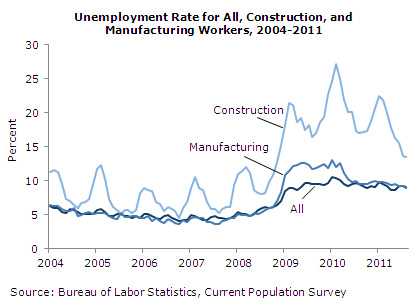
Unemployment Rate for All, Construction, and Manufacturing Workers, 2004-2011


One item worth noting is the continuing decline in the unemployment rate for workers in the construction and manufacturing industries. The former is down to 13.5 percent from 17.0 percent a year ago, and the latter is now 8.9 percent, slightly below the overall unemployment rate. This trend undermines the argument that any substantial portion of the rise in unemployment is structural. Together these sectors increase overall unemployment by less than 0.2 percentage points.

Adjusting for the Verizon strike and seasonal peculiarities, this report shows an economy that is growing, but at a very slow pace. It is not even creating sufficient jobs to keep pace with the growth of the labor force. It is difficult to see how this will change absent a boost from the government.

Authors@Google: Robert Reich

Monday, May 30, 2011

We're in Dire Straits When the Only Employment Sector Catching Fire Is in Unpaid Internships

The United States still counts a depressing 24 million unemployed, while the number of exploited unpaid workers keeps growing
By Scott Thill, AlterNet
Posted on May 30, 2011
Here's a particularly nasty sign that the economy is still weaker than Donald Trump's presidential run was: The United States still counts a depressing 24 million unemployed currently hunting for a full-time job, and the only employment sector really catching fire is unpaid jobs and internships, which have steadily increased to fill the undignified void. Whether you're a new college graduate or an unemployed veteran of the pre-recession employment landscape, you're now either fighting for a shrinking pool of new low-paying positions or plenty of gratis gigs where you won't ever see a dime for your earnest blood, sweat and tears.
Last week, the Department of Labor announced a minuscule drop in unemployment insurance claims to 409,000, barely below the annual average's wheelhouse of 412,000 but well above 2011's low of 375,000. For those who graduated college long ago, peak oil and climate change have continued to initiate obvious yet still destabilizing price increases in commodities like food and oil. Health insurance hikes continue unabated and unjustified, and over half of Americans think the housing market is moribund
Meanwhile on campus, corporations are still avoiding college job fairsEscalating tuition costs are said to be inevitable. Perhaps that's just what happens when the University of Chicago decides to host an academic conference on Jersey Shore. Or perhaps Americans who bought into the dream of hard work, ATM housing and paid health care have now devolved to the point that they're indistinguishable from college graduates just entering an anemic job market that shows zero signs of progressing. At this point, the only difference between the two is who eventually moves beyond the increasingly fashionable unpaid job or internship to a paid position.
If the predictable rise in unpaid jobs and internships isn't a sign that the American worker is being undervalued, the Department of Labor's recent decision to hire 250 additional regulators to enforce the Fair Labor Standards Act probably is. Passed in 1938, the FLSA mandated a national minimum wage, overtime for certain jobs and prohibited oppressive child labor. It also formed a cornerstone of Franklin Delano Roosevelt's New Deal social safety net, which is why Republicans in Maine and Missouri are predictably trying to repeal it as you read this. According to these greedy bastards, nothing says true American grit like 14-year-olds working overtime in dead-end jobs during school hours. 
When it comes to paid and unpaid labor, how the FLSA fluctuates between varying state regulations and federal mandates is a mystery to almost anyone unschooled in government or occupational bureaucracy. But one thing seems clear: The U.S. Department of Labor hired its regulators because the system obviously needs regulation.
"Our top priority is protecting the rights of all workers in the American workforce," a spokesperson for the U.S. Department of Labor's Wage and Labor Division told AlterNet. "Clearly, participating in internships, externships and training opportunities are positive and career-building experiences for individuals. But it also means ensuring that employers act responsibly -- and are held accountable when they treat their workers unfairly."
To do that, Labor has encouraged unpaid employees and interns to call 1-866-4US-WAGE if they feel their employers aren't operating in good faith or compliance with national guidelines. The helpful but still ironic recent hiring of additional federal regulators has allowed the Wage and Hour Division to open new district offices across the country, enabling especially younger workers to better report violations "so that they know their rights."
"That's absolutely a priority," the spokesperson added. "The investigators conduct extensive outreach at college campuses and at career centers all over the country. If we were to receive a complaint, we would investigate that complaint. But the fact of the matter is that Wage and Hour Division has not received a single complaint regarding an unpaid internship."
While alarming, that factoid makes sense. As Fortune recently explained in a scary article titled "Unpaid Jobs: The New Normal?" unpaid employment necessarily breeds strange relationships in which employees and employers understand that the former are "going to give their all for nothing." Because of that inequitable arrangement, employees often shirk their uneven responsibilities or give less than their all, especially if the promise of a paid position recedes with every week.
"It's better to have one decently paid person than nine unpaid people who are making it so difficult because they're slacking off or they're difficult to manage," the article quotes one frustrated employer. If unpaid labor truly is the new normal, one wonders how long it will be before the phones at Labor's Wage and Hour Division, which only recently stepped up its workplace regulation, starts ringing off the hook.
"Unpaid internships have a number of problems," Rosy Rickett, cofounder of the UK's Interns Anonymous, explained to AlterNet. "They're elitist, because only the richer can afford to work for free. They devalue labor; having unpaid journalists or architects means that newspapers or architecture firms can undercut competitors. And they are often seen -- by the British government at least -- as a cure-all for youth unemployment figures. Clearly, paid jobs, not unpaid internships, solve unemployment. I'm not sure whether 250 regulators can do the job for the whole of the U.S., but maybe I underestimate them."
Rickett's point is well-taken. While American employees have been mired in a nowhere land pockmarked by a few low-paying jobs and lots of unpaid jobs, American corporate profits have reached an all-time high. Exorbitant executive bonuses are making a comeback. Not a single major bankster responsible for the so-called Great Recession has seen the inside of a jail cell, even though the price tag on bank failures in 2010 alone hit $2 billion and the remaining banks are bigger and more failure-prone than ever. In what world will 250 additional regulators at the Department of Labor be able to adequately regulate workplace injustice or exploitation? Probably the best news to come of this development is that the Department of Labor is hiring at all.
"Not investing time or money in an intern means that we often hear reports of interns not adding value to a company," added Rickett. "Paying a worker means that you invest in them, and are therefore more likely to train them effectively and build up a good working relationship."
According to Amy Potthast, director of Service and Graduate Programs at social and environmental justice employment clearinghouse Idealist.org, that persistent problem is more uncommon to nonprofit organizations that marry their employees and interns' personal goals to their professional ones.
"In the nonprofit sector, where volunteers are usually essential to an organization's human resources capacity, unpaid internships make sense," Potthast explained. "Unpaid nonprofit internships differ from corporate internships in that they take place in a context of positive social and environmental impact. Very often, nonprofit interns pursue opportunities that allow them to build skills while working toward a mission they believe in. Their goals are not simply to learn, to network or to add to their resume, but to also significantly strengthen the community."
The corporate sector has shown that it is mostly uninterested in fortifying such communal bonds. Sitting on record profits, dishing out offensive bonuses and cheaply restricting its hiring, it has illustrated a callous disinterest in the workers who have bailed out its recently failed stratagems. In fact, corporate inaction has become so obvious that even President Obama decided to publicly call bullshit on it.
"It is time for companies to step up," Obama complained on national television in May. "American taxpayers contributed to that process of stabilizing the economy. Companies have benefited from that, and they're making a lot of money, and now's the time for them to start betting on American workers and American products."
But it's going to take more than Obama using the bully pulpit to chastise American corporations or hiring more regulators to force their compliance with employment guidelines to create the sea change he campaigned on. It's going to take fundamental shifts in priorities and policies to awaken the government and public alike to the bleaker, newer normal. It's going to take painful realizations that the American economy, currency and consumption we've enjoyed (and abused) for the last several decades is likely gone for good. Our increasing climate and economic catastrophes demand adaptation.
So the only significant way unpaid labor will be equitable in what's left of late capitalism is if it's accompanied by a secure social safety net that can aid an ailing populace's basic needs. After all, there's a reason the godfather of labor theory Karl Marx regarded surplus labor -- usually, unpaid labor -- as the ultimate source of capitalist profit.
"What would Karl Marx make of this?" Interns Anonymous asked in an insightful analysis called "WWMD: What Would Marx Do?"
"He would laugh in disbelief that the capitalist system has created slaves within its own class. Disbelief that these slaves have been 'culturally enlightened' and supposedly see the flaws in the system, yet continue to submit themselves to exploitation. They are a sub-culture existing within the middle class itself, and they are full of contradictions: Impoverished yet decadent; desperate but unwilling; culturally enlightened yet utterly naive. They are magnets for exploitation."

Sunday, May 22, 2011

Why March-April's Job Gains Will Collapse This Summer

by: Jack Rasmus, Truthout Sunday 22 May 2011

Every spring for the last three years, the business press and government policy makers declare with great fanfare that the job market in the US has finally turned the corner; sustained recovery in job creation has begun. But every summer following their pronouncements, the opposite occurs: employment and job creation retrenches from the spring and declines.

In recent months, the US Labor Department has reported that jobs for March and April 2011 grew by more than 200,000 each month. Apart from the fact that 130,000 new workers enter the labor force each month, and, therefore, the "net" gain is really only 70,000 (and a third to half of gains represent part time and temp workers), the 200,000 jobs represent an apparent relative improvement over the dismal job creation picture since last June 2010. But appearances are deceptive, and sometimes even false.

How real is the job growth in recent months? And will it continue for the remainder of 2011? Our answer to the first query is "not very" and to the second, "not likely." Here's why.

If the past three years, 2008-2010, are any indicator, employment gains that occur in the spring are not a true, reliable indicator of actual job creation. And the gains of this spring will once again likely disappear in the coming summer-fall of 2011.

The reason has to do with serious problems with the way the Department of Labor calculates employment gains every spring, and in particular, during the second quarter of April-June. When the economy is growing, the problems in calculation are minimal. But when the economy is in a deep downturn, or remains stagnant, the problems are exacerbated.

At the heart of the calculation of employment problem is a practice the US Labor Department employs called the "net new business formation" model, officially called the "Business Employment Dynamics" model (BDM). Every spring, the Labor Department "plugs in" a number of job gains from this model into the Current Establishment Survey (CES), which gathers the actual data on job totals in the economy from more than 400,000 establishments or businesses. The raw data on actual jobs created from the CES is relatively accurate. But the BDM is not. The BDM is not an actual tally of jobs. It is a convoluted "model" that estimates how many jobs are created from the formation of new businesses minus the number of companies going out of business. The numbers for the creation of new businesses, and corresponding new jobs associated with those new businesses, come from state unemployment insurance records that are a minimum of nine months old. And by the time the data is recorded, it is at least one year old. On the other hand, there is no accurate data on the "death" of old businesses. So, the Labor Department takes the number for new businesses, a year ago, and picks a number for "death" of old businesses (for which there are no records), and then plugs the "net" result into the actual number of jobs obtained from the regular CES survey of jobs for the month. But that's not all. The plug-in number is not only from data a year old. It is a historically averaged long run assumed number. So, new business formation from years ago, when the economy was doing well, further upward biases the jobs in the model when the economy is in a deep downturn. The Labor Department itself actually admits, "even in a year where total nonfarm employment declines, the residual net birth-death employment component is positive." We can have a major collapse of small businesses by the hundreds of thousands a month during a recession - which is what in fact happened and still continues to happen - but, nonetheless, the addition to jobs is "positive."

What this all results in is a falsely boosted number of jobs created from the BDM model that are added to the second quarter raw jobs numbers. The spring jobs numbers thus are always heavily inflated.

The Labor Department then takes the model's inflated numbers, adds them to the actual CES raw jobs numbers and then "seasonally adjusts" the combined numbers upward every spring-second quarter. Voila! We get a misrepresented improvement in job creation numbers every spring. But the false boost in job creation in the spring-second quarter declines just as quickly in the summer-fall third quarter when the BDM and seasonality adjustments level off.

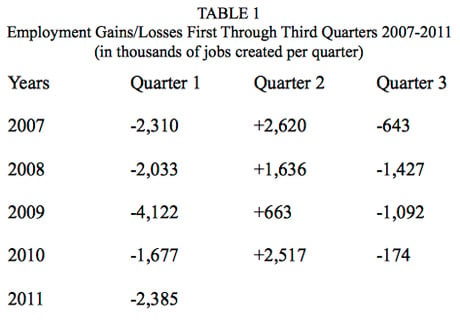
Looking at just the actual, raw jobs data from the CES survey for the second quarter for the last several years, compared to the preceding first and subsequent third quarters, shows how the gains of the second quarter always "run-up" compared to the first and then collapse in the third. This data is from the US Labor Department's CES for the past four years.


When the above raw data from the CES combined with the BDM is subsequently adjusted for seasonality, the result is a rosy picture for job creation in the second quarter radically different from the raw data above for actual jobs created or lost. As Labor Department representatives admitted in a public online question-and-answer session on the BDM model, which this writer attended, "months with generally strong seasonal increases such as April, May, June generally have a larger positive birth-death factor." When that seasonal upward bias disappears in the remainder of the year, jobs then collapse once again.

The problem with the BDM is that it does not reflect any actual job creation data. It is a "model," not an actual survey or census of jobs. It is derived from a long-run historical average for new business creation (and, thus, jobs), which includes economic growth periods when creation is higher than in recessions, when creation may in fact be negative for many months. It does not pick up actual business "deaths" and therefore, job destruction. It is based on data that is lagged at least a full year. It results in a gross overestimation of net new jobs created, and particularly in the spring when seasonality adjustments are factored into the raw data.

What it all means is we can expect a retrenchment on job creation this coming summer once again. Nearly all economic indicators are pointing to a slowdown in the US economy. Housing is in a double dip, with record level collapses in prices, housing starts, sales, and just about everything else. Manufacturing has begun to level off as the global economy slows in turn, with Japan and UK and the Euro periphery in or entering new recessions, and China, Brazil and India taking action to slow their economies. Services growth in the US is also slowing, as the US consumer is hammered by increases in gas and food prices, as well as by continuing double-digit cost increases in health care, education and local taxes. State and local governments are on schedule to lay off at least 400,000 in the coming fiscal year, having sacked 300,000 last year. And the federal government, where jobs have been flat, will lay off hundreds of thousands more if current directions in budget cutting are any indicator.

So, don't get too excited about US government jobs reports in the second quarter. And hold onto your hat. The jobs crisis is far from over.

Sunday, May 8, 2011

Why Washington Should Pay Attention to the Economy Here and Now


After a week of non-stop Osama Bin Laden, Washington is now returning to the battle of the budget deficit and debt ceiling.Earth to Washington.

All over Capitol Hill Republicans and Democrats are debating spending caps and automatic triggers, and whether to begin them before or after Election Day.

But if you don’t mind my asking, what about the economy? I’m not talking about the economy five or ten years from now, when projections show the federal budget wildly out of control or when foreigners might start dumping dollars.

I’m talking about the here and now economy – the one Americans are living in day to day.
The Labor Department reported today that unemployment for April was 9 percent, up from 8.8 percent in March. And that doesn’t count people working part-time who’d rather have full-time jobs.

Yes, 244,000 jobs were added in March — but that’s chicken feed. We’d need 350,000 a month, every month for the next three years, simply to get back to where we were before the Great Recession.

And the percentage of working-age Americans actually working – 64.2 percent – hasn’t improved. It’s almost as low as it was in the depths of the recession. 13.7 million people remain out of work.

Hello Washington?

Even for Americans with jobs, wages are going nowhere. Basically, the only employers hiring are paying peanuts. McDonalds just announced it would start hiring big time.

In fact, there’s reason to worry we’re heading back toward recession. The Labor Department also reports new claims for unemployment insurance soared to 474,000 last week.

In the first quarter of this year the U.S. economy slowed to a crawl — a measly 1.8 percent annualized growth — down from over 3 percent last fall. Higher gas and food prices are putting even more squeeze on American households.

And housing prices continue to drop.

Washington is fighting over how much to cut spending over the next ten or twelve years.

But right now we need more public spending to get people back to work, stronger safety nets to help those who have lost their jobs or can’t find new ones, lower payroll taxes on average workers, and a requirement that Wall Street banks renegotiate mortgage loans so Americans can keep their homes.

Why isn’t Washington paying attention to what most Americans need in the here-and-now economy?

Because the White House and congressional Democrats don’t dare admit how bad the economy continues to be for so many people. They’re holding their breath, hoping the recovery catches fire next year before Election Day.

Republicans don’t dare admit how bad the economy is because they don’t want to increase public spending or strengthen safety nets. And their patrons on Wall Street don’t want to modify mortgages. Republicans would rather Americans believe their big lie that taming the deficit will create jobs and restore the economy.

So Washington would rather fight over the long-term budget, spending caps, taxes, and trigger mechanisms than do something about the pain most Americans are experiencing today.

But the here-and-now economy the most important thing on Americans’ minds.

Ironically, Washington’s disregard for what’s happening right now is also worsening the long-term budget problem. That problem is not the debt per se; it’s the ratio of debt to the overall economy. If the economy sputters or continues to grow at a snail’s pace, that ratio becomes worse and worse.

In other words, attending to the here-and-now economy is also good for the future.

Earth to Washington: Listen to America.

Friday, April 8, 2011

The Real Story on the Latest Jobs Report

Hold the Applause
By DEAN BAKER


When the Labor Department announced that the U.S. economy had created 216,000 jobs in March, it set off a round of celebrations throughout Washington policy circles. The word in the New York Times, the Washington Post and other major news outlets was that the economy was back on course; we were on the right path.

Those who know arithmetic were a bit more skeptical. If the economy sustained March's rate of job it will be more than seven years before we get back to normal rates of unemployment.

Furthermore, some of this growth likely reflected a bounce back from weaker growth the prior two months. The average rate of job growth over the last three months has been just 160,000. At that pace we won't get back to normal rates of unemployment until after 2022. That's a long time to make ordinary workers suffer because the folks who run the economy are not very good at their job.

In addition to the job growth numbers, the March data also showed that the unemployment rate slipped down by another 0.1 percentage point. It now stands at 8.8 percent, almost a full percentage point below its year-ago level of 9.7 percent. This too was treated as cause for celebration.

While that may sound like progress, a more careful look at the data makes this number less impressive. The percentage of the population that is employed has actually fallen by 0.1 percentage point over the last year.

In order to be counted as unemployed you have to say that you are looking for work. The unemployment rate did not fall because the unemployed had found jobs; rather the unemployment rate fell because people have given up looking for work. Only in Washington would this be hailed as good news.

Remarkably, as the mixed basket of economic news in the March employment report was being celebrated, a major piece of unambiguously bad news was almost completely ignored. The Commerce Department released data on construction spending for February.

A decline of 1.4 percent in spending in February, coupled with sharp downward revisions to the data for the prior two months, left nominal spending in February 6.2 percent below its November level. Construction is virtually certain to be a major drag on growth in the first quarter. The big culprit this time is the non-residential sector, as a result of the bursting of the bubble in this sector, coupled with a fading out of stimulus spending on government projects.

Other recent economic news also suggests that the economy's momentum is more likely to slow than accelerate in the months ahead. Nominal Wage growth has been virtually flat the last two months. With food and gas prices rising sharply, this means that real wages are falling, leaving workers with less money to spend.

House prices are again falling rapidly, having declined at the rate of 1.0 percent a month for the last three months. If this pace of decline continues, by the end of the year homeowners will have lost more than $2 trillion in equity compared with the peak hit in the summer of 2010. This loss of housing wealth implies a reduction in annual consumption of $120 billion.

There was also a big jump in the trade deficit reported for January. While the celebrants of recent trade pacts were excited by the growth in exports, people who know economics recognize that the larger increase in imports will be another drag on economic growth. With most of the country's major trading partners experiencing weak growth, there is little prospect for an improvement in the trade deficit any time soon.

And, investment in equipment and software also appears to be weakening. New orders for capital goods (excluding volatile aircraft orders) in February were down 6.8 percent from the levels reported in December. In addition, the government cutbacks, threatened at the federal level and going into place at the state and local level, will be a further source of drag on the economy.

In short, there is little basis for last Friday's celebrations about the economy. The February jobs report would have been mediocre if the economy were already at normal rates of unemployment. It is pathetic in the context of a badly depressed economy. We should be seeing jobs growth at 2-3 times this rate. However, the real bad news is that it is more likely to get worse than better. Yet again, the economic press is missing the story.

Friday, February 19, 2010

Jobless Claims, Inflation Jump as Economy Wobbles

Jobless Claims, Inflation Jump as Economy Wobbles

Reuters

18 Feb 2010 | 08:39 AM ET

The number of U.S. workers filing new applications for unemployment insurance unexpectedly surged last week, while producer prices increased sharply in January, raising potential hurdles for the economic recovery.

Initial claims for state unemployment benefits increased 31,000 to 473,000, the Labor Department said on Thursday. That compared to market expectations for 430,000.

Another report from the department showed prices paid at the farm and factory gate rose a faster than expected 1.4 percent from December after a 0.4 percent gain in December, as higher gasoline prices and unusually cold temperatures helped boost energy costs.

"When you have PPI moving up and still no progress in the jobs situation, that doesn't bode well for continued improvement in equity prices," said Alan Lancz, president at Alan B. Lancz & Associates in Toledo, Ohio.

Last week was the survey week for the employment report for February, which is scheduled for release in early March.

The labor market, hardest hit by the worst recession in seven decades, has lagged the economic recovery that started in the second half of 2009. The economy has lost 8.4 million jobs since the start of the downturn in December 2007.

The PPI report may give investors, who keeping a wary eye on inflation following massive efforts by the Federal Reserve to pull the economy out of its worst slump since the Great Depression of the 1930s, something to worry about.

"The bottom line is that the Fed is going to have some decisions to make at its next meeting, since it seems inflation is now back on the table," said Lancz.

Fed officials, keeping an eye on how quickly the recovering economy absorbs the excess slack that built up during the recession, have said they are likely to keep interest rates extraordinarily low for "an extended period."

About three-fourths of the increase in PPI last month was due to a 5.1 percent jump in prices for energy goods, the department said. Energy costs were pushed up by a spike in prices for gasoline, liquefied petroleum and home heating oil.

Strong energy prices overshadowed a slowdown in the food prices, which rose 0.4 percent after increasing 1.3 percent in December.

Stripping out the volatile food and energy costs, core producer prices rose a faster than expected 0.3 percent last month after being flat in December. The core index had been forecast to rise 0.1 percent in January.

The department on Friday will release its consumer price report for January. Headline CPI is seen rising 0.3 percent from December and core CPI gaining 0.1 percent, according to a Reuters survey.

"It does present some upside risks to our call for only modest gains in CPI and also points to some possible upward price pressures in the pipeline," said Millan Mulraine, an economics strategist at TD Securities in Toronto.

In the claims report, the four-week moving average of new claims, which irons out week-to-week volatility, fell 1,500 to 467,500, the Labor Department said. The number of people still receiving for benefits after an initial week of aid was unchanged at 4.56 million in the week ended Feb. 6.

This measure has held below the 5 million mark for eight straight weeks and analysts believe it is starting to reflect an improvement in the labor market rather than people merely dropping off rolls because they have exhausted their benefits.