Showing posts with label false recovery. Show all posts

Monday, May 5, 2014

US Economy Is A House Of Cards

Paul Craig Roberts

The US economy is a house of cards. Every aspect of it is fraudulent, and the illusion of recovery is created with fraudulent statistics.

American capitalism itself is an illusion. All financial markets are rigged. Massive liquidity poured into financial markets by the Federal Reserve’s Quantitative Easing inflates stock and bond prices and drives interest rates, which are supposed to be a measure of the cost of capital, to zero or negative, with the implication that capital is so abundant that its cost is zero and can be had for free. Large enterprises, such as mega-banks and auto manufacturers, that go bankrupt are not permitted to fail. Instead, public debt and money creation are used to cover private losses and keep corporations “too big to fail” afloat at the expense not of shareholders but of people who do not own the shares of the corporations.

Profits are no longer a measure that social welfare is being served by capitalism’s efficient use of resources when profits are achieved by substituting cheaper foreign labor for domestic labor, with resultant decline in consumer purchasing power and rise in income and wealth inequality. In the 21st century, the era of jobs offshoring, the US has experienced an unprecedented explosion in income and wealth inequality. I have made reference to this hard evidence of the failure of capitalism to provide for the social welfare in the traditional economic sense in my book, The Failure of Laissez Faire Capitalism, and Thomas Piketty’s just published book, Capital in the 21st Century, has brought an alarming picture of reality to insouciant economists, such as Paul Krugman. As worrisome as Piketty’s picture is of inequality, I agree with Michael Hudson that the situation is worse than Piketty describes. http://michael-hudson.com/2014/04/pikettys-wealth-gap-wake-up/

Capitalism has been transformed by powerful private interests whose control over governments, courts, and regulatory agencies has turned capitalism into a looting mechanism. Wall Street no longer performs any positive function. Wall Street is a looting mechanism, a deadweight loss to society. Wall Street makes profits by front-running trades with fast computers, by selling fraudulent financial instruments that it is betting against as investment grade securities, by leveraging equity to unprecedented heights, making bets that cannot be covered, and by rigging all commodity markets.

The Federal Reserve and the US Treasury’s “Plunge Protection Team” aid the looting by supporting the stock market with purchases of stock futures, and protect the dollar from the extraordinary money-printing by selling naked shorts into the Comex gold futures market.

The US economy no longer is based on education, hard work, free market prices and the accountability that real free markets impose. Instead, the US economy is based on manipulation of prices, speculative control of commodities, support of the dollar by Washington’s puppet states, manipulated and falsified official statistics, propaganda from the financial media, and inertia by countries, such as Russia and China, who are directly harmed, both economically and politically, by the dollar payments system.

As the governments in most of the rest of the world are incompetent, Washington’s incompetence doesn’t stand out, and this is Washington’s salvation.

But it is not a salvation for Americans who live under Washington’s rule. As all statistical evidence makes completely clear, the share of income and wealth going to the bulk of the US population is declining. This decline means the end of the consumer market that has been the mainstay of the US economy. Now that the mega-rich have even more disproportionate shares of the income and wealth, what happens to an economy based on selling imports and off-shored production of goods and services to a domestic consumer market? How do the vast majority of Americans purchase more when their incomes have not grown for years and have even declined and they are too impoverished to borrow more from banks that won’t lend?

The America in which I grew up was self-sufficient. Foreign trade was a small part of the economy. When I was Assistant Secretary of the Treasury, the US still had a trade surplus except for oil. Offshoring of America’s jobs had not begun, and US earnings on its foreign investments exceeded foreign earnings on US investments. Therefore, America’s earnings abroad covered its energy deficit in its balance of trade.

The economic stability achieved during the Reagan administration was shattered by Wall Street greed. Wall Street threatened corporations with takeovers if the corporations did not produce higher profits by relocating their production of goods and services for American markets abroad. The lower labor costs boosted earnings and stock prices and satisfied Wall Street’s cravings for ever more earnings, but brought an end to the rise in US living standards except for the mega-rich. Financial deregulation loaded the economy with the risks of asset bubbles.

Americans are an amazingly insouciant people. By now any other people would have burnt Wall Street to the ground.

Washington has unique subjects. Americans will take endless abuse and blame some outside government for their predicament–Iraq, Afghanistan, Libya, China, Russia. Such an insouciant and passive people are ideal targets for looting, and their economy, hollowed-out by looting, is a house of cards.

Wednesday, January 29, 2014

How Economists and Policymakers Murdered Our Economy

Enabling Greed
by PAUL CRAIG ROBERTS

The economy has been debilitated by the offshoring of middle class jobs for the benefit of corporate profits and by the Federal Reserve’s policy of Quantitative Easing in order to support a few oversized banks that the government protects from market discipline. Not only does QE distort bond and stock markets, it threatens the value of the dollar and has resulted in manipulation of the gold price.

When US corporations send jobs offshore, the GDP, consumer income, tax base, and careers associated with the jobs go abroad with the jobs. Corporations gain the additional profits at large costs to the economy in terms of less employment, less economic growth, reduced state, local and federal tax revenues, wider deficits, and impairments of social services.

When policymakers permitted banks to become independent of market discipline, they made the banks an unresolved burden on the economy. Authorities have provided no honest report on the condition of the banks. It remains to be seen if the Federal Reserve can create enough money to monetize enough debt to rescue the banks without collapsing the US dollar. It would have been far cheaper to let the banks fail and be reorganized.

US policymakers and their echo chamber in the economics profession have let the country down badly. They claimed that there was a “New Economy” to take the place of the “old economy” jobs that were moved offshore. As I have pointed out for a decade, US jobs statistics show no sign of the promised “New Economy.”

The same policymakers and economists who told us that “markets are self-regulating” and that the financial sector could safely be deregulated also confused jobs offshoring with free trade. Hyped “studies” were put together designed to prove that jobs offshoring was good for the US economy. It is difficult to fathom how such destructive errors could consistently be made by policymakers and economists for more than a decade. Were these mistakes or cover for a narrow and selfish agenda?

In June, 2009 happy talk appeared about “the recovery,” now 4.5 years old. As John Williams (shadowstats.com) has made clear, “the recovery” is entirely the artifact of the understated measure of inflation used to deflate nominal GDP. By under-measuring inflation, the government can show low, but positive, rates of real GDP growth. No other indicator supports the claim of economic recovery.

John Williams writes that consumer inflation, if properly measured, is running around 9%, far above the 2% figure that is the Fed’s target and more in line with what consumers are actually experiencing. We have just had a 6.5% annual increase in the cost of a postage stamp.

The Fed’s target inflation rate is said to be low, but Simon Black points out that the result of a lifetime of 2% annual inflation is the loss of 75% of the purchasing power of the currency. He uses the cost of sending a postcard to illustrate the decline in the purchasing power of median household income today compared to 1951. That year it cost one cent to send a post card. As household income was $4,237, the household could send 423,700 postcards. Today the comparable income figure is $51,017. As it costs 34 cents to send one postcard, today’s household can only afford to send 150,050 postcards. Nominal income rose 12 times, and the cost of sending a postcard rose 34 times.

Just as the American people know that there is more inflation than is reported, they know that there is no recovery. The Gallup Poll reported this month that only 28% of Americans are satisfied with the economy.

From hard experience, Americans have also caught on that “free trade agreements” are nothing but vehicles for moving their jobs abroad. The latest effort by the corporations to loot and defraud the public is known as the “Trans-Pacific Partnership.” “Fast-tracking” the bill allowed the corporations to write the bill in secret without congressional input. Some research shows that 90% of Americans will suffer income losses under TPP, while wealth becomes even more concentrated at the top.

TPP affects every aspect of our lives from what we eat to the Internet to the environment. According to Kevin Zeese in Alternet, “the leak of the [TPP] Intellectual Property Chapter revealed that it created a path to patent everything imaginable, including plants and animals, to turn everything into a commodity for profit.”

The secretly drafted TPP also creates authority for the executive branch to change existing US law to make the laws that were not passed in secret compatible with the secretly written trade bill. Buy American requirements and any attempt to curtail jobs offshoring would become illegal “restraints on trade.”

If the House and Senate are willing to turn over their legislative function to the executive branch, they might as well abolish themselves.

The financial media has been helping the Federal Reserve and the banks to cover up festering problems with rosy hype, but realization that there are serious unresolved problems might be spreading. Last week interest rates on 30-day T-bills turned negative. That means people were paying more for a bond than it would return at maturity. Dave Kranzler sees this as a sign of rising uncertainty about banks. Reminiscent of the Cyprus banks’ limits on withdrawals, last Friday (January 24) the BBC reported that the large UK bank HSBC is preventing customers from withdrawing cash from their accounts in excess of several thousand pounds.

If and when uncertainty spreads to the dollar, the real crisis will arrive, likely followed by high inflation, exchange controls, pension confiscations, and resurrected illegality of owning gold and silver. Capitalist greed aided and abetted by economists and policymakers will have destroyed America.

Thursday, January 16, 2014

No Jobs For Americans

The Phony Recovery
by Paul Craig Roberts


The alleged recovery took a direct hit from Friday’s payroll jobs report. The Bureau of Labor Statistics reported that the economy created 74,000 net new jobs in December.

Wholesale and retail trade accounted for 70,700 of these jobs or 95.5%. It is likely that the December wholesale and retail hires were temporary for the Christmas shopping season, which doesn’t seem to have been very exuberant, especially in light of Macy’s decision to close five stores and lay off 2,500 employees. It is a good bet that these December hires have already been laid off.

A job gain of 74,000, even if it is real, is about half of what is needed to keep the unemployment rate even with population growth. Yet the Bureau of Labor Statistics reports that the unemployment rate fell from 7.0% to 6.7%. Clearly, this decline in unemployment was not caused by the reported 74,000 jobs gain. The unemployment rate fell, because Americans unable to find jobs ceased looking for employment and, thereby, ceased to be counted as unemployed.

In America the unemployment rate is a deception just like everything else. The rate of American unemployment fell, because people can’t find jobs. The fewer the jobs, the lower the unemployment rate.

I noticed today that the financial media presstitutes were a bit hesitant to hype the drop in the rate of unemployment when there was no jobs growth to account for it. The Wall Street and bank economists did their best to disbelieve the jobs report as did some of the bought-and-paid-for university professors. Too many interests have a stake in the non-existent recovery declared 4.5 years ago to be able to admit that it is not really there.

I have been examining the monthly jobs reports for a decade or longer. I must say that I as struck by the December report. Normally, a mainstay of jobs gain is the category “education and health services,” with “ambulatory health care services” adding thousands of jobs. In December the net contribution of “education and health services” was zero, with “ambulatory health care services” losing 4,100 jobs and health care losing 6,000 jobs. If memory serves, this is a first. Perhaps it reflects adverse impacts of the ripoff known as Obamacare, possibly the worst piece of domestic legislation passed in decades.

I was also struck by the report that the gain in employment of waitresses and bartenders, normally a large percentage of the job gain, was down to 9,400 jobs, which were offset by declines elsewhere, such as the layoff of local school teachers.

Aren’t Washington’s priorities wonderful? $1,000 billion per year in Quantitative Easing, essentially subsidies for 6 banks “too big to fail,” and nothing for school teachers. It should warm every Republican’s heart.

A tiny bright spot in the payroll jobs report is 9,000 new manufacturing jobs. The US manufacturing workforce has declined so dramatically since jobs offshoring became the policy of American corporations that 9,000 jobs doesn’t register on the scale. Fabricated metal products, which I think is roofing metal, accounted for 56% of the manufacturing jobs. Roofing metal is not an export. Employment in the production of products that could be exported, such as “computer and electronic equipment,” and “electronic instruments” declined by 2,400 and 3,500 respectively.

Clearly, this is not a payroll jobs report that provides cover for the looting of the prospects of ordinary Americans by the financial and offshoring elites. One can wonder how the BLS civil servants who produced it can avoid retribution. It will be interesting to see what occurs in the January payroll jobs report.

Monday, September 30, 2013

American Workers: Hanging on by the Skin of Their Teeth

by MIKE WHITNEY

After five years of Obama’s economic recovery, the American people are as gloomy as ever. According to a Bloomberg National Poll that was released this week, fewer people “are optimistic about the job market” or “the housing market” or “anticipate improvement in the economy’s strength over the next year.” Also, only 38 percent think that President Obama is doing enough “to make people feel more economically secure.” Worst of all, Bloomberg pollsters found that 68 percent of interviewees thought the country was “headed in the wrong direction”.

So why is everyone so miserable? Are things really that bad or have we turned into a nation of crybabies?

The reason people are so pessimistic is because the economy is still in the doldrums and no one’s doing anything about it. That’s it in a nutshell. Survey after survey have shown that what people really care about is jobs, but no one in Washington is listening. In fact, jobs aren’t even on Obama’s radar. Just look at his record. He’s worse than any president in modern times. Take a look at this graph.

More than 600,000 good-paying public sector jobs have been slashed during Obama’s tenure as president. That’s worse than Bush, worse than Clinton, worse than Reagan, worse than anyone, except maybe Hoover. Is that Obama’s goal, to one-up Herbert Hoover?

Obama has done everything he could to make the lives of working people as wretched as possible. Do you remember the Card Check sellout or the Wisconsin “flyover” when Governor Scott Walker was eviscerating collective bargaining rights for public sector unions and Obama blew kisses from Airforce One on his way to a campaign speech in Minnesota? Nice touch, Barry. Or what about the “Job’s Czar” fiasco, when Obama appointed GE’s outsourcing mandarin Jeffrey Immelt to the new position just in time for GE to lay off another 950 workers at their locomotive plant in Pennsylvania. That’s tells you what Obama really thinks about labor.

What Obama cares about is trimming the deficits and keeping Wall Street happy. That’s it. But the people who elected him don’t want him to cut the deficits, because cutting the deficits prolongs the slump and costs jobs. What they want is more stimulus, so people can find work, feed their families, and have some basic security. That’s what they want, but they’re not going to get it from Obama because he doesn’t work for them. He works for the stuffed shirts who flank him on the golf course at Martha’s Vineyard or the big shots who chow down with him at his $100,000-per-plate campaign jamborees. That’s his real constituency. Everyone else can take a flying fu** for all he cares.

Then there’s the Fed. Most people don’t think the Fed’s goofy programs work at all. They think it’s all a big ruse. They think Bernanke is just printing money and giving it to his criminal friends on Wall Street (which he is, of course.) Have you seen this in the New York Times:
“Only one in three Americans has confidence in the Federal Reserve’s ability to promote economic growth, while little more than a third think the Fed is spinning its wheels, according to a New York Times/CBS News poll….

The Fed has been trying for five years to speed the nation’s recovery from the Great Recession by reducing borrowing costs to the lowest levels on record….

Most Americans, it would appear, remain either unaware or unpersuaded.” (“Majority of Americans Doubt Benefits of Fed Stimulus“, New York Times)

“Unpersuaded”? Are you kidding me? Most Americans think they’re getting fleeced; unpersuaded has nothing to do with it. They’re not taken in by the QE-mumbo jumbo. They may not grasp the finer-points, but they get the gist of it, which is that the Fed has run up a big $3 trillion bill every penny of which has gone to chiseling shysters on Wall Street. They get that! Everyone gets that! Sure, if you want to get into the weeds about POMO or the byzantine aspects of the asset-purchase program, you might detect a bit of confusion, but –I assure you–the average Joe knows what’s going on. He knows all this quantitative jabberwocky is pure bunkum and that he’s getting schtooped bigtime. You don’t need a sheepskin from Princeton to know when you’ve been had.

And that’s why everyone is so pessimistic, because they know that the Fed, the administration and the media are all lying to them 24-7. That’s why–as Bloomberg discovered–”Americans are losing faith in the nation’s economic recovery.” Because they don’t see any recovery. As far as they’re concerned, the economy is still in recession. After all, they’re still underwater on their mortgages, Grandpa Jack just took a job at a fast-food joint to pay for his wife’s heart medication, and junior is camped out in the basement until he can get a handle on his $45,000 heap of college loans. So where’s the recovery?

Nobody needs Bloomberg to point out how grim things are for the ordinary people. They see it firsthand every damn day.
Did you catch the news on Wal-Mart this week? It’s another story that helps explain why everyone’s so down-in-the-mouth. Here’s what happened: Wal-Mart’s stock tanked shortly after they announced that their “inventory growth …had outstripped sales gains in the second quarter…. Merchandise has been piling up because consumers have been spending less freely than Wal-Mart projected….” (Bloomberg)

Okay, so the video games and Barbie dolls are piling up to the rafters because part-time wage slaves who typically shop at Wal-Mart are too broke to buy anything but the basic necessities. Is that what we’re hearing?

Indeed. “We are managing our inventory appropriately,” David Tovar, a Wal-Mart spokesman, said today in a telephone interview. “We feel good about our inventory position.”

Sure, you do, Dave. Here’s more from Bloomberg:
“US. chains are already bracing for a tough holiday season, when sales are projected to rise 2.4 percent, the smallest gain since 2009, according to ShopperTrak, a Chicago-based firm. Wal-Mart cut its annual profit forecast after same-store sales fell 0.3 percent in the second quarter. …

Wal-Mart’s order pullback is affecting suppliers in various categories, including general merchandise and apparel, said the supplier, who has worked with Wal-Mart for almost two decades and asked not to be named to protect his relationship with the company. He said he couldn’t recall the retailer ever planning ordering reductions two quarters in advance.” (“Wal-Mart Cutting Orders as Unsold Merchandise Piles Up”, Bloomberg)

So we’re back to 2009?

Looks like it. When the nation’s biggest retailer starts trimming its sails, it ripples through the whole industry. It means softer demand, shorter hours, and more layoffs. Get ready for a lean Christmas.

The Walmart story just shows that people are at the end of their rope. For the most part, these are the working poor, the people the Democratic Party threw overboard a couple decades ago when they decided to hop in bed with Wall Street. Now their hardscrabble existence is becoming unbearable; they can’t even scrape together enough cash to shop the discount stores. That means we’re about one step from becoming a nation of dumpster divers. Don’t believe it? Then check out this clip from CNN Money:
“Roughly three-quarters of Americans are living paycheck-to-paycheck, with little to no emergency savings, according to a survey released by Bankrate.com Monday. Fewer than one in four Americans have enough money in their savings account to cover at least six months of expenses, enough to help cushion the blow of a job loss, medical emergency or some other unexpected event, according to the survey of 1,000 adults. Meanwhile, 50% of those surveyed have less than a three-month cushion and 27% had no savings at all..

Last week, online lender CashNetUSA said 22% of the 1,000 people it recently surveyed had less than $100 in savings to cover an emergency, while 46% had less than $800. After paying debts and taking care of housing, car and child care-related expenses, the respondents said there just isn’t enough money left over for saving more.” (“76% of Americans are living paycheck-to-paycheck“, CNN Money)

Savings? What’s that? Do you really think people can save money on $30,000 or $40,000 a year feeding a family of four?

Dream on. Even an unexpected trip to the vet with pet Fido is enough to push the family budget into the red for months to come. Savings? Don’t make me laugh.

The truth is, most people are hanging on by the skin of their teeth. They can’t make ends meet on their crappy wages and they’re too broke to quit. There’s no way out. It’s obvious in all the data. And it’s hurting the economy, too, because spending drives growth, but you can’t spend when you’re busted. Economist Stephen Roach made a good point in a recent article at Project Syndicate. He said,
“In the 22 quarters since early 2008, real personal-consumption expenditure, which accounts for about 70% of US GDP, has grown at an average annual rate of just 1.1%, easily the weakest period of consumer demand in the post-World War II era.” (It’s also a) “massive slowdown from the pre-crisis pace of 3.6% annual real consumption growth from 1996 to 2007.” (“Occupy QE“, Stephen S. Roach, Project Syndicate)

So the economy is getting hammered because consumption is down. And working people are getting hammered because jobs are scarce and wages are flat. But we live in the richest country in the world, right?

Right. So what’s wrong with this picture?

Thursday, August 8, 2013

The “New Economy” Is The No Jobs Economy


One of my most popular columns was about escaping from the Matrix existence in which Americans live. It is a world of disinformation and misinformation in which facts are fiction, and abstract theories are substituted for empirical reality.
Official government statistics are make-believe. The government makes inflation and unemployment disappear by how it defines inflation and unemployment, and it makes the economy grow by how it defines Gross Domestic Product. The definitional basis determines the statistical result.
For example, in his report on the official GDP revisions released July 31, John Williams (shadowstats.com) writes that “academic theories, often with strong political biases, have been used to alter the GDP model over the years, resulting in “Pollyanna Creep,” where changes made to the series invariably have had the effect of upping near-term economic growth.” In other words, definitional changes produce economic growth whether or not the economy produces economic growth.
Inflation is made to disappear by substituting lower priced items for higher priced items and by defining price rises as quality improvements. Thus, the higher prices don’t count as inflation.
Unemployment disappears by defining discouraged workers who cannot find employment as people who are no longer in the work force. 
They simply are disappeared out of the ranks of the unemployed. It reminds me of Punjab’s magic blanket in the old cartoon strip, “Little Orphan Annie.” Punjab disposed of problem people by covering them with his blanket, or perhaps it was a rug, and they disappeared.
Despite the absurdity of the government’s data, Wall Street awaits with baited breath each new release to decide whether markets should go up or down or stay the same. In other words, the financial markets themselves take guidance from make believe numbers. In short, capitalism is rudderless. It has no reliable indicators. Everything is rigged to support the Matrix which keeps the population in a stupor.
Certainly the monthly payroll jobs number is misconstrued and has undeserved influence. If the economy is down, a jobs number significantly higher than the approximately 130,000 new jobs required to stay even with population growth is seen as a beacon of recovery. But the number is so distorted, as John Williams explains, by shifting and unstable seasonal adjustments and an average monthly add-on of 52,000 jobs from the “birth-death” model that no one really knows what the number is. Only a statistician like John Williams who is very familiar with the government’s data procedures can make much sense from the official statistics.
I take a simpler approach. I look at where the reported jobs are alleged to be. In the 21st century, the jobs created by “the world’s largest economy” have been lowly-paid, non-tradable, domestic service third world jobs. Manufacturing and tradable professional service jobs such as software engineering have been moved offshore to low-wage, low-salary locations. The savings in labor costs have enriched corporate executives, Wall Street, and shareholders.
I have made this point monthly for many years, and it has had no effect on economists, policymakers, money managers, or financial markets, all of which continue in their make-believe world of make-believe reality.
Here we go, one more time. Of the 161,000 reported private sector jobs gained in July, 157,000 or 97.5 percent, are in non-tradable domestic services. A non-tradable service is a job that produces services that cannot be exported, such as waitresses, bartenders, hospital orderlies, retail clerks, warehousemen. Thus, no matter how large the number might be, it cannot reduce the huge US trade deficit. Most of these jobs are part-time jobs without health or pension benefits. People in these jobs tend to live hand-to-mouth. These jobs do not produce sufficient income to drive a consumer economy.
Of these 157,000 reported jobs, 63,000 or 40 percent are reported to be in trade, transportation, and utilities. Of these 63,000 jobs, 60,500 of them or 96 percent are in wholesale and retail trade.
Before we go to the next category, ask yourself if you believe that in an economy that has had no recovery, in which there are no new manufacturing or construction jobs, in which the labor force participation rate is down, in which shopping center parking lots are far from full, stores with such a poor sales outlook would hire so many people in July?
Financial activities account for 15,000 of the reported new jobs. The Federal Reserve accounted for 80 percent of these jobs and bill collectors for the rest.
Professional and business services accounted for 36,000 of the new reported jobs. About half of these jobs were temporary help services and services to buildings and dwellings.
Health care and social assistance accounted for 8,300 jobs of which ambulatory health care services comprised 80 percent.
Waitresses and bartenders contributed 38,400 jobs. I have previously noted the anomaly of a population without good employment prospects or rising incomes going out to eat and to drink more and more often, so often that waitresses and bartenders comprise each and every month a significant percentage of the new employees.
In her commissioner’s statement accompanying the jobs report, Erica Groshen acknowledges that 8,200,000 or 6 percent of the currently employed are “involuntary part-time workers” who cannot find full-time employment.
The July 2013 payroll employment level of 136,038,000 stands 2,018,000 below the employment level in January 2008, which was 5 years and 7 months ago. If it requires 130,000 new jobs each month to keep employment equal with population growth, the US economy is behind by 10,728,000 jobs. These missing jobs show up in the declining labor force participation rate and the large number of discouraged workers who are no longer counted as unemployed.
Obviously, there is no economic recovery, despite the reporting of such by the presstitute financial press. Most likely the US economy is sinking further into a depression. The numerous indicators of economic collapse are ignored by economists and financial media busy at work weaving the Matrix to support The Lie.
As former executives of the “banks too big to fail” and their proteges run the US Treasury, the financial regulatory agencies, and the Federal Reserve, US economic policy has been focused on bailing out the excessively large banks created by mindless deregulation. The purpose of US economic policy is to save the large banks from their bad bets on poorly understood new financial instruments in the gambling casino created by deregulation.
The architects of financial deregulation, such as former Senator Phil Gramm and President Bill Clinton were rewarded for their service with fortunes of their own. The free market dupes, who aided and abetted Bill and Phil and misrepresented the repeal of financial stability as a new beginning for laissez faire capitalism, still pretend that the crisis resulted from Congress requiring banks to make mortgage loans to poor black people who could not pay.
The lack of reality in America is extreme. I do not believe anything like it has ever existed in the modern world. Essentially, no one in government or out understands anything.
The combination of the power of vested interests with ideological thinking remote from empirical reality is destroying the US economy and the economic prospects of the American people. The employment profile of the US economy is increasingly that of a third world country. Economic security, except for the rich, has disappeared. A large and growing percentage of the population experiences the insecurity of poverty or near-poverty, while the waiting lists for $50 million yachts expands. The distribution of income is so skewed upward that people of enormous wealth bid up the prices of used Ferraris from the 1950s and 1960s to $12,000,000 and $35,000,000. I can remember when a used Ferrari was something that a person with a moderate income could afford to purchase. I have a friend who bought and sold for $9,000 in the 1960s the Ferrari that last sold for $35 million.
Detroit, once the fourth largest American city and the manufacturing powerhouse of the world, is bankrupt. The populations of the cities that once were America’s thriving manufacturing base are declining. Cleveland has boarded up homes. St. Louis has 20 percent of its homes vacant. Welfare is under attack by the Republicans and even some Democrats as the plight of the population worsens and despair rises.
Washington only responds to the half dozen powerful, rich private interest groups that fund election campaigns. The American people have no one to represent them. The American people have been placed outside the system of “democratic capitalism” which is only for the one percent.
As Jeffrey St. Clair has made clear, America no longer has a left-wing. America is a right-wing world in which people, including “progressives” have been brainwashed into perceiving reality in racial contrast: the whites are well off and the blacks are poor and destitute.
This is the false reality of the Matrix. As whites are a larger percentage of the population than blacks, there are more poor whites than poor blacks. Moreover, the percentage of poor whites is growing. The way the jobs-offshoring, bail out the rich, US economy operates today makes every one poor, including the remnants of America’s once flourishing middle class. It is not a racial issue. It is a class issue. A few people have the power, and they are driving everyone else into the ground. The US government is their agent.
So go wave the flag, support the troops, believe the government’s and media’s lies, but unless you are the well-connected one percent, don’t expect any future for your children. You have been sold out by “your” government. Obama is making pretty speeches, but only the stupid will be fooled.

Wednesday, May 8, 2013

Delusions of Economic Recovery

Inside the Latest Jobs Report
by PAUL CRAIG ROBERTS


Dave Kranzler of Golden Returns Capital declares the April payroll jobs report that was released on May 3 by the Bureau of Labor Statistics to be “fictitious.”

Statistician John Williams, of shadowstats.com, says both the jobs report and unemployment rate are “nonsense.”

I agree with both. But don’t expect the financial press to report the facts.

Let’s take a walk through the BLS report and you can arrive at your own conclusion.

The BLS report says that the private sector created 185,000 service jobs in April. Even if this report were true, it would have negligible effect on the unemployment rate as about 127,000 new jobs are needed each month just to stay even with population growth and current unemployment rate.

But is the BLS report true?

We can answer that question by examining the areas where the jobs reportedly materialized:

  • 29,300 in retail trade with general merchandise stores accounting for about half of that number,
  • 73,000 in professional and business services with temporary help services accounting for 42 percent of that number,
  • 26,100 in health care and social assistance with ambulatory health care services accounting for 52 percent of that number,
  • 45,100 in accommodation and food services with waitresses and bartenders accounting for 84 percent of the jobs,
  • and 8,600 jobs created for bill collectors.

That’s it. The federal government lost 8,000 jobs, the postal service lost 4,900 jobs, state government lost 1,000 jobs and local government lost 2,000 jobs.

There were zero jobs created in manufacturing.

Considering the credit-restrained and hard pressed consumer, the jobs figure for bill collectors is likely correct. But why would there be 29,000 new jobs in retail trade when real retail sales are falling? Why would there be new professional service jobs when large consulting companies such as IBM are reducing the hours of their contract employees? How can 38,000 waitress and bartenders be hired in one month when consumers have so little discretionary income?

Notice, too, that the BLS reports that 6,000 construction jobs were lost in April. Yet, the financial press is full of reports of “housing recovery.”

You know those thousands and thousands of fracking jobs that the fracking industry has been hyping so that communities, desperate for jobs, ignore the destruction of their surface and ground waters? Well the BLS report shows that oil and gas extraction jobs, which includes normal oil and gas recovery, peaked in February. Only 900 jobs were created in April, a small reward for destroyed aquifers and surface streams. People who live in fracking areas have been warned to open their windows when showering to avoid being asphyxiated because of the methane in the water and to not be surprised if their water actually burns. There is no doubt that fracking because of its enormous external costs produces a net economic loss.
In America everything is hype for a buck. They will sell you any lie. And the bulk of the population, of course, can be counted on for falling for every lie.

In my opinion, the March BLS jobs report of only 88,000 new jobs, only 69 percent of those needed to stay even with population growth, undermined the Obama regime’s recovery hype and the stock market’s confidence in “recovery.” Even brainwashed Americans have learned that “jobless recovery” is an oxymoron. So the word was passed to the political appointee overseeing the BLS to avoid further embarrassments. However, like the old Soviet press, the professional staff delivered the required report in a way that undermined it. Goods-producing jobs are reported to have dropped by 9,000 and retail stores are being closed, so why are 100,000 new jobs needed in retail trade and professional and business services?

John Williams explains the deception in the unemployment rate reporting. The 7.5 percent reported rate (U3)is not the product of new jobs generated by a recovering economy. It is the result of discouraged workers who, unable to find jobs, give up looking and, thus, cease being counted in the work force. The real rate of unemployment when discouraged workers are counted as unemployed is 23 percent. You can see the truth of this in the collapsing labor force participation rate. The collapse in the participation rate is not the result of a return to the prosperity of my youth when one-earner families were the norm. It is the result of millions of Americans unable to find employment and no longer being counted in the labor force.

Just as the government lied about weapons of mass destruction in Iraq and is now repeating the lie about weapons of mass destruction in Syria, the government lies about jobs and the unemployment rate. What doesn’t the government lie about?

Anyone who thinks an economic recovery has been ongoing since June 2009 can cure themselves of the delusion by looking at this chart:

Sunday, May 5, 2013

The Housing Shell Game: Prices Up, Ownership Down

Wall Street Owns Obama
by MIKE WHITNEY


Why are housing prices rising when the homeownership rate has dropped to its lowest level in 18 years?

Actually, it’s not as confusing as it sounds. The Fed’s low interest rates have triggered a flurry of homebuying by Private Equity firms and other speculators which has reduced already-tight supply and pushed up prices. Of course, there is a downside to all this speculation, which is that real, “organic” demand from ordinary working people looking for a place to live, has dropped off sharply. That’s why the homeownership rate is in the dumps. It’s also why existing homes sales declined 0.6 percent in March and “the volume of purchase applications is at levels last seen in 1998″, because as prices edge higher, more people are opting to rent rather than own. Who can blame them?

Five Star Institute economist Mark Lieberman’s has done considerable research on the homeownership rate by combing through the US Census Bureau report. He found that:
“The number of housing units held off the market in the first quarter though was 7,609,000 up from 7,299,000 in the fourth quarter and but down from 7,633,000 a year ago.” (“Homeownership Rate Drops to 18-Year Low” DS News)

Can you believe it? So the banks are keeping more than 7 million homes off the market to reduce listings, create the illusion of ”scarcity”, and push up prices. And just look at the numbers. They haven’t budged in the last year, which means that things aren’t really getting better at all. It’s a complete hoax, in fact, it might be the biggest charade of all time.

That’s why I still think the housing rebound is fake and that eventually prices will return to earth. Ultimately, a sustainable housing recovery depends on 3 things: Solid wage growth, low unemployment, and easy access to credit. Presently, all three of these are weak, which means the current surge in prices won’t last.

Surprisingly, Fitch Ratings Agency agrees with me, or so it would seem judging by a recent article in DS News titled “Fitch: Recent Price Gains May Not Be Here to Stay.” Here’s a clip:
“While some might be rejoicing at the recent rising home prices and rising home sales seen across the nation, Fitch Ratings “still views these gains cautiously.” In fact, the agency predicts price gains will slow and perhaps even reverse over the next year. …

“While rising prices and sales volumes suggest a recovery, they are not moving in sync with key economic indicators that would otherwise support a sustainable price level”…

Persistent low interest rates, little new construction, and formerly-reluctant buyers are bringing action to the market, but Fitch warns this burst in demand will not last.” (“Fitch: Recent Price Gains May Not Be Here to Stay“, DS News)

And Fitch isn’t the only naysayer, Yale professor Robert Shiller is skeptical, too. Shiller maintains that “we might not see a really major turnaround in our lifetimes”. Shiller’s reaction may surprise many readers since his own Case-Shiller home price index showed (just this week) that prices rose a stunning 9.3 percent in the last year. That’s hardly reason for pessimism, is it? Even so, just hours after the report was released, Shiller appeared on the Daily Ticker where he said he thought that, “Home prices will remain relatively stagnant for the next 10 years”. Here’s more from the same interview:
“Shiller says the housing market is operating in an “abnormal economy” where the Federal Reserve is buying $40 billion worth of mortgage securities and $45 billion worth of Treasury notes each month. This has driven mortgage rates to record lows.
…
The Fed will eventually stop buying these securities, says Shiller, and mortgage rates will rise…

When asked where this all leaves the housing market 10 years from now, Shiller says home prices will be “about where they are now” after adjusting for inflation.” (See the whole interview here: “Home Prices Will Remain Relatively Stagnant For Next 10 Years“, Daily Ticker)

So, yes, the vast majority of analysts and experts say the housing recovery is real, but there are still a few contrarians, and their reasoning is sound. The fundamentals are weak, and they could get weaker still as the budget cuts take hold and the economy shifts into low-gear.

For the last year or so, prices have been driven by low rates, inventory suppression, and a surge in investment. In the hotter markets, investors have accounted for more than 30 percent of all sales. But that won’t continue through 2013, mainly because yield-seeking speculators are not making the money they figured they would buying up bank-owned properties (REOs) and renting them out. As analysts at Goldman Sachs recently pointed out:

“Rental yields on single-family homes, conditional on the current market prices, are compressed. Even among the 10 metro areas where our estimated 2013 rental yields are the highest, the average rental yield is only 5%.”

So, even the best deals are only netting 5 percent. That’s not enough to wet the beak of the big players who thought they’d be raking in the moolah. Now that the price of distressed properties has skyrocketed, the Wall street guys are going to make even less, which means they’ll probably reduce their spending on housing and move on to more lucrative areas of investment. It might not happen tomorrow, but–as prices go up and profit margins narrow–it will happen. And that will leave the banks in the same situation they find themselves today, with millions of distressed homes in the pipeline and a dwindling pool of buyers.

Now take a look at this blurb from Moody’s Ratings agency that conflicts with the Census Bureau report, but sheds a little light on what’s going on behind the scenes:
“Nationally, the market holds about 3 million homes in serious delinquency or foreclosure—which is about 3 times the normal level, according to Moody’s.
…..
Almost 40 percent of delinquent loans have been delinquent for three or more years, which translates to much greater losses than on loans in delinquency for shorter time periods.” (“Moody’s: Home Prices to Increase, Loss Severities to Remain High“, DS News)

See? It’s all a big shell game. Nearly half of ”the delinquent loans have been delinquent for three or more years”, and yet, the banks haven’t foreclosed. Why is that? It’s because they want to suppress inventory to prop up prices.

On top of that, the banks have enlisted Obama to provide them with a stealth bailout via home modification programs to keep underwater homeowners out of foreclosure until the banks are ready to take action. Take a look at this eye-popper from DS News:
“Starting July 1, large numbers of non-paying borrowers will have the opportunity to modify existing mortgages through a more streamlined process….

According to the Federal Housing Finance Agency (FHFA), Fannie Mae and Freddie Mac will offer “a new, simplified loan modification initiative” to borrowers who are at least 90 days late with their mortgage payments. Modifications can include a lower rate, a loan term stretched to 40 years and principal forbearance in some cases.

“The loan,” says FHFA, “must be owned or guaranteed by Fannie Mae or Freddie Mac. Homeowners must be 90 days to 24 months delinquent, and have a first-lien mortgage that is at least 12 months old….

FHFA says the “key difference is that borrowers will not be required to document their hardship or financial situation, but will be able to accept a Streamlined Modification Offer by simply making the trial period payments and agreeing to the terms of the modification…. the bottom line is that documentation is no longer required.” (“DeMarco Disappoints with New Streamlined Mod Program”, DS News)

Doesn’t this prove that Wall Street “owns” Obama? Just think about it: ”No doc” refis for underwater borrowers who have not made a mortgage payment for 2 years? And President Dumbass wants the US gov to guarantee these loans? Have you ever heard of anything more ridiculous in your life?

This is why housing prices are going up, because corrupt, carpetbagging public officials and their price-fixing allies at the Fed have moved heaven and earth to do the banks’ bidding and to make sure they don’t lose one red cent on their garbage stockpile of distressed homes.

The whole system is a joke.

Monday, March 11, 2013

US Housing: Is the Recovery Real?

Speculators Chasing Yield
by MIKE WHITNEY

“If it weren’t for the activity of investors, including large hedge funds, there would be no market recovery.”

– Larry Roberts, O.C. Housing News

There’s no doubt that housing prices are going up. According to Corelogic, home prices have risen nearly 10 percent in the last year. And sales have been improving, too. In fact, in the last year alone, sales for new “single-family” homes are up 28.9 percent (437,000 homes) while sales for existing homes have increased by 9.1 percent year-over-year. (4.92 million units)

At the same time, inventory is at a 13-year low, which is pushing prices even higher. Across the country, inventory is down 25.3 percent, but it’s much worse in some of the nation’s hotter markets. According to CNBC:
“Listings are down 31 percent in Seattle from a year ago, down 32 percent in Denver, down 20 percent in Houston, down 37 percent in Boston, according to local Realtor associations….

“At the moment it’s a seller’s market again,” said David Fogg, a real estate agent in Burbank, CA. “Very low inventory, very low interest rates, almost no bank inventory of homes, it’s crazy out there. Every good property I’ve listed this year has brought 10-50 offers and sales prices 10-20 percent over comps. Cash is King.” (CNBC)

So, if sales and prices are going up, and inventory is shrinking, then how can anyone dispute that housing is finally recovering?

While it’s true that the data don’t lie, it’s also true that there’s more in the data than meets the eye. For example, did you know that there are currently 9.8 million vacant housing units in the US, but only 1.74 million of those homes are listed for sale on the MLS? That’s less than 20 percent of the total. So where did the rest of the homes go? Did they just vanish into the ether or are they being kept off the market for some other reason, like to keep prices artificially high?

And as we said earlier, inventories are down 25.3 percent from 2012. There are two reasons for this. First, the banks are holding most of their distressed properties off the market to keep prices high. Second, the banks are controlling the number of underwater homeowners who are allowed to sell via short sales, that is, to sell their home for less than the current price of the mortgage. In other words, the banks control the whole shooting match. If the banks want prices to go up, they simply reduce the supply and prices edge higher. So far, the plan appears to be working.
Housing experts figure that roughly 40 percent of the people who would normally put their houses up for sale, are unable to do so because they are still underwater on their mortgage and the amount they’d get from the sale would require them to borrow money to pay the balance. Who wants to do that? It’s cheaper to just stay in the house and stop making the mortgage payment, which is what millions of people have done. Now they’re waiting for the bank to foreclose, but the banks are in no hurry because foreclosing would just add to their mountain of distressed inventory which would push prices down further. So millions of delinquent borrowers are presently living in their homes for free as they have been for the last two or three years. The “housing recovery” cheerleaders rarely mention this part of the story.

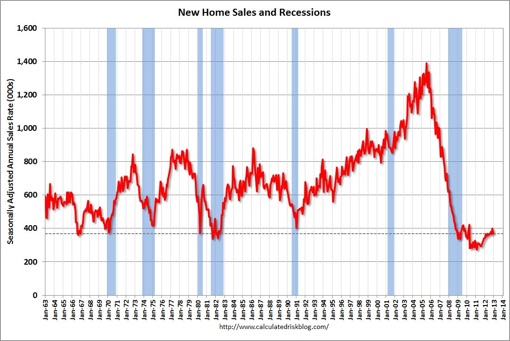
And another thing; while it may sound like houses are selling like hotcakes, the truth is far different. New home sales are less than one-third of what they were at their peak (1.4 million), while existing home sales are merely back to what they were in January 2002 before housing ballooned into a humongous bubble. In other words, the Fed’s record low rates, Obama’s mortgage modification programs, and FHA’s meager 3.5% down payment policy, have barely pushed sales back up to their historic trend. Does that sound like a strong recovery to you?

When you read about the great housing recovery, you should take it with a grain of salt. Take a look at this chart and you’ll see why.


New Home Sales


See that little squiggle at the end of the red line? That’s the housing recovery. That’s what $1.5 trillion dollars worth of mortgage backed securities (MBS) will buy you these days. Such a deal!

Now check out this excerpt from The Burning Platform:
“The contrived elevation of home sales and home prices has been engineered by the very same culprits who crashed our financial system in the first place. This has been planned, coordinated and implemented by a conspiracy of the ruling oligarchy – the Federal Reserve, Wall Street, U.S. Treasury, NAR, and the corporate media conglomerates. Ben’s job was to screw senior citizens and drive interest rates low enough that everyone in the country could refinance, attract investors and flippers into the market, and propel home prices higher. Wall Street has been the linchpin to the whole sordid plan. They were tasked with drastically limiting the foreclosure pipeline, therefore creating a fake shortage of inventory. Next, JP Morgan, Blackrock, Citi, Bank of America, and dozens of other private equity firms have partnered with Fannie Mae and Freddie Mac, using free money provided by Ben Bernanke, to create investment funds to buy up millions of distressed properties and convert them into rental properties, further reducing the inventory of homes for sale and driving prices higher. Only the connected crony capitalists on Wall Street are getting a piece of this action. The Wall Street big hanging dicks have screwed the American middle class coming and going. The NAR and media are tasked with what they do best – spew propaganda, misinform, lie, cheerlead and attempt to create a buying frenzy among the willfully ignorant masses. ….. Mortgage applications by real people who want to live in a home are no higher than they were in 2010 when home sales were 33% lower than today. Mortgage applications are lower than they were in 1997 when 4 million existing homes were sold versus the 5 million pace today. The housing recovery is just another Wall Street scam designed to bilk the American middle class of what remains of their net worth.” (“It’s always the best time to buy”, The Burning Platform)

The whole article is a must read for anyone who’s at all interested in housing or government-Wall Street collusion. The author points to another disturbing trend too, the fact that firsttime homebuyers have vanished from the marketplace. Firsttime homebuyers and “move up” buyers used to make up the majority of all housing sales. Now they’ve been replaced by over-extended FHA borrowers (leveraged at 30 to 1) and private equity speculators who represent a full 30% of the market. This new dynamic won’t last, mainly because rising prices reduce profit margins causing speculators to shift to other forms of investment.

Case in point: Just look at Las Vegas where the big Wall Street investors have been buying everyhing that’s not nailed to the floor. This is from Realty Check:
“The Las Vegas market is being fueled by investors, but even the investors can’t find the great bargains anymore….(Mike Brunson, a local appraiser) called Las Vegas the Titanic of the real estate market. It was once thought unsinkable, and even now that the worst is over, he still thinks the market is on a well-provisioned life raft, not on solid ground.

“The only thing that concerns me is that we have been here before and the market itself is not what is driving the price increases. It’s not that we have new employers coming in and creating tens of thousands of new jobs that are leading to people buying new houses. It’s ‘Las Vegas is on sale,’ and investors are buying up everything they can in the used market…..

Brunson… still worries about the fundamentals, such as the slow economic growth and the fact that so much of the funding for new home sales is coming from low down payment, government-backed mortgages.” (“What’s Fueling the Housing Boom in Vegas?” Realty Check)

Brunson crystalizes the views of the housing skeptics (like me), that is, that a recovery that depends on speculators “chasing yield” instead of “organic growth” from working people looking for a place to live, is bound to fail. It’s only a matter of time. Any tightening of rates by the Fed or stock market correction will send the speculators racing for the exits.

Here’s more from Dave Dayen at The New Republic:
Analysts insist that REO-to-rental does not represent a bubble, that the rental revenue streams will satisfy investors and prevent a mass sell-off. But any disruption in the economy would affect the market for rental housing, leading to longer vacancies and lower returns on investment. And the textbook definition of a bubble consists of speculation chasing an appreciating asset. This is precisely what we have in REO-to-rental. In the words of analyst Josh Rosner of Graham Fisher, “the speculative boom has returned.”Investors have begun to pull out of one of the leading edge markets, Phoenix, as most of the foreclosed properties worth purchasing have been snapped up. The big run-up in prices there could collapse as demand collapses, depressing prices and putting the recovery in jeopardy. And any economic downturn would increase rental vacancies and send this entire market reeling. We may not only have a bubble, but already the beginnings of a bust….” (“Your new landlord lives on Wall Street“, Dave Dayen, The New Republic)

Once the PE parasites have stripped the carcas to the bone; they’ll move on to other prey. It’s the nature of the beast. That means that all the markets that rallied in the last 9 months, will see a sharp drop off in demand in 2013 as investment dries up and prices flatten out or retreat. The investment craze is on a very fixed time-line. If lending standards don’t ease, prices will fall. It’s a sure-thing. Low interest rates alone will not keep prices high.

Even so, Fed chairman Ben Bernanke’s zero rate policy (zirp) has helped to fuel another destructive bubble that is setting up borrowers for more excruciating losses. Take a look at the bubble that is developing in California. This is from an article titled More Bubble Trouble in California?:
“In Southern California, home sales have jumped 14 percent over last year and the median price is up 16 percent, some 25 percent in Orange County. We may not quite be at 2007 super-bubble levels but we’re getting there, particularly in the more desirable areas.

Yet, before opening the champagne, we need to look at some of the downsides of this asset recovery. We are not seeing much new construction, particularly of single-family homes, so the supply is not being replenished as inventory sinks. Meanwhile, many of the homebuyers are not families seeking residences, but flippers, Wall Street types and foreign investors. A remarkable one-in-three Southern California home purchasers paid with cash, up from 27 percent from last year.

It’s clear that this increase is not being fueled primarily by income growth among middle-class Californians; these “prices are rising disconnected from household incomes,” notes one analyst….

This leads to what is becoming the biggest problem facing the state – a decline in the rates of affordability. The previous bubble left us a legacy of more-affordable housing, an advantage we may now be losing….The groups hit hardest by this scenario will be middle- and working-class Californians, particularly above the age of 30-35, most of whom desire to own their own home. Unable to qualify, or unwilling to overleverage, many will be forced either to give up their dreams or look elsewhere, taking their talents and, eventually, their offspring, with them.” (“More Bubble Trouble in California?”, Joel Kotkin, New Geography)

As always, the Fed’s meddling creates clear winners and clear losers. In this case, working people are getting shafted while Ben’s facebook friends make off with the lion’s share of the loot. Some things never change.

There’s no way to dispute that prices and sales have been improving. Interest rate stimulus, inventory suppression, and unprecedented speculation have reversed the downward trend and lifted housing off the canvas. But it’s going to take more than that to produce a sustainable housing recovery. It’s going to take a strong economy where unemployment is low and wages are growing.

Don’t hold your breath.

Total Housing Activity Chart: http://advisorperspectives.com/dshort/charts/index.html?guest/2012/LR-Home-TotalActivityIndex-112812.PNG

Friday, March 1, 2013

The Missing Recovery

March 1, 2013 | Paul Craig Roberts

Officially, since June 2009 the US economy has been undergoing an economic recovery from the December 2007 recession. But where is this recovery? I cannot find it, and neither can millions of unemployed Americans.

The recovery exists only in the official measure of real GDP, which is deflated by an understated measure of inflation, and in the U.3 measure of the unemployment rate, which is declining because it does not count discouraged job seekers who have given up looking for a job.

No other data series indicates an economic recovery. Neither real retail sales nor housing starts, consumer confidence, payroll employment, or average weekly earnings indicate economic recovery.

Neither does the Federal Reserve’s monetary policy. The Fed’s expansive monetary policy of bond purchases to maintain negative real interest rates continues 3.5 years into the recovery. Of course, the reason for the Fed’s negative interest rates is not to boost the economy but to boost asset values on the books of “banks too big to fail.”

The low interest rates raise the prices of the mortgage-backed derivatives and other debt-related assets on the banks’ balance sheets at the expense of interest income for retirees on their savings accounts, money market funds, and Treasury bonds.

Despite recovery’s absence and the lack of job opportunities for Americans, Republicans in Congress are sponsoring bills to enlarge the number of foreigners that corporations can bring in on work visas. The large corporations claim that they cannot find enough skilled Americans. This is one of the most transparent of the constant stream of lies that we are told.

Foreign hires are not additions to the work force, but replacements. The corporations force their American employees to train the foreigners, and then the American employees are discharged. Obviously, if skilled employees were in short supply, they would not be laid off. Moreover, if the skills were in short supply, salaries would be bid up, not down, and the 36% of those who graduated in 2011 with a doctorate degree in engineering would not have been left unemployed. The National Science Foundation’s report, “Doctorate Recipients From U.S. Universities,” says that only 64% of the Ph.D. engineering graduates found a pay check.

As I have reported on numerous occasions for many years, neither the payroll jobs statistics nor the Bureau of Labor Statistics’ job projections show job opportunities for university graduates. But this doesn’t stop Congress from helping US corporations get rid of their American employees in exchange for campaign donations.

There was a time not that long ago when US corporations accepted that they had obligations to their employees, customers, suppliers, the communities in which they were located, and to their shareholders. Today they only acknowledge obligations to shareholders. Everyone else has been thrown to the wolves in order to maximize profits and, thereby, shareholders’ capital gains and executive bonuses.

By focusing on the bottom line at all costs, corporations are destroying the US consumer market. Offshoring jobs reduces labor costs and raises profits, but it also reduces domestic consumer income, thus reducing the domestic market for the corporation’s products. For awhile the reduction in consumer income can be filled by the expansion of consumer debt, but when consumers reach their debt limit sales cannot continue to rise. The consequence of jobs offshoring is the ruination of the domestic consumer market.

Today the stock market is high not from profits from expanding sales revenues, but from labor cost savings.

US economic policy has been focused away from the real problems and onto a consequence of those problems–the large US budget deficit. As no interest group wants to be gored, Congress has been unable to deal with the trillion dollar plus annual budget deficit, the continuation of which raises the specter of dollar collapse and inflation.

John Maynard Keynes made it clear long ago, as has Greece today, that trying to reduce the ratio of debt to GDP by austerity measures doesn’t work.
Among the countries in the world the US is in a unique position. It not only has its own central bank to provide the money necessary to finance the government’s deficit, but also the money that is provided, the US dollar, is the world’s reserve currency used to settle international accounts among all nations and, thus, always in demand. The dollar thus serves as the world’s transaction currency and also as a store of value for countries with trade surpluses who invest their surpluses in US Treasury bonds and other dollar-denominated assets.

Without the support that the reserve currency status gives to the dollar’s exchange value (its price in foreign currencies), the enormous expansion in the quantity of dollars produced by the Fed’s years of quantitative easing would have resulted in a drop in the dollar’s exchange value, a rise in interest rates, and a rise in inflation. Since my time in government, the US has become an export-dependent economy, and export-dependent economies are subject to domestic inflation when the currency loses exchange value.

To sum up, the corporations’ focus on the bottom line has disconnected US incomes from the production of the goods and services that the American people consume, thus weakening and ultimately destroying the domestic consumer market. The Fed’s focus on saving banks, which mindless deregulation allowed to become “too big to fail,” has created a bond market bubble of negative real interest rates and a dollar bubble in which the dollar’s exchange rate has not declined in keeping with the large increase in its supply. Both the corporations and the Fed have created a stock market bubble based on profits obtained from labor arbitrage (the substitution of cheaper foreign labor for US labor) and from banks speculating with the money that the Fed is providing to them.

This situation is untenable. Sooner or later something will pop these bubbles, and the consequences will be horrendous.

Monday, November 19, 2012

The Lousiest Recovery of All Time--If It Can Really Be Called a Recovery at All

by MIKE WHITNEY
 
Is this the lousiest recovery of all time?

Check it out: The number of people currently on food stamps in the US is at a record-high of 47.1 million. That’s more than twice as many recipients than in 2007 when the crisis began. And the percent of Americans living below the poverty line has skyrocketed, too. It’s gone from 12.3 percent in 2006 to 16.1 percent today. According to the Census Bureau, nearly 50 million people in America are now living below the poverty line. In other words, if you’re poor in America your numbers are growing and things are getting worse. Some recovery, eh?

And it’s not just the poor who are hurting either. The middle class is getting clobbered, too.

Unemployment is still way too high (U3 7.9%, U6 14.3%) and, according to the Fed’s Survey of Consumer Finances, middle income families have seen nearly 40 percent of their net worth go up in smoke since 2007. The bulk of the losses are attributable to the giant housing bust of ’07 which wiped out $8 trillion in home equity leaving the majority of baby boomers unprepared for retirement. It’s a desperate situation that no one seems to want to talk about, but the reality is that millions of people are going to have to figure out how to scrape by on next-to-nothing or work until they’re too senile to punch a clock. As far as these folks are concerned, the recovery is just a big joke.

So who’s really benefited from the so called recovery?

Well, that’s a no brainer: Wall Street and the 1 percenters, that’s who. Fed chairman Ben Bernanke has pumped enough uber-cheap money into financial markets to fill a small ocean, all with the clear intention of keeping stocks bubbly so his fatcat speculator friends can cream the system and take home even bigger bonus checks. The Fed’s quantitative easing program has sent stocks into the stratosphere, in fact, all three major US indices have more than doubled since the program was first launched in 2008. There’s only one drawback; it doesn’t do jack for the real economy. Oh, and another thing, its effect on stocks is only temporary, the equivalent of a sugar rush. Check out this post by Charles Biderman at TrimTabs and you’ll see what I mean:
“On September 14 the day of the most recent Fed easing, the S&P 500 peaked at 1466. And ever since then stocks have been selling off and opened today down about 6%.
On previous videos I predicted that the current QE would have very little impact on both the stock market and the economy. And that is what happened. Why did I predict that? Short term interest rates are already at zero and it has been five months now since mortgage rates reached current record low levels. So yes, as a result of Operation Twist after tax income rose to a $300 billion in annualized growth this past June through September. That was up from a $200 billion growth rate over the first five months of 2012. Since October, after tax income – remember this is a before inflation number – has dropped back to a $200 billion growth rate. In other words, the Fed this year will in essence print half a trillion dollars that will not improve after tax income nor help stock prices grow……
So the US economy is currently barely growing despite huge amounts of deficit spending and money printing.” (“Bernanke Put Dead and Very Little Chance Stocks Avoid Year End Sell Off”, Trim Tabs Money Blog)
This is Bernanke’s worst nightmare. Stocks are looking wobbly and his nutcase monetary theories are no longer working. But rather than change directions and admit his error, Bernanke has decided to double-down and throw the printing presses into high-gear. But how can he do that, you may wonder, after all, hasn’t the Fed already committed to purchasing $40 billion mortgage-backed securities per month for “as long as it takes” (QEternity) to lift GDP rises and reduce unemployment?

Yes, he has, but that doesn’t mean the Moneymaker in Chief doesn’t have more arrows in his quiver. He does. Here’s the story from Bloomberg:
“The Federal Reserve is embarking on the next step in Chairman Ben S. Bernanke’s journey toward greater transparency — tying its outlook for borrowing costs to measures of employment and inflation.
Policy makers “generally favored the use of economic variables” to provide guidance on the when they are likely to approve their first interest-rate increase since 2008, according to minutes of their Oct. 23-24 meeting released yesterday. Such measures might replace or supplement a calendar date, currently set at mid-2015.
A number of officials also said the Fed may need to expand its monthly purchases of bonds next year after the expiration of a program to extend the maturities of assets on its balance sheet, known as Operation Twist. The discussion indicates that Fed officials judge the economy still needs record stimulus to reduce an unemployment rate stuck near 8 percent.” (“Fed Moves Toward Tying Interest-Rate Decisions to Economic Data”, Bloomberg)
So what does it all mean? It means that Bernanke and his Merry Pranksters are ratcheting it up to the next level. It means they’re going to keep flooding the financial markets with liquidity until the jobless rate comes down. It doesn’t matter that QE hasn’t moved the dial on unemployment at all or that the Fed has already expanded its balance sheet by $2.5 trillion and that no one has any idea of how Bernanke is going get rid of his stockpile of junk assets without sending the markets into an Armageddon death-spiral. None of that matters. They’re just going to put their foot on the gas and let ‘er rip! Doesn’t that sound a tad reckless?
Here’s an excerpt from the FOMC statement on September 13 that helps to connect the dots:
“If the outlook for the labor market does not improve substantially, the Committee will continue its purchases of agency mortgage-backed securities, undertake additional asset purchases, and employ its other policy tools as appropriate until such improvement is achieved in a context of price stability.”
In short: “We’re not done yet, guys, not by a long-shot.”

This is supply side arrogance in the extreme. Bernanke continues to believe that the entire economy can be effectively run by moving levers at the Central Bank. He thinks that if you plop enough money into the top of the system, (financial markets) it will eventually dribble downwards to the worker bees. Fat chance. It hasn’t happened yet, but not from want of trying.
Bernanke is right about one thing though, inflation expectations are beginning to fade which means that disinflation or outright deflation are a growing threat to the economy. Take a look at this blurb from The Economist:
“….since mid-October, there has been an unmistakable reversal in the inflation-expectations trend. Based on 5-year breakevens, all of the September spurt has been erased. And 2-year breakevens are back at July levels. Given my optimism over the Fed’s September moves and the apparent strength of underlying fundamentals in the economy, I would like to disregard this trend, but one should be very reluctant to abandon guideposts that have served one well just because they’ve moved in an inconvenient way.” (“Monetarypolicy—Is there a problem?”, The Economist)
This is why Bernanke is wheeling out the heavy artillery, because QE3 hasn’t boosted spending or borrowing at all. Business investment is still in the doldrums and earnings have hit the skids in a big way. So where are all the green shoots? The only difference between 2008 and today is a steroid-inflated stock market and a few more multi-billionaire 1 percenters. Everything else is about the same, only worse.

If Bernanke was serious about fixing the economy, he’d stop all the monetary chicanery and let stocks nosedive by a couple thousand points. That would wake up Congress and force them to do their damn job. Zero rates and boatloads of liquidity just aren’t doing the trick, anyone can see that. In fact, all the hocus pocus and crackpot “accomodative” policies are just making people nervous and adding to the uncertainty. It’s time to get back to basics, fiscal stimulus.

Bernanke should follow the advice of Nomura’s chief economist Richard Koo. Koo has done extensive research on Japan’s 20 year running-battle with deflation and explained in excruciating detail what needs to be done to emerge from, what he calls, a balance sheet recession. Here’s a sample of his work:
“The most important lesson of the last 20 years in Japan and of the last four years in western economies is that monetary policy is ineffective when there is no private demand for funds…
“In Japan, there has been little or no private loan demand since 1995, when the BOJ brought interest rates down to near-zero levels. And neither the economy nor asset prices have recovered, even though, as BOJ Governor Masaaki Shirakawa has noted, the BOJ embarked on quantitative easing fully eight years before its counterparts in Europe and the U.S…..
When businesses and households not only stop borrowing money but start to work off their debt, the resulting absence of borrowers effectively traps central bank-supplied liquidity in the financial system, and as a consequence the funds neither stimulate the economy nor spark inflation……”
Sound familiar? And here’s more from the Financial Times via Economist’s View:
“Today, the US private sector is saving a staggering 8 per cent of gross domestic product – at zero interest rates, when households and businesses would ordinarily be borrowing and spending money. … This is the result of the bursting of debt-financed housing bubbles, which left the private sector with huge debt overhangs … giving it no choice but to pay down debt or increase savings, even at zero interest rates.
However, if someone is saving money or paying down debt, someone else must be borrowing and spending that money to keep the economy going. … With monetary policy largely ineffective and the private sector forced to repair its balance sheet, the only way to avoid a deflationary spiral is for the government to borrow and spend the unborrowed savings in the private sector….
The challenge now is to maintain fiscal stimuli until private sector deleveraging is completed.” (“Explain the disease to help US citizens”, Richard Koo, Financial Times)
Bernanke’s smart enough to know that more-of-the-same (QE) won’t get the economy back on track. He knows that Koo is right. But that doesn’t mean there will be a change in policy. There won’t be, mainly because QE reinforces the caste system where all the goodies go to the silk-stocking hotshots at the top and everyone else gets table scraps. It’s just plain old class warfare. And, guess what: their class is winning.