Showing posts with label Electronic Frontier Foundation (EFF). Show all posts

Friday, February 24, 2012

Privacy advocates worry online advertisers will sneak around ‘Do Not Track’ rule

By Stephen C. Webster | RAW Story
Friday, February 24, 2012 

Following the White House’s announcement of support for new one-click Internet privacy rules, electronic privacy advocates warned Raw Story that online advertisers who claim support the new standards might not actually be keen on giving up their most valuable metrics.

Experts who spoke to Raw Story this week warned that if government officials are really serious about protecting Americans’ private data, it’s going to take a lot more than the recently announced voluntary standards.

The Electronic Frontier Foundation (EFF) is concerned that industry groups may be able to find wiggle room around any such proposals that may ultimately become law, merely by altering their little-read terms of service agreements to include the very tracking the “Do Not Track” policy purports to allow users to opt out of.

“Right now we are at the beginning of a difficult negotiation about who is going to be in the room for deciding what ‘Do Not Track’ means [in potential future laws],” EFF activism director Rainey Reitman explained to Raw Story. “Yesterday’s announcement from the [Digital Advertising Alliance] underscored the risk of allowing an advertising company to decide what ‘Do Not Track’ means.”

Following the president’s announcement, the Digital Advertising Alliance (DAA), an industry group representing the largest online ad networks, said (PDF) that it would implement a series of privacy protections that should allow users to easily opt-out of behavioral tracking systems. However, Reitman warned that while it sounds good, DAA’s move may actually be an effort to pre-empt the World Wide Web Consortium (W3C), which offers a stakeholder-driven process for open collaboration on privacy standards.

If that’s successful, online advertisers could potentially tweak their terms of service to say they’re in compliance with “Do Not Track” rules merely by exempting unwilling customers from behavioral advertising, while still conducting tracking in the background and away from public view.
“That’s the fear, but I certainly hope that’s not the case,” she said.

Those concerns were echoed to a degree by Joy Butler, a Washington, D.C. attorney and author of the book The Cyber Citizen’s Guide Through the Legal Jungle: Internet Law for Your Professional Online Presence.

“First, everyone is not in agreement on the meaning of ‘Do Not Track,’” she told Raw Story. “To some internet companies, it means no targeted ads will be sent to the consumer, but the consumer’s information may still be recorded, stored, and even shared. Hence, ‘Do Not Track’ may initially insert more consumer confusion into the marketplace.”

She added that even while the Federal Trade Commission will help to enforce adherence to industry privacy policies, “without Congressional legislation to codify it, the Consumer Privacy Bill of Rights is only a list of suggested best practices that Internet companies can voluntarily adopt or reject.”

Chris Babel, CEO of TRUSTe, a leading online privacy group, agreed that companies could potentially find ways around “Do Not Track” principles if they become law, but suggested that it wouldn’t be in their interest to do so.

“‘Do Not Track’ and the whole Privacy Bill of Rights is not a law yet,” he explained. “So, one, it needs to become a law. But the question is, could they [evade the law]? Sure, they could. Would they do that? Well, it would be a PR disaster.”

He concluded that companies getting around “Do Not Track” by putting an exemption “buried in the terms of service somewhere multiple layers deep” is probably a bad idea. “I just think that puts you in the crosshairs of so many government regulatory agencies that I don’t think they would do it,” he said. “And I don’t think that anyone would recommend that they should do it.”

So far, companies like Google, Microsoft, Yahoo! and AOL have all volunteered to comply with anti-tracking capabilities built into web browsers, and the DAA said it would work with browser makers to unify the technology. What that unifying language will be remains anyone’s guess.

The DAA did not respond to a request for comment.

Thursday, February 23, 2012

How to Remove Your Google Search History Before Google's New Privacy Policy Takes Effect

FEBRUARY 21, 2012 | BY EVA GALPERIN | Electronic Frontier Foundation

[UPDATE 2/22/2012] It is important to note that disabling Web History in your Google account will not prevent Google from gathering and storing this information and using it for internal purposes. More information at the end of this post.

On March 1st, Google will implement its new, unified privacy policy, which will affect data Google has collected on you prior to March 1st as well as data it collects on you in the future. Until now, your Google Web History (your Google searches and sites visited) was cordoned off from Google's other products. This protection was especially important because search data can reveal particularly sensitive information about you, including facts about your location, interests, age, sexual orientation, religion, health concerns, and more. If you want to keep Google from combining your Web History with the data they have gathered about you in their other products, such as YouTube or Google Plus, you may want to remove all items from your Web History and stop your Web History from being recorded in the future.

Here's how you can do that:

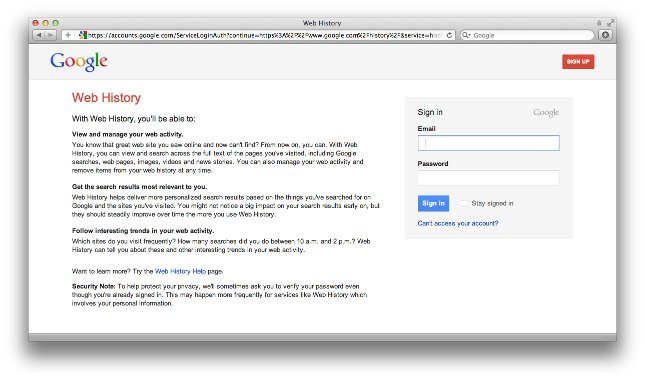
1. Sign into your Google account.

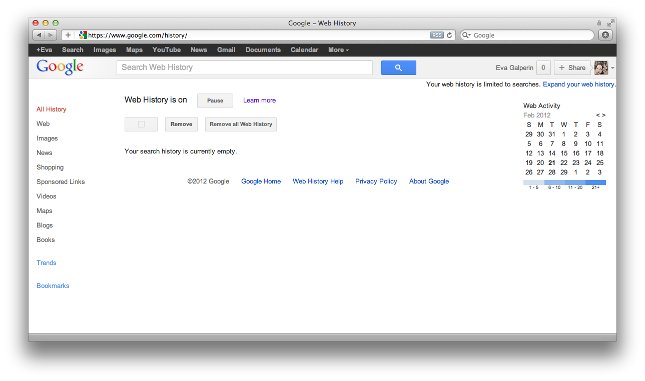
2. Go to https://www.google.com/history


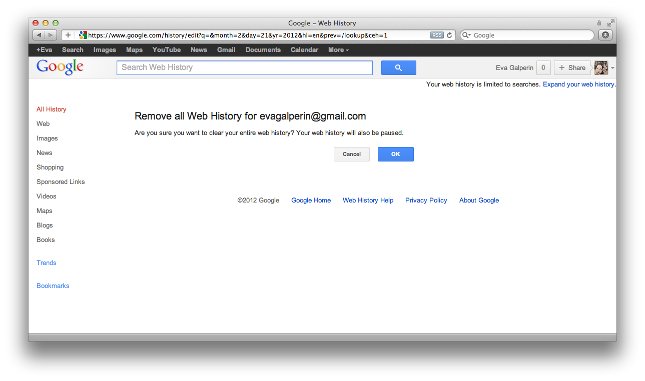
3. Click "remove all Web History."


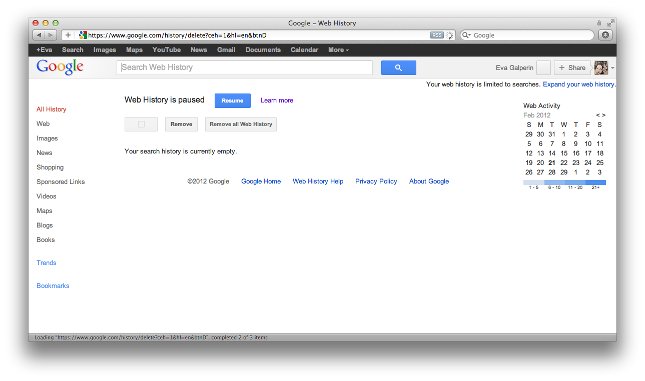
4. Click "ok."


Note that removing your Web History also pauses it. Web History will remain off until you enable it again.


[UPDATE 2/22/2012]: Note that disabling Web History in your Google account will not prevent Google from gathering and storing this information and using it for internal purposes. It also does not change the fact that any information gathered and stored by Google could be sought by law enforcement.


With Web History enabled, Google will keep these records indefinitely; with it disabled, they will be partially anonymized after 18 months, and certain kinds of uses, including sending you customized search results, will be prevented. If you want to do more to reduce the records Google keeps, the advice in EFF's Six Tips to Protect Your Search Privacy white paper remains relevant.


If you have several Google accounts, you will need to do this for each of them.

Friday, February 17, 2012

Spy Tech Companies & Their Authoritarian Customers, Part I: FinFisher And Amesys

FEBRUARY 16, 2012 | BY TREVOR TIMM - Electronic Frontier Foundation

Last week, EFF gave its recommendations to EU parliament on what steps to take to combat a growing and dangerous civil liberties concern: Western companies marketing and selling mass surveillance technology to authoritarian regimes. This technology has been linked to harassment, arrests, and even torture of journalists, human rights advocates, and democratic activists in many Middle East countries over the past year.

EFF recommended parliament approach the problem through a “know your customer” program whereby companies would investigate purchasers of surveillance technology and would refrain from doing business with a government or its agents if the sale would be used to assist in human rights abuses. This program would be voluntary for companies and encouraged via incentives but could, if necessary, become a formal requirement. As we’ve seen, transparency can be a powerful tool. The industry is notoriously secretive and a little sunlight can help spur protests and force companies to change their business practices.

Privacy International recently released a mapping of companies and countries that have attended the notorious I.S.S. World trade shows, where this technology is bought and sold. But their investigation is far from over and you can go here to help them file Freedom of Information requests, write to your representative, or dig though government spending reports.

In the first part of a new series, EFF will take a look at what we know about some of the worst offenders located in Europe and the United States. 

Part I will highlight two companies, United Kingdom based FinFisher and France based Amesys:

FinFisher, unit of Gamma International—based in the UK
Gamma International
and its subsidiary FinFisher first made headlines after the fall of Hosni Mubarak in Egypt last year, when activists found the company’s records in an abandoned state security building, along with troves of surveillance files. The documents on Gamma and FinFisher showed how they provided Mubarak with a five-month trial of their sophisticated spying technology, most notably FinSpy, which can wiretap encrypted Skype phone calls and instant messages—a service once mistakenly trusted by activists for secure communications.

The Wall Street Journal has since reported about FinFisher’s techniques and its technology’s dangerous capabilities. It works much the same way online criminals steal banking and credit card information. Authorities can covertly install malicious malware on a user’s computer without their knowledge by tricking the user into downloading fake updates to programs like iTunes and Adobe Flash. Once installed, they can see everything the user can. The FinFisher products can even remotely turn on the user’s webcam or microphone in a cell phone without the user’s knowledge.

FinFisher doesn’t pretend to market their products for solely lawful use. In 2007, they bragged that they use and incorporate “black hat (illegal and malicious) hacking techniques to allow intelligence services to acquire information that would be very difficult to obtain legally,”according to a report by OWNI.

Gamma or FinFisher, of course, won’t comment on any of these facts that have come to light over the past year. They hid behind claims of client confidentiality, telling the Wall Street Journal that they “cannot otherwise comment upon its confidential business transactions or the nature of the products it offers." But of course you can’t use claims of confidentiality to hide illegal behavior in the US or the UK. Investigators, especially in the UK and wherever these companies have sufficient contacts to establish jurisdiction, should require them to come clean about their potentially illegal business practices and uphold human rights privacy standards in the tools they offer and the customers to whom they sell.

Amesys, unit of Bull SA—based in France
When trade restrictions on Libya were eased in the early 2000s, Libya’s leader, Muammar Qaddafi, began to capitalize on the change by bringing in Western technology companies to surveil Libya's citizens’ Internet use under the guise of stopping terrorism. Instead, and to no one’s surprise, the technology was “deployed against dissidents, human-rights campaigners, journalists or everyday enemies of the state,” as the Wall Street Journal documented after seeing Qaddafi’s abandoned Internet monitoring center in Tripoli.

The main company tasked assisting Libya with all its surveillance needs was a unit of the French company Bull SA, known as Amesys. With Amesys’ monitoring centers, Libyan authorities could read emails, get passwords, read instant message conversations, and map connections among criminals, or in many cases, journalists or dissidents. OWNI graphically mapped out just how massive the surveillance system was. Documents released by WikiLeaks in November revealed that Amesys gear was even allowing Libya to spy on dissidents and opposition figures living in the United Kingdom. And as AFP reported, Qaddafi’s “regime [had previously] been accused of sending agents to harass and even kill opposition figures in exile.”

Despite the ease in trade restrictions, it was no secret Libya had a long history of human rights abuses and Amesys should have known who they were helping. The head of Libyan intelligence, the notorious Abdullah Senussi, was convicted in absentia in France of the Lockerbie terrorist bombing in 1989 that killed 170 people. Yet the former head of Amesys and current CEO of Bull, Philippe Vannier, was seen in Tripoli meeting with the same Abdullah Senussi in 2007, according to the Wall Street Journal.

Abdullah Senussi has since been indicted by the International Criminal Court for crimes against humanity for his role in the violent crackdown against Libyan citizens this past year.

The Amesys case highlights a problem with many of these companies—they are doing business with human rights violators that may have relations with the US or EU. As Amesys rightly points out, Libya was an “ally” of the west when their contract was signed and boasted of warm relations with France until NATO decided to take sides with the rebel forces late last year. "All Amesys activities strictly adhere to the statutory and regulatory requirements of both European and French international conventions," a spokeswoman said in Amesys’ defense. But this doesn’t excuse their behavior. EFF's know your customer standards address this problem by creating a framework in which companies study non-partisan human rights reports and not just the legal restrictions against the West’s perceived enemies.

"We are fully prepared to answer any questions which the legal authorities may ask us," the spokesman for Amesys also said. Authorities should take them up on their offer. In France, human rights groups have filed court documents asking for an investigation into Amesys for “possible violations of export rules and complicity in torture.” EFF encourages the French authorities to conduct a full investigation.

But Gamma and Amesys are far from the only transgressors. There are dozens of companies in both the US and EU that have been supplying this gear to authoritarian regimes as well, and EFF will soon highlight more of these companies until Congress and the EU countries act to prevent more of this dangerous technology from falling into the wrong hands.

Drone Industry’s Lobbying Plan To Expand Over Domestic, Law Enforcement Markets

Source: RepublicReport - February 17, 2012 
Drones are mainly associated with the Predator airships that patrol the Afghanistan sky. But thanks to a bipartisan vote last week, the public can expect 30,000 domestic drones flying over the United States in the next eight years.

The dramatic change in policy, which has raised concerns with everyone from civil liberties groups like the ACLU and Electronic Frontier Foundation to the pilot association and the Independent Institute, as well as conservative think tanks, occurred thanks to an aggressive and well-organized effort by drone makers and their lobbyists.

Yesterday, we reported how the Association for Unmanned Vehicle Systems International (AUVS), a drone trade group, actually doubled its recent lobbying expenses. Today, we report on a PowerPoint presentation put together by top AUVS lobbyists Michael Toscano, Mario Mairena, and Ben Gielow. The lobby group — which maintains an official partnership in Congress with Reps. Buck McKeon (R-CA), Henry Cuellar (D-TX), and dozens of other lawmakers — was the driving force behind the domestic drone decision passed last week. In the presentation obtained by Republic Report, there are several fascinating concerns raised by the lobbyists:

– Page 5: Drone lobbyists claimed access to airspace and “Global Conflict – particularly U.S. and allied nation involvement in future conflicts” will “either positively or negatively” influence “market growth” for the industry. 
– Page 6: The drone lobbyists take full credit for authoring the expansion of domestic drone use codified in the FAA authorization bill passed last week, noting “the only changes made to the UAS section of the House FAA bill were made at the request of AUVSI. Our suggestions were often taken word-for-word.” 
– Pages 10-12: The drone industry eagerly anticipates that civil drone use, including use of drones for “suspect tracking” by law enforcement, will soon eclipse military use of drones. Under a section called “Challenges facing UAS,” the lobbyists listed “Civil Liberties.”

Wednesday, February 1, 2012

International agreement cements frequently-abused U.S. copyright law

By Stephen C. Webster - RAW Story
Wednesday, February 1, 2012

With the latest round of anti-piracy bills now soundly defeated, many activists and lawmakers have begun thinking about ways that the Digital Millennium Copyright Act (DMCA) may be changed to remediate portions that have been abused by copyright holders.

Only, they’ve discovered that it may be too late.

The Obama administration signed off on an international agreement late last year called the Anti-Counterfeiting Trade Act (ACTA) that effectively exports much of the DMCA to Europe, Japan, Australia and other developed nations, and most likely cements those laws in place as-is here at home. Though negotiated in out of public view, as all U.S. Trade Representative (USTR) agreements are, portions of ACTA’s early form became public after anti-secrecy website WikiLeaks released a trove of U.S. diplomatic cables referring to the talks.

Those cables showed a vastly different — and much more objectionable — agreement than what President Barack Obama eventually signed in 2011. Nonetheless, anti-ACTA activists have tried to generate mass opposition to the treaty by comparing it to the Stop Online Piracy Act (SOPA) and the Protect Intellectual Property Act (PIPA), in an apparent effort to energize the same Internet users that were so successful in defeating those bills last month. But their arguments, largely based on conjecture and hyperbole, may ultimately hurt opponents of ACTA more than they help, allowing the Obama administration to reject lawmakers who call for reforms, like Sen. Ron Wyden (D-OR) and Rep. Darrell Issa (R-CA).

As ACTA exists today, the administration insists that it does not make any alterations to U.S. law and does not introduce any new concepts for countries that have signed on, which is why the USTR and the Obama administration treated it as an “executive agreement” and did not send it to the U.S. Senate for ratification. Such executive agreements, though controversial, are not unheard of. The president does have the authority to enter into international agreements if it does not alter U.S. law, because such an agreement does not meet the technical definition of a treaty.

Instead of mirroring SOPA/PIPA, ACTA appears to primarilly formalize language from a number of existing bilateral free trade agreements, all of which have included intellectual property enforcement requirements.

The current copyright enforcement regime, codified under the DMCA, has been greatly abused in the U.S. because of the number of pitfalls that were not foreseen by lawmakers who crafted the legislation in the mid-90s. The Electronic Frontier Foundation (EFF), a technology policy group, has a list of DMCA abuses where copyright holders have been empowered by the law to prevent the publication of damaging information, bully competition out of the market, limit consumer choices, hinder scientific research, censor media outlets, modify or delete user-submitted multimedia on the Internet and discourage technological innovation.

“Years of experience with the ‘anti-circumvention’ provisions of the DMCA demonstrate that the statute reaches too far, chilling a wide variety of legitimate activities in ways Congress did not intend,” the EFF explained. “As an increasing number of copyright works are wrapped in technological protection measures, it is likely that the DMCA’s anti-circumvention provisions will be applied in further unforeseen contexts, hindering the legitimate activities of innovators, researchers, the press, and the public at large.”

Although it’s not technically a treaty in the strictest sense because it doesn’t require changes to current law, any future legislative changes to the DCMA that counter provisions in ACTA could run into roadblocks. Once ACTA enters into force, any changes to U.S. copyright enforcement law could well run afoul of ACTA, forcing a future Administration to either withdraw from ACTA, renegotiate parts of the treaty to remain in compliance or risk sanctions from the other parties to the agreement. For its part, the Obama administration has insisted that ACTA does not tie the hands of Congress, but a future administration may read the text differently.

“The theory is that ‘foreign affairs’ is, in Article II of the Constitution, a power specifically allocated to the President — and, therefore, since ACTA is an issue under ‘foreign affairs’ it should be viewed as a Sole Executive Agreement that does not need Congressional approval,” Michael Burke, a Washington, D.C. attorney who specializes in international law, explained to Raw Story. “Both the Constitution and relevant Supreme Court cases are clear that the President, sometimes, has ‘sole’ and ‘plenary’ authority on foreign relations/foreign affairs.”

“However,” Burke added, “others feel that Article I, Section 8 of the Constitution — that allocates to Congress the power to regulate trade among nations-means that ACTA should not be considered a Sole Executive Agreement but a treaty subject to review and vote by the Senate.” That’s led the president’s critics to latch on to claims that he’s superseded his constitutional authority.

In its earliest forms, anti-ACTA activists wouldn’t have been wrong in their assertions: ACTA previously contained SOPA-like provisions that would disconnect repeat copyright offenders from the Internet, DNS blockades for rogue websites and liability provisions that would make network administrators and website owners responsible for the actions of their users. Sources say, and cables show, those provisions were fought tooth-and-nail behind the scenes and ultimately dropped from the final version, though they’ve already reappeared in the Trans-Pacific Partnership, a potential treaty which enters its 11th round of negotiations in March.

While ACTA is not a backdoor to imposing SOPA/PIPA on an unwilling populace, as some have claimed, it is broadly representative of the American entertainment industry’s long-term investment in using the American government to help it impost new copyright regimes abroad. Further evidence of that long-term goal can be found in U.S. diplomatic cables leaked last year.

ACTA is not likely to have immediate effects in the States, as part of the U.S.’s overall international copyright enforcement strategy, but it does give the Administration yet another tool in its arsenal to pursue sanctions against nations it deems insufficiently committed to protecting the U.S. entertainment industry’s profits.

For example, the U.S. keeps a list of countries that skirt these requirements, targeting them with economic pressure to force compliance. Already, Spain was the most recent to face such pressure, which was revealed in December after a U.S. diplomat’s letter was leaked to the media. Because of U.S. pressure, Spain’s new administration adopted intellectual property laws similar to SOPA, even after the previous administration refused.

Under ACTA, U.S. power to force compliance onto countries with more liberal fair use and less onerous enforcement policies will simply grow.

Saturday, October 29, 2011

Congress has declared war on the internet


Many internet users in the United States have watched with horror as countries like France and Britain have proposed or instituted so-called “three strikes” laws, which cut off internet access to those accused of repeated acts of copyright infringement. Now the U.S. has its own version of this kind of law, and it is arguably much worse: the Stop Online Piracy Act, introduced in the House this week, would give governments and private corporations unprecedented powers to remove websites from the internet on the flimsiest of grounds, and would force internet service providers to play the role of copyright police.

To recap a bit of history, the Stop Online Piracy Act or SOPA is the House version of a previous bill proposed by the Senate, which was known as the PROTECT-IP Act (a name that was an abbreviation for “Preventing Real Online Threats to Economic Creativity and Theft of Intellectual Property”). That in turn was a rewritten version of a previous proposed bill that was introduced in the Senate last year. Not wanting to be outdone by their Senate colleagues when it comes to really long acronyms, the House version is also known as the E-PARASITE Act, which is short for “Enforcing and Protecting American Rights Against Sites Intent on Theft and Exploitation.”

Copyright holders win, free speech and an open Internet lose
What it really is, however, is a disaster for the internet. As the Electronic Frontier Foundation notes in a post on the proposed legislation, the law would not only require ISPs to remove websites from the global network at the request of the government or the courts (by blocking any requests to the central domain-name system that directs internet traffic), but would also be forced to monitor their users’ behavior in order to police acts of copyright infringement. Providers who do not comply with these requests and requirements would be subject to sanctions. And in many cases, legal hearings would not be required. As Senator Ron Wyden (D-Oregon) said of the PROTECT-IP Act:
At the expense of legitimate commerce, PIPA’s prescription takes an overreaching approach to policing the Internet when a more balanced and targeted approach would be more effective. The collateral damage of this approach is speech, innovation and the very integrity of the Internet.
In effect, the new law would route around many of the protections in the Digital Millennium Copyright Act, including the “safe harbor” provisions (a number of law professors have said that they believe the proposed legislation would be unconstitutional because it is a restraint on freedom of speech). The idea that ISPs and internet users can avoid penalties if they remove content once they have been notified that it is infringing, for example, wouldn’t apply under the new legislation — and anyone who provides tools that allow users to access blacklisted sites would also be subject to penalties.


In addition to using what some are calling the “internet death penalty” of removing infringing websites from the DNS system so they can’t be found, the proposed bill would also allow copyright holders to push for websites and services to be removed from search engine results and to have their supply of advertising cut off — and would require that payment companies like PayPal and ad networks comply with these orders. If you liked what PayPal and others did when they shut off donations to WikiLeaks, you’re going to love the new Stop Online Piracy Act.

Creating a firewall around the internet, just like China
According to Techdirt, which has been a vocal critic of the bill and its predecessors, the new legislation would create a “Great Firewall of America,” similar to the firewall that the Chinese government uses to keep its citizens from accessing certain websites and servers that it deems to be illegal. Techdirt’s Mike Masnick notes that the new bill actually expands the range of websites that could be targeted by the bill: the previous version referred to sites that were “dedicated to infringing activities” with no other obvious purpose, but the new law would allow the government to target any site that has “only limited purpose or use” other than infringement (by the government’s definition).

The bottom line is that if it passes and becomes law, the new act would give the government and copyright holders a giant stick — if not an automatic weapon — with which to pursue websites and services they believe are infringing on their content. With little or no requirement for a court hearing, they could remove websites from the internet and shut down their ability to be found by search engines or to process payments from users. DMCA takedown notices would effectively be replaced by this nuclear option, and innocent websites would have to fight to prove that they deserved to be restored to the internet — a reversal of the traditional American judicial approach of being assumed innocent until proven guilty — at which point any business they had would be destroyed.

That might make for the kind of internet that media and entertainment conglomerates would prefer, but it would clearly be a much diminished version of the internet we take for granted. Opponents of the bill have set up a website to try and convince voters to reject the legislation and tell their congressman not to support it.

Saturday, August 27, 2011

Dangerous Cybercrime Treaty Pushes Surveillance and Secrecy Worldwide

(Ain't it funny/how rights just keep slippin'/away...Corporations write our laws. Corporations control the government by controlling its two party system. And it will take a huge effort on the part of us, the disenfranchised. Rise up or be plowed under.--jef)


As part of an emerging international trend to try to ‘civilize the Internet’, one of the world’s worst Internet law treaties--the highly controversial Council of Europe (CoE) Convention on Cybercrime--is back on the agenda. Canada and Australia are using the Treaty to introduce new invasive, online surveillance laws, many of which go far beyond the Convention’s intended levels of intrusiveness. Negotiated over a decade ago, only 31 of its 47 signatories have ratified it. Many considered the Treaty to be dormant but in recent years a number of countries have been modeling national laws based on the flawed Treaty. Moreover, Azerbaijan, Montenegro, Portugal, Spain, and the United Kingdom are amongst those who have ratified within the last year. However, among non-European countries, only the U.S. has ratified the Treaty to date, making Canada and Australia’s efforts unique. The Treaty has not been harmless, and both Australia and Canada are fast-tracking legislation (Australia's lower house approved a cybercrime bill last night) that will enable them to ratify the Treaty, at great cost to the civil liberties of their citizens.

Leaving out constitutional safeguardsAustralia’s invasive bill highlights one of the fundamental flaws of the Convention on Cybercrime: the Treaty’s failure to specify proper level of privacy protection necessary to limit the over-broad surveillance powers it grants law enforcement agencies. This creates problems in countries like Australia since, as the Australia Privacy Foundation points out, Australia lacks the legal constitutional safeguards afforded to many other democratic countries:
The CoE Convention has to be read within the context that applies in CoE countries – where there are substantial and actionable constitutional protections for human rights. The absence of any such countervailing protection for human rights in Australia makes it completely untenable for the Convention to be implemented in Australia without very substantial additional provisions that achieve a comparable balance.
Bills proposed in Canada (read here and here) are also affected by the Convention’s flaws as they adopt the lowest possible standard of protection against many of the invasive powers they grant. The bills provide law enforcement access to sensitive data on the mere suspicion it might be useful to an investigation. Indeed, at times they leave out the safeguards altogether, as noted in a letter from Canadian privacy scholars and civil society organizations:
[the legislation] will give state agents the power to access ...highly sensitive personal information, even where there is no reason to suspect it will assist in the investigation of any offense...What [this] facilitates, simply put, are unjustified and seemingly limitless fishing expeditions for private information of innocent and non‐suspicious Canadians.
Gag orders in place of oversight: Cultivating a culture of secrecyThe Convention’s most systemic flaw is that it seeks to impose invasive surveillance powers without legal protections. Aside from failing to specify adequate safeguards, it also leaves out the types of oversight mechanisms necessary to ensure its broad powers are not abused. Worse, the Convention takes active steps to reduce oversight and transparency by calling for limitations on when individuals can and cannot be notified that they are being surveilled upon.

The Australian bill even criminalizes any attempt to disclose the fact that the powers it grants to law enforcement have been used to spy on an individual. These gag orders will prevent anyone from disclosing the existence and content of interception warrants, all but ensuring innocent individuals will never know their civil liberties have been violated:
...it should be possible for individuals to find out that their communications have been subject to a preservation order or disclosed to law enforcement agencies once there is no longer any prejudice to an ongoing investigation.

Nigel Waters, Australia Privacy Foundation, Parliamentarian hearing on the Cybercrime Bill.
Proposed Canadian legislation also paves the way to blanket and perpetual gag orders that will apply by default to the most invasive of the seizure powers it authorizes. These gag orders can insulate abuses of power --when innocent people are surveilled for no good reason--and they will never find out nor will be able to challenge the abuse of their rights, even in situations where there is no longer any risk to an ongoing investigation.
The far-reaching powers this legislation puts in place, if adopted at all, should be accompanied by equally far-reaching oversight regimes, not gag orders. Instead of preventing abuses from ever seeing the light of day, individuals should be notified when they have been surveilled, and the extent, nature and frequency of such surveillance must be subject to rigorous external oversight.

Tamir Israel, staff attorney, Samuelson-Glushko Canadian Internet Policy & Public Interest Clinic.
Blanket gag orders are strongly disfavored under U.S. law, and at least one U.S. court of appeals has found a similar gag order provision partially unconstitutional. A provision of the PATRIOT Act permitted the government to obtain electronic communication transaction records from an Internet Service Providers without a court order. The law imposed a gag order on “National Security Letter” recipients, with extremely limited judicial review that required courts to accept the FBI’s assertions as true and placed the burden on the ISP to challenge the gag order after it had been issued. As EFF argued, such gag orders stifle free expression, and without any judicial oversight, the government was free to do what it wanted. The court agreed that the gag order provision was unconstitutional as written, but it construed the gag rules narrowly so as to pass First Amendment muster. The court found that the U.S. Justice Department could adopt additional procedures to cure the remaining defects—a result that EFF disagrees with because it is Congress’s job to write laws.

Forcing service providers to record your online activity
Countries are also using the Convention to put in place powers aimed at forcing service providers to store customer information for extended periods of time. While the Convention itself foresees targeted preservation orders in scenarios where there is a reason to believe the information would otherwise be vulnerable to loss or modification, Australian and Canadian bills ignore this important limitation. Also, while the Convention envisions a distinction between orders forcing service providers to preserve data they have already collected and orders aimed at forcing service providers to intercept and record data in real time, the misuse of proactive or ‘ongoing’ preservation orders aims to undermine this distinction.

In the U.S. and in Canada, for example, there have been cases where preservation powers have been misused to proactively compel service providers to retain data such as email or text messages that are not yet in their possession or control. Proactive preservation force service providers to record data they would never have otherwise retained, effectively bypassing legal protections in place for real-time electronic interceptions. As the U.S. DOJ notes in its manual on seizing electronic communications:
...should not be used prospectively to order providers to preserve records not yet created. If agents want providers to record information about future electronic communications, they should comply with the electronic surveillance statutes discussed in Chapter 4.
Instead of attempting to avoid such problems, the Australian bill embraces this confusion, and expressly grants law enforcement the right to order ‘ongoing preservation’. This, combined with the complete lack of any obligation to ensure preservation orders are narrowly targeted to capture relevant data at risk of deletion, opens the door to blanket retention orders aimed at real-time interception of communications services on a mass scale.

The Australian law, for example, is phrased in such broad terms that it could be applied indiscriminately, without any assurance that it will only be used to preserve data that is at risk of being destroyed:
The Bill could require an Internet Service Provider to preserve all stored communications (e.g. traffic and content data) for a telecommunications service (e.g. email, text messaging, mobile phone) for a specified period of time. Unless our concerns about the meaning of a ‘service’ are addressed, then under an ongoing domestic preservation notice, a Commonwealth agency could arguably request that a major carrier such as Telstra or Optus, preserve all emails used on its service for a 30 day period.

Australia Privacy Foundation Submission to the Parliament.
The proposed Canadian legislation also fails to ensure preservation demands will be used in a targeted manner and is likely to lead to voluntary retention of personal information that would not otherwise have been kept by telecommunications service providers.

Convention premised on outdated concepts of online data
The flaws inherent in the Convention itself are exacerbated by the fact that it was drafted over ten years ago and much has changed since then. The Convention was premised on the notion that ‘traffic data’ (data generated by computers as a by-product of online interactions) is ‘less sensitive’, and so should be more readily accessible to law enforcement. That was then, and this is now: Today’s ‘traffic data’ can include such sensitive information as your otherwise anonymous online identity or your social network of contacts. Mobile companies and our Internet services providers are now recording our whereabouts at every moment, and we are leaving far more detailed footprints that reveal sensitive information of our daily lives. Sensitive data of this nature warrants stronger protection, not an all-access pass.
Other things have changed in the online environment as well. The ongoing move towards cloud computing means that more and more of our information will be stored online.

Nowadays, countless millions are trusting web-based email services such as Google Gmail to store years worth of private correspondence, and cloud services such as Dropbox or Google Docs store your most private documents. The Treaty could not envision this reality when it was drafted in 2001. Governments must now think carefully about what the Treaty’s increased law enforcement powers will mean for citizen rights in this new digital context.

Monday, August 1, 2011

House panel approves bill forcing ISPs to log users’ web history

By Eric W. Dolan
RAW Story

The House Judiciary Committee approved legislation on Thursday that would require Internet service providers (ISPs) to collect and retain records about Internet users' activity.

CNET reported the bill would require ISPs to retain customers' names, addresses, phone numbers, credit card numbers, bank account numbers, and temporarily-assigned IP addresses for 12 months.

The bill passed by a vote of 19 to 10, and is aimed at helping law enforcement track down pedophiles.

"The bill is mislabeled," Rep. John Conyers (D-MI), a senior member of the panel told CNET. "This is not protecting children from Internet pornography. It's creating a database for everybody in this country for a lot of other purposes."

The Protecting Children from Internet Pornographers Act of 2011 (H.R. 1981) was sponsored by House Judiciary Committee Chairman Lamar Smith (R-TX) and Congresswoman Debbie Wasserman Schultz (D-FL)

“When investigators develop leads that might result in saving a child or apprehending a pedophile, their efforts should not be frustrated because vital records were destroyed simply because there was no requirement to retain them," Smith said Thursday.

"This bill requires ISPs to retain subscriber records, similar to records retained by telephone companies, to aid law enforcement officials in their fight against child sexual exploitation."
The American Civil Liberties Union and 29 other organizations sent a letter (PDF) to Rep. Smith on July 27, claiming that "any data retention mandate is a direct assault on bedrock privacy principles."

"The data retention mandate in this bill would treat every Internet user like a criminal and threaten the online privacy and free speech rights of every American, as lawmakers on both sides of the aisle have recognized," Senior Staff Attorney Kevin Bankston of the Electronic Frontier Foundation said.

"Requiring Internet companies to redesign and reconfigure their systems to facilitate government surveillance of Americans' expressive activities is simply un-American. Such a scheme would be as objectionable to our Founders as the requiring of licenses for printing presses or the banning of anonymous pamphlets."

The bill is supported by the National Center for Missing and Exploited Children, the National Center for Victims of Crime, the National Sheriff’s Association, the Major County Sheriff’s Association, the International Union of Police Associations and the Fraternal Order of Police.

Obama Increases Domestic Spying Operation Begun by Bush...even though he campaigned against it


During last spring's run-up to the reauthorization of three expiring provisions of the USA Patriot Act, Senator Ron Wyden (D-OR) charged that the administration and the FBI was relying on a "secret" interpretation of law to vacuum-up exabytes of data, including cell phone location records and internet data mining that target Americans.


In March, a written statement to the House Judiciary Subcommittee on Crime, Terrorism and Homeland Security by Justice Department official Todd Hinnen confirmed that the administration had used Section 215, the so-called "business records" section of the Act "to obtain driver's license records, hotel records, car rental records, apartment leasing records, credit card records, and the like."

Further confirmation of Wyden's charges came from an unlikely source: a White House nominee for a top counterterrorism position.

 
Last week Wired reported that Matthew Olsen, the administration's pick to head the National Counterterrorism Center "acknowledged that 'some of the pleadings and opinions related to the Patriot Act' to the secret Foreign Intelligence Surveillance Court that approves snooping warrants 'are classified'."

 
If confirmed, Olsen will replace Michael E. Leiter, the Bushist embed who told the Senate last year during hearings into 2009's aborted plot to bring down Northwest Airlines Flight 253 over Detroit on Christmas Day: "I will tell you, that when people come to the country and they are on the watch list, it is because we have generally made the choice that we want them here in the country for some reason or another."

 
What those reasons are for wanting a terrorist to board a packed airliner were not spelled out to Senate nor were they explored by corporate media. This raises an inevitable question: what else is the administration concealing from the American people?


White House Stonewall
Back in May, the Electronic Frontier Foundation (EFF) filed a Freedom of Information Act lawsuit against the Justice Department "demanding the release of a secret legal memo used to justify FBI access to Americans' telephone records without any legal process or oversight."
So far, the administration has refused to release the memos.

According to the civil liberties' watchdogs, a report last year by the DOJ's own Inspector General "revealed how the FBI, in defending its past violations of the Electronic Communications Privacy Act (ECPA), had come up with a new legal argument to justify secret, unchecked access to private telephone records."

"The Obama administration," The Washington Post reports, has continued "to resist the efforts of two Democratic senators to learn more about the government's interpretation of domestic surveillance law, stating that 'it is not reasonably possible' to identify the number of Americans whose communications may have been monitored under the statute."

In a letter to Wyden and Senator Mark Udall (D-CO), Kathleen Turner, the director of legislative affairs for the Office of the Director of National Intelligence (ODNI), claimed that a "joint oversight team" has not uncovered evidence "of any intentional or willful attempts to violate or circumvent the Foreign Intelligence Surveillance Act or FISA, which was amended in 2008."

Turner went on to say that "with respect to FAA" [FISA Amendments Act of 2008, the statute that "legalized" Bushist surveillance programs and handed retroactive immunity to spying telecoms like AT&T], "you [Wyden] asked whether any significant interpretations of the FAA are currently classified. As you are aware, opinions of the FISA Court usually contain extensive discussions of particularly sources, methods and operations and are therefore classified."


Throwing the onus back on political grifters in the House and Senate, Turner wrote: "Even though not publicly available, by law any opinion containing a significant legal interpretation is provided to the congressional intelligence committees."

With circular logic Turner claims that because "FISA Court opinions are so closely tied to the facts of the application under review that they cannot be made public in any meaningful form without compromising the sensitive sources and methods at issue."

At best, her statement is disingenuous. After all, it is precisely that secret interpretation of the law made by the White House Office of Legal Counsel that Wyden and others, including EFF, the Electronic Privacy Information Network (EPIC) and journalists are demanding the administration clarify.

Justice Department Shields NSA's Private Partners
The FBI isn't the only agency shielded by the Justice Department under cover of bogus "state secrets" assertions by the Obama administration.

On July 13, EPIC reported that a U.S. District Court Judge issued an opinion in their lawsuit (EPIC v. NSA), "and accepted the NSA's claim" that it can "neither confirm nor deny" that the agency "had entered into a relationship with Google following the China hacking incident in January 2010."

The privacy watchdogs sought documents under FOIA "because such an agreement could reveal that the NSA is developing technical standards that would enable greater surveillance of Internet users."

According to EPIC, the administration's "Glomar response" to "neither confirm nor deny" a covert relationship amongst giant media corporations such as Google and secret state agencies "is a controversial legal doctrine that allows agencies to conceal the existence of records that might otherwise be subject to public disclosure."

This issue is hardly irrelevant to internet users. CNET News reported last week that "Google's Street View cars collected the locations of millions of laptops, cell phones, and other Wi-Fi devices around the world, a practice that raises novel privacy concerns."

And given the government's penchant to vacuum-up so-called "transactional data" without benefit of a warrant, would media giants such as Google, high-tech behemoths such as Apple or Microsoft, beholden to the federal government for regulatory perks, resist efforts by the feds demanding they cough-up users' locational data?

Investigative journalist Declan McCullagh found that the cars "were supposed to collect the locations of Wi-Fi access points. But Google also recorded the street addresses and unique identifiers of computers and other devices using those wireless networks and then made the data publicly available through Google.com until a few weeks ago."

According to CNET, "the French data protection authority, known as the Commission Nationale de l'Informatique et des Libertés (CNIL) recently contacted CNET and said its investigation confirmed that Street View cars collected these unique hardware IDs. In March, CNIL's probe resulted in a fine of 100,000 euros, about $143,000."

On Friday, CNET reported that Microsoft too, is in on the geolocation spy game.

Declan McCullagh wrote that "Microsoft has collected the locations of millions of laptops, cell phones, and other Wi-Fi devices around the world and makes them available on the Web."

A security researcher confirmed that the "vast database available through Live.com publishes the precise geographical location, which can point to a street address and sometimes even a corner of a building, of Android phones, Apple devices, and other Wi-Fi enabled gadgets."

Such information in the hands of government snoops would prove invaluable when it comes to waging War On Terror 2.0, the so-called "cyber war." Which is why the administration is fighting tooth and nail to keep this information from the public.

On the cyber front, EPIC is suing the White House to obtain the top secret National Security Presidential Directive that sets out the "NSA's cyber security authority," and is seeking clarification from the agency about so-called internet vulnerability assessments, "the Director's classified views on how the NSA's practices impact Internet privacy, and the NSA's 'Perfect Citizen' program."

As Antifascist Calling previously reported, "Perfect Citizen" is a $100 million privacy-killing program under development by the agency and defense giant Raytheon. Published reports informed us that the program will rely on a suite of sensors deployed in computer networks and that proprietary software will persistently monitor whichever system they are plugged into.

While little has been revealed about how Perfect Citizen will work, it was called by a corporate insider the cyber equivalent of "Big Brother," according to an email obtained last year by The Wall Street Journal.

New Report Highlights "Transparency" Fraud
The refusal by the White House to divulge information that impact Americans' civil liberties and privacy rights, along with their expansion of repressive national security and surveillance programs launched by the Bush regime, underscores the fraudulent nature of Obama's so-called "transparency administration."

A new report published by the American Civil Liberties Union, Drastic Measures Required: Congress needs to Overhaul U.S. Secrecy Laws and Increase Oversight of the Secret Security Establishment, documents how "out-of-control secrecy is a serious disease that is hurting American democracy."

Authors Jay Stanley and former FBI undercover agent turned whistleblower, Michael German, write that "we are now living in an age of government secrecy run amok."

According to the report, "reality has not always lived up to the rhetoric" of the Obama regime. Since the administration took office, the White House:

• Embraced the Bush administration's tactic of using overbroad "state secrets" claims to block lawsuits challenging government misconduct.

• Fought a court order to release photos depicting the abuse of detainees held in U.S. custody and supported legislation to exempt these photos from FOIA retroactively. Worse, the legislation gave the Secretary of Defense sweeping authority to withhold any visual images depicting the government's "treatment of individuals engaged, captured, or detained" by U.S. forces, no matter how egregious the conduct depicted or how compelling the public's interest in disclosure.

• Threatened to veto legislation designed to reform congressional notification procedures for covert actions.

• Aggressively pursued whistleblowers who reported waste, fraud and abuse in national security programs with criminal prosecutions to a greater degree than any previous presidential administration.

• Refused to declassify information about how the government uses its authority under section 215 of the Patriot Act to collect information about Americans not relevant to terrorism or espionage investigations. (Mike German and John Stanley, Drastic Measures Required, Washington, D.C., The American Civil Liberties Union, July 2011, pp. 7-8)

Amongst other findings in the report we learn that more than 2.4 million personnel, "official" denizens of the secret state which include the 16 agencies of the so-called "Intelligence Community" and outsourced private contractors hold top secret and above security clearances.

Although the Government Accountability Office (GAO) disclosed that the Intelligence Authorization Act of 2010 "required required the Director of National Intelligence (DNI) to calculate and report the aggregate number of security clearances for all government employees and contractors to Congress by February 2011," as of this writing "the DNI has so far failed to produce this data."

Last year, The Washington Post's "Top Secret America" series revealed that "some 1,271 government organizations and 1,931 private companies work on programs related to counterterrorism, homeland security and intelligence in about 10,000 locations across the United States," and that "the privatization of national security" has been made possible by a "nine-year 'gusher' of money."

The Post's reporting on America's security outsourcing mania echoed critical investigations by other journalists, including those by Tim Shorrock, who has reported extensively on intelligence privatization in his essential book Spies For Hire and by James Bamford in The Shadow Factory, which explored how NSA was turned loose on the American people.

In a follow-up piece last December, investigative journalists Dana Priest and William M. Arkin described how "the United States is assembling a vast domestic intelligence apparatus to collect information about Americans, using the FBI, local police, state homeland security offices and military criminal investigators."

"The government's goal," Priest and Arkin wrote, "is to have every state and local law enforcement agency in the country feed information to Washington to buttress the work of the FBI, which is in charge of terrorism investigations in the United States."

As the Post reported, "technologies and techniques honed for use on the battlefields of Iraq and Afghanistan have migrated into the hands of law enforcement agencies in America."

This is a pernicious development. As I reported three years ago, one such program were efforts by the Department of Homeland Security, partnering-up with the Pentagon, to train America's fleet of top secret surveillance satellites on the American people.

That program, since killed by DHS, the National Applications Office, would have provided state and local authorities access to geospatial intelligence gleaned from military spy satellites and would have done so with no congressional oversight or privacy controls in place and would have handed over this sensitive data to selected law enforcement partners.

Local Police Control Ceded to the FBI
Along with intrusive techniques and highly-classified programs, Priest and Arkin wrote that the FBI has built "a database with the names and certain personal information, such as employment history, of thousands of U.S. citizens and residents whom a local police officer or a fellow citizen believed to be acting suspiciously."

What constitutes "suspicious behavior" of course, is in the eye of the beholder, and can constitute anything from taking photographs on a public street to organizing and participating in protests against America's endless wars.

Just recently, the San Francisco Bay Guardian revealed that local cops "assigned to the FBI's terrorism task force can ignore local police orders and California privacy laws to spy on people without any evidence of a crime."

Investigative journalist Sarah Phelan discovered that even after a "carefully crafted" set of rules on intelligence gathering had been in place "since police spying scandals of the 1990s," were "bypassed without the knowledge or consent of the S.F. Police Commission."

John Crew, a police practices expert with the American Civil Liberties Union of Northern California told the Bay Guardian that the 2007 Memorandum of Understanding by S.F. cops and the FBI means that "Police Commission policies do not apply" and that it "allows San Francisco police to circumvent local intelligence-gathering policies and follow more permissive federal rules."

Despite serious concerns over the Bureau's long-standing practice of spying on political dissidents and its "War On Terror" racial profiling policies, in a follow-up piece the Bay Guardian reported that Police Commission President Thomas Mazzucco, a former federal prosecutor, seemed "more concerned about defending federal practices and officials ... than worrying about the role and authority of the civilian oversight body he now represents."

The ACLU's Crew noted that when the FBI came to the SFPD with a new MOU, "there was no review by the City Attorney, and no notice to the police commission."

"Now, we didn't know about that MOU because it was kept secret at the insistence of the FBI for four years," Crew told Sarah Phelan. Crew also noted that "when ACLU and ALC [Asian Law Caucus] met with the SFPD in 2010, they were suddenly told that the police department couldn't talk about these issues without FBI permission.

"That set off a warning sign," Crew observed, "noting that in early April, when the ACLU and ALC finally got the MOU released, their worst suspicions were confirmed."

"There was no public discussion of transforming the SFPD into a national intelligence gathering association," ALC attorney Veena Dubal told the Bay Guardian. "The problem is that the FBI changed the deal, and the SFPD signed it, without telling anyone."

Neither the Bay Guardian nor the ACLU of Northern California have released the 2007 Memorandum of Understanding. However, the secrecy-shredding web site Public Intelligence has posted a sample MOU that makes for interesting reading indeed.

According to the document, local police agencies who participate in JTTFs will adhere to loose rules covered by the "Attorney General's Guidelines for Domestic FBI Operations." As Antifascist Calling reported last month, those rules will soon be loosened even further by "constitutional scholar" Barack Obama's Justice Department.

But here's the kicker; local police participating in JTTFs will be subject to rules crafted in Washington. State and municipal policies which sought to limit out-of-control spying on local activists by notorious police "Red Squads," are annulled in favor of "guidance on investigative matters handled by the JTTF" that "will be issued by the Attorney General and the FBI."

Such "guidance" we're told governs everything from "the Use of Confidential Informants" to "Guidelines Regarding Disclosure to the Director of Central Intelligence and Homeland Security Officials of Foreign Intelligence Acquired in the Course of a Criminal Investigation."

In other words, police participating in JTTFs become the CIA's eyes on the ground!

We are informed that "in order to comply with Presidential Directives, the policy and program management of the JTTFs is the responsibility of FBI Headquarters (FBIHQ)." As readers are well aware, more often than not those "Presidential Directives" arrive with built-in poison pills in the form of top secret annexes concealed from the public.

Such questions are not academic exercises.

More than three years ago, author and researcher Peter Dale Scott wrote in CounterPunch that "Congressman Peter DeFazio, a member of the House Homeland Security Committee, told the House that he and the rest of his Committee had been barred from reviewing parts of National Security Presidential Directive 51, the White House supersecret plans to implement so-called 'Continuity of Government' in the event of a mass terror attack or natural disaster."

"The story," Scott wrote, "ignored by the mainstream press, involved more than the usual tussle between the legislative and executive branches of the U.S. Government. What was at stake was a contest between Congress's constitutional powers of oversight, and a set of policy plans that could be used to suspend or modify the constitution."

Should something go wrong, the onus for civil or criminal penalties resulting from lawsuits for illegal acts by JTTF officers rests solely with local taxpayers who may have to foot the bill. This is clearly spelled out: "The Participating Agency acknowledges that financial and civil liability, if any and in accordance with applicable law, for the acts and omissions of each employee detailed to the JTTF remains vested with his or her employing agency."
Got that? You violate someone's rights and then get caught, well, tough luck chumps.

Intelligence Spending, No End in Sight
While the administration and their troglodytic Republican allies in Congress are planning massive cuts in social spending as a result of a manufactured "deficit crisis," the President's fiscal year 2012 budget proposes a five-year freeze for "all discretionary spending outside of security."

Indeed, according to the Associated Press, the Defense Department will reap a windfall some $727.4 billion and DHS $44.3 billion. But these numbers only tell part of the story.

Back in March, Secrecy News disclosed that figures provided by ODNI and the Secretary of Defense "document the steady rise of the total U.S. intelligence budget from $63.5 billion in FY2007 up to last year's total of $80.1 billion."
Americans are told they face "hard choices" when it comes to America's fiscal house of cards and that they--and they alone--not the capitalist thieves who destroyed the economy, must shoulder the burden.

But as economist Michael Hudson warned last week in a Global Research article, the American people are "being led to economic slaughter."

Hudson writes that "whenever one finds government officials and the media repeating an economic error as an incessant mantra, there always is a special interest at work. The financial sector in particular seeks to wrong-foot voters into believing that the economy will be plunged into crisis if Wall Street does not get its way--usually by freeing it from taxes and deregulating it."

However, when it comes to the secret state and the corporate interests they serve, regulators, in the form of congressional oversight or the public, seeking answers about illegal government programs, need not apply.

After all, as ODNI securocrat Kathleen Turner told the Senate, "the questions you pose ... are difficult to answer in an unclassified letter."

Thursday, June 23, 2011

U.S. anti-Internet piracy campaign violates First Amendment


By Eric W. Dolan  Thursday, June 23rd, 2011
 
 
The Electronic Frontier Foundation (EFF) urged a federal court to return two domain names seized as part of the U.S. government's "Operation in Our Sites," an ongoing campaign against websites that illegally provide access to copyrighted material.

"This misguided intellectual property enforcement effort is causing serious collateral damage to free speech rights," said EFF Intellectual Property Director Corynne McSherry. "These domain seizures should cease unless and until the government can fix the First Amendment flaws inherent in the program."

The U.S. Immigration and Customs Enforcement's (ICE) Homeland Security Investigations (HSI) announced in February that the domain names of ten "linking" websites had been seized for allegedly providing access to illegal, pirated telecasts of the National Football League, the National Basketball Association, the National Hockey League, World Wrestling Entertainment, and the Ultimate Fighting Championship.

Visitors to these websites now only see a banner that says the domain name was seized by the New York office of ICE HSI because of criminal copyright violations.

The websites did not themselves host any illegal content, but allowed users to easily browse for links to third party websites that were hosting pirated videos, according to ICE.

EFF's amicus brief (PDF) was filed in support of a petition from Puerto 80, the Spanish company that owns the streaming sites Rojadirecta.com and Rojadirecta.org, which were both seized by ICE.

A Spanish court found the sites did not violate copyright law.

"Neither the government nor rightsholders should fear a copyright enforcement process that complies with the rule of law," said EFF Senior Staff Attorney Matt Zimmerman. "Valid claims of copyright infringement can be pursued in a manner that allows the accused parties to defend themselves. The unilateral seizure of domain names without a court ruling -- which obstructs access to all of a website's content -- is improper and should be strongly opposed by free speech advocates everywhere."

ICE has seized a total of 125 domain names as part of their ongoing anti-infringement campaign.

The domain seizures have been carried out under a procedure that allows the government to seize physical property that has been used in the commission of a crime, a strategy questioned by Members of Congress. The Supreme Court has ruled that seizures without prior notice must be limited to "extraordinary situations where some valid government interest is at stake" -- a narrowly-drawn exception that would not appear to apply to cases of copyright violation.

+++++++++++++++++++


Four of the largest ISPs in the USA are on the verge of approving a deal with the RIAA and MPAA that'll require ISPs to limit people who repeatedly infringe copyright to visiting only 200 websites, throttled bandwidth, and/or sending them to copyright re-education school.

These are characterized as an alternative to outright disconnection, but as the entertainment execs behind it know that heavily throttled connections or limited access to a small collection of websites are tantamount to disconnection when it comes to the diverse benefits accrue to Internet users. And being sent to a copyright school designed by the entertainment industry isn't likely to deliver a decent understanding of education.
After years of negotiations, a group of bandwidth providers that includes AT&T, Comcast, and Verizon are closer than ever to striking a deal with media and entertainment companies that would call for them to establish new and tougher punishments for customers who refuse to stop using their networks to pirate films, music and other intellectual property, multiple sources told CNET. 
The sources cautioned that a final agreement has yet to be signed and that the partnership could still unravel but added that at this point a deal is within reach and is on track to be unveiled sometime next month...
Participating ISPs are given plenty of choices on how to respond to the toughest cases. They can select from a "menu" of responses outlined in the plan, such as throttling down an accused customer's bandwidth speed or limit their access to the Web. For example, a suspected pirate may be allowed to visit only the top 200 Web sites until the illegal file sharing stops. The subscriber may also be required to participate in a program that educates them on copyright law and the rights of content creators. In the past, a graduated response was also supposed to lead to a complete termination of service for chronic file sharers. Kicking someone off a network is not required under the proposed agreement, the sources said. As for who pays for all this, the ISPs and copyright owners will share the costs of operating the program, sources said.