Showing posts with label Brazil. Show all posts

Friday, April 13, 2012

How Neocons Sank Iran Nuke Deal

Friday, April 13, 2012 by Consortium Newsby Robert Parry

Two years ago, Washington’s influential neoconservatives – both inside and outside government – shot down a possible resolution to the Iranian nuclear dispute because they wanted a confrontation with Tehran that some hoped would lead to their long-held dream of “regime change.” In the ensuing two years, the cost of that confrontation has been high not just for Iranians, who have faced harsh sanctions, but for the world’s economy. For instance, Israeli Prime Minister Benjamin Netanyahu’s recent escalation of bomb-Iran rhetoric contributed to the spike in gasoline prices that seems to be choking off the U.S. recovery, just as job growth was starting to accelerate.

But the Israelis and their neocon allies have yet to back away from the path toward war. They appear ready to take President Barack Obama to task if he makes any meaningful concessions to Iran in international negotiations that are set to resume in Istanbul, Turkey, on Friday.

A key question in those talks is whether some version of an earlier peace deal can be revived, whether Iran will agree to trade some of its enriched uranium – especially the amounts refined to 20 percent – for nuclear isotopes needed for medical research. That arrangement might let Iran retain its low-enriched uranium for energy production.

Along with verifiable commitments from Iran not to develop a nuclear bomb, such a deal might be enough for President Obama and the West to begin rolling back some of the toughest economic sanctions imposed on Iran, including restrictions on Iran’s banking and oil sales.

However, it’s also clear that any compromise would provoke fury from the neocons as well as war hawks in Congress and Israel. They all may claim they don’t want a new war with Iran but still insist on a confrontational path that leads in that direction.

On Thursday, the neocon-dominated Washington Post editorialized that a deal might be within Obama’s grasp to avert an immediate conflict with Iran, but “the risk is that it would be counterproductive in the medium term, because it would ease what is now mounting economic pressure on Iran and allow the regime breathing space.”

The Post added: 
“It could leave the [Iranian] nuclear program in a stronger position than it was when the Obama administration began negotiations in the fall of 2009 — with more centrifuges and enough low-enriched uranium to make several nuclear bombs with further processing. If the regime refused a more comprehensive deal, or cheated, it might be difficult to restore sanctions that only now finally appear to be biting.
“With the presidential election looming, President Obama might be happy to trade those problems for avoiding a major international crisis in the coming months. For us, the call is closer. But most likely the Iranians themselves will settle the matter. For better or for worse, the chances the regime will meet Mr. Obama’s terms don’t look good.”

Iranian Flexibility
In recent comments, key Iranians have signaled flexibility along the lines of the earlier swap arrangement, but the reason why such a deal might leave Tehran “in a stronger position” than in 2009-2010 is that then the Post’s editors, along with other neocon pundits and allies inside the Obama administration, sank the earlier plan for Iran to surrender much of its low-enriched uranium for isotopes needed by an Iranian medical research reactor.

Iran had yet to overcome the technical obstacles to refine uranium to the 20 percent level to produce those isotopes. Now, Iran’s 20 percent level is only a few steps short of bringing uranium to the 90 percent refinement for a nuclear bomb. So, the earlier deal would have left Iran much further from the threshold of a nuclear-bomb capability.

However, in 2009 – and again in 2010 – Washington’s neocon voices ridiculed the proposed uranium swap on the grounds that Iran would have kept enough low-enriched uranium (at the much lower 3.5 percent level) that it could theoretically, sometime in the future, be able to refine it and build one nuclear bomb.

Today, Iran has much more enriched uranium at a much higher level, enough for at least several theoretical nuclear bombs (though Iran says it doesn’t want any).

So, one could agree with the Post’s assessment that Iran’s nuclear position today is stronger than it was in 2009 and 2010. But whose fault was that? It would seem to rest more with the Post editorialists and other neocons who demanded the heightened confrontation with Iran in place of the uranium swap.

For instance, even before the revived swap deal was unveiled on May 17, 2010, the Washington Post’s editors were mocking the leaders of Brazil and Turkey who had spearheaded the initiative. The Post called the plan “yet another effort to ‘engage’ the extremist clique of Ayatollah Ali Khamenei and Mahmoud Ahmadinejad.”

After the Iran-Brazil-Turkey deal was announced in Tehran, the rhetorical abuse escalated with Washington pundits and administration hardliners, like Secretary of State Hillary Clinton, treating the leaders of Brazil and Turkey as unwelcome interlopers who were intruding on America’s diplomatic turf in an effort to grandstand.

On May 26, 2010, the influential New York Times columnist Thomas L. Friedman weighed in, excoriating the leaders of Brazil and Turkey for negotiating an agreement with Iran to ship about half its low-enriched uranium out of the country.

To Friedman, this deal was “as ugly as it gets,” the title of his column, though others might have had different ideas about what could be uglier, like the carnage in Iraq that Friedman and other neocon pundits had advocated seven years earlier.

But Friedman stuck the “ugly as it gets” label on the peace-seeking actions of Turkish Prime Minister Recep Tayyip Erdogan and Brazil’s then-President Luiz Inácio Lula da Silva, who had persuaded Iran’s President Ahmadinejad to accept an agreement to send 2,640 pounds of Iran’s low-enriched uranium to Turkey in exchange for higher-enriched uranium that could only be put to peaceful medical uses.

That agreement followed one originally brokered by the Obama administration in fall 2009 before Iran’s internal political tensions caused the deal to collapse.

A Perturbed Leader
After the revived deal encountered a hostile reaction in Official Washington in spring 2010, a perturbed Lula da Silva challenged those Americans who insisted that it was “none of Brazil’s business” to act as an intermediary to resolve the crisis with Iran. “Who said it was a matter for the United States?” he asked.

The Brazilian president continued: “The blunt truth is, Iran is being presented as if it were the devil, that it doesn’t want to sit down” to negotiate, despite the fact “Iran decided to sit down at the negotiating table. It wants to see if the others are going to go along with what (it) has done.”

But Friedman’s column delivered a political coup de grace to the swap idea. Instead, he signaled that the neocon bottom line was the ratcheting up of pressures on Iran with the goal of “regime change” or possibly a military assault on Iran’s infrastructure.

Friedman portrayed the leaders of Brazil and Turkey as glory-seeking dupes, writing:

“I confess that when I first saw the May 17 [2010] picture of Iran’s president, Mahmoud Ahmadinejad, joining his Brazilian counterpart, Luiz Inácio Lula da Silva, and the Turkish prime minister, Recep Tayyip Erdogan, with raised arms — after their signing of a putative deal to defuse the crisis over Iran’s nuclear weapons program — all I could think of was:
“Is there anything uglier than watching democrats sell out other democrats to a Holocaust-denying, vote-stealing Iranian thug just to tweak the U.S. and show that they, too, can play at the big power table? No, that’s about as ugly as it gets.”

This U.S. hostility toward the Iran-Brazil-Turkey accord caught Brazilian and Turkish officials by surprise, in part because Obama had encouraged the initiative.

After Friedman’s column and other derogatory U.S. comments, Brazil released a three-page letter that Obama sent to Lula da Silva in April in which Obama said the proposed uranium swap “would build confidence and reduce regional tensions by substantially reducing Iran’s” stockpile of low-enriched uranium.

The contrast between Obama’s support and the anger from other voices in Washington caused “some puzzlement,” one senior Brazilian official said. After all, this official noted, the supportive “letter came from the highest authority and was very clear.”

But, in 2010, the neocons were still dreaming about “regime change” in Iran, one of the charter members of President George W. Bush’s “axis of evil.” The neocons – and much of the U.S. press – also had deluded themselves into thinking that Ahmadinejad had “stolen” the June 2009 election from the so-called Green movement and that “regime change” was just around the corner.

“In my view, the ‘Green Revolution’ in Iran is the most important, self-generated, democracy movement to appear in the Middle East in decades,” Friedman wrote. “It has been suppressed, but it is not going away, and, ultimately, its success — not any nuclear deal with the Iranian clerics — is the only sustainable source of security and stability. We have spent far too little time and energy nurturing that democratic trend and far too much chasing a nuclear deal.”

‘Regime Change’ Argument
That argument ran parallel to the neocons’ earlier case for war with Iraq, that “regime change” was the only acceptable outcome to that crisis. Thus, false or dubious claims about Iraq’s weapons of mass destruction were justified to get the American public on board for war, just as the exaggerated fears about Iran’s nuclear program became the new excuse for another bid at “regime change.”

However, unlike Iraq which was ruled by dictator Saddam Hussein, the neocon goal of overthrowing Iran’s government faced the unacknowledged reality that Ahmadinejad almost certainly won the June 12, 2009, election and that he thus was a popularly elected leader (at least within the rules of Iran’s Islamic Republic).

Though the U.S. press corps refused to accept that fact – and still routinely describes the election as “fraudulent,” “rigged” or “stolen,” the reality was that no serious evidence has been presented to support those claims.

Indeed, the overwhelming evidence is that Ahmadinejad, with strong support from the poor especially in more conservative rural areas, defeated the “Green Revolution” candidate Mir Hossein Mousavi by roughly the 2-to-1 margin of the official results.

For instance, an analysis by the University of Maryland’s Program on International Policy Attitudes concluded that most Iranians voted for Ahmadinejad and viewed his reelection as legitimate, contrary to claims made by much of the U.S. news media.

Not a single Iranian poll analyzed by PIPA – whether before or after the June 2009 election, whether conducted inside or outside Iran – showed Ahmadinejad with less than majority support. None showed Mousavi, a former prime minister, ahead or even close.

“These findings do not prove that there were no irregularities in the election process,” said Steven Kull, director of PIPA. “But they do not support the belief that a majority rejected Ahmadinejad.” [For details, see Consortiumnews.com’s “Ahmadinejad Won, Get Over It!”]

If these and other scholarly examinations are correct – and there is no counter-evidence that they aren’t – what happened after the election was that Mousavi simply refused to accept the voters’ choice and – with the enthusiastic backing of the U.S. news media – undertook to reverse the results with massive street protests.

During those demonstrations, a few protesters threw Molotov cocktails at police (scenes carried on CNN but quickly forgotten by the U.S. news media) and security forces overreacted with repression and violence.

Though it’s fair to condemn excessive force used by Iran’s police, you can be sure that if the same factors were transplanted to an American ally – or, say, the United States itself – the U.S. news media’s treatment would be completely different. Suddenly, the security forces would be protecting “democracy” from anti-democratic mobs disgruntled over losing.

But Friedman and other neocon pundits took this false conventional wisdom – that Mousavi was the voters’ choice – and transformed it into a new casus belli, a pattern of turning propaganda into political truth that was eerily reminiscent of the black-and-white portrayals of the crisis with Iraq in 2002-2003.

‘Tony Blair Democrat’
In those days, Friedman was enamored of the idea of invading Iraq and was smitten by British Prime Minister Tony Blair’s glib oratory about forcibly planting seeds of “democracy.” Friedman even dubbed himself a pro-war “Tony Blair Democrat” and made the witty observation that it was time to “give war a chance” in Iraq.

Today, it might seem obvious that anyone foolish enough to call himself “a Tony Blair Democrat” – after Blair has gone down in history as “Bush’s poodle” – or to twist John Lennon’s advice to “give peace a chance” into its opposite should have the decency to simply vacate the public stage and let some other aspiring pundit try his or her luck.

But that’s not how it works in the world of U.S. punditry. As long as you don’t offend the powerful, you keep your job, and when the carousel circles around, you’re poised to reach for another brass ring – another glorious war, another lucrative book contract.

Friedman also hasn’t heard any anti-Iranian propaganda theme that he won’t repeat, much like he did in hyping threats from Iraq.

Surely, Ahmadinejad, like Saddam Hussein, has contributed to his and his nations’ problems with wrongful actions and stupid rhetoric, making the work of neocon propagandists all the easier. But the truth is that actions of any national leader can be made to appear more outrageous or more reasonable depending on how the media frames these matters.

For example, Ahmadinejad, a little-educated populist from the Tehran’s “street,” has made obnoxious and ill-informed comments questioning the Holocaust. However, to extrapolate Ahmadinejad’s offensive remarks into a readiness to attack Israel, which has hundreds of undeclared nukes, is the kind of illogical overreach that we saw before the U.S. invasion of Iraq.

Back then, the Bush administration conjured up nightmare scenarios of Iraq flying unmanned planes over the United States to spray poison gases or secretly building a nuclear bomb that it might give to Islamic radicals (though the secular Saddam Hussein was infamous for his brutal repression of those religious fundamentalists).

It’s also should be clearer today that the mercurial Ahmadinejad has been largely sidelined by Iran’s Supreme Leader Ali Khamenei, a more predictable figure who has renounced any Iranian interest in developing a nuclear bomb, calling possession of such a weapon a “grave sin.”

Still, the neocons are itching for another conflict, this time with Iran, and they are sure to condemn any concessions that Obama makes in the upcoming negotiations. However, if an eventual deal does end up more favorable to Iran than the one available in 2010, the neocons will have themselves to blame.

Saturday, February 4, 2012

Poisoned in the Fields

Victims of Agrochemicals Break Their Silence
by RAUL ZIBECHI

“My wife washed her face with rain water the day after they fumigated farmland about three kilometers from here and she started getting rashes on her arms and her body. That was a year ago. Now she’s very affected, she’s been diagnosed with lupus and is undergoing chemotherapy.” Jorge Mérola, a farmworker from Villa del Carmen in the middle of Uruguay’s soy region, speaks from the depths of a pain that is easy to understand, but almost impossible to relay to others.

A local doctor explained that the marks on Mérola’s skin are caused by “agrochemicals” sprayed over fields from small planes. “Six of my calves died with the same symptoms. They go stiff, they have no muscular mobility, and their jaws lock. The same thing happened to some neighbors,” he explains between long pauses.

When asked why he didn’t report what happened to his wife, Mérola reveals his abysmal distrust of authorities: “I didn’t want to report this to the Ministry of Livestock because a while ago there were a lot of fish dying in the Yi river, and their response was that it was because there wasn’t enough oxygen in the water. With that kind of response, I didn’t want to report anything.”

Mérola’s testimony is one of the many included in the video Collateral Damages (Efectos Colaterales), a documentary made by Redes Amigos de la Tierra Uruguay (Friends of the Earth in Uruguay) and the Programa Uruguay Sustentable (Sustainable Uruguay Program). Reporters Ignacio Cirio and Edgardo Matiolli led the production and it will be released in early February. It can be found on Radio Mundo’s web page. It’s the first visual work that presents proof of the serious human consequences of fumigations.

Breaking the Silence

All the workers interviewed by Cirio demonstrate a keen understanding of the changes in local production: the introduction of crops like soy and fumigation with agrochemicals, the spread of monoculture farming to such an extent that “you see yourself getting closed in on,” as Isabel Olivo, from the Rural Women’s Group Network, puts it. Despite being active in grassroots organizations, Olivo admits “you feel like you have no weapons to fight it.”

Mérola’s case shows the solitude of those affected by fumigations—a solitude characterized by the distance and absence of the State and the complicity of actors like doctors who should be playing an active role. In spite of the seriousness of what happened to his wife, Mérola did only one interview, on the Sarandí del Yi radio station, which Cirio picked up and turned into the beginning of his investigation. Today his project is one of the very few to break the silence.

“Those affected don’t see the State as an entity that guarantees their rights,” he affirms, after traveling hundreds of kilometers across the areas most affected by fumigations like Florida, Flores, Durazno, Paysandú and Salto.

“Professor Elsa Gomez filed a complaint after her school was sprayed two times in a row. When public health workers interviewed her, they demanded proof that would link the health problems with agrochemicals. The State doesn’t protect them, but it makes demands of them,” concludes Cirio. Gomez teaches in a small town in the province of Durazno. In Collateral Damages she explains how the planes sprayed pesticides just meters from the school over the course of several days in 2009 without anyone showing, at least publicly, the slightest sign of concern.

“There are many things that people don’t want to come out and say, because they’re neighbors, because they rely on each other, but I know of cases that have been covered up and I see how they go out to fumigate with broken equipment,” says Luis Ferreira, who was president of the school commission in Merinos, in the province of Paysandú. His son, like other children, has stomach problems and vomits every time the planes fumigate less than 100 meters away from the school.

In his film, Cirio interviews beekeepers who have watched their hives disappear, small-scale livestock owners and farmers, village neighbors, nurses and teachers who discover the consequences of agrochemicals for their students’ bodies. He didn’t interview any doctors. When asked about the silence of those who are aware of the situation and its causes, he reflects: “Businesses make deals with schools, social clubs and hospitals. The doctors don’t say anything.”

On several occasions the team that made Collateral Damages had problems with “mosquito” (a vehicle for land fumigation) drivers who saw them filming. Some of them got out of their vehicles and wanted to know what the piece was about. “They have orders not to let themselves be filmed,” Cirio concludes.

In spite of the difficulties, he found that rural and small town inhabitants were aware of the growing problem they are facing. This is because, among other things, “they are informed, they travel, they ask questions and, for this reason, they demand that the government carry out an in-depth study of the situation.” Onelia Dominguez, a nurse’s assistant in the town of Rincón de Valentín, believes that the workers don’t demand adequate working conditions because they’re afraid they’ll lose their jobs. She agrees with Cirio that “no one has ever come to investigate.”

Overcoming the Solitude

Although the indifference of both the government and the university is the main cause for the silence among the victims, this is also a population with little opportunity to make itself heard.

In March of 2001, the Uruguayan Ministry of Livestock, Agriculture and Fishing prohibited aerial spraying closer than 500 meters from schools and land spraying closer than 300 meters “to diminish the risk of exposure to intrinsically dangerous substances.” But to comply with the rules, someone must control or report abuses. Isabel Cárcamo, from the Red de Acción en Plaguicidas (RAP-AL), said, “We have had the experience of working with communities that find it very difficult to denounce the impact of fumigations, either because they have relatives working in crop-dusting or because it’s their livelihood, or because they live in small towns where everyone knows everyone and the business even ‘helps’ the community.”

It’s the same problem that the anthropologist Carlos Santos detected. Beekeepers, for example, “confront the dilemma of not reporting the death rate of the bees so they don’t get kicked off the place where they’ve been allowed to set up their hives or lose whatever space they have,” because filing a complaint causes trouble for the landowner who rents the land used for growing soy.

Dr. María Elena Curbelo pointed out that in the vicinity of Bella Unión, an agroindustrial city where she’s been working for 16 years, rice and sugar cane plantations are sprayed with pesticides. This has led to congenital deformities in newborns and year-round respiratory problems.

She affirmed that there are various cases of pediatric leukemia in the region. She recognized that “while there were fumigations on the edge of town and one part of the population wanted to complain, the workers preferred to not risk their jobs and the people opted to remain silent.”

Most people affected by fumigation live in small towns, where everyone knows each other and there exists a persistent “cultura de esperar”–a culture of expecting someone else to solve their problems. People look to rural bosses (caudillos), landowners, and now businessmen or the government. In Uruguay, they are small towns with between 400 and two thousand inhabitants.

The rural population is systematically declining throughout Latin America. Uruguay is perhaps the most alarming case– only five percent of Uruguayans live in rural areas. Adults between the ages of 50 to 65 represent 42% of the rural population. It’s not hard to conclude that the population is in a slow process of extinction. The model of production with its disastrous health effects adds to out-migration by making rural life inhospitable.

“The Ministry of Public Health can’t recruit doctors who want to live in these places. Under such conditions,” Cirio says, “there’s an awareness of the seriousness, but there are only a few isolated efforts made with little support from organizations or professional associations.”

Cárcamo insists that powerful interests are behind the silence surrounding the effects of agrochemicals. “There is no political interest. If there were, it would be necessary to question the country’s so-called production model and the use of biofuel, among other things. The issue will really only be exposed when a political decision is made. One example is the contrast between the aggressive campaign against tobacco, while nothing is said about the impacts of the daily ingestion of agrochemicals through food and water. And the worst thing is that smoking is something you can choose, but eating and drinking water aren’t.”

Brazil, World Champion in Agrochemicals

According to a recent report by the Movimento Sem Terra (MST), Brazilian society is more and more aware of the health problems caused by agrochemical contamination. “Toxins are one of the pillars that sustain the agribusiness production model,” the organization affirms. It defines the model as export-oriented and characterized by the expulsion of families from the countryside.

Since 2008, Brazil holds first place in world rankings of agrochemical use, even though it is not the largest agricultural producer. Billions of liters are poured onto crops, and this is a practice that even the MST has not escaped. In 2010, a national campaign against agrochemicals was born and created official entities like the National Cancer Institute (INCA), Fiocruz and the Sanitary Vigilance Agency. Specialists have no doubt that agrochemicals are related to cancer. According to the INCA, in the next two years one million Brazilians will be diagnosed with cancer and only six out of every ten of those affected will recover. Furthermore, there will be consequences for millions of people who experience a number of afflictions every year. In a recent conference in Rio de Janeiro, Joâo Pedro Stédile, MST coordinator, complained that in the movement’s settlements “there are instances of breast cancer in 13 and 14 year-old girls” (Carta Maior, December 20).

Brazil’s 2011 Human Rights report, released in December by the Social Network of Justice and Human Rights explains that each year 5,600 people are poisoned with agrochemicals while only half the cases are reported. Based on reports from the Ministry of Health, the report concludes that every year there are 2,300 “suicide attempts” made with agrochemicals. The southern region prides itself on agribusiness, but at the same time this model explains 75 percent of deaths there. This surprising revelation led various scientists to undertake field studies.

One study published in the Revista Brasileira de Saúde Ocupacional by the Ministry of Labor notes the connection between suicides and the massive use of agrochemicals because organophosphates, among other things, produce psychological disorders. “Scientific evidence shows that exposure to pesticides can cause irrevocable health damages. For example, advanced neuropathy is a result of overexposure to organophosphates. Indeed, exposure is associated with a long list of symptoms and with significant deficits in neurobehavioral performance and abnormalities in nervous system functions.

The journal of the Brazilian Association of Postgraduates in Public Health also published case studies based on a survey of 102 rural workers from Nova Friburgo. They concluded that there is a direct relationship between emotional and psychological disturbances and exposure to agrochemicals.

Argentina: Doctors in Fumigated Towns

In the agricultural cycle of 1990, the Argentine countryside received 35 million pounds of pesticides. In 2010, agribusinesses used more than 300 million liters of toxins. The numbers continue to grow. In 1996, when fumigation with glyphosate began, about two liters were used per hectare. By 2010, the figure had increased to more than ten liters, and there is some land fumigated with more than twenty liters per hectare.

This data was presented during the First National Conference of Doctors in Fumigated Towns, in August 2010 in Córdoba, Argentina. The conference was held by the Department of Medical Sciences of the National University of Cordoba. A hundred and sixty doctors from ten provinces and dozens of towns attended.

The conference led to the creation of the University Environment and Health Network, committed to following up on health problems created by agrotoxins.

The event’s final report states, “The doctors pointed out that, generally speaking, they have served the same populations for more than 25 years, but they find that recent years have been completely different, and they link the differences directly to systematic fumigation with pesticides.” Rodolfo Páramo, pediatric and neonatal doctor at the Malabrigo hospital in the Norte de Santa Fe reported the disturbing rate of twelve deformations of 200 births in 2006.

The neonatal service at the Perrando Hospital in Resistencia, Chaco, released its own statistics: in 1997, there were 19.5 deformities in every 10,000 newborns. In 2008, the number tripled to 85.3. In the same period, the land area planted in soybeans in the province quadrupled.

The final conference report took into account the many testimonies and reports presented and concluded, “It’s important to point out that official epidemiological reports are scant. According to what the doctors say —relying on their own figures acquired through observation— public health officials haven’t heeded the alarm from health groups and reports from the general population.” The Chaco report is “one of the only such reports generated publicly with interjurisdictional participation.”

Medardo Ávila Vázquez, coordinator of the medical network, stated that despite the scientific evidence presented, authorities from national and health care sectors are unwilling to accept reality and, in particular, unwilling to acknowledge the pathological changes in the rural population.

He decided to work with groups like the Mothers of Ituzaingó, a neighborhood group in Córdoba surrounded by soy where 300 out of 5,000 inhabitants have cancer, or the Stop Fumigating Collective that opted to protest instead of dying in silence. This group insists that “there is no controllable or safe fumigation,” which is why all fumigation should be stopped.

The Ituzaingó case shows that fumigations affect the poorest of the poor. Without organization and public protest, nothing will be gained. Back in 2002 the Mothers condemned “endosulfan and heavy metals in water tanks in people’s homes,” but to this day their children keep dying of leukemia and suffering from deformities.

Avila’s data is deeply disturbing. “There are more than 12 million people affected by fumigation in the country. In these areas, the rate of birth defects is four times higher than in the cities. Cancer is responsible for 33% of deaths in Barrio Ituzaingó—the leading cause of death— while in big cities the primary causes are cardiovascular problems, which accounts for 27% of the deaths, followed by cancer at 19%.”

Friday, January 6, 2012

Brazil fans of HELLBLAZER respond to SPIDERLEGS version of VENUS of the HARD SELL

(A post with comments on a Brazilian website about SPIDERLEGS' take on a fictional punk song--"Venus of the Hardsell"--by a fictional punk band--Mucous Membrane--from the pages of John Constantine: HELLBLAZER. English translation below the Portugese.--jef)
Hellblazer Fãs gravam música da banda fictícia de John Constantine

Assista ao clipe de "Venus of the Hardsell" criado pela banda Spiderlegs

Carina Toledo
04 de Julho de 2011


John Constantine, o mago inglês da série Hellblazer, teve uma breve carreira musical no fim da década de 70, quando metade da juventude britânica queria ser os Sex Pistols. Era a banda Membrana Mucosa, com os amigos Gary Lester, Les e Beano. Assim como tudo na vida de Constantine, a banda terminou em tragédia, mas deixou um hit constantemente citado nas HQs: “Venus of the Hardsell”.

  Agora, você pode finalmente ter uma ideia de como seria ouvir Constantine. Fãs do personagem gravaram a música “Venus of the Hardsell”, a partir da letra publicada em Hellblazer Annual #1 (HQ inédita no Brasil; o letrista foi o escritor Jamie Delano). E ainda fizeram um vídeo com cenas da HQ. Assista:

A música foi gravada pela desconhecida Spiderlegs, que tenta reproduzir como seria uma bandinha britânica de garagem do final dos anos 70. O vídeo está há pouco mais de um mês no YouTube, e nas informações comenta-se que em breve deve acontecer uma regravação.
A homenagem chega em momento especial para Constantine. Além de agora dividir seu tempo entre o Universo DC normal e a continuidade diferente na Vertigo – onde em breve vai poder se gabar de ter o gibi com a mais alta numeração entre Marvel e DC -, o anti-herói terá retrospectiva em coletâneas que vão republicar Hellblazer desde a primeira edição. A Panini já anunciou que vai seguir a onda aqui, prometendo para este ano o encadernado John Constantine: Hellblazer – Origens.

Leia mais sobre Hellblazer


------------------------------------------------------------------------------

Hellblazer Fans record music of the fictitious band of John Constantine

Listen to the clip of “Venus of The Hardsell” created by the band Spiderlegs

Carina Toledo
04 of July of 2011

John Constantine, English magus of the Hellblazer series, had a brief musical career in the end of the decade of 70, when half of British youth wanted to be the Sex Pistols. She was the band Mucous Membrane, with the friends Gary Lester, Les and Beano. As well as everything in the life of Constantine, the band finished in tragedy, but hit cited in the HQs left one constantly: “Venus of the Hardsell”.

Now, you can finally have an idea of as she would be to hear Constantine. Fans of the personage had recorded music “Venus of the Hardsell”, from the letter published in Hellblazer Annual #1 (HQ unknown in Brazil; the letrista was the writer Jamie Delano). had still made a video with scenes of the HQ. It attends:
Music was recorded by the stranger Spiderlegs, who tried to reproduce as one would be in a British garage band of the end of the 70s. The video is little has more than one month in the YouTube, and in the information it is commented that soon a rerecording will happen.
The homage arrives at special moment for Constantine. Beyond now dividing its time between normal Universe DC and the different continuity in the Vertigo - where soon he goes to be able to brag itself to have the comics with the highest numeration between Marvel and DC -, the anti-hero will have retrospect in coletâneas that go to republish Hellblazer since the first edition. The Panini already announced that it goes to follow the wave here, promising for this year the bound John Constantine: Hellblazer - Origins.

It reads more on Hellblazer


ronaldo ronaldo (05/07/2011 08:36: 50)   2★ 0  
as a rock band old guard, I loved, I found fo@#$! very good homagem… wanted to see as track in the film, in a ugly scene of treta….

Celso Celso (04/07/2011 19:45: 58)   3★ 0  
It was valid for the homage the John Constantine, one of my favourite personages to the side of Spider Jerusalem.

Carlos Carlos (04/07/2011 18:02: 28)   14★ 0  
  I pause that it has exactly left this new bound with first histories therefore spare me is that they are all the essence of the personage, very good there this initiative of this band.

DomnRamon DomnRamon (04/07/2011 17:59: 47)   188★ 1  
WOOOO

Constantine is my typebof adolescence hero. Grand, at least, the initiative.

@_JJunior @_JJunior (04/07/2011 17:52: 07)   114★ 1 
EXCELLENT MUSIC! Much fuck. These bound (Panini origins) are the light in the end of the tunnel of Brazil!

Aklash Aklash (04/07/2011 17:49: 59)   410★ 0  
Music could have most been worked, oddly found the placed letter with the time of music…

Hector Hector (04/07/2011 14:26: 23)   410★ 5 
Well punk, style Sex Pistols… good homage of the fans ace roots of the personage.

Aklash Aklash (04/07/2011 17:52: 43)   410★ 0
I found acceptable. the music, the initiative and the substance.

Massayuki Massayuki (04/07/2011 14:20: 16)   96★ 1 
Excellent Rock'n Roll, excellent music. For the video clip they could film this sequência of the HQ.

Saturday, October 29, 2011

Why Does the Obama Administration Escalate Confrontation With Iran?


The Obama administration announced two weeks ago that a bumbling Iranian-American used car salesman had conspired with a U.S. government agent posing as a representative of Mexican drug cartels, to assassinate the Saudi ambassador in Washington. This brought highly skeptical reactions from experts here  across the political spectrum.

But even if some of this tale turns out to be true, the handling of such accusations is inherently political. For example, the U.S.  government’s 9/11 commission investigated the links between the attackers and the Saudi ruling family, but refused to make public the results of that investigation. The reason is obvious: there is dirt there and Washington doesn’t want to create friction with a key ally. And keep in mind that this is about complicity with an attack on American soil that killed 3000 people.

By contrast, the Obama administration seized upon the rather dubious speculation that “the highest levels of the Iranian government” were involved in this alleged plot.  President Obama announced that “all options are on the table,” which is well-known code for possible military action. This is extremist and dangerous rhetoric.

University of Michigan professor Juan Cole, a leading Mideast scholar,offered that Obama may be “wagging the dog” – looking for a military confrontation to help his re-election in the face of a stagnant economy and high unemployment. This is certainly possible. Recall that George W. Bush used the build-up to the Iraq war to secure both houses of Congress in the 2002 election. He didn’t even have to go to war. The run-up to war worked perfectly to achieve his main goal: all of the issues that most voters cared about and were threatening to cost Republicans one or both chambers of Congress – the jobless recovery, Social Security, corporate scandals – disappeared from the news during the election season between August and November. President Obama’s advisers certainly understand these things.

Of course the latest saber-rattling could also just be part of a long-term preparation for war with Iran, just as President Clinton spent years preparing the ground for the Iraq war launched by Bush. Once this is done,war is difficult to stop; and once these wars are launched, they are even more difficult to end, as 10 years of useless, bloody war in Afghanistan show.

That is why international initiatives to roll back the march toward war, like the nuclear fuel-swap proposal brought forth by Brazil and Turkey in May 2010, are so important.  The Iranian government has recently offered to stop enriching uranium if the United States would provide uranium for Iran’s medical research reactor – which it needs for hundreds of thousands of cancer patients. This uranium would not be usable for weapons. The proposal was endorsed by leaders of the American Federation of Scientists.

Brazil is one of the few countries with the international stature, independence, neutrality and respect to help defuse this confrontation. We can only hope that it will make further attempts to save the world from another horrible war.

Monday, January 17, 2011

How Many Senators Does It Take to Screw a Taxpayer

HOW MANY SENATORS DOES IT TAKE TO SCREW A TAXPAYER?

15th January 2011
“Today, the government decides and they misdirect the investment to their friends in the corn industry or the food industry. Think how many taxpayer dollars have been spent on corn [for ethanol], and there’s nobody now really defending that as an efficient way to create diesel fuel or ethanol. The money is spent for political reasons and not for economic reasons. It’s the worst way in the world to try to develop an alternative fuel.” - Ron Paul
When bipartisanship breaks out in Washington DC, check to make sure your wallet is still in your pocket. Every time you fill up your car this winter you are participating in the biggest taxpayer swindle in history. Forcing consumers to use domestically produced ethanol is one of the single biggest boondoggles ever committed by the corrupt brainless twits in Washington DC. Ethanol prices have soared 30% in the last year as the supplies of corn have plunged. Only a policy created in Washington DC could drive up the prices of gasoline and food, with the added benefits of costing the American taxpayer billions in tax subsidies and killing people in 3rd world countries.


The grand lame duck Congress tax compromise extended a 45-cent incentive to ethanol refiners for each gallon of the fuel blended with gasoline and renewed a 54-cent tariff on Brazilian imports. The extension of these subsidies, besides costing American taxpayers $6 billion per year, has the added benefit of driving up food costs across the globe, causing food riots in Tunisia, and resulting in the starving of poor peasants throughout the world.

This taxpayer boondoggle is a real feather in the cap of that fiscally conservative curmudgeon Senator Charley Grassley. He was joined in this noble effort by another fiscal conservative, presidential hopeful John Thune. It seems these guys hate wasteful spending, except when it benefits their states. The bipartisanship in this effort was truly touching, as Democrats Kent Conrad and Tom Harkin also brought home the pork for their states.

A bipartisan group of 15 senators signed a letter in late November demanding an extension of U.S. ethanol subsidies. I wonder if the fact they have received hundreds of thousands of dollars in campaign contributions during the past six years from pro-ethanol companies and interest groups like ADM, Monsanto, the National Corn Growers Association, and the Iowa Renewable Fuels Association had anything to do with this demand. You can always count on a Senator to do what’s best for his re-election campaign rather than what is best for the country. These symbols of political integrity will always spout the standard talking points:
  • Promoting ethanol reduces our dependence on foreign oil
  • Ethanol is green renewable energy
  • Ethanol is cheaper than gasoline
As we all know when dealing with a politician, “half the truth, is often a great lie.”

Amaizing

Corn is the most widely produced feed grain in the United States, accounting for more than 90% of total U.S. feed grain production. 81.4 million acres of land are utilized to grow corn, with the majority of the crop grown in the Midwest. Although most of the crop is used to feed livestock, corn is also processed into food and industrial products including starch, sweeteners, corn oil, beverage and industrial alcohol, yogurt, latex paint, cosmetics, and last but not least, fuel Ethanol. Of the 10,000 items in your average grocery store, at least 2,500 items use corn in some form during the production or processing. The United States is the major player in the world corn market providing more than 50% of the world’s corn supply. In excess of 20% of our corn crop had been exported to other countries, but the government ethanol mandates have reduced the amount that is available to export.


This year, the US will harvest approximately 12.5 billion bushels of corn. More than 42% will be used to feed livestock in the US, another 40% will be used to produce government mandated ethanol fuel, 2% will be used for food products, and 16% is exported to other countries. Ending stocks are down 963 million bushels from last year. The stocks-to-use ratio is projected at 5.5%, the lowest since 1995/96 when it dropped to 5.0%. As you can see in the chart below, poor developing countries are most dependent on imports of corn from the US. Food as a percentage of income for peasants in developing countries in Africa and Southeast Asia exceeds 50%. When the price of corn rises 75% in one year, poor people starve.

The combination of an asinine ethanol policy and the loosest monetary policy in the history of mankind are combining to kill poor people across the globe. I wonder if Blankfein, Bernanke, and Grassley chuckle about this at their weekly cocktail parties while drinking Macallan scotch whiskey and snacking on mini beef wellington hors d’oeuvres. The Tunisians aren’t chuckling as food riots have brought down the government. This month, the U.N. Food and Agricultural Organization (FAO) reported that its food price index jumped 32% in the second half of 2010 — surpassing the previous record, set in the early summer of 2008, when deadly clashes over food broke out around the world, from Haiti to Somalia.


Let’s Starve a Tunisian
“What is my view on subsidizing ethanol and farmers? Under the constitution, there is no authority to take money from one group of people and give it to another group of people for so called economic benefits. So, no, I don’t think we should do that. Besides, bureaucrats and the politicians don’t know how to invest money.” - Ron Paul
The United States is the big daddy of the world food economy. It is far and away the world’s leading grain exporter, exporting more than Argentina, Australia, Canada, and Russia combined. In a globalized food economy, increased demand for corn, to fuel American vehicles, puts tremendous pressure on world food supplies. Continuing to divert more food to fuel, as is now mandated by the U.S. federal government in its Renewable Fuel Standard, will lead to higher food prices, rising hunger among the world’s poor and to social chaos across the globe. By subsidizing the production of ethanol, now to the tune of $6 billion each year, U.S. taxpayers are subsidizing skyrocketing food bills at home and around the world.


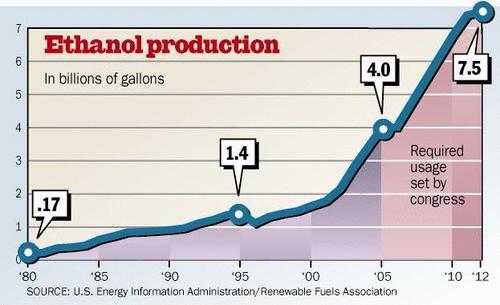
The energy bill signed by that free market capitalist George Bush in 2008 mandates that increasing amounts of corn based ethanol must be used in gasoline sold in the U.S. This energy legislation requires a five-fold increase in ethanol use by 2022. Some 15 billion gallons must come from traditional corn-blended ethanol. Nothing like combining PhD models and political corruption to cause worldwide chaos. Ben Bernanke and Charley Grassley have joined forces to bring down the President of 23 years in Tunisia. People tend to get angry when they are starving. Bringing home the bacon for your constituents has consequences. In the U.S. only about 10% of disposable income is spent on food.  By contrast, in India, about 40% of personal disposable income is spent on food. In the Philippines, it’s about 47.5%.  In some sub-Saharan Africa, consumers spend about 50% of the household budget on food. And according to the U.S.D.A., “In some of the poorest countries in the region such as Madagascar, Tanzania, Sierra Leone, and Zambia, this ratio is more than 60%.”
  

The 107 million tons of grain that went to U.S. ethanol distilleries in 2009 was enough to feed 330 million people for one year at average world consumption levels. More than a quarter of the total U.S. grain crop was turned into ethanol to fuel cars last year. With 200 ethanol distilleries in the country set up to transform food into fuel, the amount of grain processed has tripled since 2004. The government subsidies led to a boom in the building of ethanol plants across the heartland. As usual, when government interferes in the free market, the bust in 2009, when fuel prices collapsed, led to the bankruptcy of almost 20% of the ethanol plants in the U.S.

People fed by US ethanol grain

The amount of grain needed to fill the tank of an SUV with ethanol just once can feed one person for an entire year. The average income of the owners of the world’s 940 million automobiles is at least ten times larger than that of the world’s 2 billion hungriest people. In the competition between cars and hungry people for the world’s harvest, the car is destined to win. In March 2008, a report commissioned by the Coalition for Balanced Food and Fuel Policy  estimated that the bio-fuels mandates passed by Congress cost the U.S. economy more than $100 billion from 2006 to 2009. The report declared that “The policy favoring ethanol and other bio-fuels over food uses of grains and other crops acts as a regressive tax on the poor.” A 2008 Organization for Economic Cooperation and Development (O.E.C.D.) issued its report on bio-fuels that concluded: “Further development and expansion of the bio-fuels sector will contribute to higher food prices over the medium term and to food insecurity for the most vulnerable population groups in developing countries.” These forecasts are coming to fruition today.

It Costs What?


The average American has no clue about the true cost of ethanol. They probably don’t even know there is ethanol mixed in their gasoline. The propaganda spread by the ethanol industry and their mouthpieces in Congress obscures the truth and proclaims the clean energy mistruths and the thousands of jobs created in America. The truth is that producing ethanol uses more energy than is created while driving costs higher. The jobs created in Iowa are offset by the jobs lost because users of energy incur higher costs and hire fewer workers as a result. It takes a lot of Saudi oil to make the fertilizers to grow the corn, to run the tractors, to build the silos, to get the corn to a processing plant, and to run the processing plant. Also, ethanol cannot be moved in pipelines, because it degrades. This means using thousands of big diesel sucking polluting trucks to move the ethanol – first as corn from the fields to the processing plants, and then from the processing plants to the coasts.

The current ethanol subsidy is a flat 45 cents per gallon of ethanol usually paid to the an oil company, that blends ethanol with gasoline. Some States add other incentives, all paid by the taxpayer. On top of this waste of taxpayer funds, the free trade capitalists in Congress slap a 54 cent tariff on all imported ethanol. Ronald R. Cooke, author of Oil, Jihad & Destiny, created the chart below to estimate the true cost for a gallon of corn ethanol. Cooke describes a true taxpayer boondoggle:

It costs money to store, transport and blend ethanol with gasoline. Since ethanol absorbs water, and water is corrosive to pipeline components, it must be transported by tanker to the distribution point where it is blended with gasoline for delivery to your gas station. That’s expensive transportation. It costs more to make a gasoline that can be blended with ethanol. Ethanol is lost through vaporization and contamination during this process. Gasoline/ethanol fuel blends that have been contaminated with water degrade the efficiency of combustion. E-85 ethanol is corrosive to the seals and fuel systems of most of our existing engines (including boats, generators, lawn mowers, hand power tools, etc.), and can not be dispensed through existing gas station pumps. And finally, ethanol has about 30 percent less energy per gallon than gasoline. That means the fuel economy of a vehicle running on E-85 will be about 25% less than a comparable vehicle running on gasoline.

Real Cost For A Gallon Of Corn Ethanol

Corn Ethanol Futures Market quote for January 2011 Delivery $2.46
Add cost of transporting, storing and blending corn ethanol $0.28
Added cost of making gasoline that can be blended with corn ethanol $0.09
Add cost of subsidies paid to blender $0.45
Total Direct Costs per Gallon $3.28
Added cost from waste $0.40
Added cost from damage to infrastructure and user’s engine $0.06
Total Indirect Costs per Gallon $0.46
Added cost of lost energy $1.27
Added cost of food (American family of four) $1.79
Total Social Costs $3.06
Total Cost of Corn Ethanol @ 85% Blend $6.80
Multiple studies by independent non-partisan organizations have concluded that mandating and subsidizing ethanol fuel production is a terrible policy for Americans:
  • In May 2007, the Center for Agricultural and Rural Development at Iowa State University released a report saying the ethanol mandates have increased the food bill for every American by about $47 per year due to grain price increases for corn, soybeans, wheat, and others. The Iowa State researchers concluded that American consumers face a “total cost of ethanol of about $14 billion.” And that figure does not include the cost of federal subsidies to corn growers or the $0.51 per gallon tax credit to ethanol producers.
  • In May 2008, the Congressional Research Service blamed recent increases in global food prices on two factors: increased grain demand for meat production, and the bio-fuels mandates. The agency said that the recent “rapid, ‘permanent’ increase in corn demand has directly sparked substantially higher corn prices to bid available supplies away from other uses – primarily livestock feed. Higher corn prices, in turn, have forced soybean, wheat, and other grain prices higher in a bidding war for available crop land.”
  • Mark W. Rosegrant of the International Food Policy Research Institute, testified before the U.S. Senate on bio-fuels and grain prices. Rosegrant said that the ethanol scam has caused the price of corn to increase by 29 percent, rice to increase by 21 percent and wheat by 22 percent. Rosegrant estimated that if the global bio-fuels mandates were eliminated altogether, corn prices would drop by 20 percent, while sugar and wheat prices would drop by 11 percent and 8 percent, respectively, by 2010. Rosegrant said that “If the current bio-fuel expansion continues, calorie availability in developing countries is expected to grow more slowly; and the number of malnourished children is projected to increase.” He continued, saying “It is therefore important to find ways to keep bio-fuels from worsening the food-price crisis. In the short run, removal of ethanol blending mandates and subsidies and ethanol import tariffs, in the United States—together with removal of policies in Europe promoting bio-fuels—would contribute to lower food prices.”
The true cost of the ethanol boondoggle is hidden from the public. The mandates, subsidies and tariffs take place out of plain view.  The reason blenders (and gas stations) will pay the same for ethanol is because they can sell it at the same price as gasoline to consumers. A consumer will pay the same for ten gallons of E10 as for ten gallons of gasoline even though the E10 contains a gallon of ethanol. Consumers pay the same for the gallon of ethanol for three reasons. (1) They don’t know there’s ethanol in their gasoline. (2) There is often ethanol in all the gasoline because of state requirements, so they have no choice. (3) They never know the ethanol has only 67% the energy of gasoline and gets them only 67% as far. The result is that drivers always pay much more for ethanol energy than for gasoline energy, simply because they pay the same amount per gallon. When gasoline prices are $3.00 per gallon, Joe Six-pack pays $4.50 for the same amount of ethanol energy.

You know a politician, government bureaucrat or central banker is lying when they open their mouths. Whenever evaluating a policy or plan put forth by those in control, always seek out who will benefit and who will suffer. Who benefits from corn based ethanol mandates and subsidies? The beneficiaries are huge corporations like Archer Daniels Midland and Monsanto, along with corporate farming operations (80% of all US farm production), and Big Oil. The mandated ethanol levels are set in law. By providing tax subsidies we are bribing oil companies with taxpayer dollars to do something they are legally required to do, resulting in a $6 billion windfall profit to oil companies.  The other beneficiaries are the Senators and Representatives from the farming states who are bankrolled by the corporate ethanol beneficiaries and their constituents who will re-elect them. The environment does not benefit, as many studies have concluded that it requires more fossil fuel energy (oil & coal) to produce a gallon of ethanol than the energy created. The jobs created in the farm belt at artificially profitable ethanol plants are more than offset by job losses due to the added costs in the rest of the economy. When subsidies are removed or oil prices drop, the ethanol plant jobs disappear, resulting in a massive capital mal-investment.

Our supposedly wise PhD and MBA leaders have created a perfect storm. The unintended consequences of government intervention in the markets are causing havoc, food riots, starvation and intense suffering for the poor and middle class. Brazil produces sugar cane ethanol in vast quantities and can export it to the U.S. much cheaper than we can produce corn ethanol. Fuel prices would be lower without tariffs on Brazilian ethanol imports. 

The average cost of food as a percentage of disposable income for an American is 10%. Averages obscure the truth that the cost is probably .0001% for Lloyd Blankfein, Ben Bernanke and Chuck Grassley, while it is 30% for a poor family in Harlem. America’s horribly misguided ethanol policy combined with Ben Bernanke’s Wall Street banker subsidy program are resulting in soaring fuel and food prices across the globe. Poor people around the world suffer greatly from these policies. Below are two assessments of ethanol.    

 “Everything about ethanol is good, good, good.”Senator Chuck Grassley, Iowa
“This is not just hype — it’s dangerous, delusional bullshit. Ethanol doesn’t burn cleaner than gasoline, nor is it cheaper. Our current ethanol production represents only 3.5 percent of our gasoline consumption — yet it consumes twenty percent of the entire U.S. corn crop, causing the price of corn to double in the last two years and raising the threat of hunger in the Third World.”Jeff Goodell

Who do you believe?

Wednesday, June 2, 2010

The US Is Trying to Escape International Trade Regulation

How the US Is Trying to Escape International Trade Regulation While Brazil Asserts Itself as a Regional Leader

• While pressuring developing countries to adopt pro-trade measures, the U.S. does not enforce its WTO commitment on cotton subsidies.
• By pointing out this problem Brazil asserts itself in the international arena while the voice of African cotton exporting countries is not heard at the WTO.
On April 20th 2010, a Memorandum of Understanding (MoU) was signed between the two largest economies of the Western hemisphere, thus calming a decade-long, sometimes rancorous, dispute involving Washington and Brasilia over the subject of subsidies paid out by the U.S. to its cotton producers. By initiating a U.S.-financed fund, which would be allocated to cotton producers in Brazil and all over the world, this agreement was widely seen as resolving, once and for all, the existing trade tensions between the two countries. But, at the same time, the MoU can be seen in other, less charitable, ways as a token agreement and as a refusal by the U.S. to reform its basic system and to comply with international regulation.
Brazil’s Fight Against US Subsidized Cotton
The cotton industry is a major component of both countries’ agricultural sectors. The U.S. is the third largest producer of cotton in the world, after India and China. Since these two countries do not export the commodity but use it for their domestic clothing industry, the U.S. is the largest exporter of this commodity with 40% of world exports. U.S. cotton production is supported by heavy subsidies, averaging upwards of $3.5 billion per year. This governmental aid measure is seen as an “important safety net” by the National Cotton Council of America; the views of the Brazilian government and numerous developing countries are radically different and tend to be far less serene on the issue. 
Washington’s production support program allows American farmers to produce cotton at a lower cost and, therefore, to sell it at cheaper prices. As a result, the world price of cotton tends to head downward and the share of U.S. cotton exports increases at the expense of producers from developing countries whose governments do not have the resources to offer subsidies. As Environmental Working Group analyst David DeGennaro notes; “for farmers in Sub-Saharan Africa who are subsisting on very little money, a small reduction in price based on American subsidization is a big deal.”
Amongst other allegations, the Brazilian government has accused the U.S. of violating article 13 of the WTO Agreement on Agriculture (AA) regarding subsidy restrictions, since governmental aid to cotton producers in the U.S. has doubled since 1992 (the benchmark year used by the agreement). Brazil also asserted that production flexibility contracts (stipulated by the 1996 Farm Bill) and the direct payments received by producers under the 2002 Farm Bill, were not a form of permissible decoupled income support, since they were based on prices and production and were, therefore, not considered applicable under the reduction commitment guaranteed by the agreement in its annex 2.
An Enduring Dispute at the WTO
The aforementioned allegations and other factors dealing with the $12.9 billion of subsidies handed out by U.S. government authorities between marketing years 1999 and 2002 were lodged by the Brazilian delegation at the WTO on September 27th 2002. Brazil was supported by Argentina, Canada, China, the European Union, India, and Japan; and the panel established by the WTO Dispute Settlement Body (DSB), published a final report in favor of Brasilia in September 2004. Its findings were upheld on appeal on March 3rd of the following year. The U.S. was given until July 1st 2005 to remove the prohibited subsidies which had been established as causing a “serious prejudice” to Brazil and other third party countries.
Despite a few ameliorative steps taken by Washington, such as the suppression of the Step 2 Cotton program, Brazil requested the establishment of another compliance panel that delivered its final report on December 18th 2007. According to this report, the U.S. did not comply with the WTO recommendations. As a result, on August 31st 2009, WTO arbitrators authorized Brazil to retaliate against U.S. goods and services and to use a cross sector retaliation schema. In other words, Brazil was given the right not only to increase its tariffs on incoming U.S. goods but also to retaliate with other means, for instance by violating patents. The cross sector retaliation issue has been at the core of the dispute since tariff retaliation alone is not satisfactory to Brazil, given the fact that the country imports very little raw material from the U.S. and that tariffs on imported goods could lead to unwanted inflation in Brazil. The WTO decision is remarkable since it is the first time that the U.S. has been penalized for its subsidies and because, if Brazil decides to cross-sector retaliate, it would be the first country to do so in the history of the organization.
Recent Threats Made by the Brazilian Chamber of External Trade
As a result of the August 31st rulings, the Brazilian Chamber of External Trade (CAMEX) issued on March 8th 2010 a list of trade sanctions applicable to 102 U.S. products, that was supposed to take effect in early April. The most important tariffs were planned on products made of cotton and industries with an important political component, such as the automobile industry, that could have been subject to a 50% tariff on imports. By targeting these sensitive industries, defended by strong lobbies, the intent of the Brazilian government was, without question, to win the full attention of concerned U.S. officials.
A week later, in another statement, the CAMEX claimed that Brazil could also disregard intellectual property rights on all kinds of U.S. products (from pharmaceuticals to entertainment goods) by suspending its obligations under the Agreement on Trade Related aspects of Intellectual Property Rights (TRIPS), as well as under the General Agreement on Trade and Services (GATS). These two threats were the equivalent to a full scale retaliation amounting to respectively $591 million and $238 million, thus honoring the authorization made by the WTO that gave Brazil the second largest retaliation award since the organization was created.
A Challenge Raised by Brazil to Obama’s “New Export Initiative”
These threats were not likely to be immediately implemented, given the two countries’ interdependence, and, as Brazilian Trade and Development Minister Miguel said; “Brazil is not interested in a trade war. Nobody is. We’re ready to negotiate.” Nevertheless the CAMEX public statement triggered off a certain degree of fear and agitation in Washington. The news came out only a month and a half after President Obama’s 2010 State of the Union address during which he announced his intention to launch a “National Export Initiative” and called this project into question. Obama’s objectives were to double U.S. exports in the next five years in order to save 2 million jobs. The Obama administration intended to do so by relying on a weak dollar and by creating a series of new free trade agreements (such as the ones being negotiated with Panama and Colombia).
U.S. Trade Representative Ron Kirk asserted Washington’s willingness to comply with applicable WTO regulation if no agreement could be found. However, at a time when the U.S. unemployment rate is brushing 10%, Congress is sure to be reluctant to do anything favoring imports that could further worsen the U.S. job market. Furthermore, the upcoming midterm elections would have made it difficult for U.S. congressmen to reduce cotton subsidies, especially in countering the penetrating voice of the National Cotton Council of America. The CAMEX announcement also came in the aftermath of the crisis, at a time when protectionism seems to have come back to life. After a trade contraction of 12% in 2009, these threats raised the fear of a trade war between the major agricultural economies, especially since several analysts foresaw a possible move by China to back Brazil. After the failure of the WTO Doha Development Round, because of the seemingly insoluble disagreement between China, India, and the U.S. on agricultural trade regulation, Brazil wisely and indirectly questioned the quality of U.S. leadership of international trade.
This dispute shows the unfairness and some of the abiding problems within the trading system. On one hand, the U.S. desires developing countries to be bound up with an overwhelming pro-trade legislation, but, on the other hand, it does not itself comply with this same legislation. President Obama’s trade agenda for the year 2009 clearly stated: “This administration reaffirms America’s commitment to a rules-based trading system […] We shall continue this country’s commitment to the WTO’s system of multilateral trading rules and dispute settlement.” But few actions have backed this otherwise muscular statement. As pointed out by trade analyst Daniella Markheim:
“America’s refusal to comply with adverse WTO rulings erodes US credibility and influence in the debate shaping globalization and undermines the multilateral trading system. America can afford either trade retaliation or the loss of its leadership position in international economic issues and the WTO is already weakened by nations’ inability to conclude Doha round trade negotiations. The US should not only change its cotton program this year, but it should also take a hard look at other needed reforms if its national export initiative is to be part of legitimate trade policy.”
Brazil as a Leader in the International Economic Arena
Brazil started to impose itself as a leader of developing countries and of the Cairns group: an association of 19 agricultural exporting countries, by standing out during the London G20 Summit in April 2009, when President Lula forcefully criticized the American and European farm subsidies. The recent threats made by the CAMEX and the cotton dispute in general, are now a further step for Brazil to be asserting its leadership and its role as the voice of agricultural exporting and developing countries during recent international negotiations. Brasilia’s action was backed by the international community and its recent acquisition of $20 billion in IMF bonds, which gave it another claim for more power and enhanced representation in the international economic arena.
The implicit Brazilian threats also appeared when tensions between the two countries were increasing. For instance, after Washington’s near inaction regarding the conservative coup in Honduras, during which President Zelaya was overthrown and had to find refuge in the Brazilian embassy in Tegucigalpa. Lula also asserted his support for Palestine and the Iranian nuclear program; it was clear that Brazil was now prepared to be a more decisive factor in world affairs, even at the risk of alienating the U.S.
The Recent Agreement and Settlement of the Dispute
The April 6th 2010 Memorandum of Understanding planned the establishment of a $147.3 million fund per year for “technical assistance and capacity building related to the cotton industry” in Brazil and in other countries. This fund, financed by U.S. authorities, would remain in place until an agreement has been achieved between Brazil and the U.S, or until the next U.S. farm bill was passed in 2012. The agreement also guaranteed the U.S. recognition of the state of Santa Catarina as free of several animal diseases. In return for this little favor which would buttress Brazilian meat exports, Brazil agreed to refrain from imposing trade sanctions against the U.S. Nevertheless, this agreement has been criticized by many analysts such as David Orden of the International Food Policy Research Institute who claimed that: “Rather than have Brazil retaliate against us, the U.S. has found a way to bribe Brazil, if you will, not to impose that retaliation in exchange for various things the U.S. says it will do” and according to David DeGennaro, “It’s really kind of ridiculous that American taxpayers are going to be subsidizing Brazilian cotton farmers just so that we can keep on subsidizing our own cotton farmer. It’s really a strange situation.”
The just described agreement calmed the situation with its outcome being predictable, mainly because no one would gain from a trade war, and because it is really important for Brazil to protect property rights, in view of its enormous revenue from royalties and other forms of income that could accrue from the 2014 FIFA World cup and the 2016 Olympics Games in the country. But one should recall from this dispute that the failure by the U.S. to reform its trade system and the country’s loss of legitimacy in the trade field when it asks developing countries to adopt pro-trade measures did not win many plaudits for Washington.
One can also anticipate the dire consequences of such a fund on sub-Saharan cotton producers. Even if part of the financial pool is destined to flow to them, the voice of the coalition of Benin, Burkina Faso, Chad and Mali was not being heard at all during the WTO negotiations. Thus one of the organization’s major problems was revealed: the fact that the voice of the understaffed and inexperienced country delegations tend to be almost a non-factor when it comes to cotton pricing. The problem appears even more catastrophic when one learns through Inter Press Service that, “Studies by international organizations show that the total abolition of U.S. subsidies would increase the world cotton price by 14 percent. According to the charity Oxfam, this would translate into additional revenue that could feed one million more children per year, or pay the school fees of two million children in West Africa.”