Showing posts with label record unemployment. Show all posts

Saturday, September 29, 2012

Why Does Our Society Look Down On Unemployed Men So Much?

 September 28th, 2012/TheEconomicCollapseBlog.com

If you are unemployed for an extended period of time, people are going to look at you differently.  Unfortunately, this is especially true if you are a man.  In our society, men are primarily defined by "what they do".  If you have been unemployed for a long period of time, that can make social interactions even more awkward than normal.  Most people will instantly become more uncomfortable around you when they find out that you are unemployed.  Many will look at you with pity, and others will actually look at you with disdain.  Women will not want to date you, and if you are in a relationship unemployment will put a tremendous amount of strain on it.  Once you "don't have a job", you will not get the same level of respect from former co-workers, friends, members of your own family and possibly even your own wife. 

So why does our society look down on unemployed men so much?  Well, it is generally expected that men are supposed to be the "breadwinners" for their families.  If a woman stays home with the kids nobody has any problems with that, but if men do the same thing it tends to raise eyebrows.  But there is a big problem.  Our economy is not producing enough jobs for everyone.  In fact, there are millions upon millions more workers than there are jobs.  It would be great if this was just a temporary situation, but as I have written about previously, there will never be enough jobs in America ever again.  So there will continually be millions upon millions of men that are looked down upon by society because they can't get jobs, and as a result we are going to have millions upon millions of men that are constantly battling against soul-crushing despair.

It can be really hard to "feel like a man" when you aren't making any money.

And most women simply are not interested in becoming romantically involved with an unemployed man.  Just check out what one recent survey found....
Of the 925 single women surveyed, 75 percent said they'd have a problem with dating someone without a job. Only 4 percent of respondents asked whether they would go out with an unemployed man answered "of course."
"Not having a job will definitely make it harder for men to date someone they don't already know," Irene LaCota, a spokesperson for It's Just Lunch, said in a press release. "This is the rare area, compared to other topics we've done surveys on, where women's old-fashioned beliefs about sex roles seem to apply."


Those are some pretty overwhelming numbers.

So is it the same way when the roles are reversed?

Not even close.

When men were asked the same question, the difference was absolutely shocking....
On the other hand, the prospect of dating an unemployed woman was not a problem for nearly two-thirds of men. In fact, 19 percent of men said they had no reservations and 46 percent of men said they were positive they would date an unemployed woman.
Admittedly, men are often thinking about other things when they are evaluating whether they want to date a women or not.  Yes, there are some men these days that are concerned about how much money a woman makes, but the truth is that men tend to be much less concerned about income levels than women are.

In fact, a UK study that was released last year discovered that British women are even more concerned about the education and income of a potential mate than they were back in the 1940s.

So if you are unemployed you are probably not going to find much success in the romance department either.

If you are married, being unemployed is likely to put a huge strain on your marriage.  The following is a short excerpt from a recent Business Insider article entitled "TRUE CONFESSION: I'm Sick Of My Unemployed Husband"....
I can’t even remember when my husband stopped working.
And frankly, I don’t have time to think about it, between my full-time job and my fledgling business, volunteering at an after-school program to help teenagers prepare for the professional world and mothering two children.
But when I do think about it–when I think about all the times I come home to see evidence of his entire day’s activities cluttering the coffee table, or when I have to take our shared car to work and strand him at home because he doesn’t feel like getting up to drive me–I’m angry.
If a husband is unemployed for an extended period of time, there is a very good chance that the wife is going to start feeling very resentful.

If things get bad enough, many women will pull the plug on their marriages and will get rid of their "unproductive" husbands.

Last year, Time Magazine reported on a study that indicated that unemployed men were significantly more likely to get divorced than employed men were.

My goal in writing this is not to "bash women".  I am just pointing out how hard things are for unemployed men in our society.  Many wives (and their extended families) simply do not understand that our economy has fundamentally changed.  In the old days just about any hard working man that wanted a job could go out and get one.  That is most definitely NOT the case today.

Hopefully we can get more women to understand this.  I know that it can be hard to be patient when your husband is unemployed for month after month after month.

But at a time when husbands need their support the most, many wives withdraw emotionally and become very angry.

For example, how many women have you ever heard declare how proud they are of their unemployed husbands?

Of course there are definitely situations where these roles are reversed and employed husbands are badgering their unemployed wives about getting a job, but in general our society tends to have a greater degree of tolerance for unemployed women than it does for unemployed men.

Sadly, most people simply do not understand how dramatically things have changed in our economy.

The following chart shows the stunning decline in the percentage of working age men with a job over the past 60 years....
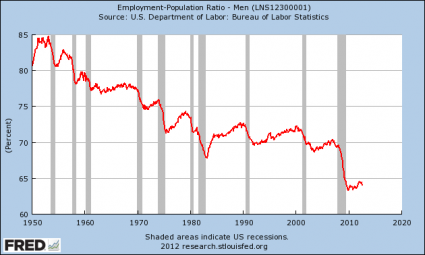


Back in the 1950s, there were times when nearly 85 percent of all working age men had jobs.

We will never get back to anything close to that ever again.

Prior to the last recession, about 70 percent of all working age men were employed.

Since the end of the recession, that number has not gotten back to 65 percent at any point.

That means somewhere around 5 percent of all working age American men have been displaced from the workforce permanently.

The mainstream media would have us believe that we are experiencing an "economic recovery" but that is a massive lie.  The real unemployment numbers are much worse than we have been told.

If you take a look at all working age Americans (men and women), there are actually more than 100 million of them that do not have jobs right now.

I know that statistic can be hard to believe.  I had a hard time believing it at first.  But it is actually true.

Meanwhile, the incomes of those who are working continue to fall.  According to the U.S. Census Bureau, median household income in the United States has fallen for four years in a row.

But this is not a trend that just started recently.  According to one study, between 1969 and 2009 the median wages earned by American men between the ages of 30 and 50 dropped by 27 percent after you account for inflation.

We are in the midst of a long-term economic decline and it is time for all of us to admit how bad things have really gotten.

So what are all of the men who are not working doing these days?

Well, there are some that have chosen to stay at home with the kids.  In a previous article, I discussed how the number of "stay at home dads" has doubled over the past decade.

But the overall percentage of "Mr. Moms" is still very, very low according to Fox News....
There were only about 81,000 Mr. Moms in 2001, or about 1.6 percent of all stay-at-home parents. By last year, the number had climbed to 176,000, or 3.4 percent of stay-at-home parents, according to U.S. Census data.
The vast majority of working age men still want to work outside of the home and earn a living for their families.

Unfortunately, most families need more than one income to make it these days.  In fact, in many cases both parents are working multiple jobs in an attempt to make ends meet.

Meanwhile, the number of good jobs continues to decline and the middle class in America continues to shrink.

This is hitting our young people that are just starting out particularly hard.  For example, during 2011 53 percent of all Americans with a bachelor's degree under the age of 25 were either unemployed or underemployed.

And as I have written about previously, this is resulting in huge numbers of our young people moving back home with Mom and Dad.

This is particularly true when it comes to young men.  According to CNN, American men in the 25 to 34 age bracket are nearly twice as likely to live with their parents as women the same age are....
The number of adult children who live with their parents, especially young males, has soared since the economy started heading south. Among males age 25 to 34, 19% live with their parents today, a 5 percentage point increase from 2005, according to Census data released Thursday. Meanwhile, 10% of women in that age group live at home, up from 8% six years ago.
How are our young men going to be able to get married and start families if they can't find jobs and they are living in our basements?

Sadly, things are really hard for everyone right now.  Since June 2009, we have supposedly been in "the Obama recovery", but median household income in America has fallen during that time period by $3040.

People keep waiting for things to "get better", but it just isn't happening.  This was beautifully illustrated the other night during a Saturday Night Live skit that had "Barack Obama" speaking in front of a rally of unemployed and underemployed workers.  You can find video of that skit right here.

There are millions upon millions of men (and women) all over America that are ready and willing to go back to work.

Sadly, there will never be enough jobs for all of them ever again, and that is not going to change no matter who wins the election.

In fact, when the next wave of the economic collapse hits the United States it is likely that unemployment is going to get a whole lot worse.

What will our society look like when that happens?

Thursday, October 28, 2010

Amidst record unemployment, US companies hoard $1 trillion of cash

(Knowing this, why should employees ever be loyal to their employers after this level of betrayal? Corporate America is evil and serves only the interests of the very rich. It should be destroyed and rebuilt into a system that favors the people.--jef)


Amidst record unemployment, US companies hoard $1 trillion of cash
By Reuters - Wednesday, October 27th, 2010

NEW YORK (Reuters) - U.S. companies are hoarding almost $1 trillion in cash but are unlikely to spend on expanding their business and hiring new employees due to continuing uncertainty about the strength of the economy, Moody's Investors Service said on Tuesday.

As the economy stabilizes companies are also more likely to spend on share repurchases and mergers and acquisitions, Moody's added.

Companies cut costs, reduced investment in plants and equipment and downsized operations in order to boost cash holdings during the recession. As the corporate bond market reopened many companies also boosted cash levels by selling debt and refinancing near-term debt maturities.

The US unemployment rate, meanwhile, sits at a whopping 9.2 percent. (A graph of the unemployment rates state by state can be found here).

Nonfinancial U.S. companies are sitting on $943 billion of cash and short-term investments, as of mid-year 2010, compared with $775 billion at the end of 2008, Moody's said. This would be enough to cover a year's worth of capital spending and dividends and still have $121 billion left over, it said.

However, "we believe companies are looking for greater certainty about the economy and signs of a permanent increase in sales before they let go of their cash hoards, which they suffered so much to build," Moody's said in a report.

"Given low demand and capacity utilization within certain industries, companies are wary of investing their cash in new capacity and adding workers, thereby doing little to abbreviate the jobless recovery," it added.

Around one quarter of the cash is held overseas and is unlikely to be repatriated to the United States, Moody's said.

Meanwhile only 20 companies hold a large portion of corporate cash balances, with $346 billion on their balance sheets, or 37 percent of the total, Moody's said.

Cisco Systems has the largest cash balance, at $39.86 billion, while Microsoft is second with $36.79 billion, Moody's said. Google has the third-largest balance with $30.06 billion, followed by Oracle with $23.64 billion and Ford Motor Co at $21.89 billion.

Technology companies held the most cash as a sector, at $207 billion, followed by pharmaceuticals with $124 billion, energy at $105 billion, and consumer products with $101 billion, Moody's said.

Monday, August 16, 2010

Jobless Millions Signal Death of the American Dream for Many

(See, the American Dream is just that: a dream. Our future is bleak at best because few of us are willing to consider that the trashing of the economy, endless wars, exploitation of the 3rd world, and massive unemployment are all done on purpose with a not-so-pleasant end-result in mind.--jef)

***

by Paul Harris | Sunday, August 15, 2010 by The Guardian/UK

Richard Gaines is one of the best-known faces on Camden's Haddon Avenue. It is a rough-and-tumble street, lined with cheap businesses and boarded-up houses, and is prey to drug gangs. Gaines, 50, runs a barbershop, a hair salon and a fitness business. He works hard and is committed to his community. But Haddon Avenue is not an easy place to make a living in the best of times. And these are far from the best of times.

Just how badly the great recession has struck this fragile New Jersey city, which is currently the poorest in America, was recently spelled out to Gaines. In happier times – whatever that might mean for a city as destitute as Camden – local businesses on Haddon Avenue could at least rely on a bit of trade from those who made their money on the street.

Young men bought flashy clothes and got sharp haircuts and always paid in cash. But no longer. The economy is now so bad in Camden that even the criminals are struggling and going short. "Even the guys who got money from illegal means really don't want to spend it," Gaines said.

Such a development, though, is just a snapshot of the deep problems still hitting the wider American economy. Growth rates are stuttering and a recovery is struggling to take hold. It may even now be showing signs of going backwards again, as countries such as Germany start to power forward. Joblessness has taken hold in America, with the numbers of long-term unemployed reaching levels not seen since the Depression of the 1930s. The figures are frightening and illustrate a society that remains in deep trouble.

The headline jobless figure of 9.5% is bad enough but does not begin to convey the problem as it fails to measure those who have stopped looking for work. Over the past three months alone more than a million Americans have fallen into that category: effectively giving up hope of finding a job and dropping out of the official statistics. Such cases now number some 5.9 million and their ranks are likely to grow as millions more find their jobless status becoming a permanent state of hopelessness. Surveys show that with each passing week on the dole their chances of finding a job get slimmer.

Though corporations, especially in the banking sector, are posting healthy profits, they are not hiring new workers. At the same time, government cuts are sweeping through city and state governments alike, threatening tens of thousands of jobs and slicing away at services once thought vital. Schools, street lighting, libraries, refuse collection, the police, fire services and public transport networks are all being scaled back.

America appears to be a society splitting down the centre, shattering the middle class that long formed the cultural bedrock of the country and dividing it into a country of haves and have-nots. "A once unthinkable level of economic distress is in the process of becoming the new normal," warned Nobel-prize winning economist Paul Krugman in a recent New York Times column. Or, as Steven Green, an economics lecturer at Baylor University, put it to the Observer: "We are really in a tough spot right now."

There is a new name for those falling down the black hole of joblessness that has opened up in America's economy. They are the 99ers.

It is a moniker that no one wants. It refers to the 99 weeks of benefits that the jobless can qualify for in America. Government cash helps those laid off keep a tenuous grip on a normal life. It keeps a roof over their heads, pays a phone bill, puts food on a table and petrol in a car. But once the 99 weeks are up the payments stop – as is happening now for millions of people – and they are 99ers.

For many, that moment, which America's politicians have refused to extend, represents the moment of destitution; a sort of modern American version of the old Victorian trip to the workhouse. There are now more than a million 99ers and the number gets bigger each week.

But who are they? Despite Republican attempts to paint them as feckless or job-shy, they are usually anything but. The 99ers are people like Anne Strauss, 58, who spent 35 years working as a PR professional on Long Island. Despite spending every day hunting for work, she has not had a job since June 2008. She and her husband are now living on credit cards watching debts mount as they stare into the abyss. "Looking for a job is the hardest I have ever worked," she said with a smile that conveyed no humour or happiness, only the deep stress that is common to many 99ers.

Strauss, along with about 50 other 99ers, protested on Wall Street last week, demanding an extension of the benefits that could keep them out of poverty. As bankers and financiers strode into the flag-draped Stock Exchange they chanted: "Shame! Shame!" and told their stories. It was a litany of middle-class lives shattered by the recession. There was Connie Kaplan, a corporate librarian who was desperate to resume her career. "We are not bums, we are hardworking," she said. Or Lori Ghavami, a New Jersey financial analyst in her 30s, who had once worked on Wall Street itself and now was staring at landlords' bills she was scared she could not pay. Or New Yorker Steven Bilarbi, 62, who had worked for the same employer for 37 years, until 2007. He has not worked since, despite refusing to spend daytime hours at home and engaging in a permanent job hunt. He is now living off savings and depleting his pension.

"I go to job fairs. I don't feel like staying home. What would I do? Watch game shows and soap operas?" he fumed.

Meeting 99ers is to tap into a deep well of anger at lives that have been knocked off course, shattering the enduring vision of the American dream that many had felt they had achieved. Just take Donna Faiella, a 53-year-old New Yorker who lives alone in Queens. She spent 28 years working in film post-production and video-editing. She was successful and had a career. Now she is desperate for a job, any job. But she cannot find one. "I will do anything. I will sweep floors. You think I look forward to collecting unemployment? It is fucking degrading," she said, almost quivering with anger.

Faiella is in dire trouble. Joblessness has eaten away at her sense of identity. "I feel like we are worthless. We are lost in the world. I don't know what to call myself. I don't have a title any more. What do we do? What do we do?" she implored. Faiella has one week of benefits to go. Then her 99 weeks will be up. She will have a title again. But not one she expected. She will be a 99er. "I am petrified. Do I become homeless?" she said, adding that she has begun making inquiries at local shelters.

If the 99ers are coming to symbolise a human segment of society that America is slowly abandoning to its fate, then Camden is the geographic expression of that marginalisation. Large stretches of the once bustling river port city seem to epitomise urban blight. Vacant lots and burned-out abandoned houses line many of its streets.

Its 79,000 residents have the lowest median household annual income of any city in the US at just $24,000 (£15,000). In terms of crime rates it was the nation's second-most dangerous city last year. Some estimates reckon that about a third of Camden's houses are empty. A third of its people are in poverty and a fifth are unemployed.

It is a deeply grim picture and it is getting worse. Camden's city government is facing the prospect of massive cuts as its cash-strapped resources have run out and it has built up huge debts. Services have already been cut and only a last-minute rescue last week saved Camden's three public libraries from being closed.

In a city that has had it tough for decades these are hammer blows to its residents. One woman who has watched in dismay as the recession unfolded outside her door is Dorothy Allen, 81, who has lived near Haddon Avenue for almost four decades. Known by almost everyone as "Mom", she calls herself "the mother of the block". She has never known anything like the area's current troubles. "I have been here since 1971 and it's the worst it's ever been," she said. Yet to listen to America's politicians many would think recovery is just a matter of time. Yes, they say, the recession has been hard, but America will pull through and everything will be as it once was. Last week New Jersey senator Robert Menendez visited Camden, stopping at a local health clinic. He spoke of the achievements of the Democrats in staving off economic disaster.

Job creation was coming, he told his audience of health executives: "It is not going fast enough to get people back to work but it's a dramatic turnaround." It does not feel that way for millions of Americans all across the country. Camden is far from unique in slashing its services. In Colorado Springs more than a third of street lights have been switched off to cut the municipal electricity bill. The city has also sold off its police helicopters.

In Hawaii schoolchildren were told to stay at home for 17 Fridays to save costs. In a suburb of Atlanta local bus routes were closed, at a stroke wiping out public transport for thousands of people who relied on it to get to precious jobs.

Whether it's the poor of Camden or Colorado Springs or Atlanta, or among the growing throngs of the 99ers, millions of Americans are discovering that working hard, doing the right thing and obeying the rules are no longer enough.

Back at the 99er rally on Wall Street, Anne Strauss felt that way. During her working life she had refused to claim benefits to which she was entitled as she thought she was doing just fine. Now, as a newly minted 99er, she was looking for help from the country that she had always believed in. But the help was not forthcoming. It is hard to see how the version of the American dream that Menendez described could now ever apply to her. For Strauss, living on credit, desperate to work, but with no job in sight, that dream looks a thing of the past, not the future. "This is not the country I grew up in," Strauss said.

Case study: 'This is my last $260 and barring a miracle I'll be sleeping in my car'

Alexandra Jarrin, 49, worked for a small technology company near New York City, earned $56,000 a year, had petrol in her car and a roof over her head. She was enrolled in a graduate business school. Then, two years ago, she lost her job .

She received her last unemployment payment in March, putting her among the first wave of "99ers" who have come to the end of their 99 weeks of entitlement to benefits. When interviewed by the New York Times, she was living in a motel in Brattleboro, Vermont, having paid $260 she managed to scrape together from friends and from selling her living-room furniture – enough for a week-long stay.

She said she wept as she left her old life. 'I thought, you know, what if I turned the wheel in my car and wrecked my car?' Her vehicle is now on the verge of being repossessed. Jarrin has contacted her local shelter, but was told there was a waiting list. "Barring a miracle, I'm going to be [sleeping] in my car," she said.

Our Only Existing Jobs Program Is the Military

...an Insane Way to Keep Americans Employed
"National security is a cover for job security. This is nuts."
By Robert B. Reich, Robert Reich's Blog
Posted on August 12, 2010

America's biggest -- and only major -- jobs program is the U.S. military.

Over 1,400,000 Americans are now on active duty; another 833,000 are in the reserves, many full time. Another 1,600,000 Americans work in companies that supply the military with everything from weapons to utensils. (I'm not even including all the foreign contractors employing non-US citizens.)

If we didn't have this giant military jobs program, the U.S. unemployment rate would be over 11.5 percent today instead of 9.5 percent.

And without our military jobs program personal incomes would be dropping faster. The Commerce Department reported Monday the only major metro areas where both net earnings and personal incomes rose last year were San Antonio, Texas, Virginia Beach, Virginia, and Washington, D.C. -- because all three have high concentrations of military and federal jobs.

This isn't an argument for more military spending. Just the opposite. Having a giant undercover military jobs program is an insane way to keep Americans employed. It creates jobs we don't need but we keep anyway because there's no honest alternative. We don't have an overt jobs program based on what's really needed.

For example, when Defense Secretary Robert Gates announced Monday his plan to cut spending on military contractors by more than a quarter over three years, congressional leaders balked. Military contractors are major sources of jobs back in members' states and districts. California's Howard P. "Buck" McKeon, the top Republican on the House Armed Services Committee, demanded that the move "not weaken the nation's defense." That's congress-speak for "over my dead body."

Gates simultaneously announced closing the Joint Force Command in Norfolk, Virginia, that employees 6,324 people and relies on 3,300 private contractors. This prompted Virginia Democratic Senator Jim Webb, a member of the Senate Armed Services Committee, to warn that the closure "would be a step backward." Translated: "No chance in hell."

Gates can't even end useless weapons programs. That's because they're covert jobs programs that employ thousands.

He wants to stop production of the C-17 cargo jet he says is no longer needed. But it keeps 4,000 people working at Boeing's Long Beach assembly plant and 30,000 others at Boeing suppliers strategically located in 40 states. So despite Gates's protests the Senate has approved ten new orders.

That's still not enough to keep all those C-17 workers employed, so the Pentagon and Boeing have been hunting for foreign purchasers. The Indian Air Force is now negotiating to buy ten, and talks are underway with several other nations, including Oman and Saudi Arabia.

Ever wonder why military equipment is one of America's biggest exports? It's our giant military jobs program in action.

Gates has also been trying to stop production of a duplicate engine for the F-25 joint Strike Fighter jet. He says it isn't needed and doesn't justify the $2.9 billion slated merely to develop it.

But the unnecessary duplicate engine would bring thousands of jobs to Indiana and Ohio. Cunningly, its potential manufacturers Rolls-Royce and General Electric created a media blitz (mostly aimed at Washington, D.C. where lawmakers wold see it) featuring an engine worker wearing a "Support Our Troops" T-shirt and arguing the duplicate engine will create 4,000 American jobs. Presto. Despite a veto threat from the White House, a House panel has just approved funding the duplicate.

By the way, Gates isn't trying to cut the overall Pentagon budget. He just wants to trim certain programs to make room for more military spending with a higher priority.

The Pentagon's budget -- and its giant undercover jobs program -- keeps expanding. The President has asked Congress to hike total defense spending next year 2.2 percent, to $708 billion. That's 6.1 percent higher than peak defense spending during the Bush administration.

This sum doesn't even include Homeland Security, Veterans Affairs, nuclear weapons management, and intelligence. Add these, and next year's national security budget totals about $950 billion.

That's a major chunk of the entire federal budget. But most deficit hawks don't dare cut it. National security is sacrosanct.

Yet what's really sacrosanct is the giant jobs program that's justified by national security. National security is a cover for job security.

This is nuts.

Wouldn't it be better to have a jobs program that created things we really need -- like light-rail trains, better school facilities, public parks, water and sewer systems, and non-carbon energy sources -- than things we don't, like obsolete weapons systems?

Historically some of America's biggest jobs programs that were critical to the nation's future have been justified by national defense, although they've borne almost no relation to it. The National Defense Education Act of the late 1950s trained a generation of math and science teachers. The National Defense Highway Act created millions of construction jobs turning the nation's two-lane highways into four- and six-lane Interstates.

Maybe this is the way to convince Republicans and blue-dog Democrats to spend more federal dollars putting Americans back, and working on things we genuinely need: Call it the National Defense Full Employment Act.

Friday, August 13, 2010

New claims for unemployment aid reach 484K

New applications for jobless benefits rise to highest since February as layoffs continue
CHRISTOPHER S. RUGABER
AP News | Aug 12, 2010 09:27 EDT

The employment picture is looking bleaker as applications for jobless benefits rose last week to the highest level in almost six months.

It's a sign that hiring is weak and employers are still cutting their staffs.

First-time claims for jobless benefits edged up by 2,000 to a seasonally adjusted 484,000, the Labor Department said Thursday. Analysts had expected a drop. That's the highest total since February.

Initial claims have now risen in three of the last four weeks and are close to their high point for the year of 490,000, reached in late January. The four-week average, which smooths volatility, soared by 14,250 to 473,500, also the highest since late February.

Analysts said that the unexpected rise in claims suggests hiring in August won't be much better than July. The economy added a net 12,000 jobs last month after excluding the loss of temporary census positions.

The jobless claims report "represents a very adverse turn in the labor market, threatening income growth and consumer spending," Pierre Ellis, an economist at Decision Economics, wrote in a note to clients.

The prospect of more layoffs added to this week's grim outlook for the economy, which began Tuesday when the Federal Reserve lowered its assessment of the recovery.

Investors were bracing for another rocky day on Wall Street. Dow Jones industrial average futures, which were down about 50 points before the report came out, fell further. They were down nearly 90 points before the market opened.

Economists closely watch weekly claims, which are considered a gauge of the pace of layoffs and an indication of employers' willingness to hire.

The government's July jobs report, released Friday, showed that the economy lost a net total of 131,000 jobs last month. Excluding the impact of the elimination of 143,000 temporary census jobs, the economy added a meager 12,000 positions, as layoffs by state and local governments almost canceled out weak hiring by businesses.

Thursday's report on jobless claims indicates that trend may not change soon. Claims fell steadily last year from their peak of 651,000, reached in March 2009. But they have mostly leveled out this year at or above 450,000. In a healthy economy with rapid hiring, claims usually drop below 400,000.

The rise in claims could be a sign private employers are ramping up layoffs, which declined as recently as June, according to a separate government report released Wednesday.

Some economists speculate that many census workers whose jobs are finished are requesting unemployment benefits.

Claims could also be rising because of large job cuts by state and local governments, which are struggling with unprecedented budget gaps. State and local governments cut 48,000 jobs in July.

Another possibility is that small companies, facing tight credit, are still reducing their staffs, even as larger corporations slowly resume hiring.

The total number of people receiving benefits dropped 118,000 to 4.45 million, the department said. But that doesn't include another 5.3 million people receiving extended benefits paid for by the federal government, as of the week ending July 24, the latest data available.

During the recession, Congress added up to 73 extra weeks of unemployment benefits, on top of the 26 usually provided by states. That extended program lapsed in early June but was reinstated by Congress last month.

Some companies are still cutting workers. Medical products manufacturer CareFusion Corp. said Wednesday it plans to eliminate 700 jobs, saving the company up to $120 million a year.

99ers Rally For Unemployment Extension

Advocates for the 1.5 Million Americans Who Have Exhausted Unemployment Insurance Benefits Press for Aid from Washington
by Annie Lowery | Friday, August 13, 2010 by The Washington Independent

After 99 weeks, or more, of unemployment, traveling to a political rally is a luxury. Across the country, thousands of 99ers, Americans who have exhausted the maximum weeks of unemployment benefits, have written letters or called Congress advocating for legislation extending benefits or creating jobs programs. But the first 99ers rally, held on Wall Street this Thursday, proved a more modest affair.

Normally, the unemployed suffer from political disenfranchisement, on top of the hardships of joblessness, including loss of income, poorer health outcomes and eroding skills. But a group of activists working online have founded list-servs and websites to connect hundreds of thousands of unemployed workers. And they have teamed up with major labor unions, like the AFL-CIO and the SEIU, to flex their political might. Up until now, their efforts have been virtual; at Thursday's rally, the unemployed took to the streets for the first time.

The rally came at a good time politically. Despite the very long odds of passage, Senate and House Democrats have originated two bills to aid the 99ers in the past 10 days. Sen. Debbie Stabenow (Mich.) introduced a bill moving the maximum number of weeks of federal and state benefits to 119 last week. And this week, Rep. Jim McDermott (Wash.) and Shelley Berkley (Nv.) introduced similar legislation in the House.

But just two dozen or so 99ers and a few dozen more unemployed persons met on the steps of Federal Hall, across from the New York Stock Exchange. (Most of the 99ers or figures in the unemployment netroots I spoke with before the event said that they could not afford the gas or plane ticket to get to the rally.) Members of the Transport Workers Union of America Local 100 and the United Federation of Teachers joined them.

A few hiccups marred the event. The weather hardly cooperated, with spitting rain and punishing heat and humidity. Additionally, the organizers failed to register for a sound permit, so the New York City Policy officers keeping the peace ordered activists to put away the megaphone about 10 minutes into the event.

Organized by the fledgling Unemployed Workers Action Group, the rally called for an expansion of unemployment insurance and jobs programs for the long-term unemployed. There are an estimated 1.5 million 99ers across the country, and their plight results from a recession with not just an unusually high unemployment rate, but an unusually long average duration of unemployment. Indeed, a typical jobless worker - of whom there are 14.6 million - has been out of work for more than 34 weeks, about 8 months, a length unprecedented since the Great Depression.

Despite its small size, the 99ers' rally accomplished an important goal: It got the attention of the press, and advocates for the 99ers see the press as the key to creating pressure for legislation. "Two months ago, nobody knew who the 99ers were," LaDona King, a 99er and major figure in the 99er netroots told me. "Everybody thought it was some city's AAA baseball team."

But with growing awareness, they hope, will come political action. To that end, a volunteer at the rally took journalists' names and numbers, and ensured that any reporter wanting access to a 99er for her story got easy access to several. Late in the event, Ed Schultz - the MSNBC and radio host who has devoted countless programming minutes to the 99ers, and for that reason holds nearly beatific standing among them - stood in a pair of khaki shorts at the back, conducting interviews and shaking hands. (He planned to address the crowd, but could not because of the noise permit issue.)

And with the press there, the 99ers at the rally got their chance to speak, and tell their stories. Betty S. Cohen, of Brooklyn, worked as an administrative assistant at an investment bank - not a commercial bank, she notes - for two years before she was laid off in July 2008. "My skills are excellent," she sighs, "but I can't get a job anywhere." She has applied to hundreds of positions via Monster.com and other online search engines, as well as contacting former employers and friends for leads. "I have gotten five calls, and no offers." she says. "They don't tell you why."

She has long since exhausted any savings, does not have any living family and is increasingly late on her rent and bills, though she says she was recently approved for Supplemental Nutrition Assistance Program, or SNAP, benefits. "A friend loaned me $20," she says. "And I told her I didn't know when I would pay it back. I offered to pay her back in food. I can buy that now, at least."

Marion Glandorf formerly worked for Grenadier Realty Corp. on Roosevelt Island as an executive assistant. She managed contractor relationships for 1,100 apartments, assessed tenant needs and answered scores of calls per day. She came to the rally - she notes she is not a 99er, not yet - wearing a giant sign with her resume on it around her neck.

Joining her was Bob Kohler of Suffolk County, New York. He had worked as an IT project manager before the recession, and has focused on writing motivational works about the power of positive thinking and the need to accept hardship. (He said the angry tone of the rally, with speakers shouting at the nearby investment banks, would prove counterproductive.)

Kohler did not realize his unemployment insurance would run out shortly after Christmas. It just stopped. "It happened abruptly," he said, and his wife and he had not adequately prepared. "The American dream?" he says, softly. "It's decimated."

The rally attempted to capture that sense of decimation, with speakers sharing their stories of hardship - the loss of homes, the loss of respect, the trouble with health, the depression - on the Federal Hall steps, facing the New York Stock Exchange. Some rallied against the banks nearby, but most focused on the need for congressional jobs bills and a Tier V.

Dozens of tourists stopped to listen and to clap in support among the protesters and the camera crews. So did a few investment bankers. "Get a fucking job" shouted one young man dressed, stereotypically, in a dark suit, red tie and loafers, his hair sharply parted. He was booed.

America Enters a New Time

By ALEXANDER COCKBURN

I went to get my hair cut the other day in the town of Fortuna and waited ten minutes when the elderly barber finished buzz-cutting a young Mexican American. After the young man had exited under his thin skullcap of black stubble, Don the barber sighed and said, “That’s the third boy I’ve cut today who’s headed into the Marines. They all say the same thing. “There’s no work around here and I’ve got a family to support.” When I tell them to hold off, they say the same thing: “Too late. I’ve signed up.”

This is Humboldt county, northern California, where the marijuana boom is in its final paroxysms, with people flocking from around the world to get a piece of the action, just like they did in the Gold Rush. One of the many places selling bags of good soil to marijuana growers ($10 a bag, 8 bags to each marijuana plant, grown in a 100 foot x 30 foot plastic greenhouse, $25,000 or so) had a $300,000 day lately. So there’s more money here than most places across America, where the situation is truly desperate.

Profits are up 41 percent since Obama’s election; yet half of American workers have suffered a job loss or a cut in hours or wages over the past 30 months. They’re saying around 28 million people either have no job or one that doesn’t yield them enough money to get through the week. On Friday, August 13, the Bureau of Labor Statistic noted on its home page that “Employers initiated 1,851 mass layoff events in the second quarter of 2010 that resulted in the separation of 338,064 workers from their jobs for at least 31 days.”

Millions are plummeting into total destitution, having reached the end of their 99-weeks of unemployment benefits. Their only option then is the soup line at a church and getting on he waiting list for a shelter. The nearest big city north of me is Portland, Oregon, adjacent to the CounterPunch co-editor bunker in Oregon City of Jeffrey St Clair. The downtown area in Portland is filled with homeless people, napping on steps, bedding down on cardboard in doorways. Jeffrey kayaks frequently down the Willamette and can see colonies of the destitute all along the river bank, from North Portland to Willamette Falls, sleeping under thin plastic and grey skies.

California agriculture and much of the construction industry depends on undocumented workers coming across the border from Mexico – minimum cost $1000 – for an 8-day walk through the Arizona desert. Since building is in a terminal slump, many Mexicans would like to head back home till times improve, but nowadays it’s so tough to come back across, that they daren’t risk it. Hence the paradox: trying to lock “illegals” out means locking them in. Frank Bardacke who lives in the farm town of Watsonville, a couple of hours south of San Francisco, recently described amid an important piece in our newsletter a bank robbery by one young, desperate immigrant.

“Several months ago," Frank writes, “Jario took his father’s pickup truck, drove 20 miles to the upscale tourist playpen Carmel By the Sea, and walked into the local branch of the Bank of America. He waited in line to see a teller, and, when his turn came, he pretended to have a gun under his shirt and quietly demanded that the teller give him her cash. As she was passing out the money, he apologized for frightening her; meanwhile, she was hiding a GPS device among the bills.

“He left the bank, his crime apparently unnoticed, and returned to the truck for the drive home. On the way, he got confused and took a wrong turn through Monterey before he got back on the right road home. Twenty police cars from four different police jurisdictions followed the GPS signal and stopped him 45 minutes after he left the bank. He immediately confessed, explaining that he needed the money to help his dad pay the family mortgage. When his case came to trial, the DA pressed for two years in State Prison. The judge decided that six months in the county jail and five years probation would be enough.”

In Texas or anywhere in the South the fellow would probably have got 25 years. But in desperate times one can expect people to do desperate, stupid things, and this decent judge showed compassion and understanding. One can’t say the same for many Americans, starting with the Republicans in Congress who’ve been happily voting for a cut-off in benefits for the jobless, while simultaneously engaging in the politically insane enterprise of repealing the 14th Amendment, no longer making it a constitutional provision that those “born or naturalized in the United States and subject to the jurisdiction thereof, are citizens of the United States.” Do the Republicans want to cede Texas and Florida permanently to the Democrats?

Conspicuous good works are always a feature of Depression, the rich zealous to purchase moral insurance. Some billionaires, led by Warren Buffett and Bill Gates, have been pledging that they will earmark not less than 50 per cent of their personal wealth for charity. But since whatever they give away is tax deductible, so revenues to Uncle Sam will drop.

The rich don’t get to be rich by being the nicest guys in the shark tank. As Carl Ginsburg recently remarked in a fine piece on this site , “In its fledgling years, profits on Bill Gates’ software were reportedly 70 per cent annually. Another way to gauge Gates’s billions is by catching a glimpse of the multitudes of students priced out of the computer market – thanks in part to that Great Giver’s expensive software – lined up daily at community college libraries for some free access to computers, each machine an expression of Gates’ creative commitment to profit in the +40 percent range – a gift Gates gave himself that keeps on giving. As Gates told Fortune: ‘The diversity of American giving is part of its beauty.’”

We can probably expect more laid-off workers going postal, as David Rosen discussed here on our site last week On August 3, at seven am, Omar Thornton showed up for a disciplinary hearing at the Hartford Distributors, a Budweiser distribution warehouse in Manchester, Connecticut. Thornton had been caught on video pinching some beer. They asked him whether he wanted to be fired, or just quit. Thornton pulled out a handgun and killed seven fellow employees before shooting himself dead. Before he loosed off his last shot into his head, Thornton, a black man, called a friend on his cellphone and said he’s taken care of some racists who’d been giving him a hard time. Unemployment means fear and fear nourishes racism, all the more because we have a black president. Racism is drifting across America like mustard gas in the trenches in World War One.

And, final token of hard times, we have Bonnie and Clyde on the run. In their latest guise the duo consists of John McCluskey and his cousin and fiancee, Casslyn Welch, who’s no Faye Dunaway. She threw some wire cutters over the fence of her man’s Arizona prison. Cops suspect them of killing a couple of retirees, then stealing their truck and heading north up to the Canadian line through GlacierNational Park. That’s the last sanctuary in America of Ursus horribilis, the American grizzly. Behind them the cops, ahead the bears. It could be the first movie of a new time.

Tuesday, July 20, 2010

Economic Pain

By Michael Snyder Published 07-20-2010

For decades, most Americans have enjoyed an extremely high standard of living.  In fact, most of us have been "enjoying the high life" and "living the dream" for so long that we have assumed that it is just always going to be that way.  But now a rapidly growing percentage of Americans is getting the chance to experience some very serious economic pain.  Today, over 40 million Americans are on food stamps and over 20 million U.S. children are living in poverty.  Tens of millions of Americans are unemployed, and personal bankruptcies and foreclosures continue to set all-time records.  For many people, all of this economic turmoil was completely unexpected.  Millions of people now can't sleep at night because they are constantly stressed about finances.  More couples than ever are being torn about by arguments over money.  Unprecedented numbers of Americans have experienced a sinking feeling in the pit of their stomachs upon the realization that they are going to lose the homes that they have been raising their families in.  Money may not buy happiness, but as tens of millions of Americans are finding out, the lack of it can bring a whole lot of pain.

Now, the truth is that there have always been a small percentage of Americans that have struggled to get by, but today we are seeing more Americans who are "down on their luck" than at any other time in recent memory.  According to one shocking new survey, 28% of all U.S. households have at least one member that is looking for a full-time job.

It seems like almost everyone has a family member or a close friend who is looking for a job.  The truth is that there are not enough jobs for everyone, and there certainly are not nearly enough good jobs.

A recent Pew Research survey found that 55 percent of the U.S. labor force has experienced either unemployment, a pay decrease, a reduction in hours or an involuntary move to part-time work since the recession began.

55 percent?

That is incredible.

That means that over half of all American workers have been unemployed or have been forced to take a reduction in pay since the recession started.

Things are getting really tough out there.

Millions of Americans are wondering why their husbands or wives suddenly can't find jobs.

In fact, the average duration of unemployment in the United States has risen to an all-time high.  The declining economy has created a new class of chronically unemployed Americans who would love to work but can't seem to find anyone to hire them.

Millions of Americans have been forced to turn to part-time work.  In fact, one recent survey found that approximately 8.6 million American workers are working part timebecause they can't get full-time jobs.
In this economic environment, there is significant competition for even the lowest paying jobs.

You never know - this holiday season the friendly gentleman greeting you down at the local Wal-Mart may actually have several advanced degrees but just cannot find anyone else who will hire him.

As the economic situation continues to deteriorate, record numbers of Americans are going bankrupt and are losing their homes.  In fact, banks repossessed a record number of U.S. homes during the second quarter of 2010.

So it is really no wonder why so many Americans are feeling so negative about the economy.
According to one new survey, U.S. consumer sentiment weakened in early July to its lowest in 11 months.  In addition, one recent poll found that 76 percent of Americansbelieve that the U.S. economy is still in a recession.

But sometimes what gets lost in all the numbers are the individual stories of the very real pain that so many Americans are going through.  Today, I thought that I would share just a few of the stories of economic pain that my readers have been sharing with me.

A reader of my column on The American Dream blog named Kate recently graduated from college but now finds that she can't even get a retail job....
I just graduated college in May… Moved to a new state and am now living with my boyfriend who should not and cannot continue to have to pay everything because i just plain can’t get a job.
I’m over qualified for retail survivor jobs… so I lie on my application. But then retail stores just plain don’t hire full time. So even if I could get a job as a cashier someplace… I’d only work enough hours to maybe pay for my car payment/ car insurance/ gas…. and my half of rent/electric and such is out of the question… not to mention charged to the limit credit cards from being unemployed and student loans that will hit in just a matter of months.
Any other jobs either don’t exist or they just ALL want 5 years professional experience…. which is impossible for someone who just graduated and has been working part time retail jobs since high school.
AND internships are unpaid or only for college students so thats out of the question….
But the fact of the matter is that jobs don’t care about education in the least bit if you don’t have the real professional work experience to back it up.
A reader of this column named David ended up taking a very low paying job overseas because he simply couldn't find anything here in the United States....
I have been looking for a job since June 2009. I am a prior Army officer who knows four foreign languages and has lived around the world. I have sent out over 100 resumes over the past year. Finally, I got a job offer to teach English in Russia for $720 per month. Yes, $720 per month. Luckily my housing is paid for. So, I took my tax return and left for Russia to teach English. The American economy is broken and it will get worse. We are in the early stages of a total meltdown in America. Yes, if you are an American, you better prepare yourself for the worst is still to come.
But even those who do have jobs are facing some very difficult circumstances as one of my readers named Ana recently described....
I am a cop’s wife. My husband currently works for a Sheriff’s office who is extremely understaffed and the county wastes money like there is no tomorrow. They threaten the Sheriff with more layoffs if they don’t write more tickets on the highway. My husband has often had to patrol the entire county by himself for a full 12 hour shift. It is a bad situation for everyone.
The truth is that there are millions of stories like the ones above.  Economic pain is everywhere, and the American people are becoming increasingly frustrated.  Most Americans don't understand why the economy is suddenly in the toilet - all most of them know is that things are broken and they desperately want someone to fix things.

A lot of this frustration is coming out as anger towards the government.  People are waking up and are starting to realize that the American ruling class has been doing an incredibly bad job of running things.  The American people are hungry for a real change.  In fact, a new Rasmussen Reports national telephone survey found that just 23% of voters nationwide believe that the U.S. government has the consent of the governed.

But will we start to see some real changes in the years ahead?

Unfortunately, that is quite doubtful.  The reality is that the American ruling class has a stranglehold on both political parties, and they are not going to release their grip easily.

Meanwhile, our leaders continue to perpetuate the same failed policies that got us into this mess in the first place.  But unless some fundamental changes are made soon, the economic pain that Americans are experiencing is going to continue to get even worse.

Wednesday, June 2, 2010

Calif. jobless claims at record high

June 1st, 2010, 1:00 am ·  by Mary Ann Milbourn
Unemployment claims in California hit 768,709 in April, a modern-day record and the highest during this recession, state Employment Development Department officials report.
The number comes after the U.S. Senate went into its Memorial Day recess without acting on a bill that would allow at least the more recently unemployed to continue to get extended jobless benefits.
Just two years ago in April — a year into California's recession — the unemployed filed 254,123 claims for benefits, EDD stats show. This April, that number more than tripled as the state remained at a record 12.6% unemployment rate, third highest in the country.


Claims are piling up in large part because Congress has approved four extensions of  the typical 26 weeks of unemployment in addition to so-called Fed-Ed for high unemployment states like California. Many of those laid off in California can now receive up to 99 weeks in benefits.
Those extensions, however, are up in the air after Congress recessed May 28 before the Senate could approve legislation allowing the more recently unemployed to continue to move into their next tier of jobless benefits until at least Nov. 30.  The Senate is due back June 7. If the bill is not approved, most of the unemployed will lose their benefits after completing their current tier of extended unemployment.
In addition, the latest bill drops the 65% subsidy for COBRA health insurance premiums that the government has been supplementing for the past year.
The latest bill also does nothing for the more than 111,000 Californians who have exhausted their 99 weeks of benefits.  Change. org has launched a grass roots campaign for the so-called "99ers" to get additional benefits for those who have now fallen off the unemployment rolls after exhausting their 99 weeks.
However, Republicans and a growing number of conservative Democrats are balking at granting what are already nearly two years of unemployment benefits at a time when the nation is running up record deficits. Many in the anti-extension camp believe that 99 weeks should be enough to find a job and continued unemployment benefits simply encourage people to stay on government aid rather than take any work that may be available.
Because the political situation in Washington is so up in the air, California's EDD is now advising the unemployed that their extended benefits may be delayed if the Senate does not act quickly when it returns June 7.