Showing posts with label World Trade Organization (WTO). Show all posts

Wednesday, October 5, 2011

Free Trade Is Ravaging National Economies

by: Thom Hartmann, Berrett-Koehler Publishers
Tuesday 4 October 2011
In the great days of the USA, Henry Ford stated that he wanted to pay high wages to his employees so that they could become his customers and buy his cars. Today we are proud of the fact that we pay low wages. We have forgotten that the economy is a tool to serve the needs of society, and not the reverse. The ultimate purpose of the economy is to create prosperity with stability.
—Billionaire speculator Sir James Goldsmith, 1993 1


Equal trade, fair trade, honest, decent trade requires reasonable balance between trading partners and strong domestic economies. When that happens, Adam Smith’s model works pretty well: prices for labor, materials, and finished goods all settle near the area where they “naturally” should be.

But as we’ve seen from the immensely imbalanced statistics on distribution of wealth, something is not working the way Smith envisioned. Wages appear to be dwindling, and the number of strong, healthy competitors appears to be shrinking.

Watch: Free Trade - POOF goes the Money & the Stimulus

Teddy Roosevelt Weighs In
President Theodore Roosevelt brilliantly defined the American Dream in the context of the dynamic difference between a business that is a builder of community and one that hollows out community. “We are a business people,” Roosevelt said at the Ohio Constitutional Convention in Columbus in 1912.
The tillers of the soil, the wage workers, the business men—these are the three big and vitally important divisions of our population. The welfare of each division is vitally necessary to the welfare of the people as a whole.
The great mass of business is of course done by men whose business is either small or of moderate size.
The middle-sized business men form an element of strength which is of literally incalculable value to the nation. Taken as a class, they are among our best citizens. They have not been seekers after enormous fortunes; they have been moderately and justly prosperous, by reason of dealing fairly with their customers, competitors, and employees. They are satisfied with a legitimate profit that will pay their expenses of living and lay by something for those who come after, and the additional amount necessary for the betterment and improvement of their plant.
The average business man of this type is, as a rule, a leading citizen of his community, foremost in everything that tells for its betterment, a man whom his neighbors look up to and respect; he is in no sense dangerous to his community, just because he is an integral part of his community, bone of its bone and flesh of its flesh. His life fibers are intertwined with the life fibers of his fellow citizens...
So much for the small business man and the middle-sized business man. Now for big business.
It is imperative to exercise over big business a control and supervision which is unnecessary as regards small business. All business must be conducted under the law, and all business men, big or little, must act justly....“Big business” in the past has been responsible for much of the special privilege which must be unsparingly cut out of our national life.
I do not believe in making mere size of and by itself criminal.
The mere fact of size, however, does unquestionably carry the potentiality of such grave wrongdoing that there should be by law provision made for the strict supervision and regulation of these great industrial concerns doing an interstate business, much as we now regulate the transportation agencies which are engaged in interstate business. The antitrust law does good in so far as it can be invoked against combinations which really are monopolies or which restrict production or which artificially raise prices....
The important thing is this: that, under such government recognition as we may give to that which is beneficent and wholesome in large business organizations, we shall be most vigilant never to allow them to crystallize into a condition which shall make private initiative difficult.
It is of the utmost importance that in the future we shall keep the broad path of opportunity just as open and easy for our children as it was for our fathers during the period which has been the glory of America’s industrial history— that it shall be not only possible but easy for an ambitious man, whose character has so impressed itself upon his neighbors that they are willing to give him capital and credit, to start in business for himself, and, if his superior efficiency deserves it, to triumph over the biggest organization that may happen to exist in his particular field.
Whatever practices upon the part of large combinations may threaten to discourage such a man, or deny to him that which in the judgment of the community is a square deal, should be specifically defined by the statutes as crimes. And in every case the individual corporation officer responsible for such unfair dealing should be punished.
We grudge no man a fortune which represents his own power and sagacity exercised with entire regard to the welfare of his fellows. We have only praise for the business man whose business success comes as an incident to doing good work for his fellows. But we should so shape conditions that a fortune shall be obtained only in honorable fashion, in such fashion that its gaining represents benefit to the community....
We stand for the rights of property, but we stand even more for the rights of man.
We will protect the rights of the wealthy man, but we maintain that he holds his wealth subject to the general right of the community to regulate its business use as the public welfare requires.2
In this speech Roosevelt identified the key distinction and pointed directly to the situation the world finds itself in now.

Corporations have become so large and powerful that We the People— citizens and their governments around the world—no longer have the ability to control or restrain corporate misbehavior when it endangers the common good. And so we have epidemics of cancer, acid rain, ozone holes, and massive species die-offs as multinational corporations roam the world, strip-mining it for human labor, minerals, fossil fuels, and the fragile remaining bounty of its forests and oceans.

The ultimate in unequal trade has ensued from increasing corporate influence. Very large corporations—Roosevelt’s “big businesses”—have now become able to sue an entire nation, in a court that they, the companies, lob- bied to create, and can overturn the laws of independent nations with virtually no appeal. And unlike any court in the civilized world, this court is as secret, private, and difficult to appeal to as any military tribunal.

Free Trade Ravages National Economies
Free trade is a phrase behind which multinational corporations have essentially strip-mined both the developed and the developing world. That’s strong language, but the metaphor holds up under examination. In strip-mining, a company comes in, strips off anything necessary to get at what it wants, and leaves. Similarly, the developing world is being mined for its resources, including human labor. At the same time, the already-developed world is being mined for its wealth, as its middle class and working poor sink farther into debt while multinational corporations become richer than any historic kingdom the planet has ever seen.

To understand what we can do about this, we first need to understand the mechanism. And there most definitely is a mechanism. When properly executed, it works quite reliably.3
Every product from shoes to nails to computers requires some human labor to manufacture. This can be done under working conditions that are safe and comfortable (or unsafe and uncomfortable) and using chemicals, techniques, and energy from toxic or safe/renewable sources.

For the cost of one American or European or Australian laborer, a company can hire between fifteen and fifty laborers in a developing country; and as an added bonus, the company can go back to using toxic chemicals banned in the United States over the past fifty years and buying cheap electricity from coal-fired power plants that would be illegal in this country. And when workers are injured or die, there’s virtually no cost to the company.

Thus as transnational corporate lobbying succeeded in bringing about a “flat” world opened for free trade, about 4 billion people suddenly came into the same labor market that was once a protected space occupied by about a half-billion, and the other costs of manufacturing fell through the floor.

The first result of this was that companies that moved manufacturing from the developed world to the developing world were able to decrease labor and externality costs and increase earnings (profits). As companies used this principle to their advantage and built empires in industries from shoes to retailing by selling products made in low-labor-cost nations into the retail channels of the high-labor-cost nations, it seemed like it was a good thing (it was certainly promoted as a good thing!). Cheaper products were available in the wealthy nations, jobs were created in the poorer nations, and the people who made it all happen got rich.

But there were complications.
  • If an American company wanted to compete with the one that had gone offshore for labor or to avoid environmental regulations, it faced only two choices: shut its domestic factories and move manufacturing offshore, or go out of business. The result—on a vast scale—has been that the larger companies have moved offshore and the smaller companies that lacked the resources to do that have gone out of business. The number of competitors has dwindled, and markets have become concentrated in fewer and fewer hands.
  • As a consequence well-paying manufacturing jobs in the developed world have evaporated at a startling pace. This echoes all the way up from the local level, through state and national economies, finally showing up as a general lowering of the standard of living in the developed world. Wages drop, benefits vanish, jobs become scarce, and people become insecure.
  • Along with the economic changes come social changes. The worst of it shows up at the bottom first—the number of people in prison explodes, as do other negative social indicators. Antidepressant drug use goes up, suicide goes up (particularly among teenagers, who are developmentally most fragile and are watching their future earnings prospects evaporate), and spouses and even children go to work to help support the household. Debt goes up as the society becomes progressively poorer.
  • Wealthy nations respond to the offshore challenge by trying to be competitive, which means further lowering wages and benefits. Companies may even cut promised benefits to their longtime employees who have already retired. But even if the local company cuts wages in half (doing enormous damage to the local economy), a transnational corporation is still able to hire a dozen or more workers for the same job in a poor nation. Consequently, the race to the bottom gathers momentum—the bottom is where more than 6 billion people compete for the same work that was, until recently, performed in a tariff-protected economy of 1 billion people (the developed world). Resources won’t stretch that far. The bottom is worldwide poverty supervised by a wealthy few, also known as feudalism.
  • In the developing nations where these “new jobs are created,” people who have been doing traditional farming leave the land for the sweat-shops, and the land is turned over to intensive corporate agriculture. People who in previous generations were independent, self-sufficient farmers become urban slum-dwellers, the working poor, dependent on agribusiness and supermarkets for their food.
  • When the new sweatshop nation’s urban working poor begin demanding higher wages and benefits, clean air and water, and a safe workplace, the corporations move to another country where labor is cheaper and regulations are looser. It happened in the 1990s when a mass exodus of multinational corporations left Korea, Taiwan, and Thailand for the ultracheap labor of Vietnam, Myanmar (Burma), and China, shattering the economies of those former “Asian tigers.”* Poverty explodes as slums overflow with crime, drugs, and prostitution—the symptoms of desperate people seeking some sort of income when the real jobs are gone. It is just like strip-mining, and it’s a sign of the worst sort of corporate citizen—one without the slightest concern for the impact it has.
  • In the process the multinational corporations become richer, moving their “mining” activities from one nation to another as profits dictate. As multinational corporate wealth increases, stock prices go up and the top few percent of the socioeconomic pyramid become wealthier. Nations learn to watch the stock market, thinking—in complete error— that it is an accurate indicator of the nation’s wealth and economic health. In fact, from the Dutch tulip market collapse in 1637 to the U.S. stock market rises and crashes of 1929 and 2008, rapidly increasing markets have historically been indicators of an economy on the edge of implosion or undergoing radical social transformation.
As Sir James Goldsmith suggested in the epigraph of this chapter, we have forgotten that the purpose of economies—the whole reason why humans began trading with each other from the earliest days—was to provide for social stability. Your country makes good cheese, we make good clothing, another country makes good wine: let’s all trade these products with one another so all three of us can enjoy good cheese, clothing, and wine.

But in a “flat” free-trade world dominated by corporate values instead of human values, social stability is not a consideration unless or until it affects profits. This is the lesson of unequal values. And when a country becomes socially unstable, rather than working to restore the stability of the nation, multinationals simply leave town and go somewhere else, as Asian nations learned in the 1990s and Argentina learned in 2002.

This is not a new model, by the way. It’s how the East India Company treated India, the early American colonies, and numerous smaller countries that it considered its property. It reflects the mentality not of communities but of pirates, a mentality that gives birth to phrases like robber baron, corporate raider, and private equity.

Herman Daly and Robert Goodland used to work at the World Bank. They didn’t like what they saw. Consider this prophetic 1992 comment, two years before GATT was approved:
If by wise policy or blind luck, a country has managed to control its population growth, provide social insurance, high wages, reasonable working hours and other benefits to its working class (i.e., most of its citizens), should it allow these benefits to be competed down to the world average by unregulated trade?...
This leveling of wages will be overwhelmingly downward due to the vast number and rapid growth rate of under-employed populations in the third world. Northern laborers will get poorer, while Southern laborers will stay much the same.4
And this is exactly what we have seen happening.

The Corrective, Balancing Power of Tariffs
Historically, nations used tariffs—taxes on imported goods—to equalize differences between nations. Expensive-labor nations would charge tariffs on imported goods that were labor-intensive in their manufacture, to protect their domestic industries. Nations that wanted to protect unique natural resources or strategic products would use import/export policy to ensure their long-term survival and wise use. Trade was possible—it’s always happened among nations—but it was fair trade, fair to the humans in the trading nations and in the interest of the nations themselves.

Now multinational corporations have finally succeeded in freeing themselves from the constraints of social commitment to any nation whatsoever.

In the absence of tariffs and self-interested national trade policies, they are free to roam anywhere on a moment’s notice, looking for minerals, rain forests, and cheap labor. And because increasingly all money flows through them, they have essentially infinite power in all negotiations.

Finally, in a replay of events on American shores, they have in some cases taken roles in governments around the world. More than 150 countries have joined the WTO, and the giant transnational corporations are now dangling the carrot of cash to the leaders of the poorer nations. We’ve seen this movie before; it’s easy to tell what happens next. These governments readily comply, join the WTO, and subscribe to free trade. But what they get may not be quite what they bargained for. That’s what happened to no less a power than America.

How US Legislators React
The world’s largest transnational corporations are among the biggest contributors to politicians in America, and most members of Congress have supported the WTO even if they get a bit testy when the Dispute Resolution Panels rule against their favorite legislation. One good example comes from a speech to Congress by Representative John D. Dingell of Michigan on June 21, 2000:
Our major trading partners, including Japan, Korea, and the EU [European Union nations], have turned the WTO dispute settlement process into a de facto appeals court that reviews U.S. trade agency determinations and strikes down our trade laws. Japan and Korea have gone so far as to say they will launch WTO appeals of every U.S. trade determination that is adverse to their interests. Already, WTO decisions are gutting the effectiveness of U.S. trade remedies in ways that the Administration and Congress expressly rejected during the negotiations on the agreement establishing the WTO.
Increasingly, both governments and citizens of nations all over the world are expressing concern about the WTO’s process of leveling the corporate playing field across 153 member nations. Corporations manufacturing and exporting from countries that have lax or minimal environmental and labor laws are aggressively challenging and striking down the stronger laws passed in more-developed nations.

Countries with laws that banned the import or marketing of products they consider dangerous to their citizens are finding those laws struck down because other countries with weaker laws can now, to some extent, define the standard to which every WTO-member nation must be held accountable. They do this through WTO’s primary trade-law model, which says that a country cannot ban the import of a product because of how or with what type of labor it was produced.

Overturning Our Laws
Thus it’s now largely illegal to ban the import of products made by slaves or under inhumane conditions or made with chemicals that poisoned the local environment. This has sparked an explosion of industrial activity in labor-cheap and environmentally lax nations. At the same time, the industrial core of more-developed nations with higher labor and environmental standards has been hollowed out in just the past few decades, leaving vast landscapes of abandoned factories and a populace increasingly on edge about employment security.

In a developing nation where there is little or no cost or penalty to dump-ing toxins into the air or water, manufacturing is vastly more profitable than in a developed nation where toxins must be captured, stored, tracked, and cleanly disposed of in environmentally responsible ways. In the developed world, we have minimum-wage laws, laws regarding the maximum hours that may be worked per week, and safety and environmental laws. In the past, if an offshore product wasn’t made in ways we approved, we either banned its import or added taxes or tariffs to give our cleaner domestic companies a competitively level playing field.

For example, say there’s an hour’s work in the manufacture of a pair of American-made shoes. In the United States, that hour costs $12.77, including benefits and overhead.5 That same labor may be 10 cents an hour in Malaysia. So for the past century or so, the United States would have added a tariff, or tax, of $12.67 on any shoe imported from Malaysia that had an hour’s labor in it. That way U.S. shoe manufacturers could stay in business. It would level the playing field between the two cultures and nations, thus providing for fair trade.
 
Nations have often used tariffs to discourage manufacturing operations from moving their factories and jobs to less regulated nations.

But according to WTO, those tariffs are considered “restraint of free trade.” It’s illegal under WTO rules to consider how or who makes a product or at what level of pay it is manufactured. The loss of jobs to offshore began decades ago, but the elimination of tariffs during the Reagan and Clinton administrations accelerated it markedly. In the past few decades, more than 20 million Americans in labor-intensive industries have lost their jobs.

The other upshot of this is a dramatic increase in people around the world who are working either as overt slaves or at a wage rate that makes them virtual slaves in dangerous and toxic workplaces and living in an environment of company stores and company housing.

The developed world, and particularly the United States, at first appeared to have benefited from this. It allows our consumer-based economy to continue to hum, with low inflation and rising profits, just as the American South benefited so much from cheap slave labor before the Civil War. But at best this was a short-term benefit.

The “New World Order”
In most nations of the world today, there are basically two types of political parties. Those two parties stand on either side of a nearly invisible line—one party huge and imposing and the other thin and sickly, a political sumo wrestler pitted against an aging and infirm Woody Allen. The parties, regardless of local labels, are “We Who Represent the Interests of Multinational Corporations” and “We Who Represent the Interests of Human Beings.” The first group has gotten laws passed that allow the easy movement of capital from nation to nation under rules far different and more relaxed than those for humans.

In the United States and most other developed nations, most of the distinctions between politicians are becoming increasingly blurred, and in many nations all the local politicians have joined the parties of the corporations. Those parties and politicians that exist to represent the interests of human beings have been marginalized or overwhelmed by the parties and politicians that exist to represent the interests of the corporations. The reason for this is simple: most of the world has followed our lead regarding “free speech” campaign contributions.

After the end of apartheid in South Africa, American corporations donated the services of corporate lawyers to help draft the new South African constitution. Pointing to the 1886 Santa Clara case, they essentially said that in America corporations have the same constitutional status as humans, so you should write this into your constitution, too.

South Africa did that, as have many other countries that have emerged or developed or separated from the former Soviet Union. It’s a challenge to find the details and the statistics, and I’m hopeful that this book may spur somebody to do that hard, nation-by-nation, language-by-language research, but it appears that many of the countries of the world have written corporations-as-persons into their constitutions or laws, thinking that they were following the original intent of the Framers of the U.S. Constitution, which, of course, is not the case.

The result is that corporations have functionally taken control of governments the world over, particularly through their participation in the funding of the electoral process. Thus, corporations have become the honey pot from which many politicians and political parties draw their nourishment.

In a Democracy...
In the 1996 election cycle in the United States, 96 percent of Americans didn’t make any direct contribution whatsoever to a politician or political party, and fewer than one-quarter of 1 percent of Americans gave more than $200. By contrast, each of America’s top five hundred corporations gave more than $0.5 million to the Democrats and the Republicans during the decade preceding the 1996 elections.

In the 1998 election cycle, which was not even a presidential election year, those corporations contributed $660 million to candidates, while the last remaining organized groups that represent workers—unions, which are not considered persons in the United States and most other countries but are instead regulated as artificial persons—were able to pony up only $60 million in campaign contributions raised from their members.

Unions have to operate under the same types of rules and laws that corporations did before 1886, and, in fact, additional restrictions have been placed on them since then. So-called “paycheck protection” legislation is being pro- moted by corporate lobbyists that would essentially criminalize union contributions to candidates. And, increasingly, in corporate-controlled nations around the world, unions are being deemed illegal, political, or even labeled as terrorist organizations and ferociously stamped out.
Can it change? I believe so. But only if the word gets out.


Notes: 
The collapse of “the Asian tigers” also had much to do with IMF structural adjustment programs, according to many commentators.
1. Sir James Goldsmith in an interview with Yves Messarovitch, published as The Trap (New York: Carroll & Graf, 1994).
2. Theodore Roosevelt, “A Charter for Democracy” speech at the Ohio State Constitu- tional Convention, February 21, 1912, http://teachingamericanhistory.org/library/ index.asp?document=1126.
3. A more detailed explanation of the concepts in these points is found in Goldsmith’s The Trap (see note 1 above).
4. Herman Daly and Robert Goodland, “An Ecological-economic Assessment of Dereg- ulation of International Commerce under GATT” (Washington, DC: World Bank, 1992), quoted in The Trap (see note 1 above).
5. Example from http://www.aflcio.org.

Wednesday, June 8, 2011

Corporate Takeover of Food Production

Food Sovereignty Responds 
by: Yve le Grand , Truthout 
 
Introduction 

Although the credit crunch has pushed the issue of the global food crisis to the background, it is still going on today. In fact, the number of chronically hungry people worldwide has risen and is estimated to amount to 967 million people according to the new Declaration of Human Rights, launched by the Cordoba process[1] at the end of 2008, on the occasion of the Declaration's 60th anniversary.

In 1948, the of the United Nations declared "... everyone has a right to be free from hunger and to adequate food including drinking water, as set out in Article 25 of the Universal Declaration of Human Rights."[2]

The world famine in the 1970s led the Declaration to introduce the concept of food security: "... the availability at all times of adequate world food supplies of basic foodstuffs to sustain a steady expansion of food consumption and to offset fluctuations in production and prices."[3]

This definition of food security, which is basically a technical matter of providing adequate human nutrition, led to the assumption that more food production would solve the problem of mass starvation. The Green Revolution led to a spectacular increase in the amount of food produced, but the numbers of the chronically hunger did not diminish accordingly.[4]

In his landmark book on poverty and famines,[5] Amartya Sen, concluded that enough food was being produced (i.e. enough calories per capita), but that the access to food, the entitlement to it, was the core of the problem. The poor simply lacked the financial and political means to claim their share of world food production. Sen made it clear that the world food problem was, thus, not so much a matter of food production, as it was one of social inequality and injustice. To see how a perfect storm has been in the making since the first Declaration of Human Rights, it is necessary to go back to the root of all food: seeds.

The Seed Situation 

In and of themselves, "Seeds are the very beginning of the food chain. He, who controls the seeds, controls the food supply and thus controls the people."[6] To understand why this is important for current developments in the agrarian industrial complex, it is necessary to have an understanding of how "normal" agricultural practices and techniques have evolved over time, in contrast to contemporary corporate practice in the last few decades.

When people first settled down and started to grow crops for food, through a lot of hard work and through trial and error, indigenous plant breeds were improved upon over time by cross pollination. Thus, plants developed that were suited best for local circumstances and climate conditions (e.g. drought, wind, flooding, soil). Through the techniques of crop rotation, mixed crop planting and by using natural fertilizers (manure, compost), the soil was not too depleted to recover and be (re)used.

Two of the most important agricultural practices are brown bagging and seed exchange. Brown bagging is the farmer's custom to save part of the seeds from the current harvest, to sow them in the following year. Seed exchange makes for the dissemination of new strands of DNA that have been obtained through crossbreeding plants. In this way, the various genetic materials guarantee biodiversity, which is of the utmost importance in order to withstand insect attacks or other pests that threaten a growing crop.

After the Second World War, chemical companies that had already diversified into seed fertilizers, herbicides and pesticides, began to invest heavily in the research and development (R & D) of so-called "hybrid" seeds, while buying up seed companies. Hybrid seeds grow with the input of petroleum-based fertilizers, herbicides and pesticides; e.g. "Roundup Ready" seeds developed by Monsanto the devil would only be able to grow through the exclusive use of their Roundup chemicals. A short while later, R & D would focus on genetically modified (GM) seeds, for which use companies could charge money on the basis of intellectual property rights (IPR).

How has the jump from seed saving and exchange to IPR on seeds been legally possible? In 1980, in Diamond v. Chakrabarty,[7] 447 US 303, the US Supreme Court ruled that a patent covering a living organism from now on was extended to cover "a live human-made micro-organism. "

In other words, whereas prior to this process, plants and animals themselves were subject to property rights and ownership, their genetics were not. After the process, the genetics of plants and animals could be owned and, thus, subject to intellectual property rights.

As a consequence, farmers could neither freely and legally plant nor save seeds for replanting of any plant variety registered under the plant variety provisions of the new patent law. This development marked a shift from public agrarian practice in which seeds could be exchanged and saved freely, to privately owned seed DNA, subject to IPR.


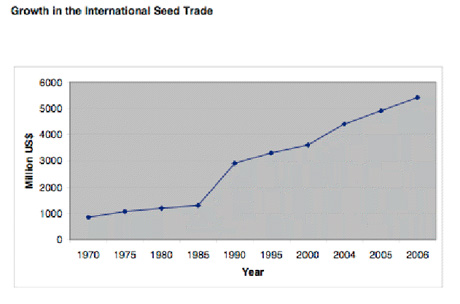
Source: International Seed Federation.[8] Since 1985, the trade in commercial seed has been soaring.

IPR deprives farmers from what they and many others worldwide claim as their inherent right to save and replant seeds. Seed varieties, which have been developed over centuries, have adapted to their particular environments, while their gene pool has to survive unforeseen factors such as pests and diseases - or climate change. Thus, farmers are losing their independence and become "extensions" in the field for the biotech corporations the world over,[9] as IPR clauses in the contracts between them and the farmer forbid the farmer to save and replant their seeds. Though farmers buy the GM seeds, they do not own them. In fact, farmers are renting the GM seeds from the biotech corporation on an annual basis.

Another consequence of the court ruling is the explosion of tactical cooperations, strategic mergers and takeovers among agro-chemical-biotech companies and the ensuing consolidation of power in the hands of a few transnational corporations (TNCs).

Based on a report published by the ETC Group, the action group on Erosion, Technology and Concentration:[10]
  • From thousands of seed companies and public breeding institutions three decades ago, 10 companies now control more than two-thirds of global proprietary seed sales.
     
  • From dozens of pesticide companies three decades ago, 10 now control almost 90 percent of agrochemical sales worldwide.
     
  •  From almost 1,000 biotech start-ups 15 years ago, 10 companies now account for three-quarters of industry revenues.
The concentration of power makes for strong industry lobbies in governmental organizations such as the World Trade Organization (WTO) and the World Bank, in favor of governmental deregulation and the promotion of free trade, including agriculture. This directly affects the lives of people, in particular in the global South.

Free Trade and Agriculture

The Agreement on Agriculture (AoA) came into being at the same time as the WTO - until then GATT[11] - on January 1, 1995. The AoA, effectively considering agricultural crops as commodities, was based on three pillars for trade regulation: domestic support, market access and export subsidies.[12]

The first pillar, domestic support, is a set of rules that regulate under which circumstances local producers can be subsidized. The second pillar, market access, is aimed at reducing the tariff on imported goods, in an attempt to "create order, fair competition and a less distorted agricultural sector."[13] Non-tariff barriers on imports - such as import quotas or import restrictions - have to be "tarifficated" in order to become part of the global market process. Once bonded to a tariff, the rate will subsequently be reduced over time. The third pillar obliges developed countries to reduce the export subsidies given to local producers, in order to reduce false competition.

Only developed countries are rich enough to sponsor their agricultural producers one way or the other.[14] These subsidized crops flood the global market at below-cost prices. This both undercuts and lowers the farm gate prices for the local producers in developing countries, while these countries cannot afford to support their domestic producers or pay them export subsidies. In practice, this leads to what has become known as export dumping.

Due to the asymmetric power relations between developed and developing countries, it seems that the trade regulations have had a virtually opposite effect from that ostensibly intended: the reduction of tariff protections has negatively affected small-scale farmers - who make up 70 percent of the population in developing countries - who see the key source of their income slip away, driving them off the land and into the cities, in search of a new way to make a living.[15]

Subsistence farmers are effectively threatened by the conditions put forward once their state government takes out a loan from the World Bank or signs a WTO Trade agreement, as these come with structural adjustment programs (SAPs). SAPs are in effect prescribed economic "reform" policies, such as the reduction of government budgets and social spending; the cutting of programs and subsidies for basic goods; the elimination of restrictions on foreign ownership; the increase in interest rates; the promotion of a switch from subsistence farming to export economies, while eliminating import tariffs.[16]

Government deregulation thus favors TNCs over smallholders[17] in a bid to compete with export crops in a global market that, in fact, is seriously distorted by the agricultural subsidy policies of the developed countries.

Recently, the dash for agrofuels, diverting food crops to produce energy, has put yet more strain on the competition for land and other resources such as water.[18] The social and environmental consequences of business as usual has driven many farmers off their land toward cities, putting additional pressure on the land, as agricultural land is urbanized. Nowhere can these non-trade concerns[19] be witnessed better than in the growing number of slums around cities in the developing world.

The dispossessed are fighting back, however. They have organized themselves in all sorts of organizations, the aim of which is to resist further global appropriation of their lands and local economies. They campaign for agricultural reform and the human right to food; they demand food sovereignty for all.

Food Sovereignty

"People facing hunger and malnutrition are, to a large extent, smallholders, landless workers, pastoralists and fisherfolk, often situated in marginal and vulnerable ecological environments. Neglected by (inter)national policies, they cannot compete with increasingly subsidized industrialized agriculture, both nationally and in the world market. Many farmers tried to catch the Green Revolution train, but became stuck in the debt trap of increasing input costs and decreasing product prices. Concentration in the food market chain is another worrying trend causing increasing dependence of both consumers and producers on a declining number of seed, inputs and food products conglomerates."[20]

Food sovereignty is a term originally coined in 1996 by the members of La Via Campesina as an alternative policy framework, countering the narrow view of food security as access to global food imports by food-deficient countries as a political goal.

Emerging in 1993, Via Campesina is "an international movement of peasants, small- and medium-sized producers, landless, rural women, indigenous people, rural youth and agricultural workers that fight for the right of people to determine their own local policy to food security through agrarian reform and rural development."[21]

Via Campesina's Seven Principles of Food Sovereignty[22]

1. Food: A Basic Human Right

Everyone must have access to safe, nutritious and culturally appropriate food in sufficient quantity and quality to sustain a healthy life with full human dignity. Each nation should declare that access to food is a constitutional right and guarantee the development of the primary sector to ensure the concrete realization of this fundamental right.

2. Agrarian Reform

A genuine agrarian reform is necessary, which gives landless and farming people - especially women - ownership and control of the land they work, and returns territories to indigenous peoples. The right to land must be free of discrimination on the basis of gender, religion, race, social class or ideology; the land belongs to those who work it.

3. Protecting Natural Resources

Food sovereignty entails the sustainable care and use of natural resources, especially land, water, seeds and livestock breeds. The people who work the land must have the right to practice sustainable management of natural resources and to conserve biodiversity free of restrictive intellectual property rights. This can only be done from a sound economic basis with security of tenure, healthy soils and reduced use of agro-chemicals.

4. Reorganizing Food Trade

Food is first and foremost a source of nutrition and only secondarily an item of trade. National agricultural policies must prioritize production for domestic consumption and food self-sufficiency. Food imports must neither displace local production nor depress prices.

5. Ending the Globalization of Hunger

Food sovereignty is undermined by multilateral institutions and by speculative capital. The growing control of multinational corporations over agricultural policies has been facilitated by the economic policies of multilateral organizations such as the WTO, World Bank and the International Monetary Fund (IMF). Regulation and taxation of speculative capital and a strictly enforced code of conduct for TNCs is therefore needed.

6. Social Peace

Everyone has the right to be free from violence. Food must not be used as a weapon. Increasing levels of poverty and marginalization in the countryside, along with the growing oppression of ethnic minorities and indigenous populations, aggravate situations of injustice and hopelessness. The ongoing displacement, forced urbanization, repression and increasing incidence of racism of smallholder farmers cannot be tolerated.

7. Democratic control

Smallholder farmers must have direct input into formulating agricultural policies at all levels. The United Nations and related organizations will have to undergo a process of democratization to enable this to become a reality. Everyone has the right to honest, accurate information and open and democratic decision-making. These rights form the basis of good governance, accountability and equal participation in economic, political and social life, free from all forms of discrimination. Rural women, in particular, must be granted direct and active decision-making on food and rural issues.

The acceptance of this framework[23] in the context of the Declaration of Human Rights, is extremely important, not only for the small, food-producing people involved, but also for the end consumer in the developed world: the true right to food and the true right to produce food, mean that all people have an unalienable right to safe, nutritious and culturally-appropriate food as well as to food-producing resources, while they have the ability to sustain themselves and their societies in the process.

If the no consensus on a G8-driven global partnership against hunger is the surprise outcome of the High Level Meeting on Food Security held in Madrid in January of this year, it may well be an indication that the food sovereignty movement is conquering terrain. In the final declaration of the farmers' and civil society organizations, they state that:
"We see the proposed Global Partnership as just another move to give the big corporations and their foundations a formal place at the table, despite all the rhetoric about the 'inclusiveness' of this initiative. Furthermore it legitimates the participation of WTO, World Bank and IMF and other neoliberalism-promoting institutions in the solution of the very problems they have caused. This undermines any possibility for civil society or governments from the Global South to play any significant role. We do not need this Global Partnership or any other structure outside the UN system."[24]
After all, until a few decades ago, it was primarily the small farmers of this world who sustained us all with their hard work in the field.
Footnotes:
[1] "The Cordoba process was started at an international seminar on the right to food at CEHAP [Chair of Studies on Hunger and Poverty], Cordoba October 2007, further pursued at the Right to Food Forum organised by the FAO Right to Food Unit in October 2008 and completed in its present version following a second meeting convened in Cordoba by CEHAP on November 28-29, 2008. It will be subject of further consultations and possible revisions during 2009." Source.
[2] Source.
[3] FAO 1974
[4] See here.
[5] Sen, Amartya (1981): "Poverty and Famines: An Essay on Entitlements and Deprivation," Claredon Press, Oxford.
[6] Dominique Guillet, Association Kokopelli.
[7] Diamond v. Chakrabarty, 447 US 303 (1980)
[8] See here.
[9] For a brief history of the seed industry, see here and here.
[10] The ETC Group, an international advocacy organization based in Canada, has been monitoring corporate power in the industrial life sciences for the past 30 years, revealed this in a report in November 2008 that can be downloaded here.
[11] General Agreement on Tariffs and Trade, 1947. A tariff is a tax on goods upon importation.
[12] See here.
[13] See here.
[14] United Nations Development Programme (UNDP) Human Development Report 2005, p.129 vv.
[15] UNDP Human Development Report 2005, chapter 4.
[16] See here.
[17] Raj Patel in "Stuffed and Starved" (2007), London Portobello Books, describes this process in detail.
[18] GRAIN, "Stop the Agrofuel Craze."
[19] Fourth Special Session of the Committee on Agriculture (2000).
[20] Jonas Vanruesel, 2008. "Food as a human right: a struggle for human dignity and food sovereignty" in Omertaa Volume 2008/2.
[21] See here.
[22] A concise summary of the principles of food sovereignty can be found on the site of the organization for the defense of family farms in the USA.
[23] See here and here.
[24] Final declaration of farmers and civil society organizations.

Thursday, September 30, 2010

WTO Calls On US to Cut Farm Subsidies

Wednesday, September 29, 2010 by Agence France Presse

GENEVA - The World Trade Organization called on the United States on Wednesday to cut its farm subsidies, saying that they were so "considerable" that they could affect market prices.

In a report analysing Washington's policies since 2007, the trade body said that while promoting its exports, the United States should also reduce "distorting measures ... including ... support for agriculture."

The WTO noted that support granted to the sector under the multi-billion-dollar 2008 Farm Act are mostly "linked to prices and or production."

Thanks to this support, "producers of cereals, oilseeds, and cotton are effectively insulated from market prices while sugar and dairy have market price support programmes," said the WTO.

"The large size of the agriculture sector means that the absolute amount of support is considerable, varies from one year to another depending on prices, and can affect world prices," it added.

Brazil also hit out against the US' farm policies during the WTO's examination of Washington's trade policies every two years.

"Agriculture accounts for only 0.8 percent of US GDP and it employs just 1.4 percent of its labour force," noted Roberto Azevedo, Brazil's envoy to the WTO.

"Nevertheless, this sector displays a considerable arsenal of trade-restrictive and distorting measures."

Azevedo pointed out that most of the subsidies are concentrated on crops such as cotton soybeans and rice.

"When prices drop, those subsidies will be in place again precisely at the moment when they will provoke the largest distortions and most damage to producers elsewhere," he charged.

Washington's subsidies to its agriculture sector is a key sticking point holding up long-stalled Doha negotiations for a new global free trade deal.

Its support for cotton producers has been judged illegal by the WTO, in a complaint brought by Brazil.

Brazil however agreed to not apply reprisals after both countries decided to wait for the new Farm bill in 2012 to see what modifications would be made.

Wednesday, June 2, 2010

The US Is Trying to Escape International Trade Regulation

How the US Is Trying to Escape International Trade Regulation While Brazil Asserts Itself as a Regional Leader

• While pressuring developing countries to adopt pro-trade measures, the U.S. does not enforce its WTO commitment on cotton subsidies.
• By pointing out this problem Brazil asserts itself in the international arena while the voice of African cotton exporting countries is not heard at the WTO.
On April 20th 2010, a Memorandum of Understanding (MoU) was signed between the two largest economies of the Western hemisphere, thus calming a decade-long, sometimes rancorous, dispute involving Washington and Brasilia over the subject of subsidies paid out by the U.S. to its cotton producers. By initiating a U.S.-financed fund, which would be allocated to cotton producers in Brazil and all over the world, this agreement was widely seen as resolving, once and for all, the existing trade tensions between the two countries. But, at the same time, the MoU can be seen in other, less charitable, ways as a token agreement and as a refusal by the U.S. to reform its basic system and to comply with international regulation.
Brazil’s Fight Against US Subsidized Cotton
The cotton industry is a major component of both countries’ agricultural sectors. The U.S. is the third largest producer of cotton in the world, after India and China. Since these two countries do not export the commodity but use it for their domestic clothing industry, the U.S. is the largest exporter of this commodity with 40% of world exports. U.S. cotton production is supported by heavy subsidies, averaging upwards of $3.5 billion per year. This governmental aid measure is seen as an “important safety net” by the National Cotton Council of America; the views of the Brazilian government and numerous developing countries are radically different and tend to be far less serene on the issue. 
Washington’s production support program allows American farmers to produce cotton at a lower cost and, therefore, to sell it at cheaper prices. As a result, the world price of cotton tends to head downward and the share of U.S. cotton exports increases at the expense of producers from developing countries whose governments do not have the resources to offer subsidies. As Environmental Working Group analyst David DeGennaro notes; “for farmers in Sub-Saharan Africa who are subsisting on very little money, a small reduction in price based on American subsidization is a big deal.”
Amongst other allegations, the Brazilian government has accused the U.S. of violating article 13 of the WTO Agreement on Agriculture (AA) regarding subsidy restrictions, since governmental aid to cotton producers in the U.S. has doubled since 1992 (the benchmark year used by the agreement). Brazil also asserted that production flexibility contracts (stipulated by the 1996 Farm Bill) and the direct payments received by producers under the 2002 Farm Bill, were not a form of permissible decoupled income support, since they were based on prices and production and were, therefore, not considered applicable under the reduction commitment guaranteed by the agreement in its annex 2.
An Enduring Dispute at the WTO
The aforementioned allegations and other factors dealing with the $12.9 billion of subsidies handed out by U.S. government authorities between marketing years 1999 and 2002 were lodged by the Brazilian delegation at the WTO on September 27th 2002. Brazil was supported by Argentina, Canada, China, the European Union, India, and Japan; and the panel established by the WTO Dispute Settlement Body (DSB), published a final report in favor of Brasilia in September 2004. Its findings were upheld on appeal on March 3rd of the following year. The U.S. was given until July 1st 2005 to remove the prohibited subsidies which had been established as causing a “serious prejudice” to Brazil and other third party countries.
Despite a few ameliorative steps taken by Washington, such as the suppression of the Step 2 Cotton program, Brazil requested the establishment of another compliance panel that delivered its final report on December 18th 2007. According to this report, the U.S. did not comply with the WTO recommendations. As a result, on August 31st 2009, WTO arbitrators authorized Brazil to retaliate against U.S. goods and services and to use a cross sector retaliation schema. In other words, Brazil was given the right not only to increase its tariffs on incoming U.S. goods but also to retaliate with other means, for instance by violating patents. The cross sector retaliation issue has been at the core of the dispute since tariff retaliation alone is not satisfactory to Brazil, given the fact that the country imports very little raw material from the U.S. and that tariffs on imported goods could lead to unwanted inflation in Brazil. The WTO decision is remarkable since it is the first time that the U.S. has been penalized for its subsidies and because, if Brazil decides to cross-sector retaliate, it would be the first country to do so in the history of the organization.
Recent Threats Made by the Brazilian Chamber of External Trade
As a result of the August 31st rulings, the Brazilian Chamber of External Trade (CAMEX) issued on March 8th 2010 a list of trade sanctions applicable to 102 U.S. products, that was supposed to take effect in early April. The most important tariffs were planned on products made of cotton and industries with an important political component, such as the automobile industry, that could have been subject to a 50% tariff on imports. By targeting these sensitive industries, defended by strong lobbies, the intent of the Brazilian government was, without question, to win the full attention of concerned U.S. officials.
A week later, in another statement, the CAMEX claimed that Brazil could also disregard intellectual property rights on all kinds of U.S. products (from pharmaceuticals to entertainment goods) by suspending its obligations under the Agreement on Trade Related aspects of Intellectual Property Rights (TRIPS), as well as under the General Agreement on Trade and Services (GATS). These two threats were the equivalent to a full scale retaliation amounting to respectively $591 million and $238 million, thus honoring the authorization made by the WTO that gave Brazil the second largest retaliation award since the organization was created.
A Challenge Raised by Brazil to Obama’s “New Export Initiative”
These threats were not likely to be immediately implemented, given the two countries’ interdependence, and, as Brazilian Trade and Development Minister Miguel said; “Brazil is not interested in a trade war. Nobody is. We’re ready to negotiate.” Nevertheless the CAMEX public statement triggered off a certain degree of fear and agitation in Washington. The news came out only a month and a half after President Obama’s 2010 State of the Union address during which he announced his intention to launch a “National Export Initiative” and called this project into question. Obama’s objectives were to double U.S. exports in the next five years in order to save 2 million jobs. The Obama administration intended to do so by relying on a weak dollar and by creating a series of new free trade agreements (such as the ones being negotiated with Panama and Colombia).
U.S. Trade Representative Ron Kirk asserted Washington’s willingness to comply with applicable WTO regulation if no agreement could be found. However, at a time when the U.S. unemployment rate is brushing 10%, Congress is sure to be reluctant to do anything favoring imports that could further worsen the U.S. job market. Furthermore, the upcoming midterm elections would have made it difficult for U.S. congressmen to reduce cotton subsidies, especially in countering the penetrating voice of the National Cotton Council of America. The CAMEX announcement also came in the aftermath of the crisis, at a time when protectionism seems to have come back to life. After a trade contraction of 12% in 2009, these threats raised the fear of a trade war between the major agricultural economies, especially since several analysts foresaw a possible move by China to back Brazil. After the failure of the WTO Doha Development Round, because of the seemingly insoluble disagreement between China, India, and the U.S. on agricultural trade regulation, Brazil wisely and indirectly questioned the quality of U.S. leadership of international trade.
This dispute shows the unfairness and some of the abiding problems within the trading system. On one hand, the U.S. desires developing countries to be bound up with an overwhelming pro-trade legislation, but, on the other hand, it does not itself comply with this same legislation. President Obama’s trade agenda for the year 2009 clearly stated: “This administration reaffirms America’s commitment to a rules-based trading system […] We shall continue this country’s commitment to the WTO’s system of multilateral trading rules and dispute settlement.” But few actions have backed this otherwise muscular statement. As pointed out by trade analyst Daniella Markheim:
“America’s refusal to comply with adverse WTO rulings erodes US credibility and influence in the debate shaping globalization and undermines the multilateral trading system. America can afford either trade retaliation or the loss of its leadership position in international economic issues and the WTO is already weakened by nations’ inability to conclude Doha round trade negotiations. The US should not only change its cotton program this year, but it should also take a hard look at other needed reforms if its national export initiative is to be part of legitimate trade policy.”
Brazil as a Leader in the International Economic Arena
Brazil started to impose itself as a leader of developing countries and of the Cairns group: an association of 19 agricultural exporting countries, by standing out during the London G20 Summit in April 2009, when President Lula forcefully criticized the American and European farm subsidies. The recent threats made by the CAMEX and the cotton dispute in general, are now a further step for Brazil to be asserting its leadership and its role as the voice of agricultural exporting and developing countries during recent international negotiations. Brasilia’s action was backed by the international community and its recent acquisition of $20 billion in IMF bonds, which gave it another claim for more power and enhanced representation in the international economic arena.
The implicit Brazilian threats also appeared when tensions between the two countries were increasing. For instance, after Washington’s near inaction regarding the conservative coup in Honduras, during which President Zelaya was overthrown and had to find refuge in the Brazilian embassy in Tegucigalpa. Lula also asserted his support for Palestine and the Iranian nuclear program; it was clear that Brazil was now prepared to be a more decisive factor in world affairs, even at the risk of alienating the U.S.
The Recent Agreement and Settlement of the Dispute
The April 6th 2010 Memorandum of Understanding planned the establishment of a $147.3 million fund per year for “technical assistance and capacity building related to the cotton industry” in Brazil and in other countries. This fund, financed by U.S. authorities, would remain in place until an agreement has been achieved between Brazil and the U.S, or until the next U.S. farm bill was passed in 2012. The agreement also guaranteed the U.S. recognition of the state of Santa Catarina as free of several animal diseases. In return for this little favor which would buttress Brazilian meat exports, Brazil agreed to refrain from imposing trade sanctions against the U.S. Nevertheless, this agreement has been criticized by many analysts such as David Orden of the International Food Policy Research Institute who claimed that: “Rather than have Brazil retaliate against us, the U.S. has found a way to bribe Brazil, if you will, not to impose that retaliation in exchange for various things the U.S. says it will do” and according to David DeGennaro, “It’s really kind of ridiculous that American taxpayers are going to be subsidizing Brazilian cotton farmers just so that we can keep on subsidizing our own cotton farmer. It’s really a strange situation.”
The just described agreement calmed the situation with its outcome being predictable, mainly because no one would gain from a trade war, and because it is really important for Brazil to protect property rights, in view of its enormous revenue from royalties and other forms of income that could accrue from the 2014 FIFA World cup and the 2016 Olympics Games in the country. But one should recall from this dispute that the failure by the U.S. to reform its trade system and the country’s loss of legitimacy in the trade field when it asks developing countries to adopt pro-trade measures did not win many plaudits for Washington.
One can also anticipate the dire consequences of such a fund on sub-Saharan cotton producers. Even if part of the financial pool is destined to flow to them, the voice of the coalition of Benin, Burkina Faso, Chad and Mali was not being heard at all during the WTO negotiations. Thus one of the organization’s major problems was revealed: the fact that the voice of the understaffed and inexperienced country delegations tend to be almost a non-factor when it comes to cotton pricing. The problem appears even more catastrophic when one learns through Inter Press Service that, “Studies by international organizations show that the total abolition of U.S. subsidies would increase the world cotton price by 14 percent. According to the charity Oxfam, this would translate into additional revenue that could feed one million more children per year, or pay the school fees of two million children in West Africa.” 

Monday, May 10, 2010

The Market: the New Faith

A Death-Breeding Logic
By ERIC TOUSSAINT

Practically all political leaders - whether from the traditional Left or the Right, from the North or the South - have a quasi-religious faith in the market, especially the financial markets. Or rather, they themselves are the high priests of this religion. Every day in every country, anyone with a television or an Internet connection can attend mass and worship the market-god - in the form of stock exchange and financial market reports. The market-god sends his messages through television anchormen and the financial editors of daily newspapers. Today, this happens not only in OECD countries, but in most parts of the planet. Whether you are in Shangai or Dakar, Rio de Janeiro or Timbuktu, you can receive 'market signals'. Everywhere, governments have privatised and created the illusion that the population will be able to participate directly in market rituals (by buying shares) and reap the benefits in accordance with how well one interprets signals sent by the market-god. In actual fact, the small part of the working population that has acquired shares has no say over market tendencies.

In a few centuries, the history books might say that from the 1980s onwards a fetishist cult prospered. The dramatic rise of this cult will perhaps be associated with two heads of state, Margaret Thatcher and Ronald Reagan. It will be noted that, from the start, this cult had the backing of governments and powerful private financial interests. Indeed, for this cult to gain ground within the population, public and private media found it necessary to pay homage to it day in and day out.

The gods of this religion are the financial markets. Its temples are known as Stock Exchanges. Only the high priests and their acolytes can tread their holy ground. The faithful are called upon to commune with their market-god on television, on their computer screen, in the daily papers, on the radio or at the bank. Thanks to television, radio and the Internet even in the most remote parts of the planet, hundreds of millions of people who are deprived of the right to meet their basic needs, are also urged to celebrate the market-god. In the North, in newspapers read by a majority of workers, housewives and unemployed, an 'investment' section is published every day, even though the overwhelming majority of readers do not own a single share. Journalists are paid to help the faithful understand signals sent by the gods.

To heighten the power of the gods in the eyes of the faithful, commentators periodically declare that the gods have sent signals to governments to express their satisfaction or discontent. The Greek government and parliament have at last understood the message sent by the gods and adopted a drastic austerity plan that has the lower classes paying the price. But the gods are dissatisfied with Spain, Portugal, Italy and Ireland. Their governments too will have to contribute their ritual offerings in the guise of strong antisocial measures.

The places where the gods are most likely to forcefully express their moods are Wall Street in New York, the City in London, and the Paris, Frankfurt and Tokyo stock exchanges. To gauge their moods, special indicators have been devised: the Dow Jones in New York, the Nikkei in Tokyo, the CAC40 in France, the Footsie in London, the Dax in Francfort,… To appease the gods, governments must sacrifice the Welfare State to the stock markets. They must also privatise public property.

Why are ordinary market operators given a religious aura? They are neither anonymous nor ethereal. They have names, addresses. They are the people in charge of the 200 biggest TNCs that control the world with the help of the G7, the G20 and institutions such as the IMF, which came back into the limelight thanks to the financial crisis. Next we also have the World Bank and the World Trade Organisation, currently in a rather difficult predicament, but who knows, the gods might favour it again soon. Governments are no strangers to this situation; from Reagan and Thatcher onwards, they relinquished the means they had of controlling financial markets. The situation is now almost reversed: institutional investors (i.e. major banks, pension funds, insurance companies,hedge funds, etc.) received thousands of billions dollars from governments in the form of grants or loans to bail them out after the 2007-8 meltdown. The European Central Bank, the US Federal Reserve, the Bank of England now lend them money on a daily basis at a lower rate than the capital inflation that institutional investors immediately use to speculate against the euro and against public money.

Money can cross borders without a single cent in taxes being levied. More than 3,000 billion dollars race around the planet every day. Less than 2 per cent of this amount is linked to actual trade in goods and services or to productive investments. More than 98 per cent is used for purely speculative operations mainly on currencies, on commodities, and on debt securities.

We have to put a stop to this death-breeding logic. We have to develop a new financial discipline, to expropriate the financial sector and exert social democratic control on all financial matters, to tax all institutional investors (which triggered and then profited from the crisis) heavily, to audit and cancel public debts, to implement a distributive tax reform, to drastically reduce working hours so as to offer more jobs while maintaining wages at their current level... In short, we must launch an anticapitalist project.

Wednesday, May 5, 2010

Why You Should Care About The ACTA Copyright Treaty

The ACTA Copyright Treaty and Why You Should Care
By Michael Geist
May. 2, 2010

After years of secrecy, the eighth round of talks aimed at drafting an international treaty called the Anti-Counterfeiting Trade Agreement (ACTA) recently concluded in New Zealand — and in the face of public pressure, a version of the text was subsequently made available to the public. The ACTA is neither a trade agreement nor one focused primarily on counterfeiting, but a copyright deal featuring provisions on Internet service provider and Internet company liability, DMCA-style notice and takedown requirements, legal protection for digital locks, and requirements for statutory damages that could result in millions in liability for non-commercial infringement — even heightened searches at border crossings.

Ever since the ACTA partners — among them the U.S., E.U., Canada, Japan, South Korea, Australia, New Zealand, Mexico, Morocco and Singapore — announced negotiations plans in October 2007, ACTA has been dogged by controversy over a near-total lack of transparency. Early talks were held in secret locations with each participating country offering virtually identical, cryptic press releases that did little more than fuel public concern. Now that the ACTA text is public, some might wonder whether there’s still cause for concern. Indeed, given widespread support for measures that target genuine commercial counterfeiting, some might believe it’s time to actively support ACTA.

It’s not — at least not this version.

Still secret

From a transparency perspective, the text release still feels like the exception to the general secrecy rule. The ACTA governments have revealed that the next round of negotiations will take place in Switzerland in June, but currently refuse to provide a specific location or dates. Moreover, the official release scrubbed all references to country positions (such information was available in a previously leaked version), so as to U.S. government claims that ACTA is fully consistent with current U.S. law, at this point we have to take their word for it.

Different region, different rules

Of even greater concern are the provisions themselves. Because of the large number of substantive rules and the differences in domestic law among the ACTA countries, fears about specific provisions vary from region to region. In the U.S., ACTA might means the rules for obtaining injunctions would have to be changed, removing some of the balancing safeguards that currently exist. In Europe, ACTA’s privacy implications have generated concern from data protection authorities and the prospect of mandatory statutory damages, which has led to the multimillion-dollar file-sharing lawsuits in the U.S., would represent a major change in the law there.

Virtually every member country would have to amend its own rules and regulations: Japan would have to change its laws to require ISP policies on allegations of subscriber infringement, Australia would need anti-camcording rules, New Zealand would have to change its anti-circumvention rules and Canada would be forced to adopt a notice-and-takedown system similar to the one found in the U.S. Of course, the many countries excluded from the ACTA talks — including China, Brazil and India — would likely face pressure to conform to ACTA standards and if they complied, even more dramatic changes.

Behind closed doors

Beyond the fundamental reshaping of intellectual property law on a global scale, ACTA is also reframing how those laws are made. The alphabet soup of international organizations typically responsible for such issues — WTO, WIPO, WHO, UNCITRAL, UNIDROIT, UNCTAD, OECD –- are all far more open, transparent and inclusive than ACTA.

Moreover, final approval of ACTA raises significant constitutional issues. In the U.S., ACTA is being treated as executive agreement in a blatant attempt to sidestep Congressional approval. Across the pond, the European Parliament has demanded far greater involvement in the ACTA process, but has been largely rebuffed by the European Commission, which heads its delegation.

Public pressure helped make ACTA marginally better, but the release of text only confirms many of the fears regarding the substance of the treaty. Add in the ongoing transparency and process concerns and it is clear that public engagement on ACTA is needed now more than ever.