Showing posts with label wealth disparity. Show all posts

Tuesday, March 31, 2015

Why America’s inequality conversation is such a farce

Tuesday, Mar 31, 2015
“It’s your own damn fault!” The upcoming campaign is supposedly going to be about inequality. Here's why it's just another plutocratic charade
Elias Isquith

As I’ve noted previously, one of the stranger recent developments in American politics has been the swift arrival of a bipartisan consensus over economic inequality. For years and years — decades, even — the left and the right have quarreled over inequality’s very existence. But now, worrying about the maldistribution of income and wealth in the U.S. is utterly mainstream. Noting the widening chasm between the 1 percent and everyone else has become so anodyne, in fact, that even would-be presidents like Hillary Clinton, Jeb Bush, Ted Cruz, Rand Paul and Marco Rubio are doing it. It’s enough to make a longtime class-warrior think she’s winning.

That would be a mistake. Because although the political value of inequality is different today than was the case before the Great Recession, it’s mainly been rhetoric — and not policy — that has changed. We may talk more than we once did about the rich are, as Fitzgerald wrote, “not like you and me.” So far, very little’s been done on the national level to explicitly confront the problem. On the contrary, the economic recovery has been so full of McJobs that there’s reason to suspect the issue may only get worse in years to come.

But if the U.S. economy is just as iniquitous as ever, and if the near-total gutting of campaign finance regulation has made the U.S. political economy almost as plutocratic as ever, then how do we explain the rise of inequality as a mainstream topic of conversation? If the 1 and .01 percent still wields such a massively disproportionate degree of influence over our culture as well as our politics, wouldn’t talk of class remain verboten? Shouldn’t the super-rich be telling voters and the public in general to pay no attention to the moneybags behind the curtain?

You might think so; but that would only be true if the wealthy’s control of American politics was more direct (and ham-handed) than it actually is. As Noam Chomsky has argued, the way the wealthy and the powerful operate in a formal democracy is significantly different from how they act in an illiberal society. The discourse has its regulators and gate-keepers, of course. But rather than outright censorship, the powers-that-be in the U.S. tend to head-off opposition by setting the parameters of the debate — and doing so in such a way as to ensure their interests are never really threatened.

Noam Scheiber’s New York Times piece on Monday shows us what that process looks like in the real world. What we see in his report is a donor class that’s acquiesced to inequality being a major 2016 issue, partially because they’ve succeeded so far in rendering any serious responses to the problem out of the question. As Scheiber notes, strong majorities of Americans — including Republicans— are in favor of the government taking action to address the crisis, with redistribution from the 1 percent to the rest being an especially popular response. Yet for all their talk of inequality and opportunity, none of the declared or soon-to-declare presidential candidates of consequence have provided even a general endorsement of such a plan.

Unsurprisingly, their hesitation is shared by one significant group — donors. Citing the invaluable work of Benjamin Page, Jason Seawright and Larry Bartels, Scheiber notes that although a majority of the wealthy Chicago-area persons these researchers interviewed professed concern over inequality, too, they were dramatically less interested in any public policy solutions. “Only 13 percent of wealthy interview subjects” want to see government work to address the problem, Scheiber writes. And only 17 percent are supportive of policies that involve raising taxes on the rich.

And it’s not just tax hikes that the wealthy are keeping off the table. While two-out-of-three Americans think the government should help citizens find a job, provided they’re willing and able, fewer than one-out-of-five of wealthy respondents agree. “Forty percent of the wealthy,” Scheiber writes, want the minimum wage to be high enough to support a family; among the general public, support for that idea nearly doubles, coming out at 78 percent. Perhaps even more telling, though, is the way the overall philosophy of the very rich permeates the public discourse at large.

For example: According to interviews with the wealthy conducted by Fiona Chin, a Northwestern graduate student whom Scheiber describes as a Page “protégé,” the 1 percent is much more likely to believe that inequality is a byproduct of virtue and hard work, rather than any flaws in the U.S.’s economic system. The wealthy, Chin says, think inequality is “a story about individual hard work, effort and character.” Sure, the rich have some built-in advantages, they say. But they’re disadvantaged too; being born with means, after all, can make you less inclined to work.

If you didn’t strike it rich in America, these 1 percenters told Chin, it’s most likely because you “didn’t take advantage of the education system.” That, of course, is a euphemistic way of saying it’s your own damn fault. And while Scheiber’s report doesn’t bring up this angle directly, it’s not hard to see how there might be a connection between the 1 percent’s focus on education and the burgeoning movement to “reform” public schooling. A grand experiment in charter schools is fine. But reducing inequality by giving money to the people who need it? Not okay.

So we may now hear Bush — or Cruz, or Rubio, or Paul — talk about “opportunity” gaps; and we may soon listen as Clinton rails against cutting hedge fund managers’ taxes. But given the constraints the 1 percent establishes upfront, you can expect that most of the ideas to come from Bush, Rubio and, eventually, Clinton will differ little from what they would’ve proposed in the years before the Great Recession. And until they stop trying to sell the same-old policies under an inequality-themed banner, the politics of the issue will not be appreciably different. We’ll merely have transitioned from denial to a charade.

Tuesday, June 3, 2014

Why Can't the Unemployed Get Off Their Couches? And Eight Other Critical Questions for Americans

Tuesday, 03 June 2014
By Peter Van Buren, TomDispatch


Last year eight Americans -- the four Waltons of Walmart fame, the two Koch brothers, Bill Gates, and Warren Buffett -- made more money than 3.6 million American minimum-wage workers combined. The median pay for CEOs at America's large corporations rose to $10 million per year, while a typical chief executive now makes about 257 times the average worker's salary, up sharply from 181 times in 2009. Overall, 1% of Americans own more than a third of the country’s wealth.

As the United States slips from its status as the globe's number one economic power, small numbers of Americans continue to amass staggering amounts of wealth, while simultaneously inequality trends toward historic levels. At what appears to be a critical juncture in our history and the history of inequality in this country, here are nine questions we need to ask about who we are and what will become of us. Let's start with a French economist who has emerged as an important voice on what’s happening in America today.

1) What does Thomas Piketty have to do with the 99%?

French economist Thomas Piketty’s surprise bestseller, Capital in the Twenty-First Century, is an unlikely beach read, though it’s selling like one. A careful parsing of massive amounts of data distilled into “only” 700 pages, it outlines the economic basis for the 1%-99% divide in the United States. (Conservative critics, of course, disagree.)

Just in case you aren’t yet rock-bottom certain about the reality of that divide, here are some stats: the top 1% of Americans hold 35% of the nation's net worth; the bottom 80%, only 11% percent. The United States has such an unequal distribution of wealth that, in global rankings, it falls among the planet’s kleptocracies, not the developed nations that were once its peers. The mathematical measure of wealth-inequality is called "Gini," and the higher it is, the more extreme a nation's wealth-inequality. The Gini for the U.S. is 85; for Germany, 77; Canada, 72; and Bangladesh, 64. Nations more unequal than the U.S. include Kazakhstan at 86 and the Ukraine at 90. The African continent tips in at just under 85. Odd company for the self-proclaimed “indispensable nation.”

Piketty shows that such inequality is driven by two complementary forces. By owning more of everything (capital), rich people have a mechanism for getting ever richer than the rest of us, because the rate of return on investment is higher than the rate of economic growth. In other words, money made from investments grows faster than money made from wages. Piketty claims the wealth of the wealthiest Americans is rising at 6%-7% a year, more than three times as fast as the economy the rest of us live in.

At the same time, wages for middle and lower income Americans are sinking, driven by factors also largely under the control of the wealthy. These include the application of new technology to eliminate human jobs, the crushing of unions, and a decline in the inflation-adjusted minimum wage that more and more Americans depend on for survival.

The short version: A rising tide lifts all yachts.


2) So why don't the unemployed/underemployed simply find better jobs?

Another way of phrasing this question is: Why don't we just blame the poor for their plight? Mention unemployment or underemployment and someone will inevitably invoke the old "pull yourself up by your bootstraps" line. If workers don't like retail or minimum-wage jobs, or if they can't find good paying jobs in their area, why don’t they just move? Quit retail or quit Pittsburgh (Detroit, Cleveland, St. Louis) and...

Move to where to do what? Our country lost one-third of all decent factory jobs -- almost six million of them -- between 2000 and 2009, and wherever "there" is supposed to be, piles of people are already in line. In addition, many who lost their jobs don't have the means to move or a friend with a couch to sleep on when they get to Colorado. Some have lived for generations in the places where the jobs have disappeared. As for the jobs that are left, what do they pay? One out of four working Americans earn less than $10 per hour. At 25%, the U.S. has the highest percentage of low-wage workers in the developed world. (Canada and Great Britain have 20%, Japan under 15%, and France 11%.)
One in six men, 10.4 million Americans aged 25 to 64, the prime working years, don't have jobs at all, a portion of the male population that has almost tripled in the past four decades. They are neither all lazy nor all unskilled, and at present they await news of the uncharted places in the U.S. where those 10 million unfilled jobs are hidden.

Moving “there” to find better work isn't an option.

3) But aren't there small-scale versions of economic “rebirths” occurring all over America?

Travel through some of the old Rust Belt towns of this country and you’ll quickly notice that “economic rebirth” seems to mean repurposing buildings that once housed factories and shipping depots as bars and boutiques. Abandoned warehouses are now trendy restaurants; a former radiator factory is an artisanal coffee shop. In other words, in a place where a manufacturing plant once employed hundreds of skilled workers at union wages, a handful of part-timers are now serving tapas at minimum wage plus tips.

In Maryland, an ice cream plant that once employed 400 people with benefits and salaries pegged at around $40,000 a year closed its doors in 2012. Under a "rebirth" program, a smaller ice cream packer reopened the place with only 16 jobs at low wages and without benefits. The new operation had 1,600 applicants for those 16 jobs. The area around the ice cream plant once produced airplanes, pipe organs, and leather car seats. No more. There were roughly 14,000 factory jobs in the area in 2000; today, there are 8,000.

General Electric’s Appliance Park, in Louisville, Kentucky, employed 23,000 union workers at its peak in 1973. By 2011, the sputtering plant held onto only about 1,800 workers. What was left of the union there agreed to a two-tier wage scale, and today 70% of the jobs are on the lower tier -- at $13.50 an hour, almost $8 less than what the starting wage used to be. A full-time worker makes about $28,000 a year before taxes and deductions. The poverty line for a family of four in Kentucky is $23,000. Food stamp benefits are available to people who earn up to 130% of the poverty line, so a full-timer in Kentucky with a family still qualifies. Even if a worker moved to Kentucky and lucked out by landing a job at the plant, standing on your tiptoes with your lips just above sea level is not much of a step up.

Low paying jobs are not a rebirth. 


4) Can't people just get off their couches and get back to work?

There are 3.8 million Americans who have been out of work for 27 weeks or more. These are the country’s long-term unemployed, as defined by the Department of Labor. Statistically, the longer you are unemployed, the less likely it is that you'll ever find work again. Between 2008 and 2012, only 11% of those unemployed 15 months or more found a full-time job, and research shows that those who do find a job are less likely to retain it. Think of it as a snowball effect: more unemployment creates more unemployable people.

And how hard is it to land even a minimum-wage job? This year, the Ivy League college admissions acceptance rate was 8.9%. Last year, when Walmart opened its first store in Washington, D.C., there were more than 23,000 applications for 600 jobs, which resulted in an acceptance rate of 2.6%, making the big box store about twice as selective as Harvard and five times as choosy as Cornell.

Telling unemployed people to get off their couches (or out of the cars they live in or the shelters where they sleep) and get a job makes as much sense as telling them to go study at Harvard. 


5) Why can't former factory workers retrain into new jobs?

Janesville, Wisconsin, had the oldest General Motors car factory in America, one that candidate Obama visited in 2007 and insisted would be there for another 100 years. Two days before Christmas that year and just before Obama's inauguration, the plant closed forever, throwing 5,000 people out of work. This devastated the town, because you either worked in the plant or in a business that depended on people working in the plant. The new president and Congress quickly paid for a two-million-dollar Janesville retraining program, using state community colleges the way the government once used trade schools built to teach new immigrants the skills needed by that Janesville factory a century ago.

This time around, however, those who finished their retraining programs simply became trained unemployables rather than untrained ones. It turned out that having a certificate in “heating and ventilation” did not automatically lead to a job in the field. There were already plenty of people out there with such certificates, never mind actual college degrees. And those who did find work in some field saw their take-home pay drop by 36%. This, it seems, is increasingly typical in twenty-first-century America (though retraining programs have been little studied in recent years).

Manufacturing is dead and the future lies in a high-tech, information-based economy, some say. So why can't former factory workers be trained to do that? Maybe some percentage could, but the U.S. graduated 1,606,000 students with bachelor's degrees in 2014, many of whom already have such skills.

Bottom Line: Jobs create the need for training. Training does not create jobs. 


6) Should we cut public assistance and force people into the job market?

At some point in any discussion of jobs, someone will drop the nuclear option: cut federal and state benefits and do away with most public assistance. That'll motivate people to find jobs -- or starve. Unemployment money and food stamps (now called the Supplemental Nutrition Assistance Program, or SNAP) encourage people to be lazy. Why should tax dollars be used to give food to people who won't work for it? “If you’re able-bodied, you should be willing to work,” House Majority Leader Eric Cantor said discussing food stamp cuts.

The problem with such statements is 73% of those enrolled in the country’s major public benefits programs are, in fact, from working families -- just in jobs whose paychecks don’t cover life’s basic necessities. McDonald’s workers alone receive $1.2 billion in federal assistance per year.

Why do so many of the employed need food stamps? It’s not complicated. Workers in the minimum-wage economy often need them simply to survive. All in all, 47 million people get SNAP nationwide because without it they would go hungry.

In Ohio, where I did some of the research for my book Ghosts of Tom Joad, the state pays out benefits on the first of each month. Pay Day, Food Day, Mother’s Day, people call it. SNAP is distributed in the form of an Electronic Bank Transfer card, or EBT, which, recipients will tell you, stands for “Eat Better Tonight.” EBT-friendly stores open early and stay open late on the first of the month because most people are pretty hungry come the Day.

A single person with nothing to her name in the lower 48 states would qualify for no more than $189 a month in SNAP. If she works, her net monthly income is multiplied by .3, and the result is subtracted from the maximum allotment. Less than fifty bucks a week for food isn’t exactly luxury fare. Sure, she can skip a meal if she needs to, and she likely does. However, she may have kids; almost two-thirds of SNAP children live in single-parent households. Twenty percent or more of the child population in 37 states lived in “food insecure households” in 2011, with New Mexico (30.6%) and the District of Columbia (30%) topping the list. And it's not just kids. Households with disabled people account for 16% of SNAP benefits, while 9% go to households with senior citizens.

Almost 22% of American children under age 18 lived in poverty in 2012; for those under age five, it’s more than 25%. Almost 1 in 10 live in extreme poverty.

Our system is trending toward asking kids (and the disabled, and the elderly) to go to hell if they're hungry. Many are already there.


7) Why are Walmart and other businesses opposed to SNAP cuts?

Public benefits are now a huge part of the profits of certain major corporations. In a filing with the Securities and Exchange Commission, Walmart was oddly blunt about what SNAP cuts could do to its bottom line:
“Our business operations are subject to numerous risks, factors, and uncertainties, domestically and internationally, which are outside our control. These factors include... changes in the amount of payments made under the Supplemental Nutrition Assistance Plan and other public assistance plans, [and] changes in the eligibility requirements of public assistance plans.”


How much profit do such businesses make from public assistance? Short answer: big bucks. In one year, nine Walmart Supercenters in Massachusetts received more than $33 million in SNAP dollars -- more than four times the SNAP money spent at farmers' markets nationwide. In two years, Walmart received about half of the one billion dollars in SNAP expenditures in Oklahoma. Overall, 18% of all food benefits money is spent at Walmart.

Pepsi, Coke, and the grocery chain Kroger lobbied for food stamps, an indication of how much they rely on the money. The CEO of Kraft admitted that the mac n’ cheese maker opposed food stamp cuts because users were “a big part of our audience.” One-sixth of Kraft’s revenues come from food stamp purchases. Yum Brands, the operator of KFC, Taco Bell, and Pizza Hut, tried to convince lawmakers in several states to allow its restaurants to accept food stamps. Products eligible for SNAP purchases are supposed to be limited to “healthy foods.” Yet lobbying by the soda industry keeps sugary drinks on the approved list, while companies like Coke and Pepsi pull in four billion dollars a year in revenues from SNAP money.

Poverty is big business.


8) Should We Raise the Minimum Wage?

One important reason to raise the minimum wage to a living one is that people who can afford to feed themselves will not need food stamps paid for by taxpayers. Companies who profit off their workers' labor will be forced to pay a fair price for it, and not get by on taxpayer-subsidized low wages. Just as important, people who can afford to feed themselves earn not just money, but self-respect. The connection between working and taking care of yourself and your family has increasingly gone missing in America, creating a society that no longer believes in itself. Rock bottom is a poor foundation for building anything human.

But won't higher wages cause higher prices? The way taxpayers functionally subsidize companies paying low-wages to workers -- essentially ponying up the difference between what McDonald's and its ilk pay and what those workers need to live via SNAP and other benefits -- is a hidden cost squirreled away in plain sight. You're already paying higher prices via higher taxes; you just may not know it.

Even if taxes go down, won't companies pass on their costs? Maybe, but they are unlikely to be significant. For example, if McDonald’s doubled the salaries of its employees to a semi-livable $14.50 an hour, not only would most of them go off public benefits, but so would the company -- and yet a Big Mac would cost just 68 cents more. In general, only about 20% of the money you pay for a Big Mac goes to labor costs. At Walmart, increasing wages to $12 per hour would cost the company only about one percent of its annual sales.

Despite labor costs not being the most significant factor in the way low-wage businesses set their prices, one of the more common objections to raising the minimum wage is that companies, facing higher labor costs, will cut back on jobs. Don’t believe it.

The Los Angeles Economic Round Table concluded that raising the hourly minimum to $15 in that city would generate an additional $9.2 billion in annual sales and create more than 50,000 jobs. A Paychex/IHS survey, which looks at employment in small businesses, found that the state with the highest percentage of annual job growth was Washington, which also has the highest statewide minimum wage in the nation. The area with the highest percentage of annual job growth was San Francisco, the city with the highest minimum wage in the nation. Higher wages do not automatically lead to fewer jobs. Many large grocery chains, including Safeway and Kroger, are unionized and pay well-above-minimum wage. They compete as equals against their non-union rivals, despite the higher wages.

Will employers leave a state if it raises its minimum wage independent of a nationwide hike? Unlikely. Most minimum-wage employers are service businesses that are tied to where their customers are. People are not likely to drive across state lines for a burger. A report on businesses on the Washington-Idaho border at a time when Washington’s minimum wage was nearly three bucks higher than Idaho’s found that the ones in Washington were flourishing.

While some businesses could indeed decide to close or cut back if the minimum wage rose, the net macro gains would be significant. Even a small hike to $10.10 an hour would put some $24 billion a year into workers' hands to spend and lift 900,000 Americans above the poverty line. Consumer spending drives 70% of our economy. More money in the hands of consumers would likely increase the demand for goods and services, creating jobs.

Yes, raise the minimum wage. Double it or more. We can't afford not to.


9) Okay, after the minimum wage is raised, what else can we do?

To end such an article, it’s traditional to suggest reforms, changes, solutions. It is, in fact, especially American to assume that every problem has a "solution." So my instant suggestion: raise the minimum wage. Tomorrow. In a big way. And maybe appoint Thomas Piketty to the board of directors of Walmart.

But while higher wages are good, they are likely only to soften the blows still to come. What if the hyper-rich like being ever more hyper-rich and, with so many new ways to influence and control our political system and the economy, never plan to give up any of their advantages? What if they don't want to share, not even a little more, not when it comes to the minimum wage or anything else?

The striking trend lines of social and economic disparity that have developed over the last 50 years are clearly no accident; nor have disemboweled unions, a deindustrialized America, wages heading for the basement (with profits still on the rise), and the widest gap between rich and poor since the slavery era been the work of the invisible hand. It seems far more likely that a remarkably small but powerful crew wanted it that way, knowing that a nation of fast food workers isn’t heading for the barricades any time soon. Think of it all as a kind of “Game of Thrones” played out over many years. A super-wealthy few have succeeded in defeating all of their rivals -- unions, regulators, the media, honest politicians, environmentalists -- and now are free to do as they wish.
What most likely lies ahead is not a series of satisfying American-style solutions to the economic problems of the 99%, but a boiling frog’s journey into a form of twenty-first-century feudalism in which a wealthy and powerful few live well off the labors of a vast mass of the working poor.


Once upon a time, the original 99% percent, the serfs, worked for whatever their feudal lords allowed them to have. Now, Walmart “associates” do the same. Then, a few artisans lived slightly better, an economic step or two up the feudal ladder. Now, a technocratic class of programmers, teachers, and engineers with shrinking possibilities for upward mobility function similarly amid the declining middle class. Absent a change in America beyond my ability to imagine, that's likely to be my future -- and yours.

Monday, May 5, 2014

US Economy Is A House Of Cards

Paul Craig Roberts

The US economy is a house of cards. Every aspect of it is fraudulent, and the illusion of recovery is created with fraudulent statistics.

American capitalism itself is an illusion. All financial markets are rigged. Massive liquidity poured into financial markets by the Federal Reserve’s Quantitative Easing inflates stock and bond prices and drives interest rates, which are supposed to be a measure of the cost of capital, to zero or negative, with the implication that capital is so abundant that its cost is zero and can be had for free. Large enterprises, such as mega-banks and auto manufacturers, that go bankrupt are not permitted to fail. Instead, public debt and money creation are used to cover private losses and keep corporations “too big to fail” afloat at the expense not of shareholders but of people who do not own the shares of the corporations.

Profits are no longer a measure that social welfare is being served by capitalism’s efficient use of resources when profits are achieved by substituting cheaper foreign labor for domestic labor, with resultant decline in consumer purchasing power and rise in income and wealth inequality. In the 21st century, the era of jobs offshoring, the US has experienced an unprecedented explosion in income and wealth inequality. I have made reference to this hard evidence of the failure of capitalism to provide for the social welfare in the traditional economic sense in my book, The Failure of Laissez Faire Capitalism, and Thomas Piketty’s just published book, Capital in the 21st Century, has brought an alarming picture of reality to insouciant economists, such as Paul Krugman. As worrisome as Piketty’s picture is of inequality, I agree with Michael Hudson that the situation is worse than Piketty describes. http://michael-hudson.com/2014/04/pikettys-wealth-gap-wake-up/

Capitalism has been transformed by powerful private interests whose control over governments, courts, and regulatory agencies has turned capitalism into a looting mechanism. Wall Street no longer performs any positive function. Wall Street is a looting mechanism, a deadweight loss to society. Wall Street makes profits by front-running trades with fast computers, by selling fraudulent financial instruments that it is betting against as investment grade securities, by leveraging equity to unprecedented heights, making bets that cannot be covered, and by rigging all commodity markets.

The Federal Reserve and the US Treasury’s “Plunge Protection Team” aid the looting by supporting the stock market with purchases of stock futures, and protect the dollar from the extraordinary money-printing by selling naked shorts into the Comex gold futures market.

The US economy no longer is based on education, hard work, free market prices and the accountability that real free markets impose. Instead, the US economy is based on manipulation of prices, speculative control of commodities, support of the dollar by Washington’s puppet states, manipulated and falsified official statistics, propaganda from the financial media, and inertia by countries, such as Russia and China, who are directly harmed, both economically and politically, by the dollar payments system.

As the governments in most of the rest of the world are incompetent, Washington’s incompetence doesn’t stand out, and this is Washington’s salvation.

But it is not a salvation for Americans who live under Washington’s rule. As all statistical evidence makes completely clear, the share of income and wealth going to the bulk of the US population is declining. This decline means the end of the consumer market that has been the mainstay of the US economy. Now that the mega-rich have even more disproportionate shares of the income and wealth, what happens to an economy based on selling imports and off-shored production of goods and services to a domestic consumer market? How do the vast majority of Americans purchase more when their incomes have not grown for years and have even declined and they are too impoverished to borrow more from banks that won’t lend?

The America in which I grew up was self-sufficient. Foreign trade was a small part of the economy. When I was Assistant Secretary of the Treasury, the US still had a trade surplus except for oil. Offshoring of America’s jobs had not begun, and US earnings on its foreign investments exceeded foreign earnings on US investments. Therefore, America’s earnings abroad covered its energy deficit in its balance of trade.

The economic stability achieved during the Reagan administration was shattered by Wall Street greed. Wall Street threatened corporations with takeovers if the corporations did not produce higher profits by relocating their production of goods and services for American markets abroad. The lower labor costs boosted earnings and stock prices and satisfied Wall Street’s cravings for ever more earnings, but brought an end to the rise in US living standards except for the mega-rich. Financial deregulation loaded the economy with the risks of asset bubbles.

Americans are an amazingly insouciant people. By now any other people would have burnt Wall Street to the ground.

Washington has unique subjects. Americans will take endless abuse and blame some outside government for their predicament–Iraq, Afghanistan, Libya, China, Russia. Such an insouciant and passive people are ideal targets for looting, and their economy, hollowed-out by looting, is a house of cards.

Thursday, April 17, 2014

Princeton Concludes What Kind of Government America Really Has, and It's Not a Democracy

By Tom McKay April 16, 2014 


The news: A new scientific study from Princeton researchers Martin Gilens and Benjamin I. Page has finally put some science behind the recently popular argument that the United States isn't a democracy any more. And they've found that in fact, America is basically an oligarchy.

An oligarchy is a system where power is effectively wielded by a small number of individuals defined by their status called oligarchs. Members of the oligarchy are the rich, the well connected and the politically powerful, as well as particularly well placed individuals in institutions like banking and finance or the military.
For their study, Gilens and Page compiled data from roughly 1,800 different policy initiatives in the years between 1981 and 2002. They then compared those policy changes with the expressed opinion of the United State public. Comparing the preferences of the average American at the 50th percentile of income to what those Americans at the 90th percentile preferred, as well as the opinions of major lobbying or business groups, the researchers found out that the government followed the directives set forth by the latter two much more often.

It's beyond alarming. As Gilens and Page write, "the preferences of the average American appear to have only a minuscule, near-zero, statistically non-significant impact upon public policy." In other words, their statistics say your opinion literally does not matter.

That might explain why mandatory background checks on gun sales supported by 83% to 91% of Americans aren't in place, or why Congress has taken no action on greenhouse gas emissions even when such legislation is supported by the vast majority of citizens.

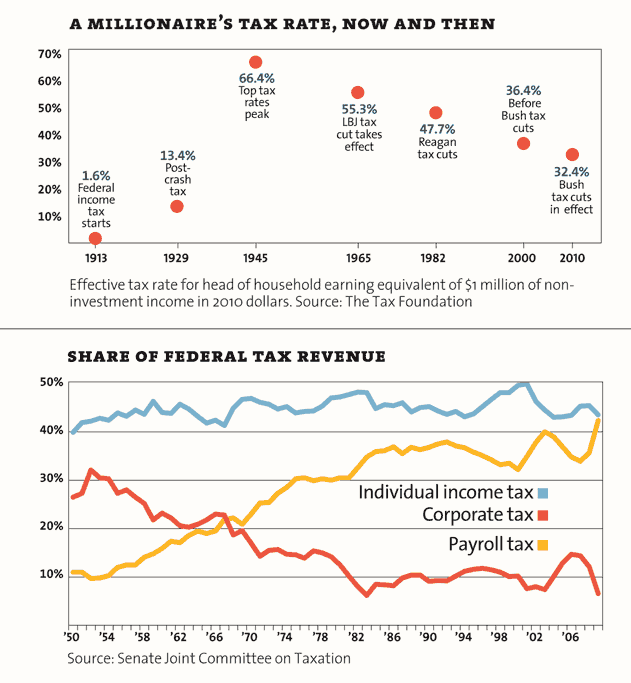
This problem has been steadily escalating for four decades. While there are some limitations to their data set, economists Thomas Piketty and Emmanuel Saez constructed income statistics based on IRS data that go back to 1913. They found that the gap between the ultra-wealthy and the rest of us is much bigger than you would think, as mapped by these graphs from the Center On Budget and Policy Priorities:


Piketty and Saez also calculated that as of September 2013 the top 1% of earners had captured 95% of all income gains since the Great Recession ended. The other 99% saw a net 12% drop to their income. So not only is oligarchy making the rich richer, it's driving policy that's made everyone else poorer.

What kind of oligarchy? As Gawker's Hamilton Nolan explains, Gilens and Page's findings provide support for two theories of governance: economic elite domination and biased pluralism. The first is pretty straightforward and states that the ultra-wealthy wield all the power in a given system, though some argue that this system still allows elites in corporations and the government to become powerful as well. Here, power does not necessarily derive from wealth, but those in power almost invariably come from the upper class. Biased pluralism on the other hand argues that the entire system is a mess and interest groups ruled by elites are fighting for dominance of the political process. Also, because of their vast wealth of resources, interest groups of large business tend to dominate a lot of the discourse. America, the findings indicate, tends towards either of these much more than anything close to what we call "democracy."

In either case, the result is the same: Big corporations, the ultra-wealthy and special interests with a lot of money and power essentially make all of the decisions. Citizens wield little to no political power. America, the findings indicate, tends towards either of these much more than anything close to what we call "democracy" — systems such as majoritarian electoral democracy or majoritarian pluralism, under which the policy choices pursued by the government would reflect the opinions of the governed.

Nothing new: And no, this isn't a problem that's the result of any recent Supreme Court cases — at least certainly not the likes FEC v. Citizens United or FEC v. McCutcheon. The data is pretty clear that America has been sliding steadily into oligarchy for decades, mirrored in both the substantive effect on policy and in the distribution of wealth throughout the U.S. But cases like those might indicate the process is accelerating.

"Perhaps economic elites and interest group leaders enjoy greater policy expertise than the average citizen does," Gilens and Page write. "Perhaps they know better which policies will benefit everyone, and perhaps they seek the common good, rather than selfish ends, when deciding which policies to support.

"But we tend to doubt it."

Wednesday, April 9, 2014

8 Headlines the Mainstream Media Doesn’t Have the Balls to Print

Paul Buchheit
RINF Alternative News

The following are all relevant, fact-based issues, the “hard news” stories that the media has a responsibility to report. But the business-oriented press generally avoids them.

1. U.S. Wealth Up $34 Trillion Since Recession. 93% of You Got Almost None of It.
That’s an average of $100,000 for every American. But the people who already own most of the stocks took almost all of it. For them, the average gain was well over a million dollars — tax-free as long as they don’t cash it in. Details available here.

2. Eight Rich Americans Made More Than 3.6 Million Minimum Wage Workers
A recent report stated that no full-time minimum wage worker in the U.S. can afford a one-bedroom or two-bedroom rental at fair market rent. There are 3.6 million such workers, and their total (combined) 2013 earnings is less than the 2013 stock market gains of just eight Americans, all of whom take more than their share from society: the four Waltons, the two Kochs, Bill Gates, and Warren Buffett.

3. News Sources Speak for the 5%
It would be refreshing to read an honest editorial: “We dearly value the 5 to 7 percent of our readers who make a lot of money and believe that their growing riches are helping everyone else.”

Instead, the business media seems unable to differentiate between the top 5 percent and the rest of society. The Wall Street Journal exclaimed, “Middle-class Americans have more buying power than ever before,” and then went on to sputter: “What Recession?…The economy has bounced back from recession, unemployment has declined..”

The Chicago Tribune may be even further out of touch with its less privileged readers, asking them: “What’s so terrible about the infusion of so much money into the presidential campaign?”

4. TV News Dumbed Down for American Viewers
A 2009 survey by the European Journal of Communication compared the U.S. to Denmark, Finland, and the UK in the awareness and reporting of domestic vs. international news, and of ‘hard’ news (politics, public administration, the economy, science, technology) vs. ‘soft’ news (celebrities, human interest, sport and entertainment). 

The results:
  • Americans [are] especially uninformed about international public affairs.
  • American respondents also underperformed in relation to domestic-related hard news stories.
  • American television reports much less international news than Finnish, Danish and British television;
  • American television network newscasts also report much less hard news than Finnish and Danish television.

Surprisingly, the report states that “our sample of American newspapers was more oriented towards hard news than their counterparts in the European countries.” Too bad Americans are reading less newspapers.

5. News Execs among White Male Boomers Who Owe Trillions to Society
The hype about the “self-made man” is fantasy. In the early 1970s, we privileged white males were spirited out of college to waiting jobs in management and finance, technology was inventing new ways for us to make money, tax rates were about to tumble, and visions of bonuses and capital gains danced in our heads.

While we were in school the Defense Department had been preparing the Internet for Microsoft and Apple, the National Science Foundation was funding the Digital Library Initiativeresearch that would be adopted as the Google model, and the National Institute of Health was doing the early laboratory testing for companies like Merck and Pfizer. Government research labs and public universities trained thousands of chemists, physicists, chip designers, programmers, engineers, production line workers, market analysts, testers, troubleshooters, etc., etc.

All we created on our own was a disdainful attitude, like that of Steve Jobs: “We have always been shameless about stealing great ideas.”

6. Funding Plummets for Schools and Pensions as Corporations Stop Paying Taxes
Three separate studies have shown that corporations pay less than half of their required state taxes, which are the main source of K-12 educational funding and a significant part of pension funding. Most recently, the report ”The Disappearing Corporate Tax Base” found that the percentage of corporate profits paid as state income taxes has dropped from 7 percent in 1980 to about 3 percent today.

7. Companies Based in the U.S. Paying Most of their Taxes Overseas
Citigroup had 42% of its 2011-13 revenue in North America (almost all U.S.) and made $32 billion in profits, but received a U.S. current income tax benefit all three years.

Pfizer had 40% of its 2011-13 revenues and nearly half of its physical assets in the U.S., but declared almost $10 billion in U.S. losses to go along with nearly $50 billion in foreign profits.

In 2013 Exxon had about 43% of management, 36% of sales, 40% of long-lived assets, and 70-90% of its productive oil and gas wells in the U.S., yet only paid about 2 percent of its total income in U.S. income taxes, and most of that was something called a “theoretical” tax.

8. Restaurant Servers Go Without Raise for 30 Years
An evaluation by Michelle Chen showed that the minimum wage for tipped workers has been approximately $2 an hour since the 1980s. She also notes that about 40 percent of these workers are people of color, and about two-thirds are women.

Saturday, March 15, 2014

Why Society Is More Unequal Than Ever


Five years after The Spirit Level, its authors argue that research backs up their views on the iniquity of inequality

by Richard Wilkinson and Kate Pickett
 
A lot has happened in the five years since we published our book, The Spirit Level. New Labour were still perhaps too relaxed about people becoming "filthy rich". And there was an assumption that inequality mattered only if it increased poverty, and that for most people "real" poverty was a thing of the past.

But so much has changed. In the aftermath of the financial crash and the emergence of Occupy, there has been a resurgence of interest in inequality. Around 80% of Britons now think the income gap is too large, and the message has been taken up by world leaders.

According to Barack Obama, income inequality is the "defining challenge of our times", while Pope Francis states that "inequality is the roots of social ills".

The unexpected success of The Spirit Level owes more to luck than judgment. Although serious non-fiction books rarely sell well, for a week or so we even outsold Jeremy Clarkson. We now feel a bit like the dog being wagged by its tail: in the past five years, we've given over 700 seminars and conference lectures. We've talked to academics, religious groups, thinktanks of both right and left, and to international agencies such as the UN, WHO, OECD, EU and ILO.

The truth is that human beings have deep-seated psychological responses to inequality and social hierarchy. The tendency to equate outward wealth with inner worth means that inequality colours our social perceptions. It invokes feelings of superiority and inferiority, dominance and subordination – which affect the way we relate to and treat each other.

As we looked at the data, it became clear that, as well as health and violence, almost all the problems that are more common at the bottom of the social ladder are more common in more unequal societies – including mental illness, drug addiction, obesity, loss of community life, imprisonment, unequal opportunities and poorer wellbeing for children. The effects of inequality are not confined to the poor. A growing body of research shows that inequality damages the social fabric of the whole society. When he found how far up the income scale the health effects of inequality went, Harvard professor Ichiro Kawachi, one of the foremost researchers in this field, described inequality as a social pollutant. The health and social problems we looked at are between twice and 10 times as common in more unequal societies. The differences are so large because inequality affects such a large proportion of the population.

To the political defenders of inequality, the idea that too much inequality was an obstacle to a better society was a monstrous suggestion. They accused us of conjuring up the evidence with smoke and mirrors.
But since our book, research confirming both the basic pattern and the social mechanisms has mushroomed. It's not just rich countries or US states where greater equality is beneficial, it is also important in poorer countries. Even the more equal provinces of China do better than the less equal ones.

Most important has been the rapid accumulation of evidence confirming the psychosocial processes through which inequality gets under the skin. When we were writing, evidence of causality often relied on psychological experiments that showed how extraordinarily sensitive people are to being looked down on and regarded as inferior.

They demonstrated that social relationships, insecurities about social status and how others see us have powerful effects on stress, cognitive performance and the emotions. Almost absent were studies explicitly linking income inequality to these psychological states in whole societies. But new studies have now filled that gap. That inequality damages family life is shown by higher rates of child abuse, and increased status competition is likely to explain the higher rates of bullying confirmed in schools in more unequal countries.
We showed that mental illnesses are more prevalent in more unequal societies: this has now been confirmed by more specific studies of depression and schizophrenia, as well as by evidence that your income ranking is a better predictor of developing illness than your absolute income.

Strengthening community life is hampered by the difficulty of breaking the ice between people, but greater inequality amplifies the impression that some people are worth so much more than others, making us all more anxious about how we are seen and judged. Some are so overcome by lack of confidence that social contact becomes an ordeal. Others try instead to enhance self-presentation and how they appear to others. US data also show that narcissism increased in line with inequality. The economic effects of inequality have also gained more attention. Research has shown that greater inequality leads to shorter spells of economic expansion and more frequent and severe boom-and-bust cycles that make economies more vulnerable to crisis. The International Monetary Fund suggests that reducing inequality and bolstering longer-term economic growth may be "two sides of the same coin". And development experts point out how inequality compromises poverty reduction.

Lastly, inequality is being taken up as an important environmental issue; because it drives status competition, it intensifies consumerism and adds to personal debt.

In Britain, one of the few signs of real progress are the fairness commissions set up by local government in many cities to recommend ways of reducing inequalities. Partly as a result, many local authorities and companies now pay the living wage. But the coalition government has failed to reverse the continuing tendency for the richest 1% to get richer faster than the rest of society. The Equality Trust calculates that the richest 100 people in Britain now have as much wealth as the poorest 30% of households. The top-to-bottom pay ratios of around 300:1 in the FTSE 100 companies is not diminishing.

It is hard to think of a more powerful way of telling people at the bottom that they are almost worthless than to pay them one-third of one percent of what the CEO in the same company gets. Politicians must recognise that reducing inequality is about improving the psychosocial wellbeing of the whole society.

Thursday, February 6, 2014

When the Rich Write the Rules to Make Themselves Richer

The Attack of the Robots
by DEAN BAKER


Economists are not very good at economics. We know this because we had a huge housing bubble that collapsed, which almost none of them saw. The pre-crash projections from the Congressional Budget Office imply that this downturn has already cost us more than $7.6 trillion, or $25,000 per person. This could have been prevented if we had economists in policy positions who understood how the economy worked.

But even if economists aren’t very good at dealing with the economy, they still can provide value to society. In particular they can be a great source of entertainment. That’s how we should view the story that robots will take all of our jobs and leave most of the population unemployed.

This story has become a popular theme lately among Washington policy types. There are important people from across the political spectrum running around town wringing their hands over the prospect that the economy may not provide jobs for large segments of the labor force.

The first aspect of this story that should impress people is that many of the same people have been wringing their hands about the exact opposite problem, most likely without even knowing it.

Remember the story about how the aging of the baby boomers will bankrupt us because we will have too few workers to support the surge of retired baby boomers?

In that story, all of us aging baby boomers will be left waiting around for someone to change our bedpans. But now we are supposed to be worried that we won’t have any work for people to do because the robots will be there to do it faster and cheaper.

Either of these stories could in principle be true, but they cannot both be true. If robots are capable of doing most of the tasks that humans now do, then we don’t have to worry about declining ratios of workers to retirees. We will have plenty of robots to do the work for us.

Alternatively, if we are facing labor shortages because there are too few workers to support a growing population of retirees, then clearly robots will not have taken everyone’s job. At worst we have to worry about one of these problems, but not both.

Let’s assume robots are the problem. This would actually not be a new story. The robots might be new, but this is the story of productivity growth that we have dealt with for centuries. Ordinarily we think productivity growth makes us richer, since we can produce more goods or services in every hour of work. This can lead to rising pay and living standards or alternatively more leisure time.

However, the robot story is somewhat different or so its proponents would claim. Robots are supposed to lead to such rapid increases in productivity that there will be no way for all the displaced workers to be reemployed. The problem in this case is not productivity; rather the problem is that all the benefits are going to the owners of the robots.

Before evaluating the logic of this one, it’s first worth noting that we have yet to see any evidence to back up this picture of the economy. In the last six years, productivity growth has been notably slower than in the years from the beginning of the productivity speed-up in 1995 to the beginning of the downturn in 2008. There also is no evidence that robots and other technological change is responsible for the upward distribution of income in the last three decades.

But there is a more fundamental problem with this robot-driven inequality story. The owners of the robots won’t directly get rich from owning the machines: robots will presumably be relatively cheap to make. After all, we can have robots make them. If the owners of robots get really rich it will be because the government has given them patent monopolies so that they can collect lots of money from anyone who wants to buy or build a robot.

Patents are not given to us by the gods or nature, we write patent laws. If patent monopolies are making most of us poor and a small number rich, then we can just write the laws differently. It’s very simple; we make patents shorter and weaker. That could mean 10 years rather than 20 years. And perhaps more importantly, we make patent enforcement more difficult.

That means interpreting the patents more narrowly. For example, the next time some character like Jeff Bezos tries to claim a patent on something like one-click shopping, we not only turn down his patent suit, but we fine him really big bucks for trying to beat his competitors in the courts rather than the marketplace and for wasting everyone’s time.

If we adjust patent laws to better serve the economy we can ensure that robots and other technological breakthroughs make most of the world richer not poorer. The economists might tell us that the problem of inequality is just the natural progress of technology and the economy, but the bubble and its collapse should have taught us better than to take this crew seriously. The problem is really just one of the rich writing the rules to make themselves richer.

Saturday, January 25, 2014

Why There's No Outcry


People ask me all the time why we don’t have a revolution in America, or at least a major wave of reform similar to that of the Progressive Era or the New Deal or the Great Society.

Middle incomes are sinking, the ranks of the poor are swelling, almost all the economic gains are going to the top, and big money is corrupting our democracy. So why isn’t there more of a ruckus?

The answer is complex, but three reasons stand out.

First, the working class is paralyzed with fear it will lose the jobs and wages it already has.

In earlier decades, the working class fomented reform. The labor movement led the charge for a minimum wage, 40-hour workweek, unemployment insurance, and Social Security.

No longer. Working people don’t dare. The share of working-age Americans holding jobs is now lower than at any time in the last three decades and 76 percent of them are living paycheck to paycheck.

No one has any job security. The last thing they want to do is make a fuss and risk losing the little they have.

Besides, their major means of organizing themselves — labor unions — have been decimated. Four decades ago more than a third of private-sector workers were unionized. Now, fewer than 7 percent belong to a union.

Second, students don’t dare rock the boat.

In prior decades students were a major force for social change. They played an active role in the Civil Rights movement, the Free Speech movement, and against the Vietnam War.

But today’s students don’t want to make a ruckus. They’re laden with debt. Since 1999, student debt has increased more than 500 percent, yet the average starting salary for graduates has dropped 10 percent, adjusted for inflation. Student debts can’t be cancelled in bankruptcy. A default brings penalties and ruins a credit rating.

To make matters worse, the job market for new graduates remains lousy. Which is why record numbers are still living at home.

Reformers and revolutionaries don’t look forward to living with mom and dad or worrying about credit ratings and job recommendations.

Third and finally, the American public has become so cynical about government that many no longer think reform is possible.

When asked if they believe government will do the right thing most of the time, fewer than 20 percent of Americans agree. Fifty years ago, when that question was first asked on standard surveys, more than 75 percent agreed.

It’s hard to get people worked up to change society or even to change a few laws when they don’t believe government can possibly work.

You’d have to believe in a giant conspiracy to think this was all the doing of the forces in America most resistant to positive social change.

It’s possible. of course, that they intentionally cut jobs and wages so much as to cow average workers, buried students under so much debt they’d never take to the streets, and made most Americans so cynical about government they wouldn’t even try to for change.

But it’s more likely they merely allowed all this to unfold, like a giant wet blanket over the outrage and indignation most Americans feel but don’t express.

Change is coming anyway. We cannot abide an ever-greater share of the nation’s income and wealth going to the top while median household incomes continue too drop, one out of five of our children living in dire poverty, and big money taking over our democracy.

At some point, working people, students, and the broad public will have had enough. They will reclaim our economy and our democracy. This has been the central lesson of American history.

Reform is less risky than revolution, but the longer we wait the more likely it will be the latter.

Tuesday, January 21, 2014

Another Huge Wealth Grab by the Rich


by Paul Buchheit
 
It was shown in a recent report that the richest Americans have made millions from their stock holdings since the recession.

 It's getting worse. The facts are summarized here, and presented in greater detail at Us Against Greed.

1. Just 13 Americans Made More from Their Investments in 2013 than the Entire SNAP Budget
Some wealthy Americans like to refer to themselves as "makers," and food stamp recipients as "takers," even though most of the latter are children, the elderly, or low-wage workers. Many of the top 13 on the Forbes list did not make anything of significance in 2013. Yet by being heavily invested in the stock market they were able to take $80 billion among them, more than a year of food stamps for almost 50 million people.

2. The Richest 400 Took $300 Billion in 2013, Approximately the ENTIRE Safety Net
The total budget for SNAP, WIC (Women, Infants, children), Child Nutrition, Earned Income Tax Credit, Supplemental Security Income, Temporary Assistance for Needy Families, and Housing is less than the $300 billion 'earned' by the Forbes 400.

3. The Richest 12,000 Families are Estimated to have Each Made $40 Million in the Past Year
The stock market grew by $4.7 trillion in 2013. The richest 1% owns about 38% of all stocks, or about $1.8 trillion of the 2013 gain.
At the lofty levels of the unimaginably rich, the takings of the .1% (120,000 households), and even moreso of the .01% (12,000 households), become progressively greater and greater for the very richest households (unlike their taxes). According to wealth data compiled by Kopczuk and Saez, each member of the elite .01% group owns about 40 times the wealth of an average member of the richest one percent. Assuming that this ratio holds for accumulated 2013 wealth, each of the 12,000 super-rich American families made about $40 million in just one year. This is not an unreasonable conclusion, in light of the average gain of $750 million for each member of the Forbes 400.

4. The Richest 400 Individuals Own More Than Three-Fifths of America
The richest 400 now own over $2 trillion among them, or about 2.8% of the country's wealth of $72 trillion. This is more than the holdings of three-fifths of America, or 72 million families.

Conclusion: The System Is Broken
The overall calculations reveal that, to the best approximation:
--The richest 400 individuals made an average of $750,000,000 each in 2013.
--The .01% (12,000 families) made about $40,000,000 each.
--The .1% (120,000 families) made about $3,600,000 each.
--The rest of the 1% (1,068,000 families) made over $830,000 each.
--The 2-5% (4,800,000 households) made about $300,000 each.
--The 6-10% (6,000,000 households) made about $95,000 each.
--The 11-20% (12,000,000 households) made about $39,000 each.
--The 21-40% (24,000,000 households) made about $13,000 each.
--The 41-60% (24,000,000 households) made about $4,000 each.
--The 61-80% (24,000,000 households) made about $333 each.
--The bottom 20% (24,000,000 households) made nothing.
Capitalism is supposed to provide everyone the opportunity to benefit from our country's productivity. But it hasn't worked that way for the past 35 years. Today only the people who already have money can increase their wealth. Congress doesn't seem to recognize, or doesn't care, that the system is horribly distorted in favor of a small group of people who need to do very little to take most of the wealth.

Sunday, May 5, 2013

Hypocrites With Fat Wallets: CEOs Want It All

Sunday, 05 May 2013 | By Sam Pizzigati, Inequality.org

America’s top corporate executives love lecturing the rest of us about ‘fiscal responsibility.’ They want us to expect less from government. But they expect more, and a new report shows how they’re getting it.

Last week, federal unemployment benefits for the 400,000 Californians out of work since last fall dropped almost 18 percent, a $52 cut out of an average $297 weekly check. Similar cuts have already started rolling out in other states.

In all, 3.8 million long-term unemployed Americans will on average lose near $1,000 each by September 30, the date that ends the 2012 federal fiscal year.

The direct cause of all these cuts: the “sequester,” the $85 billion in federal austerity budget reductions that kicked in this past March 1.

Who deserves the “credit” for this meat-axe sequester? Credit the power suits who occupy Corporate America’s loftiest executive suites. These top corporate executives — organized in groups like “Fix the Debt” and the Business Roundtable — have been lobbying relentlessly for deep cuts in federal spending.

Only significant cutbacks in programs near and dear to average Americans, these executives proclaim, can save the nation from debt disaster.

But these same top executives, says a new report released last week, are actually running up the federal debt — purely to enrich themselves.

The giant firms these execs manage, details this new report from the Institute for Policy Studies and the Campaign for America’s Future, “are exploiting the U.S. tax code to send taxpayers the bill for the huge rewards they’re doling out to their top executives.”

How huge do these rewards go? UnitedHealth Group CEO Stephen Hemsley, a “Fix the Debt” endorser, pulled in $199 million between 2009 and 2011.

A convenient federal tax loophole — in place since 1993 — let UnitedHealth deduct $194 million of that windfall compensation on its corporate tax return. That deduction, in turn, saved UnitedHealth — and denied the federal treasury — $68 million, enough to extend full federal unemployment benefits for the rest of the 2013 fiscal year to over 65,000 jobless Americans.

The loophole UnitedHealth so lucratively exploited lets companies deduct off their taxes every dollar of “performance pay” they shovel into their executives’ personal pockets. UnitedHealth, of course, hardly stands alone here. All American corporate and banking giants play the “performance pay” game.

The 90 giant firms that belong to “Fix the Debt” play the game particularly well. Between 2009 and 2011, the deductions these 90 claimed for top executive “performance pay” added at least $953 million — and maybe as much as $1.6 billion — to America’s national debt.

The U.S. tax code’s exceedingly bountiful “performance pay” loophole has its roots in an earlier epoch of American public outrage at excessive CEO pay. Back in 1992, Bill Clinton campaigned against over-the-top executive pay in his drive for the White House. Congress, just months after Clinton’s inauguration, would go on to pass legislation that lawmakers hailed as a check on CEO excess.

The new law allowed corporations to deduct off their taxes no more than $1 million in compensation per executive. But the law had a huge escape hatch. Firms could exempt any “performance-based” pay from the $1 million limit.

The predictable result? An explosion of “performance-based” compensation, particularly in the form of stock options, an explosion that would keep CEO pay soaring. CEOs had been averaging 42 times U.S. worker pay in 1982. By 1992, the gap had jumped to 201 times. The average gap today: 354 times.

The “performance pay” loophole, the new Institute for Policy Studies and the Campaign for America’s Future report stresses, has served “as a critical subsidy for excessive compensation.”

“The larger the executive payout, the less the corporation pays in taxes,” the report explains. “And average taxpayers wind up footing the bill.”

That footing would end if legislation Representative Barbara Lee from California has introduced ever became law. Her Income Equity Act would deny corporations a tax deduction on any executive compensation that runs over 25 times the pay of a company’s lowest-paid workers or $500,000.

Interestingly, the Affordable Health Care Act enacted in President Obama’s first term sets a $500,000 cap, effective this year, on how much health insurers like UnitedHealth can deduct for executive compensation.

With this cap now law for health care execs, notes the new Institute for Policy Studies and the Campaign for America’s Future report, “taxpayers won’t have to worry so much about their hard-earned dollars going to subsidize fat paychecks for CEOs like Stephen Hemsley of UnitedHealth.”

“But,” sums up the study, “taxpayers may want to wonder why — at a time of scarce government resources — their tax dollars are subsidizing fat paychecks at any American corporate giant.”

Saturday, May 4, 2013

Average Income For The Bottom 90 Percent Of Americans Grew Just $59 In 40 Years

By Travis Waldron | ThinkProgress

The top 10 percent of Americans have experienced rapid income growth over the last 40 years, but the bottom 90 percent haven’t been so lucky. In fact, average income rose just $59 from 1966 to 2011 for the bottom 90 percent once those incomes were adjusted for inflation.

That’s according to a new study of tax data from David Cay Johnston, who won a Pulitzer Prize for his writing about tax policy. While the bottom 90 percent’s incomes rose just $59, the top 10 percent fared much better, he found:
In 2011 the average AGI of the vast majority fell to $30,437 per taxpayer, its lowest level since 1966 when measured in 2011 dollars. The vast majority averaged a mere $59 more in 2011 than in 1966. For the top 10 percent, by the same measures, average income rose by $116,071 to $254,864, an increase of 84 percent over 1966.

The difference in those gains has reduced the share of income the bottom 90 percent holds as well. That segment held two-thirds of all household income in 1966 but just 51.8 percent in 2011, Cay Johnston found. Other studies have had similar results. One study found that pay for chief executives increased 127 times faster than worker pay over the last 30 years, and official data has shown worker wages stagnating since the 1970s. That has led to a sharp increase in American income inequality, which now rivals rates from countries like the Ivory Coast and Pakistan.

The biggest driver in that disparity, Cay Johnston wrote, was not that the rich were working harder, “but the shift of income from labor to capital and changes in federal income, gift, and estate tax rules.” Indeed, the estate tax has been eased over recent decades and federal income taxes have become more favorable to the wealthy thanks to breaks for investment income. A recent study, in fact, found that the capital gains tax cut, which benefits the wealthy but does virtually nothing for everyone else, was “by far” the biggest driver in the growth of American income inequality. (HT: Huffington Post)

Sunday, April 28, 2013

Recovery for the 7 Percent

April 28, 2013 — Paul Craig Roberts

“From the end of the recession in 2009 through 2011 (the last year for which Census Bureau wealth data are available), the 8 million households in the U.S. with a net worth above $836,033 saw their aggregate wealth rise by an estimated $5.6 trillion, while the 111 million households with a net worth at or below that level saw their aggregate wealth decline by an estimated $600 billion.” ~ Pew Research, An Uneven Recovery, by Richard Fry and Paul Taylor.

Since the recession was officially declared to be over in June 2009, I have assured readers that there has been no recovery. Gerald Celente, John Williams (shadowstats.com), and no doubt others have also made it clear that the alleged recovery is an artifact of an understated inflation rate that produces an image of real economic growth.

Now comes the Pew Research Center with its conclusion that the recession ended only for the top 7 percent of households that have substantial holdings of stocks and bonds. The other 93% of the American population is still in recession.

The Pew report attributes the recovery for the affluent to the rise in the stock and bond markets, but does not say what caused these markets to rise.

The stock market’s recovery does not reflect rising consumer purchasing power and retail sales. The labor force is shrinking, not growing. Job growth lags population growth, and the few jobs that are created are primarily dead-end jobs in lowly paid domestic services. Retail sales adjusted for inflation and real median household income have been bottom bouncing since 2009.

To the extent that there is profit growth in US corporations, it comes from labor cost savings from offshoring US jobs and from bringing in foreign workers on work visas. By lowering labor costs, corporations boost profits and thereby capital gains for those 7 percent who have large holdings of financial assets. Those in the 93 percent who are displaced by foreign workers experience income reductions. This transfer of the incomes of the 93 percent to the 7 percent via jobs offshoring and work visas is the reason for the stark rise in US income inequality.
Another source of the stock market’s rise is the Federal Reserve’s policy of quantitative easing, that is, the printing of $1,000 billion dollars annually with which to support the too-big-to-fail banks’ balance sheets and to finance the federal budget deficit. The cash that the Fed is pouring into the banks is not finding its way into business and consumer loans, but the money is available for the banks to speculate in derivatives and stock market futures. Thus, the Fed’s policy, which is directed at keeping afloat a few oversized banks, also benefits the 7 percent by driving up the value of their stock portfolios.

The reason bond prices are so high that real interest rates are negative is that the Fed is purchasing $1,000 billion of mortgage-backed “securities” and US Treasury debt annually. The lower the Fed forces interest rates, the higher go bond prices. If you are among the 7 percent, the Fed has produced capital gains for your bond portfolio. But if you are a saver among the 93 percent, you are losing purchasing power because the interest you receive is less than the rate of inflation.

The Pew report puts it this way: Since the “recovery” that began in June 2009, wealthy households experienced a 28 percent rise in their net worth, while everyone else lost 4 percent of their assets.

Is this the profile of a democracy in which government serves the public interest, or is it the profile of a financial aristocracy that uses government to grind the population under foot?

Wednesday, February 6, 2013

Corporate Personhood and the Culture of Pathology

Morality Turned Upside Down
by NOZOMI HAYASE


With drone attacks, torture and drug money laundering, the interlocking network of the corporate military-industrial complex and banking cartels continue the age-old Western pattern of colonization around the world. From Iraq to Afghanistan; from Lybia to Mali, bloody resource wars are camouflaged behind the fear-based rhetoric of ‘national security’ and ‘humanitarian intervention’.

Western societies are rapidly losing their moral center. The employment of reason in the majority of society now seems divorced from the basic capacity for empathy. Government war criminals walk free, while whistleblowers reporting their crimes are punished. Bankers who commit massive fraud are bailed out while taxpayers have their futures foreclosed. When a culture rewards selfish deeds and immunizes the criminal acts of its leaders, it skews the norm toward depravity. How has this happened? How is it that Western civilization has devolved into something like a global rouge state?

Michael Nagler, professor and peace activist once said, “There is something deeper than our culture (at the root of the problem) and that is our spiritual predisposition, which means who we think we are”. We have seen deeply embedded racism, growing exploitation and militarism and an explosion of the gap between the rich and poor. So many social problems that have manifested in the world throughout the last century seem to have radiated from a particular view of humanity.

The State of Power 2013 report reveals the concentration of wealth and power in the world. Fewer than 1% of the world’s transnational corporations, mostly banks, control 40% of global businesses. .001% of the population control assets worth $14.6 trillion — or over 20% of the world’s annual GDP. Corporate institutions, with a narrow mandate of maximizing profit at great human or environmental cost are the real governing forces in most countries, controlling health, safety, environment, monetary systems and food supplies. This is affecting all aspects of our lives.

We are born into a corporate state. Children as early as three are prey to corporate marketing. Education in America and abroad has become a dumbing-down of creativity and reduced to a simple vocational training. Critical thinking is discouraged and most schools just offer skills for serving the corporate work force. The corporate-consumer mindset has grown exponentially and has insidiously worked itself into the very fabric of life.

The first beginnings of this ever-increasing spread of corporate power can be traced back to a pivotal moment in US history, when a little known Supreme Court clerk made a notation from an off-hand comment of a Supreme Court Judge in 1886, which launched the legal fiction of corporate personhood. Economist and author, David Korten (2000) outlined this crucial turning point:

“In 1886, . . . in the case of Santa Clara County v. Southern Pacific Railroad Company, the U.S. Supreme Court decided that a private corporation is a person and entitled to the legal rights and protections the Constitutions affords to any person. …Thus it was that a two-sentence [off hand] assertion by a single judge elevated corporations to the status of persons under the law, prepared the way for the rise of global corporate rule, and thereby changed the course of history”. (pp. 185-186)

With this ruling, corporations were granted the Constitutional rights of personhood under the equal protection clause of the Constitution. Ever since then, corporations and the men that serve them have successfully drawn the notion of “We the People” in a direction determined by corporate motives of ‘profit at any cost.’ By defining these entities as artificial persons (corporations are not actual human beings), no one can be held accountable for their actions. Yet, they are afforded the freedoms and protections that the Constitution guarantees for each person, while wielding enormous power and resources not available to any one person.

Corporations were initially granted existence with short-term charters meant to serve the community. They often involved large projects such as building a bridge or a railroad. Then over time, through a series of legal maneuvers and this constructed fiction of corporate personhood, the tendency to monopolize markets through ever-expanding growth was cemented. Then, self-preservation was incorporated into their very structure. When the law of limited-liability and hierarchical style of management were implemented, the corporate character became prone to excess.

The ‘corporate mentality’ that has evolved now serves only selfish and narrow interests. The system filters out those CEOs and board members who don’t exhibit this kind of ruthless character. Thus, the people at the top tend to be those who have developed this limited mentality. The end result is a small number of giant companies that gain more money and power than whole countries.

The transnational corporation, with limited liability, an ethos of profit at any cost and the drive for insatiable expansion has become a callous machine. When these patterns of behavior are carefully examined, they can be seen as pathological in nature. The 2003 documentary film The Corporation  psychoanalyzed the actions and patterns of this historically unique entity as if it were a person. It examined the personality and characteristic attributes of the corporation and concluded that its psychological orientation is a textbook example of a psychopath. It consistently meets the diagnostic criteria of psychopaths designated in the DSM-IV, namely a lack of empathy, conscience, the incapacity to feel guilt, as well as a callous disregard for safety of others.

Psychoanalyst Adolf Guggenbuhl-Craig (1990) said the defining characteristic of the psychopath is someone that does not have a capacity to feel guilt. He described how an element that “connects us to our environment” (p. 89) is lacking, then, manipulation, control and domination will take over (p. 92). He noted that many researchers recognized this lack of connection as primary characteristic of psychopathy.

Aside from the psychopathic element, the behaviors of corporate entities seem to consistently exhibit behavioral traits of a soul driven to addiction. In the thirst for ever-expanding material accumulation, we can see an internal hunger that is seemingly never satisfied. Like addicts that engage in destructive behaviors, lust for greed and power becomes an uncontrollable force and in many cases spins out of control.

Canadian physician Gabor Maté used the Buddhist mandala, the wheel of life as metaphor. He described addicts as inhabitants of the realm of hungry ghosts or the Buddhist version of hell:

“…. the creatures in it are depicted as people with large empty bellies, small mouths and scrawny thin necks. They can never get enough satisfaction. They can never fill their bellies. They’re always hungry, always empty, always seeking it from the outside. That speaks to a part of us that I have and everybody in our society has, where we want satisfaction from the outside, where we’re empty, where we want to be soothed by something in the short term, but we can never feel that or fulfill that insatiety from the outside. The addicts are in that realm all the time”.

Corporate personhood sucks people into this false caricature of humanity and tends to shape their wills within the restricted neuro-pathways that repeat a vicious circle of obsessive pursuit of profits. Hungry ghosts, with their pathological need to fill ever-empty stomachs, will do anything for that goal at the expense of all others. Anyone who has lived with an addict understands how destructive their behaviors can be to those around them.

Huge segments of society have become cogs in the corporate machine. They are trained to execute efficiency through blocking feelings for their environment and care for others. This process divorces them from the development of social morality and they remain cut off from the consequences of their actions.

On January 21, 2010, the increase of corporate influence in political and social life reached a zenith in the US, with the ruling in Citizens United v. Federal Election Commission. The Supreme Court proclaimed that corporations are persons, entitled by the U.S. Constitution with their massive wealth to buy elections and run governments from behind a curtain of anonymity.

Unchecked corporate power is expanding around the globe. It seems to have morphed into a force of exploitation, similar to colonialism. Transnational corporations jump between countries; to China and Mexico for cheap labor and to occupation Green Zones like the Las Vegas of Baghdad, where the water of life decays into the Black-water of death. The corporate-state subverts laws and political structures and has turned the living earth into a materialized playground for consumption and exploitation. It seduces people to the vapid and soulless pursuit of power and preaches eternal life in the material kingdom. This artificial person pulls human beings into a false conception of their own humanity, one that is essentially inhuman.

When culture becomes pathological, morality is turned upside down. Cruelty and dehumanizing behaviors are rewarded, while kindness, justice and compassion are punished. Maté (2010) described the root cause of addictive behaviors: “At the core of all addictions there lies a spiritual void.” (p. 83). He explained how “Addiction floods in where self-knowledge — and therefore divine knowledge — are missing. To fill the unendurable void, we become attached to things of the world that cannot possibly compensate us for the loss of who we are.” (p. 413).

Maybe the true nature of corporate power is that of a rootless orphan whose destructive sociopathic behavior is a desperate call to be understood. When culture becomes pathological, restoring sanity starts from each person deeply connecting with what makes them truly human; what makes them real. Only then can we transform and heal our brutal, pathological society and create a humane culture embedded in communal values and connection to the earth.


References:
Guggenbuhl-Craig, A. (1999). The emptied soul: On the nature of the psychopath. Woodstock, CT: Spring.
Korten D. (2000). The post- corporate world, life after capitalism. SF: Berrett Koehler Publishers.
Mate, G. (2010). In the realm of hungry ghosts: Close encounters with addiction. Berkeley, CA: North Atlantic Books.