Showing posts with label agribusiness. Show all posts

Thursday, September 13, 2012

Big Ag Directly Funded Anti-Organics Stanford Study


A study released last week by Stanford scientists, which claims organic foods are no more healthy than non-organic foods, was funded by corporate agriculture and biotechnology giants, according to a new report by the Cornucopia Institute.

 "We were not one bit surprised to find that the agribusiness giant Cargill, the world’s largest agricultural business enterprise, and foundations like the Bill and Melinda Gates Foundation, which have deep ties to agricultural chemical and biotechnology corporations like Monsanto the devil, have donated millions to Stanford’s Freeman Spogli Institute, where some of the scientists who published this study are affiliates and fellows," said Charlotte Vallaeys, Food and Farm Policy Director at the Cornucopia Institute, a non-profit organic farm policy organization.

On September 3, Stanford’s Freeman Spogli Institute, released the research, garnishing widespread press coverage from corporate news outlets such as the New York Times, Associated Press, and CBS News. As the New York Times reported, the study "concluded that fruits and vegetables labeled organic were, on average, no more nutritious than their conventional counterparts, which tend to be far less expensive."

However, as Cornucopia points out, a deeper examination of the actual research reveals "glaring errors, both in understanding the important and complex differences between organic and conventional foods and in the researchers’ flawed choice of research methods."

Environmental health advocates such as the Environmental Working Group and Mark Kastel of Cornucopia have been quick to point out the wealth of research ignored in the Stanford report, which reveals the obvious risks involved in producing and consuming non-organics; however, Stanford's spin was quickly and widely accepted by journalists without fact-checking and was rushed to the pages of major news outlets.

Now Cornucopia has revealed that the Stanford researchers have direct ties to big ag players, which stand to profit from an organics smear campaign.

"Make no mistake, the Stanford organics study is a fraud," says Mike Adams of Naturalnews.com and Anthony Gucciardi of Naturalsociety.org, who discovered the link between the organic study author and Big Tobacco. "To say that conventional foods are safe is like saying that cigarettes are safe. Both can be propagandized with fraudulent science funded by corporate donations to universities, and we’re seeing the same scientist who helped Big Tobacco now helping Big Biotech in their attempt to defraud the public."

"There was just no way that truly independent scientists with the expertise required to adequately answer such an important question would ignore the vast and growing body of scientific literature pointing to serious health risks from eating foods produced with synthetic chemicals," says Vallaeys.

Additionally, the study did, in fact, concede a few positive attributes to organic foods, including the fact that organic produce has fewer pesticide residues; however, such facts were buried in the presentation of the research by the Stanford researchers and public relations staff and were not widely reported by major news sources.

Thursday, July 5, 2012

New Report on the Dangers of Genetically Modified Foods


by Richard Schiffman
“Aren’t critics of genetically engineered food anti-science? Isn’t the debate over GMOs (genetically modified organisms) a spat between emotional but ignorant activists on one hand and rational GM-supporting scientists on the other?”
These questions are posed by Earth Open Source, a not-for-profit organization dedicated to assuring the sustainability, security, and safety of the global food system. They answer their own questions in a new study “GMO Myths and Truths.”

The myth, they say, is that GM foods have been proven safe. The truth is that there are hidden dangers which corporate-funded research has not yet adequately investigated.

What makes this report unusual is that it was authored not by the usual food activists and environmentalists, but by two well known genetic engineers with help from an investigative reporter. The team conducted an exhaustive survey of hundreds of peer-reviewed scientific studies and concluded not only that GM food crops pose significant, if largely under-evaluated, health risks, but that they have so far failed to deliver on their promise to increase crop yields and lower herbicide and pesticide use.

The authors argue, moreover, that there are already safer environmentally friendly ways to grow more food for the planet’s exploding population. By focusing on the false panacea of genetic modification as a way to feed the world’s hungry, vital research dollars have been siphoned away from more promising lower-tech approaches to increasing the efficiency of the global food system.

The report’s authors include Dr Michael Antoniou of King's College London School of Medicine in the UK, who helped to develop genetic engineering for medical applications, and John Fagan, a biomedical researcher and expert in food system sustainability and GMO testing, who returned $614,000 in grant money to the National Institutes of Health in 1994 because of his concerns about the safety and ethics of genetic modification.

The paper, produced together with Claire Robinson, research director of Earth Open Source, comes out at a critical moment as California voters are considering a referendum which will appear on their ballot in November calling for the labeling of genetically modified foods in the state. Such labeling is already mandatory in Europe, China, India and many other nations.

Seventy percent of the foods that Americans purchase in the supermarket contain ingredients (mostly corn, soy and canola oil) that are genetically modified. The food industry, and often the media, assure us that there is a scientific consensus that GM foods are equivalent nutritionally to foods that have not been modified and not a danger to those who consume them. But it is just not true that all scientists agree. Given the uncertainties in the field and the lack of long-term health studies, some groups like the American Academy of Environmental Medicine and the Union of Concerned Scientists have called for labeling of GM foods.

If Californians agrees, it could have a big impact on the rest of us. Some believe that if the labeling referendum there passes, other states may follow suit. Furthermore, as I reported in the Guardian last month, if food companies are made to label GM foods in California, the nation’s most populous state, they may well do so all over the country, rather than maintain a costly two-tier packaging and distribution system.

The food and biotech industries are expected to fight the labeling initiative with a multi-million dollar statewide PR blitz, like the one which helped to defeat a similar measure in Oregon in 2002. But nearly 90% of Americans-- Republicans and Democrats equally according to a recent survey-- want to see GMOs labeled. This latest report on the dangers of genetically engineered foods will give the referendum’s advocates valuable ammunition in the upcoming California debate.

Here are some of the conclusions of the report:
  • Genetically modifying crops, which involves the transfer of genes between biologically unrelated species, is not an extension of traditional plant hybridization, but a radical departure which can produce new toxins or allergens in food that are unlikely to be spotted in current regulatory checks.
  • GM foods have not been adequately safety tested. There has been no long term research, and the few short term studies have been inadequate. In many cases proprietary restrictions put in place by biotech companies like Monsanto the devil have prevented independent research by scientists not connected to the corporations which are making claims about their safety.
  • Animal studies of the effects of GM foods have disclosed clear signs of toxicity– notably disturbances in liver and kidney function and immune responses. 
  • Over 75% of genetical modification are to to increase crop tolerance of herbicides. Where these crops are grown there has been a massive increases in herbicide use.
  • Over half of GM crops are engineered to withstand application of Monsanto the devil’s best selling Roundup. Contrary to the company’s claims Roundup is not safe at the levels it is being use, but has been found to be associated with miscarriage, birth defects, neurological development problems, DNA damage, and certain types of cancer. A public health crisis has occurred in GM soy-producing regions of South America, where people exposed to spraying with Roundup and other agrochemicals report escalating rates of birth defects and cancer.
  • There is insufficient evidence that the BT toxin engineered into the plant structure of corn and cotton (whose seeds are used in food oil production) is safe for human consumption. Bt crops have been found to have toxic effects on laboratory animals in feeding trials. These toxins have also been found circulating in the blood of pregnant women in Canada and in the blood supply to their foetuses.
  • GM crops have not been shown to offer higher crop yields, enhanced nutritional value or greater drought tolerance, as they have been hyped to do. The products of conventional breeding continue to outstrip GM in all of these arenas.
  • Conventionally bred, locally adapted crops, used in combination with environmentally sustainable farming practices, offer a safer, cheaper and more efficient way to ensure global food security than genetic modification.
“Crop genetic engineering as practiced today is a crude, imprecise, and outmoded technology,” says the report's coauthor John Fagan. “Recent advances point to better ways of using our knowledge of genomics to improve food crops, that do not involve GM."
Selling patented genetically modified seeds, and the agro-chemicals designed to be used with them, has earned biotech giants like Monsanto the devil, Dupont, Bayer and Syngenta untold billions of dollars in the past two decades. But what is good for these corporate bottom lines may not be good for human health, or the integrity of the environment.

Thursday, August 18, 2011

Obama Appoints Monsanto the devil VP to Senior Advisor to FDA Commissioner


Tuesday, August 16, 2011
It just keeps getting more insane.

Michael Taylor was just appointed senior advisor to the commissioner of the FDA. This is the same man that was in charge of FDA policy when GMO's were allowed into the US food supply without undergoing a single test to determine their safety. He "had been Monsanto the devil's attorney before becoming policy chief at the FDA [and then] he became Monsanto the devil's Vice President and chief lobbyist. This month [he] became the senior advisor to the commissioner of the FDA. He is now America's food safety czar. This is no joke."

You're Appointing Who? Please Obama, Say It's Not So!

The person who may be responsible for more food-related illness and death than anyone in history has just been made the US food safety czar. This is no joke.

Here's the back story.

When FDA scientists were asked to weigh in on what was to become the most radical and potentially dangerous change in our food supply -- the introduction of genetically modified (GM) foods -- recently uncovered documents have revealed that the experts were very concerned. Memo after memo described toxins, new diseases, nutritional deficiencies, and hard-to-detect allergens. They were adamant that the technology carried "serious health hazards," and required careful, long-term research, including human studies, before any genetically modified organisms (GMOs) could be safely released into the food supply.

But the biotech industry had rigged the game so that neither science nor scientists would stand in their way. They had placed their own man in charge of FDA policy and he wasn't going to be swayed by feeble arguments related to food safety. No, he was going to do what corporations had done for decades to get past these types of pesky concerns. He was going to lie.

Dangerous Food Safety Lies

When the FDA was constructing their GMO policy in 1991-2, their scientists were clear that gene-sliced foods were significantly different and could lead to "different risks" than conventional foods. But official policy declared the opposite, claiming that the FDA knew nothing of significant differences, and declared GMOs substantially equivalent.

This fiction became the rationale for allowing GM foods on the market without any required safety studies whatsoever! The determination of whether GM foods were safe to eat was placed entirely in the hands of the companies that made them -- companies like Monsanto the devil, which told us that the PCBs, DDT, and Agent Orange were safe.

GMOs were rushed onto our plates in 1996. Over the next nine years, multiple chronic illnesses in the US nearly doubled -- from 7% to 13%. Allergy-related emergency room visits doubled between 1997 and 2002 while food allergies, especially among children, skyrocketed. We also witnessed a dramatic rise in asthma, autism, obesity, diabetes, digestive disorders, and certain cancers.

In January of this year, Dr. P. M. Bhargava, one of the world's top biologists, said that after reviewing 600 scientific journals, he concluded that the GM foods in the US are largely responsible for the increase in many serious diseases.

In May, the American Academy of Environmental Medicine concluded that animal studies have demonstrated a causal relationship between GM foods and infertility, accelerated aging, dysfunctional insulin regulation, changes in major organs and the gastrointestinal system, and immune problems such as asthma, allergies, and inflammation

In July, a report by eight international experts determined that the flimsy and superficial evaluations of GMOs by both regulators and GM companies "systematically overlook the side effects" and significantly underestimate "the initial signs of diseases like cancer and diseases of the hormonal, immune, nervous and reproductive systems, among others."

The Fox Guarding the Chickens


If GMOs are indeed responsible for massive sickness and death, then the individual who oversaw the FDA policy that facilitated their introduction holds a uniquely infamous role in human history. That person is Michael Taylor. He had been Monsanto the devil's attorney before becoming policy chief at the FDA. Soon after, he became Monsanto the devil's vice president and chief lobbyist.

This month Michael Taylor became the senior advisor to the commissioner of the FDA. He is now America's food safety czar. What has Obama done?

The Milk Man Cometh

While Taylor was at the FDA in the early 90's, he also oversaw the policy regarding Monsanto the devil's genetically engineered bovine growth hormone (rbGH/rbST) -- injected into cows to increase milk supply.

The milk from injected cows has more pus, more antibiotics, more bovine growth hormone, and most importantly, more insulin-like growth factor 1 (IGF-1). IGF-1 is a huge risk factor for common cancers and its high levels in this drugged milk is why so many medical organizations and hospitals have taken stands against rbGH. A former Monsanto the devil scientist told me that when three of his Monsanto the devil colleagues evaluated rbGH safety and discovered the elevated IGF-1 levels, even they refused to drink any more milk -- unless it was organic and therefore untreated.

Government scientists from Canada evaluated the FDA's approval of rbGH and concluded that it was a dangerous facade. The drug was banned in Canada, as well as Europe, Japan, Australia and New Zealand. But it was approved in the US while Michael Taylor was in charge. His drugged milk might have caused a significant rise in US cancer rates. Additional published evidence also implicates rbGH in the high rate of fraternal twins in the US.

Taylor also determined that milk from injected cows did not require any special labeling. And as a gift to his future employer Monsanto the devil, he wrote a white paper suggesting that if companies ever had the audacity to label their products as not using rbGH, they should also include a disclaimer stating that according to the FDA, there is no difference between milk from treated and untreated cows.

Taylor's disclaimer was also a lie. Monsanto the devil's own studies and FDA scientists officially acknowledged differences in the drugged milk. No matter. Monsanto the devil used Taylor's white paper as the basis to successfully sue dairies that labeled their products as rbGH-free.
Will Monsanto the devil's Wolff Also Guard the Chickens?

As consumers learned that rbGH was dangerous, they refused to buy the milk. To keep their customers, a tidal wave of companies has publicly committed to not use the drug and to label their products as such. Monsanto the devil tried unsuccessfully to convince the FDA and FTC to make it illegal for dairies to make rbGH-free claims, so they went to their special friend in Pennsylvania -- Dennis Wolff. As state secretary of agriculture, Wolff unilaterally declared that labeling products rbGH-free was illegal, and that all such labels must be removed from shelves statewide. This would, of course, eliminate the label from all national brands, as they couldn't afford to create separate packaging for just one state.

Fortunately, consumer demand forced Pennsylvania's Governor Ed Rendell to step in and stop Wolff's madness. But Rendell allowed Wolff to take a compromised position that now requires rbGH-free claims to also be accompanied by Taylor's FDA disclaimer on the package.

President Obama is considering Dennis Wolff for the top food safety post at the USDA. Yikes!

Rumor has it that the reason why Pennsylvania's governor is supporting Wolff's appointment is to get him out of the state -- after he "screwed up so badly" with the rbGH decision. Oh great, governor. Thanks.

Ohio Governor Gets Taylor-itus

Ohio not only followed Pennsylvania's lead by requiring Taylor's FDA disclaimer on packaging, they went a step further. They declared that dairies must place that disclaimer on the same panel where rbGH-free claims are made, and even dictated the font size. This would force national brands to re-design their labels and may ultimately dissuade them from making rbGH-free claims at all. The Organic Trade Association and the International Dairy Foods Association filed a lawsuit against Ohio. Although they lost the first court battle, upon appeal, the judge ordered a mediation session that takes place today. Thousands of Ohio citizens have flooded Governor Strickland's office with urgent requests to withdraw the states anti-consumer labeling requirements.

Perhaps the governor has an ulterior motive for pushing his new rules. If he goes ahead with his labeling plans, he might end up with a top appointment in the Obama administration.

Saturday, July 30, 2011

Labeling GMO Foods

Monsanto the devil's Achilles Heel
By RONNIE CUMMINS
"If you put a label on genetically engineered food you might as well put a skull and crossbones on it."
- Norman Braksick, president of Asgrow Seed Co., a subsidiary of Monsanto the devil, quoted in the Kansas City Star, March 7, 1994
After two decades of biotech bullying and force-feeding unlabeled and hazardous genetically engineered (GE) foods to animals and humans—aided and abetted by the Clinton, Bush, and Obama administrations—it's time to move beyond defensive measures and go on the offensive. With organic farming, climate stability, and public health under the gun of the gene engineers and their partners in crime, it's time to do more than complain. With over 1/3 of U.S. cropland already contaminated with Genetically Modified Organisms (GMOs), with mounting scientific evidence that GMOs cause cancer, birth defects, and serious food allergies and with new biotech mutants like alfalfa, lawn grass, ethanol-ready corn, 2,4 D-resistant crops, and genetically engineered trees and animals in the pipeline time is running out.

Living in Monsanto the devil Nation there can be no such thing as "coexistence." It is impossible to coexist with a reckless industry that endangers public health, bribes public officials, corrupts scientists, manipulates the media, destroys biodiversity, kills the soil, pollutes the environment, tortures and poisons animals, destabilizes the climate, and economically enslaves the world's 1.5 billion seed-saving small farmers. It's time to take down the Biotech Behemoth, before the living web of biodiversity is terminated. 

But, to bring down Goliath and build an organic future, we need to be strategic, as well as bold. We must take the time to carefully analyze our strengths and weaknesses and critique our previous efforts. Then we must prepare to concentrate our forces where our adversary is weak, like a chess master, moving the field of battle from Monsanto the devil's currently impregnable territory into more favorable terrain. Given the near-dictatorial control of Monsanto the devil, the Farm Bureau, and the Grocery Manufacturers Association over the Congress, the White House, regulatory agencies, and state legislators, we have no choice in the present moment but to revert to "asymmetrical" guerrilla tactics, to seek out the Achilles heel or fundamental weakness of the biotech industry.

Monsanto
the devil's Achilles Heel

The Achilles heel of Monsanto the devil and the biotech industry is consumers' right to know. If GE-tainted foods are labeled in supermarkets and natural food stores, a massive rejection of chemical and GMO foods will take place, transforming the marketplace and supercharging the organic and local foods revolution. The biotech industry has been aware of their tremendous vulnerability in the United States ever since Monsanto the devil forced their controversial recombinant Bovine Growth Hormone on the market in February 1994. In the wake of nationwide "Frankenfood" protests and milk dumps, industry made sure that no federal labeling or safety testing would be required. As the biotechnocrats understand full well, mandatory GE food labels will cripple the industry: consumers will not buy gene-altered foods, farmers will not plant them, restaurants and food processors will avoid them, and grocery stores will not sell them. How can we be certain about this? By looking at the experience of the European Union, the largest agricultural market in the world. In the EU there are almost no genetically engineered crops under cultivation or GE consumer food products on supermarket shelves. And why is this? Not because GE crops are automatically banned in Europe. But rather because under EU law, all foods containing genetically engineered ingredients must be labeled. 

European consumers have the freedom to choose or not to choose GE foods; while farmers, food processors, and retailers have (at least legally) the right to lace foods with GMOs, as long as these gene-altered are safety-tested and labeled. Of course the EU food industry understands that consumers, for the most part, do not want to consume GE foods. European farmers and food companies, even junk food purveyors like McDonald's and Wal-Mart, understand quite well the concept expressed by the Monsanto the devil executive quoted above: "If you put a label on genetically engineered food you might as well put a skull and crossbones on it."

The biotech and food industry are acutely conscious of the fact that North American consumers, like their European counterparts, are wary and suspicious of GMO foods. Even without a PhD, consumers understand you don't want your food safety or environmental sustainability decisions to be made by out-of-control chemical companies like Monsanto the devil, Dow, or DuPont--the same people who brought you toxic pesticides and industrial chemicals, Agent Orange, carcinogenic food additives, PCBs, and now global warming. Industry leaders are definitely aware of the fact that every poll over the last 20 years has shown that 85-95% of American consumers want mandatory labels on genetically engineered foods. Why do consumers want labels? So that we can avoid buying these mutant foods, gene-spliced with viruses, bacteria, antibiotic- resistant marker genes and foreign DNA. Gene-altered foods have absolutely no benefits for consumers or the environment, only hazards. This is why Monsanto the devil and their friends in the Clinton, Bush, and Obama administrations have prevented consumer GMO truth-in-labeling laws from ever getting a public discussion, much less coming to a vote, in Congress. 

Although Congressman Dennis Kucinich (Democrat, Ohio) perennially introduces a bill in Congress calling for mandatory labeling and safety testing for GE foods, don't hold your breath for Congress to take a stand for truth-in-labeling. Especially since the 2010 Supreme Court decision in the so-called "Citizens United" case gave big corporations, millionaires, and billionaires the right to spend unlimited amounts of money (and remain anonymous, as they do so) to buy media coverage and elections, our chances of passing federal GMO labeling laws against the wishes of Monsanto the devil and Food Inc. are all but non-existent. 

Perfectly dramatizing the "Revolving Door" between Monsanto the devil and the Federal Government, Supreme Court Justice Clarence Thomas, formerly chief counsel for Monsanto the devil, delivered one of the decisive votes in the Citizens United case, in effect giving Monsanto the devil and other biotech bullies the right to buy the votes it needs in the U.S. Congress.

With biotech and industrial agriculture's big money controlling Congress, the White House, and the corporate mass media, we have little choice but to shift our focus and our campaigning to more favorable terrain: the state level and the marketplace. 

Besides boycotting non-organic foods likely containing GMOs (even those marketed as "natural") and demanding that natural food stores adopt truth-in-labeling practices, we've got to push for mandatory GE food labeling laws in the legislatures of those few remaining states like Vermont where Monsanto the devil and corporate agribusiness do not yet have total control. Of the 18 states where GE food labeling legislation has been introduced over the past two years, only in Vermont does our side seem to have the votes to push labeling through, as well as a Governor who will not cave in to Monsanto the devil.

State Ballot Initiatives
Although passing a mandatory GE foods labeling law in Vermont is a distinct possibility, and something we should all support, the most promising strategy for restoring consumers' right to know lies in utilizing one of the most important remaining tools of direct citizen democracy, state ballot initiatives. A state ballot initiative is a means by which a petition signed by a certain minimum number of registered voters can bring about a public vote on a proposed statute or constitutional amendment, in our case a law requiring mandatory labeling of genetically engineered foods. Ballot initiatives are also called, depending on the state, "popular initiatives," "voter initiatives," "citizen initiatives" or just "initiatives."

Twenty-four states, mainly west of the Mississippi, allow ballot initiatives. Each state has its own requirements for how many signatures are required, how many days can be spent collecting the signatures, and when petitions must be turned in. States also vary on the average amount of money spent by initiative committees to support or oppose ballot measures. 

The essential advantage of state ballot initiatives is that they enable the grassroots (in our case the 85-95% of consumers who want labels on GE-tainted foods) to bypass corrupt politicians, industry lobbyists, and special interest legislative practices. In addition, the very strategic point to keep in mind is that it will not be necessary to pass GMO labeling ballot initiatives in all 24 of these states. In fact passage in just one large state, for example California, where there is tremendous opposition to GE foods as well as a multi-billion dollar organic food industry, will likely have the same impact as a national labeling law. 

If Vermont passes a state labeling law though its legislature in 2011, or California voters put a GMO labeling initiative on the ballot in 2012 and pass it, the biotech and food industry will face an intractable dilemma. Will they dare put labels on their branded food products in just one or two states, admitting these products contain genetically engineered ingredients, while still withholding label information in the other states? The answer is very likely no. Withholding important and controversial information in some states, while providing it to consumers in other states, would be a public relations disaster. 

A clear precedent for this situation was established in California in 1986 when voters passed, over the strenuous opposition of industry, a ballot initiative called Proposition 65, which required consumer products with potential cancer-causing ingredient to bear warning labels. Rather than label their products sold in California as likely carcinogenic, most companies reformulated their product ingredients so as to avoid warning labels altogether, and they did this on a national scale, not just in California. 

This same scenario will likely unfold if California voters pass a ballot initiative in 2012 requiring labels on food containing genetically engineered ingredients. Can you imagine Kellogg's selling Corn Flakes breakfast cereal in California with a label that admits it contains genetically engineered corn? Or labeling their corn flakes as GE in California, but not divulging this same fact to consumers in the other 49 states or Canada? Of course not. How about Kraft Boca Burgers admitting that their soybean ingredients are genetically modified? How about the entire non-organic food industry (including many so-called "natural" brands) admitting that 75% of their products are GE-tainted?

Once food manufacturers and supermarkets are forced to come clean and label genetically engineered products, they will likely remove all GE ingredients, to avoid the "skull and crossbones" effect, just like the food industry in the EU has done. In the wake of this development American farmers will convert millions of acres of GE crops to non-GMO or organic varieties.

The biotechnocrats and their allies have indeed used their vast resources to buy off Congress, the White House, and most state legislatures with campaign contributions. Monsanto the devil, DuPont, and other corporate giants have used their enormous clout to send their lawyers and scientists through the revolving door into jobs as government regulators. Biotech's financial power has polluted state and federal governments, along with trade associations, universities, research institutions, philanthropic organizations, and media outlets.

But there are two things Monsanot the devil's money can't buy: Our trust, and our votes.

Polls Show Consumers Overwhelmingly Support GE Food Labels

Poll after poll has shown that most consumers want to know whether their food includes engineered ingredients. 

The results of a recent MSNBC poll that posed the question, "Do you believe genetically modified foods should be labeled?" indicate that nearly all Americans believe that foods made with genetically modified organisms should indeed be labeled. 

Of the more than 45,000 people who participated in the poll, over 96% answered "Yes. It's an ethical issue -- consumers should be informed so they can make a choice."

It's not news that most Americans support labeling of GMO foods. Since genetically modified foods were first introduced in mid-1990s, scores of public opinion polls have shown that the vast majority of consumers want mandatory labeling of all genetically modified foods. These include recent polls by CBS News/New York Times, NPR/Thomson Reuters and the Consumers Union. Unfortunately Congress and the White House have ignored these polls, accepting instead the claims of lobbyists and indentured scientists that genetically engineered foods are perfectly safe, and that uninformed and scientifically illiterate Americans must not be given the choice to buy or not to not GMOs, because they will reject them.

Monsanto the devil spent more than $1 million on the 2010 election cycle, splitting its contributions evenly between state and federal candidates. It spends much more on lobbying -- more than $8 million in each of the last three years. Monsanto the devil's money has bought it influence and allowed it to move its lawyers and scientists through the revolving door into roles within the regulatory agencies. The USDA, FDA and State Department are full of appointees with connections to Monsanto the devil. Monsanto the devil's efforts have successfully stifled attempts in Congress and state legislatures to pass GMO labeling legislation.

The Slingshot that Can Bring Down Goliath

The most important advantage or weapon in a ballot initiative (or in a grassroots legislative lobbying campaign) is to have the overwhelming support of the people, especially registered voters. As poll after poll has shown, 85-95% of Americans support mandatory GE food labels. No matter how much money Monsanto the devil and their allies spend to defeat a ballot initiative, it is very difficult to turn back overwhelming public sentiment. Monsanto the devil has become one of the most hated corporations on earth.

The second requirement for a successful ballot initiative is to have the active support of a massive grassroots movement, like the growing anti-GE food movement and OCA's Millions Against Monsanto the devil campaign. This grassroots movement can gather petition signatures, mobilize public opinion, and get out the vote. No matter how much money Monsanto the devil and their allies spend, it will be very difficult to defeat a volunteer grassroots army of organic consumers who enjoy the massive support of the public.

The third prerequisite for victory is to have the ability to raise significant sums of money. Not only do we have millions of organic consumers in the U.S. who are passionately opposed to GMOs, and willing to donate to a labeling campaign, but we also have a rapidly growing $30 billion organic food industry that depends upon keeping GMO contamination out of the organic sector. We probably won't be able to raise enough money to outspend Monsanto the devil the devil, the Farm Bureau, and the Grocery Manufacturers Association, but we can raise enough money to defend our popular position and maintain majority support.

Just like everything in U.S. politics, ballot initiatives have a price tag.

According to the Ballot Initiative Strategy Center:
  • "The chances of victory are directly correlated with the amount of money raised and are almost always proportional to the amount of money the opposition spends."
  • "People power is equally important to factor in. Particularly for Citizen-based ballot initiative efforts, it is imperative to have people on the ground across the state that are connected and invested in the initiative."

Biotechnology or BioDemocracy?

Restoring consumers' right to know and driving genetically engineered foods off supermarket shelves are not going to solve all of the life and death issues that are currently staring us in the face: the climate crisis, endless wars, economic depression, corporate control over government, and the health crisis. But cutting Monsanto the devil and the biotechnocrats down to size and restoring consumer choice are a good first step to move us toward sustainability and a healthy food and farming system. Just as important, in political terms, by defeating the Biotech Bullies and indentured politicians we can begin to restore the tattered self-confidence of the American body politic. A resounding victory by the organic community and OCA's Millions Against Monsanto the devil campaign will prove to ourselves and the currently demoralized public that we can indeed take back control over the institutions and public policies that determine our daily lives. Now is the time to move forward.

To support or join up with the Millions Against Monsanto the devil Campaign, go to: http://www.organicconsumers.org/monsanto/

Saturday, July 16, 2011

Why Americans Can't Afford to Eat Healthy

Friday, July 15, 2011 by Salon.com
The real reason Big Macs are cheaper than more nutritious alternatives? Government subsidies
by David Sirota

The easiest way to explain Gallup's discovery that millions of Americans are eating fewer fruits and vegetables than they ate last year is to simply crack a snarky joke about Whole Foods really being "Whole Paycheck." Rooted in the old limousine liberal iconography, the quip conjures the notion that only Birkenstock-wearing trust-funders can afford to eat right in tough times.

It seems a tidy explanation for a disturbing trend, implying that healthy food is inherently more expensive, and thus can only be for wealthy Endive Elitists when the economy falters. But if the talking point's carefully crafted mix of faux populism and oversimplification seems a bit facile -- if the glib explanation seems almost too perfectly sculpted for your local right-wing radio blowhard -- that's because it dishonestly omits the most important part of the story. The part about how healthy food could easily be more affordable for everyone right now, if not for those ultimate elitists: agribusiness CEOs, their lobbyists and the politicians they own.

As with most issues in this new Gilded Age, the tale of the American diet is a story of the worst form of corporatism -- the kind whereby the government uses public monies to protect private profit.

In this chapter of that larger tragicomedy, lawmakers whose campaigns are underwritten by agribusinesses have used billions of taxpayer dollars to subsidize those agribusinesses' specific commodities (corn, soybeans, wheat, etc.) that are the key ingredients of unhealthy food. Not surprisingly, the subsidies have manufactured a price inequality that helps junk food undersell nutritious-but-unsubsidized foodstuffs like fruits and vegetables. The end result is that recession-battered consumers are increasingly forced by economic circumstance to "choose" the lower-priced junk food that their taxes support.

Corn -- which is processed into the junk-food staple corn syrup and which feeds the livestock that produce meat -- exemplifies the scheme.

"Over the past decade, the federal government has poured more than $50 billion into the corn industry, keeping prices for the crop ... artificially low," reports Time magazine. "That's why McDonald's can sell you a Big Mac, fries and a Coke for around $5 -- a bargain."

Yes, it is a bargain, but one created by deliberate government policy that serves the corn industry titans, not by any genetic advantage that makes corn derivatives automatically more affordable for the budget-strapped commoner.

The aggregate effect of such market manipulation across the agriculture industry, notes Time, is "that a dollar [can] buy 1,200 calories of potato chips or 875 calories of soda but just 250 calories of vegetables or 170 calories of fresh fruit."

So while it may be amusing to use Americans' worsening recession-era diet as another excuse to promote cultural stereotypes, the nutrition crisis costing us billions in unnecessary healthcare costs is more about public policy and powerful special interests than it is about epicurean snobs and affluent tastes. Indeed, this is a problem not of individual proclivities or of agricultural biology that supposedly makes nutrition naturally unaffordable -- it is a problem of rigged economics and corrupt policymaking.

Solving the crisis, then, requires everything from recalibrating our subsidies to halting the low-income school lunch program's support for the pizza and French fry lobby (yes, they have a powerful lobby). It requires, in other words, a new level of maturity, a better appreciation for the nuanced politics of food and a commitment to changing those politics for the future.

Impossible? Hardly. A country that can engineer the seemingly unattainable economics of a $5 McDonald's feast certainly has the capacity to produce a healthy meal for the same price. It's just a matter of will -- or won't.

Wednesday, June 8, 2011

Corporate Takeover of Food Production

Food Sovereignty Responds 
by: Yve le Grand , Truthout 
 
Introduction 

Although the credit crunch has pushed the issue of the global food crisis to the background, it is still going on today. In fact, the number of chronically hungry people worldwide has risen and is estimated to amount to 967 million people according to the new Declaration of Human Rights, launched by the Cordoba process[1] at the end of 2008, on the occasion of the Declaration's 60th anniversary.

In 1948, the of the United Nations declared "... everyone has a right to be free from hunger and to adequate food including drinking water, as set out in Article 25 of the Universal Declaration of Human Rights."[2]

The world famine in the 1970s led the Declaration to introduce the concept of food security: "... the availability at all times of adequate world food supplies of basic foodstuffs to sustain a steady expansion of food consumption and to offset fluctuations in production and prices."[3]

This definition of food security, which is basically a technical matter of providing adequate human nutrition, led to the assumption that more food production would solve the problem of mass starvation. The Green Revolution led to a spectacular increase in the amount of food produced, but the numbers of the chronically hunger did not diminish accordingly.[4]

In his landmark book on poverty and famines,[5] Amartya Sen, concluded that enough food was being produced (i.e. enough calories per capita), but that the access to food, the entitlement to it, was the core of the problem. The poor simply lacked the financial and political means to claim their share of world food production. Sen made it clear that the world food problem was, thus, not so much a matter of food production, as it was one of social inequality and injustice. To see how a perfect storm has been in the making since the first Declaration of Human Rights, it is necessary to go back to the root of all food: seeds.

The Seed Situation 

In and of themselves, "Seeds are the very beginning of the food chain. He, who controls the seeds, controls the food supply and thus controls the people."[6] To understand why this is important for current developments in the agrarian industrial complex, it is necessary to have an understanding of how "normal" agricultural practices and techniques have evolved over time, in contrast to contemporary corporate practice in the last few decades.

When people first settled down and started to grow crops for food, through a lot of hard work and through trial and error, indigenous plant breeds were improved upon over time by cross pollination. Thus, plants developed that were suited best for local circumstances and climate conditions (e.g. drought, wind, flooding, soil). Through the techniques of crop rotation, mixed crop planting and by using natural fertilizers (manure, compost), the soil was not too depleted to recover and be (re)used.

Two of the most important agricultural practices are brown bagging and seed exchange. Brown bagging is the farmer's custom to save part of the seeds from the current harvest, to sow them in the following year. Seed exchange makes for the dissemination of new strands of DNA that have been obtained through crossbreeding plants. In this way, the various genetic materials guarantee biodiversity, which is of the utmost importance in order to withstand insect attacks or other pests that threaten a growing crop.

After the Second World War, chemical companies that had already diversified into seed fertilizers, herbicides and pesticides, began to invest heavily in the research and development (R & D) of so-called "hybrid" seeds, while buying up seed companies. Hybrid seeds grow with the input of petroleum-based fertilizers, herbicides and pesticides; e.g. "Roundup Ready" seeds developed by Monsanto the devil would only be able to grow through the exclusive use of their Roundup chemicals. A short while later, R & D would focus on genetically modified (GM) seeds, for which use companies could charge money on the basis of intellectual property rights (IPR).

How has the jump from seed saving and exchange to IPR on seeds been legally possible? In 1980, in Diamond v. Chakrabarty,[7] 447 US 303, the US Supreme Court ruled that a patent covering a living organism from now on was extended to cover "a live human-made micro-organism. "

In other words, whereas prior to this process, plants and animals themselves were subject to property rights and ownership, their genetics were not. After the process, the genetics of plants and animals could be owned and, thus, subject to intellectual property rights.

As a consequence, farmers could neither freely and legally plant nor save seeds for replanting of any plant variety registered under the plant variety provisions of the new patent law. This development marked a shift from public agrarian practice in which seeds could be exchanged and saved freely, to privately owned seed DNA, subject to IPR.


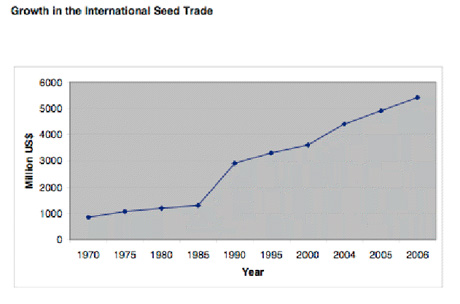
Source: International Seed Federation.[8] Since 1985, the trade in commercial seed has been soaring.

IPR deprives farmers from what they and many others worldwide claim as their inherent right to save and replant seeds. Seed varieties, which have been developed over centuries, have adapted to their particular environments, while their gene pool has to survive unforeseen factors such as pests and diseases - or climate change. Thus, farmers are losing their independence and become "extensions" in the field for the biotech corporations the world over,[9] as IPR clauses in the contracts between them and the farmer forbid the farmer to save and replant their seeds. Though farmers buy the GM seeds, they do not own them. In fact, farmers are renting the GM seeds from the biotech corporation on an annual basis.

Another consequence of the court ruling is the explosion of tactical cooperations, strategic mergers and takeovers among agro-chemical-biotech companies and the ensuing consolidation of power in the hands of a few transnational corporations (TNCs).

Based on a report published by the ETC Group, the action group on Erosion, Technology and Concentration:[10]
  • From thousands of seed companies and public breeding institutions three decades ago, 10 companies now control more than two-thirds of global proprietary seed sales.
     
  • From dozens of pesticide companies three decades ago, 10 now control almost 90 percent of agrochemical sales worldwide.
     
  •  From almost 1,000 biotech start-ups 15 years ago, 10 companies now account for three-quarters of industry revenues.
The concentration of power makes for strong industry lobbies in governmental organizations such as the World Trade Organization (WTO) and the World Bank, in favor of governmental deregulation and the promotion of free trade, including agriculture. This directly affects the lives of people, in particular in the global South.

Free Trade and Agriculture

The Agreement on Agriculture (AoA) came into being at the same time as the WTO - until then GATT[11] - on January 1, 1995. The AoA, effectively considering agricultural crops as commodities, was based on three pillars for trade regulation: domestic support, market access and export subsidies.[12]

The first pillar, domestic support, is a set of rules that regulate under which circumstances local producers can be subsidized. The second pillar, market access, is aimed at reducing the tariff on imported goods, in an attempt to "create order, fair competition and a less distorted agricultural sector."[13] Non-tariff barriers on imports - such as import quotas or import restrictions - have to be "tarifficated" in order to become part of the global market process. Once bonded to a tariff, the rate will subsequently be reduced over time. The third pillar obliges developed countries to reduce the export subsidies given to local producers, in order to reduce false competition.

Only developed countries are rich enough to sponsor their agricultural producers one way or the other.[14] These subsidized crops flood the global market at below-cost prices. This both undercuts and lowers the farm gate prices for the local producers in developing countries, while these countries cannot afford to support their domestic producers or pay them export subsidies. In practice, this leads to what has become known as export dumping.

Due to the asymmetric power relations between developed and developing countries, it seems that the trade regulations have had a virtually opposite effect from that ostensibly intended: the reduction of tariff protections has negatively affected small-scale farmers - who make up 70 percent of the population in developing countries - who see the key source of their income slip away, driving them off the land and into the cities, in search of a new way to make a living.[15]

Subsistence farmers are effectively threatened by the conditions put forward once their state government takes out a loan from the World Bank or signs a WTO Trade agreement, as these come with structural adjustment programs (SAPs). SAPs are in effect prescribed economic "reform" policies, such as the reduction of government budgets and social spending; the cutting of programs and subsidies for basic goods; the elimination of restrictions on foreign ownership; the increase in interest rates; the promotion of a switch from subsistence farming to export economies, while eliminating import tariffs.[16]

Government deregulation thus favors TNCs over smallholders[17] in a bid to compete with export crops in a global market that, in fact, is seriously distorted by the agricultural subsidy policies of the developed countries.

Recently, the dash for agrofuels, diverting food crops to produce energy, has put yet more strain on the competition for land and other resources such as water.[18] The social and environmental consequences of business as usual has driven many farmers off their land toward cities, putting additional pressure on the land, as agricultural land is urbanized. Nowhere can these non-trade concerns[19] be witnessed better than in the growing number of slums around cities in the developing world.

The dispossessed are fighting back, however. They have organized themselves in all sorts of organizations, the aim of which is to resist further global appropriation of their lands and local economies. They campaign for agricultural reform and the human right to food; they demand food sovereignty for all.

Food Sovereignty

"People facing hunger and malnutrition are, to a large extent, smallholders, landless workers, pastoralists and fisherfolk, often situated in marginal and vulnerable ecological environments. Neglected by (inter)national policies, they cannot compete with increasingly subsidized industrialized agriculture, both nationally and in the world market. Many farmers tried to catch the Green Revolution train, but became stuck in the debt trap of increasing input costs and decreasing product prices. Concentration in the food market chain is another worrying trend causing increasing dependence of both consumers and producers on a declining number of seed, inputs and food products conglomerates."[20]

Food sovereignty is a term originally coined in 1996 by the members of La Via Campesina as an alternative policy framework, countering the narrow view of food security as access to global food imports by food-deficient countries as a political goal.

Emerging in 1993, Via Campesina is "an international movement of peasants, small- and medium-sized producers, landless, rural women, indigenous people, rural youth and agricultural workers that fight for the right of people to determine their own local policy to food security through agrarian reform and rural development."[21]

Via Campesina's Seven Principles of Food Sovereignty[22]

1. Food: A Basic Human Right

Everyone must have access to safe, nutritious and culturally appropriate food in sufficient quantity and quality to sustain a healthy life with full human dignity. Each nation should declare that access to food is a constitutional right and guarantee the development of the primary sector to ensure the concrete realization of this fundamental right.

2. Agrarian Reform

A genuine agrarian reform is necessary, which gives landless and farming people - especially women - ownership and control of the land they work, and returns territories to indigenous peoples. The right to land must be free of discrimination on the basis of gender, religion, race, social class or ideology; the land belongs to those who work it.

3. Protecting Natural Resources

Food sovereignty entails the sustainable care and use of natural resources, especially land, water, seeds and livestock breeds. The people who work the land must have the right to practice sustainable management of natural resources and to conserve biodiversity free of restrictive intellectual property rights. This can only be done from a sound economic basis with security of tenure, healthy soils and reduced use of agro-chemicals.

4. Reorganizing Food Trade

Food is first and foremost a source of nutrition and only secondarily an item of trade. National agricultural policies must prioritize production for domestic consumption and food self-sufficiency. Food imports must neither displace local production nor depress prices.

5. Ending the Globalization of Hunger

Food sovereignty is undermined by multilateral institutions and by speculative capital. The growing control of multinational corporations over agricultural policies has been facilitated by the economic policies of multilateral organizations such as the WTO, World Bank and the International Monetary Fund (IMF). Regulation and taxation of speculative capital and a strictly enforced code of conduct for TNCs is therefore needed.

6. Social Peace

Everyone has the right to be free from violence. Food must not be used as a weapon. Increasing levels of poverty and marginalization in the countryside, along with the growing oppression of ethnic minorities and indigenous populations, aggravate situations of injustice and hopelessness. The ongoing displacement, forced urbanization, repression and increasing incidence of racism of smallholder farmers cannot be tolerated.

7. Democratic control

Smallholder farmers must have direct input into formulating agricultural policies at all levels. The United Nations and related organizations will have to undergo a process of democratization to enable this to become a reality. Everyone has the right to honest, accurate information and open and democratic decision-making. These rights form the basis of good governance, accountability and equal participation in economic, political and social life, free from all forms of discrimination. Rural women, in particular, must be granted direct and active decision-making on food and rural issues.

The acceptance of this framework[23] in the context of the Declaration of Human Rights, is extremely important, not only for the small, food-producing people involved, but also for the end consumer in the developed world: the true right to food and the true right to produce food, mean that all people have an unalienable right to safe, nutritious and culturally-appropriate food as well as to food-producing resources, while they have the ability to sustain themselves and their societies in the process.

If the no consensus on a G8-driven global partnership against hunger is the surprise outcome of the High Level Meeting on Food Security held in Madrid in January of this year, it may well be an indication that the food sovereignty movement is conquering terrain. In the final declaration of the farmers' and civil society organizations, they state that:
"We see the proposed Global Partnership as just another move to give the big corporations and their foundations a formal place at the table, despite all the rhetoric about the 'inclusiveness' of this initiative. Furthermore it legitimates the participation of WTO, World Bank and IMF and other neoliberalism-promoting institutions in the solution of the very problems they have caused. This undermines any possibility for civil society or governments from the Global South to play any significant role. We do not need this Global Partnership or any other structure outside the UN system."[24]
After all, until a few decades ago, it was primarily the small farmers of this world who sustained us all with their hard work in the field.
Footnotes:
[1] "The Cordoba process was started at an international seminar on the right to food at CEHAP [Chair of Studies on Hunger and Poverty], Cordoba October 2007, further pursued at the Right to Food Forum organised by the FAO Right to Food Unit in October 2008 and completed in its present version following a second meeting convened in Cordoba by CEHAP on November 28-29, 2008. It will be subject of further consultations and possible revisions during 2009." Source.
[2] Source.
[3] FAO 1974
[4] See here.
[5] Sen, Amartya (1981): "Poverty and Famines: An Essay on Entitlements and Deprivation," Claredon Press, Oxford.
[6] Dominique Guillet, Association Kokopelli.
[7] Diamond v. Chakrabarty, 447 US 303 (1980)
[8] See here.
[9] For a brief history of the seed industry, see here and here.
[10] The ETC Group, an international advocacy organization based in Canada, has been monitoring corporate power in the industrial life sciences for the past 30 years, revealed this in a report in November 2008 that can be downloaded here.
[11] General Agreement on Tariffs and Trade, 1947. A tariff is a tax on goods upon importation.
[12] See here.
[13] See here.
[14] United Nations Development Programme (UNDP) Human Development Report 2005, p.129 vv.
[15] UNDP Human Development Report 2005, chapter 4.
[16] See here.
[17] Raj Patel in "Stuffed and Starved" (2007), London Portobello Books, describes this process in detail.
[18] GRAIN, "Stop the Agrofuel Craze."
[19] Fourth Special Session of the Committee on Agriculture (2000).
[20] Jonas Vanruesel, 2008. "Food as a human right: a struggle for human dignity and food sovereignty" in Omertaa Volume 2008/2.
[21] See here.
[22] A concise summary of the principles of food sovereignty can be found on the site of the organization for the defense of family farms in the USA.
[23] See here and here.
[24] Final declaration of farmers and civil society organizations.

Monday, May 30, 2011

GMO Study: You’re Eating Insecticide…

(This is not new information--jef)
++++++++++++++
May 29, 2011
By Matt Spaeth - FIN

Most Americans remain blissfully unaware (or don’t care) they are eating genetically-modified (GM) organisms every day. Passivity and blind faith in the USDA, FDA and EPA have largely contributed to this attitude. Perhaps that will change now that a new study reveals an insecticide produced in GM corn actually gets absorbed into the human body.

If you haven’t been paying attention to your food lately, biotechnology giants such as Monsanto thank you for that. Because behind your back, they’ve succeeded in replacing 86% of US corn with their patented insecticide-producing “frankencorn”.

The industry name for this is “Bt corn” and the insecticide is actually produced inside the plant, so it is impossible to wash it off. This is accomplished by inserting genes from the bacteria Bacillus Thuringiensis into the corn.

Up until now, scientists and multinational corporations such as Monsanto the devil and DuPont have spent billions in lobbying, campaign donations and “testing” in an attempt to convince world governments that GMOs are safe. In the case of Bt corn, they stated the insecticide produced within the corn posed no danger to human health because it was broken down in the digestive system.

Despite corporate assurances, many have been skeptical. Non-GMO advocates such as Jeffrey Smith from The Institute For Responsible Technology and the Organic Consumers Association have long been concerned about the potential impact this Bt toxin could have on human health.

Scientists from the University of Sherbrooke, Canada, proved the validity of these concerns when they detected the insecticidal protein, Cry1Ab, circulating in the blood of both pregnant and non-pregnant women. They also detected the toxin in fetal blood, suggesting that the toxin can be passed on to the fetus. The research paper has been peer-reviewed and accepted for publication in the journal Reproductive Toxicology.

Neither the women studied or their spouses worked in agriculture. All reported to be consuming a typical Canadian diet that is virtually identical to the American diet.

“Generated data will help regulatory agencies responsible for the protection of human health to make better decisions”, said researchers Aziz Aris and Samuel Leblanc.

Unfortunately, I don’t feel that our pro-GMO Secretary of Agriculture Tom Vilsack will pay attention to this research. I also doubt that our Deputy Commissioner of Foods Michael Taylor, who also happens to be Monsanto tghe devil’s former vice-president, will pay this study much attention either. It doesn’t stop there. The revolving door is growing exponentially and the foxes have taken up residence in the hen house.

Are you pissed? You should be. We’ve let corporate interests turn us into poison-fed lab rats. It doesn’t end at corn either. 93% of both soy and canola are also genetically-modified. On top of that, Monsanto the devil has acres of laboratories containing new mutant species awaiting to slip into your pantry. You’re probably wearing some of their Bt cotton right now. It comprises 93% of US cotton and 68% of Chinese cotton.

Perhaps you’ve heard of the uproar around Bt brinjal, a GM variety of eggplant, in India. When it was approved in 2009, a country-wide protest began and the Indian government applied a moratorium on its release.

Meanwhile, here in the US, GMO crops are getting approved left and right and most Americans still don’t even know what “GMO” even means.

Want to do something about it? We can’t rely on our regulatory agencies to do it for us and we possess more power than we think. It won’t take much to reach the tipping point of consumer rejection and get these “frankenfoods” out of our lives. Information spreads like wildfire these days with Facebook, Twitter and email. Tell your family and friends and vote with your dollar, the world’s food supply depends on it! Now that you know, it’s your responsibility to pass it on.

Wednesday, March 30, 2011

The Future of Agriculture

Garden as If Your Life Depends On It--Because It Will
By ELLEN LaCONTE
Spring has sprung—at least south of the northern tier of states where snow still has a ban on it—and the grass has 'riz. And so has the price of most foods, which is particularly devastating just now when so many Americans are unemployed, underemployed, retired or retiring, on declining or fixed incomes and are having to choose between paying their mortgages, credit card bills, car payments, and medical and utility bills and eating enough and healthily. Many are eating more fast food, prepared foods, junk food—all of which are also becoming more expensive—or less food.

In some American towns, and not just impoverished backwaters, as many as 30 percent of residents can't afford to feed themselves and their families sufficiently, let alone nutritiously. Here in the Piedmont Triad of North Carolina where I live it's 25 percent. Across the country one out of six of the elderly suffers from malnutrition and hunger. And the number of children served one or two of their heartiest, healthiest meals by their schools grows annually as the number of them living at poverty levels tops twenty percent. Thirty-seven million Americans rely on food banks that now routinely sport half-empty shelves and report near-empty bank accounts. And this is a prosperous nation!

In some cases this round of price hikes on everything from cereal and steak to fresh veggies and bread—and even the flour that can usually be bought cheaply to make it— will be temporary. But over the long term the systems that have provided most Americans with a diversity, quantity and quality of foods envied by the rest of the world are not going to be as reliable as they were.

What's for Supper Down the Road?

As they move through the next few decades Americans can expect
* the price of conventionally produced food to rise and not come down again,

* prices to rollercoaster so that budgeting is unpredictable,

* some foods to become very expensive compared to what we're used to

* and others, beginning with some of the multiple versions of the same thing made by the same company to garner a bigger market share and more shelf space, to gradually become unavailable.
Tremors in food supply chains and pricing will make gardening look like a lot more than a hobby, a seasonal workout, a practical way to fill your pantry with your summer favorites, or a physically, spiritually and mentally healing activity, or all four. Gardening and small-scale and collective farming, especially of staple crops and the ones that could stave off malnutrition, could become as important as bringing home the bacon, both the piggy and the dollar kind. Why?

Why's Gardening So Important Now?

There are at least five reasons why more of us should take up spade, rake and hoe, make compost and raise good soil and garden beds with a vengeance, starting this spring and with an eye toward forever.
1) Peak oil. Most petroleum experts agree that we shot past peak oil in the US around 1971. Lest you've missed the raging (http://www.postcarbon.org), that's the point at which more than half the readily, affordably retrievable oil in reserves has been used up, what remains is more expensive to retrieve, and the dregs are irretrievable. We've shot or are about to shoot past peak worldwide, estimates of when ranging from 2007 to 2013, with many oil company execs agreeing to at least the latter. There are no new cheap-easy oil fields coming on line. Any new fields you hear about or new methods, like tar sands drilling are expensive, water guzzling, dangerous, environmentally disastrous and unlikely to produce more than a few years worth of oil, and that a decade or more down the line. That means abundant, cheap oil is about to be history. What difference does that make?

For one thing, there is no replacement for oil that can do all that oil has done as cheaply and universally as oil has done it. I offer an exercise in Life Rules, "The ABC's of Peak Oil" which helps readers imaginatively subtract from their lives everything that depends in one way or another on cheap easy oil. It doesn't leave much. (See Beth Terry's website, for example, for what subtracting plastics may entail.)

The global economy that presently supplies us with our food, runs on cheap oil and lots of it. It runs slower and less predictably on expensive oil that's hard to get because it's located in hard-to-reach or high-risk conflict-ridden zones. Cheap, abundant food on the shelves of grocery and big box stores and food banks, on our tables and in our bellies depends on cheap abundant oil for fertilizers, pesticides, and herbicides, and to power farm machinery and transport food from fields to processors and packagers and then to purveyors and consumers, around the world. Past peak, that system's going to have the half-life of the strontium 90 that's escaping the Fukushimi Dai-ichi reactor: 29 years, or there abouts. One good global crisis, and not that long.

2) Peak soil & space: A couple of links between peak oil and peak soil: First, it matters that one of the proposed alternatives to oil is biofuels. Acreage around the world is being converted from production of corn, wheat and soy for human and animal consumption—i.e., food—to production of ethanol and biofuels to put in trucks and cars and . . . Which makes remaining corn, et al, more expensive. Some energeconomy geniuses are proposing that Afghanis, for example, convert the fields of opium poppies that are their primary agricultural export, not to growing grains or legumes or other staple foods, but to biofuel, which would, not coincidentally, make the gasoline that goes in American military equipment much cheaper and provide Afghanis with a profitable market item rather than food.

According to a 2009 National Geographic staff report, "The corn used to make a 25-gallon tank of ethanol would feed one person for a year." Tell that to Archer-Daniels-Midland, Al Gore's deep-pockets friend and mega-ethanol and corn products producer.

Second, the huge oil-gluttonous machinery that has made factory farming possible has compacted soils, literally crushing the life out of them.

Arable land in the developing or so-called Third World has been at a premium since time immemorial, thanks to geographic location and/or persistent plundering by empires old and new. Revolutions in north Africa and the Middle East are occurring not just to obtain more democratic governments but also to obtain more food and more affordable food. Revolutionaries are barking up a tree that's seen better days.

In the United States and elsewhere in the developed, read "First" world, arable land has reached peak production. All those petroleum-based products that fueled the Green Revolution of the last century, also produce so many crops, constantly, with support from toxic chemicals and without concern for the microbes that make soil a live, self-regenerating system, that most American farmland—if its farmers didn't go organic a while back—is comprised of dead soils. Peak oil makes a repeat of the petroleum-driven 20th century Green Revolution impossible, which is good for soil and other living things, not so much for food prices and supplies.

After peak, in soil like in oil, comes descent. Adding insult to injury, every year farmers lose thousands of acres of arable land to urban and suburban sprawl and more tons of topsoil than they produce of grain and other field crops to attrition. Half the Earth's original trove of topsoil, like that which once permitted the American Midwest to feed the world, has been lost to wind and erosion. Millions of years in the making, it has been depleted and degraded by industrialized agriculture in only a couple of centuries. China's soils ride easterly winds across the Pacific to settle out on cars and rooftops in California while the American Bread Basket's soils are building deltas and dead zones at the mouth of the Mississippi. Like oil, that soil isn't coming back. We can only build it, help it to build itself and wait.

3) Monoculture: We can cut to the chase on this one. The food we eat is produced on industrial-strength, fossil-fuel-driven super farms. Those farms practice monoculture: the planting one crop, often of one genetic strain of that crop, at a time and sometimes year after year over vast landscapes of plowed field. When thousands of acres of farmland are sown with the same genetic strain of grain, uncongenial bout of weather, disease or pest to which that strain is susceptible can wipe out the whole crop. At present the Ug99 fungus, called stem rust, which emerged a decade ago in Africa, could wipe out more than 80% of the world's wheat crops as it spreads, according to a 2009 article in the L. A. Times. Recent studies follow its appearance in other countries downwind of eastern Africa where it originated, including Yemen and Iran (where revolutionaries are already protesting rising prices and shortages), which opens the possibility of its emergence further downwind in Central and Eastern Asia. The race is on to breed resistant plants before it reaches Canada or the U.S. But it can take a decade or more to create a universally adaptable new genetic line that is resistant to a new disease like stem rust that can travel much faster than that. The current spike in the price of wheat is due in part to Ug99 which might properly be renamed "Ugh."

4) Climate instability. Bad -- uncongenial -- weather has lately devastated crops in the upper Midwest, Florida, Mexico, Russia, China, Australia, parts of Africa and elsewhere. Many climate scientists believe we've passed the equivalent of peak friendly and familiar weather, too. And while increasing heat will bedevil harvests, intense cold, downpours and flooding, drought and destructive storm systems will make farming an increasingly hellish occupation if profit is what's being farmed for. The transitional climate will be unpredictable from season and will produce more extremes of weather and weather-related disasters which means farmers will not be able to assume much about growing seasons, rainfall patterns and getting crops through to harvest. If the past is precedent, the transition from the climate we've been used to for 10,000 years to whatever stable climate emerges out of climate chaos next, could take decades, centuries or even millennia. Especially if we keep messing with it. When a whole nation's or region's staple crops, especially grains, are lost or on-again-off-again, everything down the line from the crops themselves become more expensive, from meat, poultry and dairy to every kind of processed food. I.e., the food we shop for as if supermarkets were actually where food comes from.

5) The roller-coaster economy. This isn't the place for me to offer my explanation for the probability of global economic collapse. (See (www.ellenlaconte.com/excerpts-from-life-rules/#chpfour) for that.) No pundits, talking-heads or economic analysts (well, very few) deny there are rough economic times ahead. Even many of the cautious among them acknowledge that we may be looking at five or six years of high unemployment and many of the lost jobs won't be coming back. The less cautious, like me, predict the collapse of the whole fossil-fueled, funny-money, inequitable, overly-complicated global economic system in the lifetimes of anyone under 50. Well, at the rate we're going in all the wrong directions politically and economically, I hazard the guess, anyone under 80.

Clearly, depending on the present system to provide us with most or all of our food reliably or long-term, is unwise in the extreme. Which is how we get back to why we need to garden as if our lives depended on it. Bringing food production processes and systems closer to home is going to prove vital to our survival. We need to take producing our own and each other's food as seriously as we've taken producing a money income because growing numbers of us won't have enough money to buy food in the conventional ways and there will be less of it to buy. So what's our recourse?

Gardening Like Everybody's Business

Under the influence and auspices of the prevailing economy, most Americans have forgotten how to provide for themselves. We've become accustomed to earning money with which we buy provisions. That process is about the have the legs kicked out from under it. Instead of earning money (or its funny-money kin like credit cards) to buy the things we need, we'll need to start providing more of those things for ourselves and each other locally and (bio)regionally. Gardening -- and small-scale farming -- while they will need to be undertaken in a businesslike fashion will be less about doing business than about everyone's having something to eat and more people being busy providing it. And while not everyone will be able to garden or farm, we are all able to get up close and personal with those who do.