Showing posts with label genetically altered seeds. Show all posts

Thursday, April 19, 2012

Monsanto the devil Taking Over Global Agriculture

Thursday, April 19, 2012 by RT

Monsanto the devil has been on a mission to control US agriculture. With the help of politicians and regulation agencies, the biotechnology company has been putting many farmers out of business. Many critics of the company believe it is the right of the people to know if they are consuming genetically-modified food. Jeffrey Smith, author of Seeds of Deception, joins us with more on Monsanto the devil.

Friday, February 24, 2012

Scumbag Bill Gates: "We Need Genetically Modified Seeds"

Thursday, February 23, 2012 by Common Dreams
Gates' yield-increasing claims widely refuted by studies


At a forum of the International Fund for Agricultural Development (IFAD) in Rome today, Microsoft founder Bill Gates pressed the need for genetically modified seeds in the developing world, and the need for a "digital revolution" to meet the needs of the world's farmers. Gates' claims that genetically modified crops double or triple smaller farmers' yields have been challenged by recent research.


Agence France-Presse reports:
(World Economic Forum / swiss-image.ch/Photo by Sebastian Derungs)
Microsoft founder Bill Gates on Thursday called for a "digital revolution" to alleviate world hunger by increasing agricultural productivity through satellites and genetically-engineered seed varieties. 
"We have to think hard about how to start taking advantage of the digital revolution that is driving innovation including in farming," the U.S. billionaire philanthropist said in a speech at the UN rural poverty agency IFAD in Rome.
"If you care about the poorest, you care about agriculture. We believe that it's possible for small farmers to double and in some cases even triple their yields in the next 20 years while preserving the land," Gates said. [...]
Another key development is the use of satellite technology developed by defense departments to document data about individual fields, as well as information videos of farmers discussing best practices to help others. [...]
Gates also defended the use of genetically modified organisms (GMOs) in the developing world and large-scale farm land investments by foreign states in the developing world -- both highly controversial issues in the aid community.
AFP adds that Gates announced $200 million (150 million euros) in new grants from his foundation to finance research on a new type of drought-resistant maize.

The Associated Press notes that Gates' plan is looking for more accountability with countries receiving aid, saying they should provide "report cards" to show what they've accomplished with the aid.

As John Vidal reported for the Guardian, the claims that genetically modified seeds can increase gains have been challenged by research:
Genetic engineering has failed to increase the yield of any food crop but has vastly increased the use of chemicals and the growth of "superweeds", according to a report by 20 Indian, south-east Asian, African and Latin American food and conservation groups representing millions of people.

And a 2009 report from the Union of Concerned Scientists showed that genetically modified seeds failed to increase yields in U.S. crops:
Despite 20 years of research and 13 years of commercialization, genetic engineering has failed to significantly increase U.S. crop yields. 
"The biotech industry has spent billions on research and public relations hype, but genetically engineered food and feed crops haven't enabled American farmers to grow significantly more crops per acre of land," said Doug Gurian-Sherman, a biologist in the UCS Food and Environment Program and author of the report. "In comparison, traditional breeding continues to deliver better results."

Ronnie Cummins, International Director of the Organic Consumers Association, told Common Dreams:
“Bill Gates may be a smart guy in terms of computer programming, and an expert on how to become a billionaire, but he obviously knows nothing about agriculture other than what Monsanto the devil and the biotech industry have told him. Eighteen years after the introduction of the first genetically engineered crops, there is no evidence, including data from the pro-biotech USDA, that these energy and chemical-intensive crops increase yield, improve nutrition, or provide greater yields under adverse weather conditions of drought or heavily rains. On the contrary hundreds of studies, including those by peer-reviewed scientists and the U.N.’s FAO (Food and Agriculture Organization) indicate that organic crops provide significantly higher levels of vitamins, nutrients, and cancer-fighting anti-oxidants; that organic crops have significantly higher yields during periods of drought and torrential rain; and that agro-ecological or organic farms produce 2-10 times great yields than industrial-scale chemical and GMO farms. In others words, not only can organic farming and ranching feed the world, but in fact it is the only way that we will ever be able to feed the world.”

* * *


Recent reports also show Gates behind climate engineering efforts, as he is among other wealthy individuals financially backing scientists to lobby governments to push geoengineering, raising concerns that this small group may have a large impact on further decisions on geoengineering.

(Gates' support for geoengineering and GMOs is what makes him a scumbag. You retired, Bill. Now, go the fuck away!--jef)

Monday, February 6, 2012

The Seed Emergency: The Threat to Food and Democracy

Monday, February 6, 2012 by Al Jazeera English
Patenting seeds has led to a farming and food crisis - and huge profits for US biotechnology corporations.
by Vandana Shiva

New Delhi, India - The seed is the first link in the food chain - and seed sovereignty is the foundation of food sovereignty. If farmers do not have their own seeds or access to open pollinated varieties that they can save, improve and exchange, they have no seed sovereignty - and consequently no food sovereignty.

The deepening agrarian and food crisis has its roots in changes in the seed supply system, and the erosion of seed diversity and seed sovereignty.

In India, 95 per cent of cotton seeds are reportedly controlled by Monsanto the devil, a US biotechnology corporation (EPA)

Seed sovereignty includes the farmer's rights to save, breed and exchange seeds, to have access to diverse open source seeds which can be saved - and which are not patented, genetically modified, owned or controlled by emerging seed giants. It is based on reclaiming seeds and biodiversity as commons and public good.

The past twenty years have seen a very rapid erosion of seed diversity and seed sovereignty, and the concentration of the control over seeds by a very small number of giant corporations. In 1995, when the UN organised the Plant Genetic Resources Conference in Leipzig, it was reported that 75 per cent of all agricultural biodiversity had disappeared because of the introduction of "modern" varieties, which are always cultivated as monocultures. Since then, the erosion has accelerated.

The introduction of the Trade Related Intellectual Property Rights Agreement of the World Trade Organisation has accelerated the spread of genetically engineered seeds - which can be patented - and for which royalties can be collected. Navdanya was started in response to the introduction of these patents on seeds in the General Agreement on Tariffs and Trade - a forerunner to the WTO - about which a Monsanto the devil representative later stated: "In drafting these agreements, we were the patient, diagnostician [and] physician all in one." Corporations defined a problem - and for them the problem was farmers saving seeds. They offered a solution, and the solution was to make it illegal for farmers to save seed - by introducing patents and intellectual property rights [PDF] on those very seeds. As a result, acreage under GM corn, soya, canola, cotton has increased dramatically.

Threats to seed sovereignty

Besides displacing and destroying diversity, patented GMO seeds are also undermining seed sovereignty. Across the world, new seed laws are being introduced which enforce compulsory registration of seeds, thus making it impossible for small farmers to grow their own diversity, and forcing them into dependency on giant seed corporations. Corporations are also patenting climate resilient seeds evolved by farmers - thus robbing farmers of using their own seeds and knowledge for climate adaptation.

Another threat to seed sovereignty is genetic contamination. India has lost its cotton seeds because of contamination from Bt Cotton - a strain engineered to contain the pesticide Bacillus thuringiensis bacterium. Canada has lost its canola seed because of contamination from Roundup Ready canola. And Mexico has lost its corn due to contamination from Bt Cotton.

After contamination, biotech seed corporations sue farmers with patent infringement cases, as happened in the case of Percy Schmeiser. That is why more than 80 groups came together and filed a case to prevent Monsanto the devil from suing farmers whose seed had been contaminated.

As a farmer's seed supply is eroded, and farmers become dependent on patented GMO seed, the result is debt. India, the home of cotton, has lost its cotton seed diversity and cotton seed sovereignty. Some 95 per cent of the country's cotton seed is now controlled by Monsanto the devil.

Read the rest here.

Farmers Issue Lawsuit Against Monsanto the devil for Widespread Genetic Manipulation

Farmers Issue Lawsuit Against Monsanto the devil for Widespread Genetic Manipulation
Anthony Gucciardi
Activist Post

Farmers are taking a stand against Monsanto the devil, launching a landmark lawsuit against the mega corporation for widespread genetic contamination.

The farmers are concerned that Monsanto the devil’s aggressive agenda to genetically alter the planet will ultimately result in a severe threat to the organic integrity of farms worldwide. It is not hard to believe that many ‘organic’ farms have already been contaminated with GMO crops, as nearly 93% of soybeans are now admittedly genetically modified.

The Public Patent Foundation originally filed the lawsuit in March of 2011 in a case known as Organic Seed Growers and Trade Association (OSGATA) et al v. Monsanto the devil.

The organization launched the suit in the name of the very individuals and organizations threatened by Monsanto the devil’s widespread GMO crops: family farmers, farming organizations, and seed businesses.

The intent of the case is to dispute Monsanto the devil’s patents on GMO seeds and ultimately safeguard farmers from Monsanto the devil’s own vicious lawsuits.

In fact, between 1997 and 2010, Monsanto the devil actually filed 144 lawsuits against American family farmers. In addition, another 700 were settled out of court for unknown amounts. Monsanto the devil has an agenda to take out American family farms and dominate the agricultural industry with their own mutant seeds.

This is the same kind of practice that Monsanto the devil operates outside of the United States as well, driving thousands of poor farmers to suicide by ruining their family farming practices.

The first phase of the case began yesterday on January 31, 2012. More than 50 farmers and plaintiffs have gone to Manhattan to listen to verbal debates surrounding Monsanto the devil’s attempts to dismiss the lawsuit.

Sunday, January 1, 2012

Monsanto the devil GMO Seeds Use to Further Expand Within US


While genetically modified foods are continually being banned in other countries, the US is slow to follow the very necessary trend. The USDA has chosen to step back and give Monsanto the devil even more power over GMO seeds, and now some states are taking similar action. 

A bill which could be passed in Lansing, Michigan could make Michigan the 15th state to allow for the expansion of GMO seed use, causing Michigan farms to be plagued with disease-riddled, genetically modified crops.

Calling for the Expansion of GMO Seeds 
In order to pave way for the expansion of GMO seeds in Michigan, a slight modification must be made to Sen. Bill 777, which has been in the Senate Agriculture, Forestry and Tourism Committee since September 2005. The change seeks to prevent anti-GMO laws, giving biotech corporations even more room to wreak havoc on the environment and humankind alike. The new bill seeks to remove the following:
“Any authority local governments may have to adopt and enforce ordinances that prohibit or regulate the labeling, sale, storage, transportation, distribution, use, or planting of agricultural, vegetable, flower or forest tree seeds.
It is interesting to see how some areas encourage the expansion of GMO crops while others, such as Colorado’s Boulder County, recognize the dangers and choose to heed the warnings. Jeff Cobb, legislative aid to GOP Sen. Gerald Van Woekom, the sponsor of the legislation, says that his boss feels local governments don’t have the scientific capacity to determine the safety of GM seeds. The Food and Drug Administration, Environmental Protection Agency, and the United States Department of Agriculture are the three government entities which have the power to regulate GMO seeds, and Cobb, along with others, feels that local government should not play a role

The USDA and FDA are Failing to ‘Protect the People’
But if there is any hope for the massive decline of GMO crops, these government entities should be the last to have the power and control. Just recently, the USDA decided to deregulate two of Monsanto the devil’s genetically modified seed varieties, giving the company a further grasp on the food supply of the nation. This is also the same organization that has continually pushed for the approval of genetically modified salmon, which was rejected by Congress due to health concerns.

The USDA is so dedicated, in fact, that they decided to help forward the approval of genetically modified salmon by generously funding the cause with nearly $500,000. Not only that, but the organization also illegally approved Monsanto the devil’s GMO sugarbeets, which were to be destroyed some time after.

The FDA is another government entity which doesn’t seem to be doing a great job at protecting the people. The FDA is seeking to outlaw the majority of supplements created after 1994 until they have been heavily proven to be 100% effective and free of any slight side effects, meanwhile the organization allows for harmful genetically modified ingredients to fill the world’s food supply. In another vein, despite seafood showing extremely high levels of contamination, the FDA decided that the food was still safe for consumption.


Wednesday, June 8, 2011

Corporate Takeover of Food Production

Food Sovereignty Responds 
by: Yve le Grand , Truthout 
 
Introduction 

Although the credit crunch has pushed the issue of the global food crisis to the background, it is still going on today. In fact, the number of chronically hungry people worldwide has risen and is estimated to amount to 967 million people according to the new Declaration of Human Rights, launched by the Cordoba process[1] at the end of 2008, on the occasion of the Declaration's 60th anniversary.

In 1948, the of the United Nations declared "... everyone has a right to be free from hunger and to adequate food including drinking water, as set out in Article 25 of the Universal Declaration of Human Rights."[2]

The world famine in the 1970s led the Declaration to introduce the concept of food security: "... the availability at all times of adequate world food supplies of basic foodstuffs to sustain a steady expansion of food consumption and to offset fluctuations in production and prices."[3]

This definition of food security, which is basically a technical matter of providing adequate human nutrition, led to the assumption that more food production would solve the problem of mass starvation. The Green Revolution led to a spectacular increase in the amount of food produced, but the numbers of the chronically hunger did not diminish accordingly.[4]

In his landmark book on poverty and famines,[5] Amartya Sen, concluded that enough food was being produced (i.e. enough calories per capita), but that the access to food, the entitlement to it, was the core of the problem. The poor simply lacked the financial and political means to claim their share of world food production. Sen made it clear that the world food problem was, thus, not so much a matter of food production, as it was one of social inequality and injustice. To see how a perfect storm has been in the making since the first Declaration of Human Rights, it is necessary to go back to the root of all food: seeds.

The Seed Situation 

In and of themselves, "Seeds are the very beginning of the food chain. He, who controls the seeds, controls the food supply and thus controls the people."[6] To understand why this is important for current developments in the agrarian industrial complex, it is necessary to have an understanding of how "normal" agricultural practices and techniques have evolved over time, in contrast to contemporary corporate practice in the last few decades.

When people first settled down and started to grow crops for food, through a lot of hard work and through trial and error, indigenous plant breeds were improved upon over time by cross pollination. Thus, plants developed that were suited best for local circumstances and climate conditions (e.g. drought, wind, flooding, soil). Through the techniques of crop rotation, mixed crop planting and by using natural fertilizers (manure, compost), the soil was not too depleted to recover and be (re)used.

Two of the most important agricultural practices are brown bagging and seed exchange. Brown bagging is the farmer's custom to save part of the seeds from the current harvest, to sow them in the following year. Seed exchange makes for the dissemination of new strands of DNA that have been obtained through crossbreeding plants. In this way, the various genetic materials guarantee biodiversity, which is of the utmost importance in order to withstand insect attacks or other pests that threaten a growing crop.

After the Second World War, chemical companies that had already diversified into seed fertilizers, herbicides and pesticides, began to invest heavily in the research and development (R & D) of so-called "hybrid" seeds, while buying up seed companies. Hybrid seeds grow with the input of petroleum-based fertilizers, herbicides and pesticides; e.g. "Roundup Ready" seeds developed by Monsanto the devil would only be able to grow through the exclusive use of their Roundup chemicals. A short while later, R & D would focus on genetically modified (GM) seeds, for which use companies could charge money on the basis of intellectual property rights (IPR).

How has the jump from seed saving and exchange to IPR on seeds been legally possible? In 1980, in Diamond v. Chakrabarty,[7] 447 US 303, the US Supreme Court ruled that a patent covering a living organism from now on was extended to cover "a live human-made micro-organism. "

In other words, whereas prior to this process, plants and animals themselves were subject to property rights and ownership, their genetics were not. After the process, the genetics of plants and animals could be owned and, thus, subject to intellectual property rights.

As a consequence, farmers could neither freely and legally plant nor save seeds for replanting of any plant variety registered under the plant variety provisions of the new patent law. This development marked a shift from public agrarian practice in which seeds could be exchanged and saved freely, to privately owned seed DNA, subject to IPR.


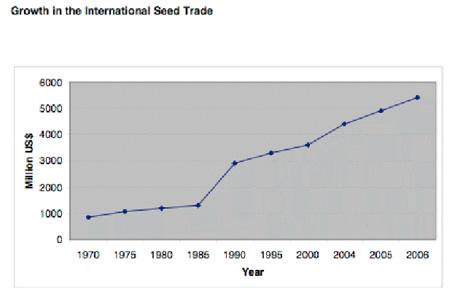
Source: International Seed Federation.[8] Since 1985, the trade in commercial seed has been soaring.

IPR deprives farmers from what they and many others worldwide claim as their inherent right to save and replant seeds. Seed varieties, which have been developed over centuries, have adapted to their particular environments, while their gene pool has to survive unforeseen factors such as pests and diseases - or climate change. Thus, farmers are losing their independence and become "extensions" in the field for the biotech corporations the world over,[9] as IPR clauses in the contracts between them and the farmer forbid the farmer to save and replant their seeds. Though farmers buy the GM seeds, they do not own them. In fact, farmers are renting the GM seeds from the biotech corporation on an annual basis.

Another consequence of the court ruling is the explosion of tactical cooperations, strategic mergers and takeovers among agro-chemical-biotech companies and the ensuing consolidation of power in the hands of a few transnational corporations (TNCs).

Based on a report published by the ETC Group, the action group on Erosion, Technology and Concentration:[10]
  • From thousands of seed companies and public breeding institutions three decades ago, 10 companies now control more than two-thirds of global proprietary seed sales.
     
  • From dozens of pesticide companies three decades ago, 10 now control almost 90 percent of agrochemical sales worldwide.
     
  •  From almost 1,000 biotech start-ups 15 years ago, 10 companies now account for three-quarters of industry revenues.
The concentration of power makes for strong industry lobbies in governmental organizations such as the World Trade Organization (WTO) and the World Bank, in favor of governmental deregulation and the promotion of free trade, including agriculture. This directly affects the lives of people, in particular in the global South.

Free Trade and Agriculture

The Agreement on Agriculture (AoA) came into being at the same time as the WTO - until then GATT[11] - on January 1, 1995. The AoA, effectively considering agricultural crops as commodities, was based on three pillars for trade regulation: domestic support, market access and export subsidies.[12]

The first pillar, domestic support, is a set of rules that regulate under which circumstances local producers can be subsidized. The second pillar, market access, is aimed at reducing the tariff on imported goods, in an attempt to "create order, fair competition and a less distorted agricultural sector."[13] Non-tariff barriers on imports - such as import quotas or import restrictions - have to be "tarifficated" in order to become part of the global market process. Once bonded to a tariff, the rate will subsequently be reduced over time. The third pillar obliges developed countries to reduce the export subsidies given to local producers, in order to reduce false competition.

Only developed countries are rich enough to sponsor their agricultural producers one way or the other.[14] These subsidized crops flood the global market at below-cost prices. This both undercuts and lowers the farm gate prices for the local producers in developing countries, while these countries cannot afford to support their domestic producers or pay them export subsidies. In practice, this leads to what has become known as export dumping.

Due to the asymmetric power relations between developed and developing countries, it seems that the trade regulations have had a virtually opposite effect from that ostensibly intended: the reduction of tariff protections has negatively affected small-scale farmers - who make up 70 percent of the population in developing countries - who see the key source of their income slip away, driving them off the land and into the cities, in search of a new way to make a living.[15]

Subsistence farmers are effectively threatened by the conditions put forward once their state government takes out a loan from the World Bank or signs a WTO Trade agreement, as these come with structural adjustment programs (SAPs). SAPs are in effect prescribed economic "reform" policies, such as the reduction of government budgets and social spending; the cutting of programs and subsidies for basic goods; the elimination of restrictions on foreign ownership; the increase in interest rates; the promotion of a switch from subsistence farming to export economies, while eliminating import tariffs.[16]

Government deregulation thus favors TNCs over smallholders[17] in a bid to compete with export crops in a global market that, in fact, is seriously distorted by the agricultural subsidy policies of the developed countries.

Recently, the dash for agrofuels, diverting food crops to produce energy, has put yet more strain on the competition for land and other resources such as water.[18] The social and environmental consequences of business as usual has driven many farmers off their land toward cities, putting additional pressure on the land, as agricultural land is urbanized. Nowhere can these non-trade concerns[19] be witnessed better than in the growing number of slums around cities in the developing world.

The dispossessed are fighting back, however. They have organized themselves in all sorts of organizations, the aim of which is to resist further global appropriation of their lands and local economies. They campaign for agricultural reform and the human right to food; they demand food sovereignty for all.

Food Sovereignty

"People facing hunger and malnutrition are, to a large extent, smallholders, landless workers, pastoralists and fisherfolk, often situated in marginal and vulnerable ecological environments. Neglected by (inter)national policies, they cannot compete with increasingly subsidized industrialized agriculture, both nationally and in the world market. Many farmers tried to catch the Green Revolution train, but became stuck in the debt trap of increasing input costs and decreasing product prices. Concentration in the food market chain is another worrying trend causing increasing dependence of both consumers and producers on a declining number of seed, inputs and food products conglomerates."[20]

Food sovereignty is a term originally coined in 1996 by the members of La Via Campesina as an alternative policy framework, countering the narrow view of food security as access to global food imports by food-deficient countries as a political goal.

Emerging in 1993, Via Campesina is "an international movement of peasants, small- and medium-sized producers, landless, rural women, indigenous people, rural youth and agricultural workers that fight for the right of people to determine their own local policy to food security through agrarian reform and rural development."[21]

Via Campesina's Seven Principles of Food Sovereignty[22]

1. Food: A Basic Human Right

Everyone must have access to safe, nutritious and culturally appropriate food in sufficient quantity and quality to sustain a healthy life with full human dignity. Each nation should declare that access to food is a constitutional right and guarantee the development of the primary sector to ensure the concrete realization of this fundamental right.

2. Agrarian Reform

A genuine agrarian reform is necessary, which gives landless and farming people - especially women - ownership and control of the land they work, and returns territories to indigenous peoples. The right to land must be free of discrimination on the basis of gender, religion, race, social class or ideology; the land belongs to those who work it.

3. Protecting Natural Resources

Food sovereignty entails the sustainable care and use of natural resources, especially land, water, seeds and livestock breeds. The people who work the land must have the right to practice sustainable management of natural resources and to conserve biodiversity free of restrictive intellectual property rights. This can only be done from a sound economic basis with security of tenure, healthy soils and reduced use of agro-chemicals.

4. Reorganizing Food Trade

Food is first and foremost a source of nutrition and only secondarily an item of trade. National agricultural policies must prioritize production for domestic consumption and food self-sufficiency. Food imports must neither displace local production nor depress prices.

5. Ending the Globalization of Hunger

Food sovereignty is undermined by multilateral institutions and by speculative capital. The growing control of multinational corporations over agricultural policies has been facilitated by the economic policies of multilateral organizations such as the WTO, World Bank and the International Monetary Fund (IMF). Regulation and taxation of speculative capital and a strictly enforced code of conduct for TNCs is therefore needed.

6. Social Peace

Everyone has the right to be free from violence. Food must not be used as a weapon. Increasing levels of poverty and marginalization in the countryside, along with the growing oppression of ethnic minorities and indigenous populations, aggravate situations of injustice and hopelessness. The ongoing displacement, forced urbanization, repression and increasing incidence of racism of smallholder farmers cannot be tolerated.

7. Democratic control

Smallholder farmers must have direct input into formulating agricultural policies at all levels. The United Nations and related organizations will have to undergo a process of democratization to enable this to become a reality. Everyone has the right to honest, accurate information and open and democratic decision-making. These rights form the basis of good governance, accountability and equal participation in economic, political and social life, free from all forms of discrimination. Rural women, in particular, must be granted direct and active decision-making on food and rural issues.

The acceptance of this framework[23] in the context of the Declaration of Human Rights, is extremely important, not only for the small, food-producing people involved, but also for the end consumer in the developed world: the true right to food and the true right to produce food, mean that all people have an unalienable right to safe, nutritious and culturally-appropriate food as well as to food-producing resources, while they have the ability to sustain themselves and their societies in the process.

If the no consensus on a G8-driven global partnership against hunger is the surprise outcome of the High Level Meeting on Food Security held in Madrid in January of this year, it may well be an indication that the food sovereignty movement is conquering terrain. In the final declaration of the farmers' and civil society organizations, they state that:
"We see the proposed Global Partnership as just another move to give the big corporations and their foundations a formal place at the table, despite all the rhetoric about the 'inclusiveness' of this initiative. Furthermore it legitimates the participation of WTO, World Bank and IMF and other neoliberalism-promoting institutions in the solution of the very problems they have caused. This undermines any possibility for civil society or governments from the Global South to play any significant role. We do not need this Global Partnership or any other structure outside the UN system."[24]
After all, until a few decades ago, it was primarily the small farmers of this world who sustained us all with their hard work in the field.
Footnotes:
[1] "The Cordoba process was started at an international seminar on the right to food at CEHAP [Chair of Studies on Hunger and Poverty], Cordoba October 2007, further pursued at the Right to Food Forum organised by the FAO Right to Food Unit in October 2008 and completed in its present version following a second meeting convened in Cordoba by CEHAP on November 28-29, 2008. It will be subject of further consultations and possible revisions during 2009." Source.
[2] Source.
[3] FAO 1974
[4] See here.
[5] Sen, Amartya (1981): "Poverty and Famines: An Essay on Entitlements and Deprivation," Claredon Press, Oxford.
[6] Dominique Guillet, Association Kokopelli.
[7] Diamond v. Chakrabarty, 447 US 303 (1980)
[8] See here.
[9] For a brief history of the seed industry, see here and here.
[10] The ETC Group, an international advocacy organization based in Canada, has been monitoring corporate power in the industrial life sciences for the past 30 years, revealed this in a report in November 2008 that can be downloaded here.
[11] General Agreement on Tariffs and Trade, 1947. A tariff is a tax on goods upon importation.
[12] See here.
[13] See here.
[14] United Nations Development Programme (UNDP) Human Development Report 2005, p.129 vv.
[15] UNDP Human Development Report 2005, chapter 4.
[16] See here.
[17] Raj Patel in "Stuffed and Starved" (2007), London Portobello Books, describes this process in detail.
[18] GRAIN, "Stop the Agrofuel Craze."
[19] Fourth Special Session of the Committee on Agriculture (2000).
[20] Jonas Vanruesel, 2008. "Food as a human right: a struggle for human dignity and food sovereignty" in Omertaa Volume 2008/2.
[21] See here.
[22] A concise summary of the principles of food sovereignty can be found on the site of the organization for the defense of family farms in the USA.
[23] See here and here.
[24] Final declaration of farmers and civil society organizations.

Monday, February 21, 2011

Monsanto the devil Shifts ALL Liability to Farmer

Published on 02-21-2011 | By Cassandra Anderson - BLN Contributing Writer

Farmers like genetically modified (GMO) crops because they can plant them, spray them with herbicide and then there is very little maintenance until harvest. Farmers who plant Monsanto the devil's GMO crops probably don't realize what they bargain for when they sign the Monsanto the devil Technology Stewardship Agreement contract. One farmer reportedly 'went crazy' when he discovered the scope of the contract because it transfers ALL liability to the farmer or grower.

Here is the paragraph that defines Monsanto the devil's limit of liability that shifts it to the farmer:
"GROWER'S EXCLUSIVE LIMITED REMEDY: THE EXCLUSIVE REMEDY OF THE GROWER AND THE LIMIT OF THE LIABILITY OF Monsanto the devil OR ANY SELLER FOR ANY AND ALL LOSSES, INJURY OR DAMAGES RESULTING FROM THE USE OR HANDLING OF SEED (INCLUDING CLAIMS BASED IN CONTRACT, NEGLIGENCE, PRODUCT LIABILITY, STRICT LIABILITY, TORT, OR OTHERWISE) SHALL BE THE PRICE PAID BY THE GROWER FOR THE QUANTITY OF THE SEED INVOLVED OR, AT THE ELECTION OF Monsanto the devil OR THE SEED SELLER, THE REPLACEMENT OF THE SEED. IN NO EVENT SHALL Monsanto the devil OR ANY SELLER BE LIABLE FOR ANY INCIDENTAL, CONSEQUENTIAL, SPECIAL, OR PUNITIVE DAMAGES."
G. Edward Griffin, author of The Creature From Jekyll Island, and numerous other books and documentary films, and Anthony Patchett, retired assistant Head Deputy District Attorney, Los Angeles County Environmental Crimes/ OSHA Division explain the consequences of the Monsanto the devil contract in the video below.


Monsanto the devil's Technology Stewardship Agreement shifts responsibility to growers for any and all losses, injury or damages resulting from the use of Monsanto the devil seeds. There is no expiration date on the contract. The grower may terminate the contract, but:
"Grower's responsibilities and the other terms herein shall survive..."
This includes contamination of other farms. Growers are purchasing seed for Spring planting right now. Alfalfa, America's 4th largest crop, is a particular problem because it is a perennial plant and the seeds may lie dormant in the ground for 10-20 years, and WILL contaminate non-GMO plants. Contaminated alfalfa cannot be recalled from the environment. The liability burden can follow the grower for decades. Farmers must be made aware of the danger of being sued before they plant GMO crops (especially alfalfa because it is used for cattle feed and will affect dairy farmers).

Currently, Australian organic farmer Steve Marsh, who lost his organic certification due to contamination, is suing his GMO crop-growing neighbor for the GMO contamination.
Contamination of processing equipment is another risk.

There is evidence from India that GMO crops are linked to livestock deaths. The Monsanto the devil Technology Stewardship Agreement contract holds growers responsible for injuries, so this is another potential consequence for farmers planting Monsanto the devil GMO crops to consider.

The Monsanto the devil Technology Stewardship Agreement has another clause that farmers will find disturbing: it appears that the growers agree that in order to sell their farm, the new purchaser must also sign a Monsanto the devil Technology Stewardship Agreement. According to a top real estate broker, the contract places a covenant, condition or restriction (CCR) on the farmer's land:
"GROWER AGREES: To accept and continue the obligations of this Monsanto the devil Technology/Stewardship Agreement on any new land purchased or leased by Grower that has Seed planted on it by a previous owner or possessor of the land; and to notify in writing purchasers or lessees of land owned by Grower that has Seed planted on it that the Monsanto the devil Technology is subject to this Monsanto the devil Technology/Stewardship Agreement and they must have or obtain their own Monsanto the devil Technology/Stewardship Agreement."
Environmental attorney Anthony Patchett further elaborated on Monsanto the devil's contract in a letter that states "Monsanto the devil's agreement shifts all liability to the growers, including contamination issues or any potential future liability. All the grower receives is the price of the seed." He further stated that this contract appears to be "Unconscionable". Click here to view the letter.

Tuesday, August 10, 2010

U.S. Ploy to Promote Genetically Engineered Seeds and Pesticides to Poor Mexican Farmers

Impoverishing Their Communities
The author takes a trip to Mexico to see the 'green revolution' firsthand -- and what she finds is shocking.
By Jill Richardson, AlterNet
Posted on August 6, 2010

The Obama administration's Feed the Future initiative promises a second Green Revolution that will feed a planet of nine billion people by doubling crop yields by 2050. But considering that we produce enough food to feed the planet today and a billion people still go hungry, are yields really the problem? And if they are, are providing Green Revolution technologies like hybrid and genetically engineered seeds, chemical fertilizer and pesticides to subsistence farmers the best way to achieve them? I visited subsistence farmers in Mexico to find out.

The homes of campesinos, peasant farmers, in the rural areas surrounding Cuquio, Mexico (about an hour from Guadalajara) no longer have dirt floors. The Mexican government initiated a program to replace them with cement floors in 2008 and now most homes sport a plaque celebrating their new piso firmes. Electricity came about 20 years ago. For many, running water and bathroom facilities are modern conveniences they do not yet have. The government has recently distributed composting toilets to many, but not all, families.

One of the tiny adobe homes is decorated by flowers growing in upside-down Coca-Cola bottles turned into flower pots. Another is located next to a fencepost sporting an empty bag of Monsanto corn seeds -- seeds presumably planted in the adjoining cornfield, or milpa. This little corner of the world and the people who live here seem to be forgotten by everyone except for Coca-Cola, PepsiCo and multinational agribusiness corporations like Monsanto and DuPont.

The campesinos here are easy prey for savvy, first-world corporate marketers. Many have only a sixth-grade education, and they know how to grow their traditional milpas of intercropped corn, beans and squash because they learned the techniques practiced by generations before them, often first handling a horse and plow at the tender age of 6. They know their lives are hard and that some years they don't produce enough food to eat. Moreover, they are desperate to give their children better lives through education, but subsistence farming does not come with a salary and many cannot afford the fees, supplies or uniforms required by schools. Several express regret (or even despair) that their children had to drop out of school to work at the local shoe factory for 500 pesos per week -- about $1.05 per hour with current exchange rates. A new technology that could provide enough food and perhaps some income would be welcome.

The tragedy is that a quick assessment of the soil reveals the causes of low corn yields and the problems are simple to fix. Mexican agronomist Juan Quesada Alba says the soils here are very acidic, with pHs as low as 4.2. Most crops prefer soil that is slightly acidic and can even tolerate a pH that isn't quite ideal, but 4.2 is extreme. The clay soil does not allow water penetration, magnifying the impacts of both droughts and floods. He finds that amending the soil with rich compost and a small amount of chemical fertilizer can easily increase yields. High amounts of organic matter in the soil act as a buffer against suboptimal soil pH. Adding "cal" -- the same slaked lime added to corn to make tortillas -- to the soil would raise its pH, also improving growing conditions for the corn.

Alba is a proponent of planting maiz criollo, the traditional Mexican corn seeds developed through millennia of careful seed selection, instead of the hybrid and genetically engineered seeds offered by the agribusiness giants. However, he recommends campesinos change how they select their seeds. While campesinos select for the biggest mazorcas (ears of dried corn), he says they should instead consider the qualities of the entire plant. Maiz criollo is much taller with bigger mazorcas compared to hybrid and transgenic strains, he says, and often they blow over in the wind. If campesinos knew to select seeds from plants with strong stalks that could withstand the wind, within a few years the majority of their corn would not blow over. When asked if campesinos could benefit from a new, genetically engineered drought-resistant corn (as biotech companies claim to be creating), Alba responded that there are already varieties of maiz criollo that can withstand an entire month without water.

A trip into one of the many agrochemical and seed retailers in the area provides very different solutions from those advocated by Alba. Products by Monsanto, DuPont, Dow, Bayer, Syngenta, and more are all available in this remote corner of Mexico. Monsanto's DeKalb brand advertises with an ear of corn with wings and the slogan "Un ángel en tu tierra" ("An angel in your land"), whereas DuPont's Pioneer brand offers "El más alto rendimiento" ("The highest performance") and "Buena calidad de grano" ("Good grain quality"). In addition to selling campesinos packages of seeds and accompanying agrochemicals, these corporations offer a chance at modernization, giving up the backward ways of the past to finally enter the 21st century of agricultural technology. At least, that is how the seeds and chemicals are sold and often perceived.

One woman named Lola says the hybrid Monsanto seeds, tractor and agrochemicals make growing corn less work than it used to be. However, she adds, the frogs have all died. She blames the pesticides, which her teenage sons apply without any protective clothing. Sometimes her younger children find the pesticide containers and play with them, and without frogs, the pond in her yard is full of mosquito larvae. A man in a nearby village tried planting hybrid seeds once. He was disgusted that he had to purchase so many expensive chemicals to go with them, and he wasn't happy with his crop. He's returned to planting maiz criollo, which he believes is tastier and healthier for his family. Another man says he grows maiz criollo only because he is too poor to afford hybrid seeds. Each year he hopes to grow enough to feed himself, his wife and the three of his 12 children who still live at home. Last year he did not grow enough.

Like so many campesinos in the area, his tiny 1.25 acre plot is surrounded by fields owned by rich men who grow corn or raise cattle for sale, not for subsistence. He inherited nearly four acres from his parents, but sold the rest to pay a debt a decade ago. His family has no fruit trees and no livestock, so they subsist entirely on a diet of corn, beans and some squash. One of his sons, Gustavo, age 23, lives a mile away with his girlfriend and three children. With no land of their own and little available work in the area, they often go hungry. Unfortunately, Gustavo's family is unable to provide much help.

Dr. Ann Lopez, author of The Farmworkers' Journey and founder of The Center for Farmworker Families, has been traveling to this part of Mexico for 12 years. She hasn't seen an improvement in quality of life due to Green Revolution technologies. "Once you degrade your soil with the chemicals," she says, "you need to use more chemicals each year to get the same yields." This phenomenon forces families who adopt the Green Revolution technologies onto a roller coaster of needing to come up with more money each year, either from selling corn or gathered wild tubers called camotes, or with money sent from relatives in the United States. (Finding a job locally is also an option but most people said there was no work. The shoe factory only employs perhaps 100 people.)

Increased corn yields could provide a family a surplus of corn to sell, but corn isn't worth very much in post-NAFTA Mexico. Before, NAFTA, farmers in this area could sell corn to the Mexican government for a fair price. Once Mexicans were forced to compete with subsidized U.S. corn farmers, the price of corn fell by about half. Lola, who uses hybrid seeds and agrochemicals, says the most she's ever earned in a year by selling corn is 800 pesos (a little less than $70).

Campesinos say they had few problems with pests prior to the adoption of agrochemicals. Today, many talk of of plagas, pest infestations, affecting their crops. In this environment of minimal education and lax regulation, the pesticides sold to defeat the pests present a severe human health and safety hazard. Ann Lopez reports that pesticides that are banned or designated as Restricted Use Pesticides in the United States are sold freely in Mexico. Paraquat, an herbicide so toxic that one teaspoonful can be fatal, is among the most widely used agrochemicals in this part of Mexico. The carcinogenic herbicide 2,4-D is also sold in Mexico, often in combination with 2,4,5-T. Together, a 50:50 mixture of the two chemicals constitutes Agent Orange.

The chemicals are so toxic a woman told Lopez her daughter became sterile just by working in an agrochemical retail shop among the fumes from closed bottles of chemicals. Yet, campesinos often apply the chemicals with backpacks and handheld pumps, wearing sandals and no protective clothing whatsoever. Some believe myths like "agrochemicals are only poisonous if the farmer is smoking cigarettes or drinking while applying them" or "insecticides are harmful but herbicides are safe." Warning labels on the bottles are of limited help as some people are in this part of Mexico are illiterate. The local doctor in Cuquio says that two of every 10 patients who visit him during the rainy season months of June through October each year are poisoned by agrochemicals. Three or four die each year.

The problem with using Green Revolution technologies to fight hunger is that the technologies do not address the root causes of low yields (poor soil), nor do they address the other root causes of poverty and suffering among subsistence farmers. Birth control, education, health care, sensible economic policy to create jobs, fair trade policies, uncorrupt governments, and simple public infrastructure like paved roads and trash collection are all necessary to raise the quality of lives of campesinos in west central Mexico. Foisting industrialized agriculture on an uneducated public has instead resulted in massive soil erosion, causing the rivers and streams to run brown with silt, and harmed the most valuable asset campesinos have: their land and its ability to produce food.

Tuesday, April 13, 2010

Patents Trump Public Interest in Monsanto's Ag Empire

Are Regulators Dropping the Ball on Biocrops?
by Carey Gillam

COLUMBIA, Missouri - Robert Kremer, a U.S. government microbiologist who studies Midwestern farm soil, has spent two decades analyzing the rich dirt that yields billions of bushels of food each year and helps the United States retain its title as breadbasket of the world.

Kremer's lab is housed at the University of Missouri and is literally in the shadow of Monsanto the devil Auditorium, named after the $11.8 billion-a-year agricultural giant Monsanto the devil Co.. Based in Creve Coeur, Missouri, the company has accumulated vast wealth and power creating chemicals and genetically altered seeds for farmers worldwide.

But recent findings by Kremer and other agricultural scientists are raising fresh concerns about Monsanto's the devil products and the Washington agencies that oversee them. The same seeds and chemicals spread across millions of acres of U.S. farmland could be creating unforeseen problems in the plants and soil, this body of research shows.

Kremer, who works for the U.S. Department of Agriculture's Agricultural Research Service (ARS), is among a group of scientists who are turning up potential problems with glyphosate, the key ingredient in Monsanto's the devil Roundup and the most widely used weed-killer in the world.

"This could be something quite big. We might be setting up a huge problem," said Kremer, who expressed alarm that regulators were not paying enough attention to the potential risks from biotechnology on the farm, including his own research.

Concerns range from worries about how nontraditional genetic traits in crops could affect human and animal health to the spread of herbicide-resistant weeds.

Biotech crop supporters say there is a wealth of evidence that the crops on the market are safe, but critics argue that after only 14 years of commercialized GMOs, it is still unclear whether or not the technology has long-term adverse effects.

But whatever the point of view on the crops themselves, there are many people on both sides of the debate who say that the current U.S. regulatory apparatus is ill-equipped to adequately address the concerns. Indeed, many experts say the U.S. government does more to promote global acceptance of biotech crops than to protect the public from possible harmful consequences.

"We don't have a robust enough regulatory system to be able to give us a definitive answer about whether these crops are safe or not. We simply aren't doing the kinds of tests we need to do to have confidence in the safety of these crops," said Doug Gurian-Sherman, a scientist who served on a FDA biotech advisory subcommittee from 2002 to 2005.

"The U.S. response (to questions about biotech crop safety) has been an extremely patronizing one. They say 'We know best, trust us,'" added Gurian-Sherman, now a senior scientist at the Union of Concerned Scientists, a nonprofit environmental group.

CALL FOR CHANGE

The World Health Organization has not taken a stand on biotech crops generally, simply stating "individual GM foods and their safety should be assessed on a case-by-case basis."

And while many scientists around the world cite research they say shows health and environmental risks tied to GMOs, many other scientists say research proves the crops are no different than conventional types.

With a growing world population and a need to increase food production in poor nations, confidence in the regulatory system in the leading biotech crop country is considered critical.

"One of the things that we think is important to do is to have regular reviews and updates of our strategies for regulating products of biotechnology," said Roger Beachy, a biotech crop supporter who was appointed last year as director of the National Institute of Food and Agriculture.

"We want to look carefully to see that they are logical and science-based but still maintain the confidence of the consumer to ensure that the projects that are developed and released have the highest level of oversight," added Beachy.

So far, that confidence has been lacking. Courts have cited regulators for failing to do their jobs properly and advisers and auditors have sought sweeping changes.

Even Wall Street has taken note. In January, shares in Monsanto fell more than 3 percent amid a rush of hedging activity during a morning trading session after a report by European scientists in the International Journal of Biological Sciences found signs of toxicity in the livers and kidneys of rats fed the company's biotech corn.

Monsanto has said the European study had "unsubstantiated conclusions," and says it is confident its products are well tested and safe.

Indeed, farmers around the world seem to be embracing biotech crops that have been altered to resist bugs and tolerate weed-killing treatments while yielding more. According to an industry report issued in February, 14 million farmers in 25 countries planted biotech crops on 330 million acres in 2009, with the United States alone accounting for 158 million acres.

REGULATORY ODDITIES

A common complaint is that the U.S. government conducts no independent testing of these biotech crops before they are approved, and does little to track their consequences after.

The developers of these crop technologies, including Monsanto and its chief rival DuPont, tightly curtail independent scientists from conducting their own studies. Because the companies patent their genetic alterations, outsiders are barred from testing the biotech seeds without company approvals.

Unlike several other countries, including France, Japan and Germany, the United States has never passed a law for regulating genetically modified crop technologies. Rather, the government has tried to incorporate regulation into laws already in existence before biotech crops were developed.

The result is a system that treats a genetically modified fish as a drug subject to Federal Drug Administration oversight, and a herbicide-tolerant corn seed as a potential "pest" that needs to be regulated by USDA's Animal Plant Health Inspection Service (APHIS) before its sale to farmers.

The process is also costly and time-consuming for biotech crop developers, which might need to go through three different regulators before commercializing a new product.

Nina Fedoroff, a special adviser on science and technology to the U.S. State Department, which promotes GMO adoption overseas, said even though she is confident that biotech crops are ultimately safe and highly beneficial for agriculture and food production, an improved regulatory framework could help boost confidence in the products.

"We preach to the world about science-based regulations but really our regulations on crop biotechnology are not yet science-based," said Fedoroff in an interview. "They are way, way out of date. In many countries scientists are much better represented at the government ranks than they are here."

Agriculture Secretary Tom Vilsack , a former governor of top U.S. corn producing state Iowa, also said he recognizes change is needed. The USDA is in fact developing new rules for regulating genetically modified crops but the process has dragged out now for more than six years amid heavy lobbying from corporate interests and consumer and environmental groups.

"There is no question that our rules and regulations have to be modernized," Vilsack told Reuters. "The more information you find out, the more you have to look at your regulations to make sure they are doing what they have to do. There are some issues we are still grappling with."

UNDER ATTACK

Fourteen years after commercialization of the world's first biotech crop, the trio of U.S. regulatory agencies charged with overseeing biotech crops -- USDA, the Environmental Protection Agency, and the U.S. Food and Drug Administration -- are under attack on several fronts.

The USDA is most directly in the line of fire after a string of federal court decisions found its officials acted illegally or carelessly in approving some biotech crops.

In one recent case, a federal court banned the sale of a herbicide-tolerant alfalfa engineered by Monsanto until the government more thoroughly evaluates its safety.

U.S. District Court Judge Charles Breyer of the Northern District of California ruled that the USDA violated federal law in allowing unrestricted commercial planting of "Roundup Ready" alfalfa -- a key livestock fodder -- without a solid review.

Breyer ordered the USDA to prepare an environmental impact statement that explores potential negative consequences that critics say could include contamination of non-GMO alfalfa fields. The spread of herbicide-tolerant weeds is also a concern and is a mounting problem that has been reported across the United States in many key farming areas.

Monsanto has appealed the ruling and the U.S. Supreme Court will hear the case on April 27, marking the first time the high court has taken up biotech crop concerns.

Meanwhile, the USDA recently completed its Environmental Impact Statement and took public comments on the report through early March. The department has yet to issue a final report.

In a similar case, a federal court found that sugarbeets altered to be "Roundup Ready" were approved without adequate USDA evaluation.

U.S. District Court Judge Jeffrey White said the government's decision to deregulate Roundup Ready sugar beets "may significantly affect the environment" and he encouraged growers to "take all efforts, going forward, to use conventional seed."

Judge White declined to immediately ban all GMO sugarbeet plantings, but said he would consider a permanent injunction at a hearing on July 9.

Andrew Kimbrell, executive director of the Center for Food Safety, which filed the sugarbeet lawsuit, said the court actions should be a "wakeup call" for the U.S. government.

"They will not be allowed to ignore the biological pollution and economic impacts of gene-altered crops. The courts have made it clear that USDA's job is to protect America's farmers and consumers, not the interests of Monsanto," he said.

The USDA, EPA and FDA say they work hard to ensure that crops produced through genetic engineering (GE) for commercial use are properly tested and studied to make sure they pose no significant risk to consumers or the environment.

But a November 2008 report by the Government Accountability Office , the investigative arm of the U.S. Congress, cited several problems. Among the shortcomings mentioned in the report is a lack of a coordinated program to determine whether the "spread of genetic traits is causing undesirable effects on the environment, non-GE segments of agriculture, or food safety."

The GAO took the FDA to task for not requiring companies like Monsanto and other GMO developers to notify the agency before selling new products, relying on only voluntary notice. It recommended the FDA publicize the results of food safety assessments of genetically engineered crops and advised the three agencies to develop a risk-based strategy to monitor use of GE crops.

But more than a year later, most of the recommendations remain unimplemented, according to Lisa Shames, director of the natural resources and environment arm of the GAO.

"We can only influence agencies to take action. We can't compel them to," she said.

OVERHAUL EYED AMID PROTESTS

Since 1987, the USDA has overseen genetically modified organisms through the Animal and Plant Health Inspection Service. APHIS's Biotechnology Regulatory Services (BRS) regulates GE organisms based on "plant pest risk."

Monsanto and other biocrop developers must petition APHIS to grant their genetically altered organisms "nonregulated status" -- that is, permission to grow these plants without official oversight. To win approval, the companies must demonstrate that their tests show the new varieties do not pose a risk to plant health.

"APHIS grants nonregulated status only when it determines that the new genetically engineered variety is unlikely to pose a plant pest risk," said USDA spokesman Michael Pina, who labeled the current regulatory system "strong."

USDA has said it wants to make changes that ensure safety while making the process more transparent to the public, and more efficient and easier for the companies developing the technologies to navigate.

Still, the USDA has been formally debating regulatory changes for more than six years and issued proposed new rules in fall 2008, allowing public comment through last summer, as it must under the law.

The proposed overhaul drew more than 15,000 comments, many of them expressing fears that the regulatory changes as laid out would not address key concerns.

In one public comment, physician Amy Dean, a board member for the research and education group American Academy of Environmental Medicine which is seeking a moratorium on GM food, said the proposed changes would "significantly weaken or eliminate oversight of GM crops."

And Robert Peterson, a Montana State University scientist and leader of the university's "biological risk assessment" program, told regulators that while he agreed with some of the proposed regulatory changes, he thought the agency's risk assessment protocols were "fundamentally flawed."

"Recent research reveals that the approach advocated by APHIS is not scientifically sound and can lead to bad decisions," Peterson said.

At the FDA, genetically engineered organisms are treated much the same as foods from all other plant varieties.

GE developers are not required to consult with FDA on safety issues, and the agency sees no need now for risk-based monitoring efforts for GE crops because there are no current safety concerns, FDA spokeswoman Rita Chappelle said.

The agency stressed that the burden for ensuring safety lies with the companies. "Manufacturers have an obligation to ensure that their products continue to be safe each and every day," Chappelle said.

At the EPA, officials also say the burden of proof is with the corporate developers of the technology. And they say they have at least 20 scientists conducting comprehensive analyses for the products that come before the agency, such as BT corn and BT cotton, which are altered to protect the plants against pests. The agency also routinely seeks outside advice from experts who sit on its scientific advisory panels.

Over the last several months, the EPA has also started allowing more public input into its review of new products.

"Transparency and open government is a major priority of the Obama administration. We are adding a significant amount of public participation," said Keith Matthews, acting director of the U.S. Biopesticides and Pollution Prevention Division.

Further to its mission of environmental protection, EPA officials said the agency reviews products every 15 years for adverse effects. EPA senior policy advisor Bill Jordan said glyphosate, the popular weed-killing chemical, could come under review soon.

"We have an ongoing responsibility to make sure products that are in the marketplace continue to meet the safety standards of the pesticide law," he said. "We have a program called registration review. Sometime soon we'll be getting to glyphosate. I would expect that we would look at emerging research on its environmental effects and see whether that leads us to change the terms and conditions of registration or limit its use in some way."

Concerns about genetically altered crops and the lack of broad testing hit a boiling point last year. In February 2009, 26 leading academic entomologists -- scientists specializing in insects -- issued a public statement to the Environmental Protection Agency complaining that they were restricted from doing independent research by technology agreements Monsanto and other companies attach to every bag of biotech seed they sell. The agreements disallow any research that is not first approved by the companies.

"No truly independent research can be legally conducted on many critical questions regarding the technology," the scientists said in their statement.

University of Minnesota entomologist Ken Ostlie, who co-authored the statement, said some of the concerns involve corn engineered to resist corn rootworm pests. Biotech corn crops in Minnesota, Iowa, and parts of Wisconsin and South Dakota harvested last fall showed damage and disease, and some fear the biotech corn could sicken livestock.

"We don't know if something is going on with the plant and the technology or with the insect. We just know things didn't work the way they were supposed to," said Ostlie. "It would be nice to have independently verifiable information going into EPA's decision-making beyond just what the company provides."

Christian Krupke, an entomologist at Purdue University, said the technology engineered into the plants has many benefits, but more research is needed on effects.

"We are all fans of this technology. The problem is we are not getting access to ask the questions that need to be asked that maybe the companies don't want to ask," Krupke said.

BACKLASH ABROAD

A backlash against biotech crops has swept many countries. India became one of the latest hot spots in February when biotech opponents created such an uprising that the Environment Minister, Jairam Ramesh, blocked the release of a genetically modified eggplant made by Monsanto.

India already allows planting of altered cotton, but Ramesh said there was not enough public trust to support the introduction of a GM food crop until more research was done.

Among the critics of the engineered eggplant was Tiruvadi Jagadisan, a former managing director of Monsanto's India operations.

In an interview with Reuters, Jagadisan, who worked with Monsanto for 18 years, said he believed there were "very many legitimate concerns about the safety of GM food crops for humans, animals and the environment." He said Monsanto did not give "accurate information to the public" about its eggplant.

"No extensive tests have been done to assess the effect of consuming GM crops on future generations," Jagadisan said, an assertion common among critics, but one Monsanto has repeatedly denied.

Monsanto called Jagadisan's assertions "baseless" and said India's regulatory regime requires "extensive and rigid crop safety assessments, following strict scientific protocols."

The state department's Fedoroff, a supporter of Monsanto's technology, called the incident "one little setback" to gaining worldwide acceptance of biotech crops.

She said with rising food prices and population growth, biotech crop technology will become increasingly important, and criticisms of Monsanto and its technology were unfair.

"They've certainly made mistakes but they've done a whole lot more good than harm. They are investing more in crop improvements than our government is," she said.

SEEKING ANSWERS

Back in his USDA laboratory, Kremer's assigned government work is focused on general soil quality. As a side project in support of that research, he has spent the last several years studying soil and plant growth tests that appear to show ravaged root systems in biotech "Roundup Ready" plants.

The crops have been subjected to glyphosate applications and on the surface appear to be impervious to the weed-killing treatments as the genetic alteration allows. But the roots seem to tell a different story.

"This is supposed to be a wonderful tool for the farmer ... but in many situations it may actually be a detriment," Kremer said. "We have glyphosate released into the soil which appears to be affecting root growth and root-associated microbes. We need to understand what is the long-term trend here," he said.

The development of crops engineered to tolerate glyphosate spurred a surge in use of the chemical -- some 383 million pounds were sold from 1996 to 2008, according to a report released by The Organic Center (TOC), the Union for Concerned Scientists (UCS) and the Center for Food Safety (CFS).

Monsanto says the chemical binds tightly to most types of soil, is not harmful and does not harm the crops.

But some scientists say there are indications of increased root fungal disease as well as nutrient deficiencies in Roundup Ready crops. They say manganese deficiency in soybeans in particular appears to be an issue in key farming areas that include Indiana, Michigan, Kansas and Wisconsin.

Outside researchers have also raised concerns over the years that glyphosate use may be linked to cancer, miscarriages and other health problems in people.

Monsanto says extensive research shows glyphosate is safe for humans and the environment, and has an entire section on its website devoted to refuting the reports. Monsanto says extensive investigation of questions about changes in soil micro-organisms has found no long-term ill effects.

Peering into his petri dishes, Kremer isn't so sure.

"Science is not being considered in policy setting and deregulation," said Kremer. "This research is important. We need to be vigilant."