Showing posts with label Fair Trade. Show all posts
Friday, February 7, 2014
Monday, March 12, 2012
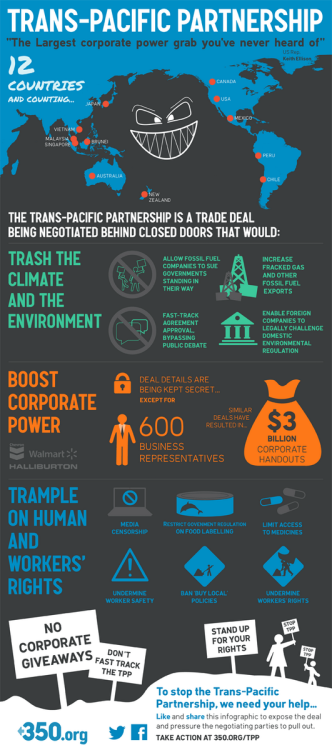
"Free Trade" is Not Free – Why We All Need to Oppose the Trans Pacific Partnership
Monday, March 12, 2012 by Common Dreams
by John Kinsman
There are always winners and losers in free trade. The winners are the 1% - the wealthy at the top. The losers are the 99% - that means the rest of us.
The latest free trade deal which is now being rushed by President Obama through Congress is known as the Trans Pacific Partnership (TPP). Thirty years ago, the first free trade deals were enacted under the auspices of the World Trade Organization (WTO), including the North American Free Trade Agreement (NAFTA), the Central American Free Trade Agreement (CAFTA), the Australia/US Free Trade Agreement (AUSFTA), and many more. During this time, the global economic crisis accelerated at an alarming rate with only the 1% reaping the profits. This ongoing crisis will not end until these destructive free trade agreements are repealed and fair trade becomes the norm.
Most recently, the Korea/US Free Trade Agreement (KORUS) was signed, over the objections of many labor, farm, and consumer groups in both countries. According to the Feb. 8. 2012 edition of the Korea Times, the leader of the Democratic United Party (DUP) vowed to nullify this deal with the United States once in power. Current predictions show the DUP winning this year’s general election. In an open letter to Obama, vice president Biden, and House Speaker Boehner, the DUP called upon the US “to reconsider the KORUS FTA in order to truly strengthen the long term relationship between our countries. If our cordial and earnest request is overlooked by your administration, we will have to take all measures possible to freeze the implementation of the KORUS FTA.”
Why would anyone expect anything but another race to the bottom in terms of farm prices, worker wages, environmental standards and human rights with passage of the TPP? We need only look at what happened in the years following NAFTA where over two million Mexican farmers were driven off their land by subsidized US corn being dumped into the market. Risking their lives, the farmers migrated across the border in search of work – families torn apart as fathers, mothers, brothers, and sisters disappear. Some died in the desert, others were murdered by traffickers (coyotes) and rightwing vigilantes. So devalued as human beings, their lives were not even worth counting. Similarly, in the US and Canada thousands of family farmers and small business owners have seen their livelihoods sacrificed on the altar of greater corporate profit.
Those in the 1% who are now pushing the TPP hope to take advantage of the huge supply of cheap labor and natural resources to be found in the Pacific Rim. The recent expose of the Chinese sweatshops behind Apple’s iPhones, where workers regularly commit suicide by jumping off factory rooftops, is just the tip of the iceberg when it comes to the horrific conditions that are spawned by these free trade deals.
Who else will lose under the TPP? US dairy farmers fear they will go bankrupt as cheap foreign powder imports like milk protein concentrate (MPC) flood the domestic market. US consumers will likely face more contaminated products – whether it is pet food laced with melamine or children’s toys coated with lead paint. US pharmaceutical giants are poised to undermine access to generic drugs by imposing their expensive patents on Australia and New Zealand where people currently enjoy better and more affordable healthcare than is found here. Japanese farmers and consumers will be forced to accept genetically engineered crops and hormone-tainted meat exported by US agribusiness that they do not even want. So much for freedom under "free trade."
As Congress considers the TPP, we need to express our opposition – not only to convince our elected officials that this will just lead to more economic chaos on top of the current crisis, but to also let our friends across the Pacific know that they are not alone in opposing free trade deals that are only designed to profit the 1%. Those of us in the 99% will end up losers if we do not repeal KORUS and stop the TPP. We could ALL be winners if we worked together in constructive cooperation for a new global economic system based upon fair trade instead.
by John Kinsman
There are always winners and losers in free trade. The winners are the 1% - the wealthy at the top. The losers are the 99% - that means the rest of us.
The latest free trade deal which is now being rushed by President Obama through Congress is known as the Trans Pacific Partnership (TPP). Thirty years ago, the first free trade deals were enacted under the auspices of the World Trade Organization (WTO), including the North American Free Trade Agreement (NAFTA), the Central American Free Trade Agreement (CAFTA), the Australia/US Free Trade Agreement (AUSFTA), and many more. During this time, the global economic crisis accelerated at an alarming rate with only the 1% reaping the profits. This ongoing crisis will not end until these destructive free trade agreements are repealed and fair trade becomes the norm.
Most recently, the Korea/US Free Trade Agreement (KORUS) was signed, over the objections of many labor, farm, and consumer groups in both countries. According to the Feb. 8. 2012 edition of the Korea Times, the leader of the Democratic United Party (DUP) vowed to nullify this deal with the United States once in power. Current predictions show the DUP winning this year’s general election. In an open letter to Obama, vice president Biden, and House Speaker Boehner, the DUP called upon the US “to reconsider the KORUS FTA in order to truly strengthen the long term relationship between our countries. If our cordial and earnest request is overlooked by your administration, we will have to take all measures possible to freeze the implementation of the KORUS FTA.”
Why would anyone expect anything but another race to the bottom in terms of farm prices, worker wages, environmental standards and human rights with passage of the TPP? We need only look at what happened in the years following NAFTA where over two million Mexican farmers were driven off their land by subsidized US corn being dumped into the market. Risking their lives, the farmers migrated across the border in search of work – families torn apart as fathers, mothers, brothers, and sisters disappear. Some died in the desert, others were murdered by traffickers (coyotes) and rightwing vigilantes. So devalued as human beings, their lives were not even worth counting. Similarly, in the US and Canada thousands of family farmers and small business owners have seen their livelihoods sacrificed on the altar of greater corporate profit.
Those in the 1% who are now pushing the TPP hope to take advantage of the huge supply of cheap labor and natural resources to be found in the Pacific Rim. The recent expose of the Chinese sweatshops behind Apple’s iPhones, where workers regularly commit suicide by jumping off factory rooftops, is just the tip of the iceberg when it comes to the horrific conditions that are spawned by these free trade deals.
Who else will lose under the TPP? US dairy farmers fear they will go bankrupt as cheap foreign powder imports like milk protein concentrate (MPC) flood the domestic market. US consumers will likely face more contaminated products – whether it is pet food laced with melamine or children’s toys coated with lead paint. US pharmaceutical giants are poised to undermine access to generic drugs by imposing their expensive patents on Australia and New Zealand where people currently enjoy better and more affordable healthcare than is found here. Japanese farmers and consumers will be forced to accept genetically engineered crops and hormone-tainted meat exported by US agribusiness that they do not even want. So much for freedom under "free trade."
As Congress considers the TPP, we need to express our opposition – not only to convince our elected officials that this will just lead to more economic chaos on top of the current crisis, but to also let our friends across the Pacific know that they are not alone in opposing free trade deals that are only designed to profit the 1%. Those of us in the 99% will end up losers if we do not repeal KORUS and stop the TPP. We could ALL be winners if we worked together in constructive cooperation for a new global economic system based upon fair trade instead.
Wednesday, June 8, 2011
There Is No Such Thing as a Free Market
by: Ha-Joon Chang, Bloomsbury Publishing
Tuesday 7 June 2011
Thing 1: There is No Such Thing as a Free Market
What They Tell You
Markets need to be free. When the government interferes to dictate what market participants can or cannot do, resources cannot flow to their most efficient use. If people cannot do the things that they find most profitable, they lose the incentive to invest and innovate. Thus, if the government puts a cap on house rents, landlords lose the incentive to maintain their properties or build new ones. Or, if the government restricts the kinds of financial products that can be sold, two contracting parties that may both have benefited from innovative transactions that fulfil their idiosyncratic needs cannot reap the potential gains of free contract. People must be left ‘free to choose’, as the title of free-market visionary Milton Friedman’s famous book goes.
What They Don’t Tell You
The free market doesn’t exist. Every market has some rules and boundaries that restrict freedom of choice. A market looks free only because we so unconditionally accept its underlying restrictions that we fail to see them. How ‘free’ a market is cannot be objectively defined. It is a political definition. The usual claim by free-market economists that they are trying to defend the market from politically motivated interference by the government is false. Government is always involved and those free-marketeers are as politically motivated as anyone. Overcoming the myth that there is such a thing as an objectively defined ‘free market’ is the first step towards understanding capitalism.
Labour Ought to Be Free
In 1819 new legislation to regulate child labour, the Cotton Factories Regulation Act, was tabled in the British Parliament. The proposed regulation was incredibly ‘light touch’ by modern standards. It would ban the employment of young children – that is, those under the age of nine. Older children (aged between ten and sixteen) would still be allowed to work, but with their work- ing hours restricted to twelve per day (yes, they were really going soft on those kids). The new rules applied only to cotton factories, which were recognized to be exceptionally hazardous to workers’ health.
The proposal caused huge controversy. Opponents saw it as undermining the sanctity of freedom of contract and thus destroying the very foundation of the free market. In debating this legislation, some members of the House of Lords objected to it on the grounds that ‘labour ought to be free’. Their argument said: the children want (and need) to work, and the factory owners want to employ them; what is the problem?
Today, even the most ardent free-market proponents in Britain or other rich countries would not think of bringing child labour back as part of the market liberalization package that they so want. However, until the late nineteenth or the early twentieth century, when the first serious child labour regulations were introduced in Europe and North America, many respectable people judged child labour regulation to be against the principles of the free market.
Thus seen, the ‘freedom’ of a market is, like beauty, in the eyes of the beholder. If you believe that the right of children not to have to work is more important than the right of factory owners to be able to hire whoever they find most profitable, you will not see a ban on child labour as an infringement on the freedom of the labour market. If you believe the opposite, you will see an ‘unfree’ market, shackled by a misguided government regulation.
We don’t have to go back two centuries to see regulations we take for granted (and accept as the ‘ambient noise’ within the free market) that were seriously challenged as undermining the free market, when first introduced. When environmental regulations (e.g., regulations on car and factory emissions) appeared a few decades ago, they were opposed by many as seri- ous infringements on our freedom to choose. Their opponents asked: if people want to drive in more polluting cars or if factories find more polluting production methods more profitable, why should the government prevent them from making such choices? Today, most people accept these regulations as ‘natural’. They believe that actions that harm others, however unintentionally (such as pollution), need to be restricted. They also understand that it is sensible to make careful use of our energy resources, when many of them are non-renewable. They may believe that reducing human impact on climate change makes sense too.
If the same market can be perceived to have varying degrees of freedom by different people, there is really no objective way to define how free that market is. In other words, the free market is an illusion. If some markets look free, it is only because we so totally accept the regulations that are propping them up that they become invisible.
Piano Wires and Kungfu Masters
Like many people, as a child I was fascinated by all those gravity-defying kungfu masters in Hong Kong movies.
Like many kids, Conditions of trade are specified too. One of the things that surprised me when I first moved to Britain in the mid 1980s was that one could demand a full refund for a product one didn’t like, even if it wasn’t faulty. At the time, you just couldn’t do that in Korea, except in the most exclusive department stores. In Britain, the consumer’s right to change her mind was considered more important than the right of the seller to avoid the cost involved in returning unwanted (yet functional) products to the manufacturer. There are many other rules regulating various aspects of the exchange process: product liability, failure in delivery, loan default, and so on. In many countries, there are also necessary permissions for the location of sales outlets – such as restrictions on street-vending or zoning laws that ban commercial activities in residential areas.
Then there are price regulations. I am not talking here just about those highly visible phenomena such as rent controls or minimum wages that free-market economists love to hate.
Wages in rich countries are determined more by immigration control than anything else, including any minimum wage legislation. How is the immigration maximum determined? Not by the ‘free’ labour market, which, if left alone, will end up replacing 80–90 per cent of native workers with cheaper, and often more productive, immigrants. Immigration is largely settled by politics. So, if you have any residual doubt about the massive role that the government plays in the economy’s free market, then pause to reflect that all our wages are, at root, politically deter- mined (see Thing 3).
Following the 2008 financial crisis, the prices of loans (if you can get one or if you already have a variable rate loan) have become a lot lower in many countries thanks to the continuous slashing of interest rates. Was that because suddenly people didn’t want loans and the banks needed to lower their prices to shift them? No, it was the result of political decisions to boost demand by cutting interest rates. Even in normal times, interest rates are set in most countries by the central bank, which means that political considerations creep in. In other words, interest rates are also determined by politics.
If wages and interest rates are (to a significant extent) politically determined, then all the other prices are politically determined, as they affect all other prices.
Is Free Trade Fair?
We see a regulation when we don’t endorse the moral values behind it. The nineteenth-century high-tariff restriction on free trade by the US federal government outraged slave-owners, who at the same time saw nothing wrong with trading people in a free market. To those who believed that people can be owned, banning trade in slaves was objectionable in the same way as restricting trade in manufactured goods. Korean shopkeepers of the 1980s would probably have thought the requirement for ‘unconditional return’ to be an unfairly burdensome government regulation restricting market freedom.
This clash of values also lies behind the contemporary debate on free trade vs. fair trade. Many Americans believe that China is engaged in international trade that may be free but is not fair. In their view, by paying workers unacceptably low wages and making them work in inhumane conditions, China competes unfairly. The Chinese, in turn, can riposte that it is unacceptable that rich countries, while advocating free trade, try to impose artificial barriers to China’s exports by attempting to restrict the import of ‘sweatshop’ products. They find it unjust to be prevented from exploiting the only resource they have in greatest abundance – cheap labour.
Of course, the difficulty here is that there is no objective way to define ‘unacceptably low wages’ or ‘inhumane working conditions’. With the huge international gaps that exist in the level of economic development and living standards, it is natural that what is a starvation wage in the US is a handsome wage in China (the average being 10 per cent that of the US) and a fortune in India (the average being 2 per cent that of the US). Indeed, most fair-trade-minded Americans would not have bought things made by their own grandfathers, who worked extremely long hours under inhumane conditions. Until the beginning of the twenti- eth century, the average work week in the US was around sixty hours. At the time (in 1905, to be more precise), it was a country in which the Supreme Court declared unconstitutional a New York state law limiting the working days of bakers to ten hours, on the grounds that it ‘deprived the baker of the liberty of work- ing as long as he wished’.
Thus seen, the debate about fair trade is essentially about moral values and political decisions, and not economics in the usual sense. Even though it is about an economic issue, it is not some- thing economists with their technical tool kits are particularly well equipped to rule on.
All this does not mean that we need to take a relativist posi- tion and fail to criticize anyone because anything goes. We can (and I do) have a view on the acceptability of prevailing labour standards in China (or any other country, for that matter) and try to do something about it, without believing that those who have a different view are wrong in some absolute sense. Even though China cannot afford American wages or Swedish working conditions, it certainly can improve the wages and the working conditions of its workers. Indeed, many Chinese don’t accept the prevailing conditions and demand tougher regulations. But economic theory (at least free-market economics) cannot tell us what the ‘right’ wages and working conditions should be in China.
I Don't Think We Are in France Anymore
In July 2008, with the country’s financial system in meltdown, the US government poured $200 billion into Fannie Mae and Freddie Mac, the mortgage lenders, and nationalized them. On witnessing this, the Republican Senator Jim Bunning of Kentucky famously denounced the action as something that could only happen in a ‘socialist’ country like France.
France was bad enough, but on 19 September 2008, Senator Bunning’s beloved country was turned into the Evil Empire itself by his own party leader. According to the plan announced that day by President George W. Bush and subsequently named TARP (Troubled Asset Relief Program), the US government was to use at least $700 billion of taxpayers’ money to buy up the ‘toxic assets’ choking up the financial system.
President Bush, however, did not see things quite that way. He argued that, rather than being ‘socialist’, the plan was simply a continuation of the American system of free enterprise, which ‘rests on the conviction that the federal government should interfere in the market place only when necessary’. Only that, in his view, nationalizing a huge chunk of the financial sector was just one of those necessary things.
Mr Bush’s statement is, of course, an ultimate example of political double-speak – one of the biggest state interventions in human history is dressed up as another workaday market process. However, through these words Mr Bush exposed the flimsy foundation on which the myth of the free market stands. As the statement so clearly reveals, what is a necessary state intervention consistent with free-market capitalism is really a matter of opinion. There is no scientifically defined boundary for free market.
If there is nothing sacred about any particular market boundaries that happen to exist, an attempt to change them is as legitimate as the attempt to defend them. Indeed, the history of capitalism has been a constant struggle over the boundaries of the market.
A lot of the things that are outside the market today have been removed by political decision, rather than the market process itself – human beings, government jobs, electoral votes, legal decisions, university places or uncertified medicines. There are still attempts to buy at least some of these things illegally (bribing government officials, judges or voters) or legally (using expensive lawyers to win a lawsuit, donations to political parties, etc.), but, even though there have been movements in both directions, the trend has been towards less marketization.
For goods that are still traded, more regulations have been introduced over time. Compared even to a few decades ago, now we have much more stringent regulations on who can produce what (e.g., certificates for organic or fair-trade producers), how they can be produced (e.g., restrictions on pollution or carbon emissions), and how they can be sold (e.g., rules on product label- ling and on refunds).
Furthermore, reflecting its political nature, the process of re-drawing the boundaries of the market has sometimes been marked by violent conflicts. The Americans fought a civil war over free trade in slaves (although free trade in goods – or the tariffs issue – was also an important issue). The British govern- ment fought the Opium War against China to realize a free trade in opium. Regulations on free market in child labour were implemented only because of the struggles by social reformers, as I discussed earlier. Making free markets in government jobs or votes illegal has been met with stiff resistance by political parties who bought votes and dished out government jobs to reward loyalists. These practices came to an end only through a combi- nation of political activism, electoral reforms and changes in the rules regarding government hiring.
Recognizing that the boundaries of the market are ambiguous and cannot be determined in an objective way lets us realize that economics is not a science like physics or chemistry, but a polit- ical exercise. Free-market economists may want you to believe that the correct boundaries of the market can be scientifically determined, but this is incorrect. If the boundaries of what you are studying cannot be scientifically determined, what you are doing is not a science.
Thus seen, opposing a new regulation is saying that the status quo, however unjust from some people’s point of view, should not be changed. Saying that an existing regulation should be abol- ished is saying that the domain of the market should be expanded, which means that those who have money should be given more power in that area, as the market is run on one-dollar-one-vote principle.
So, when free-market economists say that a certain regulation should not be introduced because it would restrict the ‘freedom’ of a certain market, they are merely expressing a political opinion that they reject the rights that are to be defended by the proposed law. Their ideological cloak is to pretend that their politics is not really political, but rather is an objective economic truth, while other people’s politics is political. However, they are as politically motivated as their opponents.
Breaking away from the illusion of market objectivity is the first step towards understanding capitalism.
Tuesday 7 June 2011
23 Things They Don't Tell you About Capitalism
Thing 1: There is No Such Thing as a Free Market
What They Tell You
Markets need to be free. When the government interferes to dictate what market participants can or cannot do, resources cannot flow to their most efficient use. If people cannot do the things that they find most profitable, they lose the incentive to invest and innovate. Thus, if the government puts a cap on house rents, landlords lose the incentive to maintain their properties or build new ones. Or, if the government restricts the kinds of financial products that can be sold, two contracting parties that may both have benefited from innovative transactions that fulfil their idiosyncratic needs cannot reap the potential gains of free contract. People must be left ‘free to choose’, as the title of free-market visionary Milton Friedman’s famous book goes.
What They Don’t Tell You
The free market doesn’t exist. Every market has some rules and boundaries that restrict freedom of choice. A market looks free only because we so unconditionally accept its underlying restrictions that we fail to see them. How ‘free’ a market is cannot be objectively defined. It is a political definition. The usual claim by free-market economists that they are trying to defend the market from politically motivated interference by the government is false. Government is always involved and those free-marketeers are as politically motivated as anyone. Overcoming the myth that there is such a thing as an objectively defined ‘free market’ is the first step towards understanding capitalism.
Labour Ought to Be Free
In 1819 new legislation to regulate child labour, the Cotton Factories Regulation Act, was tabled in the British Parliament. The proposed regulation was incredibly ‘light touch’ by modern standards. It would ban the employment of young children – that is, those under the age of nine. Older children (aged between ten and sixteen) would still be allowed to work, but with their work- ing hours restricted to twelve per day (yes, they were really going soft on those kids). The new rules applied only to cotton factories, which were recognized to be exceptionally hazardous to workers’ health.
The proposal caused huge controversy. Opponents saw it as undermining the sanctity of freedom of contract and thus destroying the very foundation of the free market. In debating this legislation, some members of the House of Lords objected to it on the grounds that ‘labour ought to be free’. Their argument said: the children want (and need) to work, and the factory owners want to employ them; what is the problem?
Today, even the most ardent free-market proponents in Britain or other rich countries would not think of bringing child labour back as part of the market liberalization package that they so want. However, until the late nineteenth or the early twentieth century, when the first serious child labour regulations were introduced in Europe and North America, many respectable people judged child labour regulation to be against the principles of the free market.
Thus seen, the ‘freedom’ of a market is, like beauty, in the eyes of the beholder. If you believe that the right of children not to have to work is more important than the right of factory owners to be able to hire whoever they find most profitable, you will not see a ban on child labour as an infringement on the freedom of the labour market. If you believe the opposite, you will see an ‘unfree’ market, shackled by a misguided government regulation.
We don’t have to go back two centuries to see regulations we take for granted (and accept as the ‘ambient noise’ within the free market) that were seriously challenged as undermining the free market, when first introduced. When environmental regulations (e.g., regulations on car and factory emissions) appeared a few decades ago, they were opposed by many as seri- ous infringements on our freedom to choose. Their opponents asked: if people want to drive in more polluting cars or if factories find more polluting production methods more profitable, why should the government prevent them from making such choices? Today, most people accept these regulations as ‘natural’. They believe that actions that harm others, however unintentionally (such as pollution), need to be restricted. They also understand that it is sensible to make careful use of our energy resources, when many of them are non-renewable. They may believe that reducing human impact on climate change makes sense too.
If the same market can be perceived to have varying degrees of freedom by different people, there is really no objective way to define how free that market is. In other words, the free market is an illusion. If some markets look free, it is only because we so totally accept the regulations that are propping them up that they become invisible.
Piano Wires and Kungfu Masters
Like many people, as a child I was fascinated by all those gravity-defying kungfu masters in Hong Kong movies.
Like many kids, Conditions of trade are specified too. One of the things that surprised me when I first moved to Britain in the mid 1980s was that one could demand a full refund for a product one didn’t like, even if it wasn’t faulty. At the time, you just couldn’t do that in Korea, except in the most exclusive department stores. In Britain, the consumer’s right to change her mind was considered more important than the right of the seller to avoid the cost involved in returning unwanted (yet functional) products to the manufacturer. There are many other rules regulating various aspects of the exchange process: product liability, failure in delivery, loan default, and so on. In many countries, there are also necessary permissions for the location of sales outlets – such as restrictions on street-vending or zoning laws that ban commercial activities in residential areas.
Then there are price regulations. I am not talking here just about those highly visible phenomena such as rent controls or minimum wages that free-market economists love to hate.
Wages in rich countries are determined more by immigration control than anything else, including any minimum wage legislation. How is the immigration maximum determined? Not by the ‘free’ labour market, which, if left alone, will end up replacing 80–90 per cent of native workers with cheaper, and often more productive, immigrants. Immigration is largely settled by politics. So, if you have any residual doubt about the massive role that the government plays in the economy’s free market, then pause to reflect that all our wages are, at root, politically deter- mined (see Thing 3).
Following the 2008 financial crisis, the prices of loans (if you can get one or if you already have a variable rate loan) have become a lot lower in many countries thanks to the continuous slashing of interest rates. Was that because suddenly people didn’t want loans and the banks needed to lower their prices to shift them? No, it was the result of political decisions to boost demand by cutting interest rates. Even in normal times, interest rates are set in most countries by the central bank, which means that political considerations creep in. In other words, interest rates are also determined by politics.
If wages and interest rates are (to a significant extent) politically determined, then all the other prices are politically determined, as they affect all other prices.
Is Free Trade Fair?
We see a regulation when we don’t endorse the moral values behind it. The nineteenth-century high-tariff restriction on free trade by the US federal government outraged slave-owners, who at the same time saw nothing wrong with trading people in a free market. To those who believed that people can be owned, banning trade in slaves was objectionable in the same way as restricting trade in manufactured goods. Korean shopkeepers of the 1980s would probably have thought the requirement for ‘unconditional return’ to be an unfairly burdensome government regulation restricting market freedom.
This clash of values also lies behind the contemporary debate on free trade vs. fair trade. Many Americans believe that China is engaged in international trade that may be free but is not fair. In their view, by paying workers unacceptably low wages and making them work in inhumane conditions, China competes unfairly. The Chinese, in turn, can riposte that it is unacceptable that rich countries, while advocating free trade, try to impose artificial barriers to China’s exports by attempting to restrict the import of ‘sweatshop’ products. They find it unjust to be prevented from exploiting the only resource they have in greatest abundance – cheap labour.
Of course, the difficulty here is that there is no objective way to define ‘unacceptably low wages’ or ‘inhumane working conditions’. With the huge international gaps that exist in the level of economic development and living standards, it is natural that what is a starvation wage in the US is a handsome wage in China (the average being 10 per cent that of the US) and a fortune in India (the average being 2 per cent that of the US). Indeed, most fair-trade-minded Americans would not have bought things made by their own grandfathers, who worked extremely long hours under inhumane conditions. Until the beginning of the twenti- eth century, the average work week in the US was around sixty hours. At the time (in 1905, to be more precise), it was a country in which the Supreme Court declared unconstitutional a New York state law limiting the working days of bakers to ten hours, on the grounds that it ‘deprived the baker of the liberty of work- ing as long as he wished’.
Thus seen, the debate about fair trade is essentially about moral values and political decisions, and not economics in the usual sense. Even though it is about an economic issue, it is not some- thing economists with their technical tool kits are particularly well equipped to rule on.
All this does not mean that we need to take a relativist posi- tion and fail to criticize anyone because anything goes. We can (and I do) have a view on the acceptability of prevailing labour standards in China (or any other country, for that matter) and try to do something about it, without believing that those who have a different view are wrong in some absolute sense. Even though China cannot afford American wages or Swedish working conditions, it certainly can improve the wages and the working conditions of its workers. Indeed, many Chinese don’t accept the prevailing conditions and demand tougher regulations. But economic theory (at least free-market economics) cannot tell us what the ‘right’ wages and working conditions should be in China.
I Don't Think We Are in France Anymore
In July 2008, with the country’s financial system in meltdown, the US government poured $200 billion into Fannie Mae and Freddie Mac, the mortgage lenders, and nationalized them. On witnessing this, the Republican Senator Jim Bunning of Kentucky famously denounced the action as something that could only happen in a ‘socialist’ country like France.
France was bad enough, but on 19 September 2008, Senator Bunning’s beloved country was turned into the Evil Empire itself by his own party leader. According to the plan announced that day by President George W. Bush and subsequently named TARP (Troubled Asset Relief Program), the US government was to use at least $700 billion of taxpayers’ money to buy up the ‘toxic assets’ choking up the financial system.
President Bush, however, did not see things quite that way. He argued that, rather than being ‘socialist’, the plan was simply a continuation of the American system of free enterprise, which ‘rests on the conviction that the federal government should interfere in the market place only when necessary’. Only that, in his view, nationalizing a huge chunk of the financial sector was just one of those necessary things.
Mr Bush’s statement is, of course, an ultimate example of political double-speak – one of the biggest state interventions in human history is dressed up as another workaday market process. However, through these words Mr Bush exposed the flimsy foundation on which the myth of the free market stands. As the statement so clearly reveals, what is a necessary state intervention consistent with free-market capitalism is really a matter of opinion. There is no scientifically defined boundary for free market.
If there is nothing sacred about any particular market boundaries that happen to exist, an attempt to change them is as legitimate as the attempt to defend them. Indeed, the history of capitalism has been a constant struggle over the boundaries of the market.
A lot of the things that are outside the market today have been removed by political decision, rather than the market process itself – human beings, government jobs, electoral votes, legal decisions, university places or uncertified medicines. There are still attempts to buy at least some of these things illegally (bribing government officials, judges or voters) or legally (using expensive lawyers to win a lawsuit, donations to political parties, etc.), but, even though there have been movements in both directions, the trend has been towards less marketization.
For goods that are still traded, more regulations have been introduced over time. Compared even to a few decades ago, now we have much more stringent regulations on who can produce what (e.g., certificates for organic or fair-trade producers), how they can be produced (e.g., restrictions on pollution or carbon emissions), and how they can be sold (e.g., rules on product label- ling and on refunds).
Furthermore, reflecting its political nature, the process of re-drawing the boundaries of the market has sometimes been marked by violent conflicts. The Americans fought a civil war over free trade in slaves (although free trade in goods – or the tariffs issue – was also an important issue). The British govern- ment fought the Opium War against China to realize a free trade in opium. Regulations on free market in child labour were implemented only because of the struggles by social reformers, as I discussed earlier. Making free markets in government jobs or votes illegal has been met with stiff resistance by political parties who bought votes and dished out government jobs to reward loyalists. These practices came to an end only through a combi- nation of political activism, electoral reforms and changes in the rules regarding government hiring.
Recognizing that the boundaries of the market are ambiguous and cannot be determined in an objective way lets us realize that economics is not a science like physics or chemistry, but a polit- ical exercise. Free-market economists may want you to believe that the correct boundaries of the market can be scientifically determined, but this is incorrect. If the boundaries of what you are studying cannot be scientifically determined, what you are doing is not a science.
Thus seen, opposing a new regulation is saying that the status quo, however unjust from some people’s point of view, should not be changed. Saying that an existing regulation should be abol- ished is saying that the domain of the market should be expanded, which means that those who have money should be given more power in that area, as the market is run on one-dollar-one-vote principle.
So, when free-market economists say that a certain regulation should not be introduced because it would restrict the ‘freedom’ of a certain market, they are merely expressing a political opinion that they reject the rights that are to be defended by the proposed law. Their ideological cloak is to pretend that their politics is not really political, but rather is an objective economic truth, while other people’s politics is political. However, they are as politically motivated as their opponents.
Breaking away from the illusion of market objectivity is the first step towards understanding capitalism.
Posted by
spiderlegs
Labels:
deregulated markets,
exploiting low labor costs,
Fair Trade,
Financial Crisis,
free market capitalism,
Free Trade,
lower wages,
Milton Friedman,
Regulation,
Troubled Assets Relief Program (TARP),
US economy
Tuesday, March 2, 2010
The Innovation Delusion
Ralph Gomory
March 1, 2010
In the United States, innovation has become almost synonymous with economic competitiveness. Even more remarkable, we often hear that our economic salvation can only be through innovation. We hear that because of low Asian wages we must innovate because we cannot really compete in anything else. Inventive Americans will do the R&D and let the rest of the world, usually China, do the dull work of actually making things. Or we'll do programming design but let the rest of the world, usually India, do low-level programming. This is a totally mistaken belief and one that, if accepted, will consign this nation to second- or third-class status.
The latest offender to advance this line of thought is Thomas Friedman, who has prominently displayed this familiar and entirely incorrect line of thought in the New York Times. Unfortunately, this idea is one that is widely accepted without careful thought about either its truthfulness or its consequences.
Truth and Consequences
Cheap labor abroad is cited as the incurable handicap that explains why the United States cannot compete. But cheap labor doesn't explain the fact that Japan and Germany, both high-wage countries, are successful in the automobile industry. Nor does it explain how semiconductors, a model of a high investment, low-labor content industry, are mainly made in Asia. The premise that the inescapable burden of competing against low wages means failure is simply not correct.
Perhaps even more disturbing than the lack of truthfulness is the fact that we are not addressing the consequences of not competing. There are some inescapable truths about any economic good, be it a manufactured good or a service: (1) you either produce it in your own country, (2) you trade something you do produce for it, (3) you do without it, or (4) you import it and promise to pay later.
We are moving steadily away from producing what we need in this country. We are also moving away from producing on a scale that enables us to trade for what we do need. Rather than do without, we are increasingly importing things with a promise to pay later. This cannot go on. When our trading partners, especially China, no longer want to loan us hundreds of billions of dollars a year to be paid later, we will have little productive capacity left and we will be a poor nation.
Friedman is only the latest to assume that we can avoid this fate by emphasizing designs, ideas, and R&D and trading them for the items we need. This is an attractive idea; we often hear about innovation parks and university research centers and often their work is both exciting and good.
But the chasm-sized flaw in this otherwise alluring proposition is scale. Balancing trade on ideas and R&D simply cannot be done. The most elementary analysis shows that the scale is entirely wrong. As one who spent many years as the head of research of a large corporation, I know how much R&D matters; I also know how small it is. Eight percent is a very large percent of revenue to spend on R&D. Even in manufacturing, which is relatively R&D intensive, 4 to 5 percent is typical. It is really wrong to think that you can scale up R&D to be big enough so we can trade it for the huge quantity of things we need but don't make in this country.
A Strange and Unworkable Strategy
Ignoring the issue of scale, Tom Friedman goes on to quote authoritative Chinese sources who say that by the end of the decade China will be dominating global production of the whole range of power equipment. To Friedman's approving eye this just means that China is going to make clean power technologies cheaper for itself and everyone else. Friedman says that Chinese experts believe it will all happen faster and more effectively if China and America work together with the United States specializing in energy research and innovation, at which, he asserts, China is still weak, while China will specialize in mass production.
It is probably true that all this will happen faster with the specialization Friedman describes, but where will we be at the end of that process? China will be making power equipment cheaply, but the chasm is still there, so what will we have to trade for it? Power equipment will be cheap in China, but if we adopt this approach it may well be unaffordable in the United States.
Meanwhile the Chinese wisely welcome our nascent innovations and turn them into products. They are building plants, making things manufacturable, and adding them to their growing GDP. Friedman's article contains an excellent example of this. He describes a U.S. developer with a new approach to solar-thermal power, whose proposal to the U.S. government asking for small scale support was easily outbid by a Chinese offer that was far larger and was aimed at much larger scale plants.
Specializing in R&D, but sending its fruits on to others is a strange and completely unworkable strategy for a nation.
Other Issues
Thinking of innovation as a standalone activity without production has other major flaws. First, our global corporations, understanding that innovation and production are in fact closely tied, are rapidly moving not only production but also R&D overseas. Intel's CEO made this very clear when he said that the goal of Intel's new plant in China is to support a transition from "manufactured in China" to "innovated in China".
In addition, the standalone innovation approach leaves most Americans entirely out. After all, only a very small portion of Americans are engaged in R&D. At a recent meeting I heard "The only thing that matters is innovative and passionate people." These people do matter, but they are very far from being the only ones. This attitude misses the point that it was all our people, working in many different work settings, that made this country prosper. And all of them will all be needed in any viable future for our country.
What We Must Do - The Role of Trade
We need successful industries and we need to innovate within them to keep them thriving. However, when your trading partner is thinking about GDP rather than profit, and has adopted mercantilist tactics, subsidizing industries, and mispricing its currency, while loaning you the money to buy the underpriced goods, this may simply not be possible.
The ability to compete in a world that is half-mercantilist, half-free is inescapably tied to effective trade policy. Our present policy is to beg. We ask countries like China to stop the subsidies and currency mispricings because they are creating a one-way flow of underpriced goods; goods that are destroying jobs on a large scale in many of the most productive sectors of our economy. But why should they stop? It's working for them.
We must move to balanced trade. With balanced trade every dollar of imports is matched by a dollar of exports of goods or services produced here in the U.S.A. We are fortunate that there are in fact ways to balance trade. One very attractive way is to adopt some version of Warren Buffet's Import Certificates plan, which Buffet has described in a remarkably insightful Fortune article.
We should act now to balance trade. We should not continue to beg while jobs disappear and our productive ability erodes.
What We Must Do - Motivating our Companies
Today our companies are motivated to take innovations abroad, produce there and import the goods into the United States. Increasingly we can expect services also to go overseas. We must produce here in the U.S.A., to employ the people of this country, and we must keep their activities effective by a steady stream of innovations in design and production. While other countries roll out a welcome mat of tax breaks and subsidies for our companies because their common sense tells them that their people being employed in productive work is the road to being a rich country, we provide no incentive for U.S. companies to produce here.
We cannot continue to have our corporations, faithful only to the interests of their shareholders, engage in a one-way flow of jobs, technology, and innovation out of the country. We need to realize that with globalization the interests of our country and of our global corporations have diverged. We can realign the interests of corporations with those of our country by rewarding companies that are productive here. And that can be done in ways that are consistent with our history and with the limited capabilities of our government.
Conclusion
Specializing in innovation is an attractive idea, but a misleading one; an idea that blinds us to what we really need to do.
We need to do more than produce exciting new ideas; we must also be able to compete in large productive industries. This requires us to both balance trade and to motivate our corporations not only to innovate, but also to produce in this country. While this is hard to do, it can be done. Specializing in innovation, though often recommended, is in fact a delusion, an alluring path that in reality will lead us straight downhill.
Ralph Gomory
March 1, 2010
In the United States, innovation has become almost synonymous with economic competitiveness. Even more remarkable, we often hear that our economic salvation can only be through innovation. We hear that because of low Asian wages we must innovate because we cannot really compete in anything else. Inventive Americans will do the R&D and let the rest of the world, usually China, do the dull work of actually making things. Or we'll do programming design but let the rest of the world, usually India, do low-level programming. This is a totally mistaken belief and one that, if accepted, will consign this nation to second- or third-class status.
The latest offender to advance this line of thought is Thomas Friedman, who has prominently displayed this familiar and entirely incorrect line of thought in the New York Times. Unfortunately, this idea is one that is widely accepted without careful thought about either its truthfulness or its consequences.
Truth and Consequences
Cheap labor abroad is cited as the incurable handicap that explains why the United States cannot compete. But cheap labor doesn't explain the fact that Japan and Germany, both high-wage countries, are successful in the automobile industry. Nor does it explain how semiconductors, a model of a high investment, low-labor content industry, are mainly made in Asia. The premise that the inescapable burden of competing against low wages means failure is simply not correct.
Perhaps even more disturbing than the lack of truthfulness is the fact that we are not addressing the consequences of not competing. There are some inescapable truths about any economic good, be it a manufactured good or a service: (1) you either produce it in your own country, (2) you trade something you do produce for it, (3) you do without it, or (4) you import it and promise to pay later.
We are moving steadily away from producing what we need in this country. We are also moving away from producing on a scale that enables us to trade for what we do need. Rather than do without, we are increasingly importing things with a promise to pay later. This cannot go on. When our trading partners, especially China, no longer want to loan us hundreds of billions of dollars a year to be paid later, we will have little productive capacity left and we will be a poor nation.
Friedman is only the latest to assume that we can avoid this fate by emphasizing designs, ideas, and R&D and trading them for the items we need. This is an attractive idea; we often hear about innovation parks and university research centers and often their work is both exciting and good.
But the chasm-sized flaw in this otherwise alluring proposition is scale. Balancing trade on ideas and R&D simply cannot be done. The most elementary analysis shows that the scale is entirely wrong. As one who spent many years as the head of research of a large corporation, I know how much R&D matters; I also know how small it is. Eight percent is a very large percent of revenue to spend on R&D. Even in manufacturing, which is relatively R&D intensive, 4 to 5 percent is typical. It is really wrong to think that you can scale up R&D to be big enough so we can trade it for the huge quantity of things we need but don't make in this country.
A Strange and Unworkable Strategy
Ignoring the issue of scale, Tom Friedman goes on to quote authoritative Chinese sources who say that by the end of the decade China will be dominating global production of the whole range of power equipment. To Friedman's approving eye this just means that China is going to make clean power technologies cheaper for itself and everyone else. Friedman says that Chinese experts believe it will all happen faster and more effectively if China and America work together with the United States specializing in energy research and innovation, at which, he asserts, China is still weak, while China will specialize in mass production.
It is probably true that all this will happen faster with the specialization Friedman describes, but where will we be at the end of that process? China will be making power equipment cheaply, but the chasm is still there, so what will we have to trade for it? Power equipment will be cheap in China, but if we adopt this approach it may well be unaffordable in the United States.
Meanwhile the Chinese wisely welcome our nascent innovations and turn them into products. They are building plants, making things manufacturable, and adding them to their growing GDP. Friedman's article contains an excellent example of this. He describes a U.S. developer with a new approach to solar-thermal power, whose proposal to the U.S. government asking for small scale support was easily outbid by a Chinese offer that was far larger and was aimed at much larger scale plants.
Specializing in R&D, but sending its fruits on to others is a strange and completely unworkable strategy for a nation.
Other Issues
Thinking of innovation as a standalone activity without production has other major flaws. First, our global corporations, understanding that innovation and production are in fact closely tied, are rapidly moving not only production but also R&D overseas. Intel's CEO made this very clear when he said that the goal of Intel's new plant in China is to support a transition from "manufactured in China" to "innovated in China".
In addition, the standalone innovation approach leaves most Americans entirely out. After all, only a very small portion of Americans are engaged in R&D. At a recent meeting I heard "The only thing that matters is innovative and passionate people." These people do matter, but they are very far from being the only ones. This attitude misses the point that it was all our people, working in many different work settings, that made this country prosper. And all of them will all be needed in any viable future for our country.
What We Must Do - The Role of Trade
We need successful industries and we need to innovate within them to keep them thriving. However, when your trading partner is thinking about GDP rather than profit, and has adopted mercantilist tactics, subsidizing industries, and mispricing its currency, while loaning you the money to buy the underpriced goods, this may simply not be possible.
The ability to compete in a world that is half-mercantilist, half-free is inescapably tied to effective trade policy. Our present policy is to beg. We ask countries like China to stop the subsidies and currency mispricings because they are creating a one-way flow of underpriced goods; goods that are destroying jobs on a large scale in many of the most productive sectors of our economy. But why should they stop? It's working for them.
We must move to balanced trade. With balanced trade every dollar of imports is matched by a dollar of exports of goods or services produced here in the U.S.A. We are fortunate that there are in fact ways to balance trade. One very attractive way is to adopt some version of Warren Buffet's Import Certificates plan, which Buffet has described in a remarkably insightful Fortune article.
We should act now to balance trade. We should not continue to beg while jobs disappear and our productive ability erodes.
What We Must Do - Motivating our Companies
Today our companies are motivated to take innovations abroad, produce there and import the goods into the United States. Increasingly we can expect services also to go overseas. We must produce here in the U.S.A., to employ the people of this country, and we must keep their activities effective by a steady stream of innovations in design and production. While other countries roll out a welcome mat of tax breaks and subsidies for our companies because their common sense tells them that their people being employed in productive work is the road to being a rich country, we provide no incentive for U.S. companies to produce here.
We cannot continue to have our corporations, faithful only to the interests of their shareholders, engage in a one-way flow of jobs, technology, and innovation out of the country. We need to realize that with globalization the interests of our country and of our global corporations have diverged. We can realign the interests of corporations with those of our country by rewarding companies that are productive here. And that can be done in ways that are consistent with our history and with the limited capabilities of our government.
Conclusion
Specializing in innovation is an attractive idea, but a misleading one; an idea that blinds us to what we really need to do.
We need to do more than produce exciting new ideas; we must also be able to compete in large productive industries. This requires us to both balance trade and to motivate our corporations not only to innovate, but also to produce in this country. While this is hard to do, it can be done. Specializing in innovation, though often recommended, is in fact a delusion, an alluring path that in reality will lead us straight downhill.
Posted by
spiderlegs
Labels:
Economic Crisis,
Economic Recovery,
Economic Stimulus,
Fair Trade,
Foreign Affairs,
Free Trade,
Green Jobs,
Gross Domestic Product (GDP),
high unemployment,
Innovation,
Job Creation Bill,
Jobs,
Manufacturing Jobs
Subscribe to:
Posts (Atom)

