
Showing posts with label horizontal hydraulic fracturing. Show all posts
Showing posts with label horizontal hydraulic fracturing. Show all posts
Monday, October 12, 2015


Sunday, March 8, 2015
Since the City of Denton Banned Fracking, Texas GOP Moves to Pre-empt Local Control
Sunday, 08 March 2015By Candice Bernd, Truthout | Report
Carol Soph, a board member of the Denton Drilling Awareness Group, the driving force behind Denton's fracking ban, speaks with Rep. Phil King about her concerns regarding a bill he introduced in response to the Denton ban that would gut cities' ability to introduce similar measures or regulations. King is this year's national chair of the American Legislative Exchange Council.
"I do feel very strongly that air-quality measures and the engineering and scientific issues of oil and gas should be regulated at the state level, where the expertise is," Texas Rep. Phil King (R-Weatherford) told a group of North Texans Monday, March 2, during a meeting in his Capitol office about a bill he introduced that would create barriers to a city's ability to regulate the oil and gas industry.
The room was largely filled with people from Denton, which passed Texas' first ban on hydraulic fracturing (fracking) within city limits. Since the ban passed last fall in a landslide victory, state lawmakers connected to the oil and gas industry and to the American Legislative Exchange Council (ALEC) have introduced a number of bills aimed at undermining local democracy, ostensibly to prevent other cities from following Denton's lead.
Activists, however, says these bills would effectively kill local democracy so that citizens would lose the ability to introduce ballot referendums, and local governments would be unable to regulate industry to protect the health and safety of residents.
"The reason that we're here is because the state did a terrible job. That's why the opposition [to oil and gas drilling] is growing," said Sharon Wilson, a Gulf coast organizer with Earthworks, in response to King's assessment.
King continued to assert his confidence in state oil and gas regulators and told the group he plans to move forward with his bills. One of the bills would allow the state to reject a municipal ordinance and the other would require a city to assess the tax revenue cost of any attempt to regulate oil and gas.
At the March 2 meeting, about 40 residents from Denton, Dallas, Arlington, Mansfield, Grand Prairie and Pantego expressed concerns about the state-level regulatory lapses that brought Denton to the point of banning fracking. These lapses are driving many other cities across the state to make their local oil and gas regulations stronger.
As a resident of Denton myself, I watched the city struggle for more than five years to regulate the oil and gas industry's activities within city limits. Yet oil and gas companies refused to follow many of the rules the city adopted when it revised its gas drilling ordinance in 2013, claiming instead that their drilling activities were grandfathered under old rules. Finally, Denton was left with no other option but to ban fracking entirely in 2014, delivering a blow to the industry in a city on the same shale where the drilling technique was pioneered in the '90s.
Years earlier, Denton City Council members had instructed residents to take their concerns about gas drilling to Austin, telling many of my neighbors that their hands were simply tied at the local level. Residents took their advice and traveled to Austin multiple times, but rather than finding the help they were seeking, Austin lawmakers at the time sent representatives of the Denton Drilling Awareness Group (DAG) back to Denton, telling them explicitly that it was a local issue. Now, as it turns out, they seem to be changing their minds.
"We did work on [regulating drilling] at the state level, and Phil King and Myra Crownover and Tan Parker did everything they could to undermine getting anything passed at the state level," said former Fort Worth Rep. Lon Burnam, who now works for Public Citizen, referring to Denton County representatives. "So they've kind of reaped what they sowed."
King's bills are part of a wider strategy emerging in Republican-dominated state legislatures this year to curtail municipalities' regulatory authority, including their ability to pass local ordinances and citizen-led ballot referendums. The legislation often comes at the behest of industries that stand to lose money because of regulations initiated in the municipalities where they operate.
According to The New York Times, eight states led by Republicans have prohibited municipalities from passing paid sick day legislation in just the past two years. Other such pre-emption laws have barred cities from raising the minimum wage and regulating the activities of landlords. This year, Arkansas passed a law that blocks a city's ability to pass anti-discrimination laws that would protect LGBT people, and bills introduced in six states this session would follow Arkansas' lead.
Many industries, including, most prominently, the restaurant industry and oil and gas interests, are working together this year through ALEC, which generates "model" legislation that advances the interests of its corporate members throughout state legislatures. Rep. King is serving as ALEC's national chair this year and introduced his two pre-emption bills with Denton's fracking ban in mind.
King denied that his role in ALEC had anything to do with the introduction of his pre-emption bills and said the bills were not model legislation created by ALEC. The organization's corporate funders have contributed tens of thousands of dollars to King over the years.
Two other bills filed in Austin this session would go even further than King's in gutting local regulatory power: One would prevent any city or county in Texas from banning fracking, and another would effectively kill home rule authority (a city's ability to pass laws to govern itself) so that cities cannot pass local ordinances.
State lawmakers and the oil and gas industry isn't just responding to the blow delivered to fracking interests in Texas, but also hoping to beat back frack bans nationally. Bans on hydraulic fracturing passed in local municipalities across the nation during midterms elections. Those bans, and in particular, Denton's ban - have created a backlash from the oil and gas industry and conservative statehouses in the United States.
Last month, the Ohio Supreme Court ruled that only the state - not cities or counties - has the authority to regulate oil and gas drilling, effectively killing a municipality's ability to ban the drilling practice. But in other states, judges have ruled exactly the opposite, such as in New York's Supreme Court, which in July decided that local governments did have the authority to ban fracking. In another case in Pennsylvania, a court ruled that cities have the authority to regulate fracking, but not to outlaw it.
"The reason all these [pre-emption] bills are being filed is [state legislators are] in a state of shock, because the people of Denton conducted an electoral revolution and passed this [fracking ban], and now they are reeling from it," Burnam said.
Dentonites and other North Texans living on top of the Barnett Shale formation are fighting a state and industry attack on their right to determine what's best for their communities. They point out the hypocrisy of conservative lawmakers in Austin who rail against so-called "Big Government" at the federal level while simultaneously attempting to strip small municipal governments of their power.
The grassroots activists have also been quick to point out conservative lawmakers' duplicity when it comes to property rights. They have largely framed their arguments at the state Capitol in those terms because state representatives often ignore other valuable environmental and health concerns.
"The whole ALEC team, led by Phil King, is more considerate of the property rights of corporations than they are the property rights of homeowners and individuals, and this is what this battle is really about, because in Texas, the overriding law is deferential treatment to the subsurface mineral right owners over the surface homeowners," Burnam said.
This contradiction was front-and-center during anti-fracking activists' meeting with Sen. Craig Estes about the bill he introduced, which mandates that cities compensate mineral owners if they pass regulations that cut into potential mineral profits.
The activist group argued that mineral owners' rights to extract minerals and earn profits from them conflicts with the property rights of homeowners, because the industrial process of fracking can create property damage and decrease property values, as well as prevent homeowners from enjoying their property due to light, noise and air pollution created by fracking.
Dentonites are also continuing efforts to defend their city's fracking ban at the local level. DAG members, with the help of Earthworks, are intervening in two court cases brought against the city by the Texas Oil and Gas Association and Texas' General Land Office, which argue the city's ban violates the Texas Constitution. The Denton groups asked that the cases be moved to Denton County from Travis County, and the court agreed.
Meanwhile, Dentonites continue to testify at City Council meetings as council members once again work to revise the city's drilling ordinance, which will become the last word on drilling regulations if the city's ban is overturned in court.
Wednesday, September 17, 2014
Scientists Find ‘Direct Link’ Between Earthquakes And Process Used For Oil And Gas Drilling
But like with everything controversial that makes people lots of money, the profiteers of this industry will deny it until the earth swallows them up. i'm sorry, folks--if anyone still reads this blog--but the only thing that can save humanity is something which will wipe out civilization. technology is wonderful, but we are too stupid and shortsighted to use it correctly. we destroy something permanently if we can profit from its destruction. THAT'S why UFOs and aliens don't come here any more. They put up a "quarantined" sign in the Kuiper Belt telling explorers that this solar system is off-limits. imagine if we were allowed to travel the galaxy--we would be hated instantly and cause our planet to be invaded and destroyed to keep us from expanding. like the great Bill Hicks said: "humanity is a virus with shoes."
by Emily Atkin, THINKPROGRESS
Posted on September 16, 2014 A team of scientists with the U.S. Geological Survey have found evidence “directly linking” the uptick in Colorado and New Mexico earthquakes since 2001 to wastewater injection, a process widely used in the controversial technique of hydraulic fracturing, or fracking, and conventional drilling.
In a study to be published in the Bulletin of the Seismological Society of America on Tuesday, the scientists presented “several lines of evidence [that] suggest the earthquakes in the area are directly related to the disposal of wastewater” deep underground, according to a BSSA press release. Fracking and conventional natural gas companies routinely dispose of large amounts of wastewater underground after drilling. During fracking, the water is mixed with chemicals and sand, to “fracture” underground shale rock formations and make gas easier to extract.
The USGS research is just the latest in a string of studies that have suggested the disposed water is migrating along dormant fault lines, changing their state of stress, and causing them to fail.
For their research, the four California-based USGS scientists monitored the 2,200 square mile Raton Basin, which goes from southern Colorado into New Mexico. They pointed out that the Basin had been “seismically quiet” until 1999, when companies began “major fluid injection” deep into the ground. Earthquakes began in 2001 when Colorado wastewater injection rates were under 600,000 barrels per month, and and since then there have been 16 earthquakes that could be considered large (above a magnitude of 3.8, including two over a 5.0 magnitude), compared with only one — a 4.0 magnitude quake — in the 30 years prior.

CREDIT: Rubenstein et. al.
“These earthquakes are limited to the area of fluid injection, they occur shortly after major fluid injection activities began, and the earthquake rates track the fluid injection rates in the
Raton Basin,” the paper said, noting the scientists’ comparisons of the timing and location of earthquakes with the timing and location of injected wastewater. By the mid-2000s, Colorado’s wastewater injection rates were up to 1.9 million barrels per month.
Taking that and the unexpected frequency of the earthquakes into consideration, the paper noted that it was “highly unlikely” that the quakes could have been due to any random fluctuations underground.
“Detailed investigations of two seismic sequences places them in proximity to high-volume, high-injection-rate wells, and both sequences occurred after a nearby increase in the rate of injection,” the study’s accompanying press release said. “A comparison between seismicity and wastewater injection in Colorado and New Mexico reveals similar patterns, suggesting seismicity is initiated shortly after an increase in injection rates.”
The study does note that despite the strong and direct link, the findings are not definitive, echoing language often used by climate scientists to describe why it’s nearly impossible to say that individual weather events are caused by climate change. “Although there are many lines of evidence showing that the seismicity in the Raton Basin has been induced by wastewater injection activities in the area, it is very difficult to say whether an individual earthquake was caused by injection because natural seismicity has also been recorded there,” the study says. “For future research, a longer-term study with dense network coverage on both sides of the border would be especially useful in understanding the inducing relationship between the earthquakes and fluid injection in the Raton Basin.”
The U.S. government announced back in May that it would begin to track the risks that so-called “frackquakes” pose, and start including them on official maps that help influence building codes. Before then, the USGS had never taken man-made earthquakes into account during its regular quake mapping activity. It made the decision to do so after finding that two strong earthquakes in heavily-drilled areas of Colorado and Oklahoma in 2011 might have been the result of wastewater injection. “For future research, a longer-term study with dense network coverage on both sides of the border would be especially useful in understanding the inducing relationship between the earthquakes and fluid injection in the Raton Basin.”
Since then, drilling for natural gas and fracking has proliferated across the country, as have earthquakes in the places where those booms are occurring. Oklahoma, a hotbed for fracking, is currently experiencing anywhere from 5 to 20 small earthquakes every day, according to the state’s Geology Survey. What’s more, Cornell University scientists have linked more than 2,500 small earthquakes that have hit Oklahoma in the past five years to the wastewater disposal process.
These quakes are usually too small to be felt, but scientists have warned that they stand to get stronger as more wastewater injection happens — a likelihood considering the growing expansion of fracking.
Thursday, September 11, 2014
People Who Live Near Fracking More Likely To Become Sick, Study Finds
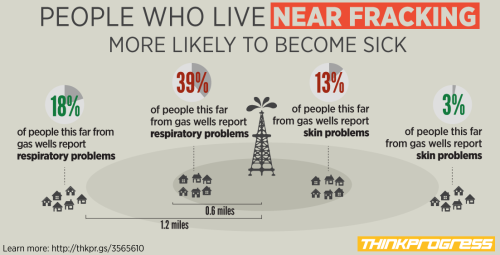
People Who Live Near Fracking More Likely To Become Sick, Study Finds
by Emily Atkin
September 10, 2014
People living close to natural gas wells in southwestern Pennsylvania are more than twice as likely to report respiratory illnesses and skin problems than those living farther away, according to a new study from Yale University.
Dr. Peter Rabinowitz, a former Yale School of Medicine professor who now teaches at the University of Washington’s School of Public Health, got the results by randomly surveying 180 households with 492 people in Washington County, Pennsylvania. Washington County is in the heart of the Marcellus Shale, one of one of America’s fracking hotspots — and arguably the epicenter of fracking-related pollution complaints and industrial accidents.
Of those surveyed, Rabinowitz found that 39 percent of people living less than 0.6 miles from a gas well reported upper-respiratory problems like sinus infections and nosebleeds, compared to just 18 percent of people living more than 1.2 miles away. For skin problems like rashes, 13 percent living close to the wells reported irritation, compared to only 3 percent living further away who said the same.
Rabinowitz said that his findings represent “the largest study to date of general health status of people living near natural gas wells.”
The study, published in the peer-reviewed journal Environmental Health Perspectives, is careful not to claim outright that the fracking itself is causing the health problems. Rather, it solely states that there are higher rates of illness in households closer to gas wells. To say that drilling or fracking causes illness would require more research, Rabinowitz said.
“It’s more of an association than a causation,” Rabinowitz told the New Haven Register. “We want to make sure people know it’s a preliminary study. … To me it strongly indicates the need to further investigate the situation and not ignore it.”
Rabinowitz is not the first to assert that more research needs to be done into the health impacts of fracking.
Just last week, scientists at the University of Texas published research stating that 30 percent of water wells near Texas fracking sites contained higher-than-normal levels of arsenic. However, the researchers stated that their findings were not conclusive in stating that the contamination is because of fracking.
“We think that the strongest argument we can say is that this needs more research,” Brian Fontenot, the paper’s lead author, said at the time.
In addition, preliminary scientific research is finding more and more of a connection between birth defects and the proximity of the child’s mother to a natural gas well. Still, scientists generally agree that more research needs to be done before a conclusive statement can be made about whether that proximity to natural gas drilling actually causes birth defects or other health problems in babies and mothers.
Fracking is a controversial yet popular technique used to stimulate natural gas wells underground by injecting high-pressure water, sand, and chemicals miles-deep into subsurface rock, effectively cracking or “fracturing” it, making the gas easier to extract. It has been controversial in part because of how quickly the practice has spread in the United States, without much credible scientific information regarding the potential impact on public health.
Pennsylvania has had more than 6,000 hydraulic fracturing wells drilled within the last six years, and zero state studies on their health impacts. Because of the lack of research, it’s been increasingly hard to prove that families can be sickened by drilling.
Natural gas drilling in Pennsylvania has skyrocketed under Gov. Tom Corbett. He has expanded fracking in Pennsylvania’s state parks and forests, and in 2012 implemented a controversial state oil and gas law, known as Act 13, which severely restricts the ability of local governments to have control over drilling in their area. Multiple portions of the law have since been ruled unconstitutional by the state Supreme Court.
Tuesday, August 5, 2014
Fracking’s untold health threat: How toxic contamination is destroying lives
America's natural gas boom has real consequences for children and animals,
researchers tell Salon
Lindsay Abrams
If we’re going to talk about fracking, we can’t just talk about energy independence, or the economy, or the potential for natural gas to act as a “bridge fuel” to help solve the global warming crisis. We also need to talk about the effect that hydraulic fracturing is having on the communities where it’s taking place, and to ask whether that cost — to people’s health and property — is too high.
The main barrier to that conversation, of course, is that it’s one the industry definitely doesn’t want to be having, aside from insisting that fracking is safe. Michelle Bamberger, a veterinarian, and Robert Oswald, a professor of molecular medicine at Cornell, believe differently, and they have the research to back up their claims. The two have documented cases of contaminated water and air, of sick pets and dying livestock and of similar symptoms experienced by the animals’ owners, all with few apparent explanations. And that, the researchers, argue, is the real scandal: It’s up to the people being affected, and not the industry causing the damage, to prove that something’s wrong.
In “The Real Cost of Fracking: How America’s Shale Boom is Threatening Our Families, Pets and Food,” Bamberger and Oswald share the stories of people whose lives have been affected — and in some cases, destroyed — by fracking, in a way that aims to open up the conversation to what’s at stake. “Simply put,” they write, “we are not certain of the public health implications of large-scale industrial oil and gas drilling.” The effects we are seeing, they add, are being seen most prominently in animals, children and oil and gas workers: the ones who, because they are so sensitive to hazards from gas operations, end up serving as the canaries in the coal mine.
Bamberger and Oswald spoke with Salon about the challenges of studying the health risks of fracking, and about why they believe the evidence they’ve found is enough to make us seriously question whether they’re risks worth taking. This interview has been lightly edited for length and clarity.
What got you started investigating this aspect of fracking?
MB: We heard about this issue about five years ago when we read in our local paper about a community group that was going through all the leases and just plotting out where surface and mineral rights were leased in the county. It made it really easy to know where you were and who your neighbors were that were leased — the land that was leased around you. We’re out in the country, about 15 minutes from Ithaca, and we saw that we were surrounded by farmers who owned 100 acres or more of land and had leased. The way compulsory integration works in New York is that if you are in a land unit, which is usually one square mile, that is 60 percent or more leased, then your land could be drilled under.
So that got us really interested in the issue, because we’re not leased, but we would be drilled under. So we thought, we’d better start paying attention to this. So we started attending meetings and learning more about it. And in the process, I started hearing about cases in Pennsylvania where animals were becoming ill, and no one was trying to figure out why, or owners didn’t know why, or their vets didn’t know why. That’s what pulled me into it; and for Robert’s part, I think I can speak for him, he started getting involved with it from looking at the documentation I was starting to collect.
researchers tell Salon
Lindsay Abrams
If we’re going to talk about fracking, we can’t just talk about energy independence, or the economy, or the potential for natural gas to act as a “bridge fuel” to help solve the global warming crisis. We also need to talk about the effect that hydraulic fracturing is having on the communities where it’s taking place, and to ask whether that cost — to people’s health and property — is too high.
The main barrier to that conversation, of course, is that it’s one the industry definitely doesn’t want to be having, aside from insisting that fracking is safe. Michelle Bamberger, a veterinarian, and Robert Oswald, a professor of molecular medicine at Cornell, believe differently, and they have the research to back up their claims. The two have documented cases of contaminated water and air, of sick pets and dying livestock and of similar symptoms experienced by the animals’ owners, all with few apparent explanations. And that, the researchers, argue, is the real scandal: It’s up to the people being affected, and not the industry causing the damage, to prove that something’s wrong.
In “The Real Cost of Fracking: How America’s Shale Boom is Threatening Our Families, Pets and Food,” Bamberger and Oswald share the stories of people whose lives have been affected — and in some cases, destroyed — by fracking, in a way that aims to open up the conversation to what’s at stake. “Simply put,” they write, “we are not certain of the public health implications of large-scale industrial oil and gas drilling.” The effects we are seeing, they add, are being seen most prominently in animals, children and oil and gas workers: the ones who, because they are so sensitive to hazards from gas operations, end up serving as the canaries in the coal mine.
Bamberger and Oswald spoke with Salon about the challenges of studying the health risks of fracking, and about why they believe the evidence they’ve found is enough to make us seriously question whether they’re risks worth taking. This interview has been lightly edited for length and clarity.
What got you started investigating this aspect of fracking?
MB: We heard about this issue about five years ago when we read in our local paper about a community group that was going through all the leases and just plotting out where surface and mineral rights were leased in the county. It made it really easy to know where you were and who your neighbors were that were leased — the land that was leased around you. We’re out in the country, about 15 minutes from Ithaca, and we saw that we were surrounded by farmers who owned 100 acres or more of land and had leased. The way compulsory integration works in New York is that if you are in a land unit, which is usually one square mile, that is 60 percent or more leased, then your land could be drilled under.
So that got us really interested in the issue, because we’re not leased, but we would be drilled under. So we thought, we’d better start paying attention to this. So we started attending meetings and learning more about it. And in the process, I started hearing about cases in Pennsylvania where animals were becoming ill, and no one was trying to figure out why, or owners didn’t know why, or their vets didn’t know why. That’s what pulled me into it; and for Robert’s part, I think I can speak for him, he started getting involved with it from looking at the documentation I was starting to collect.
Monday, July 7, 2014
Just 4 fracking wastewater sites cause 20 percent of all central US earthquakes – study
RT
Published time: July 04, 2014
Just four wastewater wells in Oklahoma – where energy companies dump water after completing the hydraulic fracturing process – have caused scores of earthquakes this year, some 30 km from the site, according to a new study by top US universities.
The report, published in Science magazine, focused on the Midwestern state, which has produced 45 percent of the country’s magnitude 3 or bigger seismic shocks in the past five years – with the numbers rising rapidly to match the intensification of fracking activities in the area.
While hydraulic fracturing, or fracking, – which involves pressuring rock formations with liquid until they crack, and then extracting the oil and gas within – poses an inherent risk of earthquakes, according to the authors, the biggest culprits were the wastewater wells, where the liquids used for fracking are pumped, once a reservoir is opened.
“The disposed fluids are capable of contributing to the seismic activity,” Katie Keranen, a geophysics professor at Cornell, and the lead author of the study, told The Oklahoman newspaper.
“These wells are capable. That doesn’t exclude anything else from contributing, but we have no reason to think these are tectonic. They don’t match tectonic activity in other areas. It does seem these are just linked to wastewater. Our research focuses on wastewater and shows it is sufficient.”
Because of a paucity of real data from the thousands of sites in Oklahoma, the team, which included a member from the US Geological Survey, used a three-dimensional model of the underground formations in the area, and then combined that with real liquid injection rates in the area.
There are more than 4,500 active disposal wells in the state, but scientists found that of those, four large wells collectively responsible for pumping 5 million barrels – the equivalent of more than 200 Olympic swimming pools – of liquid into the ground each month, exceed a threshold beyond which disproportionately large earthquakes can happen.
“These really big wells have the biggest impacts on the system,” said Geoffrey Abers, one of the authors, and a professor at Columbia University's Lamont-Doherty Earth Observator.
“The earthquakes themselves seem to occur on small discrete faults. As the pressure builds up in the sedimentary formation that they are pumped into... They put that fault over the edge by jacking up the pore pressure.”
The researchers have not named the four sites, though they are located around Oklahoma City. This is particularly alarming, as the academics say that the impact of the earthquake in their model was as far as 22 miles away (the previous limit was thought to be about, and also could happen even after the disposal well was shut down.
This is a situation where the pumping starts months or a couple of years before the earthquakes are observed at all,” said Abers.
New Dominion, which operates the biggest wastewater wells in the state, has dismissed the simulation used to draw the conclusions.
"An initial review reflects it is premised on certain false assumptions," said company spokesman Jack Money. "At best these incorrect assumptions are irresponsible."
The oil and gas industry – which directly or indirectly employs 1 in 6 in the formerly lagging state – has also urged caution.
“As an industry, we’ve been saying we need more data and we need to work with regulators and others to help determine what is causing the significant increase in seismic activity,” said Chad Warmington, president of the Oklahoma Oil and Gas Association. “But to unequivocally link it to wastewater injections, I think there still needs to be more research.”
Between 1967 and 2000, there was an average of 21 earthquakes of a magnitude greater than 3.0 – considered strong enough to be noticed - in Oklahoma. Last year there were over a hundred, and this year there have been more than 200.
State industry regulator, the Oklahoma Corporation Commission, said it would not comment on the findings until it had a chance to examine them carefully.
Published time: July 04, 2014
Just four wastewater wells in Oklahoma – where energy companies dump water after completing the hydraulic fracturing process – have caused scores of earthquakes this year, some 30 km from the site, according to a new study by top US universities.
The report, published in Science magazine, focused on the Midwestern state, which has produced 45 percent of the country’s magnitude 3 or bigger seismic shocks in the past five years – with the numbers rising rapidly to match the intensification of fracking activities in the area.
While hydraulic fracturing, or fracking, – which involves pressuring rock formations with liquid until they crack, and then extracting the oil and gas within – poses an inherent risk of earthquakes, according to the authors, the biggest culprits were the wastewater wells, where the liquids used for fracking are pumped, once a reservoir is opened.
“The disposed fluids are capable of contributing to the seismic activity,” Katie Keranen, a geophysics professor at Cornell, and the lead author of the study, told The Oklahoman newspaper.
“These wells are capable. That doesn’t exclude anything else from contributing, but we have no reason to think these are tectonic. They don’t match tectonic activity in other areas. It does seem these are just linked to wastewater. Our research focuses on wastewater and shows it is sufficient.”
Because of a paucity of real data from the thousands of sites in Oklahoma, the team, which included a member from the US Geological Survey, used a three-dimensional model of the underground formations in the area, and then combined that with real liquid injection rates in the area.
There are more than 4,500 active disposal wells in the state, but scientists found that of those, four large wells collectively responsible for pumping 5 million barrels – the equivalent of more than 200 Olympic swimming pools – of liquid into the ground each month, exceed a threshold beyond which disproportionately large earthquakes can happen.
“These really big wells have the biggest impacts on the system,” said Geoffrey Abers, one of the authors, and a professor at Columbia University's Lamont-Doherty Earth Observator.
“The earthquakes themselves seem to occur on small discrete faults. As the pressure builds up in the sedimentary formation that they are pumped into... They put that fault over the edge by jacking up the pore pressure.”
The researchers have not named the four sites, though they are located around Oklahoma City. This is particularly alarming, as the academics say that the impact of the earthquake in their model was as far as 22 miles away (the previous limit was thought to be about, and also could happen even after the disposal well was shut down.
This is a situation where the pumping starts months or a couple of years before the earthquakes are observed at all,” said Abers.
New Dominion, which operates the biggest wastewater wells in the state, has dismissed the simulation used to draw the conclusions.
"An initial review reflects it is premised on certain false assumptions," said company spokesman Jack Money. "At best these incorrect assumptions are irresponsible."
The oil and gas industry – which directly or indirectly employs 1 in 6 in the formerly lagging state – has also urged caution.
“As an industry, we’ve been saying we need more data and we need to work with regulators and others to help determine what is causing the significant increase in seismic activity,” said Chad Warmington, president of the Oklahoma Oil and Gas Association. “But to unequivocally link it to wastewater injections, I think there still needs to be more research.”
Between 1967 and 2000, there was an average of 21 earthquakes of a magnitude greater than 3.0 – considered strong enough to be noticed - in Oklahoma. Last year there were over a hundred, and this year there have been more than 200.
State industry regulator, the Oklahoma Corporation Commission, said it would not comment on the findings until it had a chance to examine them carefully.
Thursday, June 5, 2014
How Regulators Ignore Science and Cave to Oil & Gas Companies
Frack, Rattle and Roll
by JOSHUA FRANK
When one thinks of earthquakes, what comes to mind is usually the vast fault line straddled lands of southern California or the great subduction zones off the coasts of Chile and Japan. Surely, it isn’t the cattle fields of Texas or the rolling plains of Ohio and Oklahoma. Natural disasters in the central and southern United States typically blow in with the winds in the form of deadly tornadoes and storms. Yet, thanks to the insatiable rush to tap every last drop of oil and gas from the depths of the earth’s crust, earthquakes are fast becoming the new norm in “fly-over country”.
Fracking involves shooting a mix of sand, water and chemicals deep underground to force natural gas and oil to the surface. The practice is employed in geological areas where typical extraction methods can’t be utilized. Depending on the size of the operations, fracking produces millions of gallons of water waste, which ends up being stored undergound in so-called injection wells. In 2012 fracking in the U.S. produced nearly 280 billion gallons of this chemically-laden fluid and the EPA reports there are over 155,000 oil and gas wastewater wells active nationwide. Geologists have long associated these deep wells with earthquakes.
Back in the 1960s the U.S. military injected chemical waste northeast of Denver, Colorado at the Rocky Mountain Arsenal station. From March of 1962 to September 1963 an average of 21 million liters were injected 3,600 meters below the earth’s surface monthly. While injections ceased for nearly a year, the military again resumed the practice in April 1965 through February 1966, only to be halted once earthquakes were reported at local seismic stations. After observing this earthquake activity before, during and after the injection of chemical water waste, researchers were convinced the pressurized injection had caused numerous tremors that would have otherwise not occurred.
Since this recorded instance, dozens of other cases have been studied with reports being published in peer reviewed journals, where geologists have concluded there is indeed causality between deep-well injections and earthquakes. Yet, this stark research hasn’t stopped state governments from issuing thousands of permits to allow wastewater and other drilling to proceed, often in close proximity to homes and schools. In many such instances state resource departments blatantly ignore science that doesn’t favor the oil and gas industry.
Take the case of lonesome Youngstown, Ohio. Prior to 2011, Youngstown, population 65,405, had never experienced an earthquake, at least not since records were first kept by Europeans who settled the region in 1776. Nonetheless, this lack of seismic activity changed dramatically when the area recorded 100+ tremors over the course of 2011, including a 3.9 quake that shook the town on New Year’s Eve. Those earthquakes, according to a study by Won-Young Kim of Columbia University, published in the Journal of Geophysical Research, were the result of a pesky injection well known as Northstar 1.
“Earthquakes were triggered by fluid injection shortly after the injection initiated – less than two weeks,” Dr. Won-Young Kim told LiveScience.
After eight quakes occurred near Northstar 1, Ohio Department of Natural Resources’ (ODNR) spokesperson Heidi Hetzel-Evans stated, “ODNR has not seen any evidence that shows a correlation between localized seismic activity and deep injection well disposal.”
It’s important to note that it’s not the process of fracking itself that is causing quakes, but the practice of pumping wastewater back into the earth after it’s been used to help extract oil or natural gas. These wells, if located in and around fault lines, have a high likelihood to causing tremors.
Dr. Ray Beiersdorfer, a geology professor at Youngstown University, was mystified by ODNR’s response to the Youngstown quakes. “Based on what I witnessed in the 2011 incident, I believe ODNR is a captured agency,” argues Beiersdorfer. “The language used by industry and the regulatory agency was indistinguishable.”
Professor Beiersdorfer’s suspicion that ODNR is in bed with industry isn’t far-fetched. In a leaked internal document obtained by the Sierra Club, a 2012 draft communication plan outlined how agency staff ought to respond to criticism of the fracking operations ODNR was greenlighting.
“[Fracking] will be met with zealous resistance by environmental activist opponents, who are skilled propagandists,” the Communication Plan stated. “Neutral parties in particular – such as ordinary citizens concerned about families’ health – will be vulnerable to messaging by opponents that the initiative represents dangerous and radical state policy by Gov. Kasich.”
While the Northstar 1 injection well was shut down after the significant 3.9 magnitude earthquake on December 31, 2011, ODNR wasn’t about to admit it had ignored the science and allowed the operation to continue for far too long. It also didn’t stop ODNR from issuing other permits to allow injection well drilling in Ohio.
Consequentially, in March 2014 twelve new earthquakes hit south of Lowellville, Ohio where Hilcorp Energy was fracking. On March 10, ODNR stated it would force Hilcorp to “suspend all activity”, yet the agency allowed the company to continue gas production and flaring at the site.
Unsurprisingly, Beiersdorfer and others aren’t pleased with the state’s half-hearted response and have called on ODNR to deploy portable seismic stations closer to the Hilcorp operation to get better measurements of quakes, which will in turn provide scientists clearer information about size and location of the tremors.
“The request has been ignored,” Beiersdorfer frustratingly asserts in a piece in Columbus Free Press, “According to a telephone conversation I had with [ODNR Spokesperson] Mark Bruce they are not even discussing deploying portable seismic stations to the site. He said that the five seismometers located within 8 miles (the closest is 4 miles away) are sufficient. My reply that these stations are not close enough to precisely determine the depth of these small earthquakes was not addressed.”
Ohio state Representative Bob Hagen has repeatedly asked ODNR for more information on these quakes as well as drilling activity, yet Hagen has been stonewalled by the agency who would rather fight the “zealous resistance” by environmentalists than allow geologists and even elected representatives access to information about drilling activity. Without the data there can be no research and therefore no blame.
Currently citizens of Youngstown are rallying to ban fracking and injection wells through ballot measures, having failed twice before. Beirsdorfer and his wife, a fellow geologist, have joined the local fight against fracking despite having both worked for oil companies in the past.
“We suffered another set of earthquakes in [Ohio’s] Mahoning Valley and the ODNR claims to be getting to the bottom of this, yet the most important thing they could do, deploy the remote seismic stations, is not being done,” Professor Beiersdorfer contends. “Representative Hagan is being neglected. The press is being avoided. Somehow, we are expected to believe that ODNR has the technical expertise and social reasonability to decide where in our communities fracking and waste-injection can take place, whether you want them or not.”
Oklahoma is far worse than Ohio, and California for that matter, at least when it comes to earthquake activity. By early April of this year the state had already been dealt 109 earthquakes with a magnitude 3.0 or higher – that’s as many quakes as the Sooner state had in all of 2013. Still, Oklahoma regulatory and industry officials aren’t ready to admit outright the quakes are a result of injection wells.
Yet, all this shaking is not an entirely new phenomenon. In 2011 Oklahoma experienced a large 5.6 earthquake and a 4.7 aftershock near the sleepy town of Prague, which damaged over 200 buildings and injured two people. The Corporation Commission, which tracks injection wells in the state, says there are at least 10,000 active underground injection wells in Oklahoma.
The Oklahoma Geological Survey examined a cluster of quakes that hit near wells in August 2011 and found “that shortly after hydraulic fracturing began small earthquakes started occurring, and more than 50 were identified, of which 43 were large enough to be located. Most of these earthquakes occurred within a 24 hour period after hydraulic fracturing operations had ceased.”
“We’re trying to make sure we understand what data the state needs in order to start making some determinations on cause and effect,” Chad Warmington, president Oklahoma Oil and Gas Association told Bloomberg in response to the seismic activity. “We don’t want anybody to jump to conclusions.”
But conclusive links between deep wastewater injection wells and earthquakes is exactly what the scientific community has detected. The U.S. Interior Department has openly acknowledged the six-fold increase in quakes in the central U.S. from 2000-2011 are strongly correlated to wastewater injection, including those rolling through Oklahoma.
Even the few scientists that don’t oppose fracking see the dangers. Stanford University professor Mark Zoback, who moonlights as a senior adviser to Baker-Hughes, a multinational well services firm, wrote in a 2011 issue of Earth Magazine that man-made earthquakes can be managed, noting that “…it is important to avoid injection into active faults.” Zoback went on to admit that “a number of the small-to-moderate earthquakes that occurred in the U.S. interior in 2011 appear to be associated with the disposal of wastewater, at least in part related to natural gas production.”
Even so, state officials have not halted companies from continuing to inject millions of gallons of wastewater into underground wells in Oklahoma near known faults. Many of these wastewater dumping holes are located less than three miles from the epicenter of the large Prague quake of 2011.
Austin Holland, an Oklahoma Geological Survey seismologist, recently told E&E News that injections must continue despite the swarm of quake activity rattling Oklahoma. “We can actually learn what’s going on,” he claimed, “and perhaps mitigate these things in the future.”
Such brash sentiments are disconcerting to folks who are living in the midst of these ongoing earthquakes. For those residing in the tremor zones down in Arkansas, where numerous injection wells are active, daily anxiety caused by numerous quakes has many on edge.
“I remember days when the tremors were most active in the Greenbrier area, the rural town where I grew up [in Arkansas],” says Emily Lane, who now sits on the Board of Directors of Faulkner County Citizens Advisory Group in Arkansas. “Some days I’d feel 1-2 earthquakes an hour. The roar would approach quickly and roll through the house like a train passing through. Pictures rattled, the dog barked, and a fear grew inside me and many in the community about when the ‘big one’ would come.”
Arkansas officials shut down four disposal wells near Greenbrier and the quakes have stopped; yet tremors in other areas of the state near injection wells continue. “These quakes in outlying areas continue to compromise the integrity of well casings, increasing the likelihood of water contamination in the area,” attests Lane, who is deeply concerned about what lies ahead. “What is most discouraging, beyond the obvious dangers present from future earthquakes and fluid migration/contamination, is that most people in Arkansas still do not realize that a strong correlation was found between disposal wells and seismicity.”
Residents in Arkansas have filed a class action suit against the drillers who operate the disposal wells. Texas residents also lodged a similar case against Royal Dutch Shell, Sunoco and others, claiming their properties have been damaged by earthquakes near the companies’ injection wells.
The fight to end fracking, or at least relocate these earthquake-inducing disposal wells away from fault zones, is going to be an uphill battle. It will likely take thousands more earthquakes, severe property damage, injuries and perhaps death before regulatory agencies stop ignoring science and start protecting people instead of Oil & Gas industry profits.
by JOSHUA FRANK
When one thinks of earthquakes, what comes to mind is usually the vast fault line straddled lands of southern California or the great subduction zones off the coasts of Chile and Japan. Surely, it isn’t the cattle fields of Texas or the rolling plains of Ohio and Oklahoma. Natural disasters in the central and southern United States typically blow in with the winds in the form of deadly tornadoes and storms. Yet, thanks to the insatiable rush to tap every last drop of oil and gas from the depths of the earth’s crust, earthquakes are fast becoming the new norm in “fly-over country”.
Fracking involves shooting a mix of sand, water and chemicals deep underground to force natural gas and oil to the surface. The practice is employed in geological areas where typical extraction methods can’t be utilized. Depending on the size of the operations, fracking produces millions of gallons of water waste, which ends up being stored undergound in so-called injection wells. In 2012 fracking in the U.S. produced nearly 280 billion gallons of this chemically-laden fluid and the EPA reports there are over 155,000 oil and gas wastewater wells active nationwide. Geologists have long associated these deep wells with earthquakes.
Back in the 1960s the U.S. military injected chemical waste northeast of Denver, Colorado at the Rocky Mountain Arsenal station. From March of 1962 to September 1963 an average of 21 million liters were injected 3,600 meters below the earth’s surface monthly. While injections ceased for nearly a year, the military again resumed the practice in April 1965 through February 1966, only to be halted once earthquakes were reported at local seismic stations. After observing this earthquake activity before, during and after the injection of chemical water waste, researchers were convinced the pressurized injection had caused numerous tremors that would have otherwise not occurred.
Since this recorded instance, dozens of other cases have been studied with reports being published in peer reviewed journals, where geologists have concluded there is indeed causality between deep-well injections and earthquakes. Yet, this stark research hasn’t stopped state governments from issuing thousands of permits to allow wastewater and other drilling to proceed, often in close proximity to homes and schools. In many such instances state resource departments blatantly ignore science that doesn’t favor the oil and gas industry.
Take the case of lonesome Youngstown, Ohio. Prior to 2011, Youngstown, population 65,405, had never experienced an earthquake, at least not since records were first kept by Europeans who settled the region in 1776. Nonetheless, this lack of seismic activity changed dramatically when the area recorded 100+ tremors over the course of 2011, including a 3.9 quake that shook the town on New Year’s Eve. Those earthquakes, according to a study by Won-Young Kim of Columbia University, published in the Journal of Geophysical Research, were the result of a pesky injection well known as Northstar 1.
“Earthquakes were triggered by fluid injection shortly after the injection initiated – less than two weeks,” Dr. Won-Young Kim told LiveScience.
After eight quakes occurred near Northstar 1, Ohio Department of Natural Resources’ (ODNR) spokesperson Heidi Hetzel-Evans stated, “ODNR has not seen any evidence that shows a correlation between localized seismic activity and deep injection well disposal.”
It’s important to note that it’s not the process of fracking itself that is causing quakes, but the practice of pumping wastewater back into the earth after it’s been used to help extract oil or natural gas. These wells, if located in and around fault lines, have a high likelihood to causing tremors.
Dr. Ray Beiersdorfer, a geology professor at Youngstown University, was mystified by ODNR’s response to the Youngstown quakes. “Based on what I witnessed in the 2011 incident, I believe ODNR is a captured agency,” argues Beiersdorfer. “The language used by industry and the regulatory agency was indistinguishable.”
Professor Beiersdorfer’s suspicion that ODNR is in bed with industry isn’t far-fetched. In a leaked internal document obtained by the Sierra Club, a 2012 draft communication plan outlined how agency staff ought to respond to criticism of the fracking operations ODNR was greenlighting.
“[Fracking] will be met with zealous resistance by environmental activist opponents, who are skilled propagandists,” the Communication Plan stated. “Neutral parties in particular – such as ordinary citizens concerned about families’ health – will be vulnerable to messaging by opponents that the initiative represents dangerous and radical state policy by Gov. Kasich.”
While the Northstar 1 injection well was shut down after the significant 3.9 magnitude earthquake on December 31, 2011, ODNR wasn’t about to admit it had ignored the science and allowed the operation to continue for far too long. It also didn’t stop ODNR from issuing other permits to allow injection well drilling in Ohio.
Consequentially, in March 2014 twelve new earthquakes hit south of Lowellville, Ohio where Hilcorp Energy was fracking. On March 10, ODNR stated it would force Hilcorp to “suspend all activity”, yet the agency allowed the company to continue gas production and flaring at the site.
Unsurprisingly, Beiersdorfer and others aren’t pleased with the state’s half-hearted response and have called on ODNR to deploy portable seismic stations closer to the Hilcorp operation to get better measurements of quakes, which will in turn provide scientists clearer information about size and location of the tremors.
“The request has been ignored,” Beiersdorfer frustratingly asserts in a piece in Columbus Free Press, “According to a telephone conversation I had with [ODNR Spokesperson] Mark Bruce they are not even discussing deploying portable seismic stations to the site. He said that the five seismometers located within 8 miles (the closest is 4 miles away) are sufficient. My reply that these stations are not close enough to precisely determine the depth of these small earthquakes was not addressed.”
Ohio state Representative Bob Hagen has repeatedly asked ODNR for more information on these quakes as well as drilling activity, yet Hagen has been stonewalled by the agency who would rather fight the “zealous resistance” by environmentalists than allow geologists and even elected representatives access to information about drilling activity. Without the data there can be no research and therefore no blame.
Currently citizens of Youngstown are rallying to ban fracking and injection wells through ballot measures, having failed twice before. Beirsdorfer and his wife, a fellow geologist, have joined the local fight against fracking despite having both worked for oil companies in the past.
“We suffered another set of earthquakes in [Ohio’s] Mahoning Valley and the ODNR claims to be getting to the bottom of this, yet the most important thing they could do, deploy the remote seismic stations, is not being done,” Professor Beiersdorfer contends. “Representative Hagan is being neglected. The press is being avoided. Somehow, we are expected to believe that ODNR has the technical expertise and social reasonability to decide where in our communities fracking and waste-injection can take place, whether you want them or not.”
* * *
Oklahoma is far worse than Ohio, and California for that matter, at least when it comes to earthquake activity. By early April of this year the state had already been dealt 109 earthquakes with a magnitude 3.0 or higher – that’s as many quakes as the Sooner state had in all of 2013. Still, Oklahoma regulatory and industry officials aren’t ready to admit outright the quakes are a result of injection wells.
Yet, all this shaking is not an entirely new phenomenon. In 2011 Oklahoma experienced a large 5.6 earthquake and a 4.7 aftershock near the sleepy town of Prague, which damaged over 200 buildings and injured two people. The Corporation Commission, which tracks injection wells in the state, says there are at least 10,000 active underground injection wells in Oklahoma.
The Oklahoma Geological Survey examined a cluster of quakes that hit near wells in August 2011 and found “that shortly after hydraulic fracturing began small earthquakes started occurring, and more than 50 were identified, of which 43 were large enough to be located. Most of these earthquakes occurred within a 24 hour period after hydraulic fracturing operations had ceased.”
“We’re trying to make sure we understand what data the state needs in order to start making some determinations on cause and effect,” Chad Warmington, president Oklahoma Oil and Gas Association told Bloomberg in response to the seismic activity. “We don’t want anybody to jump to conclusions.”
But conclusive links between deep wastewater injection wells and earthquakes is exactly what the scientific community has detected. The U.S. Interior Department has openly acknowledged the six-fold increase in quakes in the central U.S. from 2000-2011 are strongly correlated to wastewater injection, including those rolling through Oklahoma.
Even the few scientists that don’t oppose fracking see the dangers. Stanford University professor Mark Zoback, who moonlights as a senior adviser to Baker-Hughes, a multinational well services firm, wrote in a 2011 issue of Earth Magazine that man-made earthquakes can be managed, noting that “…it is important to avoid injection into active faults.” Zoback went on to admit that “a number of the small-to-moderate earthquakes that occurred in the U.S. interior in 2011 appear to be associated with the disposal of wastewater, at least in part related to natural gas production.”
Even so, state officials have not halted companies from continuing to inject millions of gallons of wastewater into underground wells in Oklahoma near known faults. Many of these wastewater dumping holes are located less than three miles from the epicenter of the large Prague quake of 2011.
Austin Holland, an Oklahoma Geological Survey seismologist, recently told E&E News that injections must continue despite the swarm of quake activity rattling Oklahoma. “We can actually learn what’s going on,” he claimed, “and perhaps mitigate these things in the future.”
Such brash sentiments are disconcerting to folks who are living in the midst of these ongoing earthquakes. For those residing in the tremor zones down in Arkansas, where numerous injection wells are active, daily anxiety caused by numerous quakes has many on edge.
“I remember days when the tremors were most active in the Greenbrier area, the rural town where I grew up [in Arkansas],” says Emily Lane, who now sits on the Board of Directors of Faulkner County Citizens Advisory Group in Arkansas. “Some days I’d feel 1-2 earthquakes an hour. The roar would approach quickly and roll through the house like a train passing through. Pictures rattled, the dog barked, and a fear grew inside me and many in the community about when the ‘big one’ would come.”
Arkansas officials shut down four disposal wells near Greenbrier and the quakes have stopped; yet tremors in other areas of the state near injection wells continue. “These quakes in outlying areas continue to compromise the integrity of well casings, increasing the likelihood of water contamination in the area,” attests Lane, who is deeply concerned about what lies ahead. “What is most discouraging, beyond the obvious dangers present from future earthquakes and fluid migration/contamination, is that most people in Arkansas still do not realize that a strong correlation was found between disposal wells and seismicity.”
Residents in Arkansas have filed a class action suit against the drillers who operate the disposal wells. Texas residents also lodged a similar case against Royal Dutch Shell, Sunoco and others, claiming their properties have been damaged by earthquakes near the companies’ injection wells.
The fight to end fracking, or at least relocate these earthquake-inducing disposal wells away from fault zones, is going to be an uphill battle. It will likely take thousands more earthquakes, severe property damage, injuries and perhaps death before regulatory agencies stop ignoring science and start protecting people instead of Oil & Gas industry profits.
Thursday, February 6, 2014
Fracking's Terrifying Water Usage Trends Spell Disaster
Wednesday, February 5, 2014 by Common Dreams

The irony of fracking: It destroys the natural resource it needs most. The tragedy for those living nearby fracking operations: That natural resource is the fresh—and increasingly scarce—water supply on which they, too, depend.
And not only does fracking—or hydraulic fracturing—demand enormous amounts of fresh water no matter where it takes place, a troubling new study released Wednesday found that a majority of places where the controversial drilling technique is most prevalent are the same regions where less and less water is available.
Overlay the regions where most of the fracking is being done in North American with the places experiencing the most troubling and persistent water resource problems and the resulting picture becomes an alarm bell as politicians and the fossil fuel industry continue to push fracking expansion as the savior for the U.S. and Canada's energy woes.
According to the report, Hydraulic Fracturing and Water Stress: Water Demand by the Numbers (pdf), produced by the non-profit Ceres investor network, much of the oil and gas fracking activity in both the U.S. and Canada is happening in "arid, water stressed regions, creating significant long-term water sourcing risks" that will strongly and negatively impact the local ecosystem, communities, and people living nearby.
“Hydraulic fracturing is increasing competitive pressures for water in some of the country’s most water-stressed and drought-ridden regions,” said Ceres President Mindy Lubber, in announcing Hydraulic Fracturing and Water Stress: Water Demand by the Numbers. “Barring stiffer water-use regulations and improved on-the-ground practices, the industry’s water needs in many regions are on a collision course with other water users, especially agriculture and municipal water use."
Richard Heinberg, senior fellow of the California-based Post Carbon Institute and author of a recent book on the "false promise" of the fracking industry, says the irony of the study's findings "would be delicious if it weren't so terrifying."
"Nationally," according to Heinberg, "only about 50 percent of fracking wastewater is recycled. Billions of gallons of freshwater are still taken from rivers, streams, and wells annually for this purpose, and—after being irremediably polluted—this water usually ends up being injected into deep disposal wells. That means it is no longer available to the hydrological cycle that sustains all terrestrial life."
Click here to look at Ceres' interactive map on fracking and water use.
The study drew on industry data detailing water usage from from 39,294 oil and gas wells from January 2011 through May 2013 and compared that information with "water stress indicator maps" developed by the World Resources Institute (WRI).
What it found:
Specifically:
Although water use for hydraulic fracturing is often less than two percent of state water demands, the impacts can be large at the local level, sometimes exceeding the water used by all of the residents in a county.
"It's a wake-up call," Professor James Famiglietti, a hydrologist at the University of California, Irvine, told the Guardian. "We understand as a country that we need more energy but it is time to have a conversation about what impacts there are, and do our best to try to minimise any damage."
The irony of the latest findings, explained Heinberg in an email to Common Dreams, is based on the fact that "much of the fracking boom is centered in the western United States—Texas, Oklahoma, Colorado, and California—which just happens to be drying up, likely as a result of climate change. And that climate change, in turn, is happening because we're burning fossil fuels like oil and natural gas."
Heinberg observed that the Ceres report is largely written from the standpoint of the oil and gas companies—using much of their data—and directed at those who may be invested or would like to invest in the continuation or proliferation of the industry. However, he indicated, detailing the increasing difficulties the industry and its investors are likely to experience in sourcing water for their operations is still valuable for those opposed to fracking.
"In California, where I live," he said, "we're experiencing a 500-year drought. The grape-wine industry here in Sonoma County is facing disaster. Farmers in the Central Valley are weighing whether to plant at all this year. The fact that California's Democratic governor [Jerry Brown] wants to spend what little water we have on fracking—which will only make our climate problems worse—makes the report frighteningly relevant."
New study shows that fracking boom is happening in places that can least afford to lose precious water supplies
Almost half (47%) of all U.S. wells are being developed in regions with high to extremely high water stress. This means that more than 80 percent of the annual available water is already allocated to municipal, industrial and agricultural users in these regions. (Source: Ceres)
The irony of fracking: It destroys the natural resource it needs most. The tragedy for those living nearby fracking operations: That natural resource is the fresh—and increasingly scarce—water supply on which they, too, depend.
And not only does fracking—or hydraulic fracturing—demand enormous amounts of fresh water no matter where it takes place, a troubling new study released Wednesday found that a majority of places where the controversial drilling technique is most prevalent are the same regions where less and less water is available.
Overlay the regions where most of the fracking is being done in North American with the places experiencing the most troubling and persistent water resource problems and the resulting picture becomes an alarm bell as politicians and the fossil fuel industry continue to push fracking expansion as the savior for the U.S. and Canada's energy woes.
According to the report, Hydraulic Fracturing and Water Stress: Water Demand by the Numbers (pdf), produced by the non-profit Ceres investor network, much of the oil and gas fracking activity in both the U.S. and Canada is happening in "arid, water stressed regions, creating significant long-term water sourcing risks" that will strongly and negatively impact the local ecosystem, communities, and people living nearby.
“Hydraulic fracturing is increasing competitive pressures for water in some of the country’s most water-stressed and drought-ridden regions,” said Ceres President Mindy Lubber, in announcing Hydraulic Fracturing and Water Stress: Water Demand by the Numbers. “Barring stiffer water-use regulations and improved on-the-ground practices, the industry’s water needs in many regions are on a collision course with other water users, especially agriculture and municipal water use."
Richard Heinberg, senior fellow of the California-based Post Carbon Institute and author of a recent book on the "false promise" of the fracking industry, says the irony of the study's findings "would be delicious if it weren't so terrifying."
"Nationally," according to Heinberg, "only about 50 percent of fracking wastewater is recycled. Billions of gallons of freshwater are still taken from rivers, streams, and wells annually for this purpose, and—after being irremediably polluted—this water usually ends up being injected into deep disposal wells. That means it is no longer available to the hydrological cycle that sustains all terrestrial life."
Click here to look at Ceres' interactive map on fracking and water use.
The study drew on industry data detailing water usage from from 39,294 oil and gas wells from January 2011 through May 2013 and compared that information with "water stress indicator maps" developed by the World Resources Institute (WRI).
What it found:
Over 55 percent of the wells hydraulically fractured were in areas experiencing drought and 36 percent overlay regions with significant groundwater depletion – key among those, California which is in the midst of a historic drought and Texas, which has the highest concentration of shale energy development and hydraulic fracturing activity in the U.S.
Specifically:
In Texas, which includes the rapidly developing Eagle Ford and Permian Basin shale plays, more than half (52 percent) of the wells were in high or extreme high water stress areas. In Colorado and California, 97 and 96 percent of the wells, respectively, were in regions with high or extremely high water stress. Nearly comparable trends were also shown in New Mexico, Utah and Wyoming.
Among hundreds of hydraulic fracturing companies whose water use was evaluated, those with the highest exposure to water sourcing risk are Anadarako (APC), Encana (ECA), Pioneer (PXD) and Apache (APA). Most of the wells being developed by each of these companies are in regions of high or extreme water stress. The top three service providers, Halliburton, (HAL) Schlumberger (SLB) and Baker Hughes (BHI), handled about half of the water used for hydraulic fracturing nationally and also face water sourcing risks.
Although water use for hydraulic fracturing is often less than two percent of state water demands, the impacts can be large at the local level, sometimes exceeding the water used by all of the residents in a county.
"It's a wake-up call," Professor James Famiglietti, a hydrologist at the University of California, Irvine, told the Guardian. "We understand as a country that we need more energy but it is time to have a conversation about what impacts there are, and do our best to try to minimise any damage."
The irony of the latest findings, explained Heinberg in an email to Common Dreams, is based on the fact that "much of the fracking boom is centered in the western United States—Texas, Oklahoma, Colorado, and California—which just happens to be drying up, likely as a result of climate change. And that climate change, in turn, is happening because we're burning fossil fuels like oil and natural gas."
Heinberg observed that the Ceres report is largely written from the standpoint of the oil and gas companies—using much of their data—and directed at those who may be invested or would like to invest in the continuation or proliferation of the industry. However, he indicated, detailing the increasing difficulties the industry and its investors are likely to experience in sourcing water for their operations is still valuable for those opposed to fracking.
"In California, where I live," he said, "we're experiencing a 500-year drought. The grape-wine industry here in Sonoma County is facing disaster. Farmers in the Central Valley are weighing whether to plant at all this year. The fact that California's Democratic governor [Jerry Brown] wants to spend what little water we have on fracking—which will only make our climate problems worse—makes the report frighteningly relevant."
Saturday, January 25, 2014

Tuesday, December 17, 2013
City of Dallas effectively bans fracking
RT - December 13, 2013
The Dallas City Council passed Wednesday new restrictions that bar hydraulic fracturing within 1,500 feet of a home, school, church, and other protected areas. The new rules effectively ban the practice within the city.
The council approved the ordinance in a vote of 9-6, with Mayor Mike Rawlings voting for it.
The city is on the edge of the Barnett Shale area, predicted to be a treasure trove of onshore natural gas reserves. However, the new limit placed on hydraulic fracturing - known as fracking - effectively bans the practice.
“[W]e might as well save a lot of paper and write a one-line ordinance that says there will be no gas drilling in the city of Dallas,” said council member Lee Kleinman, who opposed the measure. “That would be a much easier ordinance to have.”
A gas industry representative for Trinity East, a Barnett Shale gas company that was prepared to drill, lamented the measure as a death for prospects in Dallas.
“You just can’t drill under these conditions,” said Dallas Cothrum, according to CBS DFW. “It’d require more than 250-acres of property and in an urban area it’s just not possible.”
Petroleum engineer Bill Crowder of Dallas indicated that the economic and legal wrangling over fracking in the city is not yet over.
“I want you to look me in the eye next February or March,” he said, according to the Dallas Morning News, “when I ask you, ‘What the heck were you thinking?’”
Another council member, who supported the limits, said the ordinance doesn’t ban drilling, but is aimed at keeping residents safe.
“I think this is about making sure people are protected in their neighborhoods,” council member Carolyn Davis said, according to KERA News. “It is the right thing to do.”
Dallas had previously outlawed fracking within 300 feet of protected areas.
The new ordinance keeps protections on parkland and flood plains, though KERA News reported that the ordinance does allow for drilling in parks if certain requirements are followed and the Texas Parks and Wildlife Department gives its mandatory approval.
The council also passed Wednesday an amendment that calls for a two-thirds majority vote to override the measure.
Hydraulic fracking is the highly controversial process of injecting water, sand, and various chemicals into layers of rock in hopes of releasing oil and gas deep underground. The practice is opposed worldwide, as shown by global protests against fracking in October, for its damning environmental impacts.
Supporters say it brings jobs and opportunities for energy independence, though detractors have pointed to exaggerated employment claims.
The latest move by Dallas highlights similar aims in other cities to ban fracking. Voters in four cities in the state of Colorado recently succeeded in either banning or suspending hydraulic fracturing, despite heavy spending by the oil and gas industry to the tune of $870,000 to defeat the measures.
All four of those measures passed in Colorado will face legal challenges by the fracking industry along with the office of Governor John Hickenlooper, which has expressed the position that the municipalities lack the authority to determine the use of the state’s natural resources.
The Dallas City Council passed Wednesday new restrictions that bar hydraulic fracturing within 1,500 feet of a home, school, church, and other protected areas. The new rules effectively ban the practice within the city.
The council approved the ordinance in a vote of 9-6, with Mayor Mike Rawlings voting for it.
The city is on the edge of the Barnett Shale area, predicted to be a treasure trove of onshore natural gas reserves. However, the new limit placed on hydraulic fracturing - known as fracking - effectively bans the practice.
“[W]e might as well save a lot of paper and write a one-line ordinance that says there will be no gas drilling in the city of Dallas,” said council member Lee Kleinman, who opposed the measure. “That would be a much easier ordinance to have.”
A gas industry representative for Trinity East, a Barnett Shale gas company that was prepared to drill, lamented the measure as a death for prospects in Dallas.
“You just can’t drill under these conditions,” said Dallas Cothrum, according to CBS DFW. “It’d require more than 250-acres of property and in an urban area it’s just not possible.”
Petroleum engineer Bill Crowder of Dallas indicated that the economic and legal wrangling over fracking in the city is not yet over.
“I want you to look me in the eye next February or March,” he said, according to the Dallas Morning News, “when I ask you, ‘What the heck were you thinking?’”
Another council member, who supported the limits, said the ordinance doesn’t ban drilling, but is aimed at keeping residents safe.
“I think this is about making sure people are protected in their neighborhoods,” council member Carolyn Davis said, according to KERA News. “It is the right thing to do.”
Dallas had previously outlawed fracking within 300 feet of protected areas.
The new ordinance keeps protections on parkland and flood plains, though KERA News reported that the ordinance does allow for drilling in parks if certain requirements are followed and the Texas Parks and Wildlife Department gives its mandatory approval.
The council also passed Wednesday an amendment that calls for a two-thirds majority vote to override the measure.
Hydraulic fracking is the highly controversial process of injecting water, sand, and various chemicals into layers of rock in hopes of releasing oil and gas deep underground. The practice is opposed worldwide, as shown by global protests against fracking in October, for its damning environmental impacts.
Supporters say it brings jobs and opportunities for energy independence, though detractors have pointed to exaggerated employment claims.
The latest move by Dallas highlights similar aims in other cities to ban fracking. Voters in four cities in the state of Colorado recently succeeded in either banning or suspending hydraulic fracturing, despite heavy spending by the oil and gas industry to the tune of $870,000 to defeat the measures.
All four of those measures passed in Colorado will face legal challenges by the fracking industry along with the office of Governor John Hickenlooper, which has expressed the position that the municipalities lack the authority to determine the use of the state’s natural resources.
Sunday, November 24, 2013
Fracking-Friendly Bills Flourish as Industry Donations Skyrocket
Friday, November 22, 2013 by Common Dreams
'House Majority Leadership showed they’ll sacrifice anything for the oil and gas industry'
by Sarah Lazare, staff writer
A wave of legislation friendly to the fracking industry in the House of Representative appears to be following skyrocketing donations from the fossil fuel industry.
A Citizens for Responsibility and Ethics in Washington report this week reveals that from 2004 to 2012, oil and gas industry contributions to Congressional campaigns climbed 231 percent in fracking states and districts.
Several bills passed in Congress this week suggest these contributions are paying off.
In a landslide 252 to 165 vote, the GOP-controlled House rammed through the fracking industry friendly HR 1900 on Thursday that would fast-track pipeline construction if signed into law.
It follows two other bills passed in the House earlier this week that would make it easier to get fast permits for oil and gas drilling on federal lands and roll back federal fracking regulations.
While none of these bills is expected to advance in the Senate, critics charge they nonetheless reveal a Congress hijacked by the fracking industry.
"This week, House Majority Leadership showed that they’ll sacrifice just about anything for the oil and gas industry, whether it’s the hunters and fishermen who enjoy using our public lands, parents trying to protect their children from the health impacts of fracking, even the rights of property owners along proposed gas pipeline projects," said Earthjustice Senior Legislative Representative Jessica Ennis.
"The reason for this loyalty? Look no further than a damning report out yesterday showing a 231 percent increase in industry contributions to candidates in areas of fracking activity," she added.
'House Majority Leadership showed they’ll sacrifice anything for the oil and gas industry'
by Sarah Lazare, staff writer
A wave of legislation friendly to the fracking industry in the House of Representative appears to be following skyrocketing donations from the fossil fuel industry.
A Citizens for Responsibility and Ethics in Washington report this week reveals that from 2004 to 2012, oil and gas industry contributions to Congressional campaigns climbed 231 percent in fracking states and districts.
Several bills passed in Congress this week suggest these contributions are paying off.
In a landslide 252 to 165 vote, the GOP-controlled House rammed through the fracking industry friendly HR 1900 on Thursday that would fast-track pipeline construction if signed into law.
It follows two other bills passed in the House earlier this week that would make it easier to get fast permits for oil and gas drilling on federal lands and roll back federal fracking regulations.
While none of these bills is expected to advance in the Senate, critics charge they nonetheless reveal a Congress hijacked by the fracking industry.
"This week, House Majority Leadership showed that they’ll sacrifice just about anything for the oil and gas industry, whether it’s the hunters and fishermen who enjoy using our public lands, parents trying to protect their children from the health impacts of fracking, even the rights of property owners along proposed gas pipeline projects," said Earthjustice Senior Legislative Representative Jessica Ennis.
"The reason for this loyalty? Look no further than a damning report out yesterday showing a 231 percent increase in industry contributions to candidates in areas of fracking activity," she added.
Saturday, October 5, 2013
Shut It All Down: Report Calls for Nationwide Ban on Fracking
Friday, October 4, 2013 by Common Dreams
Hydraulic fracturing gas drilling turning America's water into cancer-causing, radioactive waste
- Jon Queally, staff writer
The explosion of hydraulic fracturing in the last several years, according to a new report, is creating a previously 'unimaginable' situation in which hundreds of billions of gallons of the nation's fresh water supply are being annually transformed into unusable—sometimes radioactive—cancer-causing wastewater.
According to the report, Fracking by the Numbers, produced by Environment America, the scale and severity of fracking’s myriad impacts betray all claims that natural gas is a "cleaner" or somehow less damaging alternative to other fossil fuels.
The report explores various ways in which gas fracking negatively impacts both human health and the environment, including the contamination of drinking water, overuse of scarce water sources, the effect of air pollution on public health, its connection to global warming, and the overall cost imposed on communities where fracking operations are located.
“The bottom line is this: The numbers on fracking add up to an environmental nightmare,” said John Rumpler, the report's lead author and senior attorney for Environment America. “For our environment and for public health, we need to put a stop to fracking.”
In fact, the report concludes that in state's where the practice is now occurring, immediate moratoriums should be enacted and in states where the practice has yet to be approved, bans should be legislated to prevent this kind of drilling from ever occurring.
Though the report acknowledges its too early to know the full the extent of the damage caused by the controversial drilling practice, it found that even a look at the "limited data" available—taken mostly from industry reports and government figures between 2005 and 2012—paints "an increasingly clear picture of the damage that fracking has done to our environment and health."
So what are the numbers?
The report measured key indicators of fracking threats across the country, and found:
“The numbers don't lie," said Rumbpler. "Fracking has taken a dirty and destructive toll on our environment. If this dirty drilling continues unchecked, these numbers will only get worse."
The Environment America report comes on the heels of a study released by researchers at Duke University earlier this week that found a "surprising magnitude of radioactivity" in the local water near a fracking operation in Pennsylvania.
And ClimateProgress adds:
In addition to the impact on surface and ground water supplies, fracking is a well-known contributor to global warming and numerous studies have shown that the methane emissions created by the extraction and transportation of natural gas far outweighs any benefit generated by its ability to burn "cleaner" than oil or coal.
Download or read the complete report here (pdf).
Hydraulic fracturing gas drilling turning America's water into cancer-causing, radioactive waste
- Jon Queally, staff writer
The explosion of hydraulic fracturing in the last several years, according to a new report, is creating a previously 'unimaginable' situation in which hundreds of billions of gallons of the nation's fresh water supply are being annually transformed into unusable—sometimes radioactive—cancer-causing wastewater.
According to the report, Fracking by the Numbers, produced by Environment America, the scale and severity of fracking’s myriad impacts betray all claims that natural gas is a "cleaner" or somehow less damaging alternative to other fossil fuels.
The report explores various ways in which gas fracking negatively impacts both human health and the environment, including the contamination of drinking water, overuse of scarce water sources, the effect of air pollution on public health, its connection to global warming, and the overall cost imposed on communities where fracking operations are located.
“The bottom line is this: The numbers on fracking add up to an environmental nightmare,” said John Rumpler, the report's lead author and senior attorney for Environment America. “For our environment and for public health, we need to put a stop to fracking.”
In fact, the report concludes that in state's where the practice is now occurring, immediate moratoriums should be enacted and in states where the practice has yet to be approved, bans should be legislated to prevent this kind of drilling from ever occurring.
Though the report acknowledges its too early to know the full the extent of the damage caused by the controversial drilling practice, it found that even a look at the "limited data" available—taken mostly from industry reports and government figures between 2005 and 2012—paints "an increasingly clear picture of the damage that fracking has done to our environment and health."
So what are the numbers?
The report measured key indicators of fracking threats across the country, and found:
• 280 billion gallons of toxic wastewater generated in 2012,
• 450,000 tons of air pollution produced in one year,
• 250 billion gallons of fresh water used since 2005,
• 360,000 acres of land degraded since 2005,
• 100 million metric tons of global warming pollution since 2005.
“The numbers don't lie," said Rumbpler. "Fracking has taken a dirty and destructive toll on our environment. If this dirty drilling continues unchecked, these numbers will only get worse."
The Environment America report comes on the heels of a study released by researchers at Duke University earlier this week that found a "surprising magnitude of radioactivity" in the local water near a fracking operation in Pennsylvania.
And ClimateProgress adds:
The report also pointed out the weaknesses of current wastewater disposal practices — wastewater is often stored in deep wells, but over time these wells can fail, leading to the potential for ground and surface water contamination. In New Mexico alone, chemicals from oil and gas pits have contaminated water sources at least 421 times, according to the report.
Those toxic chemicals are exempt from federal disclosure laws, so it’s up to each state to decide if and how the oil and gas companies should disclose the chemicals they use in their operations — which is why in many states, citizens don’t know what goes into the brew that fracking operators use to extract oil and natural gas. Luckily, some states are beginning to address this — California recently passed a law ordering fracking companies to make their chemicals public, an order similar to laws in about seven other states.
The report also noted the vast quantities of water needed for fracking — from 2 million to 9 million gallons on average to frack one well. Since 2005, according to the report, fracking operations have used 250 billion gallons of freshwater. This is putting a strain on places like one South Texas county, where fracking was nearly one quarter of total water use in 2011 — and dry conditions could push that amount closer to one-third.
In addition to the impact on surface and ground water supplies, fracking is a well-known contributor to global warming and numerous studies have shown that the methane emissions created by the extraction and transportation of natural gas far outweighs any benefit generated by its ability to burn "cleaner" than oil or coal.
Download or read the complete report here (pdf).
Thursday, September 19, 2013
Fox News Sells Fracking as ‘Incredibly Good for Our Environment”
Corporate Propaganda September 16, 2013 | By WakingTimes
Alex Pietrowski, Staff WriterRecently on Fox News, Alex Epstein, the founder of the Center for Industrial Progress, and author of the book, Fossil Fuels Improve the Planet, argues in favor of hydraulic gas fracturing, or fracking, as it has become known. This is the technique of extracting natural gas and oil from layers of underground shale rock by pressure-injecting an undisclosed mixture of water and chemicals deep into the ground.“Nature doesn’t give us a clean environment.”
This particular segment serves as an outstanding example of what corporate propaganda looks like and how the media triggers our cultural programming to stimulate fear/desire conditioning, in order to persuade us into conforming to a selected position on an issue.
The clip begins with the graphic of a printing press rolling out unlimited dollar bills across the screen and the Fox host framing the conversation, asking their central question about fracking…
“…its being called a modern day gold rush… reducing the need for foreign oil. With so many opportunities to frack in the Unites States, could this technology be a new path to American wealth?”
A New Path to American Wealth?The guest, Epstein, is introduced and hails fracking as a technological revolution as important to society as the invention of the computer, explaining how we are sitting on a Texas sized amount of shale rock that should be extracted for the benefit of all.
The host goes on to explain ‘one of the big stories this week,’ a report issued by somebody about the economic benefits of fracking and how in high fracking areas they are already seeing a ‘trickling down’ of this vast wealth to the average person. Wages are supposedly up, U.S. tax revenues are up, disposable income is up, and the question is asked by the host…
“… is this really going to affect my own wallet, is fracking really going to help me save more money and live a better life?”There are close-ups of dollar bills hovering in the background.
The central concern over fracking, for those who oppose it, is not that the economy will suffer if we don’t frack, but rather the damage it does to the environment; making people sick, contaminating water and causing droughts, drying up aquifers and causing earthquakes. This question was raised by the host, and addressed by Epstein:
“…fracking is actually incredibly good for our environment, and there’s two reasons. One is that this rock right here [holds up a piece of black oil shale rock], this exists 5000 feet away from ground water, so the last thing that’s going to contaminate your ground water is a fracking operation. But #2, look at the places in the world with the best environments. They’re the places that use the most energy, because nature doesn’t give us a clean environment. We have to clean it up, that takes a lot of energy to purify the water, to grow crops, to make the word a better place, and that’s why I titled my book, Fossil Fuels Improve the Planet.”The host closes by stating that the EPA claims that there is no evidence that fracking ‘contaminates gravel,’ whatever that means, and so the question seems resolved to these two, and the closing postulation of the issue is offered:
“…gonna be interesting to see if we get lower energy bills across this country as a result of fracking if it takes hold.”Clip from Media Matters:
Propaganda Is Exactly This
Propaganda according to WIKI:
“Propaganda is a form of communication aimed towards influencing the attitude of the community toward some cause or position by presenting only one side of an argument. Propaganda statements may be partly false and partly true. Propaganda is usually repeated and dispersed over a wide variety of media in order to create the chosen result in audience attitudes.”
Propaganda according to Merriam-Webster:
2: the spreading of ideas, information, or rumor for the purpose of helping or injuring an institution, a cause, or a person
3: ideas, facts, or allegations spread deliberately to further one’s cause or to damage an opposing cause; also : a public action having such an effect
You Decide!
This short piece of corporate propaganda is aimed at triggering our programmed fear of economic insecurity, and our programmed desire to be monetarily wealthy. By appealing to both our fear of loss and need for gain, this attempts to persuade the viewer that an increase in fracking is supportive of prosperity and personal security, and therefore a good idea. There is inadequate representation of the other sides of this argument, and there clearly is strong bias toward fracking and the oil and gas industry.
In the era of alternative media, where individuals have picked up the torch of journalistic integrity, is it any wonder why alternative news sources are winning out over the corporate model that offers us brain-washing like this that Fox and Friends presents here?
So much more to the Story
As with any issue where there is a tremendous amount of money to be made by those with entrenched connections, there is alwasys so much more than what is routinely spoken of in the mainline press, and, as usual, opposing viewpoints are easily found. Here are a few other angles on the issue of fracking, highlighting some of the well-founded concerns of people not approached for comment in this Fox news segment:
Saturday, September 7, 2013
Fracking Away Our Water Supply
Fracking is how humanity commits suicide.
September 6, 2013 | By WakingTimes
Farron Cousins, DeSmogBlog
Waking Times
As many areas of the country experience severe droughts, the fight for clean, fresh water is becoming vital to survival for many American citizens. The problem has been made worse by the expansion of hydraulic fracturing (fracking), which gobbles up hundreds of millions (billions, according to some estimates) of gallons of potable water every month.
The state of Texas has become the prime example of what can happen when the natural gas industry is allowed to run roughshod over citizens. The state is currently experiencing one of the worst droughts in modern times, and certain areas have already had to resort to water rationing.
But the dwindling supply of fresh water in Texas has barely slowed down the natural gas industry’s fracking activities. Even as livestock are dying off, crops are withering, and citizens are having to purchase bottled water in order to quench their thirst, fracking companies are sucking fresh water out of the ground in order to satisfy their need to extract every ounce of natural gas from beneath the Texas soil.
The drought and water shortages in Texas have gotten so bad that some residents have said that on some days, they can turn on their faucets and nothing even comes out anymore.
But some residents aren’t bothered by the lack of water, or by the gas industry’s activities that are compounding the problem. In fact, they’ve figured out how to make a fortune off the disaster.
According to AmericaBlog, some Texas residents have begun to lease their property to the gas industry simply to dig wells and pump water. One man reported that he is leasing his land for a staggering $36,000 a month to the gas industry. This man is either the world’s greatest salesman, or the gas industry knows that they have created a problem that is only going to become worse in the very near future.
There is also the push-back from the dirty energy industry’s astroturf organizations. The industry front group Energy in Depth dismisses the claims that fracking uses too much water by making silly comparisons to the paltry amount of water used on golf courses, car washes, and even the water that flows from the Mississippi River into the Gulf of Mexico (which Energy in Depth apparently thinks is wasteful). However, they seem to overlook the fact that none of these activities (which all use less water than fracking) are pumping toxic chemical cocktails into the ground, further contaminating remaining water supplies as fracking does.
The reason the gas industry is allowed to use up all of Texas’ fresh water while residents goes thirsty is simple. They are one of the largest campaign donors and lobbying groups in the state, and few Texas politicians are willing to deny those hefty paychecks, or to stand up to the abuse that they are inflicting upon the state.
Texas is not alone, either. The state of Colorado is also willing to let the gas industry have access to water while denying that privilege to residents. Thanks to the effects of climate change, the Colorado River basin is drying up very quickly, starving aquifers that feed large portions of the Midwest. There is now a battle taking place in Colorado on who gets what’s left of the water – farmers, residents, or the gas industry.
The fracking / water shortage story is almost too ironic to believe. Americans are overly dependent on fossil fuels, which leads to climate change, which leads to droughts and water shortages, and the remaining water is then used up in our quest for more and more fossil fuels. It’s a self-sustaining cycle that can only be broken by embracing clean, renewable forms of energy. But in places like Texas, the state that oil built, the idea that renewables can win the day is laughable.
While independent media outlets have done a great job of telling this story, there is a separate, but related, component that has yet to be fully developed, and that is the problem of water privatization.
As the general concept of privatization continues to impact education, prisons, and national security, the impact that it is having on our water supply has been grossly overlooked.
All over the country, private companies are trying to take over the water delivery systems, which would be a disaster for American citizens. A prime example is the city of Atlanta, Georgia. Many years ago, they experimented with privatizing their water supply, and the results were less than flattering. Residents soon began to complain about dirty, brown water being delivered through their pipes, and some areas actually stopped being served altogether. The enormous public backlash prompted the city to cut the 20-year contract they had signed off after only a few years.
The same story unfolded in Detroit when they moved to privatize their water supply, and it was replayed again in states like Massachusetts, Ohio, and Detroit. Rate hikes, poor water quality, and the reduction in covered areas are all common when private companies take over the supply and delivery of water.
So that leaves us with a three-fold attack on the American water supply: There is the growing threat of water shortages from climate change, a problem that could be irreversible; The over-consumption of water from the natural gas industry; And the threat that private corporations pose when they try to take over our water.
Sadly, little is being done to mitigate this three-pronged assault on water. How many more livestock and crops will we sacrifice to the gas industry as they can continue to frack us right out of drinkable water?
September 6, 2013 | By WakingTimes
Farron Cousins, DeSmogBlog
Waking Times
As many areas of the country experience severe droughts, the fight for clean, fresh water is becoming vital to survival for many American citizens. The problem has been made worse by the expansion of hydraulic fracturing (fracking), which gobbles up hundreds of millions (billions, according to some estimates) of gallons of potable water every month.
The state of Texas has become the prime example of what can happen when the natural gas industry is allowed to run roughshod over citizens. The state is currently experiencing one of the worst droughts in modern times, and certain areas have already had to resort to water rationing.
But the dwindling supply of fresh water in Texas has barely slowed down the natural gas industry’s fracking activities. Even as livestock are dying off, crops are withering, and citizens are having to purchase bottled water in order to quench their thirst, fracking companies are sucking fresh water out of the ground in order to satisfy their need to extract every ounce of natural gas from beneath the Texas soil.
The drought and water shortages in Texas have gotten so bad that some residents have said that on some days, they can turn on their faucets and nothing even comes out anymore.
But some residents aren’t bothered by the lack of water, or by the gas industry’s activities that are compounding the problem. In fact, they’ve figured out how to make a fortune off the disaster.
According to AmericaBlog, some Texas residents have begun to lease their property to the gas industry simply to dig wells and pump water. One man reported that he is leasing his land for a staggering $36,000 a month to the gas industry. This man is either the world’s greatest salesman, or the gas industry knows that they have created a problem that is only going to become worse in the very near future.
There is also the push-back from the dirty energy industry’s astroturf organizations. The industry front group Energy in Depth dismisses the claims that fracking uses too much water by making silly comparisons to the paltry amount of water used on golf courses, car washes, and even the water that flows from the Mississippi River into the Gulf of Mexico (which Energy in Depth apparently thinks is wasteful). However, they seem to overlook the fact that none of these activities (which all use less water than fracking) are pumping toxic chemical cocktails into the ground, further contaminating remaining water supplies as fracking does.
The reason the gas industry is allowed to use up all of Texas’ fresh water while residents goes thirsty is simple. They are one of the largest campaign donors and lobbying groups in the state, and few Texas politicians are willing to deny those hefty paychecks, or to stand up to the abuse that they are inflicting upon the state.
Texas is not alone, either. The state of Colorado is also willing to let the gas industry have access to water while denying that privilege to residents. Thanks to the effects of climate change, the Colorado River basin is drying up very quickly, starving aquifers that feed large portions of the Midwest. There is now a battle taking place in Colorado on who gets what’s left of the water – farmers, residents, or the gas industry.
The fracking / water shortage story is almost too ironic to believe. Americans are overly dependent on fossil fuels, which leads to climate change, which leads to droughts and water shortages, and the remaining water is then used up in our quest for more and more fossil fuels. It’s a self-sustaining cycle that can only be broken by embracing clean, renewable forms of energy. But in places like Texas, the state that oil built, the idea that renewables can win the day is laughable.
While independent media outlets have done a great job of telling this story, there is a separate, but related, component that has yet to be fully developed, and that is the problem of water privatization.
As the general concept of privatization continues to impact education, prisons, and national security, the impact that it is having on our water supply has been grossly overlooked.
All over the country, private companies are trying to take over the water delivery systems, which would be a disaster for American citizens. A prime example is the city of Atlanta, Georgia. Many years ago, they experimented with privatizing their water supply, and the results were less than flattering. Residents soon began to complain about dirty, brown water being delivered through their pipes, and some areas actually stopped being served altogether. The enormous public backlash prompted the city to cut the 20-year contract they had signed off after only a few years.
The same story unfolded in Detroit when they moved to privatize their water supply, and it was replayed again in states like Massachusetts, Ohio, and Detroit. Rate hikes, poor water quality, and the reduction in covered areas are all common when private companies take over the supply and delivery of water.
So that leaves us with a three-fold attack on the American water supply: There is the growing threat of water shortages from climate change, a problem that could be irreversible; The over-consumption of water from the natural gas industry; And the threat that private corporations pose when they try to take over our water.
Sadly, little is being done to mitigate this three-pronged assault on water. How many more livestock and crops will we sacrifice to the gas industry as they can continue to frack us right out of drinkable water?
Friday, September 6, 2013
Saturday, August 31, 2013
Wrecking the Earth: Fracking has grave radiation risks few talk about
by Christopher Busby, who is an expert on the health effects of ionizing radiation and Scientific Secretary of the European Committee on Radiation Risk.
RT - August 28, 2013
Environmentalists point to various dangerous consequences of using fracking technology, but none can be compared to the issue of radiation exposure and radioactive contamination of the development areas it poses.
UK government plans to use fracking technology in populated areas of the country recently drew hundreds of people to the streets in protests. Protesters pointed to the dangerous example of the US, the worldwide leader in fracking, where hydraulic fracturing (which consumes vast amounts of water) led to areas of Arkansas, Colorado, New Mexico, Oklahoma, Texas, Utah and Wyoming facing a dire water crisis.
Fracking involves toxic chemicals being lowered into kilometer-deep holes drilled in the ground to isolate gas and oil from shale. The toxic chemicals can then float into lakes and rivers or contaminate the ground. Also, fracking produces a disproportionate amount of waste, including radioactive water, which then has to be dumped somewhere.
The key to fracking
Uranium is the key element to fracking, or hydraulic fracturing, to use its proper name. In the real-world version of Phineas Fogg’s “Eighty Days Around the World,” burning the ship’s masts and furniture to make steam, governments are now encouraging the oil and gas merchants to blast their way deep into the Earth to squeeze the last ounce of oil and gas from that poor creature. But there will be a terrible revenge. Locked up in the strata into which they pump the pressurized process water, to fracture and thus create the huge surface area sponge which will yield up its cargo of gas and oil, is a monstrous amount of natural uranium and its deadly daughter Radium-226. And vast amounts of the radioactive alpha emitting gas Radon-222, and its own daughters Bismuth 214, Lead-210 and the alpha emitter Polonium-210. Remember Polonium-210? That was the material used when a few millionths of a gram poisoned ex-Russian agent Alexander Litvinenko.
Deep down in the earth, there is a lot of radioactivity, which is safe enough, so long as it is not brought up to the surface. The technical term is NORM (Naturally Occurring Radioactive Material). When it is brought to the surface it becomes Technologically Enhanced, or TENORM, and it is a serious health problem near oil wells and gas production sites. It is in the production water, in the oil, in the gas, around the production sites, the groundwater, in the pipes and tanks – and in your kitchen.
The easy oil and gas deposits are those where there are subterranean reservoirs, and the oil and gas can obtained by drilling into the reservoir and then pumping down water to displace the oil back up the drill pipe. These are now running out, or are owned by people who control the flow and the price. But there are many other deposits, where the resource is spread throughout the rock, like water in a sponge. Fracking comprises any method employed to break up the solid rock, shale or sandstone to provide channels that allow the oil or gas in the strata to more easily be pumped to the surface. Fracking is not a new idea, but there are some new technologies being employed that make it easy to obtain gas economically from such hitherto unassailable rock sources. For reasons which I will outline, this development has some worrying aspects.
The gas or oil will not normally be available because it is trapped in and interspersed through solid rock. To get it out you have to drill horizontally along the solid organic clay material, the shale, (or whatever oil-bearing rock type is there) and then break that unto small pieces in various ways so that the gas or oil can be pushed by the water you pump in back to the well pipe and up to the surface. The methods of breaking up the rock and holding the subsequent channels apart vary; put together they are “fracking”.
The shale strata are between 1,000 and 8,000 feet deep. Owing the weight of rock above, the pressure on the rocks in the gas bearing strata at these depths is enormous. The drill has to pass a tube (the “gun”) along the stratum for as long a length as possible and then this has to become perforated along its length with holes that allow the gas or oil to get into the tube and up to the surface.
Historically difficult. But technology has come to the rescue in the manifestation of specially designed explosives called “shaped charges.” These are cone-shaped dense metal explosive devices that send the explosive energy in an enormously powerful directed jet of metal atoms that act as a drill and melt the rock or shale along the length of the jet. This creates a radially distributed set of channels along and around the length of the drill tube, in the shape of a bottle-cleaning brush. Once this is done, water containing a whole range of acids and chemical additives is injected under immense pressure and this is followed up by small balls and sand or grit, termed “proppant” like the pit props in a mine, to hold the channels formed open. The extreme pressure pushes the weight of the upper layers of rock upwards and releases the tension in the strata where the gas is trapped. It has been noticed that the effect of all this on geophysical stability of the local deep earth results in small earth tremors and shocks, noticed by people living nearby. But the real cause of these tremors may be more sinister.
Nuclear implications
The metal which was formerly employed for the shaped charge head or “gun” was copper. This creates a pressure of 300,000 atmospheres which pushes the rock aside by plastic deformation. But in 1984 a US patent (US 4441428) was filed by one Thomas Wilson, entitled “Conical Shaped Charge Liner of Depleted Uranium.” The patent begins: “this invention relates to a novel blasting device especially adapted for drilling oil and gas wells.” Wilson records that DU is 5-times as efficient as copper in terms of the length of the jetted hole, creating a pressure of 600,000 atmospheres. Because of the uranium’s greater chemical reactivity it actually creates new chemical compounds with the material in the rock (and the oil and gas).
The DU cuts through the rock like butter, just as the military versions of this technology, which we believe has been fitted to missiles can cut through concrete reinforced bunkers. The multiple-shaped charge explosions will certainly shake the ground. The earth tremors and earthquakes are then not so hard to explain. Where do the process water acids, chemical compounds end up? At the surface? In the local aquifer? In the local rivers? Yes. But where to the DU nanoparticles from the shaped charge end up? Perhaps the mix of process water and chemicals spilled at the surface. Perhaps in the oil or in the gas. In your kitchen? No one looks, but someone should, since we know from the Iraq wars what these things can do to human health.
In case you might think this is all scaremongering, academic and unrelated to fracking, another patent was filed more recently in 2011 (US Patent 20110000669) by Halliburton (think: oil, gas, armaments, missiles, Dick Cheney) entitled “Perforating gun assembly and method for controlling wellbore pressure during perforating”. The patent specifically refers to Depleted Uranium.
So not only is there a lot of natural radioactive material surfacing in the gas or oil stream, and the production water, there is the possibility also a lot of unnatural radioactivity coming up from the DU shaped charges. And besides the fact that Depleted Uranium is the most efficient of these shaped charge metals, let’s not forget the attraction to the US nuclear industry of a way of getting rid of its vast stocks of Depleted Uranium, or even natural Uranium, or even nuclear waste. I mean, who is going to look at the radioactivity in the process water? It will be radioactive from the Radium and Radon daughters anyway. You would need to carry out some sophisticated analysis to see if it contained any nasty man-made radionuclides, especially DU nanoparticles. Who will do that?
Fracking contamination
The issue of natural radioactivity and fracking gas was raised by my friend, Marvin Resnikoff, who was an expert on the NORM cases. He has examined the fracking situation in relation to the exploitation of the Marcellus Shale gas, New York State. He pointed out that there were two critical issues. There is the concentration of Radium-226 in the rock. Then there is the length of time it takes for the gas to get to the kitchen.
Radon has a half-life of about four days, and so if the gas takes a short time to get from the well production site to the consumer, then levels in the kitchen can be significant. He calculated that there would be between 1,000 and 30,000 extra lung cancers in New York State from such an exposure. And that no one in environmental protection agencies had paid any attention to this issue.
This is certainly of concern, but there are other issues. The process water (and chemicals) certainly contaminates the areas around the gas production machinery. In a recent court case I was involved with in Louisiana there was a gas distribution plant that was scarily radioactive, and the land around it was also radioactive. I also studied oil well production areas in a Kentucky court case. The process water dissolves Radium-226 and this precipitates as scale on the pipes and tanks and is left on the ground near the wellheads and distribution facilities. The transfer pipes are radioactive. One of the worst radionuclides left behind is the Radon daughter Lead-210 which has a longish half-life (22 years) and builds up in these situations as a fine dust. It gets into the gas stream as nanoparticles and I believe it remains in the gas stream. It decays to Bismuth-210 which immediately decays to the alpha emitter Polonium-210 with a half-life of 138 days.
Fracking will increase the amount of Radon in the extracted gas. Why? Because of the high surface area created by smashing up the rock. In the simple gas or oil well there is a big cavern. The radon seeps out of the wall which has a surface area equal to that of the cavern wall. But in the case of the fracked strata, the surface area out of which the Radon can seep is enormously enhanced. So a faster Radon transfer can occur.
Burning our ship
So I conclude that fracking carries with it some serious health issues relating to radiation exposure and local contamination, issues which, as Marvin Resnikoff points out in his articles, have not been addressed properly (or at all) by the environmental impact statements published by the operators, or by the Environmental Protection Agency in the USA. The well heads and distribution areas will become radioactively contaminated. Isolated wells along the south coast of England, the Texas-ification of Sussex being encouraged by Prime Minister David Cameron, will not be like windmills. The contamination from the process water will get into the groundwater and drinking water. And let’s not forget the Depleted Uranium.
I don’t want to be all negative: oil and gas are valuable resources, and techniques for increasing availability have to be applauded, even if examined with more caution than they have been. But let’s finish by stepping back from all of this and asking what it’s for. The short answer, of course, is that it’s for money and cheaper energy, security, independence in energy terms from remote suppliers. But we know what it’s really for. It is the necessary fuel for the continuing economic system, the market-forces-driven, short-attention-span, continued global extravaganza of manufacturing, working, buying and selling that life has now become. Of course this can’t last since (fracking or not) the fossil fuel (and other fuels) will eventually run out, and/or the limited biosphere will die off from the toxic waste products of the activity, something that is currently happening at a frightening rate. But fracking will buy them more time.
RT - August 28, 2013
Environmentalists point to various dangerous consequences of using fracking technology, but none can be compared to the issue of radiation exposure and radioactive contamination of the development areas it poses.
UK government plans to use fracking technology in populated areas of the country recently drew hundreds of people to the streets in protests. Protesters pointed to the dangerous example of the US, the worldwide leader in fracking, where hydraulic fracturing (which consumes vast amounts of water) led to areas of Arkansas, Colorado, New Mexico, Oklahoma, Texas, Utah and Wyoming facing a dire water crisis.
Fracking involves toxic chemicals being lowered into kilometer-deep holes drilled in the ground to isolate gas and oil from shale. The toxic chemicals can then float into lakes and rivers or contaminate the ground. Also, fracking produces a disproportionate amount of waste, including radioactive water, which then has to be dumped somewhere.
The key to fracking
Uranium is the key element to fracking, or hydraulic fracturing, to use its proper name. In the real-world version of Phineas Fogg’s “Eighty Days Around the World,” burning the ship’s masts and furniture to make steam, governments are now encouraging the oil and gas merchants to blast their way deep into the Earth to squeeze the last ounce of oil and gas from that poor creature. But there will be a terrible revenge. Locked up in the strata into which they pump the pressurized process water, to fracture and thus create the huge surface area sponge which will yield up its cargo of gas and oil, is a monstrous amount of natural uranium and its deadly daughter Radium-226. And vast amounts of the radioactive alpha emitting gas Radon-222, and its own daughters Bismuth 214, Lead-210 and the alpha emitter Polonium-210. Remember Polonium-210? That was the material used when a few millionths of a gram poisoned ex-Russian agent Alexander Litvinenko.
Deep down in the earth, there is a lot of radioactivity, which is safe enough, so long as it is not brought up to the surface. The technical term is NORM (Naturally Occurring Radioactive Material). When it is brought to the surface it becomes Technologically Enhanced, or TENORM, and it is a serious health problem near oil wells and gas production sites. It is in the production water, in the oil, in the gas, around the production sites, the groundwater, in the pipes and tanks – and in your kitchen.
The easy oil and gas deposits are those where there are subterranean reservoirs, and the oil and gas can obtained by drilling into the reservoir and then pumping down water to displace the oil back up the drill pipe. These are now running out, or are owned by people who control the flow and the price. But there are many other deposits, where the resource is spread throughout the rock, like water in a sponge. Fracking comprises any method employed to break up the solid rock, shale or sandstone to provide channels that allow the oil or gas in the strata to more easily be pumped to the surface. Fracking is not a new idea, but there are some new technologies being employed that make it easy to obtain gas economically from such hitherto unassailable rock sources. For reasons which I will outline, this development has some worrying aspects.
The gas or oil will not normally be available because it is trapped in and interspersed through solid rock. To get it out you have to drill horizontally along the solid organic clay material, the shale, (or whatever oil-bearing rock type is there) and then break that unto small pieces in various ways so that the gas or oil can be pushed by the water you pump in back to the well pipe and up to the surface. The methods of breaking up the rock and holding the subsequent channels apart vary; put together they are “fracking”.
The shale strata are between 1,000 and 8,000 feet deep. Owing the weight of rock above, the pressure on the rocks in the gas bearing strata at these depths is enormous. The drill has to pass a tube (the “gun”) along the stratum for as long a length as possible and then this has to become perforated along its length with holes that allow the gas or oil to get into the tube and up to the surface.
Historically difficult. But technology has come to the rescue in the manifestation of specially designed explosives called “shaped charges.” These are cone-shaped dense metal explosive devices that send the explosive energy in an enormously powerful directed jet of metal atoms that act as a drill and melt the rock or shale along the length of the jet. This creates a radially distributed set of channels along and around the length of the drill tube, in the shape of a bottle-cleaning brush. Once this is done, water containing a whole range of acids and chemical additives is injected under immense pressure and this is followed up by small balls and sand or grit, termed “proppant” like the pit props in a mine, to hold the channels formed open. The extreme pressure pushes the weight of the upper layers of rock upwards and releases the tension in the strata where the gas is trapped. It has been noticed that the effect of all this on geophysical stability of the local deep earth results in small earth tremors and shocks, noticed by people living nearby. But the real cause of these tremors may be more sinister.
Nuclear implications
The metal which was formerly employed for the shaped charge head or “gun” was copper. This creates a pressure of 300,000 atmospheres which pushes the rock aside by plastic deformation. But in 1984 a US patent (US 4441428) was filed by one Thomas Wilson, entitled “Conical Shaped Charge Liner of Depleted Uranium.” The patent begins: “this invention relates to a novel blasting device especially adapted for drilling oil and gas wells.” Wilson records that DU is 5-times as efficient as copper in terms of the length of the jetted hole, creating a pressure of 600,000 atmospheres. Because of the uranium’s greater chemical reactivity it actually creates new chemical compounds with the material in the rock (and the oil and gas).
The DU cuts through the rock like butter, just as the military versions of this technology, which we believe has been fitted to missiles can cut through concrete reinforced bunkers. The multiple-shaped charge explosions will certainly shake the ground. The earth tremors and earthquakes are then not so hard to explain. Where do the process water acids, chemical compounds end up? At the surface? In the local aquifer? In the local rivers? Yes. But where to the DU nanoparticles from the shaped charge end up? Perhaps the mix of process water and chemicals spilled at the surface. Perhaps in the oil or in the gas. In your kitchen? No one looks, but someone should, since we know from the Iraq wars what these things can do to human health.
In case you might think this is all scaremongering, academic and unrelated to fracking, another patent was filed more recently in 2011 (US Patent 20110000669) by Halliburton (think: oil, gas, armaments, missiles, Dick Cheney) entitled “Perforating gun assembly and method for controlling wellbore pressure during perforating”. The patent specifically refers to Depleted Uranium.
So not only is there a lot of natural radioactive material surfacing in the gas or oil stream, and the production water, there is the possibility also a lot of unnatural radioactivity coming up from the DU shaped charges. And besides the fact that Depleted Uranium is the most efficient of these shaped charge metals, let’s not forget the attraction to the US nuclear industry of a way of getting rid of its vast stocks of Depleted Uranium, or even natural Uranium, or even nuclear waste. I mean, who is going to look at the radioactivity in the process water? It will be radioactive from the Radium and Radon daughters anyway. You would need to carry out some sophisticated analysis to see if it contained any nasty man-made radionuclides, especially DU nanoparticles. Who will do that?
Fracking contamination
The issue of natural radioactivity and fracking gas was raised by my friend, Marvin Resnikoff, who was an expert on the NORM cases. He has examined the fracking situation in relation to the exploitation of the Marcellus Shale gas, New York State. He pointed out that there were two critical issues. There is the concentration of Radium-226 in the rock. Then there is the length of time it takes for the gas to get to the kitchen.
Radon has a half-life of about four days, and so if the gas takes a short time to get from the well production site to the consumer, then levels in the kitchen can be significant. He calculated that there would be between 1,000 and 30,000 extra lung cancers in New York State from such an exposure. And that no one in environmental protection agencies had paid any attention to this issue.
This is certainly of concern, but there are other issues. The process water (and chemicals) certainly contaminates the areas around the gas production machinery. In a recent court case I was involved with in Louisiana there was a gas distribution plant that was scarily radioactive, and the land around it was also radioactive. I also studied oil well production areas in a Kentucky court case. The process water dissolves Radium-226 and this precipitates as scale on the pipes and tanks and is left on the ground near the wellheads and distribution facilities. The transfer pipes are radioactive. One of the worst radionuclides left behind is the Radon daughter Lead-210 which has a longish half-life (22 years) and builds up in these situations as a fine dust. It gets into the gas stream as nanoparticles and I believe it remains in the gas stream. It decays to Bismuth-210 which immediately decays to the alpha emitter Polonium-210 with a half-life of 138 days.
Fracking will increase the amount of Radon in the extracted gas. Why? Because of the high surface area created by smashing up the rock. In the simple gas or oil well there is a big cavern. The radon seeps out of the wall which has a surface area equal to that of the cavern wall. But in the case of the fracked strata, the surface area out of which the Radon can seep is enormously enhanced. So a faster Radon transfer can occur.
Burning our ship
So I conclude that fracking carries with it some serious health issues relating to radiation exposure and local contamination, issues which, as Marvin Resnikoff points out in his articles, have not been addressed properly (or at all) by the environmental impact statements published by the operators, or by the Environmental Protection Agency in the USA. The well heads and distribution areas will become radioactively contaminated. Isolated wells along the south coast of England, the Texas-ification of Sussex being encouraged by Prime Minister David Cameron, will not be like windmills. The contamination from the process water will get into the groundwater and drinking water. And let’s not forget the Depleted Uranium.
I don’t want to be all negative: oil and gas are valuable resources, and techniques for increasing availability have to be applauded, even if examined with more caution than they have been. But let’s finish by stepping back from all of this and asking what it’s for. The short answer, of course, is that it’s for money and cheaper energy, security, independence in energy terms from remote suppliers. But we know what it’s really for. It is the necessary fuel for the continuing economic system, the market-forces-driven, short-attention-span, continued global extravaganza of manufacturing, working, buying and selling that life has now become. Of course this can’t last since (fracking or not) the fossil fuel (and other fuels) will eventually run out, and/or the limited biosphere will die off from the toxic waste products of the activity, something that is currently happening at a frightening rate. But fracking will buy them more time.
Subscribe to:
Posts (Atom)