Showing posts with label trillions of dollars. Show all posts

Tuesday, May 22, 2012

On the War Path: The Nearly $1 Trillion National Security Budget


by Chris Hellman and Mattea Kramer
 
Recent months have seen a flurry of headlines about cuts (often called “threats”) to the U.S. defense budget. Last week, lawmakers in the House of Representatives even passed a bill that was meant to spare national security spending from future cuts by reducing school-lunch funding and other social programs.

Here, then, is a simple question that, for some curious reason, no one bothers to ask, no less answer: How much are we spending on national security these days? With major wars winding down, has Washington already cut such spending so close to the bone that further reductions would be perilous to our safety?

In fact, with projected cuts added in, the national security budget in fiscal 2013 will be nearly $1 trillion -- a staggering enough sum that it’s worth taking a walk through the maze of the national security budget to see just where that money’s lodged.

If you’ve heard a number for how much the U.S. spends on the military, it’s probably in the neighborhood of $530 billion. That’s the Pentagon’s base budget for fiscal 2013, and represents a 2.5% cut from 2012. But that $530 billion is merely the beginning of what the U.S. spends on national security. Let’s dig a little deeper.

The Pentagon’s base budget doesn’t include war funding, which in recent years has been well over $100 billion. With U.S. troops withdrawn from Iraq and troop levels falling in Afghanistan, you might think that war funding would be plummeting as well.  In fact, it will drop to a mere $88 billion in fiscal 2013. By way of comparison, the federal government will spend around $64 billion on education that same year.

Add in war funding, and our national security total jumps to $618 billion. And we’re still just getting started.

The U.S. military maintains an arsenal of nuclear weapons. You might assume that we’ve already accounted for nukes in the Pentagon’s $530 billion base budget.  But you’d be wrong. Funding for nuclear weapons falls under the Department of Energy (DOE), so it’s a number you rarely hear. In fiscal 2013, we’ll be spending $11.5 billion on weapons and related programs at the DOE. And disposal of nuclear waste is expensive, so add another $6.4 billion for weapons cleanup.

Now, we’re at $636 billion and counting.

How about homeland security? We’ve got to figure that in, too. There’s the Department of Homeland Security (DHS), which will run taxpayers $35.5 billion for its national security activities in fiscal 2013. But there’s funding for homeland security squirreled away in just about every other federal agency as well.  Think, for example, about programs to secure the food supply, funded through the U.S. Department of Agriculture. So add another $13.5 billion for homeland security at federal agencies other than DHS.

That brings our total to $685 billion.

Then there’s the international affairs budget, another obscure corner of the federal budget that just happens to be jammed with national security funds. For fiscal 2013, $8 billion in additional war funding for Iraq and Afghanistan is hidden away there. There’s also $14 billion for what’s called “international security assistance” -- that’s part of the weapons and training Washington offers foreign militaries around the world. Plus there’s $2 billion for “peacekeeping operations,” money U.S. taxpayers send overseas to help fund military operations handled by international organizations and our allies.

National security accounts for one quarter of every dollar the federal government is projected to spend in 2013. And if you pull trust funds for programs like Social Security out of the equation, that figure rises to more than one third of every dollar in the projected 2013 federal budget.

That brings our national security total up to $709 billion.

We can’t forget the cost of caring for our nation’s veterans, including those wounded in our recent wars. That’s an important as well as hefty share of national security funding. In 2013, veterans programs will cost the federal government $138 billion.

That brings us to $847 billion -- and we’re not done yet.

Taxpayers also fund pensions and other retirement benefits for non-veteran military retirees, which will cost $55 billion next year. And then there are the retirement costs for civilians who worked at the Department of Defense and now draw pensions and benefits. The federal government doesn’t publish a number on this, but based on the share of the federal workforce employed at the Pentagon, we can estimate that its civilian retirees will cost taxpayers around $21 billion in 2013.

By now, we’ve made it to $923 billion -- and we’re finally almost done. 

Just one more thing to add in, a miscellaneous defense account that’s separate from the defense base budget. It’s called “defense-related activities,” and it’s got $8 billion in it for 2013.

That brings our grand total to an astonishing $931 billion.

And this will turn out to be a conservative figure. We won’t spend less than that, but among other things, it doesn’t include the interest we’re paying on money we borrowed to fund past military operations; nor does it include portions of the National Aeronautics and Space Administration that are dedicated to national security. And we don’t know if this number captures the entire intelligence budget or not, because parts of intelligence funding are classified.

For now, however, that whopping $931 billion for fiscal year 2013 will have to do. If our national security budget were its own economy, it would be the 19th largest in the world, roughly the size of Australia’s. Meanwhile, the country with the next largest military budget, China, spends a mere pittance by comparison. The most recent estimate puts China’s military funding at around $136 billion.

Yet the House recently passed legislation to spare the defense budget from cuts, arguing that the automatic spending reductions scheduled for January 2013 would compromise national security. Secretary of Defense Leon Panetta has said such automatic cuts, which would total around $55 billion in 2013, would be “disastrous” for the defense budget. To avoid them, the House would instead pull money from the National School Lunch Program, the Children’s Health Insurance Program, Medicaid, food stamps, and programs like the Social Services Block Grant, which funds Meals on Wheels, among other initiatives. (Because killing people in the Middle East is more important than taking care of our own people, obviously. They certainly aren't protecting the US citizens, they are protecting their corporate interests and potential natural resources they can tap into, and new markets, and...--jef)

Yet it wouldn’t be difficult to find savings in that $931 billion.  There’s plenty of low-hanging fruit, starting with various costly weapons systems left over from the Cold War, like the Virginia class submarine, the V-22 Osprey tiltrotor aircraft, the missile defense program, and the most expensive weapons system on the planet, the F-35 jet fighter. Cutting back or cancelling some of these programs would save billions of dollars annually.

In fact, Congress could find much deeper savings, but it would require fundamentally redefining national security in this country. On this issue, the American public is already several steps ahead of Washington. Americans overwhelmingly think that national security funding should be cut -- deeply. (as in, quit spending money spying on us, assholes. We aren't the enemy, we aren't the terrorists. Fuck off and stop that domestic spying money from bleeding us dry. We the people are NOT afraid of terrorists, and we are not afraid of our paranoid, fascist government.--jef)

If lawmakers don’t pay closer attention to their constituents, we already know the alternative: pulling school-lunch funding.

***

How do you justify a budget like that unless we are constantly at war? With a $trillion  budget funding them, these wars will never end.--jef

Monday, August 29, 2011

First Federal Reserve Audit Reveals Trillions in Secret Bailouts


by Matthew Cardinale 
 
The first-ever audit of the U.S. Federal Reserve has revealed 16 trillion dollars in secret bank bailouts and has raised more questions about the quasi-private agency’s opaque operations.
 
 "This is a clear case of socialism for the rich and rugged, you’re-on-your-own individualism for everyone else," U.S. Senator Bernie Sanders, an Independent from Vermont, said in a statement.

The majority of loans were issues by the Federal Reserve Bank of New York (FRBNY).

"From late 2007 through mid-2010, Reserve Banks provided more than a trillion dollars… in emergency loans to the financial sector to address strains in credit markets and to avert failures of individual institutions believed to be a threat to the stability of the financial system," the audit report states.

"The scale and nature of this assistance amounted to an unprecedented expansion of the Federal Reserve System’s traditional role as lender-of-last-resort to depository institutions," according to the report.

The report notes that all the short-term, emergency loans were repaid, or are expected to be repaid.

The emergency loans included eight broad-based programs, and also provided assistance for certain individual financial institutions. The Fed provided loans to JP Morgan Chase bank to acquire Bear Stearns, a failed investment firm; provided loans to keep American International Group (AIG), a multinational insurance corporation, afloat; extended lending commitments to Bank of America and Citigroup; and purchased risky mortgage-backed securities to get them off private banks’ books.

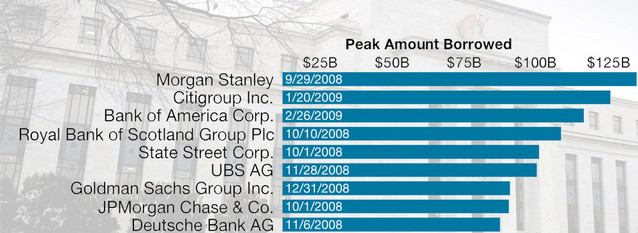
Overall, the greatest borrowing was done by a small number of institutions. Over the three years, Citigroup borrowed a total of 2.5 trillion dollars, Morgan Stanley borrowed two trillion; Merrill Lynch, which was acquired by Bank of America, borrowed 1.9 trillion; and Bank of America borrowed 1.3 trillion.

Banks based in counties other than the U.S. also received money from the Fed, including Barclays of the United Kingdom, the Royal Bank of Scotland Group (UK), Deutsche Bank (Germany), UBS (Switzerland), Credit Suisse Group (Switzerland), Bank of Scotland (UK), BNP Paribas (France), Dexia (Belgium), Dresdner Bank (Germany), and Societe General (France).

"No agency of the United States government should be allowed to bailout a foreign bank or corporation without the direct approval of Congress and the President," Sanders wrote.
In recent days, ‘Bloomberg News’ obtained 29,346 pages of documentation from the Federal Reserve about some of these secret loans, after months of fighting in court for access to the records under the Freedom of Information Act.

Some of the financial institutions secretly receiving loans were meanwhile claiming in their public reports to have ample cash reserves, Bloomberg noted.

The Federal Reserve has neither explained how they legally justified several of the emergency loans, nor how they decided to provide assistance to certain firms but not others.

"The main problem is the lack of Congressional oversight, and the way the Fed seemed to pick winners who would be protected at any cost," Randall Wray, professor of economics at University of Missouri- Kansas City, told IPS.

"If such lending is not illegal, it should be. Our nation really did go through a liquidity crisis - a run on the short-term liabilities of financial institutions. There is only one way to stop a run: lend reserves without limit to all qualifying institutions. The Fed bumbled around before it finally sort of did that," Wray said.

"But then it turned to phase two, which was to try to resolve problems of insolvency by increasing Uncle Sam’s stake in the banksters’ fiasco. That never should have been done. You close down fraudsters, period. The Fed and FDIC (Federal Deposit Insurance Commission) should have gone into the biggest banks immediately, replaced all top management, and should have started to resolve them," Wray said.

Renewed questions about the Federal Reserve have inspired some young activists to organize grassroots protests across the U.S.

"Since its creation by the U.S. Government in 1913, the Federal Reserve has created so much new money out of thin air that it has destroyed 95 percent of the dollar’s value," Joseph Brown, a college student and one of the organizers of a recent protest of the Federal Reserve Bank of Atlanta, said.

"This hidden inflation tax benefits Wall Street and the government, but hurts the poor and those living on fixed incomes, such as senior citizens, the most," Brown said.

The U.S. Government Accountability Office (GAO) audit itself was the result of at least two years of grassroots lobbying. IPS reported in June 2009 a wide bi-partisan coalition of Members of Congress had co-sponsored legislation to audit the Federal Reserve.

The audit was ordered as an amendment by Sanders as part of the Dodd-Frank Wall Street Reform and Consumer Protection Act - a major banking overhaul passed by President Barack Obama and the U.S. Congress in 2010.

"I think this (the first ever GAO audit) was a good start to uncovering what the Fed did so that we can begin to determine whether similar actions should ever be permitted again," Wray wrote, adding, "my preliminary answer is a resounding no."

The GAO also found existing Federal Reserve policies do not prevent significant conflicts of interest. For example, "the FRBNY’s existing restrictions on its employees’ financial interests did not specifically prohibit investments in certain non-bank institutions that received emergency assistance," the report stated.

The GAO report noted on Sep. 19, 2008, William Dudley, who is now the President of the FRBNY, was granted a waiver to let him keep investments in AIG and General Electric, while at the same time the Federal Reserve granted bailout funds to the same two companies.
"No one who works for a firm receiving direct financial assistance from the Fed should be allowed to sit on the Fed’s board of directors or be employed by the Fed," Sanders said.
The GAO is currently working on a more detailed report regarding Federal Reserve conflicts of interest, which is due on Oct. 18, 2011.

Tuesday, August 23, 2011

Hiding commercial real estate losses by laundering bad loans through the Fed

A banking system built on lies and deception
August 22, 2011


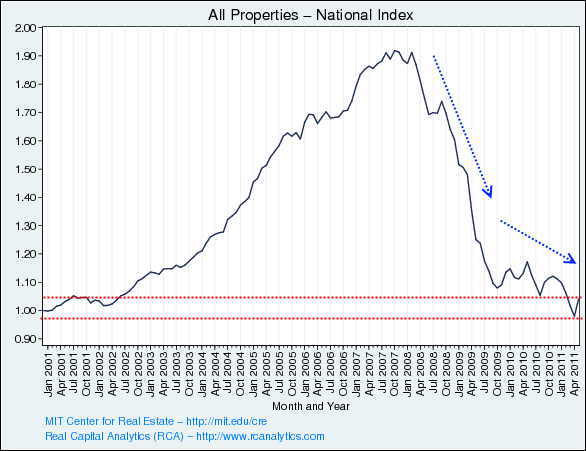
Part of the massive challenges facing our brittle financial system is the opaque and secretive nature of the Federal Reserve.  It is difficult enough to confront a challenge with all information present but make it purposely convoluted and dark and we have a crisis of historical proportions.  The recent market volatility is simply a dire reflection of a system unsure of what is going on.  Markets despise distrust and that is what we are finding.  A few years ago we were told that the banking system was fine yet we now have data showing over $1.2 trillion in emergency loans were made to countless too big to fail banks.  In other words we were being lied to by both the Federal Reserve and the giant banks that largely created and spread this financial crisis like wildfire.  As more information leaks out we are starting to get a grim picture of how the Federal Reserve assisted and is assisting banks not only to hide residential real estate loans but also toxic commercial real estate debtOver $3 trillion in commercial real estate (CRE) values has evaporated since the crisis took hold yet banks continue to tell the public all is well while shifting these toxic bets onto the taxpayer balance sheet.

The collapse in CRE values
mit cre data aug 2011
Source:  MIT

CRE values have already experienced a lost decade and are likely to remain depressed for years to come.  Many of these properties were developed with lofty aspirations and with future growth in mind yet an economy that is contracting has little use for more commercial space.  It is also the case that many of these CRE projects were designed for high flying easy money days.  Take for example some of the condo mix projects in Las Vegas.  Many now sit empty when they were once envisioned as selling for millions of dollars to high rolling aficionados.  Those days simply did not materialize because austerity is taking hold across the world because the debt bubble has burst.  The chart above is data collected monthly by MIT on CRE values.  It is rather obvious that the trajectory of CRE values has imploded since the crisis hit.  Yet somehow the Federal Reserve is openly shifting CRE debt onto its trillion dollar balance sheet even though it knows these are failed projects.  Why?  To aid and protect the banks it serves, not the nation’s economic wellbeing.

More problems ahead for CMBS
CMBS-Maturity-Graph
Source:      CRE Console

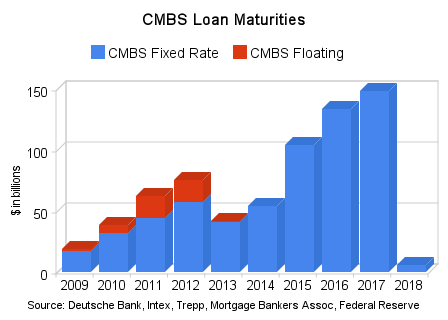
Many of the loans in the CRE market are bundled in CMBS similar to RMBS (residential mortgage backed securities).  As the chart above clearly highlights many of these will hit maturities in the years to come.  The problem then stands as who will take on the loans?  At the moment banks have been silently shifting these bad loans onto the Federal Reserve balance sheet for liquid assets.  This kind of behavior slowly but surely crushes the U.S. dollar as we comingle our safer investments with the toxic waste of the banking industry.  This can only go on for so long and the fact that the Fed balance sheet is still near a peak level above $2.8 trillion tells you that there are no sane buyers in the market for this waste.  All of this of course is kept in the shadows from the public.

After the housing burst then comes the CRE bust
double-bubble
Source:  The American

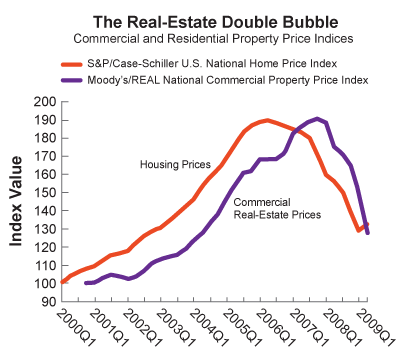
Many of the CRE projects were built with the idea that perma-growth in residential real estate would be unlimited.  Think of the cookie cutter malls and office parks built around towns in places like Arizona that overestimated population growth by leaps and bounds.  These CRE projects take years to complete and were likely started at the height of the mania only to come online with no one in the market as a buyer or anyone else that would want to lease the units out.  This is the dilemma.  Unlike a home, there is likely a bottom price, many of these CRE properties have very little value.  The chart above shows this common pattern when CRE bubbles burst.  So with $3 trillion in CRE values evaporating since 2008, why is the Federal Reserve not publicly talking about this?

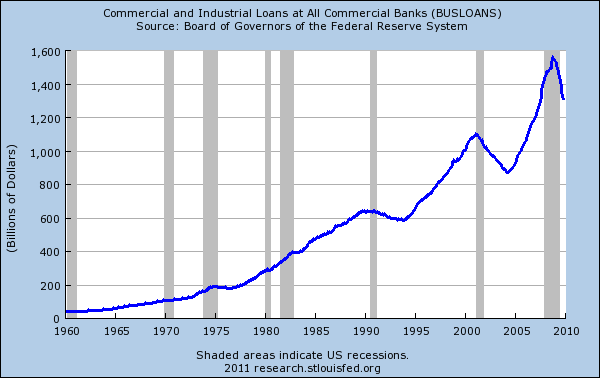
Commercial and industrial loans contract
commercial and industrial loans

Banks might put on a happy face and say all is well in their balance sheet.  But just as we have found out with clear data the Fed was actively bailing out the banks behind closed doors while they openly conveyed to the public that all was well.  If all was well why in the world did they take on $1.2 trillion in emergency loans at the height of the crisis?


bloomberg data
Source:  Bloomberg

The fact that banks are lending less and borrowing from the Fed is simply a reflection to the financial balance sheet issues still being faced by the largest banks in the country.  The fact that these banks can use the Federal Reserve as some sophisticated way of laundering money into the nation’s financial bloodstream is troubling to say the least.  The data presented recently shows us and confirms exactly what many have believed for years and that is the Federal Reserve has been clandestinely bailing out the entire banking system and problems were not only systemic, but the entire system was polluted with bad loans and deception.  So with this data at hand, why would we trust the system that openly lied to the public at the peak of the crisis?

Monday, August 8, 2011

A National Debt Of $14 Trillion? Try $211 Trillion

All Things Considered
by NPR Staff - August 6, 2011

When Standard & Poor's reduced the nation's credit rating from AAA to AA-plus, the United States suffered the first downgrade to its credit rating ever. S&P took this action despite the plan Congress passed this past week to raise the debt limit.

The downgrade, S&P said, "reflects our opinion that the fiscal consolidation plan that Congress and the administration recently agreed to falls short of what, in our view, would be necessary to stabilize the government's medium-term debt dynamics."

It's those medium- and long-term debt problems that also worry economics professor Laurence J. Kotlikoff, who served as a senior economist on President Reagan's Council of Economic Advisers. He says the national debt, which the U.S. Treasury has accounted at about $14 trillion, is just the tip of the iceberg.

"We have all these unofficial debts that are massive compared to the official debt," Kotlikoff tells David Greene, guest host of weekends on All Things Considered. "We're focused just on the official debt, so we're trying to balance the wrong books."

Kotlikoff explains that America's "unofficial" payment obligations — like Social Security, Medicare and Medicaid benefits — jack up the debt figure substantially.
Laurence J. Kotlikoff served as a senior economist on President Ronald Reagan's Council of Economic Advisers and is a professor of economics at Boston University.
Courtesy of Boston University

Laurence J. Kotlikoff served as a senior economist on President Ronald Reagan's Council of Economic Advisers and is a professor of economics at Boston University.

"If you add up all the promises that have been made for spending obligations, including defense expenditures, and you subtract all the taxes that we expect to collect, the difference is $211 trillion. That's the fiscal gap," he says. "That's our true indebtedness."

We don't hear more about this enormous number, Kotlikoff says, because politicians have chosen their language carefully to keep most of the problem off the books.

"Why are these guys thinking about balancing the budget?" he says. "They should try and think about our long-term fiscal problems."

According to Kotlikoff, one of the biggest fiscal problems Congress should focus on is America's obligation to make Social Security payments to future generations of the elderly.

"We've got 78 million baby boomers who are poised to collect, in about 15 to 20 years, about $40,000 per person. Multiply 78 million by $40,000 — you're talking about more than $3 trillion a year just to give to a portion of the population," he says. "That's an enormous bill that's overhanging our heads, and Congress isn't focused on it."

"We've consistently done too little too late, looked too short-term, said the future would take care of itself, we'll deal with that tomorrow," he says. "Well, guess what? You can't keep putting off these problems."

To eliminate the fiscal gap, Kotlikoff says, the U.S. would have to have tax increases and spending reductions far beyond what's being negotiated right now in Washington.

"What you have to do is either immediately and permanently raise taxes by about two-thirds, or immediately and permanently cut every dollar of spending by 40 percent forever. The [Congressional Budget Office's] numbers say we have an absolutely enormous problem facing us."

Tuesday, July 19, 2011

Sitting Atop Trillions: What Would Corporations Do with Another Tax Break?

(Come on! You're still not pissed off to do anything about all this? What's it going to take for Americans to say they've had enough? It's acceptable for you to be really mad at this point. But it's like watching someone commit suicide by holding their breath.--jef)

+++++


Conservatives routinely declare that businesses can’t hire anyone because tax burdens are too high (or "uncertain"—the bête noir of the day) and the way to create jobs is to give business more money. Among other things, corporations have launched a new campaign in Washington for a tax repatriation holiday that would allow businesses to bring home as much as $1 trillion in offshore profits at a very low-tax rate, cash they say could be used to create jobs and boost the economy.

But business already has plenty of cash, and if you look at what corporate America is actually doing with this money, it’s not pretty.

In 2010, businesses in the U.S. were sitting on $2 trillion in cash (a record high percentage of assets) and when we look at the global picture we see that the top 1,000 non-financial companies in the world are still sitting on more than $3.4 trillion in cash. In case you were wondering what happens with that cash, cash does not create jobs—investments do and investments don't happen without consumer demand. Thus, giving business more money leads to bigger numbers in checking accounts, not jobs.

Maybe things have changed in 2011? As the economy inches back to health, how are these companies deciding to spend all this pent up cash? The Federal Flow of Funds reports that the ratio of nonfinancial corporate cash assets to total assets has actually continued to grow through the second quarter of 2011. The biggest growth is in checkable deposits and currency which has risen 51% since the second quarter of 2010.  So not only are businesses refusing to hire workers, they’re buying currency in a bet against America in the hope that the dollar will fall.

But aren’t businesses doing something productive with that cash? Well, yes. Not only is corporate America using cash to fill space in bank boxes and stuff speculative mattresses overseas, they have decided to use some of it to pad the salaries of their CEOs. In 2010, the S&P 500 companies paid their CEOs an average of $11.4 million—an increase in CEO total compensation by 23%! This collective raise could have hired nearly 32,000 median earning workers instead (or 63 workers per company).

Using the public purse to give even more tax break cash to businesses is exactly the wrong move.  This country needs investments such as that called for in Conyers’ jobs bill, not cash hoarding, asset speculation, and CEO raises. The best investment the public purse can make right now is jobs.

Thursday, October 28, 2010

Amidst record unemployment, US companies hoard $1 trillion of cash

(Knowing this, why should employees ever be loyal to their employers after this level of betrayal? Corporate America is evil and serves only the interests of the very rich. It should be destroyed and rebuilt into a system that favors the people.--jef)


Amidst record unemployment, US companies hoard $1 trillion of cash
By Reuters - Wednesday, October 27th, 2010

NEW YORK (Reuters) - U.S. companies are hoarding almost $1 trillion in cash but are unlikely to spend on expanding their business and hiring new employees due to continuing uncertainty about the strength of the economy, Moody's Investors Service said on Tuesday.

As the economy stabilizes companies are also more likely to spend on share repurchases and mergers and acquisitions, Moody's added.

Companies cut costs, reduced investment in plants and equipment and downsized operations in order to boost cash holdings during the recession. As the corporate bond market reopened many companies also boosted cash levels by selling debt and refinancing near-term debt maturities.

The US unemployment rate, meanwhile, sits at a whopping 9.2 percent. (A graph of the unemployment rates state by state can be found here).

Nonfinancial U.S. companies are sitting on $943 billion of cash and short-term investments, as of mid-year 2010, compared with $775 billion at the end of 2008, Moody's said. This would be enough to cover a year's worth of capital spending and dividends and still have $121 billion left over, it said.

However, "we believe companies are looking for greater certainty about the economy and signs of a permanent increase in sales before they let go of their cash hoards, which they suffered so much to build," Moody's said in a report.

"Given low demand and capacity utilization within certain industries, companies are wary of investing their cash in new capacity and adding workers, thereby doing little to abbreviate the jobless recovery," it added.

Around one quarter of the cash is held overseas and is unlikely to be repatriated to the United States, Moody's said.

Meanwhile only 20 companies hold a large portion of corporate cash balances, with $346 billion on their balance sheets, or 37 percent of the total, Moody's said.

Cisco Systems has the largest cash balance, at $39.86 billion, while Microsoft is second with $36.79 billion, Moody's said. Google has the third-largest balance with $30.06 billion, followed by Oracle with $23.64 billion and Ford Motor Co at $21.89 billion.

Technology companies held the most cash as a sector, at $207 billion, followed by pharmaceuticals with $124 billion, energy at $105 billion, and consumer products with $101 billion, Moody's said.

Saturday, June 12, 2010

Three Wars Uncompleted, the Price Unpaid

What Did Our Trillion Dollars Buy?
By VIJAY PRASHAD
“Let contradictions prevail! Let one thing contradict another! And let one line of my poems contradict another!”


-- Walt Whitman, Leaves of Grass.
On May 30, at 10:06am, the United States exchequer turned over its trillionth dollar to the U. S. armed forces for the wars in Iraq and Afghanistan. A trillion dollars is a lot of money. As my friends at the National Priorities Project put it, if I made a $1 million a year, it would take me a million years to earn a trillion dollars. The U. S. government expended the same amount in nine years, fighting two wars. So what did our trillion tax dollars buy?

The best way to answer this question is to see if the U. S. government was able to attain its war aims in each theatre. But what are the war aims? These are unclear. Albeit a democracy, the United States government has been chary with its intentions. Of such silences are conspiracies made. The bilious Daniel Patrick Moynihan once wrote that most of what is classified by the government is meaningless (Secrecy, 1999). Much of it is already in the public domain. War aims are not hidden because they are secret. Most of the time they are unarticulated because the wars themselves are embarrassingly tied to certain limited class needs: power and resources lead the pack. Patriotism is much easier as social glue than patrimonial entitlement.

The banners at the anti-war demonstrations in 2002 and 2003 said, “No Blood for Oil.” At the time, the media decided to mock the linkage. Then along came Alan Greenspan, four years later, with this rather charmless sentence, “I am saddened that it is politically inconvenient to acknowledge what everyone knows: the Iraq war is largely about oil” (The Age of Turbulence, 2007, p. 463). Was the war for oil? Not entirely. The war was also about power, about the continued attempt by the G7, led by the United States, to maintain dominance over an increasingly unruly and unreliable planet. In 2007, the U. S. military formed AFRICOM and began to turn the drug-runners of the Sahel into a detachment of al-Qaeda, as well to pretend that the Somali pirates came out of Old History rather than the overfishing of the Indian Ocean. The answer to every question was military action, and if the question was simply, “could we have some more fish, please,” the answer (bombardment) began to produce an entirely different, and now a new, self-perpetuating question (why do they hate us?).

If the war aims were resources and power, they have largely failed. U. S. power is in drift, not yet in decline. Goldman Sachs is able to force New York City to move the West Side Highway so that its limousines can make a right turn; China Youth Daily calls Goldman Sachs a “gold slurping black-hand” (June 8, 2010). The steretypes are upended; it is the New Yorkers who are deferential to Money, and it is the Chinese who write their editorials with the Middle Finger. Oil plumes and the carcasses of potentially extinct species are blackening the Gulf of Mexico. Corporations run rings around Washington, D. C. Drift is hardly worth a trillion dollars.

Whether Bush or Obama, the government has failed to articulate definitive war aims. Without war aims, how do the military planners construct a strategy, and then, how do they produce tactics? The National Security strategy of the Bush years was simply a promissory note to the world that it would get a good clobbering every once in a while. The strategy was obvious; the tactics followed. At least it had the merit of being honest. It was war without end.

The Obama strategy, from May 2010, has been largely unheralded – very few analysts have given it the time of day. I don’t blame them. It is pabulum, all about interconnected worlds and enhanced prestige. The Obama team promises to “pursue a strategy of national renewal and global leadership – a strategy that rebuilds the foundation of American strength and influence.” To this end, the Obama team says, “Our Armed Forces will always be a cornerstone of our security, but they must be complemented. Our security also depends upon diplomats who can act in every corner of the world, from grand capitals to dangerous outposts.” Not much of this on offer. When the Brazilians and Turks produced a diplomatic gambit with Iran, the U. S. diplomats, in their dangerous outpost at the United Nations, went for new sanctions – all this during the same period as the Turks are up in arms about the Mavi Marmara, and the U. S. remains obdurate about not condemning Israel’s actions in the Mediterranean. It is hard to take the Obama strategy seriously when the administration seems not to be following its own promises.

What of those trillion dollars? Were they well spent? Let’s take four of the openly articulated war aims.

Afghanistan.
(1) Destroy and Disrupt al-Qaeda. After 9/11, the Taliban government informed the U. S. government that it was ready to hand over Osama Bin Laden and the rest of the al-Qaeda leadership to an international court, if the U. S. was able to provide a dossier on their crimes. This was a diplomatic opening. Rather than engage it, the U. S. went to war. Al-Qaeda has not been destroyed. Bin Laden remains at large, so does his deputy (Ayman al-Zawahiri). Al-Qaeda’s operation has now moved into Pakistan, where it threatens to disrupt the nuclear-armed State. For that, the U. S. government now uses the term Af-Pak. The existence of such a term is itself a sign of defeat.

(2) Bring Democracy to Afghanistan. In early June, the U. S. backed Afghan government conducted a jirga whose purpose was to bring the Taliban back into the corridors of power. This is a government that has already adopted much of the Taliban program, including a Supreme Court that banned female singing on television and permits husbands to starve wives who are unwilling to have sex. Recall that it was the U. S. in the 1980s that backed these Islamists in the first place, and used them to attack the progressive laws passed by the Democratic Republic of Afghanistan (including the right to divorce and land reform). Between the Taliban and the Warlords there is little difference; the U. S. government has empowered one against the other, and both against the Afghan people.
Iraq.
(3) Destroy Weapons of Mass Destruction. The United States government went to war in Iraq in 2003 on the pretext of weapons of mass destruction. None were found. Iraq had been starved by the sanctions of the 1990s. It barely had an army left, as the U. S. troops soon found. What army was left became the guerrilla force that morphed into the sectarian militias, which continue to bedevil Iraq. No weapons of mass destruction, although with the U. S. military bogged down in Afghanistan and Iraq, an emboldened North Korea went ahead and tested its own nuclear device. The next best thing for isolated Pyongyang is if its football team is able to make the quarter-finals at the 2010 World Cup (as it did during its last outing, in 1966).

(4) Create a Stable Ally in the Middle East. We were told that an Iraq absent Saddam Hussein would look like Lebanon before the 1975-1990 sectarian civil war, with Beirut, the Paris of the East, now to be found in Baghdad. The destruction of Iraq in 2003 resembled the invasion by the Mongol Helegu in 1258: all that remained were facades of a city that once was. From the ashes of a destroyed people rose the sectarian militias and a civil war as brutal as broke apart Lebanon for fifteen years. Iraq remains unstable, with suicide bombing a constant and unreported feature. Trapped in Iraq, trapped by Israel’s variances from normality, unable to find any allies among the Turks or the Iranians: a miserable soup for the planners at Foggy Bottom.
What did the American people get for the trillion dollars? At least a million dead in Iraq and Afghanistan, and instability in key parts of the world. The United States could continue to throw money into these two conflicts, but in neither case will the articulated and unarticulated war aims be attained. Iraq and Afghanistan deserve another future, one that is not to be determined by military force. No point being dragged again and again down what Martin Luther King, Jr. called, “the shameful corridor of time reserved for those who possess power without compassion.”

It is time to consider other solutions.

Saturday, May 15, 2010

Trillions More Than We've Been Told...


The Bailout of Big American Banks Has Cost Trillions More Than We've Been Told
Published on 05-14-2010


Granted, the $700 billion dollar TARP bailout was a massive bait-and-switch. The government said it was doing it to soak up toxic assets, and then switched to saying it was needed to free up lending. It didn't do that either. Indeed, the Fed doesn't wantthe banks to lend.
True, as I wrote in March 2009:
The bailout money is just going to line the pockets of the wealthy, instead of helping to stabilize the economy or even the companies receiving the bailouts:
  • A lot of the bailout money is going to the failing companies'shareholders
  • Indeed, a leading progressive economist says that the true purpose of the bank rescue plans is "a massive redistribution of wealth to the bank shareholders and their top executives"
  • The Treasury Department encouraged banks to use the bailout money to buy their competitors, and pushed through an amendment to the tax laws which rewards mergers in the banking industry (this has caused a lot of companies to bite off more than they can chew, destabilizing the acquiring companies)
And as the New York Times notes, "Tens of billions of [bailout] dollars have merely passed through A.I.G. to its derivatives trading partners".

***

In other words, through a little game-playing by the Fed, taxpayer money is going straight into the pockets of investors in AIG's credit default swaps and is not even really stabilizing AIG.
But the TARP bailout is peanuts compared to the numerous other bailouts the government has given to the giant banks.

And I'm not referring to the $23 trillion in bailouts, loans, guarantees and other known shenanigans that the special inspector general for the TARP program mentions. I'm talking about more covert types of bailouts.

Like what?

Guaranteeing a Fat Spread on Interest Rates
Well, as Bloomberg notes:

“The trading profits of the Street is just another way of measuring the subsidy the Fed is giving to the banks, said Christopher Whalen, managing director of Torrance, California-based Institutional Risk Analytics. “It’s a transfer from savers to banks.” 
The trading results, which helped the banks report higher quarterly profit than analysts estimated even as unemployment stagnated at a 27-year high, came with a big assist from the Federal Reserve. The U.S. central bank helped lenders by holding short-term borrowing costs near zero, giving them a chance to profit by carrying even 10-year government notes that yielded an average of 3.70 percent last quarter. 
The gap between short-term interest rates, such as what banks may pay to borrow in interbank markets or on savings accounts, and longer-term rates, known as the yield curve, has been at record levels. The difference between yields on 2- and 10-year Treasuries yesterday touched 2.71 percentage points, near the all-time high of 2.94 percentage points set Feb. 18.
Harry Blodget explains:
The latest quarterly reports from the big Wall Street banks revealed a startling fact: None of the big four banks had a single day in the quarter in which they lost money trading.
For the 63 straight trading days in Q1, in other words, Goldman Sachs (GS), JP Morgan (JPM), Bank of America (BAC), and Citigroup (C) made money trading for their own accounts.
Trading, of course, is supposed to be a risky business: You win some, you lose some. That's how traders justify their gargantuan bonuses--their jobs are so risky that they deserve to be paid millions for protecting their firms' precious capital. (Of course, the only thing that happens if traders fail to protect that capital is that taxpayers bail out the bank and the traders are paid huge "retention" bonuses to prevent them from leaving to trade somewhere else, but that's a different story). 
But these days, trading isn't risky at all. In fact, it's safer than walking down the street.
Why? 
Because the US government is lending money to the big banks at near-zero interest rates. And the banks are then turning around and lending that money back to the US government at 3%-4% interest rates, making 3%+ on the spread. What's more, the banks are leveraging this trade, borrowing at least $10 for every $1 of equity capital they have, to increase the size of their bets. Which means the banks can turn relatively small amounts of equity into huge profits--by borrowing from the taxpayer and then lending back to the taxpayer. 
The government's zero-interest-rate policy, in other words, is the biggest Wall Street subsidy yet. So far, it has done little to increase the supply of credit in the real economy. But it has hosed responsible people who lived within their means and are now earning next-to-nothing on their savings. It has also allowed the big Wall Street banks to print money to offset all the dumb bets that brought the financial system to the brink of collapse two years ago. And it has fattened Wall Street bonus pools to record levels again.
Paul Abrams chimes in:
To get a clear picture of what is going on here, ignore the intermediate steps (borrowing money from the fed, investing in Treasuries), as they are riskless, and it immediately becomes clear that this is merely a direct payment from the Fed to the banking executives...for nothing. No nifty new tech product has been created. No illness has been treated. No teacher has figured out how to get a third-grader to understand fractions. No singer's voice has entertained a packed stadium. No batter has hit a walk-off double. No "risk"has even been "managed", the current mantra for what big banks do that is so goddamned important that it is doing "god's work". 
Nor has any credit been extended to allow the real value-producers to meet payroll, to reserve a stadium, to purchase capital equipment, to hire employees. Nothing.
Congress should put an immediate halt to this practice. Banks should have to show that the money they are borrowing from the Fed is to provide credit to businesses, or consumers, or homeowners. Not a penny should be allowed to be used to purchase Treasuries. Otherwise, the Fed window should be slammed shut on their manicured fingers.
And, stiff criminal penalties should be enacted for those banks that mislead the Fed about the destination of the money they are borrowing. Bernie Madoff needs company.
There is another type of guaranteed spread that allows the giant banks to make money hand over fist. Specifically, the Fed pays the big banks interest to borrow money at no interest and then keep money parked at the Fed itself. (The Fed is intentionally doing this for the express purpose of preventing too much money from being lent out to Main Street. That's just dandy.)

The giant banks are receiving many other covert bailouts and subsidies as well.

Too Big As Subsidy
Initially, the fact that the giant banks are "too big to fail" encourages them to take huge, risky gambles that they would not otherwise take. If they win, they make bigbucks. If they lose, they know the government will just bail them out. This is a gambling subsidy.

The very size of the too big to fails also decreases the ability of the smaller banks to compete. And - since the government itself helped make the giants even bigger - that is also a subsidy to the big boys (see this).

The monopoly power given to the big banks (technically an "oligopoly") is a subsidy in other ways as well. For example, Nobel prize winning economist Joseph Stiglitz said in September that giants like Goldman are using their size to manipulate the market:
"The main problem that Goldman raises is a question of size: 'too big to fail.' In some markets, they have a significant fraction of trades. Why is that important? They trade both on their proprietary desk and on behalf of customers. When you do that and you have a significant fraction of all trades, you have a lot of information."

Further, he says, "That raises the potential of conflicts of interest, problems of front-running, using that inside information for your proprietary desk. And that's why the Volcker report came out and said that we need to restrict the kinds of activity that these large institutions have. If you're going to trade on behalf of others, if you're going to be a commercial bank, you can't engage in certain kinds of risk-taking behavior."
The giants (especially Goldman Sachs) have also used high-frequency program trading which not only distorted the markets - making up more than 70% of stock trades - but which also let the program trading giants take a sneak peak at what the real (aka “human”) traders are buying and selling, and then trade on the insider information. Seethisthisthisthis and this. (This is frontrunning, which is illegal; but it is a lot bigger than garden variety frontrunning, because the program traders are not only trading based on inside knowledge of what their own clients are doing, they are also trading based on knowledge of what all other traders are doing).

Goldman also admitted that its proprietary trading program can "manipulate the markets in unfair ways". The giant banks have also allegedly used their Counterparty Risk Management Policy Group (CRMPG) to exchange secret information and formulate coordinated mutually beneficial actions, all with the government's blessings.

In addition, the giants receive many billions in subsidies by receiving government guarantees that they are "too big to fail", ensuring that they have to pay lower interest rates to attract depositors.

Derivatives
The government's failure to rein in derivatives or break up the giant banks also constitute enormous subsidies, as it allows the giants to make huge sums by keeping the true price points of their derivatives secret. See this and this.

Toxic Assets
The PPIP program - which was supposed to reduce the toxic assets held by banks - actually increased them, and just let the banks make a quick buck.

In addition, the government suspended mark-to-market valuation of the toxic assets held by the giant banks, and is allowing the banks to value the assets at whatever price they desire. This constitutes a huge giveaway to the big banks.

As one writer notes:

By allowing banks to legally disregard mark-to-market accounting rules, government allows banks to maintain investment grade ratings.
By maintaining investment grade ratings, banks attract institutional funds. That would be the insurance and pension funds money that is contributed by the citizen.
As institutional money pours in, the stock price is propped up ....

Mortgages and Housing
PhD economists John Hussman and Dean Baker (and fund manager and financial writer Barry Ritholtz) say that the only reason the government keeps giving billions to Fannie and Freddie is that it is really a huge, ongoing, back-door bailout of the big banks.

Many also accuse Obama's foreclosure relief programs as being backdoor bailouts for the banks. (See thisthis and this).

Foreign Bailouts
The big banks - such as JP Morgan - also benefit from foreign bailouts, such as the European bailout, as they are some of the largest creditors of the bailed out countries, and the bailouts allow them to get paid in full, instead of having to write down their foreign losses.