Showing posts with label health problems. Show all posts

Thursday, September 11, 2014

People Who Live Near Fracking More Likely To Become Sick, Study Finds


People Who Live Near Fracking More Likely To Become Sick, Study Finds
by Emily Atkin
September 10, 2014

People living close to natural gas wells in southwestern Pennsylvania are more than twice as likely to report respiratory illnesses and skin problems than those living farther away, according to a new study from Yale University.

Dr. Peter Rabinowitz, a former Yale School of Medicine professor who now teaches at the University of Washington’s School of Public Health, got the results by randomly surveying 180 households with 492 people in Washington County, Pennsylvania. Washington County is in the heart of the Marcellus Shale, one of one of America’s fracking hotspots — and arguably the epicenter of fracking-related pollution complaints and industrial accidents.

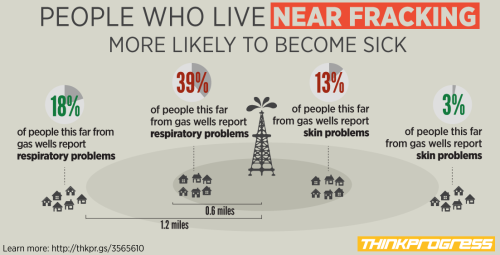
Of those surveyed, Rabinowitz found that 39 percent of people living less than 0.6 miles from a gas well reported upper-respiratory problems like sinus infections and nosebleeds, compared to just 18 percent of people living more than 1.2 miles away. For skin problems like rashes, 13 percent living close to the wells reported irritation, compared to only 3 percent living further away who said the same.

Rabinowitz said that his findings represent “the largest study to date of general health status of people living near natural gas wells.”

The study, published in the peer-reviewed journal Environmental Health Perspectives, is careful not to claim outright that the fracking itself is causing the health problems. Rather, it solely states that there are higher rates of illness in households closer to gas wells. To say that drilling or fracking causes illness would require more research, Rabinowitz said.

“It’s more of an association than a causation,” Rabinowitz told the New Haven Register. “We want to make sure people know it’s a preliminary study. … To me it strongly indicates the need to further investigate the situation and not ignore it.”

Rabinowitz is not the first to assert that more research needs to be done into the health impacts of fracking.

Just last week, scientists at the University of Texas published research stating that 30 percent of water wells near Texas fracking sites contained higher-than-normal levels of arsenic. However, the researchers stated that their findings were not conclusive in stating that the contamination is because of fracking.

“We think that the strongest argument we can say is that this needs more research,” Brian Fontenot, the paper’s lead author, said at the time.

In addition, preliminary scientific research is finding more and more of a connection between birth defects and the proximity of the child’s mother to a natural gas well. Still, scientists generally agree that more research needs to be done before a conclusive statement can be made about whether that proximity to natural gas drilling actually causes birth defects or other health problems in babies and mothers.

Fracking is a controversial yet popular technique used to stimulate natural gas wells underground by injecting high-pressure water, sand, and chemicals miles-deep into subsurface rock, effectively cracking or “fracturing” it, making the gas easier to extract. It has been controversial in part because of how quickly the practice has spread in the United States, without much credible scientific information regarding the potential impact on public health.

Pennsylvania has had more than 6,000 hydraulic fracturing wells drilled within the last six years, and zero state studies on their health impacts. Because of the lack of research, it’s been increasingly hard to prove that families can be sickened by drilling.

Natural gas drilling in Pennsylvania has skyrocketed under Gov. Tom Corbett. He has expanded fracking in Pennsylvania’s state parks and forests, and in 2012 implemented a controversial state oil and gas law, known as Act 13, which severely restricts the ability of local governments to have control over drilling in their area. Multiple portions of the law have since been ruled unconstitutional by the state Supreme Court.

Tuesday, August 5, 2014

Fracking’s untold health threat: How toxic contamination is destroying lives

America's natural gas boom has real consequences for children and animals,
researchers tell Salon

Lindsay Abrams

If we’re going to talk about fracking, we can’t just talk about energy independence, or the economy, or the potential for natural gas to act as a “bridge fuel” to help solve the global warming crisis. We also need to talk about the effect that hydraulic fracturing is having on the communities where it’s taking place, and to ask whether that cost — to people’s health and property — is too high.

The main barrier to that conversation, of course, is that it’s one the industry definitely doesn’t want to be having, aside from insisting that fracking is safe. Michelle Bamberger, a veterinarian, and Robert Oswald, a professor of molecular medicine at Cornell, believe differently, and they have the research to back up their claims. The two have documented cases of contaminated water and air, of sick pets and dying livestock and of similar symptoms experienced by the animals’ owners, all with few apparent explanations. And that, the researchers, argue, is the real scandal: It’s up to the people being affected, and not the industry causing the damage, to prove that something’s wrong.

In The Real Cost of Fracking: How America’s Shale Boom is Threatening Our Families, Pets and Food,” Bamberger and Oswald share the stories of people whose lives have been affected — and in some cases, destroyed — by fracking, in a way that aims to open up the conversation to what’s at stake. “Simply put,” they write, “we are not certain of the public health implications of large-scale industrial oil and gas drilling.” The effects we are seeing, they add, are being seen most prominently in animals, children and oil and gas workers: the ones who, because they are so sensitive to hazards from gas operations, end up serving as the canaries in the coal mine.

Bamberger and Oswald spoke with Salon about the challenges of studying the health risks of fracking, and about why they believe the evidence they’ve found is enough to make us seriously question whether they’re risks worth taking. This interview has been lightly edited for length and clarity.

What got you started investigating this aspect of fracking?
MB: We heard about this issue about five years ago when we read in our local paper about a community group that was going through all the leases and just plotting out where surface and mineral rights were leased in the county. It made it really easy to know where you were and who your neighbors were that were leased — the land that was leased around you. We’re out in the country, about 15 minutes from Ithaca, and we saw that we were surrounded by farmers who owned 100 acres or more of land and had leased. The way compulsory integration works in New York is that if you are in a land unit, which is usually one square mile, that is 60 percent or more leased, then your land could be drilled under.

So that got us really interested in the issue, because we’re not leased, but we would be drilled under. So we thought, we’d better start paying attention to this. So we started attending meetings and learning more about it. And in the process, I started hearing about cases in Pennsylvania where animals were becoming ill, and no one was trying to figure out why, or owners didn’t know why, or their vets didn’t know why. That’s what pulled me into it; and for Robert’s part, I think I can speak for him, he started getting involved with it from looking at the documentation I was starting to collect.

Was it hard to find people who were willing to speak about the experiences they’re having?
MB: I started to get emails from people who knew I was a veterinarian who were local farmer-type people up here in New York who had connections with people in other states through the farming groups. So they started putting me in contact with people, and I started to become known as a vet who was interested in looking into these cases and starting to document them, and that’s how I got pulled into this.
 
What are some of the more shocking things you turned up?
MB: I can think of one particular occasion — this was in Louisiana in April 2009 — and that was the one where the cattle were exposed to hydraulic fracturing fluid and they died within an hour. What was shocking about that was that these are animals, which are over 1,000 pounds, and it takes something pretty powerful to knock them out, that they’re exposed to it and then dead in just an hour. That really grabbed me by the neck, because what I’ve been reading about was usually cattle exposures, where even if it’s pretty toxic, it’s one to three days. One to three days is pretty fast, actually, but within an hour is pretty amazing. So I think that was the most amazing thing that I heard of with these cases. Robert is shaking his head in agreement.

RO: I think that was the most dramatic case we had. We had a lot of cases that were interesting but that was a dramatic one.

MB: Robert, the other answer you give for this is the case where we were sitting at the kitchen…

RO: That wasn’t dramatic but it had a big effect on me, let’s put it that way. We went to visit some people and they had actually had some documented contamination on their land and their cows were quarantined. And we’re just sitting in their dining room, which is off their kitchen, and you can look through their kitchen window and all you can see out their kitchen window is a well pad. We look outside the dining room window and about 10 feet away from it is a driveway, and that’s the access road to the pad. So I realized for these people, all this drilling and fracking and everything, it was right on top of their house. These people had several hundred acres and they didn’t want them to put the pad there, but the company insisted on putting the pad right by their house. That was a thing that was really early on and it really struck me as something that I just didn’t understand — how people could live with that, and how the companies could actually do that.

Would you say that all adds up to these people’s lives being dominated, or ruined, by drilling operations? Or is it just that we’re not hearing enough about any of these things that are happening?
MB: I think their lives are in many cases being dominated, and I think that’s true especially in the cases when people lose their water — we all know what it’s like when our electricity goes out or our power goes out and we can’t run our spigot. To have that be all the time, how do you compensate for that? What do you with water that’s not good, and you can’t drink it and maybe you can’t even bathe in it? You’re getting rashes, you’re getting ill — it really does turn your life upside down and it does dominate it. We have one woman we described in our book who said, “I go to sleep thinking of water. I wake up thinking of water. Every minute is thinking of water.” It just made me realize that we take so much for granted. But this is huge: When you have to think of every drop, counting exactly how much water you’re going to need and how much you’re going to use and think of your community and think of your neighbors, it’s really overwhelming. It’s hard to really understand. We got a little bit of a taste of it when we went and visited these people and spent some time with them, but I think no one could ever understand it unless you go through it.

RO: You know, Tony Hayward, the CEO of BP, during the BP oil spill, he said he wanted his life back. That had such a hollow ring to it. These are people who really need their lives back, and they’re not going to get it back.

There’s one point in the book where you compare some of these people to victims of rape, which seems like a pretty extreme comparison.
MB: The thing I was trying to get at there as an analogy was lack of control. They’re powerless. And again, you can get that feeling through all the chapters that we’ve written in describing the cases. Especially in that last chapter, on environmental justice, where they’re at the complete mercy of these companies that are working around them and then at the companies’ mercy as to whether they’re provided with a water buffalo [a large container of replacement water], to whether it’s decided that the results of their testing show they need it. What do they have to prove in order to be able to have good water again? I think that’s the sort of thing I was trying to build and get there with that analogy: powerlessness and lack of control.

Going back to your research, how many of these case studies that you feature are backed up by conclusive evidence that says “Yes, fracking is definitely causing these problems?”
MB: So on those cases, a few are, most are not. We feel strongly that it’s because of the current testing methods that are used and the fact that for a lot of these chemicals, we don’t know what they are actually using — especially the proprietary mixes, we don’t know what all the components are. But also we don’t know what the maximum contaminate levels (MCLs) are. So, in other words, what is the level below which there are no health effects and above which definitely there are? And what are the effective screening levels for air? If we don’t really know them, then we believe these people have no recourse because there’s no MCL. And that came out really strongly for me. We have several cases in the book that are part of the EPA study, where I was shocked when I saw the water results that a large majority of those chemicals the EPA was testing didn’t have MCLs. And if you don’t have an MCL, you can’t go into litigation, you can’t go to court and say “we have conclusive evidence.” It doesn’t matter how sick they are and that they can’t use their water or that when they stop using their water they get better and when they use it again they get worse. None of that counts as conclusive evidence. Having said that, we do have several cases you can read about in the book where it is conclusive evidence. But it’s the rarity really because of the many reasons we discussed in the book.

RO: You should also sort of realize that it took about 30 years to determine conclusively that cigarettes caused cancer, and part of the reason is that there’s always some sort of plausible deniability. It really depends on what we accept as a level of truth and what’s more important. Is it more important to absolutely prove there’s contamination here, or is it more important to prove that there’s not contamination here? And where do we find the balance? The balance, unfortunately, is very much in favor of companies and not in favor of the people who are living with this.

So you mentioned more testing. Are there simple things that could be put in place to help make the link more clear, or to help protect people?
MB: That’s a really good question. We are now, getting back to the testing thing, thinking of looking at it in a different light, to make it simpler for people to know right away: “Is this water I shouldn’t be drinking? And if it needs much further testing that maybe I can’t afford, at least I shouldn’t be drinking it.”

As far as simple things that could be done that might lessen the effects right now, I think the best discussion of that is in our first paper, where we talk about what could be done: just getting further away from these operations, for the drilling companies to operate further away, there’s also been a lot, lately, about cement casing failures. I think the big thing is that we were shocked about the number of inspectors. There are so few inspectors that they cannot get out and really make sure things are running correctly, even as they stand now. So there’s something that’s really simple and really basic, and the state regulators would probably say we don’t have the money for that, we can’t afford it. But then it comes down to this question that we’re hearing all over the country now: “What’s more important, to get the energy out of the ground or people’s health?” That’s a real basic question; that’s what it comes down to now and we strongly believe people’s health and children and animals and food and all of that should come way before going after an energy source that’s not really viable, especially in light of the climate change we have — but that’s another issue.

I can’t imagine that the industry has had a positive response to your work.
MB: Energy In Depth is one of the energy industry sites and they pretty much attack anybody who doesn’t say that this is great stuff they’re doing. So we are not the only ones who have been attacked. But we look at it like we don’t really care what they have to say. We’re just going to do the best science in the most objective way possible and that’s what we’re still trying to do. The reason to write the book, in addition to the articles, is to reach an audience that might not read an article, even though our article was pretty easy to read. A lot of people hearing it from a scientific journal just would not read it. So the book is an effort to reach those people who would read a book. So we’re hoping to get more people aware of the situation, and if more people are aware maybe things will change eventually.

Would you say nondisclosure agreements are making it harder to get those stories out there?  
MB: That is true and I think that’s happening more and more. And it’s been hard; we’ve had a few cases shut down and people say “I can’t provide you with any more information,” or right up front we were not able to follow up on a really good case because they’d already signed. So for us as researchers that really cuts out a lot of information where we’re trying to find out what’s happening, especially as health researchers for the public health — it’s hard to protect the public health if you can’t ask what’s happening.

Leaving aside the climate change aspect, and just so far as the direct effects on people who live near fracking operations, do you see the point where the industry could make significant enough improvements that fracking will be safe — or at least safe enough — to be justifiable, from an energy standpoint?
RO: Well I think they can do better, that’s true. And maybe they are doing better. I don’t know. I don’t think there will ever be a case where it will always be safe. There will always be problems; mistakes happen. And when they wipe out a community’s water by making a mistake, that’s the major issue. When you get right down to it, what’s more important: Do we find alternative ways of getting energy? I think there are alternatives, but I think what we’re doing is sending all our money to subsidize the oil and gas industry and sending very little money subsidizing alternative energy. It’s that balance for change for alternative energy, which has become much more affordable for people. I think it would not be worth taking the risk of contaminating water and air and ruining some people’s lives.

Monday, March 3, 2014

Reasons Monsanto's "Science" Doesn't Add Up

Monday, 03 March 2014
By Katherine Paul and Ronnie Cummins, Organic Consumers Association 

 
To hear the pesticide and junk food marketers of the world tell it, anyone who questions the value, legitimacy or safety of GMO crops is naïve, anti-science and irrational to the point of hysteria.

But how long can Monsanto ignore the mounting actual scientific evidence that their technology is not only failing to live up to its promises, it’s putting public health at risk?

Jim Goodman, farmer, activist and member of the Organic Consumers Association policy advisory board, recently wrote about Monsanto’s deceptive use of the expression “sound science.”
But, ‘sound science’ has no scientific definition. It does not mean peer reviewed, or well documented research. ‘Sound science’ is only a term, an ideological term, used to support a particular point of view, policy statement or a technology. ‘Sound science’ is little more than the opinions of so-called “experts” representing corporate interests.
Simply put, ‘sound science’ always supports the position of industry over people, corporate profit over food safety, the environment and public health.

Here are five new reports and studies, published in the last two months, that blow huge holes in Monsanto’s “sound science” story. Reports of everything from Monsanto’s Roundup causing fatal, chronic kidney disease to how, contrary to industry claims, Roundup persists for years, contaminating soil, air and water. And oh-by-the-way, no, GMO crops will not feed the world, nor have they reduced the use of herbicides and pesticides.

1.   Monsanto’s Roundup linked to fatal, chronic kidney disease.
Article in Journal of Environmental Research and Public Health, February 2014

What happens when you mix glyphosate, the key active ingredient in Monsanto’s Roundup, with “hard” water? That is, water that contains metals, such as calcium, magnesium, strontium and iron, either found naturally in the soil, or resulting from the use of chemical fertilizers?

The glyphosate becomes “extremely toxic” to the kidneys.

That’s the theory put forth by researchers trying to uncover the mystery of thousands of deaths from chronic kidney disease among people in farming areas of Sri Lanka, El Salvador and Nicaragua.

2.   Monsanto’s Roundup persists in soil and water. U.S. Geological Survey report in Environmental Toxicology and Chemistry, February 2014

Monsanto has always insisted (despite evidence to the contrary) that its Roundup herbicide is benign, that its toxicity doesn’t persist.

But that’s only half the story, according to a study published this month in Environmental Toxicology and Chemistry. Researchers now say that if you study only the key active ingredient, glyphosate, you might, as Monsanto claims, determine that Roundup is benign.

But there are other ingredients in Roundup, including one called Aminomethylphosphonic acid, or AMPA. The study, called "Pesticides in Mississippi air and rain: A comparison between 1995 and 2007," found that glyphosate and its still-toxic byproduct, AMPA, were found in over 75 percent of the air and rain samples tested from Mississippi in 2007.

What does that mean for you? According to one analysis, “if you were breathing in the sampled air you would be inhaling approximately 2.5 nanograms of glyphosate per cubic meter of air. It has been estimated the average adult inhales approximately 388 cubic feet or 11 cubic meters of air per day, which would equal to 27.5 nanograms (billionths of a gram) of glyphosate a day.” Gasp.

3.   GMO crops have led to an increase in use of pesticides and herbicides. U.S. Department of Agriculture (USDA) report, February 2014.

The USDA, which gauging from its track record has never met a GMO crop it didn’t like, published a report substantiating what responsible, independent scientists have been saying along. Genetic engineering does not result in increased yields (as industry would have us believe)—but it has led to the increased (not decreased, as industry claims) use of pesticides and herbicides.

To be fair, the report gives overall favorable reviews to GMO crops. Not surprising, given the agency’s cozy relationship with Monsanto. But that makes it all the more telling that the once staunch-defender of GMO crops is now raising questions about industry’s long-term, decidedly unproven and unscientific, claims that biotechnology is the best thing since sliced (GMO wheat) bread.

Sustainable Pulse does a good job of sifting through the USDA’s report to reveal the agency’s criticisms of GMO crops.

4.   Pesticides are more dangerous than we thought.  Article in BioMed Research International, February 2014

More bad news on pesticides. A study published in BioMed Research International this month says that it’s not just the toxic chemicals we need to worry about in pesticides. It’s the inert ingredients, and how they interact with the active, toxic ingredients.

Typically, studies conducted to determine the safety of pesticides focus exclusively on the active ingredients. But scientists at the University of Caen tested eight commercial products, including Roundup, and found that nine of them were hundreds of times more toxic than their active ingredient alone.

Which product won the “Most Toxic” award? Monsanto’s Roundup, which was found to be “by far the most toxic of the herbicides and insecticides tested,” according to the study.

5. Small-Scale, organic farming needed to feed the world. U.N. Commission on Trade and Development (UNCTAD), Wake Up Before It Is Too Late, December 2013

In December 2013, the U.N. Commission on Trade and Development (UNCTAD) released the results of a lengthy, in-depth study that blows a huge hole in one of Monsanto’s favorite claims, that we need GMOs to feed the world. The study, entitled Wake Up Before it is Too Late, concluded with this warning: Small-scale organic farming is the only way to feed the world.

According to an analysis by one of the report’s contributors, the report contains in-depth sections on the shift toward more sustainable, resilient agriculture; livestock production and climate change; the importance of research and extension; the role of land use; and the role of reforming global trade rules.

More than 60 experts from around the world contributed to the report.

Clearly the evidence—real, scientific evidence—against GMO crops is mounting, when five new anti-GMO studies and reports surface in a matter of a couple of months.

How much more will it take before the USDA, U.S. Food & Drug Administration (FDA) and the U.S. Environmental Protection Agency stop supporting an industry under attack from the scientific community? And start putting public health before corporate profits?

In December, more than 200 scientists, physicians, and experts from relevant fields, signed a statement declaring that the biotech industry is deceiving the public when it claims that GMOs are safe. There is, the group said, no “scientific consensus” to support industry’s claims that GMOs are safe.

But as new studies surface every day, it’s become increasingly clear that among credible physicians and scientists, the consensus is that we’d better wake up, soon, to the risks and threats posed by a reckless technology that has been allowed to dominate our food and farming systems, unchecked, for far too long.

Wednesday, October 9, 2013

Looming Health Crisis: Wireless Technology and the Toxification of America

By James F. Tracy
Project Censored


As a multitude of hazardous wireless technologies are deployed in homes, schools and workplaces, government officials and industry representatives continue to insist on their safety despite growing evidence to the contrary. A major health crisis looms that is only hastened through the extensive deployment of “smart grid” technology.


In October 2009 at Florida Power and Light’s (FPL) solar energy station President Barack Obama announced that $3.4 billion of the American Reinvestment and Recovery Act would be devoted to the country’s “smart energy grid” transition. Matching funds from the energy industry brought the total national Smart Grid investment to $8 billion. FPL was given $200 million of federal money to install 2.5 million “smart meters” on homes and businesses throughout the state.[1]

By now many residents in the United States and Canada have the smart meters installed on their dwellings. Each of these meters is equipped with an electronic cellular transmitter that uses powerful bursts of electromagnetic radiofrequency (RF) radiation to communicate with nearby meters that together form an interlocking network transferring detailed information on residents’ electrical usage back to the utility every few minutes or less. Such information can easily be used to determine individual patterns of behavior based on power consumption.

The smart grid technology is being sold to the public as a way to “empower” individual energy consumers by allowing them to access information on their energy usage so that they may eventually save money by programming “smart” (i.e, wireless enabled) home appliances and equipment that will coordinate their operability with the smart meter to run when electrical rates are lowest. In other words, a broader plan behind smart grid technology involves a tiered rate system for electricity consumption that will be set by the utility to which customers will have no choice but to conform.

Because of power companies’ stealth rollout of smart meters a large majority of the public still remains unaware of the dangers they pose to human health. This remains the case even though states such as Maine have adopted an “opt out” provision for their citizens. The devices have not been safety-tested by Underwriters Laboratory and thus lack the UL approval customary for most electronics.[2] Further, power customers are typically told by their utilities that the smart meter only communicates with the power company “a few times per day” to transmit information on individual household energy usage. However, when individuals obtained the necessary equipment to do their own testing they found the meters were emitting bursts of RF radiation throughout the home far more intense than a cell phone call every minute or less.[3]

America’s Telecom-friendly Policy for RF Exposure
A growing body of medical studies is now linking cumulative RF exposure to DNA disruption, cancer, birth defects, miscarriages, and autoimmune diseases. Smart meters significantly contribute to an environment already polluted by RF radiation through the pervasive stationing of cellular telephone towers in or around public spaces and consumers’ habitual use of wireless technologies. In the 2000 Salzburg Resolution European scientists recommended the maximum RF exposure for humans to be no more than one tenth of a microwatt per square centimeter. In the United States RF exposure limits are 1,000 microwatts per centimeter, with no limits for long term exposure.[4] Such lax standards have been determined by outdated science and the legal and regulatory maneuvering of the powerful telecommunications and wireless industries.

The Environmental Protection Agency (EPA)
ceased studying the health effects of radiofrequency radiation when the Senate Appropriations Committee cut the department’s funding and forbade it from further research into the area.[5] Thereafter RF limits were codified as mere “guidelines” based on the EPA’s tentative findings and are to this day administered by the Federal Communications Commission (FCC).

These weakly enforced standards are predicated on the alleged “thermal effect” of RF. In other words, if the energy emitted from a wireless antenna or device is not powerful enough to heat the skin or flesh then no danger is posed to human health.[6] This reasoning is routinely put forward by utilities installing smart meters on residences, telecom companies locating cellular transmission towers in populated areas, and now school districts across the US allowing the installation of cell towers on school campuses.[7]

The FCC’s authority to impose this standard was further reinforced with the passage of the 1996 Telecommunications Act that included a provision lobbied for by the telecom industry preventing state and local governments from evaluating potential environmental and health effects when locating cell towers “so long as ‘such facilities comply with the FCC’s regulations concerning such emissions.’”[8]

In 2001 an alliance of scientists and engineers with the backing of the Communications Workers of America filed a federal lawsuit hoping the Supreme Court would reconsider the FCC’s obsolete exposure guidelines and the Telecom Act’s overreach into state and local jurisdiction. The high court refused to hear the case. When the same group asked the FCC to reexamine its guidelines in light of current scientific studies the request was rebuffed.[9] Today in all probability millions are suffering from a variety of immediate and long-term health effects from relentless EMF and RF exposure that under the thermal effect rationale remain unrecognized or discounted by the telecom industry and regulatory authorities alike.

Growing Evidence of Health Risks From RF Exposure
The main health concern with electromagnetic radiation emitted by smart meters and other wireless technologies is that EMF and RF cause a breakdown in the communication between cells in the body, interrupting DNA repair and weakening tissue and organ function. These are the findings of Dr. George Carlo, who oversaw a comprehensive research group commissioned by the cell phone industry in the mid-1990s.

When Carlo’s research began to reveal how there were indeed serious health concerns with wireless technology, the industry sought to bury the results and discredit Carlo. Yet Carlo’s research has since been upheld in a wealth of subsequent studies and has continuing relevance given the ubiquity of wireless apparatuses and the even more powerful smart meters. “One thing all these conditions have in common is a disruption, to varying degrees, of intercellular communication,” Carlo observes. “When we were growing up, TV antennas were on top of our houses and such waves were up in the sky. Cell phones and Wi-Fi have brought those things down to the street, integrated them into the environment, and that’s absolutely new.”[10]

In 2007 the BioInitiative Working Group, a worldwide body of scientists and public health experts, released a 650-page document with over 2000 studies linking RF and EMF exposure to cancer, Alzheimer’s disease, DNA damage, immune system dysfunction, cellular damage and tissue reduction.[11]

In May 2011 the World Health Organization’s International Agency for Research on Cancer categorized “radiofrequency electromagnetic fields as possibly carcinogenic to humans based on an increased risk for glioma, a malignant type of brain cancer, associated with wireless cellphone use.”[12]

In November 2011 the Board of the American Academy of Environmental Medicine (AAEM), a national organization of medical and osteopathic physicians, called on California’s Public Utilities Commission to issue a moratorium on the continued installation of smart meters in residences and schools “based on a scientific assessment of the current available literature.” “[E]xisting FCC guidelines for RF safety that have been used to justify installations of smart meters,” the panel wrote,

“only look at thermal tissue damage and are obsolete, since many modern studies show metabolic and genomic damage from RF and ELF exposure below the level of intensity which heats tissues … More modern literature shows medically and biologically significant effects of RF and ELF at lower energy densities. These effects accumulate over time, which is an important consideration given the chronic nature of exposure from ‘smart meters.’”[13]

In April 2012 the AAEM issued a formal position paper on the health effects of RF and EMF exposure based on a literature review of the most recent research. The organization pointed to how government and industry arguments alleging the doubtful nature of the science on non-thermal effects of RF were not defensible in light of the newest studies. “Genetic damage, reproductive defects, cancer, neurological degeneration and nervous system dysfunction, immune system dysfunction, cognitive effects, protein and peptide damage, kidney damage, and developmental effects have all been reported in the peer‐reviewed scientific literature,” AAEM concluded.[14]

Radiating Children
The rollout of smart meters proceeds alongside increased installation of wireless technology and cell phone towers in and around schools in the US. In 2010 Professor Magda Havas conducted a study of schools in 50 US state capitols and Washington DC to determine students’ potential exposure to nearby cell towers. A total 6,140 schools serving 2.3 million students were surveyed using the antennasearch.com database. Of these, 13% of the schools serving 299,000 students have a cell tower within a quarter mile of school grounds, and another 50% of the schools where 1,145,000 attend have a tower within a 0.6 mile radius. The installation of wireless networks and now smart meters on and around school properties further increases children’s RF exposure.[15]

Many school districts that are strapped for cash in the face of state budget cuts are willing to ignore the abundance of scientific research on RF dangers and sign on with telecom companies to situate cell towers directly on school premises. Again, the FCC’s thermal effect rule is invoked to justify tower placement together with a disregard of the available studies.

The School District of Palm Beach County, the eleventh largest school district in the US, provides one such example. Ten of its campuses already have cell towers on their grounds while the district ponders lifting a ban established in 1997 that would allow for the positioning of even more towers. When concerned parents contacted the school district for an explanation of its wireless policies, the administration assembled a document, “Health Organization Information and Academic Research Studies Regarding the Health Effects of Cell Tower Signals.” The report carefully selected pronouncements from telecom industry funded organizations such as the American Cancer Society and out-of-date scientific studies supporting the FCC’s stance on wireless while excluding the long list of studies and literature reviews pointing to the dangers of RF and EMF radiation emitted by wireless networks and cell towers. [16]

The Precautionary Principle / Conclusion
Surrounded by the sizable and growing body of scientific literature pointing to the obvious dangers of wireless technology, utility companies installing smart meters on millions of homes across the US and school officials who accommodate cell towers on their grounds are performing an extreme disservice to their often vulnerable constituencies. Indeed, such actions constitute the reckless long term endangerment of public health for short term gain, sharply contrasting with more judicious decision making.

The 1992 Rio Declaration on Environment & Development adopted the precautionary principle as a rule to follow in the situations utilities and school districts find themselves in today. “Where there are threats of serious or irreversible damage lack of full scientific certainty shall not be used as a reason for postponing cost effective measures to prevent environmental degradation.”[17] In exercising the precautionary principle, public governance and regulatory bodies should “take preventive action in the face of scientific uncertainty to prevent harm. The focus is no longer on measuring or managing harm, but preventing harm.”[18]

Along these lines, the European Union and the Los Angeles School District have prohibited cell phone towers on school grounds until the scientific research on the human health effects of RF are conclusive. The International Association of Fire Fighters also interdicted cell towers on fire stations pending “’a study with the highest scientific merit and integrity on health effects of exposure to low-intensity [radio frequency/microwave] radiation is conducted and it is proven that such sitings are not hazardous to the health of our members.’”[19]

Unwitting families with smart meters on their homes and children with cell towers humming outside their classrooms suggest the extent to which the energy, telecom and wireless industries have manipulated the regulatory process to greatly privilege profits over public health. Moreover, it reveals how the population suffers for want of meaningful and conclusive information on the very real dangers of RF while the telecom and wireless interests successfully cajole the media into considering one scientific study at a time.

“When you put the science together, we come to the irrefutable conclusion that there’s a major health crisis coming, probably already underway,” George Carlo cautions. “Not just cancer, but also learning disabilities, attention deficit disorder, autism, Alzheimer’s, Parkinson’s, and psychological and behavioral problems—all mediated by the same mechanism. That’s why we’re so worried. Time is running out.”[20]
Notes
[1] Energy.gov, “President Obama Announces $3.4 Billion Investment to Spur Transition to Smart Energy Grid,” October 27, 2009, http://energy.gov/articles/president-obama-announces-34-billion-investment-spur-transition-smart-energy-grid
[2] Ilya Sandra Perlingieri, “Radiofrequency Radiation: The Invisible Hazards of Smart Meters,” August 19, 2011, GlobalReserach.ca, http://www.globalresearch.ca/index.php?context=va&aid=26082
[3] Dr. Bill Deagle, “Smart Meters: A Call for Public Outrage,” Rense.com, August 30, 2011, http://www.rense.com/general94/smartt.htm. Some meters installed in California by Pacific Gas and Electric carry a “’switching mode power-supply’ that ‘emit sharp spikes of millisecond bursts’ around the clock and is a chief cause of ‘dirty electricity.’” See Perlingieri, “Radiofrequency Radiation: The Invisible Hazards of Smart Meters.” This author similarly measured bursts of radiation in excess of 2,000 microwatts per meter every 30 to 90 seconds during the day, and once every two-to-three minutes at night.
[4] Magda Havas, BRAG Antenna Ranking of Schools, 2010, http://electromagnetichealth.org/wp-content/uploads/2010/04/BRAG_Schools.pdf
[5] Susan Luzzaro, “Field of Cell Phone Tower Beams,” San Diego Reader, May 18, 2011, http://www.sandiegoreader.com/news/2011/may/18/citylights2-cell-phone-tower/?page=1&
[6] FCC Office of Engineering and Technology, http://www.fcc.gov/oet/rfsafety
[7] Luzzaro, “Field of Cell Phone Tower Beams”; Marc Freeman, “Cell Towers Could Be Coming to More Schools,” South Florida Sun Sentinel, January 5, 2012, http://articles.sun-sentinel.com/2012-01-05/news/fl-cell-towers-schools-palm-20120105_1_cell-towers-cellular-phone-towers-stealth-towers
[8] Amy Worthington, “The Radiation Poisoning of America,” GlobalResearch.ca, October 9, 2007, http://www.globalresearch.ca/index.php?context=va&aid=7025
[9] Worthington, “The Radiation Poisoning of America.”
[10] Sue Kovach, “The Hidden Dangers of Cell Phone Radiation,” Life Extension Magazine, August 2007, http://www.lef.org/magazine/mag2007 /aug2007_report_cellphone_radiation_01.htm
[11] Susan Luzzaro, “Field of Cell Phone Tower Beams”; Bioinitiative Report: A Rationale For a Biologically-based Public Exposure Standard For Electromagnetic Fields, http://www.bioinitiative.org/freeaccess/report/index.htm.
[12] World Health Organization International Agency for Research on Cancer, “IARC Classifies Radiofrequency Electromagnetic Fields as Possibly Carcinogenic,” May 31, 2011, www.iarc.fr/en/media-centre/pr/2011/pdfs/pr208_E.pdf; Joseph Mercola, “Be Aware: These Cell Phones Can Emit 28 Times More Radiation,” Mercola.com, June 18, 2011, http://articles.mercola.com/sites/articles/archive/2011/06/18/finally-experts-admit-cellphones-are-a-carcinogen.aspx.
[13] American Academy of Environmental Medicine, “Proposed Decision of Commissioner Peevy [Mailed 11/22/2011] Before the Public Utilities Commission of the State of California,” January 19, 2012. www.aaemonline.org
[14] American Academy of Environmental Medicine, “The American Academy of Environmental Medicine Calls for Immediate Caution regarding Smart Meter Installation,” April 12, 2012, http://www.aaemonline.org/
[15] Havas, BRAG Antenna Ranking of Schools, 31-38.
[16] Donna Goldstein, “Health Organization Information and Academic Research Studies Regarding the Health Effects of Cell Tower Signals,”Planning and Real Estate Development, Palm Beach County School District, January 30, 2012.
[17] Havas, BRAG Antenna Ranking of Schools, 17.
[18] Multinational Monitor, “Precautionary Precepts: The Power and Potential of the Precautionary Principle: An Interview with Carolyn Raffensperger,” September 2004, http://multinationalmonitor.org/mm2004/09012004/september04interviewraffen.html.
[19] Luzzaro, “Field of Cell Phone Tower Beams.”
[20] Kovach, “The Hidden Dangers of Cell Phone Radiation.”

Monday, September 30, 2013

Some Facts You Should Know About Fukushima

A Letter to All Young Athletes Who Dream of Coming to Tokyo in 2020
by TAKASHI HIROSE

 On September 7, 2013 Japan’s Prime Minister Shinzo Abe said to the 125th session of the International Olympic Committee, the following:
Some may have concerns about Fukushima. Let me assure you, the situation is under control. It has never done and will never do any damage to Tokyo.

This will surely be remembered as one of the great lies of modern times. In Japan some people call it the “Abesolute Lie”. Believing it, the IOC decided to bring the 2020 Olympics to Tokyo.

Japanese government spokespersons defend Abe’s statement by saying that radiation levels in the Pacific Ocean have not yet exceeded safety standards.

This recalls the old story of the man who jumped off a ten-storey building and, as he passed each storey, could be heard saying, “So far, so good”.

We are talking, remember, about the Pacific Ocean – the greatest body of water on earth, and for all we know, in the universe. Tokyo Electric Power Company – TEPCO – has been pouring water through its melted-down reactor at Fukushima and into the ocean for two and a half years, and so far the Pacific Ocean has been able to dilute that down to below the safety standard. So far so good. But there is no prospect in sight of turning off the water.

Here are eight things you need to know.


A letter to All Young Athletes ENGLISH (1)_html_7c908f6a


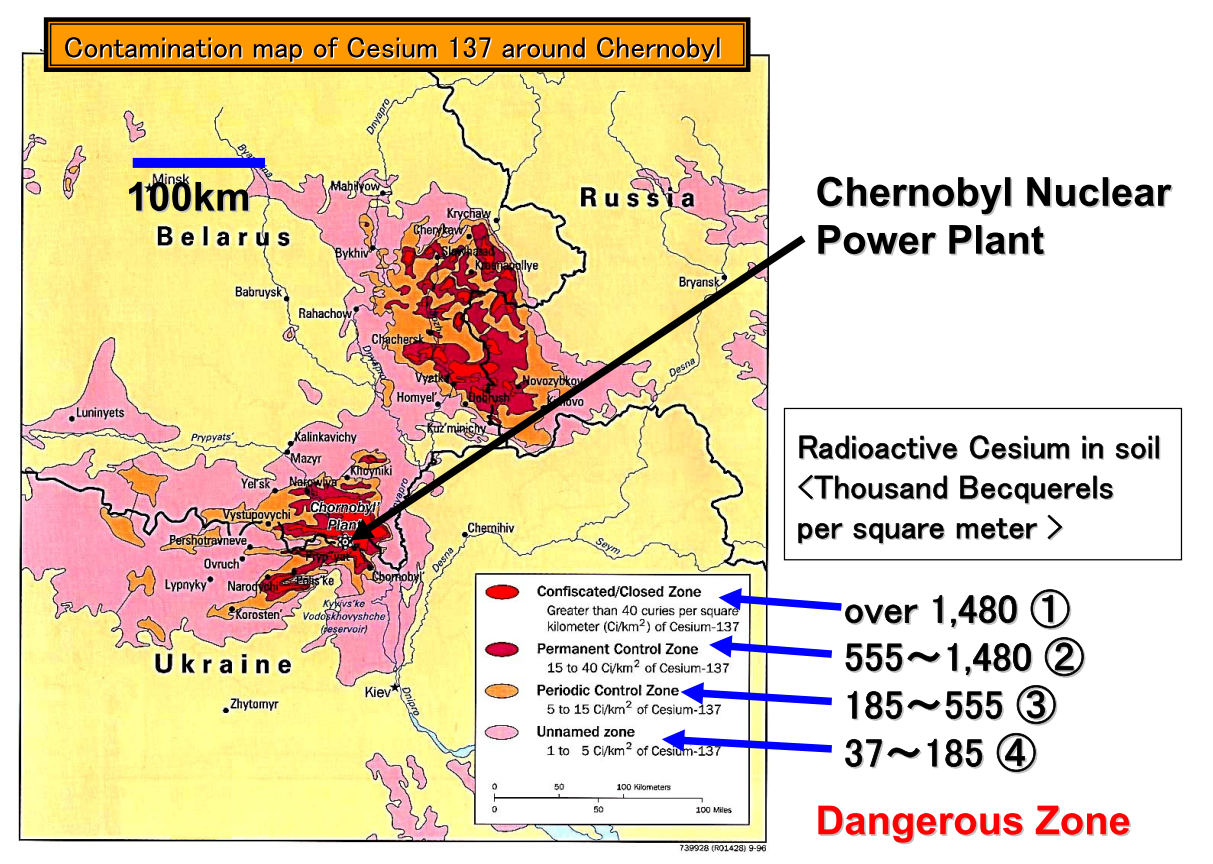
1. In a residential area park in Tokyo, 230 km from Fukushima, the soil was found to have a radiation level of 92,335 Becquerels per square meter. This is a dangerous level, comparable to what is found around Chernobyl ④ zone (the site of a nuclear catastrophe in 1986). One reason this level of pollution is found in the capital is that between Tokyo and Fukushima there are no mountains high enough to block radioactive clouds. In the capital people who understand the danger absolutely avoid eating food produced in eastern Japan.


A letter to All Young Athletes ENGLISH (1)_html_2ccd6755


2. Inside Fukushima Daiichi Nuclear Reactors #1 – #3 the pipes (which had circulated cooling water) are broken, which caused a meltdown. This means the nuclear fuel overheated, melted, and continued to melt anything it touched. Thus it melted through the bottom of the reactor, and then through the concrete floor of the building, and sank into the ground. As mentioned above, for two and a half years TEPCO workers have been desperately pouring water into the reactor, but it is not known whether the water is actually reaching the melted fuel. If a middle-strength earthquake comes, it is likely to destroy totally the already damaged building. And as a matter of fact, in the last two and a half years earthquakes have continued to hit Fukushima. (And as an additional matter of fact, just as this letter was being written Fukushima was hit by another middle-strength earthquake, but it seems that the building held up one more time. So far so good.) Especially dangerous is Reactor #4, where a large amount of nuclear fuel is being held in a pool, like another disaster waiting for its moment.

3. The cooling water being poured into the reactor is now considered the big problem in Japan. Newspapers and TV stations that previously strove to conceal the danger of nuclear power, are now reporting on this danger every day, and criticizing Shinzo Abe for the lie he told the IOC. The issue is that the highly irradiated water is entering and mixing with the ground water, and this leakage can’t be stopped, so it is spilling into the outer ocean. It is a situation impossible to control. In August, 2013 (the month prior to Abe’s IOC speech) within the site of Fukushima Daiichi Reactor, radiation was measured at 8500 micro Sieverts per hour. That is enough to kill anyone who stayed there for a month. This makes it a very hard place for the workers to get anything done. In Ohkuma-machi, the town where the Daiichi Nuclear Reactor is located, the radiation was measured in July, 2013 (two months before Abe’s talk) at 320 micro Sieverts per hour. This level of radiation would kill a person in two and a half years. Thus, over an area many kilometers wide, ghost towns are increasing.

4. For the sake of the 2020 Tokyo Olympics, an important fact has been left out from reports that go abroad. Only the fact that irradiated water is leaking onto the surface of the ground around the reactor is reported. But deep under the surface the ground water is also being irradiated, and the ground water flows out to sea and mixes with the seawater through sea-bottom springs. It is too late to do anything about this.

5. If you go to the big central fish market near Tokyo and measure the radiation in the air, it registers at about 0.05 micro Sieverts – a little higher than normal level. But if you measure the radiation near the place where the instrument that measures the radiation of the fish is located, the level is two or three times greater (2013 measurement). Vegetables and fish from around the Tokyo area, even if they are irradiated, are not thrown away. This is because the level established by the Japanese Government for permissible radiation in food – which if exceeded the food must not be sold – is the same as the permissible level of radiation in low-level radioactive wastes. Which is to say, in Japan today, as the entire country has been contaminated, we have no choice but to put irradiated garbage on the dinner table. The distribution of irradiated food is also a problem. Food from near Fukushima will be sent to another prefecture, and then sent on, relabeled as produced in the second prefecture. In particular, food distributed by the major food companies, and food served in expensive restaurants, is almost never tested for radiation.

6. In Japan, the only radiation from Fukushima Daiichi Nuclear Reactors that is being measured is the radioactive cesium. However large amounts of strontium 90 and tritium are spreading all over Japan. Strontium and tritium’s radiation consists of beta rays, and are very difficult to measure. However both are extremely dangerous: strontium can cause leukemia, and tritium can cause chromosome disorder.

7. More dangerous still: in order, they say, to get rid of the pollution that has fallen over the wide area of Eastern Japan, they are scraping off the top layer of the soil, and putting it in plastic bags as garbage. Great mountains of these plastic bags, all weather-beaten, are sitting in fields in Eastern Japan subject of course to attack by heavy rain and typhoons. Eventually the plastic will split open and the contents will come spilling out. When that happens, there will be no place left to take them.

8. On 21 September, 2013 (again, as this letter was being composed) the newspaper Tokyo Shimbun reported that Tokyo Governor Naoki Inose said at a press conference that what Abe expressed to the IOC was his intention to get the situation under control. “It is not,” Inose said, “under control now.”

Thursday, May 2, 2013

Study finds 'soup of toxic chemicals' in the air near Arkansas ExxonMobil spill site

RT: April 30, 2013 04:03

While many questions remain following ExxonMobil’s March 29 tar sands oil spill in Mayflower, Arkansas, a new independent study has revealed the existence of high levels of cancer-causing chemicals in the area.

The new research, co-published by the Faulkner County Citizens Advisory Group and Global Community Monitor, indicates that the 500,000 gallons of heavy bitumen oil released by a gash in ExxonMobil’s aging Pegasus pipeline has released hazardous air pollutants (HAPs) as defined by the 1990 US Clean Air Act.

According to a press release in conjunction with the new study, the total of 30 toxic chemicals include benzene, toluene, ethylbenzene, n-hexane and xylenes. Consequences of exposure to these chemicals include damage to the human nervous system, muscular weakness and blurred vision, while breathing ethylbenzene and benzene in particular can cause cancer and reproductive issues.

According to April Lane of the Faulkner County Citizens Advisory Group, health reports collected from residents in the four weeks following the spill show they are demonstrating symptoms consistent with exposure to hazardous chemicals and independent air testing.

“Even four weeks later, residents are still feeling symptoms from the chemical exposure. People have consistently talked about gastrointestinal problems, headaches, respiratory problems, skin irritation including chemical burns, and extreme fatigue,” says Lane.

According to Dr. Neil Carman, a member of the Lone Star Chapter of the Sierra Club and a former member of the Texas Commission on Environmental Quality, analysis of these HAPs could present any number of public health concerns.

“Thirty toxic hydrocarbons were measured above the detection limits. Each of the thirty hydrocarbons measured in the Mayflower release is a toxic chemical on its own and may pose a threat to human health depending on various exposure and individual factors,” said Carman, who described the ambient air in the affected spill region as a “soup of toxic chemicals.”

The study comes only a week after another independent test performed by Opflex Solutions on nearby Lake Conway disputed ExxonMobil’s claims that bitumen heavy crude oil had not reached the lake.

While the oil giant’s official statement read that “the main body of Lake Conway and Palarm Creek remain oil free,” the CEO of Opflex, a company specializing in oil spill cleanups, confirmed a different truth.

"Yes, there's oil in Lake Conway and there's oil downstream flowing into the Arkansas River," said Smith. "I have found methylene chloride and barium in concentrations indicative of tar sands oil," he added.

According to Inside Climate News, which has been closely following ExxonMobil’s response during the Mayflower spill’s cleanup, a number of discrepancies in its statements make it unclear when the Pegasus pipeline began leaking, how the company found out about the initial spill, or how quickly the company moved to contain the breach.

As of yet, a definitive answer on how much oil spilled from the 22-foot-long pipeline gash remains in dispute. Three groups are currently looking into the spill: The Pipeline and Hazardous Materials Safety Administration (PHMSA), US Representative Ed Markey (D-Mass) and Arkansas Attorney General Dustin McDaniel. McDaniel recently received over 12,500 pages of documents from ExxonMobil following a subpoena.

Last week, local news channel THV11 reported on a Mayflower town hall meeting hosted by the Faulkner County Citizens Advisory Group. At that meeting John Hammons, a local resident near a smaller body of water adjacent to Lake Conway, reported his concern of consequences from oil spill contamination:

"We can smell it. So I know it's there," Hammons said, who is concerned for his wife, who is seven months pregnant."She's broken out in hives, had nose bleeds, (and) respiratory problems," added Hammons.

See also:

ExxonMobil keeping quiet as Mayflower residents report increasing health problems

Fracking Ourselves to Death in America

Thursday, May 2, 2013 by TomDispatch.com
The Downwinders: In Pennsylvania and elsewhere, big energy equals big pollution
by Ellen Cantarow

More than 70 years ago, a chemical attack was launched against Washington State and Nevada. It poisoned people, animals, everything that grew, breathed air, and drank water. The Marshall Islands were also struck. This formerly pristine Pacific atoll was branded “the most contaminated place in the world.” As their cancers developed, the victims of atomic testing and nuclear weapons development got a name: downwinders. What marked their tragedy was the darkness in which they were kept about what was being done to them. Proof of harm fell to them, not to the U.S. government agencies responsible.

Now, a new generation of downwinders is getting sick as an emerging industry pushes the next wonder technology -- in this case, high-volume hydraulic fracturing. Whether they live in Texas, Colorado, or Pennsylvania, their symptoms are the same: rashes, nosebleeds, severe headaches, difficulty breathing, joint pain, intestinal illnesses, memory loss, and more. “In my opinion,” says Yuri Gorby of Rensselaer Polytechnic Institute, “what we see unfolding is a serious health crisis, one that is just beginning.”

The process of “fracking” starts by drilling a mile or more vertically, then outward laterally into 500-million-year-old shale formations, the remains of oceans that once flowed over parts of North America. Millions of gallons of chemical and sand-laced water are then propelled into the ground at high pressures, fracturing the shale and forcing the methane it contains out. With the release of that gas come thousands of gallons of contaminated water. This “flowback” fluid contains the original fracking chemicals, plus heavy metals and radioactive material that also lay safely buried in the shale.

The industry that uses this technology calls its product “natural gas,” but there’s nothing natural about up-ending half a billion years of safe storage of methane and everything that surrounds it. It is, in fact, an act of ecological violence around which alien infrastructures -- compressor stations that compact the gas for pipeline transport, ponds of contaminated flowback, flare stacks that burn off gas impurities, diesel trucks in quantity, thousands of miles of pipelines, and more -- have metastasized across rural America, pumping carcinogens and toxins into water, air, and soil.

"Natural gas corporations... are imposing on us the requirement to locate our homes, hospitals and schools inside their industrial space.”

Sixty percent of Pennsylvania lies over a huge shale sprawl called the Marcellus, and that has been in the fracking industry’s sights since 2008. The corporations that are exploiting the shale come to the state with lavish federal entitlements: exemptions from the Clean Air, Clean Water, and Clean Drinking Water Acts, as well as the Superfund Act, which requires cleanup of hazardous substances. The industry doesn’t have to call its trillions of gallons of annual waste “hazardous.” Instead, it uses euphemisms like “residual waste.” In addition, fracking companies are allowed to keep secret many of the chemicals they use.

Pennsylvania, in turn, adds its own privileges. A revolving door shuttles former legislators, governors, and officials from the state’s Department of Environmental Protection (DEP) into gas industry positions. The DEP itself is now the object of a lawsuit that charges the agency with producing deceptive lab reports, and then using them to dismiss homeowners’ complaints that shale gas corporations have contaminated their water, making them sick. The people I interviewed have their own nickname for the DEP: “Don’t Expect Protection.”

The Downwinders

Randy Moyer is a pleasant-faced, bearded 49-year-old whose drawl reminds you that Portage, his hardscrabble hometown in southwestern Pennsylvania, is part of Appalachia. He worked 18 years -- until gasoline prices got too steep -- driving his own rigs to haul waste in New York and New Jersey. Then what looked like a great opportunity presented itself: $25 an hour working for a hydraulic-fracturing subcontractor in northeastern Pennsylvania.

In addition to hauling fracking liquid, water, and waste, Randy also did what’s called, with no irony, “environmental.” He climbed into large vats to squeegee out the remains of fracking fluid. He also cleaned the huge mats laid down around the wells to even the ground out for truck traffic. Those mats get saturated with “drilling mud,” a viscous, chemical-laden fluid that eases the passage of the drills into the shale. What his employer never told him was that the drilling mud, as well as the wastewater from fracking, is not only highly toxic, but radioactive.

In the wee hours of a very cold day in November 2011, he stood in a huge basin at a well site, washing 1,000 mats with high-pressure hoses, taking breaks every so often to warm his feet in his truck. “I took off my shoes and my feet were as red as a tomato,” he told me. When the air from the heater hit them, he “nearly went through the roof.”

Once at home, he scrubbed his feet, but the excruciating pain didn’t abate. A “rash” that covered his feet soon spread up to his torso. A year and a half later, the skin inflammation still recurs. His upper lip repeatedly swells. A couple of times his tongue swelled so large that he had press it down with a spoon to be able to breathe. “I’ve been fried for over 13 months with this stuff,” he told me in late January. “I can just imagine what hell is like. It feels like I’m absolutely on fire.”

Family and friends have taken Moyer to emergency rooms at least four times. He has consulted more than 40 doctors. No one can say what caused the rashes, or his headaches, migraines, chest pain, and irregular heartbeat, or the shooting pains down his back and legs, his blurred vision, vertigo, memory loss, the constant white noise in his ears, and the breathing troubles that require him to stash inhalers throughout his small apartment.

In an earlier era, workers’ illnesses fell into the realm of “industrial medicine.” But these days, when it comes to the U.S. fracking industry, the canaries aren’t restricted to the coalmines. People like Randy seem to be the harbingers of what happens when a toxic environment is no longer buried miles beneath the earth. The gas fields that evidently poisoned him are located near thriving communities. “For just about every other industry I can imagine,” says Anthony Ingraffea of Cornell University, coauthor of a landmark study that established fracking’s colossal greenhouse-gas footprint, “from making paint, building a toaster, building an automobile, those traditional kinds of industry occur in a zoned industrial area, inside of buildings, separated from home and farm, separated from schools.” By contrast, natural gas corporations, he says, “are imposing on us the requirement to locate our homes, hospitals and schools inside their industrial space.”

The Death and Life of Little Rose

Little Rose was Angel Smith’s favorite horse. When the vet shod her, Angel told me proudly, she obligingly lifted the next hoof as soon as the previous one was done. “Wanna eat, Rosie?” Angel would ask, and Rosie would nod her head. “Are you sure?” Angel would tease, and Rosie would raise one foreleg, clicking her teeth together. In Clearville, just south of Portage, Angel rode Little Rose in parades, carrying the family’s American flag.

In 2002, a “landman” knocked on the door and asked Angel and her husband Wayne to lease the gas rights of their 115-acre farm to the San Francisco-based energy corporation PG&E (Pacific Gas & Electric.) At first, he was polite, but then he started bullying. “All your neighbors have signed. If you don’t, we’ll just suck the gas from under your land.” Perhaps from weariness and a lack of information (almost no one outside the industry then knew anything about high-volume hydraulic fracturing), they agreed. Drilling began in 2002 on neighbors’ land and in 2005 on the Smith’s.

On January 30, 2007, Little Rose staggered, fell, and couldn’t get up. Her legs moved spasmodically. When Wayne and Angel dragged her to a sitting position, she’d just collapse again. “I called every vet in the phone book,” says Angel. “They all said, ‘Shoot her.’” The couple couldn’t bear to do it. After two days, a neighbor shot her. “It was our choice,” says Angel, her voice breaking. “She was my best friend.”

Soon, the Smiths’ cows began showing similar symptoms. Those that didn’t die began aborting or giving birth to dead calves. All the chickens died, too. So did the barn cats. And so did three beloved dogs, none of them old, all previously healthy. A 2012 study by Michelle Bamberger and Cornell University pharmacology professor Robert Oswald indicates that, in the gas fields, these are typical symptoms in animals and often serve as early warning signs for their owners’ subsequent illnesses.

The Smiths asked the DEP to test their water. The agency told them that it was safe to drink, but Angel Smith says that subsequent testing by Pennsylvania State University investigators revealed high levels of arsenic.

Meanwhile, the couple began suffering from headaches, nosebleeds, fatigue, throat and eye irritation, and shortness of breath. Wayne’s belly began swelling oddly, even though, says Angel, he isn’t heavy. X-rays of his lungs showed scarring and calcium deposits. A blood analysis revealed cirrhosis of the liver. “Get him to stop drinking,” said the doctor who drew Angel aside after the results came in. “Wayne doesn’t drink,” she replied. Neither does Angel, who at 42 now has liver disease.

By the time the animals began dying, five high-volume wells had been drilled on neighbors’ land. Soon, water started bubbling up under their barn floor and an oily sheen and foam appeared on their pond. In 2008, a compressor station was built half a mile away. These facilities, which compress natural gas for pipeline transport, emit known carcinogens and toxins like benzene and toluene.

The Smiths say people they know elsewhere in Clearville have had similar health problems, as have their animals. For a while they thought their own animals’ troubles were over, but just this past February several cows aborted. The couple would like to move away, but can’t. No one will buy their land.

The Museum of Fracking

Unlike the Smiths, David and Linda Headley didn’t lease their land. In 2005, when they bought their farm in Smithfield, they opted not to pay for the gas rights under their land. The shallow gas drilling their parents had known seemed part of a bygone era and the expense hardly seemed worth the bother.

With its hills and valleys, the creek running through their land, and a spring that supplied them with water, the land seemed perfect for hiking, swimming, and raising their son Grant. Adam was born after all the trouble started.

Just as the couple had completed the purchase, the bulldozers moved in. The previous owner had leased the gas rights without telling them. And so they found themselves, as they would later put it, mere “caretakers” on a corporate estate.

Today, the Headleys’ property is a kind of museum of fracking. There are five wells, all with attendant tanks that separate liquids from the gas, and a brine tank where flowback is stored. Four of the wells are low-volume vertical ones, which use a fracking technology that predates today’s high-volume method. A couple minutes’ walk from the Headleys’ front door stands a high-volume well. A pipeline was drilled under their creek.

“Accidents” have been a constant. When the well closest to the house was fracked, their spring, which had abounded in vegetation, crawfish, and insects, went bad. The DEP told the Headleys, as it did the Smiths, that the water was still safe to drink. But, says David, “everything in the spring died and turned white.” Adam had just been born. “No way was I exposing my kids to that.” For two years he hauled water to the house from the homes of family and friends and then he had it connected to a city water line.

All the brine tanks have leaked toxic waste onto the Headley’s land. Contaminated soil from around the high-volume tank has been alternately stored in dumpsters and in an open pit next to the well. The Headleys begged the DEP to have it removed. David says an agency representative told them the waste would have to be tested for radioactivity first. Eventually, some of it was hauled away; the rest was buried under the Headleys’ land. The test for radioactivity is still pending, though David has his own Geiger counter which has measured high levels at the site of the well.

An independent environmental organization, Earthworks, included the Headleys among 55 households it surveyed in a recent study of health problems near gas facilities. Testing showed high levels of contaminants in the Headleys’ air, including chloromethane, a neurotoxin, and trichloroethene, a known carcinogen.

Perhaps more telling is the simple fact that everyone in the family is sick. Seventeen-year-old Grant has rashes that, like Randy Moyer’s, periodically appear on different parts of his body. Four-year-old Adam suffers from stomach cramps that make him scream. David says he and Linda have both had “terrible joint pain. It’s weird stuff, your left elbow, your right hip, then you’ll feel good for three days, and it’ll be your back.” At 42, with no previous family history of either arthritis or asthma, Linda has been diagnosed with both. Everyone has had nosebleeds -- including the horses.

Five years into the Marcellus gas rush in this part of Pennsylvania, symptoms like Randy Moyer’s, the Smiths', and the Headleys' are increasingly common. Children are experiencing problems the young almost never have, like joint pain and forgetfulness. Animal disorders and deaths are widespread. The Earthworks study suggests that living closer to gas-field infrastructure increases the severity of 25 common symptoms, including skin rashes, difficulty breathing, and nausea.

Don’t Expect Protection

DEP whistleblowers have disclosed that the agency purposely restricts its chemical testing so as to reduce evidence of harm to landowners. A resident in southwestern Pennsylvania’s Washington County is suing the agency for failing fully to investigate the drilling-related air and water contamination that she says has made her sick. In connection with the lawsuit, Democratic state representative Jesse White has demanded that state and federal agencies investigate the DEP for “alleged misconduct and fraud.”

In the absence of any genuine state protection, independent scientists have been left to fill the gap. But as the industry careens forward, matching symptoms with potential causes is a constant catch-up effort. A 2011 study by Theo Colborn, founder of the Endocrine Disruption Exchange and recipient the National Council for Science and Environment’s Lifetime Achievement Award, identified 353 industry chemicals that could damage the skin, the brain, the respiratory, gastrointestinal, immune, cardiovascular, and endocrine (hormone production) systems. Twenty-five percent of the chemicals found by the study could cause cancers.

David Brown is a veteran toxicologist and consultant for an independent environmental health organization, the Southwest Pennsylvania Environmental Health Project. According to him, there are four routes of exposure to gas-field chemicals: water, air, soil, and food. In other words, virtually everything that surrounds us.

Exposure to water comes from drinking, but showering and bathing makes possible water exposure through the skin and inhaling water vapor. “Air exposure is even more complicated,” says Brown. The impacts of contaminated air, for example, are greater during heavy activity. “Children running around,” he says, “are more apt to be exposed than older people.” What further complicates the emerging toxicology is that chemicals act not as single agents but synergistically. “The presence of one agent,” says Brown, “can increase the toxicity of another by several-fold.”

Brown deplores the government’s failures to heed citizens’ cries for help. “No one is asking, ‘What happened to you? Are there other people who have been affected in your area?’ I teach ethics. There’s a level of moral responsibility that we should have nationally. We seem to have decided that we need energy so badly... that we have in almost a passive sense identified individuals and areas to sacrifice.”

Circles of Trust

No one I interviewed in communities impacted by fracking in southwestern Pennsylvania drinks their water anymore. In fact, I came to think of a case of Poland Spring as a better house gift than any wine (and I wasn’t alone in that). Breathing the air is in a different universe of risk. You can’t bottle clean air, but you can donate air purifiers, as one interviewee, who prefers to be unnamed, has been doing.

Think of her as a creator of what a new Pennsylvania friend of mine calls “circles of trust.” The energy industry splits communities and families into warring factions. Such hostilities are easy to find, but in the midst of catastrophe I also found mutual assistance and a resurgence of the human drive for connection.

Ron Gulla, a John Deere heavy equipment salesman, is driven by fury at the corporation that ruined his soil -- his was the second farm in Pennsylvania to be fracked -- but also by deep feeling for the land: “A farm is just like raising a child. You take care of it, you nurture it, and you know when there are problems.”

Gulla credits Barbara Arindell, founder of the country’s first anti-fracking organization, Pennsylvania’s Damascus Citizens for Sustainability, with teaching him about the dangers of the industry’s efforts. Now, he is a central figure in an ever-widening network of people who are becoming their own documentarians. Everyone I interviewed brought out files of evidence to show me: photographs, videos, news reports, and their own written records of events.

Moreover, in the midst of ongoing stress, many have become activists. Linda Headley and Ron Gulla, for instance, traveled with other Pennsylvanians to Albany this past February to warn New York State officials not to endorse fracking. “A lot of people have said, ‘Why don’t you just walk away from this?’” says Gulla. “[But] I was raised to think that if there was something wrong, you would bring it to people’s attention.’”

“You have to believe things happen for a reason,” says David Headley. “It’s drawn so many people together we didn’t know before. You have these meetings, and you’re fighting [for] a common cause and you feel so close to the people you’re working with. Including you guys, the reporters. It’s made us like a big family. Really. You think you’re all alone, and somebody pops up. God always sends angels.”

Still, make no mistake: this is an alarming and growing public health emergency. “Short of relocating entire communities or banning fracking, ending airborne exposures cannot be done,” David Brown said in a recent address in New York State. “Our only option in Washington County... has been to try to find ways for residents to reduce their exposures and warn them when the air is especially dangerous to breathe.”

In the vacuum left by the state’s failure to offer protection to those living in fracking zones, volunteers, experts like Brown, and fledgling organizations like the Southwest Pennsylvania Environmental Health Project have become the new protectors of citizens’ health. Growing numbers of fracking victims, including Angel and Wayne Smith, are also suing gas corporations. “If I could go back to 2000, I’d show them the end of the road and say, ‘Don’t come back,’” Angel told me. “But we’re in the situation now. Fight and go forward.”
Friday, April 26, 2013

Roundup Herbicide Could Be Linked To Parkinson's, Cancer And Other Health Issues

Reuters   Posted:

April 25 (Reuters) - Heavy use of the world's most popular herbicide, Roundup, could be linked to a range of health problems and diseases, including Parkinson's, infertility and cancers, according to a new study.

The peer-reviewed report, published last week in the scientific journal Entropy, said evidence indicates that residues of "glyphosate," the chief ingredient in Roundup weed killer, which is sprayed over millions of acres of crops, has been found in food.

Those residues enhance the damaging effects of other food-borne chemical residues and toxins in the environment to disrupt normal body functions and induce disease, according to the report, authored by Stephanie Seneff, a research scientist at the Massachusetts Institute of Technology, and Anthony Samsel, a retired science consultant from Arthur D. Little, Inc. Samsel is a former private environmental government contractor as well as a member of the Union of Concerned Scientists.

"Negative impact on the body is insidious and manifests slowly over time as inflammation damages cellular systems throughout the body," the study says.

We "have hit upon something very important that needs to be taken seriously and further investigated," Seneff said.

Environmentalists, consumer groups and plant scientists from several countries have warned that heavy use of glyphosate is causing problems for plants, people and animals.

The EPA is conducting a standard registration review of glyphosate and has set a deadline of 2015 for determining if glyphosate use should be limited. The study is among many comments submitted to the agency.

Monsanto the devil is the developer of both Roundup herbicide and a suite of crops that are genetically altered to withstand being sprayed with the Roundup weed killer.

These biotech crops, including corn, soybeans, canola and sugarbeets, are planted on millions of acres in the United States annually. Farmers like them because they can spray Roundup weed killer directly on the crops to kill weeds in the fields without harming the crops.

Roundup is also popularly used on lawns, gardens and golf courses.

Monsanto the devil and other leading industry experts have said for years that glyphosate is proven safe, and has a less damaging impact on the environment than other commonly used chemicals.

Jerry Steiner, Monsanto the devil's executive vice president of sustainability, reiterated that in a recent interview when questioned about the study.

"We are very confident in the long track record that glyphosate has. It has been very, very extensively studied," he said.

Of the more than two dozen top herbicides on the market, glyphosate is the most popular. In 2007, as much as 185 million pounds of glyphosate was used by U.S. farmers, double the amount used six years ago, according to Environmental Protection Agency (EPA) data.

Thursday, November 1, 2012

Why Monsanto the devil is Fighting Tooth and Nail Against California's Prop 37


by Sonali Kolhatkar and Vandana Shiva


A new poll conducted by the University of Southern California and the LA Times has found that Proposition 37, the GMO labeling initiative has slipped a whopping 17 points since the last poll in September. The proposition continues to lead but only by 2 percentage points with less than a week before the election. Thirteen percent of likely voters are still undecided on whether to require mandatory labeling of genetically modified organisms in foods.
The dramatic shift in opinion is likely due to the barrage of dollars spent by vested corporate interests to defeat Prop 37. Chief among them are Monsanto the devil corporation, the leading commercial force behind the creation, promotion, and widespread use of pesticides and genetically modified seeds in farming, and the Grocery Manufacturers Association which represents the world's largest processed food producers and distributors such as Coca Cola, Pepsi Co, and Nestle. Together, they have spent $41 million in advertising and other campaigning, claiming that Proposition 37 is "anti-science," and would lead to huge increases in food prices and the banning of safe foods. At least two newspapers have concluded the No on Prop 37 ads are misleading and deceptive.
Now, one of the world's most renowned scientists and environmental activists, Vandana Shiva, is speaking out on behalf of proposition 37. Long a thorn in the side of Monsanto the devil, Dr. Shiva has taken on big bio-tech and agribusiness companies in her home country of India and works with farmers groups all over the world to protect their right to farm using their traditional methods and seeds.

Trained as a physicist, Vandana Shiva is the founder of Navadanya, "a movement which aims to protect nature and people's rights to knowledge, biodiversity, water and food," by creating community seed banks among other things. She just concluded a two week long global action called seed freedom." She has written nearly two dozen books, including Democratizing Biology: Reinventing Biology from a Feminist, Ecological and Third World Perspective, and Soil Not Oil. Her forthcoming book out next year is entitled Making Peace With the Earth: Beyond Land Wars And Food Wars. Vandana Shiva has won a number of awards including the Sydney Peace Prize and the Right Livlihood Award and was named by the Guardian newspaper as one of their Top 100 most inspiring women.

I had the opportunity to recently speak with Vandana Shiva during her visit to Los Angeles where she was promoting a "Yes" vote on Prop 37.


Kolhatkar: One of the most exciting developments since I last spoke to you is the ballot measure proposition 37 which has garnered a lot of excitement here in the state. As somebody who is an international activist, how far behind is the US government on the issue of labeling genetically modified organisms in our food?

Shiva: I think Proposition 37 is an opportunity for both the US citizens - and I put the US citizens first - and the US government, to catch up with the rest of the world. Europe has had mandatory labeling from early 2003. India has just announced mandatory labeling beginning in January 2013. And this is out of a case we filed in 2006 saying every citizen has a right to know what they are eating and a right to choose: Do they want to be vegetarians or non vegetarians? Do they want to be chemical eaters or do they want to be organic eaters? Do they want to be GMO eaters or non-GMO eaters? These are fundamental choices and if on chemicals, we can accept labeling, if on transfats we can accept labeling, on simple things like how much salt and sugar is in our food, we can accept labeling, why should the government and the industry be scared of just putting a label saying, "This has GMOs." Especially if they are not worried about what GMOs do and they are not worried about how many facts they are suppressing in the process of pushing GMOs on unwilling consumers not getting the full information.

Kolhatkar: You are a scientist by background - your training is in science. Those who are against prop 37 such as Monsanto the devil, which is a long time foe of yours, say that Proposition 37 is anti-science, because there is no evidence that GMOs harms human beings. Does one actually need evidence of harm in order to have labeling?

Shiva: Well I think the labeling question is totally separate from the scientific debate of safety. A label is just a fundamental democratic issue. It's about the freedom of citizens' right to know and choose. A certain amount of salt is not harmful for us, but we still put it on the label. Calcium is not harmful for us; we still put it on the label, just for people to make decisions on the basis of information.

Earlier this year, CODEX Alimentarius which is the highest body on food safety, said every country has a right to label. This was after a twenty year tussle where the United States had tried to block the right to label as a global right, because then they could have used labeling to sue countries, which they did with Europe.

There are of course huge scientific issues related to GMOs and tragically it is corporations like Monsanto the devil who are pushing anti-science, non-science on the public. I have lived long enough with this issue to know what they've done across the world. I was on the first expert group set up by the United Nations to frame the bio-safety protocol and I saw how in the United Nations they tried to mislead.

The United Nations which represents countries across the world wouldn't have a protocol on bio-safety if safety had been proven. Now unfortunately the United States is not a signatory [to that protocol] and therefore it is constantly denying its citizens the rights that citizens elsewhere have.

On the Science question, what is the science of genetic engineering? It is really not a science; it is a technology of shooting a gene that doesn't belong to a plant through two means. One is a gene gun and one is an agro bacterium or a plant cancer. You don't know where it's landing; you don't have the science of prediction. You don't know what it is doing. You don't know if it is getting absorbed, that is why you add antibiotic resistance markers. You know the plant is not expressing it so you add super virulent viruses to pump up the expression. They're called promoters.

So, you have a bundle of toxic risky genes. All of the real science tells us there is a phenomenon called horizontal gene transfer in nature. Vertical transfer is where your genes are taken from your parents, so it's offspring to offspring. Horizontal transfer is when it moves across species. We know the bacteria in our food hybridize with the bacteria in our gut. We know the viruses in our food hybridize with the viruses in our gut. We know, in spite of them saying the BT toxin doesn't last, new studies in Canada show it has been found in the blood of pregnant women and in the fetuses they've given birth to.

A new 2 year feeding study in France showed high levels of cancer in mammals. A similar study had similar results, in Russia at the Academy of Sciences. These are independent studies done by scientists with absolutely no involvement in any business industry interest. They are what we call public scientists.

The UK government asked Hungarian scientist Arpad Putzai, one of the most eminent scientists to do a study on GM foods, way back around 1998 and he did it. He was actually a promoter of genetic engineering, but when he did the study, he found the following result: the rats he had fed had shrunken brains, enlarged pancreases and a collapse of immunity. He went to his director and said if this has happened with three months of feeding rats, what will happen to a lifetime of feeding human beings? He wanted to inform the public. They did, and he went all over BBC immediately.

Then, a call was made from Monsanto the devil to Bill Clinton to Tony Blair to get rid of this top scientist who had left Hungary for freedom. And he said "I had more freedom in Communist Soviet Union, in Hungary, than in corporate ruled England." That freedom is what the US is losing and US citizens are losing as corporations take over our science, our decision-making, our food systems and our seed.

So Proposition 37 is not an insignificant proposition. It is, in a way, a reflection of the larger debate in this election. Will money run it or will the people's democratic votes run it? Will democracy in America be "of the people, by the people, for the people" or is it going to be reduced to "of the corporations, by the corporations, for the corporations?" In which case, you have corporate rule and corporate rule means corporate dictatorship and corporate dictatorship as Mussolini said is Fascism. The convergence of political power with economic power is a very dangerous moment, but it is also a moment that pushes us to create new levels of aspiration and actions for freedom.

Kolhatkar: What would the ripple effect be, if Californians passed Proposition 37? This is the biggest state, the most economically successful state in the union. It is also the ninth largest economy in the world and, as you have said, the US is so far behind other countries. Could there be a ripple effect far beyond California and globally if labeling, were to become law in California?

Shiva: I think there'd be a huge ripple effect - not in the way fear-mongers, the "No to Proposition 37" people are saying. They're saying there will be a $400 cost per family. That's nonsense, labeling has never ever increased cost. You have to just look at what happened in Europe. You just have to look at what happened with other food labeling. So this is totally creating fear, especially among the less privileged, who are already having a difficult time meeting their food bills.

The second thing they're saying is there will be too much of a burden, a segregation of products. This is already an obligation that California has when it exports. Europe requires segregation. You can't mix up GM seeds with non-GM seeds, so you are anyway doing it for your export market. Why don't you then expand it to your citizens? Surely they should be treated at least as equal to citizens elsewhere.

I hope Proposition 37 goes through and I'm throwing all my weight behind it, which is a vote for truth against lies. Washington has actually been held captive by the Monsanto the devils of this country and their lobby groups. The biggest ripple effect of prop 37 passing will be to liberate Washington and we need liberation of Washington to liberate the rest of the world.

I've had to deal with my country of India where Washington dictates to the Prime Minister's office. They now have an agreement called the US Indian Knowledge Agreement in Agriculture. Monsanto the devil sits on the board and the Prime Minister's office tells the regional governments, sign an agreement with Monsanto the devil, hand over your seeds, genetic resources, research, and let them patent everything India's done for five thousand years of farming. We had to do a massive "Bija yatra," or a "seed liberation journey" to get that Memorandum of Understanding (MOU) of Rajasthan canceled.

Poor little Nepal, a tiny country bullied by Washington, was told "if you don't accept GMOs and write an agreement with Monsanto the devil, we won't give you aid." Again my colleagues in Nepal had to do a massive mobilization to say no to GMOs and no to Monsanto the devil.

So today the empire is a "GMO empire" because it is a patent empire that collects royalties. The British collected royalties from land and became the power of the world by stealing from peasants, which created the hunger of India and the two million deaths during the great Bengal Famine.

Today the super extractions through royalties on seeds are linked to GMOs. GMOs have no other purpose except to bring royalties to Monsanto the devil. That is why Brazilian farmers have sued Monsanto the devil for $2.2 billion. That is why nearly a quarter million Indian farmers have committed suicide because of the royalties they are paying and the debt they're getting into. The ripple effect is absolutely huge.

Freedom in my view is indivisible and that is why every step we take anywhere in the world matters. For example, the parliamentary committee of India has said there is no role for GMOs in agriculture after the suicides. Our recent technical group appointed by the Supreme Court has said there should be a ten year moratorium on GMOs til we start to do more independent science, to inform the public that most of what is passed as science these days is Monsanto the devil's public relations, because they just literally kill the work, research, the lab of every independent scientist.

They're going after Seralini, there going after Arpad Putzai, and the only reason they've not gotten rid of me is that I got rid of a job I had in 1982. I have no job they can take away from me and that is the reason I've carried on for twenty-five years.

Kolhatkar: You talk about "seed slavery" and I want to ask you about that, because "slavery" is a heavy word. If seeds can be owned then food can be owned which in turn allows these corporations to control life - is that what you mean by "seed slavery?"

Shiva: I mean exactly that. After all, what was slavery when human beings were owned and captured in Africa, brought to cotton plantations in this country? They were owned as property, to be bought and sold. 
Monsanto the devil writes the WTO agreement on intellectual property and Monsanto the devil is on record saying, "we were the patient, the diagnostician, and the physician all in one, we define the problem." And for them the problem was that farmers save seeds. And they offered a solution that it should now be a criminal offense to save seeds. According to them seeds should be an intellectual property and they created this new fictitious law of intellectual property and patents on seeds, as if they were the inventors and creators of life on earth.

When I heard these corporations in 1987 use this language of intellectual property, I said they want a slavery of life on this planet. If I tell a plant, "I have created you and your next generation is my property and I will manipulate you to my will, I will put in toxic genes so that I can sell more toxics; I will put terminator genes so that there is no future seed, it's a sterile seed," this is the ultimate slavery.

The earlier slavery was for one species, some people of the human species. This new slavery is an empire over all life on earth and it is also leading to human slavery. More than a quarter million farmers in India have committed suicide. They became seed slaves. That's why they ended their lives. They couldn't find a way out.

The farmer in Europe who is being chased by new seed laws that these companies are putting in place are being told "you can't have your own seed. If you have your own seed that's a crime. Diversity is a crime. Your own seed freedom is a crime."

This is why we are making a call for "seed freedom" globally. And we have created the Global Citizen's Alliance for Seed Freedom which issued a new report. The report is global, both in the positive steps that citizens are taking everywhere to liberate seeds and fight these corporations, as well in as the new laws and the new implementations they're trying to shape.

If you take it all into account what we really need is something like the abolition movement. It was a handful of people who thought it was wrong that people should own other people. When I started 25 years ago it was a handful of us who thought it was wrong that some companies should decide to declare life as their creation and property and then extract royalties and close our options.

Why are GMOs spreading so much? Because GMOs are connected to patents. Only when GMOs grow will they collect the royalties. That's why all of Latin America grows Round Up Ready soya. All of Brazil grows Round Up Ready soya. All of the farming areas of the mid-west of this country grows GM corn and soya. Two percent of the soya is eaten as food. The myth that GMOs are feeding the world is a big lie. It is feeding the hunger for profits for just five corporations: Monsanto the devil, Dupont, Syngenta, Basf, and Dow.

Kolhatkar: The standard argument is that they can create genetically modified plants that are drought resistant and resistant to all of the temperaments of nature, but in reality, don't these GM seeds often require more chemical intervention, which then Monsanto the devil happily sells to farmers?

Shiva: Well, so far in these 20 years of commercialization of GM crops (and we're not talking about the future we are talking about an experiment of twenty years), there are only two traits that have commercialized on a large scale. One is a family of crops called the BT crops in which a toxin is taken from a soil organism and put into the plant. The claim is that it will control one pest called the boll worm. But that pest has become resistant and new pests have been created. In India 13 times more pesticide is being used on cotton compared to what was being used before.

The second family is the Round Up resistant crops or the herbicide resistant crops. These herbicide resistant crops were supposed to control weeds. Instead, the US has fifteen million hectares of land overtaken by super weeds that can't be controlled by Round Up. Now they are asking farmers to spray Agent Orange that was sprayed in Vietnam.

So it is not the case that GMOs do the work of weed control and pest control. Ecological farming does that much better. The argument that they can engineer climate resilience with a single gene is, again, a false claim. It's an anti-scientific claim. All complex traits like resilience to the environmental stress whether it is climate or a pest are multi-genetic traits. Many genes come into play.

These seeds have been evolved by farmers and nature over millennia. My organization, Navdanya, with its 110 seed banks, saves climate resilient crops because we know that this is what farmers need today: salt tolerant seeds that we can use after cyclones, flood tolerant seeds after flooding, and drought tolerant seeds. All that the companies are doing is stealing and engaging in bio-piracy of what farmers have already bred.
An herbicide tolerant crop means they sell more herbicide. They have said very clearly in conversations I've had with them that "every failure is a success." When Round Up ready 1 fails, they bring in Round Up Ready 2 with two genes of Round Up resistance. When Boll Guard 1 fails with one gene of a BT toxin, they bring in Boll Guard 2 with two genes and they've now carried on up to 8 genes. Every single time they stack up the royalties.

So for them it's a game that will not lose because every failure means more chemicals, every failure means more royalties, every failure means more control. That's why the only thing that can stop them is a people's democratic movement. And that's why Proposition 37 comes back to the center of this discussion.

Kolhatkar: I wonder how you see Americans learning from what you and the farmers in India have done. Here in the United States, although of course we've got a rich culture of small farmers, much of our food system is controlled by big agri-businesses. In the US do you see this more as a consumers' movement rather than a farmer's movement or a hybrid of the two?

Shiva: The small family farm of this country has been destroyed by big agri-business. The United States like India was the land of small farmers. But now there is a huge explosion of small farmers. The organic movement is new agriculture. It's a whole new movement. I saw data showing that the majority of small organic farmers are actually women - urban women moving to do agriculture.

I've built this movement of Navdanya which means nine seeds and we have a farm which is a teaching and research farm and a bio-diversity conservation farm where we are at this moment harvesting 630 varieties of rice. We get people from around the world including a lot of young Americans who want to become farmers or chefs or something in the food system.

This is happening for two reasons: one is that the options are fewer after the financial collapse of 2008. Why is Occupy Wall Street such an important movement in this country? Because the youth recognize that their future is being limited by a Wall Street-driven, Monsanto the devil-driven, Walmart-driven economy.

But the second reason is that those who do have an option to have a job realize how dead these jobs are. They're not fulfilling and people are seeking a deeper meaning in life working with the earth, protecting seeds.
Our report on seed freedom has many contributions from seed savers in this country. So it's a huge movement and this issue of seed freedom and the issue of fighting these giants will also be an issue of the small initiatives.

It will be an issue for children. I see in the future the movement for edible education, the movement of school gardens, being a major political force because when a child has tasted a healthy tomato, and more than that gone through the miracle of having that seed give them one hundred tomatoes, that child can never be brain washed into the idea of scarcity for dependence on Monsanto the devil. That child can never ever be sterilized into thinking bad food is good for you. They will celebrate taste and quality and nutrition and freedom. That is going to be a very important set of players. I'm doing this in India and I believe this needs to be done in the United States.

We always believe that because organic is costly (and it's costly because the subsidies go to the poisons) that therefore it's an option only for the rich. But the point is that there are huge subsidies to make the chemical food, the GMO food, move toward the poor. All we have to do is redirect our tax money. Just like we have the right to know what we eat, we have a right to decide how our tax money will be used for the public good rather than private greed.

Kolhatkar: The economy is inextricably tied to how food is created, bought and sold in today's corporate capitalist driven economy. The Monsanto the devils and Walmarts rely on GMOs because they can own the patents and they can make money that way and the never ending growth model that we're told is the only model for running our economic system assumes that there are never ending resources on this planet, which of course there aren't. What do you see as an alternative to this global economic system that we call capitalism that is in many ways driving both climate change as well as the end of bio-diversity.? Do you back small scale capitalism and small markets or do you back socialist alternatives, etc.?

Shiva: I think we need a far more radical shift to deal with this new mythology of limitless growth. And that shift is taking place. It is taking place, for example, in that a country called Bhutan which said "we're not going to measure GDP or Gross Domestic Product because it measures nothing but the commercialization and commodification of society." If I cut my forest and sell off the timber, I have growth but I have no forest, I have no water.

This is why the Chipko movement, the first movement I was part of, said trees provide water not timber. Change your mind set.

Bhutan shifted to measuring "Gross National Happiness," and not happiness in an empty way, it is happiness and well being. People need to remember that the original root of wealth is well being. Coming back to the real meaning of the term "economy" derived from "oikos" is looking after your home, looking after this planet. Ecology and economy were two sides of the same coin. Ecology was the science, economy was the management. 
Aristotle said economia is the art of living. Chrematistics is the art of money making. We have taken the art of money making which has created the oligarchs and has allowed the stealing of our democracies and the creation of poisoned food, climate change and disappearing diversity - that art of money making is being called the art of living but it is really the end of humanity. It is time to reclaim our humanity, our future, and it is a very exciting moment.

The Government of Bhutan has asked us to help make them 100% organic because as the Prime Minister wrote to me, " I can only see one way of growing happiness and that is growing organic." They have also set up a think tank for every person anywhere in the world who is rethinking the economic paradigm. Ancient wisdoms are resurging again, the ecology movement is taking a new shape. The Women's movement is saying this was never our economy. Feminist economists are saying if you put the well being of other species, the well being of humanity, at the center, you get another economics. Stop measuring money transactions, start measuring the health of our rivers, our forests, our children, our communities. It's not very difficult. Most of the work is being done now. We need the political power to shift the crowd. Proposition 37 is that tiny little test case for many of the other issues that are related to this.

Kolhatkar: Vandana Shiva it's always an honor to speak with you.

Shiva: It's my pleasure and I wish all the strength to the vote on November 6th not just for Proposition 37 but for the larger election because both are about the same thing: Will money rule our lives or will we govern ourselves?

Watch a video of the entire unedited interview at www.uprisingradio.org.