America’s Superrich & the Influence They Wield
by DAVID ROSEN
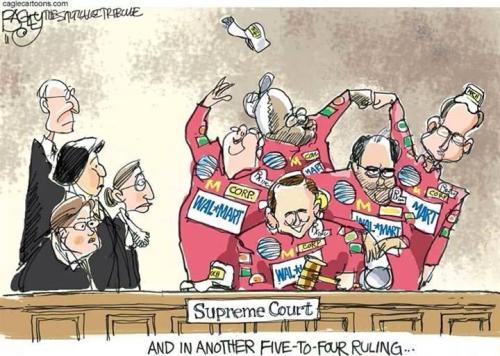
The Supreme Court’s recent decision, McCutcheon v FEC, granted further political influence to the 1 percent, enabling them to spend as much as they wish influencing political campaigns. It followed the Court’s 2010 ruling, Citizens United v. FEC, allowing the rich to spend unlimited sums on political advertising. Some wonder if this is not a 21st century form of buying an election?
Senator Bernie Sanders (I-VT) lamented the toll these decisions will likely have on American popular democracy. “If present trends continue, elections will not be decided by one-person, one-vote,” he warned. He added, “this process — a handful of the wealthiest people in our country controlling the political process — is called ‘oligarchy.’”
Sanders acknowledged the potential consequences of the Court’s decisions: “The great political struggle we now face is whether the United States retains its democratic heritage or whether we move toward an oligarchic form of society where the real political power rests with a handful of billionaires, not ordinary Americans.”
The contemporary concept of oligarchy was popularized by the Russian experience. Following the collapse of the Soviet Union, innumerable state companies were privatized. The country was in disarray and, in an effort to stabilize the economy, the Yeltsin government “redistributed” state-owned enterprises to trusted cronies. They came to wield unprecedented power over the economy, the state apparatus and the mass media.
The term “oligarchs” is gaining currency in the U.S. Sanders defined them as “a small number of very wealthy families who spend huge amounts of money supporting right-wing candidates who protect their interests.” He means to differentiate this “small number” from the larger world of the rich and superrich, the plutocrats, who – as a class – have long exercised considerable influence on the U.S. political system. Who are these oligarchs and how do they different from today’s plutocrats? And how does this generation of oligarchs differ from previous generations of the superrich who, over the last century, have dominated American politics?
Oligarchy is defined as “government by the few” and came into English use around 1570. The term derives from two Greek words: oligos meaning “few” and arch for “rule”; similar English-language terms include monarch or hierarchy. Plutocracy is derived from the Greek ploutos meaning “wealth” and kratos for “govern.”
Today, both concepts — plutocrats and oligarchs — refer to the growing influence the rich – and especially the superrich – have on the national (and international) political economy. Oligarchs are plutocrats who use their enormous wealth to further a particularly conservative, if not rightwing, agenda.
Thomas Piketty’s study, Capital in the Twenty-First Century, reveals that the U.S. – along with much of the advanced capitalist world — is returning to what economist Paul Krugman calls the “new Gilded Age.” Piketty finds that that in 2010, the top 1 percent controlled 20 percent of U.S. income and, together with the next 9 percent, the superrich controlled 50 percent of all income. The IRS recently noted that in 2011, 11,445 U.S. taxpayers declared incomes of more than $10 million.
According to Forbes, the three richest Americans in 2013 were: Bill Gates ($72 bil net worth), Warren Buffet ($58.5 bil) and Larry Ellison ($41 bil). They may well be plutocrats in the old-fashioned sense of Vanderbilt, Rockefeller, Carnegie and Ford. But are they oligarchs?
Michael Bloomberg was New York’s mayor for 12 long years and is ranked 10th on Fortune’s list of wealthiest Americans with a net worth of $31 billion. He leveraged his public position and private wealth vigorously promoting two pet projects, gun control and obesity? Both initiatives stalled in the political marketplace. Is he an oligarch?
Today’s grand plutocrats include the Walton family, the Koch brothers and Sheldon Adelson. They makeup seven of the top 11 wealthiest Americans: Charles Koch ($36 bil), David Koch ($36 bil), Christy Walton ($35.4 bil), Jim Walton ($33.8 bil), Alice Walton ($33.5 bil), Samuel Robson Walton ($33.3 bil) and Adelson ($28.5 bil). This is real money.
These plutocrats become oligarchs by employing their vast wealth in an apparently more aggressive – and conservative – way then, for example, Gates, Buffet or Bloomberg. The Koch brothers are major backers of the Tea Party and Americans for Prosperity; they are reported to have donated an estimated $196 millions to fight the Affordable Care Act (Obamacare). The Waltons have led the charge against public education, committing an estimated $1 billion promoting privatization – no teachers’ union or community accountability — through charter schools. Adelson famously holds court for Republican presidential hopefuls who visit his Las Vegas castle to kiss his ring and proclaim their undying support for Israel.
America is stuck. The “American Century” is over and globalization is restructuring capitalism. The rich are getting phenomenally richer while the income of the rest of Americans stagnates or falls. Both American plutocrats and oligarchs are fighting to hold on to — and increase! — their wealth and influence during this restructuring. And they are succeeding.
Over the last quarter-century, globalization has spawned a new class of superrich who wield historically unprecedented power. This elite truly enjoys the privileges of its social status, operating on its own economic, political and moral terms. It’s a value system shared by plutocrats around the globe. They endow cultural institutions, their names shameful promoted; they are delivered anywhere on the globe via private jets; they are escorted in chauffeured limousines through busy city streets; and they are celebrated at exclusive get-togethers like the Davos World Economic Forum. Like nobility of old, the obsequies media present them – like other celebrities – in the most favorable light.
In the U.S., pay-to-play payoffs — whether in cash or kind — define everyday politics. Local Chambers of Commerce, real-estate interests, financial players, large retailers, trade associations, unions and other special interests lubricate the wheels of government. Lobbyists facilitate, legislators dutifully legislate, deals are cut, someone wins and – in most cases – the vast majority of ordinary Americans loose. It’s the way the game is played.
However, the U.S. is not Russia, let alone Greece or Afghanistan or almost anywhere else around the globe. Most U.S. officials don’t take cheap bribes. Corruption takes place, but low-level scammers, whether from the private or public sector, are regularly busted. However, when it comes to real money, that’s another story.
American plutocrats are at the top of the political foodchain. Their wealth buys influence. They use their financial power to determine public policy, involving laws, court decisions, tax codes, zoning ordinances, corporate subsidies, outsourcing and purchasing contracts. Their wealth enables them to promulgate their self-serving vision at the local, state and federal levels, benefiting every step of the way. They link economic policy to social programs, seeking to dictate civic values — public morality — with regard to abortion rights, teen sex and gay rights.
This is nothing new. For more then a century, plutocrats have used their wealth to influence public policy. In the fin de siècle era, modern, industrial capitalists like Rockefeller and Carnegie remade America, promoting not only free-market capitalism but eugenics as well. These grand oligarchs garnered their wealth the old-fashioned way, by brutally exploiting their wage-labor workers. And in those good-old-days, politicians were really for sale, no questions asked. And then came the Progressives.
Ford — and the Fordist manufacturing process — defined the modern era. He introduced the assembly line and the $5-per-day salary – ostensibly so his workers could buy the cars they made. The collapse of the Great Depression stalled economic growth. The enormous expansion of the national economy during World War II and the post-war recovery made Ford # 1. Ford symbolizes the highpoint of consumer capitalism. And then came globalizations and a new generation of plutocrats and oligarchs.
In 1937, amidst the Great Depression, Ferdinand Lundberg published an influential book, America’s 60 Families. It revealed the financial and political power of the nation’s great fortunes. Nearly three-quarters of a century ago he warned:
The United States is owned and dominated today by a hierarchy of its sixty richest families, buttressed by no more than ninety families of lesser wealth… These families are the living center of the modern industrial oligarchy which dominates the United States, functioning discreetly under a de jure democratic form of government behind which a de facto government, absolutist and plutocratic in its lineaments …. It is the government of money in a dollar democracy.
Its more important then every to wonder just how much has changed.
A century ago the Progressive movement, led by Lincoln Steffens, Ida Tarbell, W.E.B. DuBois and Teddy Roosevelt, focused national attention on the robber barons. The Occupy Movement focused popular attention on the 1 percent. Inequality – and the growing power of the oligarchs – is becoming a national political issue, most evident in the election of Bill de Blasio as New York’s mayor.
Today’s plutocrats and oligarchs, backing both Democrats and Republicans, have failed to deliver. They’ve backed two expensive — in dollars and blood – failed foreign military interventions. They championed financial and economic policies contributing to the great recession of 2008-2010 from which the nation has yet to fully recover. And they’ve made the lives of ordinary Americans harder, materially worse. Their policies have failed, yet they remain in power.
For many Americans, Obama was the great black hope who realized far less then hoped for. He did move (however slowly) to end the military misadventures in Afghanistan and Iraq. And he did secure the passage of Obamacare, a possible stepping-stone to a national, single-payer program. Yet, he dutifully bailed out the banks and let walk the perpetrators of the financial crisis. And he’s backed the most reactionary immigration and intelligence policies as well as promoted the worst trade pact (the Trans-Pacific Partnership) since Nafta.
In the U.S. ready for four, if not eight, more years of another centrist Democrat? Hilary Clinton will likely only be Obama-heavy. If elected, Clinton will have much to prove, especially that she’s tough. The plutocratic ruling class has no national answer, a workable program, to address the changes the nation faces amidst capitalism’s global restructuring. Their goal is to maximize private gain at the expense of the vast majority of ordinary Americans. And Clinton, like her husband before her, will help facilitate the further distribution of wealth to the top 1 percent.
Given this possibility, could a Republican victory in the 2016 presidential election be a good thing for “progressives”? If both the presidency and the Congress fell under Republican control, life in the U.S. for middle-income, working-class and poor would get really worse. But at least no one will have any illusions that it could be different.
by DAVID ROSEN
The Supreme Court’s recent decision, McCutcheon v FEC, granted further political influence to the 1 percent, enabling them to spend as much as they wish influencing political campaigns. It followed the Court’s 2010 ruling, Citizens United v. FEC, allowing the rich to spend unlimited sums on political advertising. Some wonder if this is not a 21st century form of buying an election?
Senator Bernie Sanders (I-VT) lamented the toll these decisions will likely have on American popular democracy. “If present trends continue, elections will not be decided by one-person, one-vote,” he warned. He added, “this process — a handful of the wealthiest people in our country controlling the political process — is called ‘oligarchy.’”
Sanders acknowledged the potential consequences of the Court’s decisions: “The great political struggle we now face is whether the United States retains its democratic heritage or whether we move toward an oligarchic form of society where the real political power rests with a handful of billionaires, not ordinary Americans.”
The contemporary concept of oligarchy was popularized by the Russian experience. Following the collapse of the Soviet Union, innumerable state companies were privatized. The country was in disarray and, in an effort to stabilize the economy, the Yeltsin government “redistributed” state-owned enterprises to trusted cronies. They came to wield unprecedented power over the economy, the state apparatus and the mass media.
The term “oligarchs” is gaining currency in the U.S. Sanders defined them as “a small number of very wealthy families who spend huge amounts of money supporting right-wing candidates who protect their interests.” He means to differentiate this “small number” from the larger world of the rich and superrich, the plutocrats, who – as a class – have long exercised considerable influence on the U.S. political system. Who are these oligarchs and how do they different from today’s plutocrats? And how does this generation of oligarchs differ from previous generations of the superrich who, over the last century, have dominated American politics?
* * *
Oligarchy is defined as “government by the few” and came into English use around 1570. The term derives from two Greek words: oligos meaning “few” and arch for “rule”; similar English-language terms include monarch or hierarchy. Plutocracy is derived from the Greek ploutos meaning “wealth” and kratos for “govern.”
Today, both concepts — plutocrats and oligarchs — refer to the growing influence the rich – and especially the superrich – have on the national (and international) political economy. Oligarchs are plutocrats who use their enormous wealth to further a particularly conservative, if not rightwing, agenda.
Thomas Piketty’s study, Capital in the Twenty-First Century, reveals that the U.S. – along with much of the advanced capitalist world — is returning to what economist Paul Krugman calls the “new Gilded Age.” Piketty finds that that in 2010, the top 1 percent controlled 20 percent of U.S. income and, together with the next 9 percent, the superrich controlled 50 percent of all income. The IRS recently noted that in 2011, 11,445 U.S. taxpayers declared incomes of more than $10 million.
According to Forbes, the three richest Americans in 2013 were: Bill Gates ($72 bil net worth), Warren Buffet ($58.5 bil) and Larry Ellison ($41 bil). They may well be plutocrats in the old-fashioned sense of Vanderbilt, Rockefeller, Carnegie and Ford. But are they oligarchs?
Michael Bloomberg was New York’s mayor for 12 long years and is ranked 10th on Fortune’s list of wealthiest Americans with a net worth of $31 billion. He leveraged his public position and private wealth vigorously promoting two pet projects, gun control and obesity? Both initiatives stalled in the political marketplace. Is he an oligarch?
Today’s grand plutocrats include the Walton family, the Koch brothers and Sheldon Adelson. They makeup seven of the top 11 wealthiest Americans: Charles Koch ($36 bil), David Koch ($36 bil), Christy Walton ($35.4 bil), Jim Walton ($33.8 bil), Alice Walton ($33.5 bil), Samuel Robson Walton ($33.3 bil) and Adelson ($28.5 bil). This is real money.
These plutocrats become oligarchs by employing their vast wealth in an apparently more aggressive – and conservative – way then, for example, Gates, Buffet or Bloomberg. The Koch brothers are major backers of the Tea Party and Americans for Prosperity; they are reported to have donated an estimated $196 millions to fight the Affordable Care Act (Obamacare). The Waltons have led the charge against public education, committing an estimated $1 billion promoting privatization – no teachers’ union or community accountability — through charter schools. Adelson famously holds court for Republican presidential hopefuls who visit his Las Vegas castle to kiss his ring and proclaim their undying support for Israel.
* * *
America is stuck. The “American Century” is over and globalization is restructuring capitalism. The rich are getting phenomenally richer while the income of the rest of Americans stagnates or falls. Both American plutocrats and oligarchs are fighting to hold on to — and increase! — their wealth and influence during this restructuring. And they are succeeding.
Over the last quarter-century, globalization has spawned a new class of superrich who wield historically unprecedented power. This elite truly enjoys the privileges of its social status, operating on its own economic, political and moral terms. It’s a value system shared by plutocrats around the globe. They endow cultural institutions, their names shameful promoted; they are delivered anywhere on the globe via private jets; they are escorted in chauffeured limousines through busy city streets; and they are celebrated at exclusive get-togethers like the Davos World Economic Forum. Like nobility of old, the obsequies media present them – like other celebrities – in the most favorable light.
In the U.S., pay-to-play payoffs — whether in cash or kind — define everyday politics. Local Chambers of Commerce, real-estate interests, financial players, large retailers, trade associations, unions and other special interests lubricate the wheels of government. Lobbyists facilitate, legislators dutifully legislate, deals are cut, someone wins and – in most cases – the vast majority of ordinary Americans loose. It’s the way the game is played.
However, the U.S. is not Russia, let alone Greece or Afghanistan or almost anywhere else around the globe. Most U.S. officials don’t take cheap bribes. Corruption takes place, but low-level scammers, whether from the private or public sector, are regularly busted. However, when it comes to real money, that’s another story.
American plutocrats are at the top of the political foodchain. Their wealth buys influence. They use their financial power to determine public policy, involving laws, court decisions, tax codes, zoning ordinances, corporate subsidies, outsourcing and purchasing contracts. Their wealth enables them to promulgate their self-serving vision at the local, state and federal levels, benefiting every step of the way. They link economic policy to social programs, seeking to dictate civic values — public morality — with regard to abortion rights, teen sex and gay rights.
This is nothing new. For more then a century, plutocrats have used their wealth to influence public policy. In the fin de siècle era, modern, industrial capitalists like Rockefeller and Carnegie remade America, promoting not only free-market capitalism but eugenics as well. These grand oligarchs garnered their wealth the old-fashioned way, by brutally exploiting their wage-labor workers. And in those good-old-days, politicians were really for sale, no questions asked. And then came the Progressives.
Ford — and the Fordist manufacturing process — defined the modern era. He introduced the assembly line and the $5-per-day salary – ostensibly so his workers could buy the cars they made. The collapse of the Great Depression stalled economic growth. The enormous expansion of the national economy during World War II and the post-war recovery made Ford # 1. Ford symbolizes the highpoint of consumer capitalism. And then came globalizations and a new generation of plutocrats and oligarchs.
In 1937, amidst the Great Depression, Ferdinand Lundberg published an influential book, America’s 60 Families. It revealed the financial and political power of the nation’s great fortunes. Nearly three-quarters of a century ago he warned:
The United States is owned and dominated today by a hierarchy of its sixty richest families, buttressed by no more than ninety families of lesser wealth… These families are the living center of the modern industrial oligarchy which dominates the United States, functioning discreetly under a de jure democratic form of government behind which a de facto government, absolutist and plutocratic in its lineaments …. It is the government of money in a dollar democracy.
Its more important then every to wonder just how much has changed.
A century ago the Progressive movement, led by Lincoln Steffens, Ida Tarbell, W.E.B. DuBois and Teddy Roosevelt, focused national attention on the robber barons. The Occupy Movement focused popular attention on the 1 percent. Inequality – and the growing power of the oligarchs – is becoming a national political issue, most evident in the election of Bill de Blasio as New York’s mayor.
Today’s plutocrats and oligarchs, backing both Democrats and Republicans, have failed to deliver. They’ve backed two expensive — in dollars and blood – failed foreign military interventions. They championed financial and economic policies contributing to the great recession of 2008-2010 from which the nation has yet to fully recover. And they’ve made the lives of ordinary Americans harder, materially worse. Their policies have failed, yet they remain in power.
For many Americans, Obama was the great black hope who realized far less then hoped for. He did move (however slowly) to end the military misadventures in Afghanistan and Iraq. And he did secure the passage of Obamacare, a possible stepping-stone to a national, single-payer program. Yet, he dutifully bailed out the banks and let walk the perpetrators of the financial crisis. And he’s backed the most reactionary immigration and intelligence policies as well as promoted the worst trade pact (the Trans-Pacific Partnership) since Nafta.
In the U.S. ready for four, if not eight, more years of another centrist Democrat? Hilary Clinton will likely only be Obama-heavy. If elected, Clinton will have much to prove, especially that she’s tough. The plutocratic ruling class has no national answer, a workable program, to address the changes the nation faces amidst capitalism’s global restructuring. Their goal is to maximize private gain at the expense of the vast majority of ordinary Americans. And Clinton, like her husband before her, will help facilitate the further distribution of wealth to the top 1 percent.
Given this possibility, could a Republican victory in the 2016 presidential election be a good thing for “progressives”? If both the presidency and the Congress fell under Republican control, life in the U.S. for middle-income, working-class and poor would get really worse. But at least no one will have any illusions that it could be different.