Showing posts with label New York Fed President Timothy Geithner. Show all posts

Saturday, August 31, 2013

Larry Summers and the Secret “End-Game” Memo

August 26, 2013


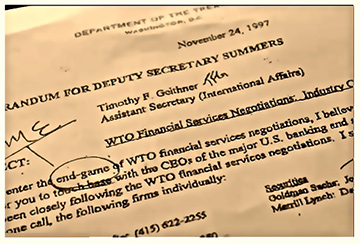
palast1When a little birdie dropped the End Game memo through my window, its content was so explosive, so sick and plain evil, I just couldn’t believe it.

The Memo confirmed every conspiracy freak’s fantasy: that in the late 1990s, the top US Treasury officials secretly conspired with a small cabal of banker big-shots to rip apart financial regulation across the planet. When you see 26.3% unemployment in Spain, desperation and hunger in Greece, riots in Indonesia and Detroit in bankruptcy, go back to this End Game memo, the genesis of the blood and tears. The Treasury official playing the bankers’ secret End Game was Larry Summers. Today, Summers is Barack Obama’s leading choice for Chairman of the US Federal Reserve, the world’s central bank. If the confidential memo is authentic, then Summers shouldn’t be serving on the Fed, he should be serving hard time in some dungeon reserved for the criminally insane of the finance world.

The memo is authentic.

To get that confirmation, I would have to fly to Geneva and wangle a meeting with the Secretary General of the World Trade Organization, Pascal Lamy. I did. Lamy, the Generalissimo of Globalization, told me,
“The WTO was not created as some dark cabal of multinationals secretly cooking plots against the people…. We don’t have cigar-smoking, rich, crazy bankers negotiating.”

Then I showed him the memo.

It begins with Summers’ flunky, Timothy Geithner, reminding his boss to call the then most powerful CEOs on the planet and get them to order their lobbyist armies to march:
“As we enter the end-game of the WTO financial services negotiations, I believe it would be a good idea for you to touch base with the CEOs….”
To avoid Summers having to call his office to get the phone numbers (which, under US law, would have to appear on public logs), Geithner listed their private lines. And here they are:
Goldman Sachs: John Corzine (212)902-8281

Merrill Lynch: David Kamanski (212)449-6868

Bank of America, David Coulter (415)622-2255

Citibank: John Reed (212)559-2732

Chase Manhattan: Walter Shipley (212)270-1380

Lamy was right: They don’t smoke cigars. Go ahead and dial them. I did, and sure enough, got a cheery personal hello from Reed–cheery until I revealed I wasn’t Larry Summers. (Note: The other numbers were swiftly disconnected. And Corzine can’t be reached while he faces criminal charges.)

It’s not the little cabal of confabs held by Summers and the banksters that’s so troubling. The horror is in the purpose of the “end game” itself.

Let me explain:

The year was 1997. US Treasury Secretary Robert Rubin was pushing hard to de-regulate banks. That required, first, repeal of the Glass-Steagall Act to dismantle the barrier between commercial banks and investment banks. It was like replacing bank vaults with roulette wheels.

Second, the banks wanted the right to play a new high-risk game: “derivatives trading.” JP Morgan alone would soon carry $88 trillion of these pseudo-securities on its books as “assets.”

Deputy Treasury Secretary Summers (soon to replace Rubin as Secretary) body-blocked any attempt to control derivatives.

But what was the use of turning US banks into derivatives casinos if money would flee to nations with safer banking laws?

The answer conceived by the Big Bank Five: eliminate controls on banks in every nation on the planet – in one single move. It was as brilliant as it was insanely dangerous.

How could they pull off this mad caper? The bankers’ and Summers’ game was to use the Financial Services Agreement, an abstruse and benign addendum to the international trade agreements policed by the World Trade Organization.

Until the bankers began their play, the WTO agreements dealt simply with trade in goods–that is, my cars for your bananas. The new rules ginned-up by Summers and the banks would force all nations to accept trade in “bads” – toxic assets like financial derivatives.

Until the bankers’ re-draft of the FSA, each nation controlled and chartered the banks within their own borders. The new rules of the game would force every nation to open their markets to Citibank, JP Morgan and their derivatives “products.”

And all 156 nations in the WTO would have to smash down their own Glass-Steagall divisions between commercial savings banks and the investment banks that gamble with derivatives.

The job of turning the FSA into the bankers’ battering ram was given to Geithner, who was named Ambassador to the World Trade Organization.

Bankers Go Bananas

Why in the world would any nation agree to let its banking system be boarded and seized by financial pirates like JP Morgan?

The answer, in the case of Ecuador, was bananas. Ecuador was truly a banana republic. The yellow fruit was that nation’s life-and-death source of hard currency. If it refused to sign the new FSA, Ecuador could feed its bananas to the monkeys and go back into bankruptcy. Ecuador signed.

And so on–with every single nation bullied into signing.

Every nation but one, I should say. Brazil’s new President, Inacio Lula da Silva, refused. In retaliation, Brazil was threatened with a virtual embargo of its products by the European Union’s Trade Commissioner, one Peter Mandelson, according to another confidential memo I got my hands on. But Lula’s refusenik stance paid off for Brazil which, alone among Western nations, survived and thrived during the 2007-9 bank crisis.

China signed–but got its pound of flesh in return. It opened its banking sector a crack in return for access and control of the US auto parts and other markets. (Swiftly, two million US jobs shifted to China.)

The new FSA pulled the lid off the Pandora’s box of worldwide derivatives trade. Among the notorious transactions legalized: Goldman Sachs (where Treasury Secretary Rubin had been Co-Chairman) worked a secret euro-derivatives swap with Greece which, ultimately, destroyed that nation. Ecuador, its own banking sector de-regulated and demolished, exploded into riots. Argentina had to sell off its oil companies (to the Spanish) and water systems (to Enron) while its teachers hunted for food in garbage cans. Then, Bankers Gone Wild in the Eurozone dove head-first into derivatives pools without knowing how to swim–and the continent is now being sold off in tiny, cheap pieces to Germany.

Of course, it was not just threats that sold the FSA, but temptation as well. After all, every evil starts with one bite of an apple offered by a snake. The apple: The gleaming piles of lucre hidden in the FSA for local elites. The snake was named Larry.

Does all this evil and pain flow from a single memo? Of course not: the evil was The Game itself, as played by the banker clique. The memo only revealed their game-plan for checkmate.

And the memo reveals a lot about Summers and Obama.

While billions of sorry souls are still hurting from worldwide banker-made disaster, Rubin and Summers didn’t do too badly. Rubin’s deregulation of banks had permitted the creation of a financial monstrosity called “Citigroup.” Within weeks of leaving office, Rubin was named director, then Chairman of Citigroup—which went bankrupt while managing to pay Rubin a total of $126 million.

Then Rubin took on another post: as key campaign benefactor to a young State Senator, Barack Obama. Only days after his election as President, Obama, at Rubin’s insistence, gave Summers the odd post of US “Economics Tsar” and made Geithner his Tsarina (that is, Secretary of Treasury). In 2010, Summers gave up his royalist robes to return to “consulting” for Citibank and other creatures of bank deregulation whose payments have raised Summers’ net worth by $31 million since the “end-game” memo.

That Obama would, at Robert Rubin’s demand, now choose Summers to run the Federal Reserve Board means that, unfortunately, we are far from the end of the game.

Monday, July 16, 2012

This Global Financial Fraud and Its Gatekeepers


The media's 'bad apple' thesis no longer works. We're seeing systemic corruption in banking – and systemic collusion
by Naomi Wolf
 
Last fall, I argued that the violent reaction to Occupy and other protests around the world had to do with the 1%ers' fear of the rank and file exposing massive fraud if they ever managed get their hands on the books. At that time, I had no evidence of this motivation beyond the fact that financial system reform and increased transparency were at the top of many protesters' list of demands.

But this week presents a sick-making trove of new data that abundantly fills in this hypothesis and confirms this picture. The notion that the entire global financial system is riddled with systemic fraud – and that key players in the gatekeeper roles, both in finance and in government, including regulatory bodies, know it and choose to quietly sustain this reality – is one that would have only recently seemed like the frenzied hypothesis of tinhat-wearers, but this week's headlines make such a conclusion, sadly, inevitable.

The New York Times business section on 12 July shows multiple exposes of systemic fraud throughout banks: banks colluding with other banks in manipulation of interest rates, regulators aware of systemic fraud, and key government officials (at least one banker who became the most key government official) aware of it and colluding as well. Fraud in banks has been understood conventionally and, I would say, messaged as a glitch. As in London Mayor Boris Johnson's full-throated defense of Barclay's leadership last week, bank fraud is portrayed as a case, when it surfaces, of a few "bad apples" gone astray.

In the New York Times business section, we read that the HSBC banking group is being fined up to $1bn, for not preventing money-laundering (a highly profitable activity not to prevent) between 2004 and 2010 – a six years' long "oops". In another article that day, Republican Senator Charles Grassley says of the financial group Peregrine capital: "This is a company that is on top of things." The article goes onto explain that at Peregrine Financial, "regulators discovered about $215m in customer money was missing." Its founder now faces criminal charges. Later, the article mentions that this revelation comes a few months after MF Global "lost" more than $1bn in clients' money.

What is weird is how these reports so consistently describe the activity that led to all this vanishing cash as simple bumbling: "regulators missed the red flag for years." They note that a Peregrine client alerted the firm's primary regulator in 2004 and another raised issues with the regulator five years later – yet "signs of trouble seemingly missed for years", muses the Times headline.

A page later, "Wells Fargo will Settle Mortgage Bias Charges" as that bank agrees to pay $175m in fines resulting from its having – again, very lucratively – charged African-American and Hispanic mortgagees costlier rates on their subprime mortgages than their counterparts who were white and had the same credit scores. Remember, this was a time when "Wall Street firms developed a huge demand for subprime loans that they purchased and bundled into securities for investors, creating financial incentives for lenders to make such loans." So, Wells Fargo was profiting from overcharging minority clients and profiting from products based on the higher-than-average bad loan rate expected. The piece discreetly ends mentioning that a Bank of America lawsuit of $335m and a Sun Trust mortgage settlement of $21m for having engaged is similar kinds of discrimination.

Are all these examples of oversight failure and banking fraud just big ol' mistakes? Are the regulators simply distracted?

The top headline of the day's news sums up why it is not that simple: "Geithner Tried to Curb Bank's Rate Rigging in 2008". The story reports that when Timothy Geithner, at the time he ran the Federal Reserve Bank of New York, learned of "problems" with how interest rates were fixed in London, the financial center at the heart of the Libor Barclays scandal. He let "top British authorities" know of the issues and wrote an email to his counterparts suggesting reforms. Were his actions ethical, or prudent? A possible interpretation of Geithner's action is that he was "covering his ass", without serious expectation of effecting reform of what he knew to be systemic abuse.

And what, in fact, happened? Barclays kept reporting false rates, seeking to boost its profit.

Last month, the bank agreed to pay $450m to US and UK authorities for manipulating the Libor and other key benchmarks, upon which great swaths of the economy depended. This manipulation is alleged in numerous lawsuits to have defrauded thousands of bank clients. So Geithner's "warnings came too late, and his efforts did not stop the illegal activity".

And then what happened? Did Geithner, presumably frustrated that his warnings had gone unheeded, call a press conference? No. He stayed silent, as a practice that now looks as if several major banks also perpetrated, continued.

And then what happened? Tim Geithner became Treasury Secretary. At which point, he still did nothing.

It is very hard, looking at the elaborate edifices of fraud that are emerging across the financial system, to ignore the possibility that this kind of silence – "the willingness to not rock the boat" – is simply rewarded by promotion to ever higher positions, ever greater authority. If you learn that rate-rigging and regulatory failures are systemic, but stay quiet, well, perhaps you have shown that you are genuinely reliable and deserve membership of the club.

Whatever motivated Geithner's silence, or that of the "government official" in the emails to Barclays, this much is obvious: the mainstream media need to drop their narratives of "Gosh, another oversight". The financial sector's corruption must be recognized as systemic.

Meanwhile, Britain is sleepwalking in a march toward total email surveillance, even as the US brings forward new proposals to punish whistleblowers by extending the Espionage Act. In an electronic world, evidence of these crimes lasts forever – if people get their hands on the books. In the Libor case, notably, a major crime has not been greeted by much demand at the top for criminal prosecutions. That asymmetry is one of the insurance policies of power.

Another is to crack down on citizens' protest.

Monday, October 17, 2011

Economists Want to End – Or Drastically Downsize – the Fed

Economists: End Or Drastically Downsize the Fed
Washington’s Blog
October 16, 2011


Economics Professor and monetary expert Randall Wray told me that we should end the regional Federal Reserve banks, as they have such terrible conflicts of interest, strip out all regulatory power from the Fed (since it doesn’t believe ine regulation, anyway), and implement monetary policy with a very small staff. He is not opposed to moving operations over to Treasury and/or the FDIC.

Professor of economics Steve Keen told me that he would pretty much limit the Fed to being a clearing house between different banks. In other words, in his view, the Fed could be stripped of all of it’s regulatory, monetary and emergency bailout powers.

Economics professor Michael Hudson told me:
Before 1913 all the Fed’s operations were conducted quite well by the Treasury. (David McKinley’s book for the 1907 described this quite well a century ago.)
the Fed’s aim was to Decentralize policy. The way things turned out, Wall Street leaders were given veto power. The role of Tim Geithner — in giving billions away in cash-for-trash trades the DAY before he was designed new Treasury Secretary (from his NY Fed position) tells it all.
But would the Treasury be different? The key is to put it back in the public interest, not Wall Street. Easier said than done.
***
[Congressman Dennis Kucinich's bill to nationalize the Fed, and his call on protesters to demand nationalization of the Fed] drastic, but it is the only way to check the fact that commercial banks create debt money recklessly, and now “casino capitalism” gambles that are bound to fail.
If we could implement the 100% reserve proposal and administer it correctly, I’m all for it. The government would NOT create credit for gambling, or ensure it.
PhD Economist Marc Faber said that protesters should Occupy the Federal Reserve:
Famed economist Milton Friedman wanted to end the Fed:
This evidence persuades me that at least a third of the price rise during and just after World War I is attributable to the establishment of the Federal Reserve System… and that the severity of each of the major contractions — 1920-1, 1929-33 and 1937-8 is directly attributable to acts of commission and omission by the Reserve authorities…
Any system which gives so much power and so much discretion to a few men, [so] that mistakes — excusable or not — can have such far reaching effects, is a bad system. It is a bad system to believers in freedom just because it gives a few men such power without any effective check by the body politic — this is the key political argument against an independent central bank…
To paraphrase Clemenceau, money is much too serious a matter to be left to the central bankers.
Austrian-school economists such as Murray Rothbard want to abolish the Fed:
Given this dismal monetary and banking situation, given a 39:1 pyramiding of checkable deposits and currency on top of gold, given a Fed unchecked and out of control, given a world of fiat moneys, how can we possibly return to a sound noninflationary market money? The objectives, after the discussion in this work, should be clear: (a) to return to a gold standard, a commodity standard unhampered by government intervention; (b) toabolish the Federal Reserve System and return to a system of free and competitive banking; (c) to separate the government from money; and (d) either to enforce 100 percent reserve banking on the commercial banks, or at least to arrive at a system where any bank, at the slightest hint of nonpayment of its demand liabilities, is forced quickly into bankruptcy and liquidation. While the outlawing of fractional reserve as fraud would be preferable if it could be enforced, the problems of enforcement, especially where banks can continually innovate in forms of credit, make free banking an attractive alternative.
I noted Tuesday:
The New York Sun reported that a … Nobel economist may have implied that the Fed should be abolished:
Thomas Sargent, the New York University professor who was announced Monday as a winner of the Nobel in economics … cites Walter Bagehot, who “said that what he called a ‘natural’ competitive banking system without a ‘central’ bank would be better…. ‘nothing can be more surely established by a larger experience than that a Government which interferes with any trade injures that trade. The best thing undeniably that a Government can do with the Money Market is to let it take care of itself.’”
Nobel prize-winning economist Joseph Stiglitz strongly dislikes the Fed:

Joseph Stiglitz – former head economist at the World Bank and a nobel-prize winner – said yesterday that the very structure of the Federal Reserve system is so fraught with conflicts that it is “corrupt” and undermines democracy.
Stiglitz said:
If we [i.e. the World Bank] had seen a governance structure that corresponds to our Federal Reserve system, we would have been yelling and screaming and saying that country does not deserve any assistance, this is a corrupt governing structure.
Stiglitz pointed out that – if another country had presented a plan to reform its financial system, and included a regulatory regime that copied the makeup of the Federal Reserve system – “it would have been a big signal that something is wrong.”
Stiglitz stressed that the Fed banks have clear conflicts of interest, since the banks are largely governed by a board of directors that includes officers of the very banks they’re supposed to be overseeing:
So, these are the guys who appointed the guy who bailed them out … Is that a conflict of interest?
They would say, ‘no conflict of interest, we were just doing our job. But you have to look at the conflicts of interest”…
The reason you talk about governance is because in a democracy you want people to have confidence … This is a structure that will undermine confidence in a democracy.
Indeed, as I noted Sunday:
Given that the 12 Federal Reserve banks are private – see this, this, this and this- the giant banks have a huge amount of influence on what the Fed does. Indeed, the money-center banks in New York control the New York Fed, the most powerful Fed bank. Indeed, Jamie Dimon – the head of JP Morgan Chase – is a Director of the New York Fed.
Former Fed officials agree. For example, the former Vice President of Dallas Federal Reserve said that the failure of the government to provide more information about the bailout signals corruption. As ABC writes:
Gerald O’Driscoll, a former vice president at the Federal Reserve Bank of Dallas and a senior fellow at the Cato Institute, a libertarian think tank, said he worried that the failure of the government to provide more information about its rescue spending could signal corruption.
“Nontransparency in government programs is always associated with corruption in other countries, so I don’t see why it wouldn’t be here,” he said.
In fact, many high-level economists have blasted the Fed for bungling virtually everything it does.

And while – admittedly – many mainstream Keynesian economists may be hesitant to question the Fed’s existence because the Fed is a big part of the printing press on which Keynesianism relies (and the Fed has essentially bought the economics profession), the same arguments which Keynesians have made against the “too big to fail” banks apply to the Fed as well.

For example, Nobel prize winning economist Paul Krugman wants the big banks to be broken up because their very size warps the political system:
My view is that I’d love to see those financial giants broken up, if only for political reasons: it’s bad to have banks so big they can often write laws.
Former chief IMF economist Simon Johnson says much the same thing.

The Federal Reserve is an enormously powerful institution, which doles out tens of trillions of dollars –many to foreign banks and governments (and see this and this) – without democratic input of any nature whatsoever. While Fed apologists say that the bank’s “independence” must be preserved, the fact that the Fed has sent trillions overseas shows the Fed is somewhat independent of American interests.

And the fact that the Fed funneled trillions to the biggest banks – instead of main street or public works projects – runs counter to the wishes of most people and of Keynes’ actual prescriptions. (Keynesians speak of “saltwater” and “freshwater” schools of thought, depending on whether economists think money can be pumped anywhere and it will stimulate the economy, or it should be pumped in specific places. But the Fed hasn’t done either, but has instead given huge sums to the big banks, and then encouraged them to park the money). See this and this.

Liberal Keynesians should oppose such a gigantic concentration of power – shielded from accountability to the people – on basic principles.

Indeed, both liberals and conservatives should despise something which runs so counter to the “separation of powers” envisioned in the Constitution.

Note: The American people want the Fed ended or at least reined in as well. See this, this and this.

Tuesday, July 6, 2010

Fed Made Taxpayers Unwitting Junk-Bond Buyers

By Caroline Salas, Craig Torres and Shannon D. Harrington - Jul 1, 2010

Federal Reserve Chairman Ben S. Bernanke and then-New York Fed President Timothy Geithner told senators on April 3, 2008, that the tens of billions of dollars in “assets” the government agreed to purchase in the rescue of Bear Stearns Cos. were “investment-grade.” They didn’t share everything the Fed knew about the money.

The so-called assets included collateralized debt obligations and mortgage-backed bonds with names like HG-Coll Ltd. 2007-1A that were so distressed, more than $40 million already had been reduced to less than investment-grade by the time the central bankers testified. The government also became the owner of $16 billion of credit-default swaps, and taxpayers wound up guaranteeing high-yield, high-risk junk bonds.

By using its balance sheet to protect an investment bank against failure, the Fed took on the most credit risk in its 96- year history and increased the chance that Americans would be on the hook for billions of dollars as the central bank began insuring Wall Street firms against collapse. The Fed’s secrecy spurred legislation that will require government audits of the Fed bailouts and force the central bank to reveal recipients of emergency credit.

“Either the Fed did not understand the distressed state of some of the assets that it was purchasing from banks and is only now discovering their true value, or it understood that it was buying weak assets and attempted to obscure that fact,” Senator Sherrod Brown, an Ohio Democrat and member of the Senate Banking Committee, said in an e-mail when informed about the credit quality of holdings in the Maiden Lane LLC portfolio. The committee held the April 3 hearing.

Bear Stearns Purchase

Maiden Lane, named for a street bordering the New York Fed’s Manhattan headquarters, was created to hold the assets the central bank acquired to facilitate JPMorgan Chase & Co.’s purchase of Bear Stearns.

The Fed disclosed the Maiden Lane holdings in March after Bloomberg News went to court using the Freedom of Information Act, and the U.S. District Court in New York held that the Fed should release documents related to Bloomberg’s request.

“The Federal Reserve was not straightforward with the American people regarding the risks they were taking with taxpayer money, despite my efforts to obtain such clarity at the time,” U.S. Senator Richard Shelby of Alabama, the Senate Banking Committee’s top Republican, told Bloomberg News. “It is apparent that the Fed withheld from the Congress and the public material information about the condition of these securities.”

Downgraded to Junk

When Bernanke and Geithner testified in April 2008, $42 million of the CDO securities the Fed would eventually buy had been downgraded to junk, data compiled by Bloomberg show. By the time the central bank funded its $28.8 billion loan to Maiden Lane 12 weeks later, about $172 million of such securities the Fed purchased were rated below investment grade, according to data compiled for Bloomberg by Red Pine Advisors LLC, a New York firm specializing in the valuation of complex, illiquid securities.

CDOs bundle assets ranging from mortgage bonds to high- yield loans and divide them into new slices, or tranches, of varying risks. High-yield, or junk, bonds are those rated below Baa3 by Moody’s Investors Service and lower than BBB- by Standard & Poor’s.

“As was noted in testimony, all of the cash securities in the Maiden Lane portfolio were investment grade on March 14, 2008, when the deal was agreed to in order to facilitate the acquisition of Bear Stearns and to prevent the systemic consequences of its sudden and disorderly failure,” Michelle Smith, a spokeswoman for the Fed’s Board of Governors, said in an e-mail.

Recover Principal

“The Federal Reserve considered not just credit-rating valuations, which have varied some over time based on economic conditions, but also relied on a separate assessment from an independent investment firm, which advised us that over time, we would likely fully recover our principal and interest,” Smith said. “We continue to expect the loan to Maiden Lane to be fully repaid.”

The Fed valued the loan at $27 billion as of the end of last year, $1.8 billion below the amount that was funded in 2008, according to financial statements audited by Deloitte & Touche LLP.

More than 88 percent of Maiden Lane’s CDO bonds and 78 percent of its non-agency residential mortgage-backed debt are now speculative grade, according to data compiled by Bloomberg based on holdings as of Jan. 29.

Securities, Derivatives

The nonagency home-loan bonds and CDO securities made up about 44 percent of the $74.9 billion in face amount of Maiden Lane’s assets, Fed data show. Maiden Lane also contains commercial real-estate loans and other mortgage debt. The central bank hasn’t released how or at what prices it has valued the securities and derivatives, which are contracts whose values are tied to assets, including stocks, bonds, commodities and currencies, or events such as changes in interest rates or the weather.

Being “investment grade” was a requirement for Maiden Lane’s bonds even after Bernanke and Geithner publicly criticized inflated ratings for helping to cause the financial crisis.

“The complexity of structured credit products, as well as the difficulty of determining the values of some of the underlying assets, led many investors to rely heavily on the evaluations of these products by credit-rating agencies,” Bernanke said in a January 10, 2008, speech in Washington. “However, as subprime-mortgage losses rose to levels that threatened even highly rated tranches, investors began to question the reliability of the credit ratings and became increasingly unwilling to hold these products.”

Princeton, Dartmouth

Members of Congress pressed Bernanke, who received a doctorate in economics from the Massachusetts Institute of Technology and served as chairman of Princeton University’s economics department, and Geithner, a Dartmouth College graduate who earned a master’s degree in economics and East Asian studies from Johns Hopkins University, about the quality of the assets during the April Bear Stearns hearings.

“You’ve got about $30 billion of collateral. And some comments have been made that you feel comfortable because it’s highly rated,” Senator Jack Reed, a Rhode Island Democrat, told Bernanke, according to a transcript. “But a lot of highly rated collateral these days is being subject to questions.”

“Senator, as was mentioned, it is all investment-grade or current performing assets,” Bernanke responded. “We do not know for sure what will transpire,” he said. “But we have engaged an independent investment-advisory firm who gives us reasonable comfort that if we can sell these assets over a period of time that we will recover principal and interest for the American taxpayer.”

Chances for Loss

When asked by Shelby during the hearing what the chances were for a loss, Robert Steel, then the U.S. Treasury undersecretary for domestic finance, said the transaction “was $30 billion, approximately, of collateral, all investment-grade securities, all of them current in interest and principal.”

Steel, who was named deputy mayor for economic development last month by New York City Mayor Michael Bloomberg, declined to comment through Andrew Brent, a spokesman for the mayor’s office. The mayor is founder and majority owner of Bloomberg News parent Bloomberg LP.

Bernanke and Geithner didn’t detail during the hearing that the Fed would expose itself to below-investment-grade assets through credit derivatives it was also acquiring. The $16 billion of credit-default swaps included bets protecting some junk-rated asset-backed securities against default, according to two people familiar with the agreement who declined to be identified because the terms weren’t made public.

‘Related Hedges’

The Fed hasn’t disclosed how much was tied to below- investment-grade debt. Geithner, who is now Treasury secretary, said in an addendum to the text of his remarks only that the Fed was assuming “related hedges,” without elaborating.

Credit-default swaps are used to hedge against losses or to speculate on creditworthiness. The derivatives pay the buyer face value if a borrower fails to meet its obligations, less the value of the defaulted debt.

“I strongly object to the mischaracterization of the portfolio,” Sylvain Raynes, a principal at R&R Consulting in New York, said in an interview. “The ratings that were purportedly investment-grade had long lost their utility” and to call several billion dollars of derivatives “related hedges” is “nonsense” and a “material omission.”

So-called hedges aren’t without risk, said Raynes, who is also co-author of “Elements of Structured Finance,” which was published in May by Oxford University Press. “You can be on the wrong side of a hedge, by definition. Which side are they on?”

Shrinking Holdings

Maiden Lane has been unwinding its credit-default swaps, according to the people familiar with the agreement. The holdings shrank to a face amount of $11.8 billion in December 2008 and $7.3 billion at the end of last year, according to its financial statements.

Of the $7.3 billion, $2.45 billion were contracts guaranteeing debt against default, including $2.1 billion of junk-rated securities. The bank valued the credit swaps it sold at a $1.8 billion loss, according to the 2009 statement.

Overall, Maiden Lane assumed more bets against securities than for them, the people familiar with the agreement said. The market value of its entire swaps book, including more than $3 billion of interest-rate contracts, was $1.13 billion as of Dec. 31, 2009, according to year-end financial statements.

The Senate Banking Committee also called JPMorgan Chief Executive Officer Jamie Dimon to testify on the Bear Stearns deal on April 3, 2008.

Riskier, More Complex

“The assets taken by the Fed consist entirely of loans that are current and rated investment grade,” Dimon said, according to a transcript. “We kept the riskier and more complex securities in the Bear Stearns portfolio for our own account. We did not cherry-pick the assets in the collateral pool.”

If the Fed hadn’t engineered the takeover, “the consequences could have been disastrous,” Dimon said.

JPMorgan didn’t pick the individual securities for Maiden Lane, Geithner said in an annex to his April 2008 testimony. Instead, it selected groups of assets that met criteria set by the central bank, and the Fed and its adviser, New York-based BlackRock Inc., reviewed those assets, according to one of the people familiar with the agreement. As part of the bailout, JPMorgan agreed to absorb the first $1 billion in losses.

Assets, Liabilities

JPMorgan had to weigh how many real-estate assets it could absorb against its existing inventory, Dimon said, adding that the New York-based company acquired about $360 billion of Bear Stearns assets and liabilities in the transaction.

JPMorgan spokesman Justin Perras declined to comment further on Maiden Lane.

“We certainly had doubts at the time: Why wouldn’t JPMorgan want a bunch of AAA assets?” said Mark Calabria, a former Senate Banking Committee staff member who was present at the April 2008 hearings and is now director of financial- regulation studies at the Cato Institute in Washington. “The answer is it was all borderline junk.”

The average CDO security was cut 7.6 grades by Moody’s and 7.3 levels by S&P in the 22 months between the time the Fed funded the loan and April 2010, according to Red Pine.

“That is quite steep,” said Wade Vandegrift, a Red Pine partner. “The default rates and the delinquency rates of these deals were a significant multiple of even the worst-case projections that rating agencies and other people projected.”

Foreclosed Loans

WaMu Asset-Backed Certificates Series 2007-HE1 M2, a $4.1 million mortgage-bond position the Fed acquired, was backed by home loans originated by the subprime-lending unit of Washington Mutual Inc., the Seattle-based thrift that went bankrupt in September 2008. As of March 2008, the month Bear Stearns collapsed, more than 26 percent of the loans were at least 60 days late, in foreclosure or the properties had already been seized, according to data compiled by Bloomberg.

Three weeks after the Fed agreed to the Bear Stearns rescue and four days after Bernanke’s April testimony, Moody’s cut the security to junk. S&P followed a month later and now rates it D.

“It is hardly surprising or particularly newsworthy that the value of” the Maiden Lane “portfolio deteriorated in the midst of the worst financial crisis in generations, but it is unlikely that the taxpayers will lose a dime on the government’s loan,” Treasury spokesman Andrew Williams said in an e-mail. The Congressional Budget Office estimates the Fed will make $200 million on Maiden Lane from inception through 2020.

Demanding Accountability

Billions of dollars in Fed loans -- some possibly involving subsidies for the biggest banks and corporations -- remain secret, and Congress is demanding more accountability from the Fed than at any time in its history.

House and Senate negotiators agreed on the sweeping Dodd- Frank Wall Street Reform and Consumer Protection Act last week, which requires the Government Accountability Office to audit the Fed’s emergency loans and forces the Fed to reveal recipients of such credit by Dec. 1. The House approved the measure 237-192 yesterday. It awaits approval by the Senate and will then go to President Barack Obama for his signature.

Vermont Senator Bernard Sanders wrote the legislation requiring an audit of Maiden Lane and other credit facilities. The act also would make it more difficult for the Fed to provide emergency loans in the future.

“We need to lift the veil of secrecy at the Federal Reserve,” Sanders, an independent, told Bloomberg News when informed about the credit quality of Maiden Lane’s holdings. “We need a complete and independent audit. The American people have a right to know what the Fed is doing with trillions of their taxpayer dollars.”