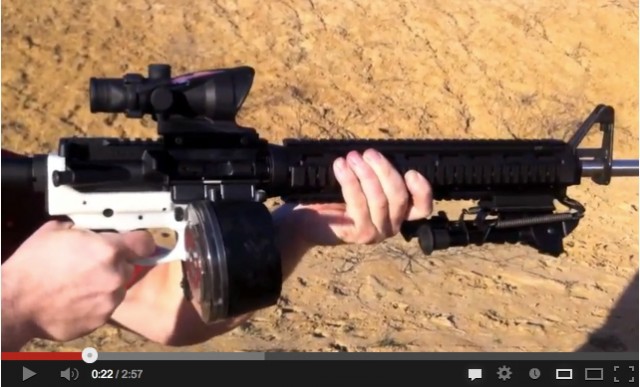
The white portion of this AR-15, known as the "lower," was manufactured using 3D printing.
Cody Wilson, like many of his Texan forebears, is fast-talkin’ and fast-shootin’—but unlike his predecessors in the Lone Star State, he’s got 3D printing technology to further his agenda.
Wilson’s non-profit organization, Defense Distributed, released a video this week showing a gun firing off over 600 rounds—illustrating what is likely to be the first wave of semi-automatic and automatic weapons produced by the additive manufacturing process.
Last year, his group famously demonstrated that they could use a 3D-printed “lower” for an AR-15 semi-automatic rifle—but the gun failed after six rounds. Now, after some re-tooling, Defense Distributed has shown that it has fixed the design flaws and can seemingly fire for quite awhile. (The AR-15 is the civilian version of the military M16 rifle.)
The “lower,” or lower receiver part of a firearm, is the crucial part that contains all the gun's operating parts, including the trigger group, and the magazine port. (Under American law, the lower is what's defined as the firearm itself.) The AR is designed to be modular, meaning it can receive different types of “uppers” (barrels) as well as different-sized magazines.
“This is the first publicly printed AR lower demonstrated to withstand a large volume of .223 without structural degradation or failure,” Wilson wrote on Wednesday. “The actual count was 660+ on day 1 with the SLA lower. The test ended when we ran out of ammunition, but this lower could easily withstand 1,000 rounds.”
Already, he says, over 10,000 people have downloaded the lower CAD file, with more on BitTorrent.
"I just made an AK-47 magazine—I’ve got it printing as we speak"
While it may be easy to paint Wilson as a 2nd Amendment-touting conservative, the 25-year-old second-year law student at the Univeristy of Texas, Austin told Ars on Thursday that he’s actually a “crypto-anarchist.”
“I believe in evading and disintermediating the state,” he said.
“It seemed to be something we could build an organization around. Just like Bitcoin can circumvent financial mechanisms. This means you can make something that is contentious and politically important—not just a multicolored cookie cutter—but something important. It’s more about disintermediating some of these control schemes entirely and there’s increasingly little that you can do about it. That’s no longer a valid answer.”
He added, “The message is in what we’re doing—the message is: download this gun.”
And he practices what he preaches: the group’s entire set of design files are made available, for free, on DEFCAD, an online library for everything from grips to lowers to magazines.
“I just made an AK-47 magazine—I’ve got it printing as we speak,” he added. “[I’ve got a] Glock 17, we got a bunch coming, man. We’ve got a library of magazines.”
Wilson’s group was founded last year on similar principles:
The specific purposes for which this corporation is organized are: To defend the civil liberty of popular access to arms as guaranteed by the United States Constitution and affirmed by the United States Supreme Court, through facilitating global access to, and the collaborative production of, information and knowledge related to the 3D printing of arms; and to publish and distribute, at no cost to the public, such information and knowledge in promotion of the public interest.
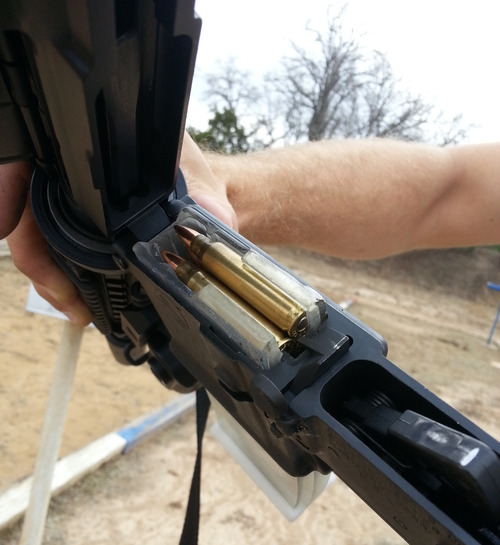
Here are .223 Remington bullets loaded into a 3D-printed magazine.
Totally legal
So that raises the question: is this legal? For now, it would appear so.
“There are no restrictions on an individual manufacturing a firearm for personal use,” a Bureau of Alcohol, Tobacco, and Firearms (ATF) spokesperson told Ars. “However, if the individual is engaged in business as a firearms manufacturer, that person must obtain a manufacturing license.”
Wilson said that he’s applied for a federal firearms license in his own name with the ATF in October, and expects to hear a response “any day now.” The ATF did not respond to our request for confirmation of Wilson’s claims.
Specifically, Wilson said he's looking eventually to become a Class 2 Special Occupational Taxpayer, as licensed under federal law (PDF), which would allow him to become a dealer under the National Firearms Act.
The law student said that anyone with the same type of 3D printer (“SLA resin and P400 ABS on a used Dimension”) could replicate his efforts with “9 to 12 hours” of print time, and “$150 to $200” in parts, adding that “we’ve proven that you can build one for $50,” presuming the builder is using lower quality materials. (Dimensions typically sell in the $30,000 range—but Wilson says his results could be duplicated using the less-expensive Ultimaker ($1500) or Reprap.”
Assuming Defense Distributed’s AR-15 lower costs around $150 to print, it likely wouldn’t end up being price-competitive with other, commercially-available polymer AR-15 lowers—a few minutes of Google searching turned up options priced at $135 to $170, depending on the manufacturer.
Of course, lots of 3D printing enthusiasts extol the fact that the price of the technology is rapidly falling—as we reported previously, a California company announced a $600 model last year.
Some experts who have been following the world of 3D printing for a while say that from a policy perspective, not much has changed in terms of firearm production, even if is cheaper to make.
“When you're thinking about it from a policy standpoint [the question is]: was this possible before 3D printing? If the answer is yes, what was the existing policy response?” said Michael Weinberg, a staff attorney at Public Knowledge.
“Has this fundamentally changed the dynamic in a way that we need to revisit the response? The answer strikes me as no—it's amazing. You can imagine a world where the 3D printer is accessible to people—I am not convinced that we need a 3D printing-specific solution.”
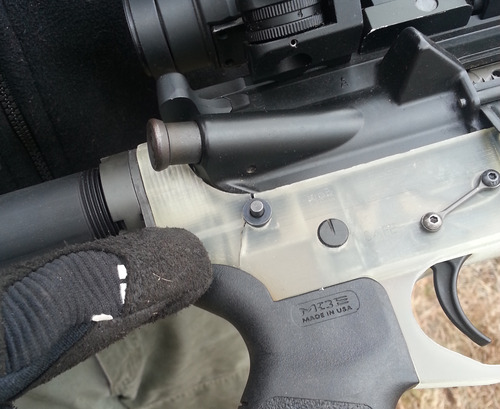
An earlier model of the 3D-printed AR-15 lower resulted in a crack by the rear takedown pin.
"The guns that will be"
Since December 2012, Wilson and his team have been hard at work on two problems. The first was the fact that the lower’s “buffer tower” (the circular ring part jutting upward that the “upper” fits into) kept breaking—that’s what caused the initial failure that prevented the gun from firing more than six rounds of 5.7x28FN bullets.
So to fix that, the group re-engineered the buffer tower so that it had increased exterior thickness. “We doubled or tripled the thickness,” Wilson said.
With that fix under their belt, the modern gunsmiths tried firing with .223 Remington bullets (standard in an AR-15), which raised the firing range to about 20 rounds before a failure—but that wasn’t good enough.
By the end of the month, there was a different failure, this time on the “rear takedown pin,” where a metal pin fits between the upper and the lower, connecting them together solidly. There, the 3D-printed plastic was cracking around the pin, making the gun less safe to use.
“There was so much force concentrating around it that that was the failure place,” Wilson said. “At first we started using bigger bosses and using longer pins, and realized that it’s still a cross-sectional area. We changed the dimensions of the rear takedown pins.”
He explained that they’ve changed pin design entirely, adding “more surface area around these pins,” as well as an “internal” 90-degree angle, along with various curves and “steps and risers,” that would take advantage of the fact that the housing was made of plastic, not metal.
“The thing was still built like it would be made out of metal,” he said. “This is about plastic and everything needs to be curves, it has to act like more of a spring.”
And that, he points out, is the ultimate lesson in gun manufacture.
“The idea is not to print components for guns that are, but the guns that will be,” he said.
For now though, Wilson said that Defense Distributed has essentially taken over the bulk of his time, and he’s effectively become a part-time amateur engineer.
“I don’t go to [law school] class, but I do pass the exams—here’s looking at you [American Bar Association]!” he told Ars.
Defense Distributed, Wilson says, receives “around $100” in daily donations and has an operating budget of about $2,400 monthly. He says that the next phase will be to publish “primers” teaching people specifically how to make such weapons.
“I don’t consider myself a tech guy, but I do consider myself a crypto-anarchist,” he said.
“I mean the philosophy that Tim May expressed, he predicted WikiLeaks and digital currency. [What I mean is] that the Internet and cryptography are these anarchic tools that can allow for the expanse of citizen action. We like the idea of the market becoming completely black and starving the nation-state from all the money they claim.”
(Thanks to Ars editor Sean Gallagher, a Navy veteran, for helping me with all my gun questions.)