Showing posts with label Marijuana Policy Project. Show all posts

Wednesday, April 4, 2012

"It is time for a new approach on marijuana policy," Drug Policy Coalition says to Obama

Six National Drug Policy Organizations Call on President Obama to End Unnecessary Assault on Medical Marijuana Providers
Wednesday, 04 April 2012

Contact: Allen St. Pierre, NORML Executive Director, (202) 483-5500
Paul Armentano, NORML Deputy Director, paul@norml.org

Washington, DC -- In the wake of recent attacks on medical marijuana providers and patients by multiple branches of the federal government, including Monday's raids on Oaksterdam University in Oakland, CA, a coalition of six national drug policy reform organizations is appealing to President Obama and his administration to follow its own previously stated policies respecting state medical marijuana laws. In the letter, posted in full below, the organizations call on the Obama administration to bring an end to the federal government's ongoing campaign to undermine state efforts to regulate safe and legal access to medical marijuana for those patients who rely on it.

The Obama Administration's National Drug Control Strategy Report 2012, reportedly being released in the coming days, is expected to cling to failed and outdated marijuana policies which further cement the control of the marijuana trade in the hands of drug cartels and illegal operators, endangering both patients in medical marijuana states and citizens everywhere. The members of this coalition stand together with members of the Global Commission on Drug Policy, current and former Latin American leaders whose countries are being ravaged by drug cartels, state officials from five medical marijuana states, and tens of millions of Americans in their call for a more rational approach to marijuana policy.

###

THE LETTER TO PRESIDENT OBAMA:
April 4, 2012 
President Barack ObamaThe White House
Washington D.C. 20500
Via Fax: 202-456-2461 
Dear Mr. President: 
Our coalition represents the views of tens of millions of Americans who believe the war on medical marijuana patients and providers you are fighting is misguided and counterproductive. As your administration prepares to release its annual National Drug Control Strategy, we want to speak with one voice and convey our deep sense of anger and disappointment in your lack of leadership on this issue. 
Voters and elected officials in sixteen states and the District of Columbia have determined that the medical use of marijuana should be legal. In many of these states, the laws also include means for providing medical marijuana patients safe access to this medicine. These laws allowing for the cultivation and distribution of medical marijuana actually shift control of marijuana sales from the criminal underground to state-licensed, taxed, and regulated producers and distributors. 
Instead of celebrating - or even tolerating - this state experimentation, which has benefited patients and taken profits away from drug cartels, you have turned your back as career law enforcement officials have run roughshod over some of the most professional and well-regulated medical marijuana providers. We simply cannot understand why you have reneged on your administration's earlier policy of respecting state medical marijuana laws. 
Our frustration and confusion over your administration's uncalled-for attacks on state-authorized medical marijuana providers was best summed up by John McCowen, the chair of the Mendocino County (CA) board of supervisors, who said, "It's almost as if there was a conscious effort to drive [medical marijuana cultivation and distribution] back underground. My opinion is that's going to further endanger public safety and the environment - the federal government doesn't seem to care about that." 
The National Drug Control Strategy you are about to release will no doubt call for a continuation of policies that have as a primary goal the ongoing and permanent control of the marijuana trade by drug cartels and organized crime. We cannot and do not endorse the continued embrace of this utterly failed policy. We stand instead with Latin American leaders, members of the Global Commission on Drug Policy, and the vast majority of people who voted you into office in recognizing that it is time for a new approach on marijuana policy. 
With approximately 50,000 people dead in Mexico over the past five years as the result of drug war-related violence, we hope that you will immediately reconsider your drug control strategy and will work with, not against, states and organizations that are attempting to shift control of marijuana cultivation and sales, at least as it applies to medical marijuana, to a controlled and regulated market. 
Sincerely, 
Drug Policy Alliance (DPA)
Law Enforcement Against Prohibition (LEAP)
Marijuana Policy Project (MPP)
National Cannabis Industry Association (NCIA)
National Organization for the Reform of Marijuana Laws (NORML)
Students for Sensible Drug Policy (SSDP) 
cc: Eric Holder, Attorney General, Department of Justice
James Cole, Deputy Attorney General, Department of Justice
Gil Kerlikowske, Director of the Office of National Drug Control Policy

Sunday, October 9, 2011

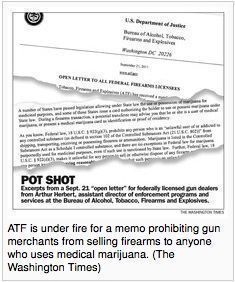
Medical-pot users fuming over ATF’s gun-sale ban

DENVER — You can have your gun, or you can have your medical marijuana. But the Obama administration now says you can’t have both.

The Bureau of Alcohol, Tobacco, Firearms and Explosives is in the crosshairs for a recent memo prohibiting gun merchants from selling firearms to anyone who uses marijuana, including those with state-issued medical-marijuana cards.

An open letter dated Sept. 21 from Arthur Herbert, ATF assistant director for Enforcement Programs and Services, said that, “any person who uses or is addicted to marijuana, regardless of whether his or her State has passed legislation authorizing marijuana use for medicinal purposes, is an unlawful user of or addicted to a controlled substance, and is prohibited by Federal law from possessing firearms or ammunition.”

That didn’t sit well with Montana Attorney General Steve Bullock, who fired off a letter this week to Attorney General Eric H. Holder Jr. saying that the policy raises “serious legal issues under the Second Amendment, and the Equal Protection and Due Process clauses of the Fifth Amendment.”

The conflict illustrates the contradictory state of affairs between the states and federal government on the subject of medical marijuana. Sixteen states and the District of Columbia have passed medical-marijuana laws, a situation the Justice Department has agreed to tolerate despite continuing to enforce federal laws banning marijuana use.

Where the agency draws the line is often a source of confusion. The Sept. 21 letter was issued in response to gun sellers who asked the agency for guidance because buyers were showing them medical-marijuana cards as identification.

Mr. Bullock blasted the ATF for failing to consult with state officials before issuing the directive, saying a cooperative approach “would be much better than the type of unilateral proclamation represented by the ATF letter.”

Critics contend that the law unfairly discriminates against marijuana users because patients who take other controlled substances, such as OxyContin, have no such restrictions. In his letter, Mr. Bullock pointed out federal law allows those who are prescribed controlled substances by a physician to possess or buy firearms and ammunition.

“The ATF letter does not take this into account,” said Mr. Bullock, who called on the department to work with the states in “exploring a reasonable solution to the problems created by the Bureau of Alcohol, Tobacco, Firearms and Explosives letter.”

Mr. Herbert states in his letter that marijuana, as a Schedule 1 controlled substance, cannot be prescribed under federal law, “even if such use is sanctioned by state law.”

The policy puts gun dealers in a difficult position, say critics.

Potential gun buyers must state on an ATF form whether they use marijuana at the time of sale. If they answer “yes,” they are denied the purchase, but even if they answer “no,” the seller cannot complete the sale if there is “‘reasonable cause to believe’ that the person is an unlawful user of or addicted to a controlled substance,” according to the directive.

“The dealers have no way of knowing whether someone smokes pot unless they come in toking,” said Gun Owners of America executive director Larry Pratt. “It’s just one more way to aggravate the dealers and play ‘gotcha’ with the dealers. They [the ATF] are totally out of control.”

In an editorial this week, the Denver Post blasted the directive, calling it an “assault on constitutional rights.” Colorado voters legalized medical marijuana in 2000.

“[U]sers of medical marijuana are faced with two choices: pass on gun ownership or illegally lie about their use of marijuana,” the Post said. “Unbelievable.”

Morgan Fox, spokesman for the Marijuana Policy Project, said his organization is drafting a letter asking the ATF to use its discretion “to be more compassionate toward medical-marijuana patients.”

“The ATF said their hands were tied, but that’s not the case,” Mr. Fox said. “This is just another way to single out and harass medical-marijuana patients.”

Montana voters legalized medical marijuana in 2004, but its use exploded after the Justice Department’s 2009 memorandum saying federal authorities would not target marijuana users as long as they comply with state law, Montana Justice Department spokesman John Doran said.

“We went from 3,000 to 30,000 medical-marijuana cardholders in the space of about a year,” he said. “We also saw an increase in the number of types of businesses.”

Those included so-called “cannibis caravans,” which traveled throughout the state signing up people for medical-marijuana cards. Often there was no doctor on site, but rather a doctor from another state who spoke with patients via computer, Mr. Doran said.

The Montana legislature cracked down on the industry earlier this year with a bill that repealed the voter-passed initiative and replaced it with tighter restrictions. In response, advocates gathered enough signatures to place the more liberal version on the November 2012 ballot.

“States, including Montana, have acted to address problems and explore workable solutions,” Mr. Bullock said. “In doing so, however, we also face issues that are, candidly, created or exacerbated by federal actions and policies that do not always reflect the kind of careful approach and appropriate accommodation that should be accorded the states.”

Wednesday, February 16, 2011

Congressman targets federal funding for the war on drugs

By Eric W. Dolan | Wednesday, February 16th, 2011

Colorado Congressman Jared Polis has offered two amendments to the House continuing resolution that would eliminate much of the federal funding for the war on drugs in the United States.

The House is currently debating HR 1, the Full Year Continuing Appropriations Act of 2011. The bill is needed to fund the government for the rest of the current fiscal year.

Rep. Jared Polis (D-CO) has offered a number of amendments to the legislation. One of his amendments, No. 501, would eliminate funding for the Office of National Drug Control Policy, commonly known as the drug czar. Another amendment, No. 427, would prohibit funds being made available for the investigation or criminal prosecution of any person for the possession, manufacture or distribution of marijuana.

The Marijuana Policy Project is urging its members to contact their representatives about the amendments.

Uh, drugs are bad, mm'kay?

"The Drug Czar's office is simply not necessary," a pre-written letter by the group said. "Levels of drug use do not change because we have a person of power in Washington going around the country saying, 'Drugs are bad.' Moreover, a case can be made that the Drug Czar's office has done a disservice to our youth by emphasizing the harms associated with marijuana at the expense of educating them about the relative harms of all drugs."

Last week, Rep. Polis said that support for legalizing marijuana at the federal level was steadily increasing in Congress.

"I find that a lot of members of Congress privately agree that we need to change our drug policy, they’re just still too timid or scared to come public with it," he said.

Although the two amendments may galvanize supporters of marijuana legalization, the American Civil Liberties Union (ACLU) warned Wednesday that the continuing resolution has become a vehicle for amendments that threaten civil liberties.

"This continuing resolution is a breathtaking assault on civil liberties," Director of the ACLU Washington Legislative Office Laura W. Murphy said. "In one fell swoop, the House bill is attempting to chip away at due process rights and eliminate access to crucial health care for many Americans. While determining federal funding concerns, it is unacceptable that the civil liberties of Americans be considered dispensable. We urge the Senate to continue its resistance to this disastrous bill."

As of Tuesday night, members of the House had offered 583 amendments to the bill.

Rep. Mike Pence (R-IN) is expected to try and attach his bill, the "Title X Abortion Provider Prohibition Act," to the continuing resolution.

The measure would eliminate all $327 million in funding for Title X, a family planning program that began 40 years ago under President Richard Nixon. And while Planned Parenthood receives millions of dollars from the program, Title X funds cannot be used for abortion services.
"If Planned Parenthood wants to be involved in providing counseling services and HIV testing, they ought not be in the business of providing abortions," Rep. Pence told Politico Tuesday. "As long as they aspire to do that, I’ll be after them."

Rep. Aaron Shock (R-IL) has offered an amendment to the continuing resolution that would ban Guantanamo detainees from being transferred to the United States for any reason.

The ACLU said the continuing resolution could be used to pass other problematic national security-related amendments and would be monitoring the debate closely.