Kyle Maxey | November 2013
Engineering.com
Surveys conducted by the German Organ Transplantation Foundation (DSO) say the number of organ transplant donors has plummeted 18 percent in the past year. With the demand for organ transplants increasingly overtaking supply, physicians are hopeful that new technologies (such as 3D printing) could one day fill in these gaps.
As a first big step, researchers at the Fraunhofer Institute for Interfacial Engineering and Biotechnology (IGB) in Stuttgart recently announced that they’ve created a bio-ink suitable for printing a number of tissue types.
The key to the new ink’s versatility is its gelatin base. Gelatin, a derivative of collagen, is one of the main constituents of human tissues. While gelatin is normally in a gelatinous state at room temperature, the IGB researchers have created a way to keep the material in a liquid form. This makes it easier for the 3D printer to manipulate the material, depositing it onto a sterile sheet where it can then be cured with a UV light and rendered solid.
According to the IGB, “researchers can control the chemical modification of the biological molecules so that the resulting gels have differing strengths and swelling characteristics. The properties of natural tissue can therefore be imitated – from solid cartilage to soft adipose tissue.”
While 3D printed organs are still a long way off, IGB’s material is an important step forward in this burgeoning medical field. “Only once we are successful in producing tissue that can be nourished through a system of blood vessels can printing larger tissue structures become feasible,” says IGB researcher Dr. Kirsten Borcher.
In the coming decades, the population of elderly people will dramatically rise around the world, increasing the demand for advanced biotechnology. If 3D printing technology can mature in time to meet these growing demands, it will find a huge market and be able to contribute to a higher quality of life.
By Mike Orcutt | November 2013
MIT Technology Review
By making the basic building blocks of batteries out of ink, Harvard materials scientist Jennifer Lewis is laying the groundwork for lithium-ion batteries and other high-performing electronics that can be produced with 3-D printers.
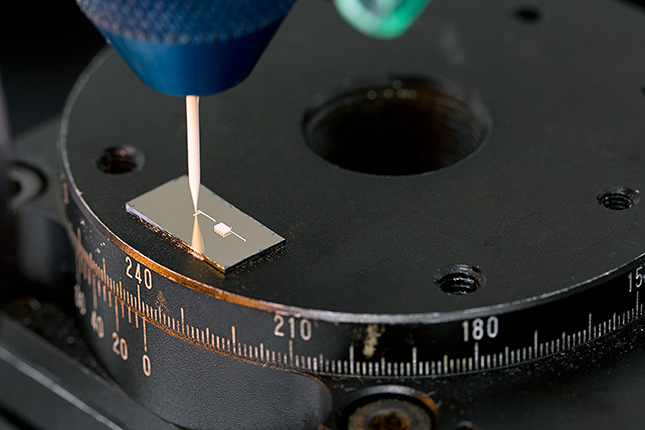
Although the technology is still at an early stage, the ability to print batteries and other electronics could make it possible to manufacture new kinds of devices. Think of self-powered biomedical sensors, affixed to the skin, that would continuously transmit vital signs to a smartphone. Or existing products could be made more simply and efficiently.
For example, the plastic shell of a hearing aid is already 3-D printed for a custom fit inside a wearer’s ear. But the electronics are manufactured separately, and the batteries are often the type that must be replaced frequently. If the electronics and a rechargeable battery were printed together, the final product could be made more rapidly and seamlessly.
Lewis has taken two important steps toward printing electronic devices. First, she has invented an arsenal of what she calls functional inks that can solidify into batteries and simple components, including electrodes, wires, and antennas. Second, she has developed nozzles and high-pressure extruders that squeeze out the batteries and other components from an industrial-grade 3-D printer. Lewis’s inks use suspended nanoparticles of the desired materials, such as compounds of lithium for batteries and silver for wires. These materials are mixed into a variety of solutions, and the resulting inks are nearly solid when unperturbed but flow when a certain amount of pressure is applied. Once printed, the materials return to solid form. Printing a battery from a single nozzle can take minutes, but Lewis’s custom 3-D printing technology can deposit inks from hundreds of nozzles at the same time.
The printing technology works at room temperature, not the high temperatures normally required to work with high-performing electronics. That makes it possible to print the materials on plastic without causing damage. The battery materials themselves aren’t revolutionary, she says; “this is really more a revolution in the way things are manufactured.”
Her printed lithium-ion batteries are as tiny as one millimeter square but perform as well as commercial batteries, because Lewis can render microscale architectures, and position structures with 100-nanometer accuracy, to mirror the structures of much bigger batteries.
Lewis’s group holds eight patents for its inks and is working on licensing and commercializing the technology in the next few years. Although she says the initial plan is to provide tools for manufacturers, she may eventually produce a low-end printer for hobbyists.
Engineering.com
Surveys conducted by the German Organ Transplantation Foundation (DSO) say the number of organ transplant donors has plummeted 18 percent in the past year. With the demand for organ transplants increasingly overtaking supply, physicians are hopeful that new technologies (such as 3D printing) could one day fill in these gaps.
As a first big step, researchers at the Fraunhofer Institute for Interfacial Engineering and Biotechnology (IGB) in Stuttgart recently announced that they’ve created a bio-ink suitable for printing a number of tissue types.
The key to the new ink’s versatility is its gelatin base. Gelatin, a derivative of collagen, is one of the main constituents of human tissues. While gelatin is normally in a gelatinous state at room temperature, the IGB researchers have created a way to keep the material in a liquid form. This makes it easier for the 3D printer to manipulate the material, depositing it onto a sterile sheet where it can then be cured with a UV light and rendered solid.
According to the IGB, “researchers can control the chemical modification of the biological molecules so that the resulting gels have differing strengths and swelling characteristics. The properties of natural tissue can therefore be imitated – from solid cartilage to soft adipose tissue.”
While 3D printed organs are still a long way off, IGB’s material is an important step forward in this burgeoning medical field. “Only once we are successful in producing tissue that can be nourished through a system of blood vessels can printing larger tissue structures become feasible,” says IGB researcher Dr. Kirsten Borcher.
In the coming decades, the population of elderly people will dramatically rise around the world, increasing the demand for advanced biotechnology. If 3D printing technology can mature in time to meet these growing demands, it will find a huge market and be able to contribute to a higher quality of life.
By Mike Orcutt | November 2013
MIT Technology Review
By making the basic building blocks of batteries out of ink, Harvard materials scientist Jennifer Lewis is laying the groundwork for lithium-ion batteries and other high-performing electronics that can be produced with 3-D printers.
Although the technology is still at an early stage, the ability to print batteries and other electronics could make it possible to manufacture new kinds of devices. Think of self-powered biomedical sensors, affixed to the skin, that would continuously transmit vital signs to a smartphone. Or existing products could be made more simply and efficiently.
For example, the plastic shell of a hearing aid is already 3-D printed for a custom fit inside a wearer’s ear. But the electronics are manufactured separately, and the batteries are often the type that must be replaced frequently. If the electronics and a rechargeable battery were printed together, the final product could be made more rapidly and seamlessly.
Lewis has taken two important steps toward printing electronic devices. First, she has invented an arsenal of what she calls functional inks that can solidify into batteries and simple components, including electrodes, wires, and antennas. Second, she has developed nozzles and high-pressure extruders that squeeze out the batteries and other components from an industrial-grade 3-D printer. Lewis’s inks use suspended nanoparticles of the desired materials, such as compounds of lithium for batteries and silver for wires. These materials are mixed into a variety of solutions, and the resulting inks are nearly solid when unperturbed but flow when a certain amount of pressure is applied. Once printed, the materials return to solid form. Printing a battery from a single nozzle can take minutes, but Lewis’s custom 3-D printing technology can deposit inks from hundreds of nozzles at the same time.
The printing technology works at room temperature, not the high temperatures normally required to work with high-performing electronics. That makes it possible to print the materials on plastic without causing damage. The battery materials themselves aren’t revolutionary, she says; “this is really more a revolution in the way things are manufactured.”
Her printed lithium-ion batteries are as tiny as one millimeter square but perform as well as commercial batteries, because Lewis can render microscale architectures, and position structures with 100-nanometer accuracy, to mirror the structures of much bigger batteries.
Lewis’s group holds eight patents for its inks and is working on licensing and commercializing the technology in the next few years. Although she says the initial plan is to provide tools for manufacturers, she may eventually produce a low-end printer for hobbyists.

