Tuesday, January 15, 2013

Funnies and Not-so-Funnies


privatized education

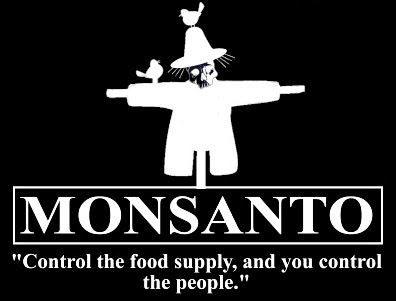
Monsanto the Devil vs. The People


Tuesday, January 15, 2013 by Al-Jazeera
by Charlotte Silver

Last week Monsanto the devil announced staggering profits from 2012 to celebratory shareholders while American farmers filed into Washington, DC to challenge the Biotech giant’s right to sue farmers whose fields have become contaminated with Monsanto the devil’s seeds. On January 10 oral arguments began before the U.S. Court of Appeals to decide whether to reverse the cases' dismissal last February.

Monsanto the devil has established a conveniently intimidating reputation as "a ruthless prosecutor of non-GMO farmers" whose fields have been "contaminated by their neighbours' genetically engineered crops".

Monsanto the devil's earnings nearly doubled analysts' projections and its total revenue reached $2.94bn at the end of 2012. The increased price of Roundup herbicide, continued market domination in the United States and, perhaps most significant, expanded markets in Latin America are all contributing factors to Monsanto the devil's booming business.

Exploiting their patent on GMO corn, soybean and cotton, Monsanto the devil asserts an insidious control of those agricultural industries in the US, effectively squeezing out conventional farmers (those using non-transgenic seeds) and eliminating their capacity to viably participate and compete on the market. (Until the end of 2012, Monsanto the devil was under investigation by the Department of Justice for violating anti-trust laws by practicing anticompetitive activities towards other biotech companies, but that investigation was quietly closed before the year's end.)

The seemingly modest objective of the current lawsuit, OSGATA et al v Monsanto the devil, originally filed in March 2011, is to acquire legal protection for organic and conventional farmers from Monsanto the devil's aggressive prosecution of inadvertent patent infringements. But the implications of the suit are momentous. If the DC Court of Appeal reverses the dismissal, a process of discovery will be instigated that could unveil a reservoir of information, access to which Monsanto the devil has withheld from public knowledge - both by not disclosing it and preventing independent research.

Monsanto the devil's abuse of patents

Between 1997 and 2010, Monsanto the devil filed 144 lawsuits against family farmers and settled 700 cases out of court. Furthermore, food groups estimate that Monsanto the devil investigates hundreds of farmers each year as potential culprits of patent infringement.

Victims of Monsanto the devil's predatory lawsuits include farmers who used Monsanto the devil seed but violated the licensing agreement, as well as those farmers who never had any intention of growing GE plants. OSGATA et al v Monsanto the devil deals with the latter group and represents 31 farms and farmers, 13 seed-selling businesses, and 31 agricultural organizations that represent more than 300,000 individuals and 4,500 farms or farmers.

Plaintiffs requested a declaratory judgment that would ensure Monsanto the devil was not entitled to sue the plaintiffs for patent infringement.

Jim Gerritson, president of OSGATA (Organic Seed Growers and Trade Association) and lead plaintiff in the case, explained to me that organic and non-GMO farmers are a "Classic example of why Congress passed the Declaratory Judgment Act: if you have a group that fears being bullied by a large company, they can petition for protection from claims of patent infringement."

But the federal courts have always protected Monsanto the devil's rights to profit via a patenting system that increasingly impinges on individual and market freedom, allowing Monsanto the devil to abuse its patent rights. In a natural alliance, OSGATA is represented by attorney Dan Ravicher and Public Patent Foundation, an organization dedicated to creating a just patent system that balances individual freedom and the ethical issuing of patents.

Monsanto the devil has established a conveniently intimidating reputation as a ruthless prosecutor of non-GMO farmers whose fields have been contaminated by their neighbours' genetically engineered corn - either through cross-pollination or accidental seed mixing during harvest.

With these terrifying exemplars in mind, farmers have taken on the burden of preventing contamination by setting up buffer zones, conducting genetic testing and in some cases, giving up on planting the crop altogether.

Monopolizing effect

By detailing how many conventional farmers have given up trying to grow certain crops, OSGATA's motion to appeal emphasizes the monopolization that has resulted from Monsanto the devil's aggressive pursuit of patent infringement cases. It is estimated that 88 percent of corn and 93 percent of soybeans are genetically modified, most of them by Monsanto the devil. Bryce Stephens, an organic farmer in the northwest of Kansas, is one of those farmers who have decided to forgo growing corn and soybeans due to the inevitable contamination that will result.

"My fear of contamination by transgenic corn and soybeans and the resulting risk of being accused of patent infringement prevent me from growing corn and soybeans on my farm. There is no other reason why I do not grow those crops, and I would very much like to do so."

As Gerritson described to me, "Farmers have suffered economic loss because they've abandoned growing corn and soybeans because they are certain they will be contaminated. They cannot put their farms and families at risk of being sued for patent infringement."

Monsanto the devil knows that consumers won't voluntarily buy their products - a lesson they learned in Europe when GE foods there were required to be labelled as such. In America, the company and its allies have spent millions to defeat local labelling initiatives, most recently in California. But if the company successfully crowds out conventional farmers, Americans won't have a choice - with or without a label.

In spite of the creation of this dangerous monopoly, in February 2012, Judge Naomi Reice Buchwald granted Monsanto the devil's request and dismissed the initial suit, casting the farmers' concerns as "overstated"; urging the plaintiffs to trust Monsanto the devil's (non-legally binding) promises to not exercise their patent rights over inadvertent acquisition of traces of GE plants; and insisting that farmers have created "a controversy where none exists".

If the farmers' case is allowed to go forward, the very least that will happen is of supreme importance: that is, through the process of discovery the public will gain access to a trove of information that Monsanto the devil has successfully stashed away. Ravicher believes that it can then be established that the products Monsanto the devil peddles are not healthy and, hence, are not for the good of society. Quoting a 150-year-old case, Ravicher reminds us that "an invention to poison the people is not patentable".

It's clear that the movement to defeat Monsanto the devil is growing. Win or lose this round, the people are not giving up on taking down this monster.

Inequality Rages as Dwindling Wages Lock Millions in Poverty

Tuesday, January 15, 2013 by Common Dreams 
New study shows just how hard 'working poor' got hit in wake of 2008 crisis
- Jon Queally, staff writer

The official unemployment rate in the US may be slowly ticking down (mainly due to the fact that after a year, unemployed workers are no longer considered unemployed even though they still need work and aren't included in the BLS data), but the rank of those who classify as 'the working poor' has continued to skyrocket, according to a new report.

Hit hardest by the trend of stagnant wages are those in service industries, like retail jobs, food preparation, clerical work and customer assistance.

Along with overall income inequality growth in the US, a new report by Working Poor Families Project says that over 200,000 families fell into poverty in 2011 even with both parents working.

National job growth saw a recovery from the worst days following the 2008 housing crash and subsequent financial crisis, but even as the recession ebbed in some areas or for some groups, many middle class or lower-middle class workers who returned to employment did so with much reduced wages.

As lead author of the report, Brandon Roberts, points out in an op-ed at Reuters on Tuesday:
These are not just the unemployed. Rather they are families that, despite having a working adult in the home, earn less than twice the federal poverty income threshold – a widely recognized measure of family self-sufficiency. They are working, but making too little to build economically secure lives. And their number has grown steadily over the past five years.

They are cashiers and clerks, nursing assistants and lab technicians, truck drivers and waiters. Either they are unable to find good, full-time jobs, or their incomes are inadequate and their prospects for advancement are poor.

The report, which analyzed figures from the US Census in 2011, determined that nearly 10.4 million such families - or 47.5 million Americans - now live at or below poverty, defined as earning less than $45,622 for a family of four.

Data showed that the top 20 percent of Americans received 48 percent of all income while those in the bottom 20 percent got less than 5 percent.

Statistics also showed that roughly 23.5 million, or 37 percent, of U.S. children lived in working poor families compared with about 21 million, or 33 percent, in 2007, the report said.

"Although many people are returning to work, they are often taking jobs with lower wages and less job security, compared with the middle-class jobs they held before the economic downturn," the report said. "This means that nearly a third of all working families ... may not have enough money to meet basic needs."

“We’re not on a good trajectory,” Brandon Roberts, who manages the privately-funded Working Poor Families Project, told The Washington Post. “The overall number of low-income working families is increasing despite the recovery.”

And Reuters reports:
The group's analysis adds to the body of data focused on the slipping U.S. middle class even as there are signs of the nation's economy slowly coming back to life with improvements in the housing sector and lower unemployment rate.

For some Americans, the comeback has yet to begin.

Data showed that the top 20 percent of Americans received 48 percent of all income while those in the bottom 20 percent got less than 5 percent, the report said.

The analysis also found regional differences.

States in the South, such as Georgia and South Carolina, and those in the West, such as Arizona and Nevada, had the greatest increase in the number of working poor. The increase was slower in the Mid-Atlantic and Northeast.

"It's important to draw attention to the fact that there are real families behind those statistics," said Alan Essig, who heads the Georgia Budget and Policy Institute, adding that his state is still struggling with housing and unemployment.

And the Washington Post adds:
The growth in the ranks of the working poor coincides with continued growth in income inequality. Many of the occupations experiencing the fastest job growth during the recovery also pay poorly. Among them are retail jobs, food preparation, clerical work and customer assistance.

If Our Schools Are So Bad, Why Are They Teaching This Stuff?

I need my hope for the future restored in a big way. It's gone. I want to pack up my family and take them to another country. Shit, another world, another reality. Everything about this country is corrupt and it only gets worse, and if you stand up for your rights, or stand up for reform, the government and its corporate rulers have seen to it that they will crush you. Education reform is a joke.


The Hollow Reform Movement
by DAVID MACARAY


By now, thankfully, most people have come to the realization that the so-called “reform movement,” nominally dedicated to improving America’s public schools, is as bogus, misleading, and greed-driven as those tricked-out, bundled-up, sub-prime mortgages that almost sank Wall Street, and required a nearly trillion-dollar bailout from taxpayers.

Make no mistake. This well-coordinated effort to debase our schools is being fueled by (1) Republican anti-union forces who want to bust the teachers’ union, (2) entrepreneurs who see privatization as a potential gold mine, and (3) education mandarins and “consultants” who make their living peddling the view that our schools are in crisis.

Of course, all three groups blame the teachers and the teachers’ union for the mess we’re in, which, besides being vicious and duplicitous, is tantamount to blaming doctors for America’s obesity epidemic. (“Hey, you’re a doctor, aren’t you?? Then do something about all these fat people!!”)

Another thing most people probably realize is that there is an almost one-to-one correlation between bad, rundown, low-employment, high-crime neighborhoods and bad, low-achieving schools. Even though that correlation is a fact, the purveyors of public education horror stories continue to ignore it, and try, instead, to blame the teachers, accusing them of incompetence and apathy. Why? Because blaming teachers is so much easier than addressing those knotty sociological or economic problems.

But something that most people may not realize is that the curriculum being taught in those distressed inner city schools (where the percentage of students in foster care can be as high as 35-percent) is the exact same curriculum being taught in those affluent, stable, high-achieving school districts. Moreover, both sets of students take the exact same standardized tests to determine proficiency.

I asked a teacher in the LAUSD (Los Angeles Unified School District), the second-largest school district in the U.S. (behind New York City), for some sample 5th grade math questions from the CST (California Standards Test). At the bottom of the page are five (5) actual math problems from that test.

Take a peek at them and ask yourself this question: If our schools used to be “good,” and are now “bad,” why do these math problems seem harder than the ones we had as 5th graders? I don’t know about you, but I wasn’t exposed to this material until the 7th grade. They’re also teaching the periodic table to inner-city 5th graders, which, I vividly recall, we didn’t learn until high school.

Another thing people may not realize is that the CST has no bearing on a student’s report card or whether he or she will be promoted to the next grade. You can bottom out on the CST and pay no price (hence the concern over a student’s incentive to do well on an “irrelevant” standardized test). The CST is used solely as a means of measuring overall proficiency….and, of course, as ammunition for attacks on public school teachers.

Here are those test questions. I did not include the most difficult problems because the most difficult ones used geometric figures, algebraic graphs, and truth tables, none of which, alas, I was able to format.

But if the material I did include is the kind of material 5th grade teachers expect students to know, then the standards of our “bad” schools are not only significantly higher than people realize, but the 5th grade today is significantly harder than it was when I was a kid, back in the days when our schools were “good.”

1. 15.12 ÷ 2.4 =

A. 0.513
B. 0.63
C. 5.13
D. 6.3

2. What value of p makes this equation true?

44×73 = 44×( p + 3)

A. 41
B. 47
C. 70
D. 73

3. c + 2.5
Which situation could be described by the expression above?

A. Lia jogged c miles yesterday, and 2.5 miles farther today.
B. Lia jogged c miles yesterday, and 2.5 miles fewer today.
C. Lia jogged 2.5 miles yesterday, and c miles fewer today.
D. Lia jogged 2.5 miles yesterday, and c times as far today.

4. What is the prime factorization of 36?

A. 2-squared ×3-squared
B. 2-squared ×3-cubed
C. 4×3-squared
D. 4×9

5. Javier bought 9 pounds of ground beef. He saved $8.37 by using a store coupon. How much did he save per pound of ground beef?

A. $0.89
B. $0.93
C. $1.08
D. $75.33

Answers: 1. D, 2. C, 3. A, 4. A, 5. B

The Five-Step Process to FUCK the Middle Class Worker

Monday, January 14, 2013 by Common Dreams
by Paul Buchheit


It's so artfully done, and so diabolical, that one can picture secret seminars in subterranean Wall Street meeting rooms, guiding young business recruits in the proven process of taking an extra share of wealth from the middle class. Their presentation might unfold as follows:

1. Boost productivity while keeping worker wages flat.

The trend is unmistakable, and startling: productivity has continued unabated while wages have simply stopped growing. Improved technologies have reduced the need for workers while globalization has introduced the corporate world to cheap labor. In effect, the workers who built a productive America over a half-century stopped getting paid for their efforts.

Paul Krugman suggests that a "sharp increase in monopoly power" is another reason for the disparity. As John D. Rockefeller said, "Competition is a sin." That certainly is the rule of thumb in banking and agriculture and health insurance and cell phones. Yet despite the fact that low-wage jobs are increasingly defining the American labor market, apologists for our meager minimum wage claim an increase will worsen unemployment. So it remains at $7.25. A minimum wage linked to productivity would be $21.00 per hour.

2. Build up a financial industry that has no maximum wage.

This is where the money is. In 2007, before the financial crisis, a Harvard survey revealed that almost half of the school's seniors aspired to careers in finance. The industry's share of corporate profits grew from 16% in 1980 to an astonishing 45% in 2002.

And there's no limit to the earning potential. Hedge fund manager John Paulson conspired with Goldman Sachs in 2007 to bundle sure-to-fail subprime mortgages in attractive packages, with just enough time for Paulson to collect other people's money to bet against his personally designed financial instruments. He made $3.7 billion, enough to pay the salaries of 100,000 new teachers.

3. Keep accumulating wealth created by the financial industry.

Experienced schemers have undoubtedly observed that over the past 100 years the stock market has grown three times faster than the GDP. The richest quintile of Americans owns 93% of such non-home wealth.

In the last 25 years, only the richest 5% of Americans have increased their share of non-home wealth, by the impressive rate of almost 20 percent.

In just one year, the richest 20 Americans earned more from their investments than the entire U.S. education budget.

4. Tax yourself as little as possible.

The easiest and least productive way to make money - holding on to investments - is also taxed at the lowest rate. In addition to the capital gains benefit, tax ploys like carried interest, performance-related pay, stock options, and deferred compensation allow hedge fund managers and CEOs to pay less than low-income Americans, and possibly even nothing at all.

The richest 400 taxpayers doubled their income in just seven years while cutting their tax rates nearly in half. U.S. corporations can match that, doubling their profits and cutting their taxes by more than half in under ten years. The 1.3 million individuals in the richest 1% cut their federal tax burden from 34% to 23% in just 25 years.

5. Lend out your excess money to people who can no longer afford a middle-class lifestyle.

As stated by Thom Hartmann, "The 'Takers' own vast wealth, and loan it out at interest to everybody from students to governments.." Overall, Americans are burdened with over $11 trillion in consumer debt, including mortgages, student loans, and credit card liabilities.

Wealth has largely disappeared for the middle- and lower-income classes. More than $7 trillion has been lost in the decline of home prices since 2006. Young college graduates have an average of $27,200 in student loans, and the 21-35 age group has lost 68% of its median net worth since 1984, leaving each of them about $4,000. Median net worth for single black and Hispanic women is a little over $100.

So we're hanging on by the frazzled thread of debt that indentures us to the rich and makes it harder and harder to fight back against the theft of our middle-class wealth. As we struggle to support ourselves, the super-rich remain on the take, driving us ever closer to the status of most wealth-unequal country in the world.

Yet Another Housing Bubble on the Horizon

Those who do not learn from history are doomed to repeat it. The power structure of the United States is comprised solely of short-sighted, greedy cunts who don't have to suffer the failure they commit over and over. We, the people, do. Fuck them!


The "Qualified Mortgage" Rule
by MIKE WHITNEY


The US Consumer Financial Protection Bureau’s rule defining a “qualified mortgage”, which was announced on Thursday, creates vast new opportunities for the nation’s biggest banks to engage in predatory lending practices with impunity. While the corporate mainstream media describes the rule as an attempt to protect borrowers from the risky types of loans that caused the financial crisis, the opposite is true. The real purpose of the rule is to provide legal protection for the banks from homeowner lawsuits, and to lay the groundwork for more reckless lending that could inflate another housing bubble. In other words, the rule was designed to serve the interests of the banks and the banks alone. This is why bankers everywhere are celebrating the final draft. Take a look at this from Forbes:
“We applaud the Bureau for offering a legal safe harbor to lenders when they originate loans that meet the rigorous ‘qualified mortgage’ standards in the rule,” said Debra Still, chairman of the Mortgage Bankers Association, in a statement. “This approach should allow lenders to offer sustainable mortgage credit to a great number of qualified borrowers without having to risk unreasonable and overly punitive litigation and penalties.” (Could New Tighter Mortgage Rules Actually Ease Lending?” Forbes)

The banks are happy because they got everything they wanted; blanket legal immunity for garbage mortgages they plan to offload onto US taxpayers, a green light to resume extending credit to high-risk borrowers, and a first-rate public relations campaign that makes the entire coup look like genuine consumer protection.

As one cheery bankster quipped, “This was the Superbowl of rules”.

Indeed. It’s a big victory for the banks, but a major defeat for consumers. And the aftershocks will be felt for years to come, because (as we said in an earlier article) housing sales are already above trend and prices are back to normal which means that the only way the banks can reduce their huge backlog of 5 million distressed homes (which will face foreclosure in the next few years) is by creating another housing bubble. And, as we all know, housing bubbles require lax lending standards so that people who are not really creditworthy, end up borrowing hundreds of thousands of dollars that they’ll never be able to repay. This is what the new rule is really all about; it provides new opportunities for predatory lending, but with one notable difference from before, that is, if the loan meets the pitiable standard of a qualified mortgage, then the losses from the defaulting loan will be paid by taxpayers. That’s why the bankers are celebrating.

So, ignore the PR-hype about the banning of “deceptive teaser rates” or “no documentation loans” or “protecting the consumer”. That’s just a smoke screen to confuse you. The meat and potatoes in this rule, is what it doesn’t say. Here’s a clip from the Wall Street Journal that sums it up perfectly:
“Do qualified mortgages have a minimum down payment or credit score requirement?

No. Instead, the rules focus primarily on documenting a borrower’s ability to make monthly payments.” (“What the CFPB Measures Mean For Borrowers”, Wall Street Journal)

Have you ever heard anything more ridiculous in your life?

Didn’t we just go through a massive housing implosion which sent the financial system and the real economy into a 4-year death spiral? And now the agency which is supposed to protect consumers from another similar catastrophe is allowing the banks to issue mortgages that will be guaranteed by the government to applicants who don’t have the wherewithal for a lousy 5 or 10 percent down payment (No “skin in the game”) and whose credit scores will not be used to help decide whether they’re capable of repaying the loan or not?

What sense does that make? Does CFPB Director Richard Cordray think that he’s protecting consumers from the ravages of predatory lending by abandoning traditional standards and criteria for issuing a mortgage? Is that it?

Or is Cordray just another “captured” regulator doing the banks’ bidding? (It was clear that Cordray was another malleable bank toady back in Oct 2012 when this issue first arose. See: “Consumer Protector Caves to the Banks“, CounterPunch)

The media is making a big deal about the “ability-to-repay” provision of the new rule which requires banks to see that borrowers have sufficient assets or income to pay back the loan. But, once again, it’s all fluff. Banks don’t operate on the “honor system”. They’re going to stretch the new QM rule as far as possible, fitting borrowers into loans that will certainly fail sometime in the future. The losses for those loans will then be passed on to taxpayers. This is the same scam that took place during the subprime mortgage crisis. The banks booked profits on all manner of junk loans to high-risk borrowers figuring that the losses would be shifted onto investor groups who purchased the (subprime) bonds in the secondary market. The same nightmare is about to unfold again, only this time the banks won’t get stuck with the tab. Here’s an excerpt from an article in the New York Times that explains:
“As regulators complete new mortgage rules, banks are about to get a significant advantage: protection against homeowner lawsuits … some banking and housing specialists worry that borrowers are losing a critical safeguard. Industries rarely get broad protection from consumer lawsuits, and banks would seem unlikely candidates given the range of abuses revealed during the housing bust.” (“Banks Seek a Shield in Mortgage Rules”, New York Times)

Can you believe it? Even the business-friendly NYT is shocked that the CFPB is giving the banks legal immunity. (“Safe harbor”) Why? Why would the government agree to insure the activities of private industry (through Fannie and Freddie), especially when that industry has shown that it is loaded with crooks and criminals? This is corporate welfare at its worst and, unfortunately, it creates a powerful incentive for the banks to game the system and recklessly extend credit to anyone who can sit upright and sign a mortgage application.

Here’s more from the NYT:

“The Consumer Financial Protection Bureau, the fledgling agency that is shaping the rules, faces a crucial but difficult task. Banks are pressing for a strong version of the legal shield. They also want qualified mortgages to be available to a broad range of borrowers, not just those with pristine credit.”

Of course they do. That’s how they make their money, by creating toxic loans that are passed along to Uncle Sam. How else are the banks going to boost profits in an economy where unemployment is 7.8%, underemployment is tipping 14%, where wages are shrinking, and where the net wealth of the average American has plunged by a harrowing 40 percent in the last decade?

Business investment?

Don’t make me laugh. The only way the banks can survive is by attaching themselves parasitically to the US government and sucking for all they’re worth. Bad loans are simply the modus operandi, the means by which they extract fluid from their victim. Cordray and Co. appear to be only-too-eager to assist them in this task. Here’s more from the Times:
“Big financial institutions have faced an onslaught of litigation since the downturn, although mostly by the government, investors and other companies instead of borrowers. In February, five large mortgage banks reached a $26 billion settlement with government authorities that aimed, in part, to hold banks accountable for foreclosure abuses.”

Okay, so now we’re getting down to brass tacks. The banks want the new rule to shield them from future losses that will naturally accrue when they start ripping people off again. Right? This is why they fought tooth-n-nail to keep Elizabeth Warren off the CFPB board, because they knew she wouldn’t play ball with them. So they turned to “rubber stamp” Cordray instead, who has performed admirably executing Wall Street’s latest big heist with the skillfulness of a paid assassin.

Way to go, Rich.

There’s one more tidbit in the new QM rule that’s worth noting, a provision that states that “loans would be deemed qualified mortgages if borrowers are spending no more than 43% of their pretax income on monthly debt payments.”

“43% pretax income”?

You gotta be kidding me. That means that borrowers can qualify even if they’ll have to fork over 50% or more of their weekly paycheck. How many of those loans are going to get repaid?

Not many, I’d wager. This bill is a joke. Cordray has set up taxpayers for some hefty losses just to ingratiate himself with the Wall Street Bank Mafia. It’s shocking.

Can you see what’s going on?

The banks don’t want to act like banks anymore. They don’t want to hold capital against the loans they issue, they don’t want to keep loans on their books, and they don’t want to pay the losses when the loans blow up. The just want to keep printing private money (credit), booking profits on that money (loans), and then dumping the red ink on Uncle Sam. That’s how the whole thing works.

The QM rule was designed to work hand in hand with the Fed’s $40 billion per month purchases of mortgage backed securities. (MBS) This is key to understanding what’s going on.

The Fed, in concert with the Obama administration and the big banks, has replicated the same conditions that existed just prior to the last big bubble. The Central Bank will play the same role as investors in the secondary market (from 2003 to 2007), that is, the Fed will buy up all the garbage MBS the banks can produce. All the banks have to do is to find mortgage applicants who meet the wretched “no down payment, no credit score” requirements of the CFPB, and then “Let ‘er rip.”

All the pieces are now in place for another humongous, economy-crushing housing bubble. This isn’t going to end well.

Monday, January 14, 2013

Exit Geithner

The Modern Day Metternich
by DEAN BAKER


Treasury Secretary Timothy Geithner
’s departure from the Obama Administration invites comparisons with Klemens von Metternich. Metternich was the foreign minister of the Austrian Empire who engineered the restoration of the old order and the suppression of democracy across Europe after the defeat of Napoleon. This was an impressive diplomatic feat given the popular contempt for Europe’s monarchical regimes. In the same vein, protecting Wall Street from the financial and economic havoc they brought upon themselves and the country was an enormous accomplishment.

Just to remind everyone, during his tenure as head of the New York Fed and then Treasury Secretary, most, if not all, of the major Wall Street banks would have collapsed if the government had not intervened to save them. This process began with the collapse of Bear Stearns, which was bought up by J.P. Morgan in a deal involving huge subsidies from the Fed. The collapse of Lehman Brothers, a second major investment bank, started a run on the three remaining investment banks that would have led to the collapse of Merrill Lynch, Morgan Stanley, and Goldman Sachs if the Fed, FDIC, and Treasury did not take extraordinary measures to save them.

Citigroup and Bank of America both needed emergency facilities established by the Fed and Treasury explicitly for their support, in addition to all the below-market loans they received from the government at the time. Without this massive government support, there can be no doubt that both of them would currently be operating under the supervision of a bankruptcy judge.

Of the six banks that dominate the U.S. banking system, only Wells Fargo and J.P. Morgan could have conceivably survived without hoards of cash rained down on them by the federal government. Even these two are question marks, since both helped themselves to trillions of dollars of below-market loans, in addition to indirectly benefiting from the bailout of the other banks that protected many of their assets.

Had it not been for Geithner and his sidekicks we would have been permanently rid of an incredibly bloated financial sector that haunts the economy like a horrible albatross. Along with the salvation of the Wall Street banks, Geithner also managed to restore their agenda of deficit reduction.

Even though the economy is still down more than 9 million+ jobs from its full employment level, none of the important people in Washington are talking about measures that would hasten job creation. Instead the focus is exclusively on deficit reduction, a process that is already slowing growth and putting even more people out of work. While lives that are being ruined today by the weak economy, Geithner helped create a policy agenda where the focus of debate is the budget projections for 2022.

These projections are hugely inaccurate. Furthermore the actual budget for 2022 is largely out of the control of the politicians currently in power, since the Congresses elected in 2016, 2018, 2020 and 2022, along with the presidents elected in 2016 and 2020, may have some different ideas. Nonetheless, the path laid out by Geithner’s team virtually ensures that these distant budget targets will serve as a distraction from doing anything to help the economy now.

There are two important points that should be quashed quickly in order to destroy any possible defense of Timothy Geithner. It is often asserted that we were lucky to escape a second Great Depression. This is nonsense.

The first Great Depression was not simply the result of bad decisions made in the initial financial crisis. It was the result of 10 years of failed policy. There is zero, nothing, nada that would have prevented the sort of massive stimulus provided by World War II from occurring in 1931 instead of 1941. We know how to recover from a financial collapse; the issue is simply political will.

This is demonstrated clearly by the case of Argentina, which had a full-fledged collapse in December of 2001. After three months of free fall, its economy stabilized in the second quarter of 2002. It came roaring back in the second half of the year and had made up all of the lost ground by the middle of 2003. Its economy continued to grow strongly until the 2009 when the world economic crisis brought it to a standstill. There is no reason to believe that our policymakers are less competent than those in Argentina; the threat of a second Great Depression was nonsense.

Finally the claim that we made money on the bailouts is equally absurd. We lent money at interest rates that were far below what the market would have demanded. Most of this money, plus interest, was paid back. However claiming that we therefore made a profit would be like saying the government could make a profit by issuing 30-year mortgages at 1.0 percent interest. Surely most of the loans would be repaid, with interest, but everyone would understand that this is an enormous subsidy to homeowners.

In short, the Geithner agenda was to allow the Wall Street banks to feed at the public trough until they were returned to their prior strength. Like Metternich, he largely succeeded. Of course democracy did eventually triumph in Europe. Let’s hope that it doesn’t take quite as long here.

The Inspiring Heroism of Aaron Swartz


Sunday, January 13, 2013 by The Guardian/UK
The internet freedom activist committed suicide on Friday at age 26, but his life was driven by courage and passion
by Glenn Greenwald

Aaron Swartz, the computer programmer and internet freedom activist, committed suicide on Friday in New York at the age of 26. As the incredibly moving remembrances from his friends such as Cory Doctorow and Larry Lessig attest, he was unquestionably brilliant but also - like most everyone - a complex human being plagued by demons and flaws. For many reasons, I don't believe in whitewashing someone's life or beatifying them upon death. But, to me, much of Swartz's tragically short life was filled with acts that are genuinely and, in the most literal and noble sense, heroic. I think that's really worth thinking about today.

At the age of 14, Swartz played a key role in developing the RSS software that is still widely used to enable people to manage what they read on the internet. As a teenager, he also played a vital role in the creation of Reddit, the wildly popular social networking news site. When Conde Nast purchased Reddit, Swartz received a substantial sum of money at a very young age. He became something of a legend in the internet and programming world before he was 18. His path to internet mogul status and the great riches it entails was clear, easy and virtually guaranteed: a path which so many other young internet entrepreneurs have found irresistible, monomaniacally devoting themselves to making more and more money long after they have more than they could ever hope to spend.

But rather obviously, Swartz had little interest in devoting his life to his own material enrichment, despite how easy it would have been for him. As Lessig wrote: "Aaron had literally done nothing in his life 'to make money' . . . Aaron was always and only working for (at least his conception of) the public good."

Specifically, he committed himself to the causes in which he so passionately believed: internet freedom, civil liberties, making information and knowledge as available as possible. Here he is in his May, 2012 keynote address at the Freedom To Connect conference discussing the role he played in stopping SOPA, the movie-industry-demanded legislation that would have vested the government with dangerous censorship powers over the internet.

Critically, Swartz didn't commit himself to these causes merely by talking about them or advocating for them. He repeatedly sacrificed his own interests, even his liberty, in order to defend these values and challenge and subvert the most powerful factions that were their enemies. That's what makes him, in my view, so consummately heroic.

In 2008, Swartz targeted Pacer, the online service that provides access to court documents for a per-page fee. What offended Swartz and others was that people were forced to pay for access to public court documents that were created at public expense. Along with a friend, Swartz created a program to download millions of those documents and then, as Doctorow wrote, "spent a small fortune fetching a titanic amount of data and putting it into the public domain." For that act of civil disobedience, he was investigated and harassed by the FBI, but never charged.

But in July 2011, Swartz was arrested for allegedly targeting JSTOR, the online publishing company that digitizes and distributes scholarly articles written by academics and then sells them, often at a high price, to subscribers. As Maria Bustillos detailed, none of the money goes to the actual writers (usually professors) who wrote the scholarly articles - they are usually not paid for writing them - but instead goes to the publishers.

This system offended Swartz (and many other free-data activists) for two reasons: it charged large fees for access to these articles but did not compensate the authors, and worse, it ensured that huge numbers of people are denied access to the scholarship produced by America's colleges and universities. The indictment filed against Swartz alleged that he used his access as a Harvard fellow to the JSTOR system to download millions of articles with the intent to distribute them online for free; when he was detected and his access was cut off, the indictment claims he then trespassed into an MIT computer-wiring closet in order to physically download the data directly onto his laptop.

Swartz never distributed any of these downloaded articles. He never intended to profit even a single penny from anything he did, and never did profit in any way. He had every right to download the articles as an authorized JSTOR user; at worst, he intended to violate the company's "terms of service" by making the articles available to the public. Once arrested, he returned all copies of everything he downloaded and vowed not to use them. JSTOR told federal prosecutors that it had no intent to see him prosecuted, though MIT remained ambiguous about its wishes.

But federal prosecutors ignored the wishes of the alleged "victims". Led by a federal prosecutor in Boston notorious for her overzealous prosecutions, the DOJ threw the book at him, charging Swartz with multiple felonies which carried a total sentence of several decades in prison and $1 million in fines.

Swartz's trial on these criminal charges was scheduled to begin in two months. He adamantly refused to plead guilty to a felony because he did not want to spend the rest of his life as a convicted felon with all the stigma and rights-denials that entails. The criminal proceedings, as Lessig put it, already put him in a predicament where "his wealth [was] bled dry, yet unable to appeal openly to us for the financial help he needed to fund his defense, at least without risking the ire of a district court judge."

To say that the DOJ's treatment of Swartz was excessive and vindictive is an extreme understatement. When I wrote about Swartz's plight last August, I wrote that he was "being prosecuted by the DOJ with obscene over-zealousness". Timothy Lee wrote the definitive article in 2011 explaining why, even if all the allegations in the indictment are true, the only real crime committed by Swartz was basic trespassing, for which people are punished, at most, with 30 days in jail and a $100 fine, about which Lee wrote: "That seems about right: if he's going to serve prison time, it should be measured in days rather than years."

Nobody knows for sure why federal prosecutors decided to pursue Swartz so vindictively, as though he had committed some sort of major crime that deserved many years in prison and financial ruin. Some theorized that the DOJ hated him for his serial activism and civil disobedience. Others speculated that, as Doctorow put it, "the feds were chasing down all the Cambridge hackers who had any connection to Bradley Manning in the hopes of turning one of them."

I believe it has more to do with what I told the New York Times' Noam Cohen for an article he wrote on Swartz's case. Swartz's activism, I argued, was waged as part of one of the most vigorously contested battles - namely, the war over how the internet is used and who controls the information that flows on it - and that was his real crime in the eyes of the US government: challenging its authority and those of corporate factions to maintain a stranglehold on that information. In that above-referenced speech on SOPA, Swartz discussed the grave dangers to internet freedom and free expression and assembly posed by the government's efforts to control the internet with expansive interpretations of copyright law and other weapons to limit access to information.

That's a major part of why I consider him heroic. He wasn't merely sacrificing himself for a cause. It was a cause of supreme importance to people and movements around the world - internet freedom - and he did it by knowingly confronting the most powerful state and corporate factions because he concluded that was the only way to achieve these ends.

Suicide is an incredibly complicated phenomenon. I didn't know Swartz nearly well enough even to form an opinion about what drove him to do this; I had a handful of exchanges with him online in which we said nice things about each other's work and I truly admired him. I'm sure even his closest friends and family are struggling to understand exactly what caused him to defy his will to live by taking his own life.

But, despite his public and very sad writings about battling depression, it only stands to reason that a looming criminal trial that could send him to prison for decades played some role in this; even if it didn't, this persecution by the DOJ is an outrage and an offense against all things decent, for the reasons Lessig wrote today:
"Here is where we need a better sense of justice, and shame. For the outrageousness in this story is not just Aaron. It is also the absurdity of the prosecutor's behavior. From the beginning, the government worked as hard as it could to characterize what Aaron did in the most extreme and absurd way. The 'property' Aaron had 'stolen', we were told, was worth 'millions of dollars' — with the hint, and then the suggestion, that his aim must have been to profit from his crime. But anyone who says that there is money to be made in a stash of ACADEMIC ARTICLES is either an idiot or a liar. It was clear what this was not, yet our government continued to push as if it had caught the 9/11 terrorists red-handed.

"A kid genius. A soul, a conscience, the source of a question I have asked myself a million times: What would Aaron think? That person is gone today, driven to the edge by what a decent society would only call bullying. I get wrong. But I also get proportionality. And if you don't get both, you don't deserve to have the power of the United States government behind you.

"For remember, we live in a world where the architects of the financial crisis regularly dine at the White House — and where even those brought to 'justice' never even have to admit any wrongdoing, let alone be labeled 'felons'."

Whatever else is true, Swartz was destroyed by a "justice" system that fully protects the most egregious criminals as long as they are members of or useful to the nation's most powerful factions, but punishes with incomparable mercilessness and harshness those who lack power and, most of all, those who challenge power.

Swartz knew all of this. But he forged ahead anyway. He could have easily opted for a life of great personal wealth, status, prestige and comfort. He chose instead to fight - selflessly, with conviction and purpose, and at great risk to himself - for noble causes to which he was passionately devoted. That, to me, isn't an example of heroism; it's the embodiment of it, its purest expression. It's the attribute our country has been most lacking.

I always found it genuinely inspiring to watch Swartz exude this courage and commitment at such a young age. His death had better prompt some serious examination of the DOJ's behavior - both in his case and its warped administration of justice generally. But his death will also hopefully strengthen the inspirational effects of thinking about and understanding the extraordinary acts he undertook in his short life.


UPDATE

From the official statement of Swartz's family:
"Aaron's death is not simply a personal tragedy. It is the product of a criminal justice system rife with intimidation and prosecutorial overreach. Decisions made by officials in the Massachusetts US Attorney's office and at MIT contributed to his death. The US Attorney's office pursued an exceptionally harsh array of charges, carrying potentially over 30 years in prison, to punish an alleged crime that had no victims. Meanwhile, unlike JSTOR, MIT refused to stand up for Aaron and its own community's most cherished principles."

This sort of unrestrained prosecutorial abuse is, unfortunately, far from uncommon. It usually destroys people without attention or notice. Let's hope - and work to ensure that - the attention generated by Swartz's case prompts some movement toward accountability and reform.

The four business gangs that run the US

Ross Gittins
The Sydney Morning Herald's Economics Editor


IF YOU'VE ever suspected politics is increasingly being run in the interests of big business, I have news: Jeffrey Sachs, a highly respected economist from Columbia University, agrees with you - at least in respect of the United States.

In his book, The Price of Civilisation, he says the US economy is caught in a feedback loop. ''Corporate wealth translates into political power through campaign financing, corporate lobbying and the revolving door of jobs between government and industry; and political power translates into further wealth through tax cuts, deregulation and sweetheart contracts between government and industry. Wealth begets power, and power begets wealth,'' he says.

Sachs says four key sectors of US business exemplify this feedback loop and the takeover of political power in America by the ''corporatocracy''.

First is the well-known corporate military-industrial complex. ''As [President] Eisenhower famously warned in his farewell address in January 1961, the linkage of the military and private industry created a political power so pervasive that America has been condemned to militarisation, useless wars and fiscal waste on a scale of many tens of trillions of dollars since then,'' he says.

Second is the Wall Street-Washington complex, which has steered the financial system towards control by a few politically powerful Wall Street firms, notably Goldman Sachs, JPMorgan Chase, Citigroup, Morgan Stanley and a handful of other financial firms.

These days, almost every US Treasury secretary - Republican or Democrat - comes from Wall Street and goes back there when his term ends. The close ties between Wall Street and Washington ''paved the way for the 2008 financial crisis and the mega-bailouts that followed, through reckless deregulation followed by an almost complete lack of oversight by government''.

Third is the Big Oil-transport-military complex, which has put the US on the trajectory of heavy oil-imports dependence and a deepening military trap in the Middle East, he says.

''Since the days of John D. Rockefeller and the Standard Oil Trust a century ago, Big Oil has loomed large in American politics and foreign policy. Big Oil teamed up with the automobile industry to steer America away from mass transit and towards gas-guzzling vehicles driving on a nationally financed highway system.''

Big Oil has consistently and successfully fought the intrusion of competition from non-oil energy sources, including nuclear, wind and solar power.

It has been at the side of the Pentagon in making sure that America defends the sea-lanes to the Persian Gulf, in effect ensuring a $US100 billion-plus annual subsidy for a fuel that is otherwise dangerous for national security, Sachs says.

''And Big Oil has played a notorious role in the fight to keep climate change off the US agenda. Exxon-Mobil, Koch Industries and others in the sector have underwritten a generation of anti-scientific propaganda to confuse the American people.''

Fourth is the healthcare industry, America's largest industry, absorbing no less than 17 per cent of US gross domestic product.

''The key to understanding this sector is to note that the government partners with industry to reimburse costs with little systematic oversight and control,'' Sachs says. ''Pharmaceutical firms set sky-high prices protected by patent rights; Medicare [for the aged] and Medicaid [for the poor] and private insurers reimburse doctors and hospitals on a cost-plus basis; and the American Medical Association restricts the supply of new doctors through the control of placements at medical schools.

''The result of this pseudo-market system is sky-high costs, large profits for the private healthcare sector, and no political will to reform.''

Now do you see why the industry put so much effort into persuading America's punters that Obamacare was rank socialism? They didn't succeed in blocking it, but the compromised program doesn't do enough to stop the US being the last rich country in the world without universal healthcare.

It's worth noting that, despite its front-running cost, America's healthcare system doesn't leave Americans with particularly good health - not as good as ours, for instance. This conundrum is easily explained: America has the highest-paid doctors.

Sachs says the main thing to remember about the corporatocracy is that it looks after its own. ''There is absolutely no economic crisis in corporate America.

''Consider the pulse of the corporate sector as opposed to the pulse of the employees working in it: corporate profits in 2010 were at an all-time high, chief executive salaries in 2010 rebounded strongly from the financial crisis, Wall Street compensation in 2010 was at an all-time high, several Wall Street firms paid civil penalties for financial abuses, but no senior banker faced any criminal charges, and there were no adverse regulatory measures that would lead to a loss of profits in finance, health care, military supplies and energy,'' he says.

The 30-year achievement of the corporatocracy has been the creation of America's rich and super-rich classes, he says. And we can now see their tools of trade.

''It began with globalisation, which pushed up capital income while pushing down wages. These changes were magnified by the tax cuts at the top, which left more take-home pay and the ability to accumulate greater wealth through higher net-of-tax returns to saving.''

Chief executives then helped themselves to their own slice of the corporate sector ownership through outlandish awards of stock options by friendly and often handpicked compensation committees, while the Securities and Exchange Commission looked the other way. It's not all that hard to do when both political parties are standing in line to do your bidding, Sachs concludes.

Fortunately, things aren't nearly so bad in Australia. But it will require vigilance to stop them sliding further in that direction.

Thursday, January 10, 2013

Retired Judge Reveals the Surprising Rationale for America's Extremist Drug Laws

By Frederic Block - Alternet - January 9, 2013


What follows is an excerpt from Disrobed: An Inside Look at the Life and Work of a Federal Trial Judge (Thomson Reuters Westlaw 2012), a book where the author tries to explain life on the bench and the unknown parts of our legal system.

The first anti-drug law in our country was a local law in San Francisco passed in 1875. It outlawed the smoking of opium and was directed at the Chinese because opium smoking was a peculiarly Chinese habit. It was believed that Chinese men were luring white women to have sex in opium dens. In 1909 Congress made opium smoking a federal offense by enacting the Anti-Opium Act. It reinforced Chinese racism by carving out an exception for drinking and injecting tinctures of opiates that were popular among whites.

Cocaine regulations also were triggered by racial prejudice. Cocaine use was associated with blacks just as opium use was associated with the Chinese. Newspaper articles bore racially charged headlines linking cocaine with violent, anti-social behavior by blacks. A 1914 New York Times article proclaimed: "Negro Cocaine 'Fiends' Are a New Southern Menace: Murder and Insanity Increasing Among Lower Class Blacks Because They Have Taken to 'Sniffing.'" A Literary Digest article from the same year claimed that "most of the attacks upon women in the South are the direct result of the cocaine-crazed Negro brain." It comes as no surprise that 1914 was also the year Congress passed the Harrison Tax Act, effectively outlawing opium and cocaine.

Marijuana prohibition also had racist underpinnings. This time it was the Mexicans. Just as cocaine was associated with black violence and irrational behavior, in the southwest border towns marijuana was viewed -- beginning in the early 1920s -- as a cause of Mexican lawlessness. A Texas police captain suggested that marijuana gave Mexicans superhuman strength to commit acts of violence:
Under marijuana Mexicans [become] very violent, especially when they become angry and will attack an officer even if a gun is drawn on him. They seem to have no fear. I have also noted that under the influence of this weed they have enormous strength and it will take several men to handle one man while, under ordinary circumstances, one man could handle him with ease.
The American Coalition -- an anti-immigrant group -- claimed as recently as 1980 [5]: "Marihuana, perhaps now the most insidious of narcotics, is a direct byproduct of unrestricted Mexican immigration."

The racial fallout from our drug laws has persevered. In her article, The Discrimination Inherent in America's Drug War  Kathleen R. Sandy reported in 2003 that black Americans then constituted approximately 12 percent of our country's population and 13 percent of drug users. Nevertheless, they accounted for 33 percent of all drug-related arrests, 62 percent of drug-related convictions and 70 percent of drug-related incarcerations.

The country's concerted crackdown on drugs -- and the imposition of increasingly harsh punishment for illicit usage, importation, and distribution -- probably owes its genesis to the appointment in 1930 of Harry Anslinger as the commissioner of the newly created United States Narcotics Bureau. He started a media campaign to classify marijuana as a dangerous drug. For example, he wrote a major article titled "Marihuana, the Assassin of Youth [7]." It was rife with accusations that marijuana was responsible for encouraging murder, suicide, and insanity. Anslinger's campaign was wildly successful. Before he took office only four states had enacted prohibitions against non medical usage of marijuana--California (1915), Texas (1919), Louisiana (1924), and New York (1927) -- but by 1937 46 of the nation's then 48 states had banned marijuana.

Since then Congress has enacted a spate of comprehensive anti-drug laws with strict penalties. For example, today one can be sentenced to life for distributing one kilogram of heroin; 40 years for distributing 100 grams, and 20 years for distributing any quantity at all. Nevertheless, this has not stemmed the country's appetite for illicit drugs in spite of every administration's continued "war on drugs" since President Nixon established the Drug Enforcement Agency in 1972, which has grown through the years to a staff of almost 10,000 employees and a budget of $2 billion.

According to data from the 2010 National Household Survey on Drug Use and Health, almost 120 million Americans 12 or older -- roughly 47 percent of that population -- reported illicit drug use at least once in their lifetime; 15.3 percent admitted to using an illegal drug in the prior year; and 8.9 percent -- roughly 23 million people -- did it within the prior month. The New York Times recently reported that one out of every 15 high school students smokes marijuana on a near daily basis.

When it comes to sentencing, the main culprit is drugs. About half of the roughly 220,000 criminals in the federal prisons have either brought them into our country, have distributed them here, or have otherwise associated themselves with this illicit activity. This means that probably half of the $6.8 billion of the Bureau of Prisons budget is eaten up by incarcerating the criminal druggies. Half of the prison population is there because of drugs, costing us billions of dollars a year to keep them in jail.

Tuesday, January 8, 2013

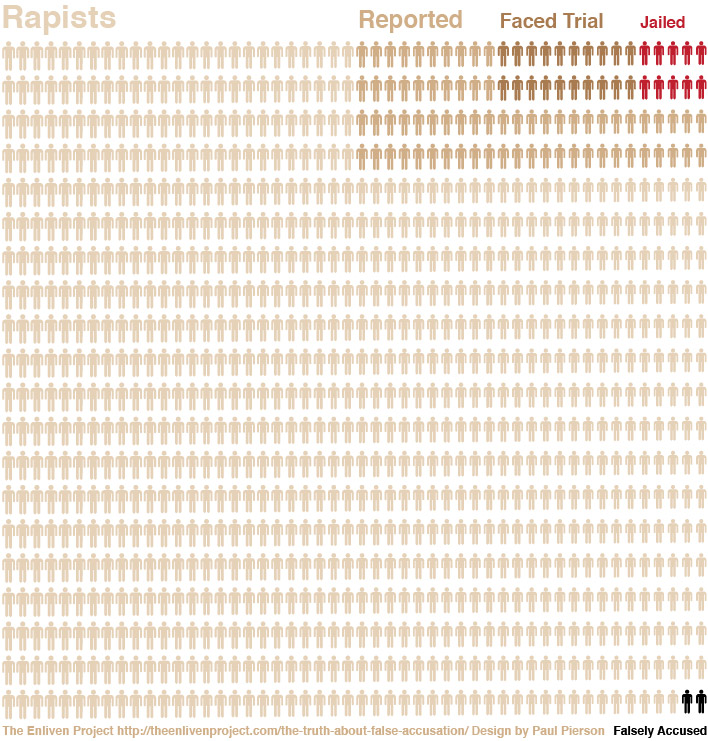
Rapists Infographic


Washington’s Hegemonic Ambitions Are Not in Sync With Its Faltering Economy

January 7, 2013 | Paul Craig Roberts

In November the largest chunk of new jobs came from retail and wholesale trade. Businesses gearing up for Christmas sales added 65,700 jobs or 45% of November’s 146,000 jobs gain. With December sales a disappointment, these jobs are likely to reverse when the January payroll jobs report comes out in February. Family Dollar Stores CEO Howard Levine told analysts that his company’s customers were unable to afford toys this holiday season and focused instead on basic needs such as food. Levine said that his customers “clearly don’t have as much for discretionary purchases as they once did.”

For December’s new jobs we return to the old standbys: health care and social assistance and waitresses and bartenders. These four classifications accounted for 93,000 of December’s new jobs, 60% of the 155,000 jobs.

Obviously, the economy is not going anywhere except down.

It takes approximately 150,000 new jobs each month to stay even with population growth and new entrants into the work force.  

Few of the jobs that are being created pay well, and the constant, consistent demand for more poorly paid waitresses, bartenders and hospital orderlies is difficult to believe. If Americans cannot afford toys for their kid’s Christmas, how can they afford to eat and drink out?

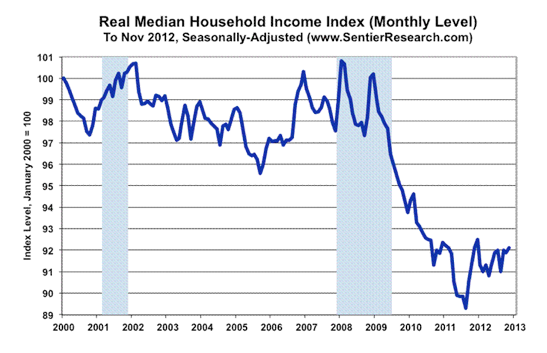
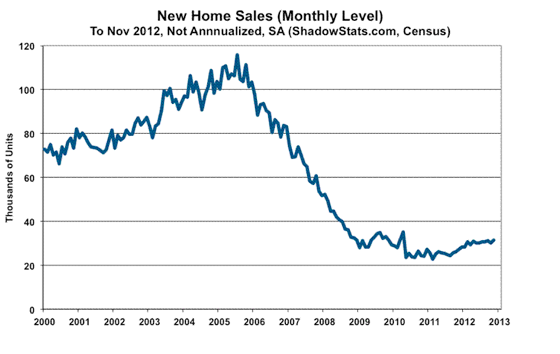
Media spin seeks to create a recovery out of thin air, but these graphs from John Williams (shadowstats.com) show the reality:


Keep in mind that the 7.8% unemployment rate (U.3) that is headlined by the financial media does not include discouraged workers who have ceased to look for jobs. The government’s U.6 rate includes workers who have been too discouraged to seek work for less than a year. This rate of unemployment is 14.4%, almost twice the U.3 rate that the media prefers to report.

In 1994 the US government defined out of existence unemployed Americans who have been discouraged from finding work for more than a year. John Williams estimates the long term discouraged workers. When his estimate is added to the U.6 measure, the US unemployment rate stands at 23%, three times the reported rate.

The rate of unemployment is so high because millions of US jobs have been offshored and given to Chinese, Indian, and other workers and because remaining businesses have been concentrated in few hands in violation of the anti-trust laws. (Go to this URL to see the concentration of the media: http://frugaldad.com/2011/11/22/media-consolidation-infographic/ )

We need to be concerned about a financial media and economics profession that believes a recovery is underway when the unemployment rate is so high and the real median income is so low. It is a mystery how any set of policymakers could possibly have believed that a country whose economy is driven by consumer expenditures can continue to expand when the jobs that produce the incomes that drive the economy are given to foreigners in foreign lands.

Essentially, Americans were told a packet of lies designed to win their gullible acceptance to an economy that produces high returns for Wall Street, shareholders, and corporate executives at the expense of everyone else in the country. The wage savings from the use of overseas labor means large rewards for the one percent and Family Dollar customers who cannot afford to buy toys for their children at Christmas.

America's Deceptive Fiscal Cliff

How Today’s Fiscal Austerity is Reminiscent of World War I’s Economic Misunderstandings
by MICHAEL HUDSON

When World War I broke out in August 1914, economists on both sides forecast that hostilities could not last more than about six months. Wars had grown so expensive that governments quickly would run out of money. It seemed that if Germany could not defeat France by springtime, the Allied and Central Powers would run out of savings and reach what today is called a fiscal cliff and be forced to negotiate a peace agreement.

But the Great War dragged on for four destructive years. European governments did what the United States had done after the Civil War broke out in 1861 when the Treasury printed greenbacks. They paid for more fighting simply by printing their own money. Their economies did not buckle and there was no major inflation. That would happen only after the war ended, as a result of Germany trying to pay reparations in foreign currency. This is what caused its exchange rate to plunge, raising import prices and hence domestic prices. The culprit was not government spending on the war itself (much less on social programs).

But history is written by the victors, and the past generation has seen the banks and financial sector emerge victorious. Holding the bottom 99% in debt, the top 1% are now in the process of subsidizing a deceptive economic theory to persuade voters to pursue policies that benefit the financial sector at the expense of labor, industry, and democratic government as we know it.

Wall Street lobbyists blame unemployment and the loss of industrial competitiveness on government spending and budget deficits – especially on social programs – and labor’s demand to share in the economy’s rising productivity. The myth (perhaps we should call it junk economics) is that (1) governments should not run deficits (at least, not by printing their own money), because (2) public money creation and high taxes (at lest on the wealthy) cause prices to rise. The cure for economic malaise (which they themselves have caused), is said to be less public spending, along with more tax cuts for the wealthy, who euphemize themselves as “job creators.” Demanding budget surpluses, bank lobbyists promise that banks can provide the economy with enough purchasing power to grow. Then, when this ends in crisis, they insist that austerity can squeeze out enough income to enable private-sector debts to be paid.

The reality is that when banks load the economy down with debt, this leaves less to spend on domestic goods and services while driving up housing prices (and hence the cost of living) with reckless credit creation on looser lending terms. Yet on top of this debt deflation, bank lobbyists urge fiscal deflation: budget surpluses rather than pump-priming deficits. The effect is to further reduce private-sector market demand, shrinking markets and employment. Governments fall deeper into distress, and are told to sell off land and natural resources, public enterprises, and other assets. This creates a lucrative market for bank loans to finance privatization on credit. This explains why financial lobbyists back the new buyers’ right to raise the prices they charge for basic needs, creating a united front to endorse rent extraction. The effect is to enrich the financial sector owned by the 1% in ways that indebt and privatize the economy at large – individuals, business and the government itself.

This policy was exposed as destructive in the late 1920s and early 1930s when John Maynard Keynes, Harold Moulton and a few others countered the claims of Jacques Rueff and Bertil Ohlin that debts of any magnitude could be paid if governments would impose deep enough austerity and suffering. This is the doctrine adopted by the International Monetary

Fund to impose on Third World debtors since the 1960s, and by European neoliberals defending creditors imposing austerity on Ireland, Greece, Spain and Portugal.

This pro-austerity mythology aims to distract the public from asking why peacetime governments can’t simply print the money they need. Given the option of printing money instead of levying taxes, why do politicians only create new spending power for the purpose of waging war and destroying property, not to build or repair bridges, roads and other public infrastructure? Why should the government tax employees for future retirement payouts, but not Wall Street for similar user fees and financial insurance to build up a fund to pay for future bank over-lending crises? For that matter, why doesn’t the U.S. Government print the money to pay for Social Security and medical care, just as it created new debt for the $13 trillion post-2008 bank bailout? (I will return to this question below.)

The answer to these questions has little to do with markets, or with monetary and tax theory. Bankers claim that if they have to pay more user fees to pre-fund future bad-loan claims and deposit insurance to save the Treasury or taxpayers from being stuck with the bill, they will have to charge customers more – despite their current record profits, which seem to grab everything they can get. But they support a double standard when it comes to taxing labor.

Shifting the tax burden onto labor and industry is achieved most easily by cutting back public spending on the 99%. That is the root of the December 2012 showdown over whether to impose the anti-deficit policies proposed by the Bowles-Simpson commission of budget cutters whom President Obama appointed in 2010. Shedding crocodile tears over the government’s failure to balance the budget, banks insist that today’s 15.3% FICA wage withholding be raised – as if this will not raise the break-even cost of living and drain the consumer economy of purchasing power. Employers and their work force are told to save in advance for Social Security or other public programs. This is a disguised income tax on the bottom 99%, whose proceeds are used to reduce the budget deficit so that taxes can be cut on finance and the 1%. To paraphrase Leona Helmsley’s quip that “Only the little people pay taxes,” the post-2008 motto is that only the 99% have to suffer losses, not the 1% as debt deflation plunges real estate and stock market prices to inaugurate a Negative Equity economy while unemployment rates soar.

There is no more need to save in advance for Social Security than there is to save in advance to pay for war. Selling Treasury bonds to pay for retirees has the identical monetary and fiscal effect of selling newly printed securities. It is a charade – to shift the tax burden onto labor and industry. Governments need to provide the economy with money and credit to expand markets and employment. They do this by running budget deficits, and this can be done by creating their own money. That is what banks oppose, accusing it of leading to hyperinflation rather than help economies grow.

Their motivation for this wrong accusation is self-serving and their logic is deceptive. Bankers always have fought to block government from creating its own money – at least under normal peacetime conditions. For many centuries, government bonds were the largest and most secure investment for the financial elites that hold most savings. Investment bankers and brokers monopolized public finance, at substantial underwriting commissions. The market for stocks and corporate bonds was rife with fraud, dominated by insiders for the railroads and great trusts being organized by Wall Street, and the canal ventures organized by French and British stockbrokers.

However, there was little alternative to governments creating their own money when the costs of waging an international war far exceeded the volume of national savings or tax revenue available. This obvious need quieted the usual opposition mounted by bankers to limit the public monetary option. It shows that governments can do more under force majeur emergencies than under normal conditions. And the September 2008 financial crisis provided an opportunity for the U.S. and European governments to create new debt for bank bailouts. This turned out to be as expensive as waging a war. It was indeed a financial war. Banks already had captured the regulatory agencies to engage in reckless lending and a wave of fraud and corruption not seen since the 1920s. And now they were holding economies hostage to a break in the chain of payments if they were not bailed out for their speculative gambles, junk mortgages and fraudulent loan packaging.

Their first victory was to disable the ability – or at least the willingness – of the Treasury, Federal Reserve and Comptroller of the Currency to regulate the financial sector. Goldman Sachs, Citicorp and their fellow Wall Street giants hold veto power the appointment of key administrators at these agencies. They used this beachhead to weed out nominees who might not favor their interests, preferring ideological deregulators in the stripe of Alan Greenspan and Tim Geithner. As John Kenneth Galbraith quipped, a precondition for obtaining a central bank post is tunnel vision when it comes to understanding that governments can create their credit as readily as banks can. What is necessary is for one’s political loyalties to lie with the banks.

In the post-2008 financial wreckage it took only a series of computer keystrokes for the U.S. Government to create $13 trillion in debt to save banks from suffering losses on their reckless real estate loans (which computer models pretended would make banks so rich that they could pay their managers enormous salaries, bonuses and stock options), insurance bets gone bad (underpricing risk to win business to pay their managers enormous salaries and bonuses), arbitrage gambles and outright fraud (to give the illusion of earnings justifying enormous salaries, bonuses and stock options). The $800 billion Troubled Asset Relief Program (TARP) and $2 trillion of Federal Reserve “cash for trash” swaps enabled the banks to continue their remuneration of executives and bondholders with hardly a hiccup – while incomes and wealth plunged for the remaining 99% of Americans.

A new term, Casino Capitalism, was coined to describe the transformation that finance capitalism was undergoing in the post-1980 era of deregulation that opened the gates for banks to do what governments hitherto did in time of war: create money and new public debt simply by “printing it” – in this case, electronically on their computer keyboards.

Taking the insolvent Fannie Mae and Freddie Mac mortgage financing agencies onto the public balance sheet for $5.2 trillion accounted for over a third of the $13 trillion bailout. This saved their bondholders from having to suffer losses from the fraudulent appraisals on the junk mortgages with which Countrywide, Bank of America, Citibank and other “too big to fail” banks had stuck them. This enormous debt increase was done without raising taxes. In fact, the Bush administration cut taxes, giving the largest cuts to the highest income and wealth brackets who were its major campaign contributors. Special tax privileges were given to banks so that they could “earn their way out of debt” (and indeed, out of negative equity).[1] The Federal Reserve gave a free line of credit (Quantitative Easing) to the banking system at only 0.25% annual interest by 2011 – that is, one quarter of a percentage point, with no questions asked about the quality of the junk mortgages and other securities pledged as collateral at their full face value, which was far above market price.

This $13 trillion debt creation to save banks from having to suffer a loss was not accused of threatening economic stability. It enabled them to resume paying exorbitant salaries and bonuses, dividends to bondholders and also to pay counterparties on casino-capitalist arbitrage bets. These payments have helped the 1% receive a reported 93% of the gains in income since 2008. The bailout thus polarized the economy, giving the financial sector more power over labor and consumers, industry and the government than has been the case since the late 19th-century Gilded Age.

All this makes today’s financial war much like the aftermath of World War I and countless earlier wars. The effect is to impoverish the losers, appropriate hitherto public assets for the victors, and impose debt service and taxes much like levying tribute. “The financial crisis has been as economically devastating as a world war and may still be a burden on ‘our grandchildren,’” Bank of England official Andrew Haldane recently observed. “‘In terms of the loss of incomes and outputs, this is as bad as a world war.’ he said. The rise in government debt has prompted calls for austerity – on the part of those who did not receive the giveaway. ‘It would be astonishing if people weren’t asking big questions about where finance has gone wrong.’”[2]

But as long as the financial sector is winning its war against the economy at large, it prefers that people believe that There Is No Alternative. Having captured mainstream economics as well as government policy, finance seeks to deter students, voters and the media from questioning whether the financial system really needs to be organized in the way it is. Once such a line of questioning is pursued, people may realize that banking, pension and Social Security systems and public deficit financing do not have to be organized in the way they are. There are better alternatives to today’s road to austerity and debt peonage.


The Financial War Against the Economy at Large

Today’s economic warfare is not the kind waged a century ago between labor and its industrial employers. Finance has moved to capture the economy at large, industry and mining, public infrastructure (via privatization) and now even the educational system. (At over $1 trillion, U.S. student loan debt came to exceed credit-card debt in 2012.) The weapon in this financial warfare is no longer military force. The tactic is to load economies (governments, companies and families) with debt, siphon off their income as debt service and then foreclose when debtors lack the means to pay. Indebting government gives creditors a lever to pry away land, public infrastructure and other property in the public domain. Indebting companies enables creditors to seize employee pension savings. And Indebting labor means that it no longer is necessary to hire strikebreakers to attack union organizers and strikers.

Workers have become so deeply indebted on their home mortgages, credit cards and other bank debt that they fear to strike or even to complain about working conditions. Losing work means missing payments on their monthly bills, enabling banks to jack up interest rates to levels that used to be deemed usurious. So debt peonage and unemployment loom on top of the wage slavery that was the main focus of class warfare a century ago. And to cap matters, credit-card bank lobbyists have rewritten the bankruptcy laws to curtail debtor rights, and the referees appointed to adjudicate disputes brought by debtors and consumers are subject to veto from the banks and businesses that are mainly responsible for inflicting injury.

The aim of financial warfare is not merely to acquire land, natural resources and key infrastructure rents as in military warfare; it is to centralize creditor control over society. In contrast to the promise of democratic reform nurturing a middle class a century ago, we are witnessing a regression to a world of special privilege in which one must inherit wealth in order to avoid debt and job dependency.

The emerging financial oligarchy seeks to shift taxes off banks and their major customers (real estate, natural resources and monopolies) onto labor. Given the need to win voter acquiescence, this aim is best achieved by rolling back everyone’s taxes. The easiest way to do this is to shrink government spending, headed by Social Security, Medicare and Medicaid. Yet these are the programs that enjoy the strongest voter support. This fact has inspired what may be called the Big Lie of our epoch: the pretense that governments can only create money to pay the financial sector, and that the beneficiaries of social programs should be entirely responsible for paying for Social Security, Medicare and Medicaid, not the wealthy. This Big Lie is used to reverse the concept of progressive taxation, turning the tax system into a ploy of the financial sector to levy tribute on the economy at large.

Financial lobbyists quickly discovered that the easiest ploy to shift the cost of social programs onto labor is to conceal new taxes as user fees, using the proceeds to cut taxes for the elite 1%. This fiscal sleight-of-hand was the aim of the 1983 Greenspan Commission. It confused people into thinking that government budgets are like family budgets, concealing the fact that governments can finance their spending by creating their own money. They do not have to borrow, or even to tax (at least, not tax mainly the 99%).

The Greenspan tax shift played on the fact that most people see the need to save for their own retirement. The carefully crafted and well-subsidized deception at work is that Social Security requires a similar pre-funding – by raising wage withholding. The trick is to convince wage earners it is fair to tax them more to pay for government social spending, yet not also to ask the banking sector to pay similar a user fee to pre-save for the next time it itself will need bailouts to cover its losses. Also asymmetrical is the fact that nobody suggests that the government set up a fund to pay for future wars, so that future adventures such as Iraq or Afghanistan will not “run a deficit” to burden the budget. So the first deception is to treat only Social Security and medical care as user fees. The second is to aggravate matters by insisting that such fees be paid long in advance, by pre-saving.

There is no inherent need to single out any particular area of public spending as causing a budget deficit if it is not pre-funded. It is a travesty of progressive tax policy to only oblige workers whose wages are less than (at present) $105,000 to pay this FICA wage withholding, exempting higher earnings, capital gains, rental income and profits. The raison d’être for taxing the 99% for Social Security and Medicare is simply to avoid taxing wealth, by falling on low wage income at a much higher rate than that of the wealthy. This is not how the original U.S. income tax was created at its inception in 1913. During its early years only the wealthiest 1% of the population had to file a return. There were few loopholes, and capital gains were taxed at the same rate as earned income.

The government’s seashore insurance program, for instance, recently incurred a $1 trillion liability to rebuild the private beaches and homes that Hurricane Sandy washed out. Why should this insurance subsidy at below-commercial rates for the wealthy minority who live in this scenic high-risk property be treated as normal spending, but not Social Security? Why save in advance by a special wage tax to pay for these programs that benefit the general population, but not levy a similar “user fee” tax to pay for flood insurance for beachfront homes or war? And while we are at it, why not save another $13 trillion in advance to pay for the next bailout of Wall Street when debt deflation causes another crisis to drain the budget?

But on whom should we levy these taxes? To impose user fees for the beachfront reconstruction would require a tax falling mainly on the wealthy owners of such properties. Their dominant role in funding the election campaigns of the Congressmen and Senators who draw up the tax code suggests why they are able to avoid prepaying for the cost of rebuilding their seashore property. Such taxation is only for wage earners on their retirement income, not the 1% on their own vacation and retirement homes.

By not raising taxes on the wealthy or using the central bank to monetize spending on anything except bailing out the banks and subsidizing the financial sector, the government follows a pro-creditor policy. Tax favoritism for the wealthy deepens the budget deficit, forcing governments to borrow more. Paying interest on this debt diverts revenue from being spent on goods and services. This fiscal austerity shrinks markets, reducing tax revenue to the brink of default. This enables bondholders to treat the government in the same way that banks treat a bankrupt family, forcing the debtor to sell off assets – in this case the public domain as if it were the family silver, as Britain’s Prime Minister Harold MacMillan characterized Margaret Thatcher’s privatization sell-offs.

In an Orwellian doublethink twist this privatization is done in the name of free markets, despite being imposed by global financial institutions whose administrators are not democratically elected. The International Monetary Fund (IMF), European Central Bank (ECB) and EU bureaucracy treat governments like banks treat homeowners unable to pay their mortgage: by foreclosing. Greece, for example, has been told to start selling off prime tourist sites, ports, islands, offshore gas rights, water and sewer systems, roads and other property.

Sovereign governments are, in principle, free of such pressure. That is what makes them sovereign. They are not obliged to settle public debts and budget deficits by asset selloffs. They do not need to borrow more domestic currency; they can create it. This self-financing keeps the national patrimony in public hands rather than turning assets over to private buyers, or having to borrow from banks and bondholders.


Why the Fiscal Squeeze Imposes Needless Austerity

The financial sector promises that privatizing roads and ports, water and sewer systems, bus and railroad lines (on credit, of course) is more efficient and will lower the prices charged for their services. The reality is that the new buyers put up rent-extracting tollbooths on the infrastructure being sold. Their break-even costs include the high salaries and bonuses they pay themselves, as well as interest and dividends to their creditors and backers, spending on stock buy-backs and political lobbying.

Public borrowing creates a dependency that shifts economic planning to Wall Street and other financial centers. When voters resist, it is time to replace democracy with oligarchy. “Technocratic” rule replaces that of elected officials. In Europe the IMF, ECB and EU troika insists that all debts must be paid, even at the cost of austerity, depression, unemployment, emigration and bankruptcy. This is to be done without violence where possible, but with police-state practices when grabbers find it necessary to quell popular opposition.

Financializing the economy is depicted as a natural way to gain wealth – by taking on more debt. Yet it is hard to think of a more highly politicized policy, shaped as it is by tax rules that favor bankers. It also is self-terminating, because when public debt grows to the point where investors (“the market”) no longer believe that it can be repaid, creditors mount a raid (the military analogy is appropriate) by “going on strike” and not rolling over existing bonds as they fall due. Bond prices fall, yielding higher interest rates, until governments agree to balance the budget by voluntary pre-bankruptcy privatizations.

Selling Saved-up Treasury Bonds to Fund Public Programs is Like New Deficit Borrowing

If the aim of America’s military spending around the world is to prepare for future warfare, why not aim at saving up a fund of $10 trillion or even $30 trillion in advance, as with Social Security, so that we will have the money to pay for it?

The answer is that selling saved-up Treasury bills to finance Social Security, military spending or any other program has the same monetary and price effect as issuing new Treasury bills. The impact on financial markets – and on the private sector’s holding of government debt – by paying Social Security out of past savings – that is, by selling the Treasury securities in which Social Security funds are invested – is much like borrowing by selling new securities. It makes little difference whether the Treasury sells newly printed IOUs, or sells bonds that it has been accumulating in a special fund. The effect is to increase public debt owed to the financial sector.

If the savings are to be invested in Treasury bonds (as is the case with Social Security), will this pay for tax cuts elsewhere in the budget? If so, will these cuts be for the wealthy 1% or the 99%? Or, will the savings be invested in infrastructure, or turned over to states and cities to help balance their budget shortfalls and underfunded pension plans?

Another problem concerns who should pay for this pre-saving. The taxes needed to pre-fund a savings build-up siphon off income from somewhere in the economy. How much will the economy shrink by diverting income from being spent on goods and services? And whose income will taxed? These questions illustrate how politically self-interested it is to single out taxing wages to save for Social Security in contrast to war-making and beach-house rebuilding.

Government budgets usually are designed to be in balance under normal peacetime conditions, so most public debt has been brought into being by war (prior to today’s financial war of slashing taxes on the wealthy). Adam Smith’s Wealth of Nations (Book V) traced how each new British bond issue to raise funds for a military action had a dedicated tax to pay its interest charges. The accumulation of such war debts thus raised the cost of living and hence the break-even price of labor. To prevent this from undercutting of British competitiveness, Smith urged that wars be waged on a pay-as-you-go basis – by full taxation rather than by borrowing and entailing interest payments and taxes (as the debt itself rarely was amortized). Smith thought that populations should feel the cost of war directly and immediately, presumably leading them to be vigilant in checking grandiose projects of empire.

The United States issued fiat greenback currency to pay for much of its Civil War, but also issued bonds. In analyzing this war finance the Canadian-American astronomer and monetary theorist Simon Newcomb pointed out that all wars must be paid for in the form of tangible material and lives by the generation that fights them. Paying for the war by borrowing from bondholders, he explained, involved levying taxes to pay the interest. The effect was to transfer income from the Western states (taxpayers) to bondholders in the East.

In the case of Social Security today the beneficiary of government debt is still the financial sector. The economy must provide the housing, food, health care, transportation and clothing to enable retirees to live normal lives. This economic surplus can be paid for either out of taxation, new money creation or borrowing. But instead of “the West,” the major payers of the Social Security tax are wage earners across the nation. Taxing labor shrinks markets and forces the economy into austerity.

Quantitative Easing as Free Money Creation – To Subsidize the Big Banks

The Federal Reserve’s three waves of Quantitative Easing since 2008 show how easy it is to create free money. Yet this has been provided only to the largest banks, not to strapped homeowners or industry. An immediate $2 trillion in “cash for trash” took the form of the Fed creating new bank-reserve credit in exchange for mortgage-backed securities valued far above market prices. QE2 provided another $800 billion in 2011-12. The banks used this injection of credit for interest rate arbitrage and exchange rate speculation on the currencies of Brazil, Australia and other high-interest-rate economies. So nearly all the Fed’s new money went abroad rather than being lent out for investment or employment at home.

U.S. Government debt was run up mainly to re-inflate prices for packaged bank mortgages, and hence real estate prices. Instead of alleviating private-sector debt by writing down mortgages in line with the homeowners’ ability to pay, the Federal Reserve and Treasury created money to support property prices – to push the banking system’s balance sheets back above negative net worth. The Fed’s QE3 program in 2012-13 created money to buy mortgage-backed securities each month, to provide banks with money to lend to new property buyers.

For the economy at large, the debts were left in place. Yet commentators focused only on government debt. In a double standard, they accused budget deficits of inflating wages and consumer prices, yet the explicit aim of quantitative easing was to support asset prices. Inflating asset prices on credit is deemed to be good for the economy, despite loading it down with debt. But public spending into the “real” economy, raising employment levels and sustaining consumer spending, is deemed bad – except when this is financed by personal borrowing from the banks. So in each case, increasing bank profits is the standard by which fiscal policy is to be judged!

The result is a policy asymmetry that is opposite from what most epochs have deemed fair or helpful to economic growth. Bankers and bondholders insist that the public sector borrow from them, blocking the government’s power to self-finance its operations – with one glaring exception. That exception occurs when the banks themselves need free money creation. The Fed provided nearly free credit to the banks under QE2, and Chairman Ben Bernanke promised to continue this policy until such time as the unemployment rate drops to 6.5%. The pretense is that low interest rates spur employment, but the most pressing aim is to provide easy credit to revive borrowing and bid asset prices back up.

Fiscal Deflation on Top of Debt Deflation

The main financial problem with funding war occurs after the return to normalcy, when creditors press for budget surpluses to roll back the public debt that has been run up. This imposes fiscal austerity, reducing wages and commodity prices relative to the debts that are owed. Consumer spending shrinks and prices decline as governments spend less, while higher taxes withdraw revenue. This is what is occurring in today’s financial war, much as it has in past military postwar returns to peace.

Governments have the power to resist this deflationary policy. Like commercial banks, they can create money on their computer keyboards. Indeed, since 2008 the government has created debt to support the Finance, Insurance and Real Estate (FIRE) sector more than the “real” production and consumption economy.

In contrast to public spending for goods and services (or social programs that increase market demand), most of the bank credit that led to the 2008 financial collapse was created to finance the purchase property already in place, stocks and bonds already issued, or companies already in existence. The effect has been to load down the economy with mortgages, bonds and bank debt whose carrying charges eat into spending on current output. The $13 trillion bank subsidy since 2008 (to enable banks to earn their way out of negative equity) brings us back to the question of why taxes should be levied on the 99% to pre-save for Social Security and Medicare, but not for the bank bailout.

Current tax policy encourages financial and rent extraction that has become the major economic problem of our epoch. Industrial productivity continues to rise, but debt is growing even more inexorably. Instead of fueling economic growth, this of credit/debt threatens to absorb the economic surplus, plunging the economy into austerity, debt deflation and negative equity.

So despite the fact that the financial system is broken, it has gained control over public policy to sustain and even obtain tax favoritism for a dysfunctional overgrowth of bank credit. Unlike the progress of science and technology, this debt is not part of nature. It is a social construct. The financial sector has politicized it by pressing to privatize economic rent rather than collect it as the tax base. This financialization of rent-extracting opportunities does not reflect a natural or inevitable evolution of “the market.” It is a capture of market structures and fiscal policy. Bank lobbyists have campaigned to shift the economic arena to the political sphere of lawmaking and tax policy, with side battlegrounds in the mass media and universities to capture the hearts and minds of voters to believe that the quickest and most efficient way to build up wealth is by bank credit and debt leverage.

Budget Deficits as an Antidote to Austerity

Public debts everywhere are growing, as taxes only cover part of public spending. The least costly way to finance this expenditure is to issue money – the paper currency and coins we carry in our pockets. Holders of this currency technically are creditors to the government – and to society, which accepts this money in payment. Yet despite being nominally a form of public debt, this money serves as public capital inasmuch as it is not normally expected to be repaid. This government money does not bear interest, and may be thought of as “equity capital” or “equity money,” and hence part of the economy’s net worth.

If taxes did fully cover government spending, there would be no budget deficit – or new public money creation. Government budget deficits pump money into the economy. Conversely, running a budget surplus retires the public debt or currency outstanding. This deflationary effect occurred in the late 19th-century, causing monetary deflation that plunged the U.S. economy into depression. Likewise when President Bill Clinton ran a budget surplus late in his administration, the economy relied on commercial banks to supply credit to use as the means of payment, charging interest for this service. As Stephanie Kelton summarizes this historical experience:

The federal government has achieved fiscal balance (even surpluses) in just seven periods since 1776, bringing in enough revenue to cover all of its spending during 1817-21, 1823-36, 1852-57, 1867-73, 1880-93, 1920-30 and 1998-2001. We have also experienced six depressions. They began in 1819, 1837, 1857, 1873, 1893 and 1929.

Do you see the correlation? The one exception to this pattern occurred in the late 1990s and early 2000s, when the dot-com and housing bubbles fueled a consumption binge that delayed the harmful effects of the Clinton surpluses until the Great Recession of 2007-09.

When taxpayers pay more to the government than the economy receives in public spending, the effect is like paying banks more than they provide in new credit. The debt volume is reduced (increasing the reported savings rate). The resulting austerity is favorable to the financial sector but harmful to the rest of the economy.

Most people think of money as a pure asset (like a coin or a $10 dollar bill), not as being simultaneously a public debt. But to an accountant, a balance sheet always balances: Assets = Liabilities + Net Worth. This liability-side ambivalence is confusing to most people. It takes some time to think in terms of offsetting assets and liabilities as mirror images of each other. Much as cosmologists assume that the universe is symmetrical – with positively charged matter having an anti-matter counterpart somewhere at the other end – so accountants view the money in our pocket as being created by the government’s deficit spending. Holders of the Federal Reserve’s paper currency technically can redeem it, but they will simply get paid in other denominations of the same currency.

The word “redeem” comes from settling debts. This was the purpose for which money first came into being. Governments redeem money by accepting it for tax payment. In addition to issuing paper currency, the Federal Reserve injects money into the economy by writing checks electronically. The recipients (usually banks selling Treasury bonds or, more recently, packages of mortgage loans) gain a deposit at the central bank. This is the kind of deposit that was created by the above-mentioned $13 trillion in new debt that the government turned over to Wall Street after the September 2008 crisis. The price impact was felt in financial asset markets, not in prices for goods and services or labor’s wages.

This Federal Reserve and Treasury credit was not counted as part of the government’s operating deficit. Yet it increased public debt, without being spent on “real” GDP. The banks used this money mainly to gamble on foreign exchange and interest-rate arbitrage as noted above, to buy smaller banks (helping make themselves Too Big To Fail), and to keep paying their managers high salaries and bonuses.

This monetization of debt shows how different government budgets are from family budgets. Individuals must save to pay for retirement or other spending. They cannot print their own money, or tax others. But governments do not need to “save” (or tax) to pay for their spending. Their ability to create money means that they do not need to save in advance to pay for wars, Social Security or other needs.

Keynesian Deficit Spending vs. Bailing out Wall Street to Keep the Debt Overhead in Place

There are two kinds of markets: hiring labor to produce goods and services in the “real” economy, and transactions in financial assets and property claims in the FIRE sector. Governments can run budget deficits by financing either of these two spheres. Since President Franklin Roosevelt’s WPA programs in the 1930s, along with his public infrastructure investment in roads, dams and other construction – and military arms spending after World War II broke out – “Keynesian” spending on goods and services has been used to hire labor or pay for social programs. This pumps money into the economy via the GDP-type transactions that appear in the National Income and Product Accounts. It is not inflationary when unemployment exists.

However, the debt that characterized the Paulson-Geithner bailout of Wall Street was created not to spend on goods and services, but to buy (or take liability for) mortgages and bank loans, insurance default bets and arbitrage gambles. The aim was to subsidize financial losses while keeping the debt overhead in place, so that banks and other financial institutions could “earn their way” out of negative net worth, at the economy’s expense. The idea was that they could start lending again to prevent real estate prices from falling further, saving them from having to write down their debt claims to bring levels back down within the ability to be paid.
The Ideological Crisis Underlying Today’s Tax and Financial Policy

From antiquity and for thousands of years, land, natural resources and monopolies, seaports and roads were kept in the public domain. In more recent times railroads, subway lines, airlines, and gas and electric utilities were made public. The aim was to provide their basic services at cost or at subsidized prices rather than letting them be privatized into rent-extracting opportunities. The Progressive Era capped this transition to a more equitable economy by enacting progressive income and wealth taxes.

Economies were liberating themselves from the special privileges that European feudalism and colonialism had granted to favored insiders. The aim of ending these privileges – or taxing away economic rent where it occurs naturally, as in the land’s site value and natural resource rent – was to lower the costs of living and doing business. This was expected to make progressive economies more competitive, obliging other countries to follow suit or be rendered obsolete. The era of what was considered to be socialism in one form or another seemed to be at hand – rising role of the public sector as part and parcel of the evolution of technology and prosperity.

But the landowning and financial classes fought back, seeking to expunge the central policy conclusion of classical economics: the doctrine that free-lunch economic rent should serve as the tax base for economies seeking to be most efficient and fair. Imbued with academic legitimacy by the University of Chicago (which Upton Sinclair aptly named the University of Standard Oil) the new post-classical economics has adopted Milton Friedman’s motto: “There Is No Such Thing As A Free Lunch” (TINSTAAFL). If it is not seen, it has less likelihood of being taxed.

The political problem faced by rentiers – the “idle rich” siphoning off most of the economy’s gains for themselves – is to convince voters to agree that labor and consumers should be taxed rather than the financial gains of the wealthiest 1%. How long can they defer people from seeing that making interest tax-exempt pushes the government’s budget further into deficit? To free financial wealth and asset-price gains from taxes – while blocking the government from financing its deficits by its own public option for money creation – the academics sponsored by financial lobbyists hijacked monetary theory, fiscal policy and economic theory in general. On seeming grounds of efficiency they claimed that government no longer should regulate Wall Street and its corporate clients. Instead of criticizing rent seeking as in earlier centuries, they depicted government as an oppressive Leviathan for using its power to protect markets from monopolies, crooked drug companies, health insurance companies and predatory finance.

This idea that a “free market” is one free for Wall Street to act without regulation can be popularized only by censoring the history of economic thought. It would not do for people to read what Adam Smith and subsequent economists actually taught about rent, taxes and the need for regulation or public ownership. Academic economics is turned into an Orwellian exercise in doublethink, designed to convince the population that the bottom 99% should pay taxes rather than the 1% that obtain most interest, dividends and capital gains. By denying that a free lunch exists, and by confusing the relationship between money and taxes, they have turned the economics discipline and much political discourse into a lobbying effort for the 1%.

Lobbyists for the 1% frame the fiscal question in terms of “How can we make the 99% pay for their own social programs?” The implicit follow-up is, “so that we (the 1%) don’t have to pay?” This is how the Social Security system came to be “funded” and then “underfunded.” The most regressive tax of all is the FICA payroll tax at 15.3% of wages up to about $105,000. Above that, the rich don’t have to contribute. This payroll tax exceeds the income tax paid by many blue-collar families. The pretense is that not taxing these free lunchers will make economies more competitive and pull them out of depression. The reality is the opposite: Instead of taxing the wealthy on their free lunch, the tax burden raises the cost of living and doing business. This is a major reason why the U.S. economy is being de-industrialized today.

The key question is what the 1% do with their revenue “freed” from taxes. The answer is that they lend it out to indebt the 99%. This polarizes the economy between creditors and debtors. Over the past generation the wealthiest 1% have rewritten the tax laws to a point where they now receive an estimated 66% – two thirds – of all returns to wealth (interest, dividends, rents and capital gains), and a reported 93% of all income gains since the Wall Street bailout of September 2008.

They have used this money to finance the election campaigns of politicians committed to shifting taxes onto the 99%. They also have bought control of the major news media that shape peoples’ understanding of what is happening. And as Thorstein Veblen described nearly a century ago, businessmen have become the heads most universities and directed their curriculum along “business friendly” lines.

The clearest way to analyze any financial system is to ask Who/Whom. That is because financial systems are basically a set of debts owed to creditors. In today’s neo-rentier economy the bottom 99% (labor and consumers) owe the 1% (bondholders, stockholders and property owners). Corporate business and government bodies also are indebted to this 1%. The degree of financial polarization has sharply accelerated as the 1% are making their move to indebt the 99% – along with industry, state, local and federal government – to the point where the entire economic surplus is owed as debt service. The aim is to monopolize the economy, above all the money-creating privilege of supplying the credit that the economy needs to grow and transact business, enabling them to extract interest and other fees for this privilege.

The top 1% have nearly succeeded in siphoning off the entire surplus for themselves, receiving 93% of U.S. income growth since September 2008. Their control over the political process has enabled them to use each new financial crisis to strengthen their position by forcing companies, states and localities to relinquish property to creditors and financial investors. So after monopolizing the economic surplus, they now are seeking to transfer to themselves the economic infrastructure, land and natural resources, and any other asset on which a rent-extracting tollbooth can be placed.

The situation is akin to that of medieval Europe in the wake of the Nordic invasions. The supra-national force of Rome in feudal times is now situated in Washington, with Christianity replaced by the Washington Consensus wielded via the IMF, World Bank, WTO and its satellite institutions such as the European Central Bank, backed by the moral and ideological role academic economists rather than the Church. And on the new financial battlefield, Wall Street underwriters have used the crisis as an opportunity to press for privatization. Chicago’s strong Democratic political machine sold rights to install parking meters on its sidewalks, and has tried to turn its public roads into privatized toll roads. And the city’s Mayor Rahm Emanuel has used privatization of its airport services to break labor unionization, Thatcher-style. The class war is back in business, with financial tactics playing a leading role barely anticipated a century ago.

This monopolization of property is what Europe’s medieval military conquests sought to achieve, and what its colonization of foreign continents replicated. But whereas it achieved this originally by military conquest of the land, today’s 1% do it l by financializing the economy (although the military arm of force is not absent, to be sure, as the world saw in Chile after 1973).

The financial quandary confronting us

The economy’s debt overhead has grown so large that not everyone can be paid. Rising default rates pose the question age-old question of Who/Whom. The answer almost always is that big fish eat little fish. Big banks (too big to fail) are eating little banks, while the 1% try to take the lion’s share for themselves by annulling public and corporate debts owed to the 99%. Their plan is to downgrade Social Security and Medicare savings to “entitlements,” as if it is a matter of sound fiscal choice not to pay low-income payers whilerentiers at the top re-christen themselves “job creators,” as if they have made their gains by helping wage-earners rather than waging war against them.

The problem is not Social Security, which can be paid out of normal tax revenue, as in Germany’s pay-as-you-go system. This fiscal problem – untaxing real estate, oil and gas, natural resources, monopolies and the banks – has been depicted as financial – as if one needs to save in advance by a special tax to lend to the government to cut taxes on the 99%.

The real pension cliff is with corporate, state and local pension plans, which are being underfunded and looted by financial managers. The shortfall is getting worse as the downturn reduces local tax revenues, leaving states and cities unable to fund their programs, to invest in new public infrastructure, or even to maintain and repair existing investments. Public transportation in particular is suffering, raising user fees to riders in order to pay bondholders. But it is mainly retirees who are being told to sacrifice. (The sanctimonious verb is “share” in the sacrifice, although this evidently does not apply to the 1%.)

The bank lobby would like the economy to keep trying to borrow its way out of debt and thus dig itself deeper into a financial hole that puts yet more private and public property at risk of default and foreclosure. The idea is for the government to “stabilize” the financial system by bailing out the banks – that is, doing for them what it has not been willing to do for recipients of Social Security and Medicare, or for states and localities no longer receiving revenue sharing, or for homeowners in negative equity suffering from exploding interest rates even while bank borrowing costs from the Fed have plunged. The dream is that the happy Greenspan financial bubble can be recovered, making everyone rich again, if only they will debt-leverage to bid up real estate, stock and bond prices and create new capital gains.

Realizing this dream is the only way that pension funds can pay retirees. They will be insolvent if they cannot make their scheduled 8+%, giving new meaning to the term “fictitious capital.” And in the real estate market, prices will not soar again until speculators jump back in as they did prior to 2008. If student loans are not annulled, graduates face a lifetime of indentured servitude. But that is how much of colonial America was settled, after all – working off the price of their liberty, only to be plunged into the cauldron of vast real estate speculations and fortunes-by-theft on which the Republic was founded (or at least the greatest American fortunes). It was imagined that such bondage belonged only to a bygone era, not to the future of the West. But we may now look back to that era for a snapshot of our future.

The financial plan is for the government is to supply nearly free credit to the banks, so that they can to lend debtors enough – at the widest interest-rate markups in recent memory (what banks charge borrowers and credit-card users over their less-than-1% borrowing costs) – to pay down the debts that were run up before 2008.

This is not a program to increase market demand for the products of labor. It is not the kind of circular flow that economists have described as the essence of industrial capitalism. It is a financial rake-off of a magnitude such as has not existed since medieval European times, and the last stifling days of the oligarchic Roman Empire two thousand years ago.

Imagining that an economy can be grounded on these policies will further destabilize the economy rather than alleviate today’s debt deflation. But if the economy is saved, the banks cannot be. This is why the Obama Administration has chosen to save the banks, not the economy. The Fed’s prime directive is to keep interest rates low – to revive lending not to finance new business investment to produce more, but simply to inflate the asset prices that back the bank loans that constitute bank reserves. It is the convoluted dream of a new Bubble Economy – or more accurately a new Great Giveaway.

Here’s the quandary: If the Fed keeps interest rates low, how are corporate, state and local pension plans to make the 8+% returns needed to pay their scheduled pensions? Are they to gamble more with hedge funds playing Casino Capitalism?

On the other hand, if interest rates rise, this will reduce the capitalization multiple at which banks lend against current rental income and profits. Higher interest rates will lower prices for real estate, corporate stocks and bonds, pushing the banks (and pension funds) even deeper into negative equity.

So something has to give. Either way, the financial system cannot continue along its present path. Only debt write-offs will “free” markets to resume spending on goods and services. And only a shift of taxes onto rent-yielding property and tollbooths, finance and monopolies will save prices from being loaded down with extractive overhead charges and refocus lending to finance production and employment. Unless this is done, there is no way the U.S. economy can become competitive in international markets, except of course for military hardware and intellectual property rights for escapist cultural artifacts.

The solution for Social Security, Medicare and Medicaid is to de-financialize them. Treat them like government programs for military spending, beachfront rebuilding and bank subsidies, and pay their costs out of current tax revenue and new money creation by central banks doing what they were founded to do.

Politicians shy away from confronting this solution mainly because the financial sector has sponsored a tunnel vision that ignores the role of debt, money, and the phenomena of economic rent, debt leverage and asset-price inflation that have become the defining characteristics of today’s financial crisis. Government policy has been captured to try and save – or at least subsidize – a financial system that cannot be saved more than temporarily. It is being kept on life support at the cost of shrinking the economy – while true medical spending for real life support is being cut back for much of the population.

The economy is dying from a financial respiratory disease, or what the Physiocrats would have called a circulatory disorder. Instead of freeing the economy from debt, income is being diverted to pay credit card debt and mortgage debts. Students without jobs remain burdened with over $1 trillion of student debt, with the time-honored safety valve of bankruptcy closed off to them. Many graduates must live with their parents as marriage rates and family formation (and hence, new house-buying) decline. The economy is dying. That is what neoliberalism does.

Now that the debt build-up has run its course, the banking sector has put its hope in gambling on mathematical probabilities via hedge fund capitalism. This Casino Capitalist has become the stage of finance capitalism following Pension Fund capitalism – and preceding the insolvency stage of austerity and property seizures.

The open question now is whether neofeudalism will be the end stage. Austerity deepens rather than cures public budget deficits. Unlike past centuries, these deficits are not being incurred to wage war, but to pay a financial system that has become predatory on the “real” economy of production and consumption. The collapse of this system is what caused today’s budget deficit. Instead of recognizing this, the Obama Administration is trying to make labor pay. Pushing wage-earners over the “fiscal cliff” to make them pay for Wall Street’s financial bailout (sanctimoniously calling their taxes “user fees”) can only shrink of market more, pushing the economy into a fatal combination of tax-ridden and debt-ridden fiscal and financial austerity.

The whistling in the intellectual dark that central bankers call by the technocratic term “deleveraging” (paying off the debts that have been run up) means diverting yet more income to pay the financial sector. This is antithetical to resuming economic growth and restoring employment levels. The recent lesson of European experience is that despite austerity, debt has risen from 381% of GDP in mid-2007 to 417% in mid—2012. That is what happens when economies shrink: debts mount up at arrears (and with stiff financial penalties).

But even as economies shrink, the financial sector enriches itself by turning its debt claims – what 19th-century economists called “fictitious capital” before it was called finance capital – into a property grab. This makes an unrealistic debt overhead – unrealistic because there is no way that it can be paid under existing property relations and income distribution – into a living nightmare. That is what is happening in Europe, and it is the aim of Obama Administration of Tim Geithner, Ben Bernanke, Erik Holder et al. They would make America look like Europe, wracked by rising unemployment, falling markets and the related syndrome of adverse social and political consequences of the financial warfare waged against labor, industry and government together. The alternative to the road to serfdom – governments strong enough to protect populations against predatory finance – turns out to be a detour along the road to debt peonage and neofeudalism.

So we are experiencing the end of a myth, or at least the end of an Orwellian rhetorical patter talk about what free markets really are. They are not free if they are to pay rent-extractors rather than producers to cover the actual costs of production. Financial markets are not free if fraudsters are not punished for writing fictitious junk mortgages and paying ratings agencies to sell “opinions” that their clients’ predatory finance is sound wealth creation. A free market needs to be regulated from fraud and from rent seeking.

The other myth is that it is inflationary for central banks to monetize public spending. What increases prices is building interest and debt service, economic rent and financial charges into the cost of living and doing business. Debt-leveraging the price of housing, education and health care to make wage-earners pay over two-thirds of their income to the FIRE sector, FICA wage withholding and other taxes falling on labor are responsible for de-industrializing the economy and making it uncompetitive.

Central bank money creation is not inflationary if it funds new production and employment. But that is not what is happening today. Monetary policy has been hijacked to inflate asset prices, or at least to stem their decline, or simply to give to the banks to gamble. “The economy” is less and less the sphere of production, consumption and employment; it is more and more a sphere of credit creation to buy assets, turning profits and income into interest payments until the entire economic surplus and repertory of property is pledged for debt service.

To celebrate this as a “postindustrial society” as if it is a new kind of universe in which everyone can get rich on debt leveraging is a deception. The road leading into this trap has been baited with billions of dollars of subsidized junk economics to entice voters to act against their interests. The post-classical pro-rentier financial narrative is false – intentionally so. The purpose of its economic model is to make people see the world and act (or invest their money) in a way so that its backers can make money off the people who follow the illusion being subsidized. It remains the task of a new economics to revive the classical distinction between wealth and overhead, earned and unearned income, profit and rentier income – and ultimately between capitalism and feudalism.

Notes.
[1] No such benefits were given to homeowners whose real estate fell into negative equity. For the few who received debt write-downs to current market value, the credit was treated as normal income and taxed!

[2] Philip Aldrick, “Loss of income caused by banks as bad as a ‘world war’, says BoE’s Andrew Haldane,” The Telegraph, December 3, 2012. Mr. Haldane is the Bank’s executive director for financial stability.