Tuesday, March 27, 2012

Obama takes Bush’s secrecy games one step further

BY GLENN GREENWALD - SALON.com
MONDAY, MAR 26, 2012

The ACLU is suing the Obama administration under the Freedom of Information Act (FOIA), seeking to force disclosure of the guidelines used by Obama officials to select which human beings (both U.S. citizens and foreign nationals) will have their lives ended by the CIA’s drone attacks (“In particular,” the group explains, the FOIA request “seeks to find out when, where and against whom drone strikes can be authorized, and how the United States ensures compliance with international laws relating to extrajudicial killing”). The Obama administration has not only refused to provide any of that information, but worse, the CIA is insisting to federal courts that it cannot even confirm or deny the existence of a drone program at all without seriously damaging national security; from the CIA’s brief in response to the ACLU lawsuit:

. . .

What makes this so appalling is not merely that the Obama administration demands the right to kill whomever it wants without having to account to anyone for its actions, choices or even claimed legal authorities, though that’s obviously bad enough (as I wrote when the ACLU lawsuit was commenced: “from a certain perspective, there’s really only one point worth making about all of this: if you think about it, it is warped beyond belief that the ACLU has to sue the U.S. Government in order to force it to disclose its claimed "legal and factual bases" for assassinating U.S. citizens without charges, trial or due process of any kind”). What makes it so much worse is how blatantly, insultingly false is its claim that it cannot confirm or deny the CIA drone program without damaging national security.

Numerous Obama officials — including the President himself and the CIA Director — have repeatedly boasted in public about this very program. Obama recently hailed the CIA drone program by claiming that “we are very careful in terms of how it’s been applied,” and added that it is “a targeted, focused effort at people who are on a list of active terrorists, who are trying to go in and harm Americans, hit American facilities, American bases and so on.” Obama has told playful jokes about the same drone program. Former CIA Director and current Defense Secretary Leon Panetta also likes to tell cute little jokes about CIA Predator drones, and then proclaimed in December that the drone program has “been very effective at undermining al Qaeda and their ability to plan those kinds of attacks.” Just two weeks ago, Attorney General Eric Holder gave a speechpurporting to legally justify these same drone attacks.

So Obama officials are eager to publicly tout the supposed benefits of the CIA’s drone programs in order to generate political gain for the President: to make him look like some sort of Tough, Brave Warrior single-handedly vanquishing Al Qaeda. The President himself boasts about how tightly controlled, precise and effective the CIA drones are. Everyone in the world knows the CIA has a drone program. It is openly discussed everywhere, certainly including the multiple Muslim countries where the drones routinely create piles of corpses, and by top U.S. Government officials themselves.

But then when it comes time to test the accuracy of their public claims by requesting the most basic information about what is done and how execution targets are selected, and when it comes time to ask courts to adjudicate its legality, then suddenly National Security imperatives prevent the government even from confirming or denying the existence of the program: the very same program they’ve been publicly boasting and joking about. As the ACLU’s Jameel Jaffer put it after Obama publicly defended the program: “At this point, the only consequence of pretending that it’s a secret program is that the courts don’t play a role in overseeing it” – that, and ensuring that any facts that contradict these public claims remain concealed.

This is why the U.S. Government’s fixation on secrecy worse than ever under the Obama administration, as evidenced by its unprecedented war on whistleblowers — is so pernicious. It not only enables government officials to operate in the dark, which inevitably ensures vast (though undiscovered) abuses of power. Worse, it enables the government to aggressively propagandize the citizenry without challenge: Obama officials are free to make all sorts of claims about how great and targeted the drone program is and how it Keeps Us Safe™, while simultaneously suppressing any official evidence or information that would test those claims and/or contradict them (even as some evidence suggests these assurances are false).

Worse still, it literally removes our highest political officials from the rule of law. The sole purpose of these vast claims of secrecy around the drone program — the absurd notion that they cannot even confirm or deny its existence without harming National Security — is to block courts from reviewing the legality of what they’re doing, which is another way of saying: they have removed themselves from the rule of law. Even Bush DOJ lawyer Jack Goldsmith, a vociferous advocate of executive authority and secrecy powers, understands how abusive this is:

First, it is wrong . . . for the government to maintain technical covertness but then engage in continuous leaks, attributed to government officials, of many (self-serving) details about the covert operations and their legal justifications. It is wrong because it is illegal. It is wrong because it damages (though perhaps not destroys) the diplomatic and related goals of covertness. And it is wrong because the Executive branch seems to be trying to have its cake (not talking about the program openly in order to serve diplomatic interests and perhaps deflect scrutiny) and eat it too (leaking promiscuously to get credit for the operation and to portray it as lawful).

Indeed, one of the worst abuses of the lawless Bush presidency was that Bush officials repeatedly invoked secrecy powers (the State Secret privilege) to shield their most controversial and lawless programs from judicial review: warrantless eavesdropping, rendition, and torture. One of the earliest alarms about what the Obama presidency would be was when the Obama DOJ told courts early in 2009 that it would continue to assert those same radical secrecy claims: thus telling courts that the very programs which candidate Obama long denounced as illegal were now such vital State Secrets that courts must not risk their disclosure by adjudicating their legality. Beyond Obama’s decree that the DOJ must not investigate Bush-era crimes, that was the instrument used by Obama to shield Bush’s criminal policies from judicial challenge: through Kafkaesque claims of secrecy whereby programs that everyone in the world knows exist were Too Secret even to let courts examine. In sum, there is only one place in the entire world where these policies of warrantless eavesdropping, rendition, torture, and CIA drones cannot be discussed: in American courts, when it’s time to review their legality and/or allow its victims to vindicate their legal rights.

Now, in this ACLU/FOIA case, the Obama administration is taking these warped secrecy games one step further. They boast publicly about the programs to lavish themselves with praise, only to turn around once they’re sued in court and insist that the programs are too secret even to acknowledge. So extreme is the fixation on secrecy from the "Most Transparent Administration Ever™" that they are routinely reduced to this type of self-parody; behold how they are insisting in response to a separate FOIA lawsuit from The New York Times that they cannot even confirm or deny the existence of the OLC memo which authorized the assassination of Anwar Awlaki — even though the NYT reported on its contents. More amazingly still, the Obama administration continues to insist that they cannot confirm or deny the memo’s existence even after Eric Holder talks about the memo in a Senate hearing.

This would be laughable if it were not so destructive. It results in the government’s most consequential actions being completely shielded not only from public scrutiny, but also from the rule of law. It enables the most powerful political officials to inculcate the public with claims about their actions while preventing any form of checks and suppressing any contrary information. It literally means that the Obama administration is able to conduct multiple secret wars around the world, ones conducted by drone attacks, the very existence of which they refuse to acknowledge. And it is yet another way the Obama presidency is cementing the worst abuses of the Bush presidency: the very same ones he so inspirationally vowed to reverse.

UPDATE: Just this weekend, The Washington Post published a lengthy, glowing profile of the anonymous CIA official who oversees the CIA drone program. We learned how the drone program has slain countless Al Qaeda leaders with such precision and force: the same program the Obama administration insists cannot be acknowledged without seriously harming national security. Given that claim, will the anonymous officials who enabled this hagiography by talking to the Post about this glorious official and all that the drone program has accomplished be prosecuted under espionage statutes? Yes, that question is rhetorical, and further highlights how severely secrecy powers are manipulated and exploited by this administration.

How the War on Drugs Gave Birth to a Permanent American Undercaste

Tuesday, March 27, 2012 by TomDispatch.com
The New Jim Crow
by Michelle Alexander

Ever since Barack Obama lifted his right hand and took his oath of office, pledging to serve the United States as its 44th president, ordinary people and their leaders around the globe have been celebrating our nation’s “triumph over race.” Obama’s election has been touted as the final nail in the coffin of Jim Crow, the bookend placed on the history of racial caste in America.

Obama’s mere presence in the Oval Office is offered as proof that “the land of the free” has finally made good on its promise of equality. There’s an implicit yet undeniable message embedded in his appearance on the world stage: this is what freedom looks like; this is what democracy can do for you. If you are poor, marginalized, or relegated to an inferior caste, there is hope for you. Trust us. Trust our rules, laws, customs, and wars. You, too, can get to the promised land.

Perhaps greater lies have been told in the past century, but they can be counted on one hand. Racial caste is alive and well in America.

Most people don’t like it when I say this. It makes them angry. In the “era of colorblindness” there’s a nearly fanatical desire to cling to the myth that we as a nation have “moved beyond” race. Here are a few facts that run counter to that triumphant racial narrative:
  • There are more African American adults under correctional control today -- in prison or jail, on probation or parole -- than were enslaved in 1850, a decade before the Civil War began.
  • As of 2004, more African American men were disenfranchised (due to felon disenfranchisement laws) than in 1870, the year the Fifteenth Amendment was ratified, prohibiting laws that explicitly deny the right to vote on the basis of race.
  • A black child born today is less likely to be raised by both parents than a black child born during slavery. The recent disintegration of the African American family is due in large part to the mass imprisonment of black fathers.
  • If you take into account prisoners, a large majority of African American men in some urban areas have been labeled felons for life. (In the Chicago area, the figure is nearly 80%.) These men are part of a growing undercaste -- not class, caste -- permanently relegated, by law, to a second-class status. They can be denied the right to vote, automatically excluded from juries, and legally discriminated against in employment, housing, access to education, and public benefits, much as their grandparents and great-grandparents were during the Jim Crow era.


Excuses for the Lockdown

There is, of course, a colorblind explanation for all this: crime rates. Our prison population has exploded from about 300,000 to more than 2 million in a few short decades, it is said, because of rampant crime. We’re told that the reason so many black and brown men find themselves behind bars and ushered into a permanent, second-class status is because they happen to be the bad guys.

The uncomfortable truth, however, is that crime rates do not explain the sudden and dramatic mass incarceration of African Americans during the past 30 years. Crime rates have fluctuated over the last few decades -- they are currently at historical lows -- but imprisonment rates have consistently soared. Quintupled, in fact. The main driver has been the War on Drugs. Drug offenses alone accounted for about two-thirds of the increase in the federal inmate population, and more than half of the increase in the state prison population between 1985 and 2000, the period of our prison system’s most dramatic expansion.

The drug war has been brutal -- complete with SWAT teams, tanks, bazookas, grenade launchers, and sweeps of entire neighborhoods -- but those who live in white communities have little clue to the devastation wrought. This war has been waged almost exclusively in poor communities of color, even though studies consistently show that people of all colors use and sell illegal drugs at remarkably similar rates. In fact, some studies indicate that white youth are significantly more likely to engage in illegal drug dealing than black youth. Any notion that drug use among African Americans is more severe or dangerous is belied by the data. White youth, for example, have about three times the number of drug-related visits to the emergency room as their African American counterparts.

That is not what you would guess, though, when entering our nation’s prisons and jails, overflowing as they are with black and brown drug offenders. In some states, African Americans comprise 80%-90% of all drug offenders sent to prison.

This is the point at which I am typically interrupted and reminded that black men have higher rates of violent crime. That’s why the drug war is waged in poor communities of color and not middle-class suburbs. Drug warriors are trying to get rid of those drug kingpins and violent offenders who make ghetto communities a living hell. It has nothing to do with race; it’s all about violent crime.

Again, not so. President Ronald Reagan officially declared the current drug war in 1982, when drug crime was declining, not rising. President Richard Nixon was the first to coin the term “a war on drugs,” but it was President Reagan who turned the rhetorical war into a literal one. From the outset, the war had relatively little to do with drug crime and much to do with racial politics. The drug war was part of a grand and highly successful Republican Party strategy of using racially coded political appeals on issues of crime and welfare to attract poor and working class white voters who were resentful of, and threatened by, desegregation, busing, and affirmative action. 

In the words of H.R. Haldeman, President Richard Nixon’s White House Chief of Staff: “[T]he whole problem is really the blacks. The key is to devise a system that recognizes this while not appearing to.”

A few years after the drug war was announced, crack cocaine hit the streets of inner-city communities. The Reagan administration seized on this development with glee, hiring staff who were to be responsible for publicizing inner-city crack babies, crack mothers, crack whores, and drug-related violence. The goal was to make inner-city crack abuse and violence a media sensation, bolstering public support for the drug war which, it was hoped, would lead Congress to devote millions of dollars in additional funding to it.

The plan worked like a charm. For more than a decade, black drug dealers and users would be regulars in newspaper stories and would saturate the evening TV news. Congress and state legislatures nationwide would devote billions of dollars to the drug war and pass harsh mandatory minimum sentences for drug crimes -- sentences longer than murderers receive in many countries. Another racially motivated factor is in the longer sentences imposed upon offenders charged with possession of crack cocaine (associated with blacks) vs. the lesser sentences for possession of powdered cocaine (associated with whites).

Democrats began competing with Republicans to prove that they could be even tougher on the dark-skinned pariahs. In President Bill Clinton’s boastful words, “I can be nicked a lot, but no one can say I’m soft on crime.” The facts bear him out. Clinton’s “tough on crime” policies resulted in the largest increase in federal and state prison inmates of any president in American history. But Clinton was not satisfied with exploding prison populations. He and the “New Democrats” championed legislation banning drug felons from public housing (no matter how minor the offense) and denying them basic public benefits, including food stamps, for life. Discrimination in virtually every aspect of political, economic, and social life is now perfectly legal, if you’ve been labeled a felon.

Facing Facts
But what about all those violent criminals and drug kingpins? Isn’t the drug war waged in ghetto communities because that’s where the violent offenders can be found? The answer is yes... in made-for-TV movies. In real life, the answer is no.

The drug war has never been focused on rooting out drug kingpins or violent offenders. Federal funding flows to those agencies that increase dramatically the volume of drug arrests, not the agencies most successful in bringing down the bosses. What gets rewarded in this war is sheer numbers of drug arrests. To make matters worse, federal drug forfeiture laws allow state and local law enforcement agencies to keep for their own use 80% of the cash, cars, and homes seized from drug suspects, thus granting law enforcement a direct monetary interest in the profitability of the drug market.

The results have been predictable: people of color rounded up en masse for relatively minor, non-violent drug offenses. In 2005, four out of five drug arrests were for possession, only one out of five for sales. Most people in state prison have no history of violence or even of significant selling activity. In fact, during the 1990s -- the period of the most dramatic expansion of the drug war -- nearly 80% of the increase in drug arrests was for marijuana possession, a drug generally considered less harmful than alcohol or tobacco and as prevalent in middle-class white communities as in the inner city.

In this way, a new racial undercaste has been created in an astonishingly short period of time -- a new Jim Crow system. Millions of people of color are now saddled with criminal records and legally denied the very rights that their parents and grandparents fought for and, in some cases, died for.

Affirmative action, though, has put a happy face on this racial reality. Seeing black people graduate from Harvard and Yale and become CEOs or corporate lawyers -- not to mention president of the United States -- causes us all to marvel at what a long way we’ve come.

Recent data shows, though, that much of black progress is a myth. In many respects, African Americans are doing no better than they were when Martin Luther King, Jr. was assassinated and uprisings swept inner cities across America. The black child poverty rate is actually higher now than it was then. Unemployment rates in black communities rival those in Third World countries. And that’s with affirmative action!

When we pull back the curtain and take a look at what our “colorblind” society creates without affirmative action, we see a familiar social, political, and economic structure: the structure of racial caste. The entrance into this new caste system can be found at the prison gate.

This is not Martin Luther King, Jr.’s dream. This is not the promised land. The cyclical rebirth of caste in America is a recurring racial nightmare.

How the New American Empire Really Works

Why the Wars Will Not End
by PAUL CRAIG ROBERTS

Great empires, such as the Roman and British, were extractive. The empires succeeded, because the value of the resources and wealth extracted from conquered lands exceeded the value of conquest and governance. The reason Rome did not extend its empire east into Germany was not the military prowess of Germanic tribes but Rome’s calculation that the cost of conquest exceeded the value of extractable resources.

The Roman empire failed, because Romans exhausted manpower and resources in civil wars fighting amongst themselves for power. The British empire failed, because the British exhausted themselves fighting Germany in two world wars.

In his book, The Rule of Empires (2010), Timothy H. Parsons replaces the myth of the civilizing empire with the truth of the extractive empire. He describes the successes of the Romans, the Umayyad Caliphate, the Spanish in Peru, Napoleon in Italy, and the British in India and Kenya in extracting resources.

Parsons does not examine the American empire, but in his introduction to the book he wonders whether America’s empire is really an empire as the Americans don’t seem to get any extractive benefits from it. After eight years of war and attempted occupation of Iraq, all Washington has for its efforts is several trillion dollars of additional debt and no Iraqi oil. After ten years of trillion dollar struggle against the Taliban in Afghanistan, Washington has nothing to show for it except possibly some part of the drug trade that can be used to fund covert CIA operations.
America’s wars are very expensive. Bush and Obama have doubled the national debt, and the American people have no benefits from it. No riches, no bread and circuses flow to Americans from Washington’s wars. So what is it all about?

The answer is that Washington’s empire extracts resources from the American people for the benefit of the few powerful interest groups that rule America. The corporate military-industrial-security complex, Wall Street, agri-business and the Israel Lobby use the government to extract resources from Americans to serve their profits and power. The US Constitution has been extracted in the interests of the Security State, and Americans’ incomes have been redirected to the pockets of the 1 percent. That is how the American Empire functions.

The New Empire is different. It happens without achieving conquest. The American military did not conquer Iraq and has been forced out politically by the government that Washington established. There is no victory in Afghanistan, and after a decade the American military does not control the country.

In the New Empire success at war no longer matters. The extraction takes place by being at war. Huge sums of American taxpayers’ money have flowed into the American armaments industries and huge amounts of power into Homeland Security. The American empire works by stripping Americans of wealth and liberty.

This is why the wars cannot end, or if one does end another starts. Remember when Obama came into office and was asked what the US mission was in Afghanistan? He replied that he did not know what the mission was and that the mission needed to be defined.

Obama never defined the mission. He renewed the Afghan war without telling us its purpose. Obama cannot tell Americans that the purpose of the war is to build the power and profit of the military/security complex at the expense of American citizens.

This truth doesn’t mean that the objects of American military aggression have escaped without cost. Large numbers of Muslims have been bombed and murdered and their economies and infrastructure ruined, but not in order to extract resources from them.

It is ironic that under the New Empire the citizens of the empire are extracted of their wealth and liberty in order to extract lives from the targeted foreign populations. Just like the bombed and murdered Muslims, the American people are victims of the American empire.

Growing Gas Cloud Forces Evacuation of Oil Rig in North Sea

Jesus! here we go again!!!--jef

Tuesday, March 27, 2012 by Common Dreams
French-owned platform is abandoned with no answers yet on how to avert further calamity

An oil and gas platform owned by French oil giant Total has been evacuated and an 'exclusion zone' has been set up around it, as a cloud of natural gas hovers over the site and a six-mile long 'sheen' has formed in the ocean around the rig.

Ships have been ordered by Maritime and Coastguard Agency in the UK to stay at least two miles from the Elgin PUQ platform, which sits about 150 miles off Aberdeen on Scotland's east coast, and aircraft must stay at least three miles away.

Technical teams from the oil company were investigating the cause of the gas leak but declined to give further details,according to a Total spokesman today. The company contends that although the situation is 'stable' though they admit they do not yet know the source of the leak.

Environmentalists have warned about the inherent risks of drilling in the North Sea, and Bellona, a Norwegian environmental NGO, has been monitoring this well closely.“This is a gas blowout that is out of control and is going to be so for a long time," Bellona President Frederic Hauge said. “The information we have right now indicates that it will be very challenging to prevent a blowout. This is a critical situation that is out of control.”

* * *

BBC reports:
Jake Molloy, of the RMT union which represents offshore workers, was asked if the incident was the most serious in the North Sea since the 1988 Piper Alpha oil platform tragedy which saw 167 men die
He told BBC Scotland: "Fortunately we have dealt with the human side of it, but the potential exists for catastrophic devastation. 
"If it somehow finds an ignition source we could be looking at complete destruction." [...] 
Dr Simon Boxall, an oceanographer at Southampton University, told BBC Scotland that this was not a deepwater drilling rig and platform but it was unusual in that they were drilling down 5km (3.1 miles) into the sea bed. 
He said: "It is a very deep well. The gas they are bringing up is what we call sour gas. 
"That gas has a high proportion of hydrogen sulfide and carbon dioxide and that makes it very flammable and quite poisonous. 
"So the big problem they have got is dealing with a very combustible gas - unlike Deepwater Horizon where we were dealing with crude oil which ironically is very difficult to light sometimes."

* * *


As the news started to pour into the Bellona offices on Monday night, the information became more and more alarming. 
“The information we have right now indicates that it will be very challenging to prevent a blowout. This is a critical situation that is out of control,” Hauge said. 
Jake Molloy, the head of the section of the UK union that represents offshore oil and gas workers, agreed telling Reuters that A separate relief well may need to be drilled to ease pressure and allow emergency teams to regain entry to the rig and try to fix the problem. 
"The well in question had caused Total some problems for some considerable time ... a decision was taken weeks ago to try to kill the well, but then an incident began to develop over the weekend," said Malloy. 
"Engineers have told me that it is almost certain that gas is leaking directly from the reservoir through the pipe casing," he said – something Hauge had pointed out might be the case early Monday morning. 
So far, three oil platforms – the Elgin, Shell’s Shearwater and nearby Rowan Viking drilling rig have evacuated a total of 323 workers – 238 from Elgin alone. 
Extreme reservoirs 
The Elgin/Franklin reservoirs are located off the coast of Aberdeen, Scotland in an area of ​​high petroleum activity. The fields are linked. The area contains a large field with wells up to 6000 meters deep and that hold extreme pressure and temperature. 
During the drilling of Elgin/Franklin in 2003, world records for pressure and temperature were broken as engineers found reservoir pressures between 600 and 1100 bar and temperatures reaching 200 degree Celsius. By comparison, the Deepwater Horizon blowout occurred at 896 bar. The field on which the platform is located was discovered in 1991. 
Bellona has learned that there have been incidents at the well that have veered dangerously close to accidents, including a serious incident in 2005. Other grave safety shortcomings have also been revealed in this field. 
Total was, in fact, considering killing the well when the problems began over the weekend.
“The well in question had caused Total some problems for some considerable time [...] a decision was taken weeks ago to try to kill the well, but then an incident began to develop,” Malloy was quoted by the BBC as saying. 
Elgin identified as a problem well 
According to Hauge, the Elgin/Franklin is “the well from hell.” 
The incident leading up to the bubbling disaster started early on Sunday morning at Elgin platform when workers discovered a well control problem. 
They noted a blue sheen on the water’s surface and bubbles from boiling water beneath the platform. The leak was already so large Sunday by 12:15 that 219 non-critical personnel were evacuated to Aberdeen, leaving a skeleton crew of 19 aboard the platform. 
Crews from Elgin, other platforms evacuated 
Those left behind tried to gain control of the leak. Over 114 hours, they attempted to jam the well with drilling mud with no success. At 6:14 am, they abandoned their attempts and were evacuated, which raises the chances of a major blowout significantly. 
After the evacuation, a no-fly zone of three nautical miles around the well was established. Coastguards said shipping was also being ordered to keep at least two nautical miles away.
During the evening on Monday the gas cloud is became so large that workers aboard Shell’s Shearwater platform 6 kilometers away reported they could smell it. 
Shell also evacuated 52 of the 90 workers aboard Shearwater platform, leaving 38 onboard. Thirty three of these have now been evacuated to the nearby Noble Hans Deul platform
Petroleum company Total E & P United Kingdom (TEP United Kingdom) operates the Elgin/Franklin platform and Rowan Viking rig, which was connected to Elgin. Total E & P told Bellona that both the platform and the rig are intact and confirmed that all crew have been evacuated to the mainland. 
Impossible to stop 
In Bellona's analysis, the discharge at the Elgin field is going to be very difficult to stop. When the gas escapes it becomes impossible to get back on board the platform to deal with it. Gas in the water affects the buoyancy of possible rescue rigs, and the water is flammable. [...] 
When gas and condensate coming from such great depths as great as 5000 meters at high pressures rise, they will expand exponentially on their way to the surface. Sand and debris will dig holes in metal near the bore hole. If the gas is moving outside of the well, it will dig further and further into the bore’s rise. 
Problematic relief wells 
Bellona believes that when a platform is evacuated, the only remaining measure to bring the situation under control is drilling a relief well – as was done at Deepwater Horizon. 
But Bellona fears this may difficult if not impossible. Such a well must be drilled very deep depending on how deep the leak in the Elgin well is. To dig the relief well, workers must somehow drill in under the leak and put in a new plug. Doing this depends on using highly advanced platforms in a nearly surgical procedure that can take months. 
High gas concentrations in the area along with the fact that gas is in the air as far as 6 kilometers away is telling as it shows how far from any platform a relief well must be drilled to avoid aerial gas pollution. 
But with buoyancy and flammability issues to consider, any rig drilling a relief well would have to do it from a great distance. To get a rig any closer than 10 kilometers, said Hauge, rescue workers would have to set the gas in the sea on fire. 
But if there are platforms available to drill from such distance and this deep, the question that remains is will they do it? This, thinks Bellona, will be very difficult to arrange. Platforms of this nature would first have to be released from their current contracts, which will take time as such highly specialized rigs are used for drilling other complex wells. Drilling for the relief well alone could then take as long as three months if not far longer. 
So task number one at the moment, says Bellona, is to immediately secure a drilling platform that is capable of drilling the relief well. If such equipment is available, it must immediately be requisitioned. 
If drilling a relief well is not possible, the only solution is the worst-case scenario of letting the reservoir blow out until all of its pressure is tamped down. As the quantity of gas in the reservoir is unknown, fears that large amounts remain are founded. This gas would then be released into the water and air for a long time to come. 
Environmental impact 
The environmental consequences of this accident could be substantial. Having large amounts of hydrocarbons in water and on the surface is not desirable. It will not look like an oil spill, but the hydrocarbons released will have many of the same dramatic effects. Bacteria, for instance, ingest hydrocarbons and hence consume enormous amounts of oxygen in the water. Condensate blue sheen on the surface of the water will destroy the plumage of sea foul. 
Should the situation develop to the point where all the gas from the reservoir is released, it will lead to major emissions of greenhouse gasses: When unburned natural gas enters the atmosphere, its detrimental effect on the atmosphere is 20 times worse than CO2.
Difficult choices ahead 
The coming days will lead to difficult choices as Total struggles to bring the lead under control. If the worst case scenario does indeed occur, it must be considered whether setting fire to the spill is not the best course of action. This too will have environmental consequences, putting Total and the government between the devil and the deep blue sea. 
The Elgin/Franklin accident bears similarities to the Deepwater Horizon blowout, the only real difference being that Elgin is pumping gas condensate and not crude oil into the sea. The Rowan Viking rig is a brand new platform launched in 2010 and considered – like the Deepwater Horizon rig – to be state of the art for the drilling industry. 
Rough conditions in the North Sea 
The drilling was taking place under difficult conditions, with extreme pressure, high temperatures and great depths of the reservoir. Drilling in such circumstances involves enormous gambles: In situations like this, there are no ready-made solutions for dealing with the worst-case scenario, as Deepwater Horizon showed.

Uninsured Will Still Need The Money To Meet The Mandate

by YUKI NOGUCHI - NPR Morning Edition


On Tuesday, the Supreme Court hears its second day of testimony about the Affordable Care Act. At issue is a central tenet of that law: whether it's legal to require individuals to purchase health care.
But apart from the legal debate, there are questions about the economics of the mandate. Some — like Peggy Bodner of Portland, Ore. — worry it may be difficult to find the money to pay for health insurance, even with government subsidies.

Bodner lost medical insurance when she lost her job three years ago. She has since found part-time work at the Oregon Zoo, but it pays half as much as her old job and doesn't offer health benefits. Despite being 41 and healthy, insuring herself under the most basic plan would cost at least $100 a month — more, Bodner says, than she can afford.

"It doesn't factor in the fact that I'm a nonsmoker, that I eat a balanced, low-fat diet, that I walk for exercise," she says. "None of those things are calculated in. And I'm like, 'OK, well what kind of a plan do you have for someone like me?' "

Starting in 2014, the law — if it's upheld — will require people like Bodner to get insurance. Oregon and all the other states will start running health care exchanges that match buyers with a selection of private insurance plans. The federal government will subsidize these plans on a sliding scale, which means people or families making up to four times the poverty level will get some help.

But for Bodner, even with the federal subsidy, a middle-range plan would still cost well over $100 a month — too much, she says, given her income barely meets her needs right now.

How Many Americans Would State Health Care Exchanges Serve?

*Estimated 2016 numbers

Exchange Coverage Graphic


"To try and put another $100 or something like that into the budget, either something would have to go, or I would just be like, 'I can't afford this insurance; I'm not taking it,' " she says.

Under the new law, Bodner must either buy a plan or pay a fine that escalates every year she doesn't get insurance. But unless the penalty exceeds the cost of insurance, she says, she would probably just take the penalty.

Bodner's dilemma strikes at a critical question: Will the estimated 16 million people who will be required to buy subsidized insurance under the mandate actually do so?

Success of the law, after all, depends on the participation of all the key players. In order for it to work, states have to set up the exchange, insurance companies have to offer plans, and consumers need to be motivated to buy the insurance. Simply put, insurance works better when it involves large numbers — that way, both the risk andadministrative costs can be distributed across many participants.

Alan Weil, executive director of the National Academy for State Health Policy, acknowledges everyone won't immediately sign up.

"There will be people who look in their pockets and say, 'I would love to be insured, but even with this subsidy, the amount that I have to pay is more than I feel I can pay,' " Weil says. "But the overwhelming response is going to be 'I finally have coverage within reach.' "
Weil says that just as other government medical programs became more popular over time, he expects people will warm to this one. Without the mandate, however, too many would opt out while a disproportionate number of sick people would opt in. According to Weil, that would destroy the system's economics.

"Remember, we've also eliminated pre-existing condition exclusions (No they didn't, they pooled those patients based on 2009 numbers--EVERYONE with a pre-existing condition won't be covered--jef) and the higher rates people pay when they're sicker," he says. "You put all of those things together and you say, 'We are going to make coverage more affordable.' And most people will respond to that. Because we've done that, we really do need everyone participating. And so we need the mandate."

That should be an easy sell to Jordan Lund. During a brief period when his family wasn't covered, his son racked up a $27,000 emergency bill.

Lund and his wife each have medical conditions, and they have also lost their jobs four times in the past year — facts that make Lund very aware of both the perils of nothaving insurance and the perils of having to pay for it.

"If somebody doesn't have money for health insurance, they're not going to have money for a fine, either," Lund says. "So it's not a matter of you can't get blood from a stone."

For now, he says, he's just hoping to hang onto his job so won't have to make a choice.

Healthcare Jujitsu: A Path to Medicare for All

Tuesday, March 27, 2012 by RobertReich.org
by Robert Reich


Not surprisingly, today’s debut Supreme Court argument over the so-called “individual mandate” requiring everyone to buy health insurance revolved around epistemological niceties such as the meaning of a “tax,” and the question of whether the issue is ripe for review.

Behind this judicial foreplay is the brute political fact that if the Court decides the individual mandate is an unconstitutional extension of federal authority, the entire law starts unraveling.

But with a bit of political jujitsu, the President could turn any such defeat into a victory for a single-payer healthcare system – Medicare for all.
Here’s how.

The dilemma at the heart of the new law is that it continues to depend on private health insurers, who have to make a profit or at least pay all their costs including marketing and advertising.

Yet the only way private insurers can afford to cover everyone with pre-existing health problems, as the new law requires, is to have every American buy health insurance – including young and healthier people who are unlikely to rack up large healthcare costs.

This dilemma is the product of political compromise. You’ll remember the Administration couldn’t get the votes for a single-payer system such as Medicare for all. It hardly tried. Not a single Republican would even agree to a bill giving Americans the option of buying into it.

But don’t expect the Supreme Court to address this dilemma. It lies buried under an avalanche of constitutional argument.

Those who are defending the law in Court say the federal government has authority to compel Americans to buy health insurance under the Commerce Clause of the Constitution, which gives Washington the power to regulate interstate commerce. They argue our sprawling health insurance system surely extends beyond an individual state.

Those who are opposing the law say a requirement that individuals contract with private insurance companies isn’t regulation of interstate commerce. It’s coercion of individuals.

Unhappily for Obama and the Democrats, most Americans don’t seem to like the individual mandate very much anyway. Many on the political right believe it a threat to individual liberty. Many on the left object to being required to buy something from a private company.

The President and the Democrats could have avoided this dilemma in the first place if they’d insisted on Medicare for all, or at least a public option.

After all, Social Security and Medicare require every working American to “buy” them. The purchase happens automatically in the form of a deduction from everyone’s paychecks. But because Social Security and Medicare are government programs financed by payroll taxes they don’t feel like mandatory purchases.

Americans don’t mind mandates in the form of payroll taxes for Social Security or Medicare. In fact, both programs are so popular even conservative Republicans were heard to shout “don’t take away my Medicare!” at rallies opposed to the new health care law.

Requiring citizens to buy something from a private company is different because private companies aren’t directly accountable to the public. They’re accountable to their owners and their purpose is to maximize profits. What if they monopolize the market and charge humongous premiums? (Some already seem to be doing this.)

Even if private health insurers are organized as not-for-profits, there’s still a problem of public accountability. What’s to prevent top executives from being paid small fortunes? (In more than a few cases this is already happening.)

Moreover, compared to private insurance, Medicare is a great deal. Its administrative costs are only around 3 percent, while the administrative costs of private insurers eat up 30 to 40 percent of premiums. Medicare’s costs are even below the 5 percent to 10 percent administrative costs borne by large companies that self-insure, and under the 11 percent costs of private plans under Medicare Advantage, the current private-insurance option under Medicare.

So why not Medicare for all?

Because Republicans have mastered the art of political jujitsu. Their strategy has been to demonize government and seek to privatize everything that might otherwise be a public program financed by tax dollars (see Paul Ryan’s plan for turning Medicare into vouchers). Then they go to court and argue that any mandatory purchase is unconstitutional because it exceeds the government’s authority.

Obama and the Democrats should do the reverse. If the Supreme Court strikes down the individual mandate in the new health law, private insurers will swarm Capitol Hill demanding that the law be amended to remove the requirement that they cover people with pre-existing conditions.

When this happens, Obama and the Democrats should say they’re willing to remove that requirement – but only if Medicare is available to all, financed by payroll taxes.

If they did this the public will be behind them — as will the Supreme Court.

Monday, March 26, 2012

Court Rules FDA is Harshly Censoring Foods and Supplements

Court Rules Against FDA In Landmark Health Freedom Case
Mike Barrett, NaturalSociety, March 23, 2012


If you are the maker or seller of health supplements, or follow the decisions made by the Food and Drug Administration, then you probably know of the blatant corruption and injustice revolving around the FDA. Through examining and following the FDA’s decisions, anyone can see that the organization continuously pushes pharmaceutical drugs while censoring health food and supplements and their ability to heal. Such is the case with a company known as Fleminger, Inc. and their green tea product.


In 2004, Fleminger Inc. submitted a health claim petition to the FDA for their green tea product. Scientific research is available showcasing green tea’s ability to boost the immune system, promote graceful aging, and help to fight cancers, and so Fleminger Inc. rightfully thought to promote these health advantages. But the FDA responded a year later with a proposed disclaimer that the “FDA concludes that it is highly unlikely that green tea reduces the risk” of breast cancer and prostate cancer — health claims that Fleminger wanted to promote. In 2010, after threatening to seize Fleminger Inc.’s products and enforce the use of new exact language proposed by the FDA, the organization sent over another revised claim which they insisted the company use:
“Green tea may reduce the risk of breast or prostate cancer. FDA does not agree that green tea may reduce the risk because there is very little scientific evidence for the claim.”
Being shocked and appalled by the FDA’s force, Fleminger created a suit in the US District Court. The Food and Drug Administration simply gave Fleminger no choice but to use their exact words in claims or risk facing the penalty by the FDA. Thankfully, judge Bryant ruled in favor of Fleminger, saying:
”The FDA’s language “effectively negates the substance–disease relationship claim altogether….There are less burdensome ways in which the FDA could indicate in a short, succinct and accurate disclaimer that it has not approved the claim without nullifying the claim altogether.”
Unfortunately, companies promoting food and supplements are seldom allowed to showcase specific health benefits resulting from use of their product. As shocking as it may seem, the FDA deems food and supplements as drugs if they are marketed with health claims. Furthermore, these ‘drugs’ would need to go through costly drug trials, and can’t be patented like all other real drugs can be.

This is also the case with Diamond Foods and their walnuts. In response to claims by a company named Diamond Foods that walnuts possess health benefits, the FDA sent the company a letter informing them of their wrongdoing. According to the FDA, claims made by Diamond Foods that omega-3′s found in walnuts produce health benefits make their walnuts ‘drugs‘. As far as the FDA is concerned, these “drugs” can not be legally marketed in the United States without an approved new drug application.

There are many cases similar to those experienced by Fleminger Inc. and Diamond Foods. Why is the FDA absurdly censoring foods and natural supplements while promoting deadly prescription drugs? Well, to put it simply, the organization really does not care about your health.

Explore More:
  1. Court Rules Smokers May Sue Tobacco Industry Over Disease Such as Lung Cancer
  2. GMO Crops Continually Banned Around the World in Display of Health Freedom
  3. FDA Claims Walnuts to be Illegal Drugs | Government Lunacy at its Best
  4. U.S. Appeals Court OKs Health Care Law
  5. New Government Regulations Signify Crackdown on Natural Health
  6. FDA Issues New Rules on Sunscreens

Did John Roberts Throw A Wrench In Major Argument Against ‘Obamacare’?

BRIAN BEUTLER MARCH 26, 2012 - TPM

In a little-noticed exchange Monday, conservative Supreme Court Chief Justice John Roberts may have tipped his hand that he’s entertaining the possibility that the health care law’s individual mandate can be upheld on a constitutional basis that’s different from the one supporters and opponents have made central to their arguments.

For over a year now, observers and experts have assumed that the court’s final decision will hinge on the extent of Congress’ power to regulate interstate commerce. But the justices could also upend that conventional wisdom, and in a worrying sign for the plaintiffs on Monday, Roberts unexpectedly highlighted one way they could do that.

In an exchange with a plaintiffs attorney, Roberts suggested he’s skeptical that the mandate and its penalties can be treated separately and may have opened the door to finding that Congress’ power to impose the mandate springs from its broad taxing power.

“The idea that the mandate is something separate from whether you want to call it a penalty or tax just doesn’t seem to make much sense,” Roberts said, over strong objections from attorney Gregory Katsas. “It’s a command. A mandate is a command. If there is nothing behind the command, it’s sort of, well what happens if you don’t file the mandate? And the answer is nothing. It seems very artificial to separate the punishment from the crime. … Why would you have a requirement that is completely toothless? You know, buy insurance or else. Or else what? Or else nothing.”

That wasn’t what the challengers wanted to hear. A key feature of their argument is that the individual mandate is distinct from the fine the government will assess on people who fail to purchase insurance. They say the case isn’t about Congress’ power to tax or penalize people but rather about its power to force people to take actions they may not want to take. Roberts dismissed this distinction.

The question now is how far-reaching the implications of that dismissal are. It’s possible that Roberts was linking the mandate and its enforcement mechanism for the purpose of answering a much narrower question — that it wasn’t a tip-of-the-hand at all. But if the two measures are linked, then the court could easily conclude they both stem from the same power, and give them the green light.

“Struck me too,” said Timothy Jost, a legal scholar and supporter of the health care law, who has followed these arguments very closely. “This is a big problem for the states’ Medicaid argument and might even support the federal government’s argument that the mandate is an exercise of the taxing power.”

The states want to avoid that at all costs — the taxing power is far too broad. In a written brief, attorneys for the state respondents noted, “The federal government’s last ditch effort to abandon its earlier rhetoric and defend the mandate as a tax fails for the simple reason that, regardless of its enforcement mechanism, the mandate itself is not a tax.”

Roberts suggested Monday that distinguishing between the two might not be so easy.

Randy Barnett, a constitutional scholar and one of the architects of the legal challenge, isn’t concerned just yet. He thinks Roberts’ critique was limited to the narrower subject of Monday’s arguments over whether the court has the jurisdiction to rule on the merits of the case yet, given that nobody will be assessed a fee for violating the mandate until 2015.

“The only thing I think Chief Justice Roberts was expressing resistance to was our argument that the mandate was separate from the penalty for purposes of the [Anti-Injunction Act],” Barnett said in an email. “That is only one of the bases on which the AIA does not foreclose consideration on the merits. I don’t think he was signaling anything at all about the constitutionality of the mandate penalty, the subject of tomorrow’s argument. If he was, however, I expect to get a much better sense of that tomorrow so we won’t have to wait long to find out.”

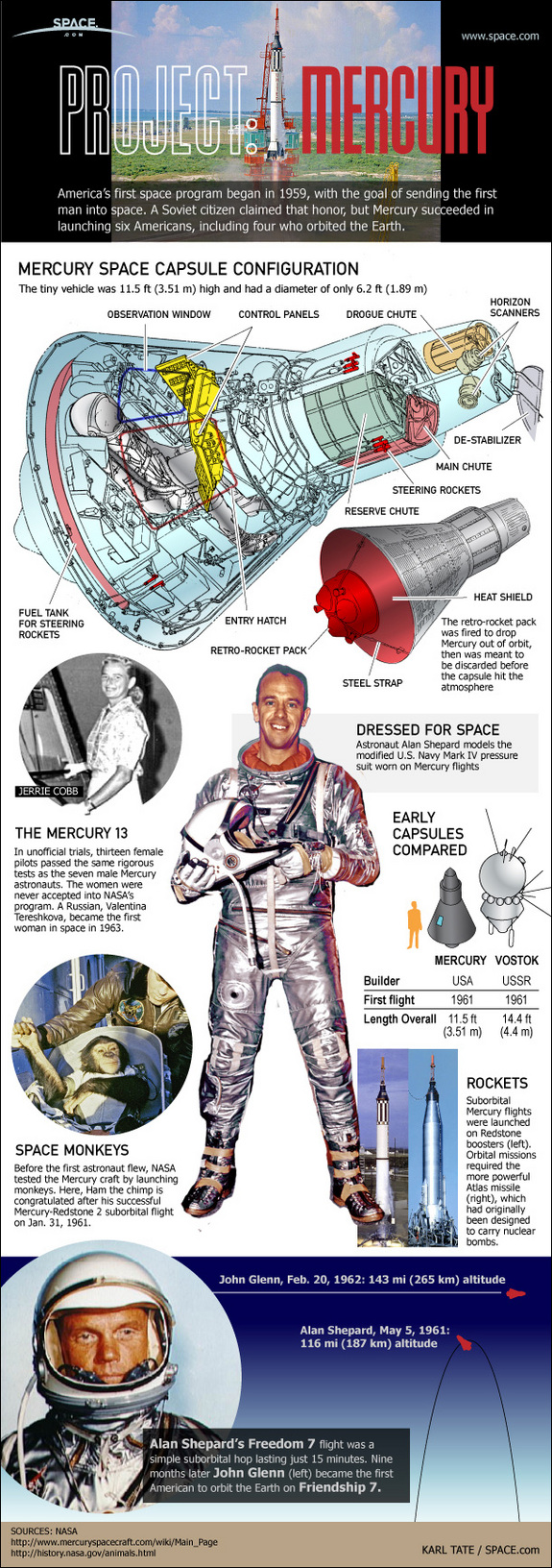
Space Infographics...

Wow...remember when this stuff mattered. It stoked imaginations, kindled dreams, and launched an entire country into space. Now, it seems like it was just an old television show from the 1960s. And the imagination has been replaced by aggression, the technological advances propelling us to space now is used to create weapons. And dreams of space travel have been replaced by the nightmare of constant war. That  is not what we were meant for. Our greatness has been murdered by our bloodlust.--jef


A graphical representative of NASA’s space shuttle.


Frmr NSA Employee Thomas Drake & Jesselyn Radack on Whistleblower Crackdown

Obama and Holder Remove Restrictions on Gathering and Keeping Data about All Americans


Matt Bewig - March 26, 2012
Source: All Gov.

Even as the Obama administration goes full speed ahead on its version of the Bush administration’s supposedly defunct “total information awareness” program by building a massive complex in the Utah desert that will intercept, analyze and store communications from around the world, including the U.S., last week it approved guidelines allowing the government to retain private information about U.S. residents for up to five years–even if they have no known connection to terrorism. Previously, the National Counterterrorism Center (NCTC) had 180 days to destroy any information about U.S. citizens or residents unless a connection to terrorism was evident. The NCTC, established by the 2004 Intelligence Reform and Terrorism Prevention Act, collects data from many agencies and maintains access to about 30 data sets across the government.

 
Administration officials defended the guidelines by arguing that they are aimed at ensuring that relevant terrorism information is accessible to analysts, while guarding against privacy intrusions by, among other things, allowing agencies that share data with the NCTC to negotiate to have the data held for shorter periods.
 
Nevertheless, civil liberties advocates voiced alarm. Michael German of the American Civil Liberties Union cautioned that “watering down the rules raises significant concerns that U.S. persons are being targeted or swept up in these collection programs and can be harmed by continuing investigations for as long as these agencies hold the data.”
 
Intelligence officials have indicated that the government has been working on the new rules since the intelligence community’s failure to connect the dots about Umar Farouk Abdulmutallab, the so-called “underwear bomber,” before his Dec. 25, 2009, failed attempt to bomb a Detroit-bound airliner.
 
U.S. Relaxes Limits on Use of Data in Terror Analysis (by Charlie Savage, New York Times)
The NSA Is Building the Country’s Biggest Spy Center (Watch What You Say) (by James Bamford, Wired

GE Unleashes Propaganda Campaign To Hide Its Tiny Tax Burden and Mass Layoffs

GE paid an average of 2.3% in taxes over the last ten years, while slashing its US workforce by 32,000 jobs. But its new ad campaign aims to whitewash all that.

By Roger Bybee, In These Times
March 25, 2012
 “The twentieth century has been characterized by three developments of great political importance: the growth of democracy, the growth of corporate power, and the growth of corporate propaganda as a means of protecting corporate power against democracy.

Alex Carey, author of Taking the Risk Out of Democracy.
No corporation has surpassed General Electric's mastery of profit-maximization, or its use of public-relations ("corporate propaganda") to mask its true aims behind the widely-supported goals of expanding scientific horizons, "bringing good things to life" and rebuilding America's industrial base.

But sometimes the profit-maximization skills of GE's top executives and tax lawyers surpass the ability of its PR staff to put an appealing gloss on the company's conduct. For example, the disclosure that GE racked up $14.2 billion in profits in 2010 while paying no federal income taxes was not well-received by the American public. GE not only avoided paying any taxes, but even managed to collect $3.2 billion in federal tax credits. This occurred against a backdrop of GE continuing to slash its U.S. workforce by 32,000 jobs, from 165,000 to 133,000 over the 2004-2010 period.

For millions of American facing a shrinking supply of middle-class jobs, falling wages, and disappearing benefits, revelations about GE have fed a renewed hostility to "free enterprise" and undoubtedly helped fuel the "Occupy" movement, now experiencing a spring resurgence.

"In my 25 years of dealing with GE, I have never seem them that embarrassed by any other issue, and so knocked off stride," said Chris Townsend, political director of the United Radio, Electrical and Machine workers (UE) union and a veteran of negotiations with GE over the past 25 years. "GE had so agitated even the mainstream media that the media sought us out," a rare occasion in the unionist's experience.

GE'S PROPAGANDA OFFENSIVE

But major corporations like GE do not remain passive targets for public outrage. Instead, they plan carefully and mobilize vast resources to re-brand themselves in the public eye. With numerous stories about corporate taxes certain to appear around April 15, GE is eager to divert attention away from its paltry tax burden and focus the spotlight on its supposed mission of providing U.S. jobs by turning out products needed by Americans.

Kicking off with the Super Bowl, GE has been filling the airwaves with ads aimed not at selling GE products to consumers, but at reassuring U.S. citizens that GE's driving mission is to meet human needs, provide deeply-satisfying work to its employees, and revitalize America's manufacturing base. The ads don't mention that the corporation paid an average of just 2.3% in tax on its income over the last 10 years, according to Citizens for Tax Justice.

 "We're seeing signs that GE has started to develop and spread a pro-active message," said Townsend. "It looks like they're trying to build a new image. I think it's aimed at serving as a dump-truck to dump the tax issue."

On its website, GE says it has created 13,000 jobs in the United States since 2009. But it is unlikely that the figure represents a net gain, since it has closed 18 plants and made significant job cuts during the same period, as reported here.

The GE ads skillfully trigger a sense of warmth as they show GE workers expressing pride in their skilled work, satisfaction in assisting severely-ill patients, a profound sense of teamwork crossing racial and gender lines, and a deeply-felt mission based on the slogan: "GE Works." To highlight just a few elements of GE's public-relations offensive:
1) In one ad, GE workers at the Waukesha, Wis. Medical Equipment Division, which makes magnetic resonance imaging machines, X-ray machines and other cutting-edge medical devices, are shown getting their-much-cherished wish of meeting a busload of cancer patients whose recovery was aided by GE's medical products.
Unmentioned, however, is the fact that GE has transferred the headquarters of the Medical Equipment Divisiion to Beijing, China. "Waukesha will not be doing GE's innovations, which will now be centered in China," said Chris Townsend. "This doesn't mean that the Waukesha plant will close right away, but the company's advances will be taking place in China and Waukesha will be making more out-of-date products. GE will be bringing in the new machines from China," Townsend adds.

The shift of the division's HQ is part of GE's $2 billion plan fror new investment in China.

While GE has claimed that the shift of its Medical Equipment Division headquarters will not result in a net loss of jobs, employment in Waukesha has been cut by about 50 percent in recent years, Townsend estimates.
2) An ad aired during the Super Bowl this year (see above) is set at its Louisville Appliance Park: "See how GE employees in Louisville's Appliance Park are changing the way appliances are manufactured in the U.S., and how it's helping to create jobs."  The ad includes a memorable scene where an African-American woman recounts how fortunate she was to find work at GE, as it occurred after the plant where she worked closed after 33 years.
But GE conveniently avoids the big picture on jobs at Louisville. The Appliance Park has lost about 80 to 90 percent of its jobs over the last two decades, Townsend says.

To its credit, the company is expanding the Louisville plant by 400 jobs—but only after wage concessions by the union [IUE] and "up to $17 million in city and state incentives," according to Appliance Magazine. Furthermore, the company claims it will create 1,300 jobs in the U.S. after a $1 billion investment in its Appliance Division is completed.
3) GE's Schenectady, N.Y., steam-turbine plant is the focus of a third ad. "When you think about GE, do you you think about beer?" the GE website asks. " See how GE employees in Schenectady help power cities, schools, businesses... and even beer."
Working stiffs are supposed to value cold beer more than anything else, right? But some workers may be just a bit less taken by GE when they learn that GE eliminate abouty two-thirds to three-quarters of the jobs in the plant, according to Townsend.

We can expect that GE will keep up with its onslaught of TV ads depicting it as a company committed to manufacturing in America. GE also appears to be utilizing "third-party" voices—conservatives who show up repeatedly on TV talk shows—to defend the company's tax record, Townsend says.

He doesn't expect a thorough look at GE's overall record from the mainstream meida. "The major media never check on the discrepancy on GE's job forecasts and the actual number of jobs they produce," he says.

Moreover, GE can expect continued success with most mainstream reporters and pundits, ardent worshippers of "free trade," by claiming that opening more plants in Mexico and China will somehow generate more jobs in the U.S. because the company's consumer base has expanded.

"GE could open a plant on the moon, and a lot of the media would be saying, 'Oh, Jeez, now we can export to the moon," Townsend says.

Earth Sends Climate Warning by Busting World Heat Records

Saturday, March 24, 2012 by Common Dreams
First decade of 21st Century warmest on record; US locations break 7,000 temperature records in March

Accelerated climate change, driven by human activity, has led to soaring temperatures around the world and the decade between 2001 and 2010 was the warmest ever recorded in all continents of the globe, according to a new report released by the World Meteorological Organization.

Additionally, an 'unprecedented' heatwave in the United States "has set or tied more than 7,000 high temperature records" across the country, according to a report from Climate Central. "This heat wave is essentially unprecedented," said the media and research orgnanization's Heidi Cullen told Reuters. "It's hard to grasp how massive and significant this is."

The increase in global temperatures since 1971 has been “remarkable” according to the WHO's assessment. Atmospheric and oceanic phenomena such as La Niña events had a temporary cooling influence in some years, the report says, but did not halt the overriding warming trend.

The “dramatic and continuing sea ice decline in the Arctic” was one of the most prominent features of the changing state of the climate during the decade, according to the preliminary findings. Global average precipitation was the second highest since 1901 and flooding was reported as the most frequent extreme event, it said.

“This 2011 annual assessment confirms the findings of the previous WMO annual statements that climate change is happening now and is not some distant future threat. The world is warming because of human activities and this is resulting in far-reaching and potentially irreversible impacts on our Earth, atmosphere and oceans,” said WMO Secretary-General Michel Jarraud. "The world is warming because of human activities and this is resulting in far-reaching and potentially irreversible impacts on our Earth, atmosphere and oceans," he added.

* * *

Reuters: US Heat 'Unprecedented,' 7,000 Records Set or Tied
An "unprecedented" March heat wave in much of the continental United States has set or tied more than 7,000 high temperature records, and signals a warming climate, health and weather experts said on Friday. 
While natural climate variability plays a major role, it is the addition of human-spurred climate change that makes this particular hot spell extraordinary, the scientists said in a telephone and web briefing. [...] 
Since March 12, more than 7,000 high temperature records have been equaled or exceeded, Cullen said, citing figures from the U.S. National Climatic Data Center. 
These records include daytime high temperatures and record-high low temperatures overnight, which in some cases are higher than previous record highs for the day, Cullen said. 
"When low temperatures are breaking previous record highs, that's when you see this is incredibly special," she said.

* * *

From Climate Central: State-by-State Look at How Early Spring Has Arrived:


For most of the country spring has sprung earlier this year, but is this anything more than a single warm year? It seems that it is. During the past several decades, with the exception of the Southeast, spring weather has, indeed, been arriving earlier. 
In the interactive above, you can see how much earlier spring has arrived state-by-state, measured by the date of "first leaf." As you hover over any state, it'll display two boxes: a gray box that represents the day spring used to arrive (based on the 1951-1980 average) and a colored box that represents how much earlier spring has arrived in recent years (based on the 1981-2010 average). 
Nationwide, the date of “first leaf” has clearly shifted — arriving roughly three days earlier now on March 17th (1981-2010 average) from March 20th (1951-1980 average). This shift affects all sorts of biological processes that are triggered by warmer temperatures — not just flowering, but animal migration and giving birth and the shedding of winter coats and the emergence from cocoons. How much will an earlier spring disrupt the intricate natural balance between the tens of thousands of species that depend on each other for food, reproduction and ultimately, survival? No one really knows.

* * *

AFP adds:
"Most likely the weird weather arises from natural variation on top of a warming climate," said Michael Oppenheimer, a geoscientist at Princeton and a veteran participant in the Intergovernmental Panel on Climate Change. "What we're seeing now is not surprising in the greenhouse world ... It's just the beginning of our experience with the new atmosphere." 
Oppenheimer was a lead author of the panel's path-breaking 2007 report that analyzed research by hundreds of scientists and found there was a 90 percent probability that climate change is occurring and human activities contribute to it. 
That report projected an increase in heat waves, droughts, floods, severe storms and extreme temperatures as a result of human-spurred global warming, caused in part by rising emissions of greenhouse gases, including carbon dioxide emitted by fossil fuel burning.

* * *

The WMO report looks at the increased prevalence of extreme weather events around the world:
Numerous weather and climate extremes affected almost every part of the globe with flooding, droughts, cyclones, heat waves, and cold waves. Two exceptional heat waves hit Europe and Russia during summer 2003 and 2010 respectively with disastrous impacts and thousands of deaths and outbreaks of prolonged bush fires. 
Flooding was the most reported extreme event during the decade with many parts of the world affected. Historical widespread and prolonged flooding affected Eastern Europe in 2001 and 2005, Africa in 2008, Asia (in particular Pakistan) in 2010 and India in 2005, and Australia in 2010. 
A large number of countries reported extreme drought conditions, including Australia, eastern Africa, the Amazonia region and the western United States. Humanitarian consequences were significant in eastern Africa during the first half of the decade, with widespread shortage of food and loss of lives and livestock. 
Forty-eight out of 102 countries (47 per cent) reported that their highest national maximum temperature was recorded in 2001-2010, compared to 20 per cent for 1991-2000 and around 10 per cent for the earlier decades. 
The decade saw the highest level of tropical cyclone activity on record for the North Atlantic basin. In 2005 category 5 hurricane Katrina was the most costly hurricane to hit the United States, with a significant human toll of more than 1 800 deaths. In 2008, tropical cyclone Nargis was the worst natural disaster in Myanmar and the world’s deadliest tropical cyclone during the decade, killing more than 70 000 people.

Banking 'Technocrats' Undermine Democracy

Monday, March 26, 2012 by Real News Network
Gerry Epstein: In Europe and the US, bankers take control of the political process

In September 2011, at a time when the sovereign debt raiders, as some people call them, were focusing on Italy as their next target, the European Central Bank sent a letter—supposed to be secret, but it was leaked. And in this letter it gave very direct instructions, you could say, to then prime minister Berlusconi about privatization, lowering pensions, changing hiring and firing, regulations and laws—all things one would think should be the outcome of the political process within Italy. So what is this about banks telling countries how to govern themselves? [...] Gerry Epstein is the codirector of the PERI institute in Amherst, Massachusetts, but today he joins [RNN] from New York.

Healthcare Showdown: Supreme Court Hears Arguments over Legality of 'Obamacare'

Monday, March 26, 2012 by Common Dreams
Supreme Court may determine the fate of Obama's landmark health reform

The Supreme Court began hearing oral arguments this morning that will determine if the Patient Protection and Affordable Care Act of 2010 (otherwise known as Obamacare) violates the Constitution. The arguments are expected to last three days and will analyze the legality of several key aspects of the bill. The most pressing questions the Court will hear relates to the lawfulness of the individual mandate -- a provision that mandates consumers purchase health insurance or face a tax penalty -- and whether or not the law can remain on the books if the mandate is struck down.

Republican opponents of the law hope a decision to overturn Obamacare, and effectively derail Obama’s most hard-fought legislative accomplishment from his first term, would serve as a decisive political victory for conservatives. Progressives are generally more supportive of the Patient Protections and Affordable Care Act, viewing it as a step towards addressing the nation’s healthcare woes. The United States currently has more than 46 million citizens without any insurance and an estimated 20,000 people die each year due to a lack of health insurance. The United States also has the most expensive healthcare in the world, accounting for about 17 percent of the nation’s gross domestic product -- almost twice as much as other developed nations.

Some progressives, however, are skeptical of the benefits of an individual mandate, an idea that first entered the national debate in 2005 when Mitt Romney, then-Governor of Massachusetts, signed a health reform bill implementing an individual mandate in Massachusetts. Kuttner, writing in the Huffington Post, argues that progressives would be better of pursuing a single-payer healthcare system, which “would have been beyond constitutional challenge.”

Medicare is a single payer program for the elderly, and nobody challenges its constitutionality. Toss out the mandate, and single-payer might be taken more seriously.,” Kuttner writes. “Bottom line: If the Court were to overturn the individual mandate, one of the worst provisions of the Affordable Care Act, it would be no tragedy. It might well do some wider good.”

* * *

Absolutely everything you need to know about health reform’s Supreme Court debut
(The Washington Post):
The individual mandate
What it is: The most-contested part of the health reform law, the Affordable Care Act’s individual mandate requires nearly all Americans to carry health insurance. The legal question centers on whether such a regulation is permissible under the Commerce Clause, which allows the federal government to regulate interstate activity. 
What they’ll argue: Health reform opponents contend that the decision not to do something — namely, not buy health insurance — is economic inactivity, rather than activity, and therefore not a behavior the federal government can regulate. Health reform supporters argue that the decision to not purchase health insurance has an economic effect. An individual without coverage, for example, may not have the money to pay for an emergency room visit, sticking hospitals or taxpayers with the bill. 
When it happens: Tuesday, March 27, 10 a.m. - 12 p.m.
Why it matters: With no penalty for not purchasing health insurance, but a requirement for insurers to accept anyone still standing, many expect the costs of insurance would skyrocket. Congress could, theoretically, replace the individual mandate with another policy that doesn’t run afoul of the activity-inactivity distinction but it is unlikely that congressional Republicans would permit such a fix, at least in the near term.

* * *

Health Reform's Day In Court: Don't Bet The Farm On The Mandate (Robert Kuttner, The Huffington Post):
Opponents argue that the mandate represents a new, dangerous, and unconstitutional infringement on liberty. The decision will be treated by commentators as either a huge victory or momentous defeat for President Obama, and either another dangerous over-reach by a right-wing court, or a prudent retreat by the court's conservatives. 
But this may be a complete misreading of the logic and the stakes. 
The individual mandate may or may not be unconstitutional, but it's dubious policy. And it would not be a fatal setback if the Court did find that it violated the Constitution. 
The Administration, in my view anyway, has made both a tactical and a Constitutional error in arguing that if the mandate is unconstitutional, so are other key provisions of the act. If the Court were to strike down the mandate but not the rest of the Act, the insurance industry would be all over Congress to find another way to solve the free-rider problem. As my colleague Paul Starr has demonstrated, that would not be difficult. 
Instead of being required to purchase private insurance, people without employer-provided insurance or access to Medicaid could be given a choice -- either buy affordable insurance through the exchanges, or deliberately opt-out of coverage. But if they opted out, they would be precluded from getting insurance through the exchanges for five years. This use of incentives would be constitutional, and would be sufficient to induce most people to get insurance, but less coercively than a mandate. Starr also proposes that people could pay an annual fee to preserve their right to buy insurance after a waiting period of only a year. 
The point is that if the best we can do politically is a mixed system such as the Affordable Care Act, there are perfectly good alternatives to a mandate should the mandate be struck down. 
There is also a delicious irony here. If conservatives on the Court were to decide that a federal mandate requiring citizens to purchase commercial products has no basis in the Constitution, it would usefully doom another favorite conservative project -- privatization of Social Security. Obviously, if Congress cannot require citizens to buy private health insurance, neither can Congress use tax dollars to require citizens to purchase commercial pension offerings.
[...] 
One further irony: As a little-noticed amicus brief by two organizations and fifty physicians who support national health insurance points out, if the government had simply enacted a single payer program, it would have been beyond constitutional challenge -- because government has an unambiguous power to tax and to use the revenues for public purposes. Medicare is a single payer program for the elderly, and nobody challenges its constitutionality. Toss out the mandate, and single-payer might be taken more seriously. 
Bottom line: If the Court were to overturn the individual mandate, one of the worst provisions of the Affordable Care Act, it would be no tragedy. It might well do some wider good.

* * *


Herman Cain, Tea Party Activists Rally Against 'Obamacare' (ABC News):

Hundreds of Tea Party activists rallied in Washington today, demonstrating just days before the Supreme Court hears arguments on the constitutionality of the Affordable Care Act. With the outline of the U.S. Capitol behind them, conservative organizers urged the judiciary to overturn the legislation and called for the defeat of President Obama in the November election. 
Former Republican presidential candidate Herman Cain was the keynote speaker at the event. Standing in a light rain, Cain told supporters he may not have survived his battle with cancer had he sought treatment under the new law. 
“That’s what this is about,” Cain said. “The freedom to choose our own doctors. The freedom to choose our own health insurance plan.” 
Virginia Attorney General Ken Cuccinelli told the crowd the upcoming elections were their chance to restore the Constitution. His state is one of 26 challenging the Affordable Care Act through lawsuits in the high court. 
“[President Obama] and this administration represent the greatest set of lawbreakers to ever run the federal government in our lifetimes,” Cuccinelli said. “The rule of law itself is at stake.”