Friday, December 23, 2011

Do Private Military Contractors Have Impunity to Torture?

Outsourced from the Law
by LAURA RAYMOND

Unbelievably, in 2011 this question has not yet been settled in the courts of the United States. Human rights attorneys are headed back to court in the coming month to argue that, yes, victims of war crimes and torture by contractors should have a path to justice.

Attorneys from my organization, the Center for Constitutional Rights, along with co-counsel, are representing Iraqi civilians who were horribly tortured in Abu Ghraib and other detention centers in Iraq in seeking to hold accountable two private contractors for their violations of international, federal and state law. By the military’s own internal investigations, private military contractors from the U.S.-based corporations L-3 Services and CACI International were involved in the war crimes and acts of torture that took place, which included rape, being forced to watch family members and others be raped, severe beatings, being hung in stress positions, being pulled across the floor by genitals, mock executions, and other incidents, many of which were documented by photographs. The cases, Al Shimari v. CACI and Al-Quraishi v. Nakhla and L-3 aim to secure a day in court for the plaintiffs, none of whom were ever charged with any crimes.

The Department of Justice has thus far failed to prosecute any of the contractors involved, so the only path currently available for any accountability is through these human rights lawsuits. However, after years of litigation, the allegations of torture by contractors in these cases have still never been seriously examined, much less ruled on, by the courts. None of the plaintiffs in any of these cases has yet to have his or her day in court to tell their account of what they suffered. The reason is because the private military contractors have raised numerous legal defenses- many of which the plaintiffs’ lawyers have argued are plainly inapplicable to private corporations-which have kept the cases from moving into the discovery phase, where the nature of the contractors obligations, actions and oversight, as well as what happened to the plaintiffs would be examined in detail. So far, CACI and Titan/L-3 have focused the courts on any question but whether the plaintiffs were tortured. As CCR and co-counsel summarize the question in their brief in Al-Quraishi v. Nakhla and L-3:
Are corporate defendants entitled to categorical “law of war” immunity for their alleged torture and war crimes when such a proposed immunity runs counter to settled understandings of the law of war and centuries of Supreme Court precedent, and would give for-profit contractors more protection from suit than genuine members of the U.S. Armed Forces?

This week, CCR and co-counsel filed briefs that argue the cases must go forward. Additionally, yesterday a number of other human rights organizations along with a group of retired high-ranking military officers are filing supporting amicus briefs to add their voices to the chorus of concern over contractor impunity. The military officers’ brief argues that, “given that employees of civilian contractors indisputably are not subject to the military chain of command, and therefore cannot be disciplined or held accountable by the military, it makes little sense to extend to them such absolute tort law immunity for their misconduct.”

This legal battle is taking place as the United States is outsourcing war at a rate beyond anything ever seen in our history. During the wars in Iraq and Afghanistan the number of contractors has at times far exceeded the number of soldiers. Now, as the U.S. ends the war in Iraq, the State Department is reporting that it has been in the process of tripling the number of armed security contractors it will employ in Iraq to provide security for the thousands of State Department employees that will remain to work in what is now by far the largest U.S. embassy in the world.

It’s important for people to understand what is going on in the courts regarding this current litigation not only because the torture survivors need justice, but also because these cases have wide implications beyond this particular situation. The corporations involved argue that they should be exempt from any investigation into the allegations against them because, among other reasons, our federal government’s interests in executing wars would be at stake if corporate contractors can be sued. This is incredibly flawed logic; the lawsuits are for acts that are far outside the “laws of war” and these are crimes that are not in the government’s interest.

They are also invoking a new, sweeping defense that first appeared two years ago in a separate case CCR and co-counsel brought against these same corporations, Saleh v Titan. The new rule is termed “battlefield preemption” and aims to eliminate any civil lawsuits against contractors that take place on any “battlefield.” Among the numerous alarms this should set off is the fact that in the U.S.’ War on Terror it is argued that many places far from any actual warzone are now battlefields. Indeed, a detention center in Iraq filled with civilians who were never charged with any crimes, which is what we’re talking about in these current cases before the court, should not be considered a battlefield. And acts of torture, which is what is at issue in these cases, cannot be characterized as “combat,” which is what this defense allows.

Think about what it would mean for private military contractors to be immune from any type of civil liability, even for war crimes, as long as it takes place on a so-called battlefield during this time of unprecedented use of contracting and when the term “battlefield” is being stretched to meaninglessness in the ever-expanding U.S. War on Terror. Anyone and everywhere could be a target. That is what is at stake here. Everyone who cares about human rights should be paying attention.

In giving their reasoning for dismissing these cases, the Fourth Circuit panel that originally heard the case (over a strong dissenting opinion) expressed its fear that cases like these would “undermine the flexibility that military necessity requires in determining the methods for gathering intelligence.” But this is exactly the point. No one should ever have the “flexibility” to commit war crimes, rape and other forms of torture. There absolutely must be consequences for these violations. If there are not, courts will essentially be saying anything goes – even the most sadistic and brutal torture – if you are a private military contractor.

Is Cancer Epidemic in America?


by RUSSELL D. HOFFMAN
 
A friend and I were looking back at 2011.

She remarked about all the cancer she’s seen this year.  Last month she lost a close friend — a woman in her 30s.  Another friend, 40, has bladder cancer for the second time.

My step-mother recently made a similar remark about cancer in my own family.  She lives on the other side of the country and the family is scattered all over the globe.  One brother-in-law has stomach cancer which has metastasized, and many of us are cancer survivors (including me (bladder, 2007)).  And on my own newsletter list I know of a number of ongoing cancer cases as well.

It feels like an epidemic, but of course, the epidemiologists who work for the state or the federal government would undoubtedly tell us they can’t discern anything “statistically significant” (they love that phrase!) from our “data” — it’s just a few random points, it doesn’t show a trend.  That’s true of course — but we’re talking about real lives of our friends and families, not raw, impersonal numbers.  We’re looking for answers.

The epidemiologist will also point out that cancer will strike about one in two Americans at some point in their lives, and will be the underlying cause of death for somewhere between one in four, and one in three of us.  So they’re not really looking for an epidemic.  They’re looking for a worsening trend within an ONGOING epidemic.

Baseline radiation values vary enormously from one location to another.  Accurate data isn’t available.  By the time something is occurring so frequently that researchers find it to be “statistically significant,” it might already be killing tens of thousands of people annually, or even more.

As an example, it took thousands of carefully-done studies to show there was a legally-defensible, statistically-significant connection between cigarettes and lung cancer, heart disease,throat, lip, esophageal, stomach, colon, and rectal cancer, and low birth weight among the babies of smokers.  All these and many additional health effects are now well-established, yet each connection was hard to prove.

But even today about a billion people think the statistics are wrong, or that they don’t apply to them for any of about a billion reasons.  They smoke anyway (including my friend, who’s excuse is that she only smokes one or two cigarettes a day).

Radiation deaths are far more difficult to prove than smoking deaths, because the source is almost always unknown in its quantity, who it was delivered to, and when.  A two-pack-a-day smoker knows he or she is a two-pack a day-smoker.

Who got what dose from Fukushima?  Nobody knows, not even in Japan.  So proper epidemiological studies will be nearly impossible to accomplish.  Three radiation experts — Robert Alvarez, Joseph Mangano, and Janette Sherman — have made an attempt to calculate Fukushima’s impact.  They estimate that nearly 14,000 excess deaths may have occurred (including over 800 infants) in America in the first few months after Fukushima (see below).

The nuclear industry will tell you they don’t see anything unusual going on.  They’ll remind you that: “No one was harmed by Three Mile Island.”  Independent studies indicate otherwise.  They’ll remind you that: “No one has ever been harmed by living downwind of a properly operating nuclear reactor”.  Again, independent studies indicate otherwise.  And they’ll tell you that: “Hardly anyone was harmed by Chernobyl” but again, independent analysis indicates as many as a MILLION people have already died because of Chernobyl.

And of course, they’ll say that: “No member of the public was harmed by Fukushima” but they’ll be wrong about that, too.

People don’t like to talk about cancer.  But ever since cancer “came out of the closet” about forty years ago, it’s felt like an epidemic even though the obituaries stopped routinely listing the CAUSE of death — about thirty years ago.  Independent studies of cancer clusters have become much more difficult since we all started clamming up about who we are, where we live, where we work, and so on.  Studies are even more difficult because we move so often, change jobs and companies, partners and eating habits.

And when a victim does manage to reach a settlement with a polluter, the terms and conditions are invariably kept secret, making the clusters that much harder to find for everyone else.

My friend is not a nuclear activist and wasn’t talking about Fukushima and its aftermath.

She just was wondering why so many people seem to have cancer these days.

“Could be Fukushima” I said.

“What’s that?” she responded.

“Remember that nuclear accident in Japan last spring?  It’s still spewing radioactive poisons into the environment, and is still out of control.  We need to shut them all down, including San Onofre.”   (SanO is our local pair of poorly-run nuclear reactors, about 15 miles away.)

“Where will we get our energy?” she asked.

I answered that San Onofre only supplies about 7% of California’s power, which could easily be replaced by solar, wind, etc..  If I had more time, I would have made her aware of some other considerations besides just where our electricity will come from.

Here are some other reasons she might be thinking we can’t shut San Onofre:

“Wind turbines kill birds!” 

They do.  So do plate glass windows in high-rise buildings, and so do cars, trucks, busses, trains and airplanes, deforestation and climate change — but no one seems to care about those!  Only wind turbines.  And there are a variety of ways to increase wind turbine blade visibility to birds, ways to site them and so on, that can greatly reduce the incidence of bird strikes.

“You’d have to cover the whole country with solar panels!” 

Not true.  Actually an area in the southwest approximately 100 miles on each side would be enough — and much of that can be found on existing rooftops, which are mostly just tar-covered, wasted space anyway!

“Hydroelectric power damages the river life.”

You can install anything improperly if you like.  Or you can build fish ladders, you can control the water levels in the rivers appropriately, you can locate the dams properly and make existing dams more efficient and so on.

“Mining for Rare Earth Elements (REEs) is extremely polluting — but all the renewable energy sources needs REEs!” 

That’s right:  For example, they need “permanent” magnets made of REEs.  However, these are 100% recyclable!  And don’t forget that “rare” is just a name:  These elements are fairly abundant, actually.

“Nuclear power has worked for 50 years.”

No it hasn’t!  Accidents have been covered up, and when that isn’t possible, they’ve been swept from the front pages of the news even as they’re still happening!  Fukushima is no longer the top item in the news each day, and yet it’s an ongoing tragedy — the most massive single environmental catastrophe the world has ever seen — and capable of an even-more catastrophic “hydrovolcanic explosion” if any of the molten cores hit the water table underneath.

Lastly but most importantly, she might think:

“They’ve solved the nuclear waste problem, it’s just a political issue now.”

Completely false!  In fact, the Yucca Mountain scientific team was allowed to come up with ANY scientifically-viable alternative to Yucca Mountain if they could.  They only thing they couldn’t consider was the same thing in a different location.  They couldn’t come up with anything else that would work, and neither will Obama’s “Blue Ribbon Committee.”

Nothing else works any better than Yucca Mountain would, but Yucca Mountain  wouldn’t work, either:  It’s geography is unstable, it suffers from water seepage, the population centers nearby are too close, transporting the waste there would be a nightmare.

Unfortunately, any OTHER location will have the same problems, or worse!  Therefore, the  only solution to the nuclear dilemma — and it’s a partial one — is to stop making more waste.

But unfortunately, the average adult in America has no idea what “radiation” is.  They don’t know an element from an isotope from a molecule from a sub-atomic particle, and couldn’t care less.  The word “epidemiology” causes their eyes to glaze over.  And cancer scares them.

How will it be possible for a “democratic” society (let alone any other) to fulfill its promise to protect its citizens, when those same citizens are ignorant of the dangers they face?  When the problems are too complex to grasp in a sound bite?  When there is always an opposing view, who usually sounds just as passionate or more so (after all, their livelihoods are usually at stake)?

My hope for 2012 is that the world will educate itself more about the problems it faces.
It is our duty to our children to learn how to protect them.

My friend has a wonderful child.  But she is probably unaware that radiation harms young children at roughly 10 times the rate it harms adults.  Infants are a hundred times more vulnerable, and fetuses a thousand — or thousands of times — more so, because their cells are differentiating.

The Nuclear Age has been an epic failure so far, and is destined only to be more so in the future.  A third of a trillion dollars are projected to be put into a dozen (or more) genocidal, environmentally-devastating nuclear-armed and nuclear powered submarines for the next generation to play war games with.  Then those sailors will need jobs in the industry.  Same as now.  But nuclear weapons have not prevented war, as was promised, and nuclear power plants have only made us vulnerable.  Electricity has not been “too cheap to meter,” as was also promised. Nothing’s worked out for the nuclear industry — except their ability to fool the public.

After 2011, the world is three meltdowns more polluted than it was in 2010.  It also has about 20,000 tons of NEW “High Level Radioactive Waste” from ~500 commercial reactors still operating around the world.  This new “HLRW” waste (mostly used nuclear reactor cores) is about ten million times more hazardous than before it was put in the reactor (and it was no picnic then, either).

TEPCO, the owners of the stricken reactors, lie constantly.  The reactors spew radioactive waste constantly.

The Japanese government lies constantly.  No one knows what’s really going on anyway.  Everyone is now admitting that it will take “40 years” to put Fukushima into “Safe Store”, a fictitious state of temporary nuclear bliss.
 
2012, here we come.

The Drug War Transformed

by TOM BARRY
 
“This is a terrorist insurgency,” says Connie Mack, the Republican who chairs the Western Hemisphere Subcommittee of the House Foreign Affairs Committee.

Mack, who introduced the Enhanced Border Security Act in mid-December, believes that the Merida Initiative has failed and that the administration needs to revamp the counterdrug assistance program to include a “counterinsurgency plan.”

Explaining why his Enhanced Border Security bill is needed, Mack said: “The Mexican drug cartels have evolved into what some call the greatest national security threat faced by the United States with the ability to severely damage the U.S. economy.”

Adopting the language of the Obama administration’s new strategy to “combat transnational organized crime,” Mack warns that both Mexico and the United States are facing a “terrorist insurgency” waged by transnational criminal organizations “along our southern border, with operations across Mexico and Central America as well as in over 1,000 U.S. cities.”

Five years after President Felipe Calderón launched Mexico’s drug war in December 2006 and three years into the Merida Initiative counterdrug assistance program, there is widespread anxiety in Mexico that the government is not gaining the upper hand on the drug cartels and that the drug-related violence, which has left a toll of 50,000 dead, will continue into the next sexenio, the six-year presidential term.

Whatever their politics, most close observers of the drug war in Mexico would agree with the Republican firebrand from Florida that the last five years of Mexico’s drug war have done little to increase governmental security and social stability. Most assessments of the Merida Initiative’s impact on Mexico and Central America are similarly negative.

The basic facts of the drug-related crisis in Mexico are clear enough, but what’s not so evident is its character and identity.

As President Calderón’s sexenio draws to an end and as the U.S. government evaluates its involvement in Mexico’s drug war and its border policy, new questions are being asked about drug threat and about the proper response.

Mack insists that traditional counternarcotics strategies are insufficient and out of step with the changing character of the drug trade in Mexico and in Central America.

What we are seeing in the region is not simply the business and violence of drug-related crime, says Mack. Instead, Mexico and the drug transit countries of Central America are facing insurgency and terrorism that threatens the security of region and of the United States.

Mexico has vociferously rejected Mack’s contention that the drug cartels represent an existential threat to state power.

But the basic facts of the drug war – widespread territorial loss of effective governing power, the involvement of local drug bosses in politics, the massive deployment of the military, the increasing firepower of the cartels, the war-level loss of life, and the use of horrific violence to make statements – seem to support Mack’s contention that Mexico is facing what he variously calls a “terrorist insurgency” and a “criminal insurgency.”

The inability of the Obama administration’s expanded border-security operations to significantly obstruct the crossborder flow of drugs from Mexico also points to the inadequacy of the U.S. response, whether at home or in Mexico.

Mack is, of course, not alone in his characterization of the Mexican drug-trafficking organizations (DTOs) as insurgents and narcoterrorists. Nor is he the only major public figure who is raising alarm about an increased threat to U.S. national security.

Two retired U.S. generals, including the former chief of the U.S. Southern Command, came to similar conclusions in a recent report commissioned by the Texas state government alarmingly titled Texas Border Security: A Strategic Military Assessment.

There’s no disputing the severity of the drug-related violence in Mexico and Central America. Yet the increasing discussion of the security implications of illegal drug trade also relates to the Obama administration’s own attempt to redefine the domestic and international drug problem as a battle against transnational criminal organizations.

The Transformed Drug Threat
The U.S. government has traditionally referred to Mexican and other Latin American drug cartels as drug trafficking organizations (DTOs). But the Obama administration has altered the nomenclature of the drug trade, and the DTOs are now routinely categorized as transnational criminal organizations (TCOs).

By newly designating the Mexican DTOs as transnational criminal organizations, the Obama administration has opened new political room for foreign policy hawks and anti-drug hardliners like Connie Mack to credibly argue that the U.S. needs to respond differently and more aggressively to the evolving drug trade scenario in the hemisphere.

Obama counternarcotics officials have dropped the term “war on drugs.” Instead, the four-decade war has been superseded by the newly organized “combat against transnational crime” and transnational organized criminal organizations – as spelled out this year by the White House in the Strategy to Combat Transnational Organized Crime.

The shift in the terminology to describe the U.S. national and international enforcement of its drug control laws – shedding an embarrassing military metaphor and adopting a more appropriate law-enforcement one – was long overdue.

Wars, after all, are fought to win not to flounder — with nary a sign of victory after four decades of drug war-fighting. In contrast, crime-fighting is accepted as a constant slog where no final victory is ever expected.

President Obama, however, insists, that the combat against the drug-trafficking TCOs is a matter of urgent national security, promising to prioritize the targeting of TCOs that represent a “high national security risk.”

In keeping with new parlance of the administration, Connie Mack, who chairs the Western Hemisphere Subcommittee, contends that the U.S. and Mexican governments no longer simply confront drug trafficking organizations but now face powerful transnational criminal organizations that threaten not only the region’s security but also U.S. national security.

In contrast to Mack, other critics, apart from those of the right wing, lambast the Merida Initiative for contributing to widespread human rights violations by the Mexican military and for continuing drug war strategies that are based on failed drug prohibition policies.

Counting on Connie Mack
During his seven years in Congress, Mack has won strong support from his conservative constituency for his hardline positions on U.S. Latin America policy, particularly with his shrill anti-communist critiques of Castro in Cuba, Chávez in Venezuela, and Zelaya (removed by military-backed coup) in Honduras.

As chairman of the Western Hemisphere subcommittee, Mack has won a larger megaphone for a view of hemispheric relations in which U.S. hegemony persists. In language reminiscent of the imperial era politics in Latin America, Mack states: “You can count on me to challenge these tyrants wherever they are and always stand on the side of freedom, security and prosperity.”

Mack’s hawkish views on Mexico represent an ideological continuity in that he regards the TCOs as insurgents who challenge the established order. Yet his new focus on Mexico and the border security also have more immediate political origins – including an opportunity to bash the Obama administration and an attempt to assuage anti-immigrant constituents outraged over Mack’s criticisms of the repressive Arizona immigration law as threat to “freedom-loving conservatives.”

Mack may see his hawkish stances on border security and on the Mexico drug war as restoring the trust of his conservative constituents and helping him in his likely bid to to unseat Democratic Senator Bill Nelson.

In a Sept. 16 letter to the State Department complaining about the failures of the Merida Initiative, Mack wrote that “the transformation of drug cartels into TCOs and their attempts to undermine the Mexican government through tactics labeled as characteristics of an insurgency” required an overhaul of the Merida Initiative to address the new security environment.

Mack told the State Department:
The failure of this Administration to set performance measures, target dates or tangible goals to measure the success of U.S. programs has made it impossible to claim ‘success’ on the initiative itself. Meanwhile, the Mexican drug cartels have capitalized on the United States’ sluggish assistance to actively undermine the Mexican state through insurgent activities such as violence, corruption, and propaganda.
Both the Calderón and Obama administrations insist that the battle against the cartels – called drug war in Mexico and combat against transnational crime in the U .S. – is making steady progress toward the goal of reducing the threat of the drug-trafficking organizations.
Responding to Mack’s letter, the State Department wrote:
We believe the [Merida] Initiative is already having a positive impact. Through its bold efforts, with U.S. support, the Mexican government has successfully dismantled drug smuggling routes, seized major amounts of illicit drugs and jailed drug kingpins.
Critiquing the Merida Initiative, Mack says, “If we are unable or unwilling to identify the problem correctly, then we are unable to properly put a policy forward to combat the issue at hand.  The security and safety of the American people depend on it.”

That’s exactly right. But it is not a problem that began with the Merida Initiative or with the Obama administration.  Mack only compounds the problem of incorrectly identifying the issue at hand in Mexico and at the border by introducing new identifiers such as “terrorist insurgency” and “criminal insurgency.” Such terms confuse tactics and methods with objectives and goals, while leading both countries down the path of increased militarization.

The Obama administration also confiscates the drug-related crisis in Mexico by raising the specter of transnational crime as a national security threat and by identifying the Mexican drug trafficking organizations as the cause of the crisis rather than as largely a product of America’s own drug war and drug prohibition policies.

The few, the proud, the very rich

Much of the current political and popular discourse has focused on inequalities that exist in the U.S. In particular the Occupy movement has brought the huge disparities in wealth to the forefront. There are a few questions floating around about wealth. First, how skewed is the distribution? Second, it is true that the rich have gotten much richer over time? —a statement I often heard my Grandma make.
Well, there is a plethora of statistics (e.g. here, here, & here) out there but here are two. The share of wealth held by the top fifth is about 87.2 percent while the bottom four-fifths share the remaining 12.8 percent of wealth—so the Occupiers are correct in their assessment.

And, the riches of those in the top 1 percent are about 225 times greater than that held by the typical family—it was 125 times in 1962—so, Grandma was correct too.

But, let’s look a bit further. The triennial Survey of Consumer Finances (SCF) is one of the best sources for data on wealth in the U.S. And, of course the Forbes 400 estimates the worth of the wealthiest amongst us—all 400 wouldn’t be captured in the SCF. If we look at both the SCF and the Forbes 400 we can glean some interesting insights.

In 2007 (the most recent SCF) the cumulative wealth of the Forbes 400 was $1.54 trillion or roughly the same amount of wealth held by the entire bottom fifty percent of American families. This is a stunning statistic to be sure.


Upon closer inspection, the Forbes list reveals that six Waltons—all children (one daughter-in-law) of Sam or James “Bud” Walton the founders of Wal-Mart—were on the list. The combined worth of the Walton six was $69.7 billion in 2007—which equated to the total wealth of the entire bottom thirty percent!

BTW the new 2011 Forbes 400 has the inherited worth of these six Waltons at $93 billion.

The 2010 SCF data that is slated for release spring of 2012 will almost certainly show a further widening of the wealth gap given that corporate profits, stocks and CEO pay have all recovered while housing values & equity (the lion’s share of wealth for average American’s), wages and family incomes have yet to turn around.

These revelations renewed my interest in the inheritance and estate tax debates. Also, didn’t I just read somewhere that Wal-Mart is substantially rolling back health care coverage for part-time workers and significantly raising premiums for many full-time staff?

We’ve got to get serious about reversing the long term trend of the ever increasing concentration of income and wealth into the hands of a few at the expense of the many. At stake is nothing less than our economy and our democracy.

TSA screenings aren't just for airports anymore

Roving security teams increasingly visit train stations, subways and other mass transit sites to deter terrorism. Critics say it's largely political theater.


Three federal air marshals in bulletproof vests and two officers trained to spot suspicious behavior watched closely as Seiko, a German shepherd, nosed Vetter's trousers for chemical traces of a bomb. Radiation detectors carried by the marshals scanned the 57-year-old lawyer for concealed nuclear materials.

When Seiko indicated a scent, his handler, Julian Swaringen, asked Vetter whether he had pets at home in Garner, N.C. Two mutts, Vetter replied. "You can go ahead," Swaringen said.

The Transportation Security Administration isn't just in airports anymore. TSA teams are increasingly conducting searches and screenings at train stations, subways, ferry terminals and other mass transit locations around the country.

"We are not the Airport Security Administration," said Ray Dineen, the air marshal in charge of the TSA office in Charlotte. "We take that transportation part seriously."

The TSA's 25 "viper" teams — for Visible Intermodal Prevention and Response — have run more than 9,300 unannounced checkpoints and other search operations in the last year. Department of Homeland Security officials have asked Congress for funding to add 12 more teams next year.

According to budget documents, the department spent $110 million in fiscal 2011 for "surface transportation security," including the TSA's viper program, and is asking for an additional $24 million next year. That compares with more than $5 billion for aviation security.

TSA officials say they have no proof that the roving viper teams have foiled any terrorist plots or thwarted any major threat to public safety. But they argue that the random nature of the searches and the presence of armed officers serve as a deterrent and bolster public confidence.

"We have to keep them [terrorists] on edge," said Frank Cilluffo, director of the Homeland Security Policy Institute at George Washington University in Washington. "We're not going to have a permanent presence everywhere."

U.S. officials note that digital files recovered from Osama bin Laden's compound in Pakistan after he was killed by U.S. Navy SEALs in May included evidence that the Al Qaeda leader had considered an attack on U.S. railways in February 2010. Over the last decade, deadly bombings have hit subways or trains in Moscow; Mumbai, India; Madrid; and London.

But critics say that without a clear threat, the TSA checkpoints are merely political theater. Privacy advocates worry that the agency is stretching legal limits on the government's right to search U.S. citizens without probable cause — and with no proof that the scattershot checkpoints help prevent attacks.

"It's a great way to make the public think you are doing something," said Fred H. Cate, a professor at the Indiana University Maurer School of Law, who writes on privacy and security. "It's a little like saying, 'If we start throwing things up in the air, will they hit terrorists?' ''

Such criticism is nothing new to the TSA.

The agency came under fresh fire this month when three elderly women with medical devices complained that TSA agents had strip-searched them in separate incidents at John F. Kennedy International Airport. Lenore Zimmerman, 84, said she was ordered to pull down her pants after she refused to pass through a full body scanner because she was afraid the machine would interfere with her heart defibrillator.

TSA officials denied the women were strip-searched, but they announced plans to create a toll-free telephone number for passengers with medical conditions who require assistance in airport screening lines. TSA officials said they also are considering a proposal by Sen. Charles E. Schumer (D-N.Y.) to designate a passengers advocate at every airport.

The TSA's viper program hasn't drawn that kind of attention, although it is increasingly active.

In Tennessee in October, a viper team used radiation monitors and explosive-trace detectors to help state police inspect trucks at highway weigh stations throughout the state. Last month in Orlando, Fla., a team set up metal detectors at a Greyhound bus station and tested passengers' bags for explosive residue.

In the Carolinas this year, TSA teams have checked people at the gangplanks of cruise ships, the entrance to NASCAR races, and at ferry terminals taking tourists to the Outer Banks.

At the Charlotte train station on Dec. 11, Seiko, the bomb-sniffing dog, snuffled down a line of about 100 passengers waiting to board an eastbound train. Many were heading home after watching the Charlotte Panthers NFL team lose to the Atlanta Falcons after holding a 16-point lead.

No one seemed especially perturbed by the TSA team.

"It's probably overkill," said Karen Stone, 26, after a behavior-detection officer asked her about the Panthers game and her trip home to Raleigh.

"It's cool," said Marcus Baldwin, 21, who was heading home to Mebane, near Burlington, where he waits tables to help pay for computer technology classes. "They're doing what our tax money is paying them to do."

"I'm mostly curious," said Barbara Spencer, 75, who was heading home to Chapel Hill after watching her grandson perform in a Christmas play. She asked the officers whether a terrorist threat had required the extra security. No, they replied.

Vetter, the lawyer, had attended the game with his son, Noah. They jogged for the train after Seiko had finished his sniff, but Vetter had bigger worries on his mind. "The Panthers blew it," he said.

Wednesday, December 21, 2011

2011 - The Year in Review (Part 1)


“Power Corrupts…”

12/20/11 Baltimore, Maryland This is the last in a series. We began by wondering how come some people get to boss other people around…

We’re not talking about wives and husbands or employees and their employers. In those cases, the bossing is legit. Husbands ask for it. And employees can walk off the job anytime they like.

We’re talking about people who have the right — by law — to tell other people what to do. The TSA agent…the policeman…the building inspector…the customs agent…the IRS clerk…the FDA…the CIA…the FBI…

It is a remarkable thing, don’t you think, dear reader? It says right there in the Declaration of Independence that ‘all men are created equal.’ Equality under the law is supposed to be the law of the land. And yet, some people are clearly above the law…some give orders to complete strangers…and some people even claim the right to make laws any way they want.

There are laws that tell you not to murder…and not to steal. In the 10 Commandments given to Moses, God named 10 laws that he considered important. But the folks walking the floors of Congress, the EPA, the SEC, the IRS and a plethora of other government agencies have added 10,000 more commandments. ‘Thou shalt’ this… ‘thou shalt not’ that.

You can barely go to the bathroom without asking permission from a dozen different bureaucracies. ‘Ignorance of the law,’ is said to be an ineffective defense. But it’s a very effective explanation. There are so many laws, rules, regulations, edicts, commandments, prohibitions, interdictions, injunctions, requirements and obligations that you are bound to miss one or two of them.

The latest Defense Authorization Bill just passed by Congress shows how far the law-makers and law-enforcers will go. The doctrine of habeas corpus goes back to before the signing of the Magna Carta in 1215. It was an ancient Anglo-Saxon limitation on the power of government. If the feds held a prisoner, a writ of habeas corpus required them to “produce the body.” The government had to either release the person or charge him with a crime. For more than 800 years, this gave people some protection against government.

But now, in the Year of Our Lord 2011, the Congress of the United States of America, with the complicity of POTUS, himself, has seen fit to deny the right of habeas corpus to American citizens. Henceforth, the feds can capture you, put you in prison and waterboard you every day for the rest of your life. They don’t have to charge you with murder or jay-walking or any crime at all. They don’t have to let you talk to a lawyer. Or to your spouse. Or to your Congressman… They don’t have to read you your rights or provide any evidence against you. Like the Argentines in the ’80s, they just ‘disappear’ you. And you’re gone forever.

The Guardian reports:

Human rights groups accused the president of deserting his principles and disregarding the long-established principle that the military is not used in domestic policing. The legislation has also been strongly criticised by libertarians on the right angered at the stripping of individual rights for the duration of “a war that appears to have no end”.
The law, contained in the defence authorisation bill that funds the US military, effectively extends the battlefield in the “war on terror” to the US and applies the established principle that combatants in any war are subject to military detention.
“It’s something so radical that it would have been considered crazy had it been pushed by the Bush administration,” said Tom Malinowski of Human Rights Watch. “It establishes precisely the kind of system that the United States has consistently urged other countries not to adopt. At a time when the United States is urging Egypt, for example, to scrap its emergency law and military courts, this is not consistent.”
Rand Paul, a strong libertarian, has said “detaining citizens without a court trial is not American” and that if the law passes “the terrorists have won”.
“We’re talking about American citizens who can be taken from the United States and sent to a camp at Guantánamo Bay and held indefinitely. It puts every single citizen American at risk,” he said. “Really, what security does this indefinite detention of Americans give us? The first and flawed premise, both here and in the badly named Patriot Act, is that our pre-9/11 police powers were insufficient to stop terrorism. This is simply not borne out by the facts.”

So now the feds, whose salaries we pay, can spy on us with drones we paid for too. They can send a swat team to disappear us…and keep us in prison.

Our question is: ‘what gives them the right?’ What bread to these people eat? What air do they breathe?

We’ve seen the theories. We’ve seen them in practice too. The ‘divine right of kings.’ The ‘social contract.’ ‘From each according to his abilities…’ ‘The greatest good for the greatest number.’

What they all have in common is that they are not theories, but apologia. One claims to know God’s own plan. Another imagines that the powerless masses agreed to be pushed around. Still another pretends that it’s for their own good.

Some of the excuses are implausible or unbelievable. Others are absurd. The ‘theories’ make no sense. But the facts are undeniable. And the fact is that there are always some people who are willing, ready and able to boss others around. Some rulers — the ‘insiders’ — are smarter than others. Some are nicer. Over time, you see all sorts. Their goal is always the same — to take power and wealth away from the outsiders. How much? As much as they can get away with.

You may wonder, for example, how come the governments of the developed countries all seem to be in the same deep hole of debt. If you listened to the politicians, for example, you might conclude that France and America were an ocean apart. Actually, overall tax, spending, and debt levels are similar in all OECD nations. And tax levels, generally, are about 10 times higher than they were in the last century. And their forms of government are about the same too — even though the insiders claim to have very different ideas about how to govern.

What happened?

The genius of modern democracy is that it makes the citizen a party to his own enslavement. Rather than give up 10% of his output to his feudal lord and master, he gives up 30% to 50% to his democratically-elected bosses. They tell him what to do. And he believes he is giving the orders!

RIAA & Movie Studios Caught Pirating TV Shows & Movies

By Sam Biddle - Gizmodo

The same copyright barons pushing SOPA, the awful internet act, are enormous hypocrites, TorrentFreak reports. They want the law as a means of stopping online piracy—but maybe they should start with their own employees.

A Russian BitTorrent tracking firm traced pirated movies and television show downloads back to IP addresses from Sony, Fox, and NBC—as TF points out, "these are the same companies who want to disconnect people from the Internet after they've been caught sharing copyrighted material."

This shouldn't surprise anyone. When studios push fascist copyright law, they're speaking on behalf of their shareholders, not the thousands of people they employ. Those people are ordinary people, who, yes, sometimes pirate albums, movies, shows, and games, like millions of other ordinary people around the world. But the hypocrisy is more than superficial. We shouldn't ever let companies that can't control their own miscreant employees shape federal legislation for all of us.

...and...


The RIAA Pirated $9 Million Worth of TV Shows

By Mario Aguilar - Gizmodo
 
The same RIAA that makes examples out of ordinary folks by suing them for millions of dollars for file sharing? Turns out someone there's been pirating full seasons of Dexter. Nine million dollars worth. Whoops!

That number—$150,000 for each of the 60 episodes illegally downloaded on the RIAA HQ ISP (OK?)—comes compliments of YouHaveDownloaded which logged the BitTorrent activity of some 50 million users and revealed that not only are the major movie studios pirating their own movies, but the RIAA is downloading pirated TV shows. Lots of 'em.

Again, this is the same RIAA that has been shaking down a Minnesota mother of four for $1.5 million over 24 songs she shared on Kazaa. And it turns out, they're being generous in that case! Since the statutory damages cited by its own guidelines are much higher:
… copyright holders can sue you for up to $150,000 in statutory damages for each of their copyrighted works that you illegally copy or distribute.
So let's see, $150k per episode times 60 episodes comes out to roughly... $9,000,000, checks payable to CBS.

Look, the RIAA's method of "enforcing" copyright law by suing people to oblivion is unfair. But to layer hypocrisy on top of that unfairness is just gross. How about you get your own house in order before you target your next Minnesota mom?

Local police stockpile high-tech, combat-ready gear

By: Andrew Becker,  | G.W. Schulz,

If terrorists ever target Fargo, N.D., the local police will be ready.

In recent years, they have bought bomb-detection robots, digital communications equipment and Kevlar helmets, like those used by soldiers in foreign wars. For local siege situations requiring real firepower, police there can use a new $256,643 armored truck, complete with a rotating turret. Until that day, however, the menacing truck is mostly used for training runs and appearances at the annual Fargo picnic, where it’s been displayed near a children’s bounce house.

“Most people are so fascinated by it, because nothing happens here,” said Carol Archbold, a Fargo resident and criminal justice professor at North Dakota State University. “There’s no terrorism here.”

Fargo, like thousands of other communities in every state, has been on a gear-buying spree with the aid of more than $34 billion in federal government grants since the Sept. 11, 2001, terrorist attacks on New York and the Pentagon.

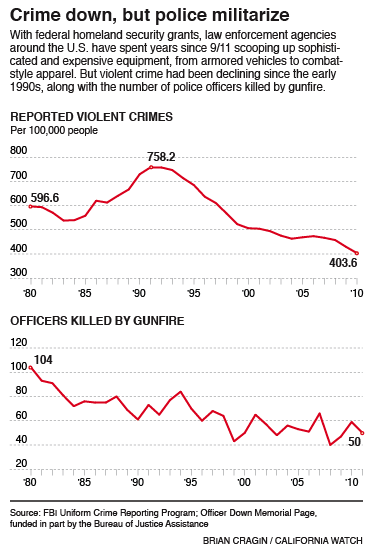
The federal grant spending, awarded with little oversight from Washington, has fueled a rapid, broad transformation of police operations in Fargo and in departments across the country. More than ever before, police rely on quasi-military tactics and equipment, the Center for Investigative Reporting has found.

No one can say exactly what has been purchased in total across the country or how it’s being used, because the federal government doesn’t keep close track. State and local governments don’t maintain uniform records. But a review of records from 41 states obtained through open-government requests, and interviews with more than two-dozen current and former police officials and terrorism experts, shows police departments around the U.S. have transformed into small army-like forces.

Since Occupy Wall Street and similar protests broke out this fall, confusion about how to respond has landed some police departments in national headlines for electing to use intimidating riot gear, pepper spray and rubber bullets to disperse demonstrators. Observers have decried these aggressive tactics as more evidence that police are overly militarized.


Among them is former Seattle police chief Norm Stamper, who today regrets his “militaristic” answer in 1999 to the infamous “Battle in Seattle” protests.

Many police, including beat cops, now routinely carry assault rifles. Combined with body armor and other apparel, many officers look more and more like combat troops serving in Iraq and Afghanistan. The list of equipment bought with the federal grants reads like a defense contractor catalog. High-tech gear fills the garages, locker rooms and patrol cars in departments across the country.

Although local officials say they have become more cautious about spending in recent years, police departments around the country are continually expanding the equipment and tactics of their jobs, despite, in many cases, the lack of an apparent need.

The share of federal grants for Fargo and the county it anchors is more than $8 million, a considerable sum for terrorism defense given its remote location and status as one of the safest areas in America. Fargo has averaged fewer than two homicides a year since 2005, and there have been no prosecutions of international terrorism in the state for at least a decade, if ever.

North Dakota’s biggest city is a humble place set on plains so flat that locals like to say you can watch your dog run away for two weeks. Yet all patrol officers in Fargo now carry an assault rifle in their squad car.

Fargo police Lt. Ross Renner, who commands a regional SWAT team, said the world is a dangerous place, and the city wants to be ready for anything.

With that in mind, Renner pushed for military-style assault rifles to become standard issue in department patrol cars.

“It’s foolish to not be cognizant of the threats out there, whether it’s New York, Los Angeles or Fargo. Our residents have the right to be protected,” Renner said. “We don’t have every-day threats here when it comes to terrorism, but we are asked to be prepared.”

Other communities also have ramped up as well. In Montgomery County, Texas, the sheriff’s department owns a $300,000 pilotless surveillance drone. In Garland County, Ark., known for its pleasant hot springs, a local law enforcement agency acquired four handheld bulletproof protective shields costing $600 each. In East Baton Rouge, La., it was $400 ballistic helmets. In Augusta, Maine, with fewer than 20,000 people and where an officer hasn’t died from gunfire in the line of duty in more than 125 years, police bought eight $1,500 tactical vests. And for police in Des Moines, Iowa, it was two $180,000 bomb robots.

Homeland security and law enforcement officials say the expenditures and modern training have helped save civilian and police lives. Do the armored vehicles and combat dress produce a sort of “shock and awe” effect? Lt. Jeremy Clark of the West Hartford Police Department in Connecticut hopes so. He said it can persuade suspects to give up sooner.
“The only time I hear the complaint of ‘God, you guys look scary’ is if the incident turns out to be nothing,” said Clark, who organizes an annual SWAT competition.

But the gear also can be used for heavy-handed – even excessive – tactics. In one case, dozens of officers in combat-style gear raided a rave in Utah as a police helicopter buzzed overhead. An online video shows the battle-ready team wearing masks and brandishing rifles as they holler for the music to be shut off and pin partygoers to the ground.

Arizona tactical officers this year sprayed the home of ex-Marine Jose Guerena with gunfire as the man stood in a hallway with a rifle that he did not shoot [PDF]. He was hit 22 times and died. Police had targeted the man’s older brother in a narcotics-trafficking probe, but nothing illegal was found in the younger Guerena’s home, and no related arrests had been made months after the raid.

Police say greater firepower and more protective equipment became increasingly necessary not only as everyday criminals obtained deadlier weapons, but also in response to 9/11 and other terrorist attacks. They point to a 1997 Los Angeles-area shootout with heavily armed bank robbers and the bloody 2008 shooting and bombing attack in Mumbai, India, which left 164 people dead and 300 wounded.

Every community in the country has some explanation for why it needs more money, not less, to protect against every conceivable threat. It could be a shooting rampage at an amusement park, a weapon of mass destruction hidden at a manufacturing plant, a nuclear device detonated at a major coastal port. Nothing short of absolute security seems acceptable.

“The argument for up-armoring is always based on the least likely of terrorist scenarios,” said Mark Randol, a former terrorism expert at the Congressional Research Service.

“Anyone can get a gun and shoot up stuff. No amount of SWAT equipment can stop that.”
Law enforcement leaders nonetheless bristle at the word “militarization,” even if the defense community itself acknowledges a convergence of the two.

“I don’t see us as militarizing police; I see us as keeping abreast with society,” said former Los Angeles Police Chief William Bratton, now chairman of Kroll Inc., the security consulting firm. “And we are a gun-crazy society.”

SWAT competition underscores training
They appear on a grainy video in slow motion, wearing battle fatigues, helmets and multi-pocketed vests.

Figures move through the scene as though on a mission. One large man with a pistol strapped to his hip swings a battering ram into a door. A colleague shoots a flash-bang grenade into a field. A third man points an assault rifle into the distance, peering at his target through a scope. A fourth, holding a pistol and wearing a rifle strapped to his back, peeks cautiously inside a bus.

The images unfold to the pulsing, ominous soundtrack of a popular video game, “Call of Duty: Modern Warfare 2.”

These are not soldiers in a far-flung warzone. They are members of the Massachusetts State Police competing at a SWAT team competition in Connecticut. The video, posted on YouTube, underscores the training and devotion tactical officers bring to their jobs. It also illustrates the level of force police units across the country can now deliver.

The annual Connecticut SWAT Challenge, hosted by the West Hartford Police Department, is one of numerous contests and exercises that have flourished since the terrorist attacks, as ultra-equipped, better-trained units sought to enhance their skills. The number of participating units more than doubled in five years, to nearly 40 teams by 2009, and dozens of sponsors seek to ensure their products and logos are on display.

One such sponsor sells ThunderSledge breaching tools for smashing open locked or chained doors. Another, Lenco Armored Vehicles, assembles black, bulletproof box-like trucks on oversized wheels that can fit up to 15 officers. Options include radiation detectors and hydraulic rams. KDH Defense Systems markets body armor to police that matches protection “used by some of the world’s most elite warfighters.”

Clark, of the West Hartford police, says he started the competition precisely because of the new counterterrorism spending. State and local governments weren’t willing to match it with costly training necessary for the gear to be used effectively and safely. Clark is startled by the number of SWAT teams falling below the 16 hours of minimum monthly training recommended by the National Tactical Officers Association. Without proper maintenance, only luck remains.

“Luck is not for cops. Luck is for drunks and fools,” Clark said. “Invariably, what happens with a police officer is he slips and falls, he breaks his back, he’s paralyzed for the rest of his life. Some suspect gets shot with an M4 (assault rifle) through the neck, and he’s out of the hospital in a day. Police officers and military guys never seem to have that kind of stubborn luck.”

Competitions in the San Francisco Bay Area and Boston use grant cash to create realistic and elaborate challenges, said Alameda County Sheriff Greg Ahern, who created the Urban Shield event in 2007.

In one scenario, officers with goggles, rifles and fatigues swept through the cabin of a boat. Flames poured from an exploded vehicle during another. Video of the 2009 Urban Shield – with its own heart-thumping doomsday music – depicts tactical teams moving carefully through darkened quarters, roping down the sides of buildings and leaping from a van.

Images of 9/11, the Columbine shootings and the 1989 Loma Prieta earthquake in California appear with the words “train, adapt, overcome.”

Special ops supplier Blackhawk Industries – founded by a former Navy SEAL – was among several elite Urban Shield sponsors this year.

Ahern points to a real-life recent case that tested area responders. A gunman killed three people and injured seven others in October at a Cupertino, Calif., cement plant where he reportedly clashed with co-workers. These incidents aren’t infrequent, Ahern insists.

“When you say low probability, I think we deal with these issues on a fairly regular basis,” Ahern said, adding that police “identify infrastructure, potential targets, in our area and try to have our teams train at those actual sites.”

No one knows for sure the number of SWAT teams nationwide. But at a time when the crime rate has been dropping, the number of police associated with SWAT duties has gone up. The National Tactical Officers Association, which provides training and develops SWAT standards, has about 1,650 team memberships, up from 1,026 in 2000, according to Executive Director John Gnagey.

“What we’ve always said is if you don’t have a specific need, you shouldn’t have one,” Gnagey said, referring to SWAT units.

Convention showcases latest tactical gear
The giant showroom in Chicago’s McCormick Place convention center provided a vivid picture of how the nation's law enforcement agencies are arming and armoring themselves. Chicago hosted the annual International Association of Chiefs of Police conference in late October. Some 800 exhibitors set up booths in 180,000 square feet of noisy space, many displaying military-style gear as thousands of police and other law enforcement professionals wandered the expo, dazzled by the latest gadgetry.
The sights and sounds are bewildering for a casual observer.

Electronic blasts and booms pour from the IES Interactive Training booth, where attendees chose among a shotgun, handgun and assault rifle with realistic recoil to aim at uncooperative suspects and inanimate targets on a life-size screen. Other booths offered combat-style apparel, such as one vest with a “Never Forget” patch, stirring up the memory of 9/11. At the Blackhawk booth, a mannequin was dressed head to toe in heavy-duty dark attire, a rifle slung from its neck and an additional sidearm strapped to its thigh. Another mannequin wore a full-face black mask.

Then there was the panoply of weapons. Colt’s Manufacturing Co. offered a selection of assault rifles. The most popular among cops? An M4 semi-automatic, “closest to what the military issues,” a salesman said.

Elsewhere, police officials admired a jumbo armored vehicle in camouflage green emblazoned with the words, “Greater Salt Lake.” It was built by Massachusetts-based truck maker Lenco, which also assembled the beefy BearCat that the Fargo-area SWAT team began using last year. The display vehicle had a battering ram affixed to the front. A man who answered questions about it showed off a remote gas delivery system that can be attached to the ram for spraying tear gas into a building from a long steel spear.

Advertising materials throughout the expo send a uniform message: The world is fraught with peril, and new high-tech gear is a solution.

“As criminal organizations are increasingly armed with military-style weapons, law enforcement operations require the same level of field-tested and combat-proven protection used by soldiers and Marines in Iraq, Afghanistan and other high-risk locations,” reads one brochure for the Oshkosh Corp.’s burly “tactical protector vehicle.” Minus passengers and cargo, it weighs more than two standard F-150 pickups built this year.

Colt makes its own appeal for a family of assault rifles: “The fundamental law enforcement mission profile has undergone drastic changes since the days of Sam Colt’s ‘gun that won the West.’ … Colt’s current law enforcement products have benefitted from decades of field and combat experience.”

Security market for state, local agencies growing
Security analyst Dilip Sarangan of Frost & Sullivan, which tracks the homeland security industry, said security spending by governments and the private sector is “event-based.” Both are suddenly willing to budget more when tragedy ignites new anxieties, such as after the 2007 Virginia Tech massacre, the 2005 London train bombings, the Mumbai terrorist attacks and, most of all, the 9/11 hijackings.

“That’s what their business is, unfortunately – anytime something bad happens, they make money,” Sarangan said.

The homeland security market for state and local agencies is projected to reach $19.2 billion by 2014, up from $15.8 billion in fiscal 2009, according to the Homeland Security Research Corp.

New opportunities are making major defense corporations more a part of our domestic lives.
Lenco, manufacturer of the BearCat and other SWAT vehicles, has sold more than 300 of its trucks to law enforcement agencies around the country. It also markets vehicles to the Defense Department, some for use in fighting improvised explosive devices.  The company does not disclose sales figures, but a spokesman said more have been sold since 9/11.

In 2007, British defense giant BAE Systems spent $4.5 billion to buy a company called Armor Holdings, which had subsidiaries that made and supplied police equipment, such as riot shields, hard-knuckle gloves, Delta 4 tactical helmets and laser sight mounts for AR-15 assault rifles.

Minnesota-based Alliant Techsystems, the Army’s primary provider of small-caliber ammunition, acquired in recent years two major tactical equipment suppliers, Blackhawk Industries and Eagle Industries. Company executives told shareholders that Blackhawk was a “highly profitable business,” with $115 million in predicted sales this year.

While such companies also outfit sporting enthusiasts and the military, law enforcement agencies are cast by Alliant as essential customers “in the rapidly growing security market.”

Local officials assert that homeland security grants, used to pay for the type of equipment showcased in Chicago, have slowed. But the grants still add up to a lot of spending: The Department of Homeland Security awarded more than $2 billion in grants this year, and President Barack Obama’s 2009 American Recovery and Reinvestment Act pumped more than a half-billion dollars into existing grant programs.

The Federal Emergency Management Agency is largely responsible for distributing homeland security grants. It operates a website known as the Responder Knowledge Base, which serves as a sort of war-on-terror catalog listing what local governments are allowed to buy with readiness funds.

One item featured is an armored bulldozer with a thick front shield and propelled by “tank-like, all-terrain tracks.” The manufacturer, Dolmen Corp., says police operate in an increasingly violent world, where the arms race between good guys and bad guys is constantly escalating.

The firm says the military-style vehicle allows police to “gain the edge on crime.”

Gnagey, of the tactical officers association, said there’s a sense among some local police that the price increases when makers know it’s being paid for with federal funds. The minute new equipment arrives, he joked, “if it’s painted black and called SWAT, the price doubles.”

But the evolution continues. In the Phoenix area, Sheriff Joe Arpaio claimed this year to have his own air armada of private pilots he could dispatch to monitor illegal border crossers. He called it Operation Desert Sky. Arpaio also picked up a full-size surplus Army tank, complete with treads.

The city of Ogden, Utah, is about to launch a 54-foot, remote-controlled “crime-fighting blimp” with a powerful surveillance camera affixed to its belly by the end of the year.
Standard-duty officers seen daily on the streets of Los Angeles were retrained to break in and kill terrorists without negotiating, under an assumption that the attackers could have a death wish and not be interested in resolving matters peacefully. Many officers were also equipped with assault rifles.

Bratton, the former police chief, said in an interview that terrorism had been a low priority early in his career. By the time he retired in 2009, it consumed a significant part of his workday. After the Mumbai attacks, Bratton believed he had to act fast to prepare for such an event.

“We were not structured for that type of attack,” he said. “Within six months, we were.”
Las Vegas rushed forward as well. Everyday patrol officers were given additional training, and each shift now has “in-the-box” squads that can meet at a pre-determined location and respond as a group to would-be campus or casino attackers. Squad members carry additional gear in their cars, including gas masks, body armor and high-powered rifles.

“When you go to a substation now at a police department and you see someone walk out to their car to start their shift, no longer are they just walking out there with a briefcase,” said Las Vegas Sheriff Doug Gillespie. “They’ve got other equipment they’re taking with them that if the situation arises, they put that on and they use it.”

Charles Ramsey, who was police chief in Washington, D.C., during 9/11, said officers in the nation’s capital began to train for multiple simultaneous attacks. The Mumbai bloodshed, which took place after Ramsey headed to Philadelphia in 2008, also served as a spur for him to make further changes and spend more money to up-armor his force.

Some 1,500 beat cops in Philadelphia have been trained to use AR-15 assault rifles – akin to the high-powered weapons issued to war fighters.

“We have a lot of people here, like most departments, who are ex-military,” Ramsey said in an interview. “Some people are very much into guns and so forth. So it wasn’t hard to find volunteers.”  

Preventative measures critical, Fargo police say
Fargo is not a place anyone associates with crime or terrorism. Its combination of friendly folk, low housing prices and high employment has garnered it recognition as one of the best places in the country to live. It is home to one of Microsoft's largest campuses and North Dakota State University.

Officials in Cass County, which includes Fargo, began buying gear in 2002. The spending on police gear rose from tens of thousands a decade ago to millions.

Police there said such spending is more than justified as a preventative measure. North Dakota has what could be perceived as targets, and the FBI established in Fargo one of its 104 Joint Terrorism Task Forces. Critical energy and agriculture sectors drive the booming economy in the remote border state. Drones used in the war on terror and homeland security are stationed at or operated from air bases in Grand Forks and at the local Fargo airport.

In addition, they say, some right-wing militias and white supremacists have been long-standing threats.

Fargo police justify the purchase of their SWAT truck, saying that with regular maintenance and low miles, it could serve the force for 30 years. They point to past shootings, like a 2004 incident in which a former Army ranger shot at SWAT team members and pinned down one officer who could have been aided by the truck.

In their minds, if it saves even one life, it’s worth the cost.

Other purchases, like the bomb-detection robots, are shared with federal agencies in Fargo that have outposts, but not the resources. The local police also say they’ve taken a regional approach to spend wisely, leveraging federal grants to buy equipment that has multiple uses.

“It doesn't make sense if we only use it for terrorism activity, and it doesn’t make sense if we only use it for criminal activity,” said Fargo police Capt. Patrick Claus, a former SWAT commander.

Some residents agree. Tim Kozojed, a corn and soybean farmer in Hillsboro, 40 miles north of Fargo, said he believes police ought to have the equipment they need. But he also believes they must spend money wisely. He’s not certain that’s happened with the grants.
“I’m very reluctant to get anxious about a terrorist attack in North Dakota,” Kozojed, 31, said. “Why would they bother?”

Claus, who was responsible for buying some of Fargo's military-style gear, including the BearCat truck, understands such thinking. But he contends it’s misguided, and he and other law enforcement authorities are obliged to prepare as well as they can.

“We prepare for the worst and hope it never happens,” he said. “But how many fires do you have to have before you buy a fire engine?”

Company Lobbied for NDAA Given $23 Million Contract for Night Raid Equipment

The Intel Hub
December 20, 2011

According to reports from the Daily Kos and Russia Today, a company specializing in night raid equipment was awarded a $23 million contract from the Department of Defense and subsequently went on to lobby for the NDAA which has given the government the power to indefinitely detain American citizens.

Surefire LLC openly lobbed for the House version of the NDAA, a bill many have claimed has effectively ended the Bill of Rights, months after receiving the $23 million contact from the DOD.

Why would this company be receiving a contract which could outfit at least 30,000 troops with new and updated night raid equipment when the U.S. is supposedly pulling troops out of Iraq and, to a smaller extent, Afghanistan?

Why has this same company gone on to lobby for a bill that has turned the United States into a war zone?
From the Daily Kos:
So what does Surefire make?  In a word, night-raid equipment, with a fresh new $23 million contract from the DoD even as we saw troops pulling out of Iraq and they are about to pull out of Afghanistan.  
The product catalog main categories read things like “weapon lights, helmet lights, sound suppressors, high capacity magazines.”  The equipment is relatively cheap, not big ticket items in Defense Department terms.  That means this is a big contract.  A $23 million contract would buy enough of these things to outfit maybe 50,000 soldiers.  
If we are pulling out of Iraq and Afghanistan, what is all this stuff for?  Night-raid gear?  These are basically made to blind people as they awake from you busting down their door, not for open combat.  
In a night firefight you don’t want any lights near you whatsoever.  That gives the other guy an easy target.
Does it seem likely that the night raid gear that will be provided to the DOD under the $23 million contract will be used outside the United States when the company who won the contract is lobbying for a bill that lets the military operate against American citizens inside the country?

Every week it seems more and more information is released that further proves that plans are in the works for detaining thousands of US citizens and they are already capable of becoming fully operational.

Whether it be Ron Paul warning about the NDAA and martial law or United Nations troops carrying out martial law drills within the US, the fact remains that the possibility of a martial law scenario in this country remains very real.

Still not convinced?
In 2008 the Pentagon openly announced their plans for a 20,000 strong military force(this is the number they admit, the actual number is sure to  be much higher) set to operate within the United States. This internal force was also called for in a Rand Corporation document titled, “A Stability Police Force for the United States

The Pentagon has an openly promoted a program(1033) that has given away close to $500 million in leftover military equipment to law enforcement in the fiscal year of 2011.

A recent document from former Halliburton subsidiary KBR outlined their need for subcontractors to be ready to provide various functions needed to establish I.C.E. detainment camps in America.

Multiple cities have seen the military take part in various police work including in Florida City which had the Air Force set up a crime prevention hotline and take part in arrests at a local convenience store.

The Pentagon and Military have been actively war gaming for what they see as a looming large scale economic collapse that will lead to civil unrest.

Early this year FEMA requested information on their ability to acquire 140 million packets of food, blankets, and underwater body bags.

Sssshhhh -- Don't Tell...

This is what my son gets for xmas...--jef

Viacom faces lawsuit over ‘What What (In the Butt)’ South Party parody

By Eric W. Dolan - RAW Story
Tuesday, December 20, 2011
 
whatwhatinthebutt-screen

 
After accusing YouTube of rampant copyright infringement, media giant Viacom has found an unusual ally in a fight over its own use of copyrighted material.

The Electronic Frontier Foundation (EFF) has filed an amicus brief in support of Viacom over a parody of a popular online video called “What What (In the Butt).”

Comedy Central’s popular show South Park parodied the video in a 2008 episode. Two years later, copyright owner Brownmark Films sued Viacom and Comedy Central, alleging copyright infringement.

A federal judge held the parody was protected by fair use laws and dismissed the case. But Brownmark appealed to the 7th U.S Circuit Court of Appeals, claiming that fair use cannot be decided on a motion to dismiss.

The EFF says if Brownmark’s claim is upheld, it would have a “chilling effect” on free speech.

“Brownmark is asking the appeals court for a rule that would make it much more difficult to resolve easy fair uses cases quickly. That would discourage artists and others from fighting claims, no matter how baseless, or even engaging in the fair use in the first place,” said EFF Fellow Michael Barclay. “The judge in this case got it exactly right: when the fair use is obvious, the case should be decided right away.”

The EFF argued that dismissing obvious fair use cases helps to deter abuses of the copyright system by so-called “copyright trolls,” who threaten to sue over copyright infringement but push to settle out of court.

“Fair use – using some copyrighted material for the purposes of art, education, or commentary – is an important part of how we communicate today. We see it everyday in segments on The Daily Show, in political advertisements, and in ‘remix’ videos on YouTube,” said EFF Staff Attorney Julie Samuels. “We can’t let litigious copyright holders chill free speech by making it more expensive.”

Making Citizens Enemy Combatants:

Glenn Greenwald on Bradley Manning and the NDAA
Constitutional lawyer and blogger Glenn Greenwald speaks to Amy Goodman about the Manning hearings and the indefinite detention of U.S. citizens. 
By Glenn Greenwald and Amy Goodman, Democracy Now!
Posted on December 19, 2011

AMY GOODMAN: We go right now to Rio, Brazil, where we’re joined by the Salon.com writer, blogger, attorney, Glenn Greenwald, who has expressed criticism of Adrian Lamo for revealing the contents of his correspondence with Manning to the military.
Glenn, welcome to Democracy Now! Talk about what’s happening right now at Fort Meade.

GLENN GREENWALD: Well, what’s happening at Fort Meade is that the individual who is most responsible for having informed the world of more journalistic scoops than every single media outlet combined, who even Bill Keller, the very anti-WikiLeaks executive editor of the New York Times, said was responsible substantially for helping to trigger the Arab Spring—this is, of course, if he’s actually has done what the U.S. government has accused him of—and, as well, has helped to bring about the end of the Iraq War, not just by showing that Apache helicopter attack video, but also by publishing documents about a U.S. air strike on a home that killed six children—or actually, they did a night raid that killed six children, and the U.S. then air-bombed that house to destroy the evidence so that they could lie about what took place, which is what the Iraqi people learned about with the release of these cables, that caused the Maliki government to refuse the release of immunity—has done more to inform the world about so many things that we ought to have known than any single person alive.

If he’s alleged to have done what he’s doing, he now faces possibly the death penalty. Although the government is not seeking it, he could still have it imposed on him if he’s convicted, as well as a lifetime in prison at the age of 23, all as a result of one of the most shameful acts of deceit and treachery we’ve seen in the last several decades, which is this individual, who he had the misfortune of befriending, assuring him on multiple occasions—go look at the chat—that nothing he was saying would ever see the light of day, that as a journalist and a minister, he could offer him complete secrecy, and then even assured him later on in the conversation, quote, "Remember, nothing—none of this is for print," and then turned over everything Bradley Manning allegedly said to the United States government. It’s an extraordinary tragedy, what has happened to Bradley Manning. The criminals whom he’s exposed have suffered no consequences. The only one who’s suffering consequences is the person who exposed these grave crimes to the world.

AMY GOODMAN: And Adrian Lamo saying you don’t have any proof that he didn’t hurt people and that he did commit a crime?

GLENN GREENWALD: Think about how incredibly insultingly stupid that is. The United States government has been trying for the last year to justify why it is that they’ve been putting Bradley Manning into conditions so severe that Amnesty and the U.N. are investigating and condemning it. Their own State Department spokesman resigned in protest over it. They’re trying to justify why these leaks that WikiLeaks helped facilitate, that they’re now trying to prosecute them for, are so harmful. And even, they came out at first and said that WikiLeaks has blood on their hands, and then when media outlets like McClatchy started investigating, they were forced to admit that not a single person has been attacked or lost their lives as a result of the Afghanistan war documents that they originally claimed had blood on their hands. The benefits that these leaks have generated for the world are so enormous that we wouldn’t have time to discuss even a fraction of them. And there’s been virtually no harm. And the idea that there might have been harm, but the U.S. government is just too shy or modest about pointing to it, is really too absurd for words.

AMY GOODMAN: Glenn Greenwald, the issue of the sexuality of Bradley Manning being raised in this hearing and what that means?

GLENN GREENWALD: You know, I think the important thing to keep in mind is that we, as journalists, or people who have an interest in this story, are looking at Bradley Manning as a hero and as somebody who has done important things for the world—at least that’s how I see him. But at the same time, he is a 23—he just turned 24. His birthday was yesterday. He’s a 24-year-old, young kid, essentially, who really does face a lifetime in prison. So he is—and I don’t blame him at all—trying to do whatever he can to avoid having his life destroyed, either being killed by the state or locked up in a cage for the rest of his life. And presumably, his attorney—and a lot of—all the Manning hearings have been shrouded in secrecy. Politico reported that there’s actually more transparency in Guantánamo hearings than there has been for the Manning tribunal, so it’s hard to know exactly what the evidence is or what’s taking place. But presumably, his lawyer believes that one of the best ways that they have to keep him out of prison for the next six decades is to argue that he had diminished capacity by virtue of emotional distress over the gender struggles that he had over his sexual orientation being in a military that had a policy of banning those who were openly gay. And so, part of this emotional distress that they’re raising is designed to say that he should be excused from his actions because they were not the byproduct of full choice.

AMY GOODMAN: Finally, Glenn, I wanted to ask you about a not wholly unrelated issue, and that is the issue of the military authorization bill that President Obama threatened to veto if it continued to contain the provisions about the treatment of terrorism prisoners, people who could be picked up, Americans in the United States, without trial, without hearing, and held indefinitely. President Obama has dropped the veto threat, saying the changes have satisfied him. Your thoughts?

GLENN GREENWALD: Well, let’s remember that under the status quo, because of the way that the Bush and Obama administrations have interpreted their own powers in the original 2001 authorization to use military force, they already claim, the executive branch does, the power to indefinitely detain people. That’s what’s happening right now at Guantánamo. It’s what’s happening at Bagram and several other facilities. And the Obama administration has vehemently defended this power to put people into prison without any trial or charges for as long as they want to keep them there. Additionally, they—the Obama administration claims the power to target even American citizens as enemy combatants, and not just to detain them indefinitely, but to kill them, as well. That’s what they did with Anwar al-Awlaki, far from any battlefield, based on this theory that they already have this power, even before this bill is passed.

But what this bill will do, and it will be signed into law now by President Obama, as you indicated, is that it will be the first time that the United States Congress has codified the power of indefinite detention into the law since the McCarthy era of the 1950s. The 1950 Congress passed a bill saying that communists and subversives could be imprisoned without a trial, without full due process, based on the allegation that they presented a national threat, an emergency, a threat to the national security of the United States.

President Truman, knowing that the bill would—the veto would be overridden, nonetheless vetoed it and said that it made a mockery of the Bill of Rights. That law was repealed in 1971 with the Non-Detention Act, that said you cannot hold people in prison without charging them with a crime. The war on terror has eroded that principle, under both the Bush and Obama administrations, but Congress is now, with the Democrats in control of the Senate and a Democratic president, is about to enact into law the first bill that will say that the military and the United States government do have this power. It’s muddled whether it applies to U.S. citizens on U.S. soil, but it’s clearly indefinite detention, and there’s a very strong case to make that it includes U.S. citizens, as well, which, as we know, the Obama administration already claims anyway, and that’s what makes it so dangerous.