Saturday, July 30, 2011

Debt Ceiling Doomsday

Shadow Banking and the Repo Market
 By MIKE WHITNEY
"International markets are absolutely on tenterhooks, because up until now there really has been a pretty blithe assumption that sooner or later politicians would strike a deal, and it would probably be last-minute, but a deal would be done before Aug. 2.

What is really starting to think in right now is that not only is there a growing risk the rating agencies could downgrade U.S. debt, even if there is some kind of short-term Band-Aid solution, but secondly there may not even be a deal by August the 2nd. And so a lot of people in the financial markets right now are starting to look at what-if scenarios and creating plans for what they half-jokingly call doom day, potential -- or D-day, potential default day."

-- Gillian Tett, editor Financial Times, PBS Newshour

Okay, so we all knew that the cultists and screwballs who run the GOP were going to take this to the 11th hour, right? But who knew that once they got us out on the ledge, they wouldn't know how to cut a deal? Instead, Tea Party confederates seem determined to make sure the US plunges into the abyss. They want to add a balanced budget amendment to the current legislation which has no chance of getting it passed. President Barack Obama has already promised to veto the bill.

So, here we are, just 4 days away from the August 2 deadline, and no closer to a budget agreement than we were two months ago when this whole fiasco started. Only now, Wall Street is worried, the public is pissed off, and anyone holding US Treasuries around the world is starting to rethink their portfolio. On top of that, the markets have been pounded for 4 days straight, futures are falling like a stone, and the economic data is getting weaker and weaker all the time. (BEA reports that 2nd Quarter GDP came in at an anemic 1.3%) The last thing the country needs is another crisis to send the economy sprawling back into recession. Here's a clip from an article in the Financial Times:
"Wall Street's leading chief executives intervened in the US debt debate on Thursday, writing to President Barack Obama and Congress to warn of "very grave" consequences of a default and urging them to cut a deal "this week".

Lloyd Blankfein of Goldman Sachs and Jamie Dimon of JPMorgan Chase were among 14 chief executives of banks and insurers who signed the letter, along with Rob Nichols, the head of the Financial Services Forum, the umbrella association for the biggest financial groups in the US.

The letter said a default, which is still perceived as unlikely, or a downgrade from a triple-A credit rating, which analysts believe is increasingly likely, "would be a tremendous blow to business and investor confidence – raising interest rates for everyone who borrows, undermining the value of the dollar, and roiling stock and bond markets"….

Banks are concerned about a wide range of operational issues as well as the broader question of how the Fed would support the financial system if there were disruption caused by a failure to raise the debt ceiling.... they would like to know whether the Fed will support the refinancing of Treasury securities by stepping in and buying any unsold stock at auctions…. ("Bank chiefs send US debt default warning", Financial Times)
So, finally, the truth begins to emerge. The reason the debt ceiling has been headline news 24-7 is not because Granny might not get her Social Security check on time, but because Wall Street fatcats might lose some dough if a deal isn't worked out pronto. But doesn't suggest that the final outcome is not yet certain? In other words, if the Tea Party contingent refuses to fall in line behind Boehner, then August 2 might come and go with no deal, and that could trigger another Lehman Bros-type meltdown. Here's an excerpt from an article in the New York Times:
"The reverberations of Washington's impasse over a debt deal are already being felt in the short-term credit markets, a key artery of the economy that daily supplies trillions of dollars of credit. Over the last week, big banks and companies have withdrawn $37.5 billion from money market funds that invest in Treasury debt and other ultra-safe securities, the biggest weekly drop this year.

Meanwhile, in the vast market for repurchase agreements, in which many financial firms make short-term loans to one another, borrowers are beginning to demand higher yields.

These moves underscore how companies and big financial institutions are beginning to rethink their traditional view that notes issued by the United States Treasury are indistinguishable from cash, even though many experts say they think it is unlikely that the government would miss payments on its obligations.... ("Debt Ceiling Impasse Rattles Short-term credit markets", New York Times)

Sound familiar? This is what ignited the Crash of '08. There was a downgrading of mortgage-backed securities (MBS) and other structured debt instruments, liquidity vanished overnight, and, before you knew it, the markets were in freefall. And it all started with a run on the shadow banking system. And, that's what's happening right now. Here's a sampling of some of the articles popping up in the financial media.

Financial Times:
"US money market funds are stockpiling cash in case Congress fails to raise the debt ceiling, distorting the short-term market for US government debt and raising borrowing costs for banks and other financial institutions....

Banks are also holding more cash and US corporations are postponing decisions due to uncertainty about where to invest cash amid fears that a failure to raise the debt ceiling would trigger a credit rating downgrade and possible default....

Money market funds, which hold $338bn of US government debt, according to Citigroup, are also reducing the amount of time they are willing to lend. This could raise funding concerns for banks, as they are reliant on short-term borrowing in the repurchase or repo market." (Financial Times)
And this is from Naked Capitalism:
"...the Merc (more formally, the Chicago Mercantile Exchange) .... announced an increase in haircuts on Treasury and agency securities today.... But it increased haircuts even more on foreign sovereign debt. This will force players who have been using any of these assets as collateral that are also pretty fully leveraged to either cut their positions or put up more cash or other collateral." (Naked Capitalism)
And, lastly, from the New York Times:
"...In the commercial paper market, where companies raise funds for their short-term borrowing needs, buyers are also seeking shorter-term paper...

While money market fund managers say they are not seeing a sizable wave of redemptions yet, they are setting aside more cash, leaving it at custodial bank accounts in case investors demand their money back." ("Debt Ceiling Impasse Rattles Short-term credit markets", New York Times)
So there's a lot of hunkering down going on, which means that Wall Street isn't really sure how this thing is going to shake out. If there is a default on August 2, the US's debt would be downgraded requiring more collateral on roughly $4 trillion in Treasuries. Does anyone believe that the maxed out, capital-starved banks have that kind of money laying around?

Not likely. The Fed would have to step in a wrap its arms around the whole financial system again, like it did after Lehman blew up. Only this time, the rest of the world might not buy it. They might see that America's dysfunctional political system and it's bankcentric beggar-thy-neighbor monetary policy makes it an unsuitable steward of the global economic system. At the very least, the dollar's exalted position as the world's reserve currency would be called into question. Is that such a bad thing?

Presently, US Treasuries play a crucial role in short-term funding markets providing the bulk of Triple A collateral in the repo (repurchase agreement) market. If Treasuries are downgraded, then money markets, commercial paper, and interbank lending will all feel the stress. That will make borrowing more expensive causing a slowdown in credit. The knock-on effects will be felt throughout the economy. Another recession will be unavoidable.

Ironically, the Financial Stability Oversight Council, which was created by Dodd-Frank legislation, issued a report last week which pointed out the vulnerabilities in the current system. The FSOC warned that it "cannot predict the precise threats that may face the financial system" emphasizing much of what we have been talking about here. Here's a clip from the Wall Street Journal which explains what they found:
"In particular, the FSOC said weaknesses exist in the "triparty repo" market, in which banks make and receive short-term loans on a day-to-day basis. The repo market temporarily froze during the financial crisis, drying up a key source of funding for many Wall Street firms. The FSOC said critical overhauls are needed, including strengthening the collateral practices backing the securities that are being loaned and borrowed...

Regulators also warned risks still exist in money-market funds, which are used by individuals and corporations as a low-risk place for parking cash. To increase stability and reduce the funds' "susceptibility to runs,".... ("Watchdog Sees Financial Weak Spots", Wall Street Journal)
What the report is saying is that nothing has been fixed. Obama's efforts to reform the markets (and avert another bank run) has amounted to nothing. Shadow banking and the repo market are just as unstable and risky as ever. And that's what the debt ceiling flap is really all about. It's about a deregulated system that's been preserved because, well, because some very rich people like the way things are right now and to hell with the rest of us. That's why.

Disastrous Outcomes From an Orchestrated Crisis

Will the Ceiling Fall In?
By PAUL CRAIG ROBERTS

With the world concerned about US financial credibility and the poor outlook for the US economy, now is not the time for the Republicans to grandstand on the public debt. The debt ceiling needed to be quietly raised. Instead, the Republicans started a fire and then threw gasoline on it, creating an inferno that could burn up the US social safety net or the US Treasury’s credit rating and the US dollar’s role as reserve currency or what remains of the separation of powers.

Consequently, world financial markets, currency markets, commodity markets, central banks, and mutual fund money market and bond funds are on pins and needles.

This level of irresponsibility is seldom seen even from American politicians.

Republicans have created a totally unnecessary crisis and turned it into compelling political theater. Will the US default? Will entitlements be slashed? Will Obama seize the power of the purse from Congress in order to save the dollar and the US credit rating? None of these questions needed to arise.

While the world media fixates on the orchestrated debt ceiling crisis, the US government continues to bomb civilians in Afghanistan, Libya, Iraq, Pakistan, Yemen, and Somalia and continues with preparations to do the same thing to Syria and Iran.

The violations of other countries’ sovereignties, the naked aggressions that constitute war crimes, the murder of noncombatants, and the horrible moral and economic expense inflicted by the maximization of the military/security complex’s profits are somehow not a crisis. These are just routine, normal, everyday necessary events. Nothing to notice or to become upset about.

The offshoring of US jobs, GDP, tax base, and consumer demand that has eroded away the US economy and the government’s tax base, thus elevating the deficit, is somehow not a crisis. These are just the imperatives of globalism and the routine maximization of shareholders’ profits and management’s performance bonuses.

The US has become such a ridiculous collection of fools that no real crisis can be recognized. Instead, the country is mesmerized by a fake crisis.

The fake orchestrated crisis can easily turn into a real one. If income support programs are slashed, so will be consumer demand, and the US economy will decline further, widening the budget deficit and national debt.

If the Republicans force the country into default, the dollar will suffer. At the least, import prices will rise and the trade deficit with them. At the worse, the dollar will lose its reserve currency role, and the US will no longer be able to pay its oil bill in its own currency. With its balance of payments deep in the red, it has no foreign currency with which to purchase oil.

If Obama has to seize the power of the purse in order to prevent a new financial crisis from landing on top of the ongoing financial crisis, democracy will take another big hit.

Americans need desperately to ask themselves why they put into political office such utterly irresponsible and incompetent people capable of creating such a totally unnecessary crisis loaded with such disastrous potential outcomes. It would appear that the American population is too insouciant to use the vote with any care.

Little wonder that the president is becoming a Caesar.

GOP Motivational Reel

Republicans use a clip from The Town as motivational caca...


Bill Maher adds his own to the GOP Motivational reel...

"New Rules" Bill Maher July 29, 2011

Maher creates ‘It Gets Better’ video for socialists | Raw Replay

Thursday, July 28, 2011

Bank ‘Activity’ Required For Wisconsin Voter ID

by Jacob Sloan on July 27, 2011

In the state of Wisconsin, you may be denied the ability to vote for lack of sufficient recent “bank activity”. A woman surreptitiously filmed the interactions as her 18-year-old son leaps through hurdle after hurdle in an attempt to get a constitutionally-guaranteed state ID so that he could vote. At the DMV, the pair is told that voter IDs were not issued when voters’ bank accounts did not show enough “activity.” The clerk had no answer when asked what would happen in the case of a resident who was homeless or unemployed, or too poor to maintain the minimum balance required for a checking account.

"Prepare for a lost decade or more" Jim Rogers

GB Court orders BT to block pirate links website

(It will happen here in the US soon, too. --jef)

+++++

28th July, 2011 by Henna Butt

A High Court judge has ruled that BT, Britain’s largest ISP must block access to Newzbin 2, a website, which like many others provides links to pirated movies.

This is a landmark case in that an ISP has not previously been asked to block a website of this nature. This ruling will provide precedent for further action to be taken with different ISPs in order to block the vast numbers of similar websites that provide links to pirated material.

Justice Arnold stated: “In my judgment it follows that BT has actual knowledge of other persons using its service to infringe copyright: it knows that the users and operators of Newzbin 2 infringe copyright on a large scale, and in particular infringe the copyrights of the studios in large numbers of their films and television programmes.”

The legal action was launched by the Motion Picture Association (MPA) who celebrated the ruling as a victory for people working in creative industries.

The digital rights organisation the Open Rights Group argued that the ruling could set a “dangerous” precedent, challenging the freedom and openness upon which the Internet has been built.

“There are serious risks of legitimate content being blocked and service slowdown. If the goal is boosting creators’ ability to make money from their work then we need to abandon these technologically naive measures, focus on genuine market reforms, and satisfy unmet consumer demand,” said ORG campaigner Peter Bradwell.

Once a ruling allows the blocking of a website then questions in future will arise over the conditions which make a site worthy of being blocked and it is this potential for ‘gagging’ that we must be wary of.

What Scandal?


Medicare for All: Fair, Frugal, and Inclusive

 
For 30 years I’ve been teaching young doctors how to practice primary care medicine at a center-city clinic in Toledo. Every day we witness heart-wrenching scenes right out of a Charles Dickens novel -- scenes that illustrate the cruelty, arbitrariness and absurdity of our health care “system.”

Imagine for a moment a 64-year-old, low-income and uninsured man whose condition requires hospitalization and specialty care. Due to the likely cost of his treatment, he and his family could soon be facing bankruptcy. As if the physical suffering were not enough, he’s now grappling with a terrible financial crisis.

Right next to him is another patient with the same condition and of similarly modest means. However, because he’s 65 and enrolled in Medicare, he’s able to get dignified and relatively hassle-free care, without the worry of a financial shipwreck. He can go to the doctor and hospital of his choice, get treated and not face overwhelming medical bills.

Two patients, two very different stories -- all because one person just happened to have been born a year earlier than the other.

Medicare, whose 46th anniversary will be observed July 30, has been a lifesaver for millions of elderly and severely disabled Americans. It’s been a major pillar of financial security for our nation’s families. And yet there are those in Congress today who would weaken or even dismantle it in the name of “fiscal responsibility."

The Medicare program has many virtues. It has created incentives for hospitals and doctors to improve the quality of care. It has produced better cost control than the private sector, despite giving patients freedom to see any doctor and go to any hospital.

The cost of administering the program is in the 1.3 percent to 3 percent range, much less than the 12-14 percent range typical of big employer-based private plans, and the 25-30 percent overhead associated with individual plans.

Given these strengths, Medicare should have been the model for health reform. Instead, in passing the Affordable Care Act, Congress added a third floor to house with a crumbling foundation. That crumbling foundation is our inefficient, wasteful private-insurance-based system of financing health care.

Private insurers make money by screening out the sick, denying claims and raising premiums. They cause us to waste enormous amounts of money on excess paperwork and bureaucracy — their own paperwork and the paperwork they inflict on hospitals, patients and doctors like me. An estimated 31 cents of every health care dollar goes toward administration in U.S. health care, at least half of it unnecessary.

It doesn’t have to be this way. Our nation needs to enact a single-payer national health insurance program, an improved Medicare for all.

Instead of the being saddled with the mean-spirited, wasteful and exclusionary insurance arrangements we have now, an improved Medicare for all program would be fair, frugal and inclusive.

By replacing the private insurers with a single, streamlined, publicly financed system that handled all bills, we’d recapture about $400 billion annually that’s currently spent on unnecessary paperwork -- enough to provide comprehensive coverage to all the uninsured and to improve coverage for the rest of us.

Such a system could negotiate pharmaceutical prices like the Veterans Administration does, lowering drug costs by about 40 percent. The same principle would apply to other supplies and services, helping us rein in costs.

The burden of rising health care costs on businesses would be sharply reduced, thereby enhancing the competitiveness of U.S. products overseas. Lowering out-of-pocket health cost would leave more money for discretionary spending that stimulates the economy.

Alarmingly, the budget deficit is prompting some in Washington to talk about cutting Medicare or delaying eligibility to age 67. That would be exactly the wrong direction in which to go. Medicare is the victim of rising health costs, not its cause.

It’s not too late to do the right thing. We should celebrate Medicare’s birthday by improving it and expanding it to all. The new system will save lives, save money and will place our nation on a path to become one of the best health systems in the world -- something of which we can all be proud.

Wednesday, July 27, 2011

Obama's Ambush on Entitlements

Under Cover of "Crisis"
By MICHAEL HUDSON

You know that the debt face-off is as staged as melodramatically as a World Wrestling Federation exhibition when Obama makes the blatantly empty threat that if Congress does not “tackle the tough challenges of entitlement and tax reform,” there won’t be money to pay Social Security checks next month. In his debt speech last night (July 25), he threatened that if “we default, we would not have enough money to pay all of our bills – bills that include monthly Social Security checks, veterans’ benefits, and the government contracts we’ve signed with thousands of businesses.”

This is not remotely true. But it has become the scare theme for over a week now, ever since the President used almost the same words in his interview with CBS Evening News anchor Scott Pelley.

Of course the government will have enough money to pay the monthly Social Security checks. The Social Security administration has its own savings – in Treasury bills. I realize that lawyers (such as . Obama and indeed most American presidents) rarely understand economics. But this is a legal issue. Obama certainly must know that Social Security is solvent, with liquid securities to pay for many decades to come. Yet . Obama has put Social Security at the very top of his hit list.

The most reasonable explanation for his empty threat is that he is trying to panic the elderly into hoping that somehow the budget deal he seems to have up his sleeve can save them. The reality, of course, is that they are being led to economic slaughter. (And not a word of correction reminding the President of financial reality from Rubinomics Treasury Secretary Geithner, neoliberal Fed Chairman Bernanke or anyone else in the Wall Street Democrat administration, formerly known as the Democratic Leadership Council.)

It is a con. Obama has come to bury Social Security, Medicare and Medicaid, not to save but kill them. This was clear from the outset of his administration when he appointed his Deficit Reduction Commission, headed by avowed enemies of Social Security Republican Senator Alan Simpson of Wyoming, and President Clinton’s Rubinomics chief of staff Erskine Bowles. Obama’s more recent choice of Republicans and Blue Dog Democrats to be delegated by Congress to rewrite the tax code on a bipartisan manner – so that it cannot be challenged – is a ploy to pass a tax “reform” that democratically elected representatives never could be expected to do.

The devil is always in the details. And Wall Street lobbyists always have such details tucked away in their briefcases to put in the hands of their favored congressmen and dedicated senators. And in this case they have the President, who has taken their advice as to whom to appoint as his cabinet to act as factotums to capture the government on their behalf and create “socialism for the rich.”

There is no such thing, of course. When governments are run by the rich, it is called oligarchy. Plato’s dialogues made clear that rather than viewing societies as democracies or oligarchies, it was best to view them in motion. Democracies tended to polarize economically (mainly between creditors and debtors) into oligarchies. These in turn tended to make themselves into hereditary aristocracies. In time, leading families would fight among themselves, and one group (such as Kleisthenes in Athens in 507 BC) would “take the people into his party” and create a democracy. And so the eternal political triangle would go on.

This is what is happening today. Instead of enjoying what the Progressive Era anticipated – an evolution into socialism, with government providing basic infrastructure and other needs on a subsidized basis – we are seeing a lapse back into neo-feudalism. The difference, of course, is that this time around society is not controlled by military grabbers of the land. Finance today achieves what military force did in times past. Instead of being tied to the land as under feudalism, families today may live wherever they want – as long as they take on a lifetime of debt to pay the mortgage on whatever home they buy.

And instead of society paying land rent and tribute to conquerors, we pay the bankers. Just as access to the land was a precondition for families to feed themselves under feudalism, one needs access to credit, to water, medical care, pensions or Social Security and other basic needs today – and must pay interest, fees and monopoly rent to the neo-feudal oligarchy that is now making its deft move from the United States to Ireland and Greece.

The U.S. Government has spent $13 trillion in financial bailouts since Lehman Bros. failed in September 2008. But . Obama warns that thirty years from now, the Social Security fund may run a $1 trillion deficit. It is to ward it off that he urges dismantling the plans for such payments now.

It seems that the $13 trillion used up all the money the government really has. The banks and Wall Street firms have taken the money and run. There is not enough to pay for Social Security, Medicare or other social spending that the Blue Dog Democrats and Republicans now plan to cut.

Not right away. The plan will be to “paper over” the current crisis by delegating the plans to a “Deficit Reduction Commission #2,” appointed from Congressional members.

Finally, we have “Change we can believe in.” Real change is always surprising, after all.

The faux crisis

Usually a crisis is needed to create a vacuum into which these toxic details are fed. Wall Street does not like real crises, of course – except to make quick computer-driven speculative gains on the usual fibrillation of today’s zigzagging markets. But when it comes to serious money, the illusion of a crisis is preferred, staged melodramatically to wring the greatest degree of emotion out of the audience much like a good film editor edits a montage sequence. Will the speeding train run over the girl strapped to the tracks? Will she escape in time?

The train is debt; the girl is supposed to be the American economy. But she turns out to be Wall Street in disguise. The exercise turns out to be a not-so-divine comedy. Obama offers a plan that looks very Republican. But the Republicans say no. There is an illusion of a real fight. They say Obama is socialist.

Democrats express shock at the giveaway being threatened. Many say, “Where is the real Obama?” But it seems that the real Obama turns out to be a Republican Wall Street imposter in Democratic clothing. That is what the Democratic Leadership Committee basically is: Wall Street Democrats.

This is not as much of an oxymoron as it may sound. There is a reason why today’s post-Clinton Democrats are the natural party to undo what FDR and earlier Democrats stood for. A Democratic Senate never would stand for such giveaways to Wall Street and double-cross of their urban constituency if a Republican president would propose what . Obama is putting before them.

Here’s what the next Republican presidential candidate can say: “You know that whatever we Republicans want, Obama will support us. If you don’t want a Republican policy, they you should vote for me for president. Because a Democratic Congress will oppose a Republican policy if we propose it. But if. Obama proposes it, congress will be de-toothed, and cannot resist.”
It’s the same story in Britain, where the Labour Party is called upon to finish up the job that the Conservatives start but need New Labour to subdue popular opposition to privatizing the railroads and a Public/Private Partnership financial giveaway for the London tube line. And it’s the same story in France, where a Socialist government is supporting the privatization program dictated by the European Central Bank.

Round up the usual fallacies

Whenever one finds government officials and the media repeating an economic error as an incessant mantra, there always is a special interest at work. The financial sector in particular seeks to wrong-foot voters into believing that the economy will be plunged into crisis of Wall Street does not get its way – usually by freeing it from taxes and deregulating it.

Obama’s first fallacy is that the government budget is like a family budget. But families can’t write IOUs and have the rest of the world treat it as money. Only governments can do that. It is a privilege that the banks would now like to obtain – the ability to create credit freely on their computer keyboards, and charge interest for what is almost free, and what governments can indeed create for free.

“Now, every family knows that a little credit card debt is manageable. But if we stay on the current path, our growing debt could cost us jobs and do serious damage to the economy.” But economies need government money to grow – and this money is provided by running federal budget deficits. This has been the essence of Keynesian counter-cyclical spending for more than half a century. Until the present, it was Democratic Party policy.

It’s true that Pres. Clinton ran a budget surplus. The economy survived by the commercial banking system supplying the credit needed to grow – at interest. To force the economy back into this reliance on Wall Street rather than on government, the government needs to stop running budget deficits. The economy will then have a choice: to shrink sharply, or to turn almost all the economic surplus over to banks as economic rent on their credit-creation privilege.

Obama also pretends that credit ratings agencies are able to act as mascots for their clients, the large financial underwriters, by making the entire economy pay even higher interest rates on its credit cards and banks. “For the first time in history,” . Obama dissembled, “our country’s Triple A credit rating would be downgraded, leaving investors around the world to wonder whether the United States is still a good bet. Interest rates would skyrocket on credit cards, mortgages, and car loans, which amounts to a huge tax hike on the American people.”

The reality is that running a budget surplus would increase interest rates, by forcing the economy into captivity to the banking system. The Obama administration is now deep into its Orwellian rhetorical phase.

During Obama’s speech I could not help feeling that I had heard it all before. And then I remembered. Back in 2008, Treasury Secretary Henry Paulson sought to counter Sheila Bair’s argument that all FDIC-insured depositors would be able to ride out the September crisis, with only the reckless gamblers losing the gains they hoped to make on their free credit. “If the financial system were allowed to collapse,” he warned in his Reagan Library speech, “it is the American people who would pay the price. This never has been just about the banks; it has always been about continued prosperity and opportunity for all Americans.”

But of course, it is all about the banks. Wall Street knows that to get sufficient Congressional votes to roll back the New Deal, Social Security, Medicare and Medicaid, a Democratic president needs to be in office. A Democratic Congress would block any Republican president trying to make the kind of cuts that Obama is sponsoring. But Congressional Democratic opposition is paralyzed when President Obama himself – the liberal president par excellence, America’s Tony Blair – acts as cheerleader for cutting back entitlements and other social spending.

So just as the City of London backed Britain’s Labour Party in taking over when the Conservative Party could not take such radical steps as privatizing the railroads and London tube system, and just as Iceland’s Social Democrats sought to plunge the economy into debt peonage to Britain and Holland, and the Greek Socialist Party is leading the fight for privatization and bank bailouts, so in the United States the Democratic Party is to deliver its constituency – urban labor, especially the racial minorities and the poor who are most injured by Pres. Obama’s austerity plan – to Wall Street.

So Obama is doing what any good demagogue does: delivering his constituency to his campaign contributors on Wall Street. Yves Smith has aptly called it Obama’s “Nixon goes to China moment in reverse.”

The Republicans help by refraining from putting forth a credible alternative presidential candidate. The effect is to give Obama room to move far to the right wing of the political spectrum. Far enough so that it is his own Democrats who are most intent on scaling back Social Security, not the Republicans.

This is done most easily under pressure of near panic. This worked after September 1008 with TARP, after all. The Wall Street bailout melodrama should be viewed as a dress rehearsal for today’s debt-ceiling non-crisis.

Obama Worse Than Herbert Hoover?

Obama's Wrecking Crew
By MARSHALL AUERBACK

It’s actually a bit over the top and unfair to compare Barack Obama with Herbert Hoover – unfair that is, to the memory of Herbert Hoover. The received image of the latter is the dour, technocrat who looked on with indifference while the country went to pieces. This is actually an exaggeration. As Kevin Baker convincingly argued in his Harper’s Magazine piece, “Barack Hoover Obama”, President Hoover did try to organize national, voluntary efforts to hire the unemployed, provide charity, and sought to create a private banking pool. When these efforts collapsed or fell short, he started a dozen Home Loan Discount Banks to help individuals refinance their mortgages and save their homes. Indeed, the Reconstruction Finance Corporation, which became famous for its exploits under FDR and Jesse Jones, was actually created by Hoover. Often tarred with the liquidationist philosophy of his Treasury Secretary, the establishment of the RFC was, as Baker suggested, “a direct rebuttal to Andrew Mellon’s prescription of creative destruction. Rather than liquidating banks, railroads, and agricultural cooperatives, the RFC would lend them money to stay afloat.”

Hoover’s tragedy lay in the fact that whilst he recognized the deficiencies of the prevailing neo-classical laissez-faire nostrums of his day, he could not ultimately break with them and accept that the economic tenets which he had grown up with were deficient in terms of dealing with the huge unemployment challenges posed by the Great Depression. By contrast, Roosevelt was himself instinctively a fiscal conservative throughout much of the early stages of his political career (and campaigned as a gold standard man during the election of 1932), but ultimately had the vision (or, at least, excellent political instincts) to recognize the need to cut himself off from the dogma of the past and try something new in a persistent spirit of experimentation. Not everything FDR did worked, but his lack of rigid ideology and his bold spirit of economic experimentation ultimately did much to reduce the scourge of unemployment, though of course such policies brought him into significant conflict with the economic royalists of his day.

Barack Obama’s style of governing largely reflects an acceptance of the status quo. His “economic experts” also reflects this preference. As Baker argued, “it’s as if, after winning election in 1932, FDR had brought Andrew Mellon back to the Treasury.”

To the extent that he displays any kind of radicalism, it is to roll back the frontiers of the New Deal and Great Society, in effect gutting the Democratic Party of its core social legacy. This assertion will no doubt inflame the dwindling band of Obama supporters, who insist the president would never cut Social Security or Medicare, that he's merely been exploring every possible route to a deal with the GOP. But the evidence increasingly suggests otherwise.
Perhaps the president sincerely believes that the intense polarization of American politics isn't merely a symptom of our problems but a problem in itself – “and thus compromise is not just a means to an end but an end in itself, to try to create a safe harbor for people to reach some new common ground”. One finds further support for this view within Barack Obama’s own writings. A major theme of his 2006 book The Audacity of Hope is impatience with “the smallness of our politics” and its “partisanship and acrimony.” He expresses frustration at how “the tumult of the sixties and the subsequent backlash continues to drive our political discourse,”

There appears little question, then, that the President values compromise, indeed appears to enshrine it as the apex of all great Presidencies (ironically citing Lincoln’s compromise on slavery as a perfect illustration of this ideal). But the problem is that the President’s accommodation with his political enemies, his apparent infatuation with a “third way”, suggests that he is being forced to compromise on a particular set of ideals and principles which he has hitherto embraced dearly.

But what is this President's ideal? The only time in our national discussions where Obama has evinced any kind of passion has been during the debt ceiling negotiations. He has, since the inception of his presidency, elevated budget deficit reductions and the "reform" of entitlements as major transformational goals of his Presidency (rather than seeing deficit reduction as a by-product of economic growth). As early as January 2009, before his inauguration (but after the election, of course), then President-elect Obama pledged to shape a new Social Security and Medicare "bargain" with the American people, saying that the nation's long-term economic recovery could not be attained unless the government finally got control over its most costly entitlement programs.

In other words, Obama has been on about this since the inception of his Presidency. Recall that it was Barack Obama, NOT the GOP, who first raised the issue of cutting entitlements via the Simpson-Bowles Commission. The President has also parroted the line of most Wall Street economists as he has persistently characterized our budget deficits and government spending as “fiscally unsustainable” without ever seeking to define what that meant. One of his earliest pledges was to cut the deficit in half by the end of his first term, in effect paying no heed to the economic context when he made that ridiculous assertion.

In essence, the debt ceiling dispute is not forcing a compromise on this President, but is instead is viewed by him as a golden opportunity to do what he's always wanted to do. That also explains why he won't ask for a clean vote on the debt ceiling, why he has ignored the coin seignorage option, and why he has persistently avoided the gambit of challenging its constitutionality via the 14th amendment, even though his Democrat predecessor has already suggested that this is precisely what he would do: Bill Clinton asserted last week that he would use the constitutional option to raise the debt ceiling and dare Congress to stop him.

It also explains why President Obama remains infatuated by bigger and bigger "grand bargains", which seem to take us further away from averting the immediate economic catastrophe potentially at hand, which is to say national default. The Administration, then, is not going for a bipartisan compromise, but going for broke on something which the President apparent holds sacrosanct. In reality, true compromise would start with the notion of a clean vote on the debt ceiling or, at the very least, a minimal series of spending cuts that would avert the immediate risk of a default, whilst creating less deflationary pressures.

Have you actually seen the President ever get angrier than he was at his press conference announcing the collapse of the negotiations on the debt ceiling extension? Not even on health care "reform" can we ever recall seeing Obama this engaged, and manifesting something close to real emotion as he has here. That does suggest something beyond mere political calculation; it hints at core beliefs.

And to what end? Neither he, nor the Congress appear to recognize the downward acceleration in GDP triggered when the spending limits are reached if the automatic stabilizers are disabled because they are no longer funded as a consequence of the debt ceiling limitations (again, a legal, rather than operational constraint – the debt ceiling reflects an unwillingness to pay, rather than an inability to pay).

So spending will be further cut, debt deflation dynamics will intensify, sales will go down more, more jobs will be lost, and tax revenues will collapse even further. Which will set the whole process off again: more spending is cut, sales go down more, more jobs are lost, and tax revenues fall more, etc. etc. etc. until no one is left working. All are radically underestimating the speed and extent of the subsequent damage.

Unlike President Hoover, who inherited the foundations of a huge credit bubble from the 1920s and found himself overwhelmed by it, this President is worse. He is, through his actions, creating the conditions for a second Great Depression because of his misconceived belief that too much government spending “crowds out” private investment, and takes dollars out of the economy when it borrows. And therefore, goes the perverse logic, when the government stops borrowing to spend, the economy will have those dollars to replace the lost federal spending.

And so after the initial fall, Obama believes, it all come back that much stronger.

Except, that as my friend Warren Mosler insists , he is dead wrong, and therefore we are all dead ducks.

As Warren notes, have you ever heard anybody say 'I wish they'd pay off those Tsy bonds so I could get my money back and go buy something.'?

Of course not! Warren:

“Treasury borrowing gives dollars people have already decided to save a place to go. Dollars that came from deficit spending- dollars spent but not taxed. If they were spent and taxed, they'd be gone, not saved.

“Treasury bonds provide a resting place for voluntary savings. They are bought voluntarily. They don't 'take' anything away from anyone.

“For example, imagine two people, each with $1 million. One pays a $1 million tax. The other doesn't get taxed and decides to buy $1 million in Treasury bonds. Pretty obvious who's better off, and who's still solvent and consuming.”

Someone please explain this basic economic tenet to the President so that he can effect a genuine compromise, not a destructive “grand bargain” which will suck trillions of demand out of a still fragile economy. The predictable result is of his current stance is that, even as he claims to recognize the interlocking nature of the problems facing us and vows to “solve the problem” once and for all via a “grand bargain”, Obama is in fact tearing apart most of the foundations which were tentatively initiated under Hoover, but which came to full fruition under FDR. If he continues down this ruinous path, $150 billion/month in spending will be cut. Such economic thinking isn’t worthy of Mellon, let alone Herbert Hoover.

The Drive to Cut Social Security Benefits

Pain With the Consumer Price Index
By DEAN BAKER
There is a full-fledged drive to cut Social Security benefits by lowering the annual cost-of-living adjustment for people already receiving benefits. The plan involves changing the index for calculating the cost of living. The new index, which is known as the "chained consumer price index" (CCPI) typically shows a rate of inflation 0.3 percentage points less than the CPI currently used to adjust benefits.

A reduction of 0.3 percent in benefits may seem small, but this will accumulate through time. After being retired 10 years, benefits will be almost 3.0 percent lower with the CCPI. After 20 years the loss will be near 6 percent, and after 30 years the reduction in benefits will be close to 9 percent. This is a serious loss of income for seniors, the vast majority of whom rely on Social Security for most of their income.

The justification for the change in the benefit formula is that the CCPI takes account of the substitutions that consumers make in response to changing prices. The classic story is that if the price of beef rises and the price of chicken doesn't, people will buy more chicken and less beef. The CCPI takes this switching from beef to chicken into account in calculating inflation. The current CPI does not.

While there is an argument for taking account of this sort of substitution in the index, there are two important issues that arise when evaluating the cost of living of seniors. First, their consumption patterns differ substantially from the rest of the population. They consume more health care and fewer computers.

The Bureau of Labor Statistics (BLS) has constructed an experimental index that tracks the consumption patterns of the elderly. This index actually has shown a somewhat higher rate of inflation than the CPI currently used to adjust benefits. In other words, it implies that the current cost-of-living adjustment is too low, not too high.

The other problem is that it is not clear that the elderly would be as likely to substitute in response to price changes as the rest of the population. There are three reasons for this. First, many of the items consumed by the elderly don't lend themselves well to substitution. If the price of heart surgery goes up, people are unlikely to substitute other medical care. Health care and shelter together account for almost half of the consumption basket in the elderly index.

Second, they tend to be a less-mobile population. This means that if responding to a change in prices means traveling further to shop, the elderly might be less capable of doing this than the rest of the population.

Finally, older people may just be more set in their ways. If they have been eating beef twice a week for 40 years, they may continue to eat beef, even if the price does rise.

At this point we don't know what a full elderly index that included substitution would show about the cost of living for the elderly. However, if the point of changing the indexation formula for Social Security is to make the indexation more accurate, then it would seem that we would want to find out.

In other words, if the people who claim to want a more accurate cost-of-living adjustment are being honest, then they should be calling for the BLS to construct a full elderly index. This index would then be used for adjusting Social Security benefits. At this point, we don't know if this index will show a higher or lower rate of inflation. We just know that it will be more accurate.
In the push to cut benefits, many have claims that "all economists agree" that we should switch to the Social Security adjustment to the CCPI and thereby lower benefits. While the claim is not true, it is also worth pointing out that "all economists" have a very bad track record.

"All economists" missed the $8 trillion housing bubble that wrecked the U.S. economy as well as the bubbles whose collapse did similar damage to the European economies. "All economists" thought that the stock bubble of the 90s would just keep inflating indefinitely. In fact those wanting to invest Social Security money in the stock market effectively assumed that price-to-earnings ratios would rise into the hundreds in the decades ahead.

"All economists" even have a very bad track record on this exact issue. Back in the 90s there was an effort to reduce the annual cost-of-living adjustment for Social Security by 1.1 percentage points based on the report of a commission chaired by Michael Boskin, the chief economist for the first president Bush. At that time "all economists" lined up behind the report, agreeing with the Boskin commission that the CPI overstated inflation by 1.1 percentage point.

This effort was defeated in Congress. Remarkably, all the economists who accepted the Boskin commission's claim that the CPI overstated inflation by 1.1 percentage point then continued to use it as though it was an accurate measure of inflation. (According to estimates from the Boskin commission, changes in the CPI reduced the overstatement by about 0.3 percentage points.) In other words, when there was a political reason to claim the CPI was overstated, "all economists" were willing to rise to the occasion. But when that reason disappeared, they ignored what they previously asserted.

Based on this track record, the public should view "all economists" as people who are either not very good at their work or not very honest, or perhaps both. They should not be looking to them for guidance in policy debates.

Debt Madness Was Always About Killing Social Security


This phony debt crisis has now passed through the looking glass into the realm where madness reigns. What should have been an uneventful moment in which lawmakers make good on the nation’s contractual obligations has instead been seized upon by Republican hypocrites as a moment to settle ideological scores that have nothing to do with the debt. 

Hypocrites, because their radical free market ideology, and the resulting total deregulation of the financial markets, is what caused the debt to spiral out of control this last decade. That and the wars George W. Bush launched but didn’t have the integrity to responsibly finance. The consequence was a banking bubble and crash leading to a 50 percent run-up of the debt that has nothing to do with the “entitlements” that those same Republicans have always wanted to destroy.

Even Barack Obama has put cuts in those programs into play, warning ominously that a failure to lift the debt ceiling could cause the government to stop sending out Social Security checks. Why, when the Social Security trust fund is fully funded for the next quarter-century and is owed money by the U.S. Treasury rather than the other way around? Why would we pay foreign creditors before American seniors? The answer, offered as conventional wisdom by leaders of both parties, is that we cannot endanger our credit by failing to back our bonds, even though the Republicans have aroused the alarm of the main U.S. credit rating agencies by their brinkmanship on the debt.

What a topsy-turvy world when the same credit rating agencies that gave the thumbs up to the bankers’ toxic mortgage-backed securities and credit default swaps now threaten the AAA rating of U.S. Treasury bonds. According to them, it will not be enough to merely lift the debt ceiling—what had been assumed by both Republican and Democratic presidents to be a routine act. In addition to that, as the credit agency Standard & Poor’s has insisted, more than $4 trillion has to be cut from programs that mostly benefit the victims of the banking meltdown. Otherwise the agencies will downgrade the U.S. credit rating, leading to higher interest rates that will destroy what remains of the U.S. housing market, dim the prospect for any improvement in employment and further enrich the Chinese government and other holders of U.S. debt.

President Obama and the Senate Democratic leadership are clearly poised to cave in to those demands in the spirit of “compromise,” Obama’s favorite word, but the Republicans keep upping the ante. The GOP is shameless: Speaker John Boehner has sanctimoniously responded to Obama’s plea for a bargain that gives up almost everything to the right wing by rebuffing the president on the grounds that the Republican Party is the last line of defense against big government.

Boehner dared blame Obama for “the largest spending binge in American history,” which he attributed to the health care reform, most of which has yet to be enacted, and a stimulus program that was an underfunded effort to save American jobs. Not a word from Boehner or the other Republicans about the banking collapse that resulted from their deregulatory policies, the real cause of the inflated debt.

Boehner’s slogan, “I’ve always believed, the bigger government, the smaller the people,” is downright bizarre coming from someone who supported the Bush tax cuts for the rich, the banking bailout and the highest war spending since World War II, all of which is what caused government to get this big. Was it job stimulus spending that kept GM jobs in this country that made people smaller, or the loss of their homes and jobs as a result of the policies that are at the core of the Republican program?

What is at stake is a radical Republican agenda to totally reverse the progress in economic justice that began with the great reforms of Franklin Roosevelt and his New Deal. Consider the direct consequence of the economic crisis that unfettered Wall Street greed has wrought, particularly in reversing the gains made by the most underprivileged sectors of the population. As The Wall Street Journal reported, based on a Pew Research Center study from 2005 to 2009, “The wealth gap between whites and each of the nation’s two largest minorities—Hispanics and blacks—has widened to unprecedented levels amid the housing crisis and the recession. … The disparities are the greatest since the government began tracking such data a quarter-century ago. …”

But there is plenty of suffering to go around as a result of the deep recession. The wealth of whites in that period declined by 16 percent, not to mention the ever-greater chasm between the top 2 percent and everyone else. That’s the same 2 percent whose tax cuts the Republicans are determined to preserve.

Monday, July 25, 2011

America's Debt Ownership

Who owns America? Hint: It's not China
July 22, 2011

Many people — politicians and pundits alike — prattle on that China and, to a lesser extent Japan, own most of America's $14.3 trillion in government debt.

But there's one little problem with that conventional wisdom: it's just not true. While the Chinese, Japanese and plenty of other foreigners own substantial amounts, it's really Americans who hold most of America's debt.

Here's a quick and fascinating breakdown by total amount held and percentage of total U.S. debt, according to Business Insider:
  • The U.S. Treasury / Federal Reserve: $1.63 trillion (11.3 percent)
  • Hong Kong: $121.9 billion (0.9 percent)
  • Caribbean banking centers: $148.3 (1 percent)
  • Taiwan: $153.4 billion (1.1 percent)
  • Brazil: $211.4 billion (1.5 percent)
  • Oil exporting countries: $229.8 billion (1.6 percent)
  • Mutual funds: $300.5 billion (2 percent)
  • Commercial banks: $301.8 billion (2.1 percent)
  • State, local and federal retirement funds: $320.9 billion (2.2 percent)
  • Money market mutual funds: $337.7 billion (2.4 percent)
  • United Kingdom: $346.5 billion (2.4 percent)
  • Private pension funds: $504.7 billion (3.5 percent)
  • State and local governments: $506.1 billion (3.5 percent)
  • Japan: $912.4 billion (6.4 percent)
  • U.S. households: $959.4 billion (6.6 percent)
  • China: $1.16 trillion (8 percent)
  • Social Security trust fund: $2.67 trillion (19 percent)
So America owes foreigners about $4.5 trillion in debt. But America owes America $9.8 trillion.

Obama is NOT “Caving” to Corporate Interests

Sunday, July 24, 2011 by CommonDreams.org
He "Caved" a long time ago...He's a sellout

by Jeff Cohen
 
In  a campaign almost as frenzied as the effort to get Barack Obama into the White House, liberal groups are now mobilizing against the White House and reported deals that would cut Social Security, Medicare and Medicaid benefits. They accuse President Obama of being weak and willing to “cave” to corporate and conservative forces bent on cutting the social safety net while protecting the wealthy.

Those accusations are wrong.

The accusations imply that Obama is on our side. Or was on our side. And that the right wing is pushing him around.

But the evidence is clear that Obama is an often-willing servant of corporate interests -- not someone reluctantly doing their bidding, or serving their interests only because Republicans forced him to.

Since coming to Washington, Obama has allied himself with Wall Street Democrats who put corporate deregulation and greed ahead of the needs of most Americans:
  • In 2006, a relatively new Senator Obama was the only senator to speak at the inaugural gathering of the Alexander Hamilton Project launched by Wall Street Democrats like Robert Rubin and Roger Altman, Bill Clinton’s treasury secretary and deputy secretary. Obama praised them as “innovative, thoughtful policymakers.” (It was Rubin’s crusade to deregulate Wall Street in the late ‘90s that led directly to the economic meltdown of 2008 and our current crisis.)
     
  • In early 2007, way before he was a presidential frontrunner, candidate Obama was raising more money from Wall Street interests than all other candidates, including New York presidential candidates Hillary Clinton and Rudy Giuliani.
     
  • In June 2008, as soon as Hillary ended her campaign, Obama went on CNBC, shunned the “populist” label and announced: “Look: I am a pro-growth, free-market guy. I love the market.” He packed his economic team with Wall Street friends -- choosing one of Bill Clinton’s Wall Street deregulators, Larry Summers, as his top economic advisor.
     
  • A year into his presidency, in a bizarre but revealing interview with Business Week, Obama was asked about huge bonuses just received by two CEOs of Wall Street firms bailed out by taxpayers. He responded that he didn’t “begrudge” the $17 million bonus to J.P. Mogan’s CEO or the $9 million to Goldman Sachs’ CEO: “I know both those guys, they are very savvy businessmen,” said Obama. “I, like most of the American people, don’t begrudge people success or wealth. That is part of the free-market system.”
After any review of Obama’s corporatist ties and positions, the kneejerk response is: “Yes, but Obama was a community organizer!”

He WAS a community organizer. . .decades before he became president. Back when Nelson Mandela was in prison and the U.S. government declared him the leader of a “terrorist organization” while our government funded and armed Bin Laden and his allies to fight the Soviets in Afghanistan.  That’s a long time ago.

It’s worth remembering that decades before Reagan became president, the great communicator was a leftwing Democrat and advocate for the working class and big federal social programs.

The sad truth, as shown by Glenn Greenwald, is that Obama had arrived at the White House looking to make cuts in benefits to the elderly. Two weeks before his inauguration, Obama echoed conservative scares about Social Security and Medicare by talking of “red ink as far as the eye can see.” He opened his doors to Social Security/Medicare cutters -- first trying to get Republican Senator Judd Gregg (“a leading voice for reining in entitlement spending,” wrote Politico) into his cabinet, and later appointing entitlement-foe Alan Simpson to co-chair his “Deficit Commission.” Obama’s top economic advisor, Larry Summers, came to the White House publicly telling Time magazine of needed Social Security cuts.

 At this late date, informed activists and voters who care about economic justice realize that President Obama is NOT “on our side.”

Independent Senator Bernie Sanders of Vermont -- widely seen as “America’s Senator” -- is so disgusted by recent White House actions that he called Friday for a challenge to Obama in Democratic primaries: “I think it would be a good idea if President Obama faced some primary opposition.”

Although Sanders has said clearly that he’s running for reelection to the senate in 2012 – not for president -- his comment led instantly to a Draft Sanders for President website.

Imagine if a credible candidate immediately threatened a primary challenge unless Obama rejects any deal cutting the safety net while maintaining tax breaks for the rich. Team Obama knows that a serious primary challenger would cost the Obama campaign millions of dollars. And it may well be a powerful movement-building opportunity for activists tired of feeling hopeless with Obama.

It’s time for progressives to talk seriously about a challenge to Obama’s corporatism. Polls show most Americans support economic justice issues, and that goes double for Democratic primary voters.

If not Bernie, who? If not now, when?

Norway PM: 'We Must – and Will – Meet Terror with More Democracy, Not Less'

(Awesome. Had this happened in the US, we'd all be under lockdown with armed police roaming the streets. WE overreact and take away our civil rights with bullshit like the Patriot Act and the TSA Scanners and/or groping agents. Their answer is to increase democracy. I'm moved by that. Go Norway!--jef)

++++

Sunday, July 24, 2011 by The Sunday Mirror/UK
Resilient and peaceful Norwegians won't allow attack to change their way of life
by y Adam Lee-Potter
 
Norway is in shock, but its 4.9 million people are a rugged, ­resilient race who will recover from this terrible attack on their shores, its leaders have vowed.
 
 Crime rates – especially murder rates – are incredibly low by UK standards, and with few safety concerns even key members of state such as Prime ­Minister Jens Stoltenberg walk the streets without security.

Norwegian social commentator Tobjorn Holt said last night: “The nation is in shock. We are quiet, low-key people who don’t like fuss. That way of life’s been rocked to its core but I hope it will ­survive. We are resilient.

“We will endure and emerge stronger. The worst of it is that this attack struck at our best and brightest. The teenagers killed symbolised our future. But we will pull together.”

Tobjorn, 47, head of London’s Norwegian Church and Seamen’s Mission, added: “This is the worst deliberate ­atrocity we have seen since World War Two. There is some small comfort this looks to be the act of a sole agent.

“That the man responsible is ­Norwegian – to be attacked from within – is hard to absorb and cope with. But the Prime Minister and youth group leader have both echoed the sentiments of most Norwegians. We must – and will – meet terror with more democracy, not less. We must not lock up Norwegian society. That would be piling tragedy upon tragedy.”

Norway’s oil makes it one of the world’s wealthiest countries, with unemployment at just 3.6 per cent, half that of Britain. In 2007 the ­country was voted the best place to live in the world. The UK was 17th.

Walnuts Are Drugs, Says FDA

(The FDA is useless, ineffectual, and run by the pharmaceutical companies. It is the worst excuse for a regulatory agency in existence.--jef)


Written by Michael Tennant
Thursday, 21 July 2011

Seen any walnuts in your medicine cabinet lately? According to the Food and Drug Administration, that is precisely where you should find them. Because Diamond Foods made truthful claims about the health benefits of consuming walnuts that the FDA didn’t approve, it sent the company a letter declaring, “Your walnut products are drugs” — and “new drugs” at that — and, therefore, “they may not legally be marketed … in the United States without an approved new drug application.” The agency even threatened Diamond with “seizure” if it failed to comply.

Diamond’s transgression was to make “financial investments to educate the public and supply them with walnuts,” as William Faloon of Life Extension magazine put it. On its website and packaging, the company stated that the omega-3 fatty acids found in walnuts have been shown to have certain health benefits, including reduced risk of heart disease and some types of cancer. These claims, Faloon notes, are well supported by scientific research: “Life Extension has published 57 articles that describe the health benefits of walnuts”; and “The US National Library of Medicine database contains no fewer than 35 peer-reviewed published papers supporting a claim that ingesting walnuts improves vascular health and may reduce heart attack risk.”

This evidence was apparently not good enough for the FDA, which told Diamond that its walnuts were “misbranded” because the “product bears health claims that are not authorized by the FDA.”

The FDA’s letter continues: “We have determined that your walnut products are promoted for conditions that cause them to be drugs because these products are intended for use in the prevention, mitigation, and treatment of disease.” Furthermore, the products are also “misbranded” because they “are offered for conditions that are not amenable to self-diagnosis and treatment by individuals who are not medical practitioners; therefore, adequate directions for use cannot be written so that a layperson can use these drugs safely for their intended purposes.” Who knew you had to have directions to eat walnuts?

“The FDA’s language,” Faloon writes, “resembles that of an out-of-control police state where tyranny [reigns] over rationality.” He adds:
This kind of bureaucratic tyranny sends a strong signal to the food industry not to innovate in a way that informs the public about foods that protect against disease. While consumers increasingly reach for healthier dietary choices, the federal government wants to deny food companies the ability to convey findings from scientific studies about their products.
Walnuts aren’t the only food whose health benefits the FDA has tried to suppress. Producers of pomegranate juice and green tea, among others, have felt the bureaucrats’ wrath whenever they have suggested that their products are good for people.

Meanwhile, Faloon points out, foods that have little to no redeeming value are advertised endlessly, often with dubious health claims attached. For example, Frito-Lay is permitted to make all kinds of claims about its fat-laden, fried products, including that Lay’s potato chips are “heart healthy.” Faloon concludes that “the FDA obviously does not want the public to discover that they can reduce their risk of age-related disease by consuming healthy foods. They prefer consumers only learn about mass-marketed garbage foods that shorten life span by increasing degenerative disease risk.”

Faloon thinks he knows why this is the case. First, by stifling competition from makers of more healthful alternatives, junk food manufacturers, who he says “heavily lobb[y]” the federal government for favorable treatment, will rake in ever greater profits. Second, by making it less likely that Americans will consume healthful foods, big pharmaceutical companies and medical device manufacturers stand to gain by selling more “expensive cardiac drugs, stents, and coronary bypass procedures” to those made ill by their diets.

But people are starting to fight back against the FDA’s tactics. “The makers of pomegranate juice, for example, have sued the FTC for censoring their First Amendment right to communicate scientific information to the public,” Faloon reports. Congress is also getting into the act with a bill, the Free Speech About Science Act (H.R. 1364), that, Faloon writes, “protects basic free speech rights, ends censorship of science, and enables the natural health products community to share peer-reviewed scientific findings with the public.”

Of course, if the Constitution were being followed as intended, none of this would be necessary. The FDA would not exist; but if it did, as a creation of Congress it would have no power to censor any speech whatsoever. If companies are making false claims about their products, the market will quickly punish them for it, and genuine fraud can be handled through the courts. In the absence of a government agency supposedly guaranteeing the safety of their food and drugs and the truthfulness of producers’ claims, consumers would become more discerning, as indeed they already are becoming despite the FDA’s attempts to prevent the dissemination of scientific research. Besides, as Faloon observed, “If anyone still thinks that federal agencies like the FDA protect the public, this proclamation that healthy foods are illegal drugs exposes the government’s sordid charade.”

++++++++

Eat crap food, get sick, take crap drugs that treat symptoms, but not the actual disease, so you can keep working to afford the crap food you eat that makes you sick requiring the crap drugs and repeat repeat repeat again and again!

Sunday, July 24, 2011

Dead at 27 Club Gets Bigger

Welcome Amy Winehouse to the club (14th Sept 1983 - 23rd July 2011) dead at 27.

Hall of Fame
Robert Johnson - blues man
Jimi Hendrix - Jimi Hendrix Experience
Janis Joplin - Big Brother and the Holding Co.
Brian Jones - Rolling Stones
Jim Morrison -  Doors
D Boon - Minutemen
Kurt Cobain - Nirvana
Kristen Pfaff - Hole
Pete de Freitas - Echo & the Bunnymen
Richey James - Manic Street Preachers
Ron "Pigpen" McKernan - Grateful Dead
Dave Alexander - Stooges
Chris Bell - Big Star
Mia Zapata - Gits
Jeremy Michael Ward  - Mars Volta
Alan "Blind Owl" Wilson - Canned Heat
Gary Thain - Uriah Heep
   

Google+, the pseudonym banstick, and the netizen cultural schism.

Google+, the pseudonym banstick, and the netizen cultural schism.

by Emlyn - point7

As we all know by now, Google+ has a policy of only using real names (real world identities) in profiles. And they’re enforcing that policy with a big lumpy banstick.

This is causing much angst, a lot of gnashing of teeth. However it seems that the technorati, as well as the Googlers (and Facebook before them) are unmoved by the arguments, and sincerely puzzled by the outcry. What’s the big deal? Just create another profile, for crying out loud.

The big deal is that we are having an identity related clash of values, I think, between two very different kinds of heavily engaged online people:
  • Integrated Identity: These are people who live online and offline with the same personality (including the Technorati because in fact their unified identity is their bread and butter), and
  • Separate Identities: people who keep their online and offline worlds quite separate, not for duplicitous reasons but because they are in many ways two people; the online person and the offline person.
The integrated identities tend to work in the web 2.0 universe. Silicon valley seems to be the cultural center of this. They meet the same people online and offline; people who have startups, tech bloggers, money guys, opinion leaders of all kind. Their identity is their primary asset, it’s got their reputation attached to it. To them, it’d be mad to have a separate online and offline identity, and seems kind of sinister; what reason could you have to split your reputation, really, other than that you are trying to hide something?

But the separate identity people are actually part of a older tradition (and yes this environment is old enough to have an older tradition). It’s the tradition of the Handle, and it comes from back when computer networks were esoteric, back when using them was a marker of class. Back before Eternal September. I think that culture began because the people you’d meet online (be that bbs, or compuserve, or whatever) were exactly people that you’d rarely meet in real life; that was the beauty of the networks, that you could meet interesting, intelligent people who you would never otherwise have access to, but with some other, better kind of proximity; shared interests, shared tastes, shared culture at some level.

I feel like the people lucky enough to live and work in the exciting geographic centers of the web 2.0 world, who do mix with the same people online and off, who all “get it”, are missing that the great majority of us live in a very different world. The types of people with a pseudonymous online life tend to live, I think, in geographical environments very unlike their online worlds. These are conservative, sleepy parts of the world, where the normal people they meet in everyday life, the family members that they love, the work colleagues they go drinking with, are largely clueless about and uninterested in the online world.

Separate Identity netizens aren’t participating in online life as an economic activity, or for networking per se; it’s really purely social. They are doing it for fun, for connection to other people who get it, for self expression. To that end, a Handle is a badge, a marker to say “I belong”. It also communicates something about the online personality (probably often as distinct from the offline personality).

There is no doubt that Separate Identity is also about keeping the identities separate, hiding one from the other to some extent. And there’s a continuum here, between people who use a pseudonym for self expression, and those who use it for far more serious reasons (like hiding from abusive stalkers, or so they can speak candidly about people in their lives, or to protect themselves from discrimination in their communities or workplaces).

I personally go by my real name, but I’m sympathetic to Separate Identity, and still partially am a Separate Identity person. Offline I’m Emlyn O’Regan, online I’m Emlyn, the virtual person. I tried using handles in my very early engagements with the online universe, but found I was too lazy to keep it going; I decided instead to make my own name into my online “brand”, let the worlds clash where they will, and deal with the fallout as it comes.

It turns out that’s been a really good decision. I was in a better position, when the web 2.0 social network storm hit, to just let loose and not worry about these issues, than many of my pseudonymous friends. But it’s still difficult. A google search on my name will dredge up a long google shadow, and while that might be cool in the context of my netizen status, to folks embedded heavily in RL it can be something that asks questions and engenders suspicion. What’s all this weird stuff he talks about online? Why does he spend all this time doing unpaid technical stuff? What’s with the weirdo anarchist/socialist tendencies?

Now I’ve chosen to just wear that stuff, and let it act as a real life filter. If you don’t like my prodigious output on frivolous social networking sites, and choose not to employ me for that reason, then maybe I’ve dodged a bullet (ie: maybe you make foolish decisions and would have been a shitty boss). But my choices are unusual.

More common in my experience is that people choose to hide parts of themselves from their real world contacts in order to live the life they want to live. Maybe you decide not to let your family know of your anarchist tendencies? Maybe the tell all blog about your relationship is something you really don’t want your partner to read? Maybe you need to discuss your atheist convictions, but not have that connect with your deeply conservative, christian employer?

For many netizens, Pseudonyms are just a way to separate concerns, to keep distinct namespaces. Forcing people to collapse these identities into one may seriously damage this, and probably end up diminishing their lives. This is especially true for those who treasure their online identity more than their offline one.

Also, many long time users of pseudonyms have serious reputation capital invested in their pseudonyms. Forcing them to rename themselves is flushing this down the toilet. It’s also potentially breaking their own relationship networks; if they are only known by the pseudonym, it might be very difficult to reestablish those ties. Certainly in the Buzz community, a crowd of google cheerleaders and fanbois, the move to Google+ has been a mixed blessing, as the banstick reeks havoc and maybe permanently damages the fabric of the community’s relationship graph.

Something else that Google (and other Integrated Identity techies) might want to consider is that people will continue to use pseudonyms. You might try to enforce real identities, but people gain value from their nicknames, and will find ways around your restrictions. The same thing applies to a large social network that applies to any large information system in which end users are being forced by policy to do something against their interests; they will rebel against the policy and fill the system with garbage, garbage that better aligns with their interests. In a work monitoring system, for example, you get stuff like bogus hours worked, weird job codes. In a social network, you’ll get real looking fake identities, and a culture of breaking the system for the lulz.

One last point for integrated identity people: you are the minority. Separate Identity is not the weird old past of the net, it is the present. The most switched on online people are Separate Identity. Look at the gamer communities and the persistent use of handles. Look at the Mommy Bloggers. Look at old email lists and usenet groups. The only subcultures that I can think of that are committed to real identities online are
  • the late adopters (“your grandma”), the people who hate computers and wouldn’t be here if they weren’t forced.
  • people who use LinkedIn (and that’s not really a subculture, just a reflection of the work world)
  • the silicon valley web 2.0 people.
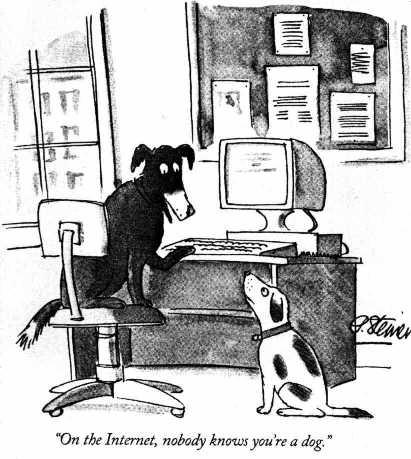
I know you guys want to change the world. I do too. But you need to absorb a truth, and that is that the Separate Identity culture is here for a *reason*. Its benefits far outweigh its drawbacks. On the internet, no one knows you are a dog, and that’s a really good thing.
You want to help people rebel against tyrants? Talk openly about their thoughts and beliefs and fears? Connect with new people, learn new things? Imagine and discuss and create a new and better world?
Then embrace the Separate Identity. It’s the right thing to do, it’s the good thing to do. And who knows? You guys might need it too one day.
****
(Excellent points and I expect I'll fall any day now in this cull.--jef)

The CIA's Secret Sites in Somalia

Jeremy Scahill | July 12, 2011 | The Nation