Congressman Dennis Kucinich (D-OH), a long-time advocate of family farmers and organic foods, today introduced H.R. 5577, The Genetically Engineered Food Right to Know Act, as well as supporting legislation that will provide a comprehensive regulatory framework for all Genetically Engineered (GE) plants, animals, bacteria, and other organisms.
“To ensure we can maximize benefits and minimize hazards, Congress must provide a comprehensive regulatory framework for all Genetically Engineered products. Structured as a common-sense precaution to ensure GE foods do no harm, these bills will ensure that consumers are protected, food safety measures are strengthened, farmers’ rights are better protected and biotech companies are responsible for their products,” said Kucinich.
In addition to the Genetically Engineered Food Right to Know Act, Kucinich introduced the Genetically Engineered Safety Act, HR 5578, which prohibits the open-air cultivation of GE pharmaceutical and industrial crops and establishes a tracking system to regulate and ensure the safety of GE pharmaceutical and industrial crops.
The third bill is the Genetically Engineered Technology Farmer Protection Act, HR 5579 which would protect farmers and ranchers that may be harmed economically by genetically engineered seeds, plants, or animals, to ensure fairness for farmers and ranchers in their dealings with biotech companies that sell GE products.
Congressman Kucinich has long been a proponent of ‘Right to Know’ legislation, and has introduced similar bills in previous sessions of Congress.
Thursday, January 13, 2011


Is Organic still Organic?
By Barbara H. Peterson
Jan. 9, 2011
Jan. 9, 2011
Organic is organic, or is it? It would seem that it is all a matter of perspective when one takes a stroll through the mountains of documents on the FDA and USDA websites.
The word “organic” is fast becoming a high-dollar money-maker for corporations smart enough to jump on the bandwagon and start marketing their products as “made with organic ingredients,” or “certified organic.” Even Monsanto the devil is taking advantage of this burgeoning market, and people naïve enough to believe that what we have traditionally thought of as pure, organic food, is still that way, are being duped.
It makes perfect sense, however, in a Machiavellian sort of way. Flood the food supply with poisons, then lead people to believe that the only safe choice left is USDA Certified Organic. Then buy up the organic companies one by one, and start changing the “organic” rules from the inside out via the bought and paid for government agencies so that you can reap the profits from those trying to escape the poisons.
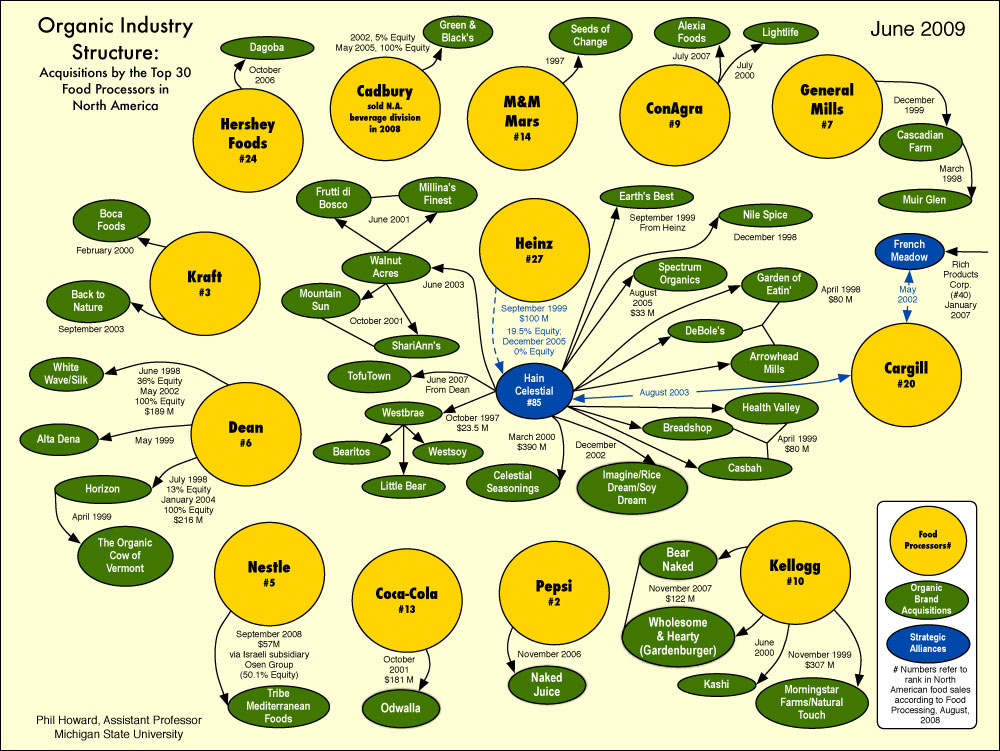 |
| Who owns whom in the organic industry? |
So let’s take a closer look at just what the word “organic” refers to according to these government agencies. You might be surprised at what we find. The fact that the very agencies (FDA and USDA), which are supposed to be protecting our organic food supply, are intensely active in its adulteration will become apparent.
What is “Certified Organic?”
In the USDA Certified Organic Program, there are four categories established for labeling purposes:
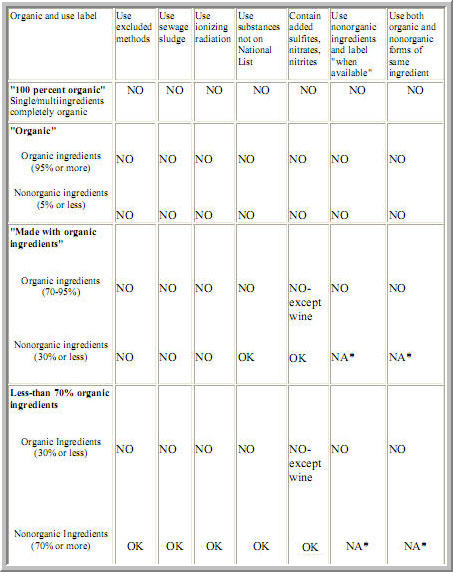
Section 205.301 establishes the organic content requirements for different labeling provisions specified under this program. The type of labeling and market information that can be used and its placement on different panels of consumer packages and in market information is based on the percentage of organic ingredients in the product. The percentage must reflect the actual weight or fluid volume (excluding water and salt) of the organic ingredients in the product. Four categories of organic content are established: 100 percent organic; 95 percent or more organic; 70 to 95 percent organic; and less than 70 percent organic. (Organic Labeling Preamble)If an item is labeled 100% Organic, then it is supposed to contain nothing but organic ingredients and processing aids that are organically produced.
Products labeled Certified Organic must contain 95% organic ingredients.70-95% Organic, labeled “Made with Organic Ingredients,” can contain the kitchen sink in the 5-30% of ingredients that are not organic. They can be grown with pesticides, but without the sewage sludge, and cannot be irradiated or genetically modified organisms (GMO).
Up to 5 percent of the ingredients may be nonagricultural substances (consistent with the National List) and, if not commercially available in organic form pursuant to section 205.201, nonorganic agricultural products and ingredients in minor amounts (hereinafter referred to as minor ingredients) (spices, flavors, colorings, oils, vitamins, minerals, accessory nutrients, incidental food additives). The nonorganic ingredients must not be produced using excluded methods [GMO], sewage sludge, or ionizing radiation. (Organic Labeling Preamble)
70% Organic, which is labeled “Contains Organic Ingredients,” can contain the kitchen sink along with the pesticides, sewage sludge, irradiation, and GMOs.
Organic Labeling Preamble Chart
A Matter of Perspective
Let’s say that you have a product that you think is better than its conventional counterpart because it has “certified organic” ingredients. So you buy it and think that you are getting healthier because you are eating mostly good, pure food. It is the word “organic” that led you to believe this. However, if an organic ingredient is mixed with conventional ingredients, doesn’t it become polluted? It’s like putting gasoline in a glass of pure water and charging a premium for that water because it only contains 30% of the contaminant. 30% contamination is probably better than 100%, but would you want to drink it? The whole glass of water is poisoned due to the gasoline, yet the companies selling this product would like you to believe that because it contains pure water it is good. They also know that they can charge you premium prices for that flawed perception.
The FDA and USDA would like us to believe that using “certified organic ingredients” somehow makes the poisons they allow in the other 30% okay, and companies charge through the nose for these adulterated products. It is a matter of perspective. Just how much gasoline in your water are you willing to tolerate just so you can live under the illusion that you are consuming a more pure product? And just how high a price are you willing to pay for it?
Organic Sleight of Hand
“USDA Certified Organic” is a big business, and the deception is great. With a bit of sleight of hand, by simply moving a word around a bit, you have a complete subterfuge.
(1) Use of “Organic” in Product Names. The NOSB, State organic program (SOP) managers, certifying agents, and a large number of individual commenters strongly recommended that USDA prohibit use of the term, “organic,” to modify an ingredient in a product name if the ingredient, itself, is not produced organically. The examples offered were “organic chocolate ice cream” and “organic cherry sweets” in which the ice cream and candy are at least 95 percent organic but the chocolate and cherry flavoring is not organically produced.
We agree with commenters that such product names can be misleading and would be a violation of section 205.300(a). In the examples, the word, “organic,” precedes the words, “chocolate” and “cherry,” and clearly implies that those ingredients are organically produced. The chocolate and cherry flavorings must be organically produced to be used in this way. If the product is at least 95 percent organically produced but the flavoring is nonorganic, the word sequence must be reversed or the word, “flavored,” must be added to the name; e.g., “chocolate organic ice cream” or “chocolate flavored organic ice cream.” A sentence has been added to section 205.300(a) to specify that the term, “organic,” may not be used in a product name to identify an ingredient that is not organically produced. (Organic Labeling Preamble)
So, you see how “organic chocolate ice cream” means that both the chocolate and the ice cream are organic, but if you reverse two words and make it “chocolate organic ice cream,” the chocolate is not organic. Or if you are really adept at manipulation, you can actually manufacture “organic beer” with conventional hops, label it “USDA Certified Organic,” and charge a premium price for it. See the National List of Allowed and Prohibited Substances, which includes hops as one of the approved non-organic substances allowed in USDA Certified Organic products.
Corporate/Government Treachery
If the FDA is here to help us instead of make money for its corporate owners, don’t you think this agency would demand that labeling be perfectly clear? If the USDA is here to help us, why would it have allowed the gross pollution and treachery that abounds in the National Organics Program (NOP) to have even gotten a foothold in what was the last bastion of safety left in our food supply?
ORGANIC IS ORGANIC. When it is mixed with non-organic ingredients, it is no longer organic, and no amount of agency double-talk will change that. When you play word games to trick people into purchasing something because they see the word “organic” on the label because you have led them to believe it is safe and better than the rest, all in the name of corporate profits, then organic or not, you are one of the bad guys. Period.
Neotame
Wikipedia
 Neotame can be included in USDA Certified “Contains Organic Ingredients” without labeling. As I stated in a previous article “USDA Certified Organic’s Dirty Little Secret: Neotame,” Neotame does not have to be labeled. Period. Why? Because the FDA approved it as a general purpose sweetener, and it is designated as a “flavor, or flavor enhancer.” And since it is not a protein hydrolysate, the following applies:
 If the flavor consists of two or more ingredients, the label either may declare each ingredient by its common or usual name or may state “All flavor ingredients contained in this product are approved for use in a regulation of the Food and Drug Administration.” Any flavor ingredient not contained in one of these regulations, and any nonflavor ingredient, shall be separately listed on the label. (FDA)
A document taken from the FDA site even states that pre-approval studies indicated that Neotame is not safe, yet it “was approved by the Food and Drug Administration (FDA) for general use in July 2002” (Wikipedia).
Sweetos
Enter Sweetos. Sweetos is Neotame. It was created for human and animal use.
EnSigns Health Care Pvt Ltd and The NutraSweet Co USA have recently launched ‘Sweetos’, a cattle feed sweetener. Sweetos has been developed with neotame, a high intensity sweetener.
Amino acids based sweetener Neotame is 8,000 to 13,000 times sweeter than sugar and is a patented product of the NutraSweet Co USA. Ensigns is one of the leading manufacturers of Sweetos, low calorie sweeteners for the food industry. Together the two companies have launched this sweetener to be added to cattle feed. (Business Standard)
Organic livestock feed uses a similar type of labeling system as human food.
(c) Products sold, labeled, or represented as “made with organic (specified ingredients or food group(s)).” Multiingredient agricultural product sold, labeled, or represented as “made with organic (specified ingredients or food group(s))” must contain (by weight or fluid volume, excluding water and salt) at least 70 percent organically produced ingredients which are produced and handled pursuant to requirements in subpart C of this part. No ingredients may be produced using prohibited practices specified in paragraphs (f)(1), (2), and (3) of §205.301. Nonorganic ingredients may be produced without regard to paragraphs (f)(4), (5), (6), and (7) of §205.301. If labeled as containing organically produced ingredients or food groups, such product must be labeled pursuant to §205.304.
(d) Products with less than 70 percent organically produced ingredients. The organic ingredients in multiingredient agricultural product containing less than 70 percent organically produced ingredients (by weight or fluid volume, excluding water and salt) must be produced and handled pursuant to requirements in subpart C of this part. The nonorganic ingredients may be produced and handled without regard to the requirements of this part. Multiingredient agricultural product containing less than 70 percent organically produced ingredients may represent the organic nature of the product only as provided in §205.305. (GPO Access)
As in human food regulations, the non-organic ingredients in “Made with Organic Ingredients” and “Contains Organic Ingredients” can contain the kitchen sink.
The question must be asked: Do we really want our cattle to be consuming feed that is made with a neurotoxin? How will it affect the animals that eat it? And just how will eating these animals affect us?
Endless Compromise
When did we learn to accept anything less than the best? When did we acquiesce to inferiority? To the endless compromise of our food supply? Why do we think that we somehow deserve to be robbed blind, lied to, poisoned for profit, and cheated every step of the way by the corrupt corporate system that acts like a black hole – sucking in everything and giving nothing back in return except abject misery? And why do we seem to like it? Why do we keep going back for more instead of ridding ourselves of these pariahs? Do you really want to know why? Because we have been trained that way! That’s why we accept “organic beer” made with conventional hops, and USDA Certified “made with organic ingredients” food items that have been poisoned with the likes of Neotame. We accept these things because we have been conditioned to think that this is somehow okay. It’s time to change our way of thinking.
It’s time to stop bowing to multi-national corporations who may or may not be what we think they are. Know your food producer. Know what you are eating. Become a food warrior, and fight for the right to not be deceived. Know how to read labels and figure out what the ingredients really are. The more people that wake up to the reality that we are surrounded by people who could care less about our health and are actually out to do us harm as long as they can profit by it, the better our chances of survival. Make no mistake about it. We are in a food war, and that is a war for our very lives.
The reflexive call for fewer liberties
By Glenn Greenwald - SALON.com
Wednesday, Jan 12, 2011
Wednesday, Jan 12, 2011
William Galston -- former Clinton adviser and current Brookings Institution Senior Fellow -- has a column in The New Republic about the Gabrielle Giffords shooting that illustrates the mentality endlessly eroding basic American liberty: namely, the belief that every tragedy must lead to new government powers and new restrictions on core liberties. The lesson of the Arizona tragedy, he argues, is that it's too difficult to force citizens into mental institutions against their will. This, he says, is the fault of "civil libertarians," who began working in the 1970s on legal reforms to require a higher burden of proof for involuntary commitment (generally: it must be proven that the person is a danger to himself or to others). As a result, Galston wants strict new laws imposing a litany of legal obligations on the mentally ill, their friends and family, and even acquaintances, as well as dramatically expanded powers to lock away those with mental illness (with broader definitions of what that means).
Listen to what he proposes: "first, those who acquire credible evidence of an individual’s mental disturbance should be required to report it to both law enforcement authorities and the courts, and the legal jeopardy for failing to do so should be tough enough to ensure compliance"; those reporting obligations should apply not only to family and friends, but extend to "school authorities and other involved parties." And "second, the law should no longer require, as a condition of involuntary incarceration, that seriously disturbed individuals constitute a danger to themselves or others"; instead, involuntary commitment should be imposed whenever there is "delusional loss of contact with reality." He concludes on this melodramatic note: 'How many more mass murders and assassinations do we need before we understand that the rights-based hyper-individualism of our laws governing mental illness is endangering the security of our community and the functioning of our democracy?"
There's so much warped reasoning embedded in this argument that it's hard to know where to begin. Galston seems to be unaware of this, but what motivated the reforms in this area were the decades of severe, horrifying abuses which those with mental illnesses -- and even those who had none -- suffered as a result of permissive involuntary commitment standards and prolonged forced incarceration. Those who suffered mental illnesses were locked away for years and sometimes decades despite having done nothing wrong and despite not being a threat to anyone, while countless people who simply exhibited strange or out-of-the-ordinary behavior were deemed mentally ill and similarly consigned. The psychitaric social worker Alicia Curtis provided just one example: "There is also a large history of the forced treatment of homosexuality as mental 'illness'." Indeed, involuntarily committing people in mental hospitals is a time-honored way for stifling any individuality and dissent; see this 2010 New York Times article on how China uses that repressive tactic.
Then there are the factually incoherent claims Galston makes. He harkens back to some sort of Golden Age of the 1960s when thousands of people were incarcerated against their will who did nothing wrong -- as though that era were relatively free of political assassinations because all the "crazies" were where locked up where they belonged. Of course, the opposite is true: there were far more violent attacks on political figures back then (MLK, JFK, RFK, George Wallace, Malcolm X, etc.) than there have been during the relatively peaceful time beginning in the 1980s when involuntary commitment became much more difficult.
Worse, Galston assumes, without offering any evidence, that there is a significant correlation between mental illness and violence, but the reality is the opposite: the vast, vast majority of people with mental illnesses never hurt anyone. Writing two days ago in Slate, Vaughn Bell decried "the fact that mental illness is so often used to explain violent acts despite the evidence to the contrary," and documented:
But that's the key point. What Galston is doing here is what the American political class reflexively does in the wake of every tragedy: it immediately seeks to exploit the resulting trauma and emotion to justify all-new restrictions on basic liberties (such as the right not to be locked away against one's will in the absence of a crime or a serious threat to others) and all-new government powers. Every traumatic event -- in the immediate, emotionally consuming aftermath -- leads to these sorts of knee-jerk responses. The 9/11 attack immediately gave rise to the Patriot Act, warrantless eavesdropping, a torture regime, due-process-free imprisonment, and ultimately an attack on Iraq. High-profile, brutal criminal acts have led to repressive measures such as three-strikes-and-out laws and minimum sentencing guidelines, causing the U.S. to maintain the largest Prison State in the world.
And when the so-called Underwear Bomber unsuccessfully attempted to detonate a bomb in an airplane over Detroit at the end of 2009, there were immediate calls -- including from the DOJ -- for loosening Miranda requirements and the right to be brought before a judge, and even a bipartisan bill to deny legal rights even to U.S. citizens arrested on U.S. soil and accused of Terrorism: all because of that one episode. In response to that reaction, I wrote:
What lies at the core of this mindset is desperate pursuit of a total illusion: Absolute Safety. People like William Galston believe that every time there is a violent or tragic act, it means that the Government should have done something -- or should have had more powers -- in order to stop it. But that is the reasoning process of a child. Even if we were to create an absolute Police State -- the most extreme Police State we could conjure -- acts like the Arizona shooting would still happen. There are more than 300 million people in the U.S. and, inevitably, some of them are going to do very bad and very violent things. Thus has it always been and always will be. The mere existence of bad events is not evidence that the Government needs to be more empowered and liberties further restricted. Just as there are serious costs to things like the Arizona shootings, there are serious costs to enacting the kinds of repressive systems Galston envisions, yet people like him never weigh those costs.
Having people do bad things is the price we pay for freedom. There is a cost to all liberty. Having to hear upsetting or toxic views is the price we pay for free speech; having propaganada spewed by large media outlets is the price we pay for a free press; and having some horrible, dangerous criminals go free is the price we pay for banning the Police from searching our homes without a warrant (the Fourth Amendment) and mandating due process before people can be imprisoned (the Fifth Amendment). The whole American political system is predicated on the idea that we are unwilling to accept large-scale abridgments of freedom in the name of safety, and that Absolute Safety is a dangerous illusion. There is a new report today that a police officer in Tuscon stopped Jared Loughner's car for speeding shortly before his rampage, but was unable to search his car because he lacked probable cause to do so. Obviously, that's regrettable -- if you're a family member of one of his victims, it's horrifying -- but the alternative (allowing Police the power to search whomever they want without cause) is worse: that's the judgment we made in the Bill of Rights.
It may very well be that it's too difficult in some states to have a person involuntarily committed even when they're a threat to themselves or others. That's a fair debate to have. But that's not the case Galston is making. Instead, he's just drowning in his own TV-generated emotions -- or trying to exploit those who are -- to usher in an amazingly oppressive scheme whereby citizens are required to inform on one another if they suspect someone is a bit mentally off, and the Government is empowered to put them away for a long time even in the absence of any threat they pose. That's neither rational nor sober; it's hysterical fear-mongering of the kind we see after every incident like this. It's why American liberties have inexorably eroded. At the very least, there ought to be a voluntary moratorium on calling for new government powers in the wake of tragedies like this until the emotional intensity dies down and rational discourse can prevail.
UPDATE: Several people made the point in comments that even had the police been able to search Loughner's car, that would likely not have changed anything, since the firearm he was carrying was legal.
Listen to what he proposes: "first, those who acquire credible evidence of an individual’s mental disturbance should be required to report it to both law enforcement authorities and the courts, and the legal jeopardy for failing to do so should be tough enough to ensure compliance"; those reporting obligations should apply not only to family and friends, but extend to "school authorities and other involved parties." And "second, the law should no longer require, as a condition of involuntary incarceration, that seriously disturbed individuals constitute a danger to themselves or others"; instead, involuntary commitment should be imposed whenever there is "delusional loss of contact with reality." He concludes on this melodramatic note: 'How many more mass murders and assassinations do we need before we understand that the rights-based hyper-individualism of our laws governing mental illness is endangering the security of our community and the functioning of our democracy?"
There's so much warped reasoning embedded in this argument that it's hard to know where to begin. Galston seems to be unaware of this, but what motivated the reforms in this area were the decades of severe, horrifying abuses which those with mental illnesses -- and even those who had none -- suffered as a result of permissive involuntary commitment standards and prolonged forced incarceration. Those who suffered mental illnesses were locked away for years and sometimes decades despite having done nothing wrong and despite not being a threat to anyone, while countless people who simply exhibited strange or out-of-the-ordinary behavior were deemed mentally ill and similarly consigned. The psychitaric social worker Alicia Curtis provided just one example: "There is also a large history of the forced treatment of homosexuality as mental 'illness'." Indeed, involuntarily committing people in mental hospitals is a time-honored way for stifling any individuality and dissent; see this 2010 New York Times article on how China uses that repressive tactic.
Then there are the factually incoherent claims Galston makes. He harkens back to some sort of Golden Age of the 1960s when thousands of people were incarcerated against their will who did nothing wrong -- as though that era were relatively free of political assassinations because all the "crazies" were where locked up where they belonged. Of course, the opposite is true: there were far more violent attacks on political figures back then (MLK, JFK, RFK, George Wallace, Malcolm X, etc.) than there have been during the relatively peaceful time beginning in the 1980s when involuntary commitment became much more difficult.
Worse, Galston assumes, without offering any evidence, that there is a significant correlation between mental illness and violence, but the reality is the opposite: the vast, vast majority of people with mental illnesses never hurt anyone. Writing two days ago in Slate, Vaughn Bell decried "the fact that mental illness is so often used to explain violent acts despite the evidence to the contrary," and documented:
Of course, like the rest of the population, some people with mental illness do become violent, and some may be riskier when they're experiencing delusions and hallucinations. But these infrequent cases do not make "schizophrenia" or "bipolar" a helpful general-purpose explanation for criminal behavior. . . . your chance of being murdered by a stranger with schizophrenia is so vanishingly small that a recent study of four Western countries put the figure at one in 14.3 million. To put it in perspective, statistics show you are about three times more likely to be killed by a lightning strike.Yet Galston, pointing to Arizona, wants to lock all of them away. The harm that would come from forcibly consigning thousands and thousands of people have done nothing wrong is so much greater than the harm from the once-every-20-years attack on a political official that the excessiveness of his solution is self-evident.
But that's the key point. What Galston is doing here is what the American political class reflexively does in the wake of every tragedy: it immediately seeks to exploit the resulting trauma and emotion to justify all-new restrictions on basic liberties (such as the right not to be locked away against one's will in the absence of a crime or a serious threat to others) and all-new government powers. Every traumatic event -- in the immediate, emotionally consuming aftermath -- leads to these sorts of knee-jerk responses. The 9/11 attack immediately gave rise to the Patriot Act, warrantless eavesdropping, a torture regime, due-process-free imprisonment, and ultimately an attack on Iraq. High-profile, brutal criminal acts have led to repressive measures such as three-strikes-and-out laws and minimum sentencing guidelines, causing the U.S. to maintain the largest Prison State in the world.
And when the so-called Underwear Bomber unsuccessfully attempted to detonate a bomb in an airplane over Detroit at the end of 2009, there were immediate calls -- including from the DOJ -- for loosening Miranda requirements and the right to be brought before a judge, and even a bipartisan bill to deny legal rights even to U.S. citizens arrested on U.S. soil and accused of Terrorism: all because of that one episode. In response to that reaction, I wrote:
"Even now, every new attempted attack causes the Government to devise a new proposal for increasing its own powers still further and reducing rights even more, while the media cheer it on. It never goes in the other direction. . . . every new incident becomes a pretext for a fresh wave of fear-mongering and still new ways to erode core Constitutional protections even further. . . . We never reach the point where we decide that we have already retracted enough rights."It's Naomi Klein's Shock Doctrine applied to non-economic matters.
What lies at the core of this mindset is desperate pursuit of a total illusion: Absolute Safety. People like William Galston believe that every time there is a violent or tragic act, it means that the Government should have done something -- or should have had more powers -- in order to stop it. But that is the reasoning process of a child. Even if we were to create an absolute Police State -- the most extreme Police State we could conjure -- acts like the Arizona shooting would still happen. There are more than 300 million people in the U.S. and, inevitably, some of them are going to do very bad and very violent things. Thus has it always been and always will be. The mere existence of bad events is not evidence that the Government needs to be more empowered and liberties further restricted. Just as there are serious costs to things like the Arizona shootings, there are serious costs to enacting the kinds of repressive systems Galston envisions, yet people like him never weigh those costs.
Having people do bad things is the price we pay for freedom. There is a cost to all liberty. Having to hear upsetting or toxic views is the price we pay for free speech; having propaganada spewed by large media outlets is the price we pay for a free press; and having some horrible, dangerous criminals go free is the price we pay for banning the Police from searching our homes without a warrant (the Fourth Amendment) and mandating due process before people can be imprisoned (the Fifth Amendment). The whole American political system is predicated on the idea that we are unwilling to accept large-scale abridgments of freedom in the name of safety, and that Absolute Safety is a dangerous illusion. There is a new report today that a police officer in Tuscon stopped Jared Loughner's car for speeding shortly before his rampage, but was unable to search his car because he lacked probable cause to do so. Obviously, that's regrettable -- if you're a family member of one of his victims, it's horrifying -- but the alternative (allowing Police the power to search whomever they want without cause) is worse: that's the judgment we made in the Bill of Rights.
It may very well be that it's too difficult in some states to have a person involuntarily committed even when they're a threat to themselves or others. That's a fair debate to have. But that's not the case Galston is making. Instead, he's just drowning in his own TV-generated emotions -- or trying to exploit those who are -- to usher in an amazingly oppressive scheme whereby citizens are required to inform on one another if they suspect someone is a bit mentally off, and the Government is empowered to put them away for a long time even in the absence of any threat they pose. That's neither rational nor sober; it's hysterical fear-mongering of the kind we see after every incident like this. It's why American liberties have inexorably eroded. At the very least, there ought to be a voluntary moratorium on calling for new government powers in the wake of tragedies like this until the emotional intensity dies down and rational discourse can prevail.
UPDATE: Several people made the point in comments that even had the police been able to search Loughner's car, that would likely not have changed anything, since the firearm he was carrying was legal.
Therapeutic Bath Salts Getting People High
Creative Drug Trend: Snorting Bath Salts
by JacobSloan on January 12, 2011
Authorities in Louisiana and Utah (below) are attempting to crack down on the growing practice of ingesting therapeutic bath salts for the purpose of achieving an amphetamine-like high. Supposedly intended for pampering the skin, the mineral packets’ contents are smoked or snorted like cocaine, and are so popular that they are now sold at smoke shops.
by JacobSloan on January 12, 2011
Authorities in Louisiana and Utah (below) are attempting to crack down on the growing practice of ingesting therapeutic bath salts for the purpose of achieving an amphetamine-like high. Supposedly intended for pampering the skin, the mineral packets’ contents are smoked or snorted like cocaine, and are so popular that they are now sold at smoke shops.
The Tragic State of the Gulf of Mexico
Sampling Reveals Oil and Dispersants on Mississippi Coast
Wednesday 12 January 2011
by: Dahr Jamail and Erika Blumenfeld, t r u t h o u t | Report
In October 2010, Truthout tested several water and soil samples from the Gulf of Mexico for chemicals in BP's crude oil and toxic dispersants. One sample of dead marine life was also tested.
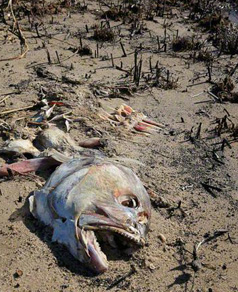 |
| Dead fish and oiled marsh grass, Blood Beach, Ocean Springs, Mississippi. (Photo: Erika Blumenfeld) |
Truthout also obtained and had analyzed a sample of pure Corexit 9500, one of the toxic dispersants used to sink the crude oil. The dispersants BP has used in the Gulf of Mexico are banned in at least 19 other countries. BP has used at least 1.9 million gallons of the dispersants in the Gulf of Mexico to sink their 4.9 million barrels of crude oil.
The samples were tested in a private lab via gas chromatography by an analyst who requested anonymity.

Pass Christian Harbor at dusk. (Photo: Erika Blumenfeld)
Lab tests have confirmed oil and chemicals from the dispersants in the samples tested, which contradicts ongoing statements from both BP and the Obama administration that the Gulf of Mexico is safe from the effects of the BP oil disaster.
Corexit 9500

Lab tests with Corexit 9500, oil, and saltwater. (Photo: Scientist who performed lab analysis)
These two vials were filled with saltwater and a small amount of motor oil. Two drops of Corexit 9500 were added to the vial on the left and both vials were gently shaken for 30 seconds. Both samples then sat for one hour before this picture was taken.
The milky color of the water in the vial on the left displays the manner in which the dispersant causes a portion of the oil to dissolve into the water. When crude oil in the Gulf is treated with dispersant, a large portion of the oil is also dissolved into the seawater, allowing harmful volatile contaminants to also dissolve into the water, which would have otherwise evaporated had the oil been sitting on the surface.
This theory is nothing new, but this picture displays this phenomenon visually. After nine days, there was still no sign of any separation between the dissolved oil and water at all. In fact, it currently appears that the effect has only increased over time.
The foam atop the vial containing the dispersed oil resembles foam that this writer, other journalists, BP cleanup workers and fishermen along the Gulf Coast have witnessed present in the wake of areas of oil having been sprayed with dispersants.
Many of the chemicals present in the oil and dispersants are known to cause headaches; nausea; vomiting; kidney damage; altered renal functions; irritation of the digestive tract; lung damage; burning pain in the nose and throat; coughing; pulmonary edema; cancer; lack of muscle coordination; dizziness; confusion; irritation of the skin, eyes, nose, and throat; difficulty breathing; delayed reaction time; memory difficulties; stomach discomfort; liver and kidney damage; unconsciousness; tiredness/lethargy; irritation of the upper respiratory tract; and hematological disorders.
Solid Samples
Mississippi Gov. Hailey Barbour has claimed that Mississippi coastal waters are clear, the beaches clean and that the seafood caught in the Gulf is safe to eat.
Yet, soil samples taken along the beach at Long Beach, Mississippi, on October 21, 2010, confirmed the presence of crude oil. One sand sample, from location 3012.45N, 8930.41W, contained 9.35 parts per million (ppm) of Oil Range Organic Petroleum Hydrocarbons (ORO), confirming the presence of crude oil. This sample also contained ethanol, which is a chemical in BP's dispersants.
Another sand sample taken from the same area contained 160 ppm ORO.
Samples with no oil or chemicals should test at 0 ppm.

Foamy substance at Long Beach, Mississippi that contains oil and ethylene glycol. (Photo: Erika Blumenfeld)
A third sample from the area, containing both sand and a brownish foam on the water that local residents and fishermen believe is the result of dispersed oil, contained 14.68 ppm ORO, confirming the presence of crude oil. This sample also contained ethylene glycol, a chemical in the dispersants.
The US Coast Guard, federal government and BP claim that no dispersants have been used since mid-July.
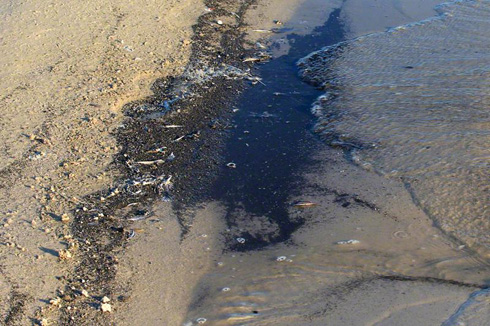
Black granular material at Long Beach, Mississippi that tested positive for crude oil. (Photo: Erika Blumenfeld)
Another sample from the area taken from sand covered in what local residents described as "coffee grounds" contained 8.65 ppm ORO, confirming the presence of crude oil.
A small inlet on the beach was filled with brown foam and oil sheen. A sample of sand covered with the foamy sheen contained 175 ppm ORO.

Foamy substance along shoreline at Long Beach, Mississippi that tested positive for crude oil. (Photo: Erika Blumenfeld)
On January 7, federal and Louisiana officials took a boat tour of an area in southern Louisiana that remains fouled with oil from the BP disaster. They found areas in Barataria Bay where oil continued to eat away at the fragile marshland, where no protective boom nor cleanup workers could be found. Affected areas were up to 100 feet wide in some sections.
"This is the biggest cover-up in the history of America," Plaquemines Parish President Billy Nungesser told reporters.
Nungesser was angered by claims by the Coast Guard and National Oceanic and Atmospheric Administration (NOAA) officials he was with, who said a plan was being developed to clean the area.
"It's like you're in bed with BP," Nungesser told the officials. "Don't tell me I got a voice in the way you put together that crappy document," Nungesser said as WDSU TV filmed the altercation. "It ain't worth the paper it's printed on. That is bullshit." Nungesser then told one of the federal officials, "You cover up for BP."
Marine Life
A dead jellyfish found on Long Beach, Mississippi, nearby a large amount of the aforementioned thick, brown foam, was tested and found to contain 15 ppm of ethanol, one of the chemicals in the dispersants, along with low levels of n-Butanol, another chemical present in the dispersants that are manufactured by Nalco Holding Company.
Nalco Holding Company has corporate ties to BP.
Based on comparative analysis of Corexit 9500 and the sample collected, the sample appears to contain approximately 500 ppm of dispersant.
Water
A water sample in the same area, taken in an area covered in thick, brown foam, contained propylene glycol, one of the confirmed ingredients of Corexit 9500.
Samples were also taken from a beach in Ocean Springs, Mississippi.

Blood Beach in Ocean Springs, Mississippi. (Photo: Erika Blumenfeld)
A water sample at this area also contained ethelene glycol, as did a water sample taken from a fish pond in the front yard of a resident's home in Ocean Springs.
Another water sample from the beach contained diethylene glycol BE.

Dead sea turtle, Blood Beach, Ocean Springs, Mississippi. (Photo: Erika Blumenfeld)
Additional Sampling and Conclusions
Earlier this month, Louisiana Environmental Action Network, Lower Mississippi Riverkeeper, in conjunction with the Subra Company, released results of sampling in the coastal regions of Louisiana.
Their press release states:
"The wetlands and ecosystem soil/sediment from Atchafalaya Bay eastward to the Louisiana/Mississippi state line contained 6 to 89 individual Alkylated Polynuclear Aromatic Hydrocarbons (PAHs) and Oil Range Organic Petroleum Hydrocarbons (ORO) up to 11,600 mg/kg [ppm] (1.16%) which corresponded to the fingerprint of the BP Louisiana Sweet Crude."
Sixty percent of the soil/sediment samples the groups tested contained up to 18 PAHs in excess of the marine sediment screening levels.
The groups tested seafood and found, "Alkylated PAHs were and continue to be detected in aquatic seafood species from the wetlands and estuaries along the Louisiana coast from Atchafalaya Bay eastward to the Louisiana/Mississippi border."
For example, they found oyster samples with up to 8,815 to 12,500 mg/kg (ppm) ORO, and blue crab samples containing up to 2,230 to 3,583 mg/kg (ppm) ORO.
Shrimp, mussels, fish and snail samples also contained exceedingly high levels of ORO and PAHs.
The press release concluded:
"Wetlands and ecosystem soil/sediment samples and aquatic tissue samples from all areas sampled contained Alkylated PAHs and Oil Range Petroleum Hydrocarbons."
Mississippi's Governor Barbour has said that Gulf seafood has been "tested more than any other food in the history of the universe."
State health departments in Louisiana, Mississippi and Alabama had issued swimming advisories while BP's well continued to gush oil into the Gulf of Mexico last summer. Since then, however, all three states have declared their beaches, waters and seafood safe from oil disaster related toxins.
Florida never issued any advisories, despite many residents reporting illnesses they attribute to the oil disaster.
US federal government agencies like the Environmental Protection Agency, Food and Drug Administration and the NOAA ,along with President Barack Obama himself, have declared the Gulf of Mexico, its waters, beaches and seafood, safe and open to the public.
The testing conducted on the samples taken by this writer only represent a tiny part of the Gulf compared to the massive area that has been affected by BP's oil catastrophe. A comprehensive sampling regime across the Gulf, taken regularly over the years ahead by independent scientists, is clearly required in order to implement appropriate cleanup responses and take public safety precautions.
6 Crackpot Conspiracy Theories That Actually Happened
By Eric Yosomono Jan 11, 2011
We really do try very hard here to maintain a no-bullshit policy. We're not the New York Times, but we do try to make sure we don't repeat a claim unless we can link to a smarter group of people who confirm it. We kind of think everyone who touches a keyboard should do that.
But in the course of looking down our noses at the nutjobs who spread urban legends and conspiracy theories, we have to sometimes stop and point out that there are downright terrifying historical precedents for even their craziest of claims.
#6. The Government Is Transmitting Thoughts Into Our Brains!
This is the stereotypical "tin foil hat" conspiracy theory that the government has the ability to beam thoughts into or out of your skull using its Illuminati mind-ray technology. This is a favorite of crazy people because, well, they're crazy, and hearing strange voices in your head is as common a symptom of craziness as you'll find. Assassins Mark Chapman and Sirhan Sirhan both claimed to hear voices in their heads telling them to murder their targets.
But they're not the only ones who have ever claimed to hear voices broadcast directly into their heads. All over the country, people who aren't murdering beloved public figures have also asserted that the United States government is trying to control their minds by transmitting thoughts directly into their brains. Which is why some of them elect to don the aforementioned tinfoil headgear -- to keep the voices out. This is why the tinfoil hat has become the emblem of all things conspiracy-related, mocked in movies and elsewhere.
Why It's Not So Crazy
They can totally beam voices into your head.
In 2006, a guy whom multiple counselors labeled as a "paranoid schizophrenic" filed a Freedom of Information Act petition requesting all declassified government documents pertaining to covert attempts at microwave auditory effect, telepathy and hypnosis. While no one was surprised that a guy who once complained that the backs of his shoes were vaporized by an electromagnetic weapon would go through the effort of filing the request, a lot of people shit a brick when they saw the papers that came back.
Page after page of verified government documents confirmed that taxpayer dollars had funded research on everything from a telepathic ray gun to fever lasers that made victims disoriented and less aggressive. And, yes, one of the released tests even broadcast a person's voice telepathically by "using close-range microwaves ... to project the spoken numbers 1 to 10 across a lab to volunteers."
Inside their heads.
So, not only is this technology possible, the government has toyed with using it. And considering the United States government's track record with mind control, well ...
#5. The Census Is a Tool for Government Oppression!
Most of us didn't give a second thought to filling out our census forms last year. But among the loonier elements of American society, speculation abounded about what exactly the government was going to do with all that data it collected, other than, you know, allocate congressional seats. One conservative website speculated that GPS coordinates of households collected by census workers would possibly prepare UN soldiers for a U.S. invasion. Congresswoman Michele Bachmann even stated that she and her family would refuse to answer any census questions beyond how many people were in her household, because "the Constitution doesn't require any information beyond that."
Thanks to the fact that, yes it does, Bachmann took a lot of heat for her paranoid rhetoric. Especially when the actual results of the census led to speculation that her own state might lose a congressional district.
So, we could all sit back and laugh at the paranoid types who thought the government was going to use the census to round us up and put us into camps.
Why It's Not So Crazy
The U.S. government totally once used census data to round people up and put them in camps.
After years of hearing nothing but denial, in 2007 the world found out that the U.S. Census Bureau actually did assist the Secret Service in rounding up Japanese-Americans for internment. And it was given the authority to do so by an executive emergency law enacted by then-president Franklin D. Roosevelt.
Prior to the Second War Powers Act of 1942, information collected by census takers was confidential and protected. But once Pearl Harbor was bombed and the U.S. got its frenetic anti-Asian ball rolling, all bets were off for any American whose eyes weren't shaped "white." So when the Secret Service came knocking on the Census Bureau's door for the names and addresses of Japanese-Americans, even the ones who were citizens, the data collectors were willing to oblige. The law that gave the government that authority wasn't repealed until after the war ended.
And that wasn't the last time racial data were handed over in a politically charged atmosphere. In 2004, the Census Bureau took a beating for giving the Department of Homeland Security information about Arab Americans, including ZIP codes with dense Arab populations. Some speculated that the data even led to the deportation of people who wouldn't have otherwise been targeted.
So, yeah, they'd never use that information against you. As long as you're white.
#4. The Government Controls the Media!
The logic behind this gem goes a little something like this:
The plot of the Robert DeNiro movie Wag the Dog involved a president actually fabricating an entire war, with the news media obediently publishing story after story at the government's behest. Ridiculous, right?
Why It's Not So Crazy
Beginning in 1948, a man named Frank Wisner ran a branch of the CIA called the Office of Policy Coordination and was given all sorts of secret authority to pretty much do any awful thing he felt like if it advanced his version of American ideology. Under that sleazy umbrella, Wisner began Operation Mockingbird, which was his effort to infiltrate every major media outlet with journalists and editors who were in his pocket.
By the mid-50s, the CIA had over 400 journalists working with them across the country. And these guys weren't just cub reporters, either. They included top level employees from all three major networks as well as The New York Times, Time Inc. and Associated Press, all not only capable of planting pro-government stories in their respective media but also able to suppress anything that wasn't government-friendly. And the whole shebang was so easy to accomplish because, as one operative noted, "You could get a journalist cheaper than a good call girl, for a couple hundred dollars a month."
The good news is that Operation Mockingbird was exposed and disbanded by the mid-70s. The bad news is that even in the past decade, the government has had its sticky fingers all over wartime reporting and is still using psychological warfare to get the entire world on our side. It's working like a dream, guys!
#3. Government Agents Are Like, Everywhere, Man!
One common thread that runs through all good conspiracy theories is that the people who believe them think they're being watched. And not just through Enemy of the State surveillance technology, either, but by actual flesh-and-blood government agents, following them down dark alleys.
Yeah, like their little group of protesters and vegans is soooo important that the government is going to pay somebody a full-time salary to do nothing but watch them. Like some kid's hippie college newsletter about how the oil companies own Washington is totally going to warrant the government planting a spook at the local Starbucks to spy on him while he slathers cream cheese on his Hawaiian bagel and bangs away on his laptop.
Why It's Not So Crazy
Through a program called COINTELPRO, J. Edgar Hoover and his FBI buds used actual government agents to infiltrate the the civil rights movement, the Black Panthers, anti-Vietnam groups, women's rights groups, the National Lawyers Guild and many, many others in an effort to neutralize and/or radicalize them.
Oh, and any individuals who took a perceived anti-government stance were targeted as well.
For most people, the 1950s brings to mind images of poodle skirts, phone booths stuffed with teenagers and children running willy-nilly with small mammal hides on their heads, but when it comes to privacy, the 50s were a pretty sinister time. Especially if you were, uh, anyone who disagreed with the government in any way at all.
COINTELPRO inserted spies into Martin Luther King Jr.'s inner circle to report on all his movements and activities, and it effectively destroyed the Black Panther Party by encouraging armed action against other black nationalist groups, smear campaigns against key members and outright targeted attacks. The result was that the group became splintered and the rest of the country didn't take them seriously as a political force.
Even though COINTELPRO activities were exposed and banned by the '70s, we still see little baby COINTELPRO efforts pop up today, like when the FBI targeted "domestic terrorist organizations" like Greenpeace and PETA along with evil Quakers. Or when one Obama adviser suggested infiltrating conspiracy theory message boards with secret agents who would discredit "false conspiracy theories about the government." Because apparently, people on conspiracy theory message boards would never appreciate the irony.
#2. The Government Is Poisoning What We Eat and Drink!
If you're looking for a fun way to spend a Saturday night, Google the words "fluoride" and "Nazi." What you'll find is that, according to many, many conspiracy theorists, the Third Reich fluoridated the water of concentration campers to keep them docile. What you'll also learn is that a buttload of people think that modern governments are doing the same thing when they put fluoride in tap water. And that's just the tip of the contaminated iceberg; nearly everything from artificial sweeteners (forced on the American people by Donald Rumsfeld!) to vaccines (a government plot to sterilize the populace!) are secret efforts by the government to poison the population in an effort to control us.
Why It's Not So Crazy
OK, that stuff might or might not be bullshit, but during Prohibition, the government wanted a way to discourage people from drinking alcohol beyond the traditional "arrest everyone caught with it" method. So, they did exactly what the conspiracy nuts accuse them of today: The government intentionally put poison in it. They apparently thought this would be a deterrent, but they VASTLY underestimated the population's desire to get drunk. By the time Prohibition ended in 1933, the federal poisoning program had killed at least 10,000 people.
Yes, that happened. And that wasn't the last time Uncle Sam tried his hand at contaminating our favorite intoxicants. In the 1970s, the American government sprayed marijuana fields in Mexico with a toxic chemical called paraquat. Mexican pot growers quickly learned that if they harvested their plants immediately after spraying, the chemical wouldn't kill off their crops. As a result, tons of pesticide-laced pot got mixed in with regular pot, then shipped to the U.S. at a time when doobie toking was the national pastime.
The government brushed off criticism of its paraquat program as it only causes pulmonary fibrosis when taken orally and "throat bleeding" when inhaled. And really, who couldn't use a little throat bleeding now and again?
#1. The Government Is Spraying Us With Biological Warfare Agents!
Experts like Billy Corgan of Smashing Pumpkins fame have tried to warn the world of the evil government program to spray chemicals on the general population from the skies. Google "chemtrails" and you'll find more than 3 million results of people talking about this conspiracy, with believers claiming that the chemicals are for population control, or weather control, or that the chemicals are causing respiratory illnesses.
And then we've all heard how AIDS was invented by the CIA to wipe out gays and black people.
Why It's Not So Crazy
Not only has the federal government secretly tested biological warfare on U.S. citizens, they've actually killed someone while doing it. During the Cold War, the U.S. government put serious research into entomological warfare and by "research," we mean they "dumped 300,000 mosquitoes over the state of Georgia to see what would happen." The mosquitoes weren't infected with yellow fever or anything. The just wanted to see if they hypothetically could use yellow fever infected mosquitoes to kill vast swaths of people.
And that was just the tip of the "secretly testing biological agents on private citizens" iceberg. Military records reveal there were 239 open-air tests of biological agents on the American public, including the 1966 dusting of the New York Subway system with a cousin of anthrax, the release of a cloud of allegedly harmless bacteria over San Francisco Bay in 1950 and the spraying of passengers with a different bacterium at National Airport in Washington, D.C.
After the San Francisco bacteria bomb, 11 people ended up in hospitals with rare urinary tract infections, and one man died. And while the New Yorkers and Washingtonians weren't exposed to bacteria that were debilitating to healthy people, the germs were dangerous to anyone who already had a compromised immune system. And considering that one of the attacks was on random people in an airport, we'll never know who got sick and died because of the tests.
We really do try very hard here to maintain a no-bullshit policy. We're not the New York Times, but we do try to make sure we don't repeat a claim unless we can link to a smarter group of people who confirm it. We kind of think everyone who touches a keyboard should do that.
But in the course of looking down our noses at the nutjobs who spread urban legends and conspiracy theories, we have to sometimes stop and point out that there are downright terrifying historical precedents for even their craziest of claims.
#6. The Government Is Transmitting Thoughts Into Our Brains!
This is the stereotypical "tin foil hat" conspiracy theory that the government has the ability to beam thoughts into or out of your skull using its Illuminati mind-ray technology. This is a favorite of crazy people because, well, they're crazy, and hearing strange voices in your head is as common a symptom of craziness as you'll find. Assassins Mark Chapman and Sirhan Sirhan both claimed to hear voices in their heads telling them to murder their targets.
But they're not the only ones who have ever claimed to hear voices broadcast directly into their heads. All over the country, people who aren't murdering beloved public figures have also asserted that the United States government is trying to control their minds by transmitting thoughts directly into their brains. Which is why some of them elect to don the aforementioned tinfoil headgear -- to keep the voices out. This is why the tinfoil hat has become the emblem of all things conspiracy-related, mocked in movies and elsewhere.
Why It's Not So Crazy
They can totally beam voices into your head.
In 2006, a guy whom multiple counselors labeled as a "paranoid schizophrenic" filed a Freedom of Information Act petition requesting all declassified government documents pertaining to covert attempts at microwave auditory effect, telepathy and hypnosis. While no one was surprised that a guy who once complained that the backs of his shoes were vaporized by an electromagnetic weapon would go through the effort of filing the request, a lot of people shit a brick when they saw the papers that came back.
Page after page of verified government documents confirmed that taxpayer dollars had funded research on everything from a telepathic ray gun to fever lasers that made victims disoriented and less aggressive. And, yes, one of the released tests even broadcast a person's voice telepathically by "using close-range microwaves ... to project the spoken numbers 1 to 10 across a lab to volunteers."
Inside their heads.
So, not only is this technology possible, the government has toyed with using it. And considering the United States government's track record with mind control, well ...
#5. The Census Is a Tool for Government Oppression!
Most of us didn't give a second thought to filling out our census forms last year. But among the loonier elements of American society, speculation abounded about what exactly the government was going to do with all that data it collected, other than, you know, allocate congressional seats. One conservative website speculated that GPS coordinates of households collected by census workers would possibly prepare UN soldiers for a U.S. invasion. Congresswoman Michele Bachmann even stated that she and her family would refuse to answer any census questions beyond how many people were in her household, because "the Constitution doesn't require any information beyond that."
Thanks to the fact that, yes it does, Bachmann took a lot of heat for her paranoid rhetoric. Especially when the actual results of the census led to speculation that her own state might lose a congressional district.
So, we could all sit back and laugh at the paranoid types who thought the government was going to use the census to round us up and put us into camps.
Why It's Not So Crazy
The U.S. government totally once used census data to round people up and put them in camps.
After years of hearing nothing but denial, in 2007 the world found out that the U.S. Census Bureau actually did assist the Secret Service in rounding up Japanese-Americans for internment. And it was given the authority to do so by an executive emergency law enacted by then-president Franklin D. Roosevelt.
Prior to the Second War Powers Act of 1942, information collected by census takers was confidential and protected. But once Pearl Harbor was bombed and the U.S. got its frenetic anti-Asian ball rolling, all bets were off for any American whose eyes weren't shaped "white." So when the Secret Service came knocking on the Census Bureau's door for the names and addresses of Japanese-Americans, even the ones who were citizens, the data collectors were willing to oblige. The law that gave the government that authority wasn't repealed until after the war ended.
And that wasn't the last time racial data were handed over in a politically charged atmosphere. In 2004, the Census Bureau took a beating for giving the Department of Homeland Security information about Arab Americans, including ZIP codes with dense Arab populations. Some speculated that the data even led to the deportation of people who wouldn't have otherwise been targeted.
So, yeah, they'd never use that information against you. As long as you're white.
#4. The Government Controls the Media!
The logic behind this gem goes a little something like this:
The mainstream media never report on government conspiracies.The believers of this idea don't just take for granted the so-called liberal bias demonstrated by media outlets across the board. What these guys allege is much more sinister: that the federal government is in charge of media outlets across the board. Not just moderating or regulating, but controlling what we see, hear and read. One conspiracy site speculates that the government exercises its control not just through content but through the information released through government spokesmen, through subsidies, press passes and embedded reporters in wartime. In other words, everything that government officials touch with regards to the media is just another way for them to control it.
Therefore ...
The mainstream media are in on government conspiracies. ERGO
The government controls the media.
The plot of the Robert DeNiro movie Wag the Dog involved a president actually fabricating an entire war, with the news media obediently publishing story after story at the government's behest. Ridiculous, right?
Why It's Not So Crazy
Beginning in 1948, a man named Frank Wisner ran a branch of the CIA called the Office of Policy Coordination and was given all sorts of secret authority to pretty much do any awful thing he felt like if it advanced his version of American ideology. Under that sleazy umbrella, Wisner began Operation Mockingbird, which was his effort to infiltrate every major media outlet with journalists and editors who were in his pocket.
By the mid-50s, the CIA had over 400 journalists working with them across the country. And these guys weren't just cub reporters, either. They included top level employees from all three major networks as well as The New York Times, Time Inc. and Associated Press, all not only capable of planting pro-government stories in their respective media but also able to suppress anything that wasn't government-friendly. And the whole shebang was so easy to accomplish because, as one operative noted, "You could get a journalist cheaper than a good call girl, for a couple hundred dollars a month."
The good news is that Operation Mockingbird was exposed and disbanded by the mid-70s. The bad news is that even in the past decade, the government has had its sticky fingers all over wartime reporting and is still using psychological warfare to get the entire world on our side. It's working like a dream, guys!
#3. Government Agents Are Like, Everywhere, Man!
One common thread that runs through all good conspiracy theories is that the people who believe them think they're being watched. And not just through Enemy of the State surveillance technology, either, but by actual flesh-and-blood government agents, following them down dark alleys.
Yeah, like their little group of protesters and vegans is soooo important that the government is going to pay somebody a full-time salary to do nothing but watch them. Like some kid's hippie college newsletter about how the oil companies own Washington is totally going to warrant the government planting a spook at the local Starbucks to spy on him while he slathers cream cheese on his Hawaiian bagel and bangs away on his laptop.
Why It's Not So Crazy
Through a program called COINTELPRO, J. Edgar Hoover and his FBI buds used actual government agents to infiltrate the the civil rights movement, the Black Panthers, anti-Vietnam groups, women's rights groups, the National Lawyers Guild and many, many others in an effort to neutralize and/or radicalize them.
Oh, and any individuals who took a perceived anti-government stance were targeted as well.
For most people, the 1950s brings to mind images of poodle skirts, phone booths stuffed with teenagers and children running willy-nilly with small mammal hides on their heads, but when it comes to privacy, the 50s were a pretty sinister time. Especially if you were, uh, anyone who disagreed with the government in any way at all.
COINTELPRO inserted spies into Martin Luther King Jr.'s inner circle to report on all his movements and activities, and it effectively destroyed the Black Panther Party by encouraging armed action against other black nationalist groups, smear campaigns against key members and outright targeted attacks. The result was that the group became splintered and the rest of the country didn't take them seriously as a political force.
Even though COINTELPRO activities were exposed and banned by the '70s, we still see little baby COINTELPRO efforts pop up today, like when the FBI targeted "domestic terrorist organizations" like Greenpeace and PETA along with evil Quakers. Or when one Obama adviser suggested infiltrating conspiracy theory message boards with secret agents who would discredit "false conspiracy theories about the government." Because apparently, people on conspiracy theory message boards would never appreciate the irony.
#2. The Government Is Poisoning What We Eat and Drink!
If you're looking for a fun way to spend a Saturday night, Google the words "fluoride" and "Nazi." What you'll find is that, according to many, many conspiracy theorists, the Third Reich fluoridated the water of concentration campers to keep them docile. What you'll also learn is that a buttload of people think that modern governments are doing the same thing when they put fluoride in tap water. And that's just the tip of the contaminated iceberg; nearly everything from artificial sweeteners (forced on the American people by Donald Rumsfeld!) to vaccines (a government plot to sterilize the populace!) are secret efforts by the government to poison the population in an effort to control us.
Why It's Not So Crazy
OK, that stuff might or might not be bullshit, but during Prohibition, the government wanted a way to discourage people from drinking alcohol beyond the traditional "arrest everyone caught with it" method. So, they did exactly what the conspiracy nuts accuse them of today: The government intentionally put poison in it. They apparently thought this would be a deterrent, but they VASTLY underestimated the population's desire to get drunk. By the time Prohibition ended in 1933, the federal poisoning program had killed at least 10,000 people.
Yes, that happened. And that wasn't the last time Uncle Sam tried his hand at contaminating our favorite intoxicants. In the 1970s, the American government sprayed marijuana fields in Mexico with a toxic chemical called paraquat. Mexican pot growers quickly learned that if they harvested their plants immediately after spraying, the chemical wouldn't kill off their crops. As a result, tons of pesticide-laced pot got mixed in with regular pot, then shipped to the U.S. at a time when doobie toking was the national pastime.
The government brushed off criticism of its paraquat program as it only causes pulmonary fibrosis when taken orally and "throat bleeding" when inhaled. And really, who couldn't use a little throat bleeding now and again?
#1. The Government Is Spraying Us With Biological Warfare Agents!
Experts like Billy Corgan of Smashing Pumpkins fame have tried to warn the world of the evil government program to spray chemicals on the general population from the skies. Google "chemtrails" and you'll find more than 3 million results of people talking about this conspiracy, with believers claiming that the chemicals are for population control, or weather control, or that the chemicals are causing respiratory illnesses.
And then we've all heard how AIDS was invented by the CIA to wipe out gays and black people.
Why It's Not So Crazy
Not only has the federal government secretly tested biological warfare on U.S. citizens, they've actually killed someone while doing it. During the Cold War, the U.S. government put serious research into entomological warfare and by "research," we mean they "dumped 300,000 mosquitoes over the state of Georgia to see what would happen." The mosquitoes weren't infected with yellow fever or anything. The just wanted to see if they hypothetically could use yellow fever infected mosquitoes to kill vast swaths of people.
And that was just the tip of the "secretly testing biological agents on private citizens" iceberg. Military records reveal there were 239 open-air tests of biological agents on the American public, including the 1966 dusting of the New York Subway system with a cousin of anthrax, the release of a cloud of allegedly harmless bacteria over San Francisco Bay in 1950 and the spraying of passengers with a different bacterium at National Airport in Washington, D.C.
After the San Francisco bacteria bomb, 11 people ended up in hospitals with rare urinary tract infections, and one man died. And while the New Yorkers and Washingtonians weren't exposed to bacteria that were debilitating to healthy people, the germs were dangerous to anyone who already had a compromised immune system. And considering that one of the attacks was on random people in an airport, we'll never know who got sick and died because of the tests.
Quote
"It must never be forgotten...that the liberties of the people are not so safe under the gracious manner of government as by the limitation of power." ~ Richard Henry Lee
The Federal Reserve Becomes Most Profitable Bank In History
Published on 01-12-2011
The Financial Times reports the financial crisis has helped the U.S. Federal Reserve become the most profitable bank in history.
According to the the Fed, it turned an $80.9 billion profit in 2010. $76.2 billion of it came from securities the Fed bought during the financial crisis. The bank sent $78.4 billion of that profit to the U.S. Treasury.
The Financial Times explains that the Fed sends most of its profit to the Treasury instead of recapitalizing itself. And there's always the possibility these profits won't hold up in the future:
It is possible that the Fed’s profits could turn to losses in future years if rising inflation forced it to tighten monetary policy rapidly. In that case, it would have to pay much more interest on its liabilities and might suffer capital losses if it had to sell securities rather than let them mature.
But a Fed official said that he could not see circumstances in which the Treasury would have to recapitalise the Fed. If a regional Fed bank did suffer losses, then it would be allowed to halt future payments to the Treasury until it had recovered them, and it could create an accounting asset to reflect the suspension of payments that would keep its capital positive.
The Federal Reserve Board on Monday announced preliminary unaudited results indicating that the Reserve Banks provided for payments of approximately $78.4 billion of their estimated 2010 net income of $80.9 billion to the U.S. Treasury. This represents a $31.0 billion increase in payments to the U.S. Treasury over 2009 ($47.4 billion of $53.4 billion of net income). The increase was due primarily to increased interest income earned on securities holdings during 2010.
Under the Board's policy, the residual earnings of each Federal Reserve Bank, after providing for the costs of operations, payment of dividends, and the amount necessary to equate surplus with capital paid-in, are distributed to the U.S. Treasury.
The Federal Reserve Banks' 2010 net income was derived primarily from $76.2 billion in income on securities acquired through open market operations (federal agency and government-sponsored enterprise (GSE) mortgage-backed securities, U.S. Treasury securities, and GSE debt securities); $7.1 billion in net income from consolidated limited liability companies (LLCs), which were created in response to the financial crisis; $2.1 billion in interest income from credit extended to American International Group, Inc.; $1.3 billion of dividends on preferred interests in AIA Aurora LLC and ALICO Holdings LLC; and $0.8 billion in interest income on loans extended under the Term Asset-Backed Securities Loan Facility (TALF) and loans to depository institutions. Additional earnings were derived primarily from revenue of $0.6 billion from the provision of priced services to depository institutions. The Reserve Banks had interest expense of $2.7 billion on depository institutions' reserve balances and term deposits.
Operating expenses of the Reserve Banks, net of amounts reimbursed by the U.S. Treasury and other entities for services the Reserve Banks provided as fiscal agents, totaled $4.3 billion in 2010. The Reserve Banks' operating expenses included assessments of $1.0 billion for Board expenditures and the cost of new currency. In 2010, statutory dividends totaled $1.6 billion and approximately $0.6 billion of net income was used to equate surplus to paid-in capital.
The preliminary unaudited results include valuation adjustments as of September 30 for TALF loans and consolidated LLCs. The final results, which will be presented in the Reserve Banks' annual audited financial statements and the Board of Governors' Annual Report, will reflect valuation adjustments as of December 31.
Tim Geithner Says The United States Is Insolvent
Geithner Says U.S. Insolvent
by Michael S. Rozeff
The U.S. government is insolvent. Who says so? Timothy F. Geithner, the U.S. Secretary of the Treasury. Geithner sent a letter to Congress on Jan. 6, 2011 asking for the debt limit to be raised. If it is not raised, he warned, the U.S. will default on its debt.
In his words:
After the government issues the new debt, its overall debt will be even higher than before. Unless its obligations that require cash payments are reduced, or unless it finds new sources of revenue, or unless the interest rates that it pays decline, the same situation will surely occur again and occur even faster because its overall debt will have risen. It will run short of cash to pay its obligations.
Suppose that you had a debt of $10,000 that required a payment of $500 in order to stave off your creditors’ seizing your assets. Suppose that you didn’t have the $500. One way out would be to borrow $500 from a new lender and use that $500 to pay off the old lenders. That buys you time. However, now you have debts of $10,500. You have to find ways of lowering this or else you will again be faced with an even worse situation.
You are approaching insolvency when you begin to run out of new lenders who are willing to add to your debt. The willing lenders dry up because they know that they have to get in line to get their promised payments while you continually seek out new borrowers, all the while making your situation worse and worse.
Knowing their precarious position, the new lenders are likely to demand rising default risk premiums.
That means they demand higher interest rates.
That means your cash payment obligations go up. That hastens your approach to insolvency.
Insolvency occurs when you cannot find enough cash from any source, even new lenders, in order to make required payments.
The U.S. is approaching insolvency, according to its Treasury Secretary. He didn’t put the matter in precisely that way, but he put it in words that are as close as you can get to it. He said that the U.S. would default, and its only way out at this moment is to issue more debt.
The increases in the debt limit have necessarily accompanied the increase in the government’s overall debt. Those increases have been especially astonishing in the last 10 years. The ceiling is now $14.29 trillion. The ceiling was $5.73 trillion in September of 2001. That’s a growth rate of over 10 percent a year.
A few months back, Laurence Kotlikoff wrote that "The U.S. is bankrupt." Using the government’s numbers properly labeled, he found that the U.S. fiscal gap, which is the difference between the present value of projected spending and revenues, is $202 trillion. An IMF study of the U.S. finances found that it would have to double taxes to close its fiscal gap. This is an impossibility. It would destroy the struggling economy.
Geithner’s statement confirms those of other analysts outside of the U.S. government.
According to Kotlikoff, the government’s sixty-year "massive Ponzi scheme" will end when there are not enough revenues to pay for Social Security, Medicare, and Medicaid. He sees large benefit cuts, large tax increases, and high inflation ahead when the government seeks to survive.
How will the U.S. extricate itself from this situation? That’s a matter of speculation because there are many interacting variables involved. There are lots of ifs, ands, and buts.
When a state cannot meet its promised obligations, there is no bankruptcy code to guide a reorganization, as there is with a company. There is no court to oversee a restructuring. There is no judge or panel that decides on the priority of claims. Instead, the government itself decides how to handle its inability to pay cash to fulfill its promises.
In the immediate future, the U.S. government will not default on its bonds. They will have priority of payment. The reason the government will do that is to maintain its capacity to borrow at reasonable rates of interest so that it can maintain its size and programs. If the government defaulted on its bonds as a way of solving its financial problem, it would have immediately to cut back its spending severely. The government would shrink radically all at once. The government would take a big bath. Congress doesn’t want to do that. It would rather stretch out the default process and inflict the pain over time and among more groups than bondholders. Congressmen prefer to maintain themselves in power while managing a large government. Other branches and bureaucracies also prefer to keep their pet programs and activities afloat.
Therefore, as usual, Congress will raise the debt limit again. That doesn’t end the financial problem. It adds to it even as it postpones and enhances possible insolvency.
The new lenders that the government seeks out to lend it new cash are likely to demand higher interest rates, except for one major lender, which is the Federal Reserve System.
Bond yields are subject to numerous worldwide influences. They include the default risk premiums demanded by foreign lenders, including Asian central banks. Those risk premiums are likely to rise.
In contrast, the Federal Reserve has committed itself to buying $600 billion of new government debt in the next few months. Its purchases tend to support bond prices and keep interest rates down, other things equal.
As the Federal Reserve keeps buying more and more government debt, with no prospect of reducing its holdings unless and until the government gets its house in order, bond yields are likely to rise, despite Fed buying, because yields also reflect inflation premiums. The prospect of inflation will rise as the Fed monetizes the debt. We would then see yields rising accompanied by firm prices of commodities and metals.
The inflationary participation by the Fed, which postpones the inevitable fiscal decisions of the government, harms all holders of fixed-dollar assets and all those whose receipts of dollars are fixed and lag behind the Fed’s production of new dollars. In addition and more importantly, the inflation sets in motion another boom-bust cycle.
Continued debt monetization by the Fed is quite likely for many reasons.
Video - Geithner on the deficit - Meet the Press
* Transcript is here...
---
Geithner says the U.S. will never lose its AAA rating...
Famous last words...
* More detail on this story is here...
---
Even Obama admits that we're broke...
Video - Obama on C-Span discussing health care & GM - May 23, 2009
The pink elephant gets some love as Obama admits:
* "Well, we're out of money now..."
* Transcript for this clip is here...
by Michael S. Rozeff
The U.S. government is insolvent. Who says so? Timothy F. Geithner, the U.S. Secretary of the Treasury. Geithner sent a letter to Congress on Jan. 6, 2011 asking for the debt limit to be raised. If it is not raised, he warned, the U.S. will default on its debt.
In his words:
He didn’t say that the government will be inconvenienced. He didn’t say that the government would be forced to muddle through by delaying payments, raising taxes, and cutting non-obligatory programs and services. He said the government will default. This means that the government doesn’t have enough cash to pay its obligations to the many and sundry persons to whom it owes cash unless Congress authorizes an issue of even more debt.
- "Never in our history has Congress failed to increase the debt limit when necessary. Failure to raise the limit would precipitate a default by the United States."
After the government issues the new debt, its overall debt will be even higher than before. Unless its obligations that require cash payments are reduced, or unless it finds new sources of revenue, or unless the interest rates that it pays decline, the same situation will surely occur again and occur even faster because its overall debt will have risen. It will run short of cash to pay its obligations.
Suppose that you had a debt of $10,000 that required a payment of $500 in order to stave off your creditors’ seizing your assets. Suppose that you didn’t have the $500. One way out would be to borrow $500 from a new lender and use that $500 to pay off the old lenders. That buys you time. However, now you have debts of $10,500. You have to find ways of lowering this or else you will again be faced with an even worse situation.
You are approaching insolvency when you begin to run out of new lenders who are willing to add to your debt. The willing lenders dry up because they know that they have to get in line to get their promised payments while you continually seek out new borrowers, all the while making your situation worse and worse.
Knowing their precarious position, the new lenders are likely to demand rising default risk premiums.
That means they demand higher interest rates.
That means your cash payment obligations go up. That hastens your approach to insolvency.
Insolvency occurs when you cannot find enough cash from any source, even new lenders, in order to make required payments.
The U.S. is approaching insolvency, according to its Treasury Secretary. He didn’t put the matter in precisely that way, but he put it in words that are as close as you can get to it. He said that the U.S. would default, and its only way out at this moment is to issue more debt.
The increases in the debt limit have necessarily accompanied the increase in the government’s overall debt. Those increases have been especially astonishing in the last 10 years. The ceiling is now $14.29 trillion. The ceiling was $5.73 trillion in September of 2001. That’s a growth rate of over 10 percent a year.
A few months back, Laurence Kotlikoff wrote that "The U.S. is bankrupt." Using the government’s numbers properly labeled, he found that the U.S. fiscal gap, which is the difference between the present value of projected spending and revenues, is $202 trillion. An IMF study of the U.S. finances found that it would have to double taxes to close its fiscal gap. This is an impossibility. It would destroy the struggling economy.
Geithner’s statement confirms those of other analysts outside of the U.S. government.
According to Kotlikoff, the government’s sixty-year "massive Ponzi scheme" will end when there are not enough revenues to pay for Social Security, Medicare, and Medicaid. He sees large benefit cuts, large tax increases, and high inflation ahead when the government seeks to survive.
How will the U.S. extricate itself from this situation? That’s a matter of speculation because there are many interacting variables involved. There are lots of ifs, ands, and buts.
When a state cannot meet its promised obligations, there is no bankruptcy code to guide a reorganization, as there is with a company. There is no court to oversee a restructuring. There is no judge or panel that decides on the priority of claims. Instead, the government itself decides how to handle its inability to pay cash to fulfill its promises.
In the immediate future, the U.S. government will not default on its bonds. They will have priority of payment. The reason the government will do that is to maintain its capacity to borrow at reasonable rates of interest so that it can maintain its size and programs. If the government defaulted on its bonds as a way of solving its financial problem, it would have immediately to cut back its spending severely. The government would shrink radically all at once. The government would take a big bath. Congress doesn’t want to do that. It would rather stretch out the default process and inflict the pain over time and among more groups than bondholders. Congressmen prefer to maintain themselves in power while managing a large government. Other branches and bureaucracies also prefer to keep their pet programs and activities afloat.
Therefore, as usual, Congress will raise the debt limit again. That doesn’t end the financial problem. It adds to it even as it postpones and enhances possible insolvency.
The new lenders that the government seeks out to lend it new cash are likely to demand higher interest rates, except for one major lender, which is the Federal Reserve System.
Bond yields are subject to numerous worldwide influences. They include the default risk premiums demanded by foreign lenders, including Asian central banks. Those risk premiums are likely to rise.
In contrast, the Federal Reserve has committed itself to buying $600 billion of new government debt in the next few months. Its purchases tend to support bond prices and keep interest rates down, other things equal.
As the Federal Reserve keeps buying more and more government debt, with no prospect of reducing its holdings unless and until the government gets its house in order, bond yields are likely to rise, despite Fed buying, because yields also reflect inflation premiums. The prospect of inflation will rise as the Fed monetizes the debt. We would then see yields rising accompanied by firm prices of commodities and metals.
The inflationary participation by the Fed, which postpones the inevitable fiscal decisions of the government, harms all holders of fixed-dollar assets and all those whose receipts of dollars are fixed and lag behind the Fed’s production of new dollars. In addition and more importantly, the inflation sets in motion another boom-bust cycle.
Continued debt monetization by the Fed is quite likely for many reasons.
Paul Ryan: I brought up page 146 in your budget which is your S-1 budget totals...
http://www.whitehouse.gov/omb/budget/fy2011/assets/budget.pdf
When you take a look at this, I just find this amazing. You've got budget totals here, which by your own admission, from your own Budget Director, and youre a smart guy, youve got smart economists over there, all of them say, that for the medium and long-run budget deficits have to get below 3% of GDP, yet this budget plan that youre bringing to us doesn't even get close to it.
Treasury Secretary Tim Geithner: You're exactly right.
Ryan: Since I have three minutes, you have this warning under here. Its like a warning on a cigarette pack. You have this little magic box underneath your budget totals that says: were going to have a commission do it. Were going to have this partisan commission, with a 2 to 1 ratio of Democrats and Republicans, that will give us a report after the election.
Geithner: Its not a 2 to 1 ratio, that's not fair. And let me say it slightly differently, were going to solve our part of the mess we inherited. We inherited a structural deficit and to bring that down, were going to have to work together.
Ryan: Why don't you solve this problem in your Budget? You run the government, if you are going to solve our fiscal situation, why don't you do that? Why don't you give us a budget that actually gets our deficits to sustainable levels?
Let me read a quote from OMB Director Peter Orszag in the Wall Street Journal:
The unusual situation that the government finds itself in with other countries willing to finance U.S. debt at low rates wont last. He added, when it flips, the question is: how do you get ahead of that to avoid the downward spiral of rising interest rates, plunging dollar, a sinking economy.Geithner: I think its a good quote, too. I agree with that.
Ryan: The vigilantes in the bond market are going to get us and the American people are going to get hurt. And so, why arent you giving us a budget - not punting to a commission - why arent you giving us a budget that using your own standards and definitions actually is sustainable?
Geithner: Congressman, we are proposing a budget that takes the huge mess we inherited and cuts that deficit dramatically.
Ryan: You can blame Bush only so long. You obviously inherited a tough situation, but you are making it worse by your own admission.
Video - Geithner on the deficit - Meet the Press
* Transcript is here...
---
Geithner says the U.S. will never lose its AAA rating...
Famous last words...
* More detail on this story is here...
---
Even Obama admits that we're broke...
Video - Obama on C-Span discussing health care & GM - May 23, 2009
The pink elephant gets some love as Obama admits:
* "Well, we're out of money now..."
* Transcript for this clip is here...
Corporations Win Big Whether Wars Are Won or Lost
Power rests with corporations. And corporations gain very lucrative profits from war.
By Chris Hedges, Truthdig
Posted on January 10, 2011
Power does not rest with the electorate. It does not reside with either of the two major political parties. It is not represented by the press. It is not arbitrated by a judiciary that protects us from predators. Power rests with corporations. And corporations gain very lucrative profits from war, even wars we have no chance of winning. All polite appeals to the formal systems of power will not end the wars in Iraq and Afghanistan. We must physically obstruct the war machine or accept a role as its accomplice.
The moratorium on anti-war protests in 2004 was designed to help elect the Democratic presidential candidate, Sen. John Kerry. It was a foolish and humiliating concession. Kerry snapped to salute like a windup doll when he was nominated. He talked endlessly about victory in Iraq. He assured the country that he would not have withdrawn from Fallujah. And by the time George W. Bush was elected for another term the anti-war movement had lost its momentum. The effort to return Congress to Democratic control in 2006 and end the war in Iraq became another sad lesson in incredulity. The Democratic Party, once in the majority, funded and expanded the wars in Iraq and Afghanistan. And Barack Obama in 2008 proved to be yet another advertising gimmick for the corporate and military elite. All our efforts to work within the political process to stop these wars have been abject and miserable failures. And while we wasted our time, tens of thousands of Iraqi, Afghan and Pakistani civilians, as well as U.S. soldiers and Marines, were traumatized, maimed and killed.
Either you are against war or you are not. Either you use your bodies to defy the war makers and weapons manufacturers until the wars end or you do not. Either you have the dignity and strength of character to denounce those who ridicule or ignore your core moral beliefs -- including Obama -- or you do not. Either you stand for something or you do not. And because so many in the anti-war movement proved to be weak and naive in 2004, 2006 and 2008 we will have to start over. This time we must build an anti-war movement that will hold fast. We must defy the entire system. We must acknowledge that it is not our job to help Democrats win elections. The Democratic Party has amply proved, by its failure to stand up for working men and women, its slavishness to Wall Street and its refusal to end these wars, that it cannot be trusted. We must trust only ourselves. And we must disrupt the system. The next chance, in case you missed the last one, to protest these wars will come Saturday, March 19, the eighth anniversary of the invasion of Iraq. Street demonstrations are scheduled in San Francisco, Los Angeles, Chicago, and Washington, D.C. You can find details on www.answercoalition.org/national/index.html.
We are spending, much of it through the accumulation of debt, nearly a trillion dollars a year to pay for these wars. We drive up the deficits to wage war while we have more than 30 million people unemployed, some 40 million people living in poverty and tens of millions more in a category euphemistically called "near poverty." The profits of weapons manufacturers and private contractors have quadrupled since the invasion of Afghanistan. But the cost for corporate greed has been chronic and long-term unemployment and underemployment and the slashing of federal and state services. The corporations, no matter how badly the wars are going, make huge profits from the conflicts. They have no interest in turning off their money-making machine. Let Iraqis die. Let Afghans die. Let Pakistanis die. Let our own die. And the mandarins in Congress and the White House, along with their court jesters on the television news shows, cynically "feel our pain" and sell us out for bundles of corporate cash.
Michael Prysner, a veteran of the Iraq War and one of the co-founders of March Forward!, gets it. His group is one of those organizing the March 19 protests. Prysner joined the Army out of high school in June 2001. He was part of the Iraq invasion force. He worked during the war in Iraq tracking targets and calling in airstrikes and artillery barrages. He took part in nighttime raids on Iraqi homes. He worked as an interrogator. He did ground surveillance missions and protected convoys. He left the Army in 2005, disgusted by the war and the lies told to sustain it. He has been involved since leaving the military in anti-recruiting drives at high schools and street protests. He was arrested with 130 others in front of the White House during the Dec. 16 anti-war protest organized by Veterans for Peace.
"I believed going into the war that we were there to help the Iraqi people and find weapons of mass destruction," he said when we spoke a few days ago. "But it quickly became clear that these two reasons for the war were absolutely false. If you mentioned weapons of mass destruction to intelligence officers they would laugh at you. It was not even part of the mission to look for these things. If it was part of the mission I would have known because I was part of the only intelligence company in the north of the country. I thought that maybe we were there to help the Iraqi people, but all I saw when I was there was Iraqis brutalized and their living conditions deteriorate drastically. Iraqis would tell me we were worse than Saddam. I soon realized there was a different purpose for the war, that we were putting in place a permanent military occupation. It was my firsthand experience during my deployment that showed me the reality of the Iraq War and led me to begin to question U.S. foreign policy. I began to wonder what U.S. foreign policy as a whole was about. I saw that Iraq was a microcosm. The U.S. military is used to conquer countries for the rich, to seize markets, land, resources and labor for Wall Street. This is what drives U.S. foreign policy.
"When Obama was elected in 2008 the majority of the country had turned against the Iraq War," he said. "You could not be a Democrat running for office without giving lip service to being against the Iraq War. The reason people were against the war is because there was a constant, senseless death of U.S. troops and Iraqi civilians. It was a squandering of our resources. This has not changed, despite the rebranding of the occupation. U.S. soldiers are still being killed, wounded and psychologically traumatized, especially those on their third, fourth and fifth deployment who were traumatized in previous deployments and are being re-traumatized. There were two U.S. soldiers killed in Iraq a few days ago. The reasons that led people to oppose the war in 2003 are still in effect. All that has changed is that the U.S. has been able to recruit enough Iraqis to put in the forefront and take the brunt of the combat operations with U.S. soldiers a few steps behind. U.S. soldiers are still involved in combat. One of our members [of March Forward!], who joined our group about a month ago, is in Iraq now. He told me yesterday that he was hit harder than he has ever been hit on his nine months of deployment. Combat is still a reality. People are still being killed and maimed."
"The war is still going on," he lamented. "It is still bad for U.S. soldiers, and Iraq is completely destroyed. It is a catastrophe for the Iraqi people. To call this current operation "New Dawn," like this is a new day for the Iraqi people, ignores the fact that Iraqis have no electricity, live with constant violence, have no functioning government, have occupying forces still in their country and suffer rampant birth defects from the depleted uranium and other things. Iraq"s "New Dawn" is a horror. It will remain that way until Iraq is given justice, which is a complete and immediate withdrawal of all occupying forces and heavy reparations paid to that country."
Iraq, despite the brutality of Saddam Hussein, was a prosperous country with a highly educated middle class before the war. Its infrastructure was modern and efficient. Iraqis enjoyed a high standard of living. The country did not lack modern conveniences. Things worked. And being in Iraq, as I often was when I covered the Middle East for The New York Times, while unnerving because of state repression, was never a hardship. Since our occupation the country has tumbled into dysfunction. Factories, hospitals, power plants, phone service, sewage systems and electrical grids do not work. Iraqis, if they are lucky, get three hours of electricity a day. Try this in 110-degree heat. Poverty is endemic. More than a million Iraqi civilians have been killed. Nearly 5 million have been displaced from their homes or are refugees. The Mercer Quality of Living survey last year ranked Baghdad last among cities -- the least livable on the planet. Iraq, which once controlled its own oil, has been forced to turn its oil concessions over to foreign corporations. That is what we have bequeathed to Iraq -- violence, misery and theft.
It is not as if the Iraq and Afghanistan wars have popular support. The latest CNN/Opinion Research Corp. poll shows that 63 percent of the American public opposes U.S. involvement in Afghanistan. And the level of discontent over the war in Iraq is even higher. Yet we continue to accept the duplicity of bankrupt liberal institutions and a corrupt political process that year after year betrays us. Public opinion is on our side. We should mobilize it to fight back. When I and the other protesters were arrested outside the White House on Dec. 16, several of the police officers who had been deployed as military members to Afghanistan or Iraq muttered to veterans as they handcuffed them that they were right about the wars. The anti-war sentiment is widespread, and we must find the courage to make it heard.
"All these people join the military because there is an abysmal job market and tuition rates are skyrocketing," Prysner said. "Many young people are cut off from a college education. People are funneled into the military so they can make a living, have a home, health care, take care of their children and have an education. If a fraction of the money spent on the wars in Iraq and Afghanistan was used to meet human needs, kids would be able to go to college at affordable rates. We would be able to create jobs for young people when they get out of high school. Vast amounts of wealth, which we create, are poured into these wars and the military while people here are facing increasing hardship. We have to demand and fight for change, not ask for it."
"We supposedly elected the most progressive president we have seen in a long time and the Democrats took control of the House and the Senate, but the wars have only expanded and intensified," Prysner said. "The wars are now going into other countries, especially Pakistan and Yemen. The Democrats had a filibuster-proof majority in Congress. We had a seemingly progressive president. But all we got was more war, more military spending, more bombing of innocent people abroad and more U.S. troops coming home in coffins. This should eradicate and shatter the idea that convincing the Democrats to be on our side will accomplish anything. Left to its own devices Washington will continue its war drive. It will continue to dominate these countries and use them for staging grounds to invade other countries. There has been no real change in our foreign policy. If we are hurting the Democrats at this point, then fine. We need to build an independent political movement that is outside of the Establishment. This is the only way we have ever won real victories in our history."
By Chris Hedges, Truthdig
Posted on January 10, 2011
Power does not rest with the electorate. It does not reside with either of the two major political parties. It is not represented by the press. It is not arbitrated by a judiciary that protects us from predators. Power rests with corporations. And corporations gain very lucrative profits from war, even wars we have no chance of winning. All polite appeals to the formal systems of power will not end the wars in Iraq and Afghanistan. We must physically obstruct the war machine or accept a role as its accomplice.
The moratorium on anti-war protests in 2004 was designed to help elect the Democratic presidential candidate, Sen. John Kerry. It was a foolish and humiliating concession. Kerry snapped to salute like a windup doll when he was nominated. He talked endlessly about victory in Iraq. He assured the country that he would not have withdrawn from Fallujah. And by the time George W. Bush was elected for another term the anti-war movement had lost its momentum. The effort to return Congress to Democratic control in 2006 and end the war in Iraq became another sad lesson in incredulity. The Democratic Party, once in the majority, funded and expanded the wars in Iraq and Afghanistan. And Barack Obama in 2008 proved to be yet another advertising gimmick for the corporate and military elite. All our efforts to work within the political process to stop these wars have been abject and miserable failures. And while we wasted our time, tens of thousands of Iraqi, Afghan and Pakistani civilians, as well as U.S. soldiers and Marines, were traumatized, maimed and killed.
Either you are against war or you are not. Either you use your bodies to defy the war makers and weapons manufacturers until the wars end or you do not. Either you have the dignity and strength of character to denounce those who ridicule or ignore your core moral beliefs -- including Obama -- or you do not. Either you stand for something or you do not. And because so many in the anti-war movement proved to be weak and naive in 2004, 2006 and 2008 we will have to start over. This time we must build an anti-war movement that will hold fast. We must defy the entire system. We must acknowledge that it is not our job to help Democrats win elections. The Democratic Party has amply proved, by its failure to stand up for working men and women, its slavishness to Wall Street and its refusal to end these wars, that it cannot be trusted. We must trust only ourselves. And we must disrupt the system. The next chance, in case you missed the last one, to protest these wars will come Saturday, March 19, the eighth anniversary of the invasion of Iraq. Street demonstrations are scheduled in San Francisco, Los Angeles, Chicago, and Washington, D.C. You can find details on www.answercoalition.org/national/index.html.
We are spending, much of it through the accumulation of debt, nearly a trillion dollars a year to pay for these wars. We drive up the deficits to wage war while we have more than 30 million people unemployed, some 40 million people living in poverty and tens of millions more in a category euphemistically called "near poverty." The profits of weapons manufacturers and private contractors have quadrupled since the invasion of Afghanistan. But the cost for corporate greed has been chronic and long-term unemployment and underemployment and the slashing of federal and state services. The corporations, no matter how badly the wars are going, make huge profits from the conflicts. They have no interest in turning off their money-making machine. Let Iraqis die. Let Afghans die. Let Pakistanis die. Let our own die. And the mandarins in Congress and the White House, along with their court jesters on the television news shows, cynically "feel our pain" and sell us out for bundles of corporate cash.
Michael Prysner, a veteran of the Iraq War and one of the co-founders of March Forward!, gets it. His group is one of those organizing the March 19 protests. Prysner joined the Army out of high school in June 2001. He was part of the Iraq invasion force. He worked during the war in Iraq tracking targets and calling in airstrikes and artillery barrages. He took part in nighttime raids on Iraqi homes. He worked as an interrogator. He did ground surveillance missions and protected convoys. He left the Army in 2005, disgusted by the war and the lies told to sustain it. He has been involved since leaving the military in anti-recruiting drives at high schools and street protests. He was arrested with 130 others in front of the White House during the Dec. 16 anti-war protest organized by Veterans for Peace.
"I believed going into the war that we were there to help the Iraqi people and find weapons of mass destruction," he said when we spoke a few days ago. "But it quickly became clear that these two reasons for the war were absolutely false. If you mentioned weapons of mass destruction to intelligence officers they would laugh at you. It was not even part of the mission to look for these things. If it was part of the mission I would have known because I was part of the only intelligence company in the north of the country. I thought that maybe we were there to help the Iraqi people, but all I saw when I was there was Iraqis brutalized and their living conditions deteriorate drastically. Iraqis would tell me we were worse than Saddam. I soon realized there was a different purpose for the war, that we were putting in place a permanent military occupation. It was my firsthand experience during my deployment that showed me the reality of the Iraq War and led me to begin to question U.S. foreign policy. I began to wonder what U.S. foreign policy as a whole was about. I saw that Iraq was a microcosm. The U.S. military is used to conquer countries for the rich, to seize markets, land, resources and labor for Wall Street. This is what drives U.S. foreign policy.
"When Obama was elected in 2008 the majority of the country had turned against the Iraq War," he said. "You could not be a Democrat running for office without giving lip service to being against the Iraq War. The reason people were against the war is because there was a constant, senseless death of U.S. troops and Iraqi civilians. It was a squandering of our resources. This has not changed, despite the rebranding of the occupation. U.S. soldiers are still being killed, wounded and psychologically traumatized, especially those on their third, fourth and fifth deployment who were traumatized in previous deployments and are being re-traumatized. There were two U.S. soldiers killed in Iraq a few days ago. The reasons that led people to oppose the war in 2003 are still in effect. All that has changed is that the U.S. has been able to recruit enough Iraqis to put in the forefront and take the brunt of the combat operations with U.S. soldiers a few steps behind. U.S. soldiers are still involved in combat. One of our members [of March Forward!], who joined our group about a month ago, is in Iraq now. He told me yesterday that he was hit harder than he has ever been hit on his nine months of deployment. Combat is still a reality. People are still being killed and maimed."
"The war is still going on," he lamented. "It is still bad for U.S. soldiers, and Iraq is completely destroyed. It is a catastrophe for the Iraqi people. To call this current operation "New Dawn," like this is a new day for the Iraqi people, ignores the fact that Iraqis have no electricity, live with constant violence, have no functioning government, have occupying forces still in their country and suffer rampant birth defects from the depleted uranium and other things. Iraq"s "New Dawn" is a horror. It will remain that way until Iraq is given justice, which is a complete and immediate withdrawal of all occupying forces and heavy reparations paid to that country."
Iraq, despite the brutality of Saddam Hussein, was a prosperous country with a highly educated middle class before the war. Its infrastructure was modern and efficient. Iraqis enjoyed a high standard of living. The country did not lack modern conveniences. Things worked. And being in Iraq, as I often was when I covered the Middle East for The New York Times, while unnerving because of state repression, was never a hardship. Since our occupation the country has tumbled into dysfunction. Factories, hospitals, power plants, phone service, sewage systems and electrical grids do not work. Iraqis, if they are lucky, get three hours of electricity a day. Try this in 110-degree heat. Poverty is endemic. More than a million Iraqi civilians have been killed. Nearly 5 million have been displaced from their homes or are refugees. The Mercer Quality of Living survey last year ranked Baghdad last among cities -- the least livable on the planet. Iraq, which once controlled its own oil, has been forced to turn its oil concessions over to foreign corporations. That is what we have bequeathed to Iraq -- violence, misery and theft.
It is not as if the Iraq and Afghanistan wars have popular support. The latest CNN/Opinion Research Corp. poll shows that 63 percent of the American public opposes U.S. involvement in Afghanistan. And the level of discontent over the war in Iraq is even higher. Yet we continue to accept the duplicity of bankrupt liberal institutions and a corrupt political process that year after year betrays us. Public opinion is on our side. We should mobilize it to fight back. When I and the other protesters were arrested outside the White House on Dec. 16, several of the police officers who had been deployed as military members to Afghanistan or Iraq muttered to veterans as they handcuffed them that they were right about the wars. The anti-war sentiment is widespread, and we must find the courage to make it heard.
"All these people join the military because there is an abysmal job market and tuition rates are skyrocketing," Prysner said. "Many young people are cut off from a college education. People are funneled into the military so they can make a living, have a home, health care, take care of their children and have an education. If a fraction of the money spent on the wars in Iraq and Afghanistan was used to meet human needs, kids would be able to go to college at affordable rates. We would be able to create jobs for young people when they get out of high school. Vast amounts of wealth, which we create, are poured into these wars and the military while people here are facing increasing hardship. We have to demand and fight for change, not ask for it."
"We supposedly elected the most progressive president we have seen in a long time and the Democrats took control of the House and the Senate, but the wars have only expanded and intensified," Prysner said. "The wars are now going into other countries, especially Pakistan and Yemen. The Democrats had a filibuster-proof majority in Congress. We had a seemingly progressive president. But all we got was more war, more military spending, more bombing of innocent people abroad and more U.S. troops coming home in coffins. This should eradicate and shatter the idea that convincing the Democrats to be on our side will accomplish anything. Left to its own devices Washington will continue its war drive. It will continue to dominate these countries and use them for staging grounds to invade other countries. There has been no real change in our foreign policy. If we are hurting the Democrats at this point, then fine. We need to build an independent political movement that is outside of the Establishment. This is the only way we have ever won real victories in our history."
Subscribe to:
Posts (Atom)