Tuesday, September 18, 2012

Occupy's Protest Is Not Over. It Has Barely Begun

As long as the Democrats and Republicans keep pushing this economy as "the new norm," the protests will continue and the numbers will increase.--jef


by Frances Fox Piven
 
 
A good many observers wonder, is Occupy over? After all, the encampments that announced the movement a year ago have largely disappeared, and no obviously similar protest demonstrations of young people have taken their place, at least not in the United States. 

Nevertheless, I think the ready conclusion that the protests have fizzled is based on a misconception of the nature of movements, a misconception influenced by the metaphors we rely on. We think of these eruptions as something like explosions, Fourth of July fireworks perhaps that shoot into the sky, dazzle us for a moment, and then quickly fade away. The metaphor leads us to think of protest movements as bursts of energy and anger that rise in a great arc and then, exhausted, disappear.

In fact, no major American movement of the past fits that description. The great protest movements of history lasted not for a moment but for decades. And they did not expand in the shape of a simple rising arc of popular defiance. Rather, they began in a particular place, sputtered and subsided, only to re-emerge elsewhere in perhaps a different form, influenced by local particularities of circumstance and culture.

Movements that may appear to us in retrospect as a unified set of events are, in fact, irregular and scattered. Only afterwards do we see the underlying common institutional causes and movement passions that mark these events so we can name them, as the abolitionist movement, for example, or the labor movement or the civil rights movement. I think Occupy is likely to unfold in a similar way.

And it will not subside quickly. Like earlier great movements that changed the course of American history, Occupy is fueled by deep institutional lacunae and inconsistencies. The mainly young people who are Occupy represent a generation coming of age in societies marked by an increasingly predatory and criminal financial capitalism that has created mass indebtness and economic insecurity. At the same time, the policies that once softened the impact of economic change (which some commentators once thought were necessary for the "legitimation" of capitalism) are being rolled back.

Think of the bitter pill of the broken promises to young people who were told that education was the route to security and prosperity and who now graduate to unemployment and huge debts. And this is occurring in the context of amazing revelations of the corruption of always-flawed American electoral procedures.

Then, there is the looming threat of ecological disasters that threaten the future of the planet itself. These conditions reflect deep institutional problems: they are not likely to be solved or even much softened very quickly, and so long as they persist, they will fuel the protests that are an extension and continuation of Occupy, whether we give them that name or not.

A movement forceful enough to change the course of history must accomplish two great tasks. One is communicative. The movement must use its distinctive repertoire of drama and disturbance, of crowds and marches and banners and chants, to raise the issues that are being papered over by normal politics, for the obvious reason that normal politics is inevitably dominated by money and propaganda.

On this, Occupy has already made substantial headway. The slogans that assert we are the 99%, they are the 1%, named the historic increase in inequality in the United States during the past few decades as the main issue, and the movement dramaturgy of encampments and masks and general assemblies and twinkling fingers helped to give the message heft and appeal, even to the media that had at first simply disparaged the movement.

To be sure, there were lots of complaints that Occupy had failed to issue its own policy proposals – which I think it was wise not to, since to do so would have ensnared the activists in endless disputes about particulars. But that is quibbling. It is far more important that we can see the influence of the movement's main issue – extreme inequality – on the speeches at the Democratic convention, for example, or on the ongoing strike of 29,000 school teachers in Chicago who have been joined by students and parents in their demands not only for salary increases, but for a roster of improvements in the public schools. So far, good.

However, movements that make an imprint do more than communicate. They also threaten to exert a distinctive kind of power that results from refusing co-operation in the routines that institutionalized social life requires. That is the power that workers wield when they walk off the job, or that students muster when they refuse to go to class, or that tenants have when refuse to pay the rent, or that urban crowds exert when they block streets and highways. In principle, it is also the power that debtors might mobilize if they threatened to default on their loans. This sort of disruption – in essence, the strike writ large – is harder to organize than a rally or a march because people will fear reactions, which are likely to be swift and harsh. So, the protesters have to figure out how to defend themselves.

This is also the problem that other great protest movements confronted: the abolitionists had to work out how to sustain the "underground railway" in the face of southern posses, and the sit-down strikers of the 1930s had to figure out how to defend their factory occupations in the face of company police and sometimes state militia. I suspect that Occupy is struggling with that problem now, as an expanded Occupy begins to try to organize campaigns against mortgage foreclosures, student and credit card debt, and even the public debt saddling municipalities.

The stakes are large, for the 1%, and for the rest of us.

The Jobs Crisis, the “Unemployable,” and the Fiscal Cliff

by SHAMUS COOKE
 
With the November elections right around the corner, the millions of unemployed and under-employed have little reason to care. Aside from some sparse rhetoric, neither Democrats nor Republicans have offered a solution to job creation. Most politicians seem purposefully myopic about the jobs crisis, as if a healthy dose of denial might get them through the electoral season unscathed.

In reality, the jobs crisis continues unaddressed, and threatens to get worse after the election. The post-election “fiscal cliff” of social cuts — “triggered” by Obama’s debt commission —will pull the economy below the current treading-water phase, drowning millions more workers in America in unemployment and hopelessness. In addition, two million more long-term unemployed — those lucky enough to still receive benefits — face the very likely possibility of having their benefits ended due to the trigger cuts.

But this is all part of the plan. The current jobs crisis is not accidental; there are public policies that could be implemented — such as a federal jobs program — that would stop unemployment in its tracks. Both parties agree that this cannot  be done for the same reason: high unemployment is desirable since it acts as a sledgehammer against wages, lowering them with the intent of boosting profitability for corporations.  Creating this nationwide “new normal” takes time.

Until corporations have an ideal environment to make super profits — aside from the short-term money printing of the Federal Reserve — unemployment will remain purposefully high. The Feds massive money-printing program — called Quantitative Easing (QE) — is a desperate move that risks super inflation, yet is deemed necessary until politicians implement the economic new normal for workers in America.

This policy is referred to as an “adjustment” period by some economists. Corporations and their puppet politicians have used the recession to start implementing the new normal of lower wages, reduced benefits, and fewer social programs on a city, state, and federal basis. In order to complete this national adjustment, expectations for working people must be drastically lowered, so that they’ll be less likely to be angry and fight against this onslaught.

This was Bill Clinton’s intention when he told the Democratic National Convention, “The old economy isn’t coming back.”  Most people in America have yet to realize this, but the economic policies of the Democrats and Republicans reflect a conscious plan to push wages down and shred the safety net to fit the “new economy” standards sought by corporate America.

Because corporations only hire workers in order to make profit, businesses today are sitting on trillions of cash, waiting for a sunnier day to invest in labor. The lower the wages of workers in America, the brighter the skies for corporations’ bottom line. It is this basic economic interest driving the jobs crisis, as politicians only offer solutions that “encourage businesses to invest” rather than creating immediate solutions for working people.

But millions of people are waiting for sunnier days too. A large number are seeking to wait out the recession by returning to school and are now graduating; a record 30 percent have bachelor degrees, a number that is expected to rise. The increasing number of graduates will drive up unemployment, while those lucky enough to find jobs aren’t finding one capable of paying off their massive student loans. The trillion-dollar student loan business is yet another example of wealth transference from bottom to top: students borrow money from the wealthy, and pay them back with interest, sometimes exorbitant interest.

The Bureau of Labor Statistics indicates that there are 12.5 million people who are officially unemployed but an additional 9.5 million who are “unofficially” unemployed — those who are not actively looking for work, “discouraged workers,” part-time workers who want full-time work, etc. The number is certainly higher. These workers are not counted in the “official” unemployment numbers, and this unofficial number is getting worse. In August 2012, 368,000 more workers joined this illustrious group by dropping out of the labor force, i.e., they gave up looking for a job and thus are no longer counted as unemployed, in this way giving Obama “positive news” since the unemployment numbers actually improved!

These workers are often referred to as “unemployable,” meaning that they are usually over forty-five years of age or under 30 and are tarnished with a lack of job experience or an excess of it. Corporations can now have an abundance of workers to choose from, and are being extra picky on whom they hire, if anybody.

The new “private sector” jobs that Obama constantly brags about are much lower paying than the jobs they are replacing.   According to a study performed by the National Employment Law Project,  
58 percent of all new post-recession jobs come with wages below $14.00 an hour, i.e. a not a living wage.

For those millions unable to find jobs, their future lies in either dependence on family or the state, or a risky life in the informal economy, which implies the possibility of imprisonment.

The reason that many labor and community groups have not fully explained the above facts — nor protested against them — is because they are “embarrassing” to the Democrats.  Labor unions have gone into pre-election hibernation, ignoring reality as they push their members to campaign for the president who is overseeing this economic “new normal.”

The still-sputtering economy is expected to grind to a halt post-election, with average working people again footing the bill. But millions of Americans are experiencing the politics of the 1%, and drawing conclusions; ever since the recession government policy has been aimed at benefiting the wealthy and corporations, while working people have only experienced layoffs, lower wages and benefits, and slashed public services.  To stop this dynamic of austerity working people must unite and protest in massive numbers, like the working people of Europe.

In Portland, Oregon, such a demonstration is being planned, pre-election, by a coalition of community groups to “stop the cuts,” for debt relief, and against the above national policy of austerity for working people. By highlighting the bi-partisan nature of the attack against working people, the community organizers in Portland hope to educate the community to take action, so that working people are prioritized.

Let the wealthy pay for their crisis.

Mitt's Secret Speech to Supporters


That he would say some of those things during a presidential campaign is a little surprising, but nothing else is. Still, this may sink his campaign being so brutally honest about how he feels about half the country--which is poor.--jef

Monday, September 17, 2012

Tax Cuts For The Rich Linked To Income Inequality, Not Economic Growth, Study Finds

The Huffington Post Bonnie Kavoussi 09/17/2012
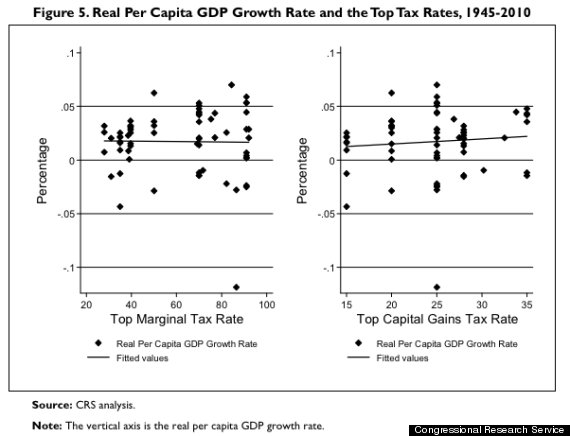
A new study by the nonpartisan Congressional Research Service has found that over the past 65 years, tax cuts for the rich have not led to economic growth and instead are linked to greater income inequality in the United States.

The study found that cutting taxes for the rich does not increase saving, investment, or productivity growth. "The top tax rates appear to have little or no relation to the size of the economic pie," the study said.

Two graphs show the lack of connection between tax rates for the rich and economic growth:

tax cuts for the rich

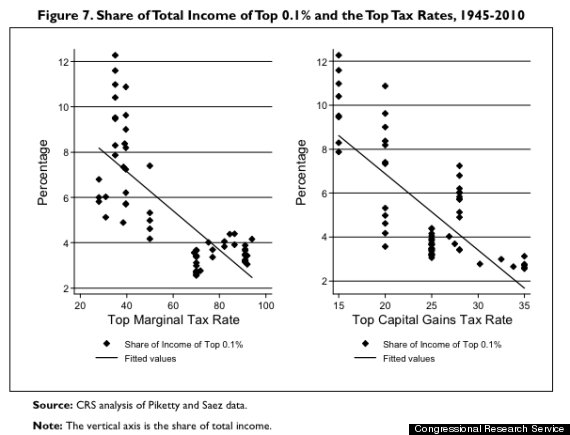
The authors noted that top-tier tax rates could have an effect on "how the economic pie is sliced." The study noted that in 1945, when the richest families had to pay a marginal tax rate of more than 90 percent, the top 0.1 percent of U.S. families accumulated 4.2 percent of all income gains. In 2007, in contrast, when the top marginal tax rate was 35 percent (which it still is), the top 0.1 percent of U.S. families captured 12.3 percent of all income gains.

Two graphs from the study show a clear connection between higher taxes for the rich and less income inequality:

tax cuts for the rich

Those findings are inconvenient for the Romney campaign. In a continuation of trickle-down economic theory, the Republican presidential nominee has argued that cutting taxes for the rich would "stimulate entrepreneurship, job creation, and investment," thus "breathing life into the present anemic recovery."

Romney has said he wants to extend all of the Bush tax cuts, while President Obama wants to extend those tax cuts only on the first $250,000 of taxable income. Romney also wants to slash marginal tax rates and taxes on investment income, as well as eliminate the estate tax -- all of which would disproportionately benefit the rich.

A recent study by Owen Zidar, a PhD student in Economics at the University of California at Berkeley, also found that tax cuts for the rich are not correlated with economic growth. But Zidar did find that tax cuts for the bottom 90 percent of income earners can stimulate economic growth and job creation.

France Says No to Genetically Modified Crops and Fracking

People in the US make fun of the French, but this is smart of them.--jef


France will maintain its ban on genetically modified crops [GMOs] and will ban fracking, politicians announced during an environmental conference held in Paris Friday and Saturday.

"The government is keeping its moratorium on the cultivation of GMO seeds currently authorized in the European Union," Prime Minister Jean-Marc Ayrault told the conference in Paris on Saturday.

Reuters reports that the ban specifically targets Monsanto the devil's MON810 maize, as it is the only GMO currently allowed in Europe.

The ban was originally enacted in 2008, was overturned by a French court in 2011, and was reinstated in March.

At the opening of the conference, President François Hollande declared the banning of shale gas drilling, or fracking.

Hollande stated that "no one" could be sure that fracking was free from "serious risks to health and the environment" and said that seven requests for fracking permits that had previously been submitted to the state are rejected.

Looming Curses of Privatization


by Paul Buchheit

With the breakdown of the private financial industry, and with the decision by corporations to stop meeting their tax responsibilities, and with the dramatic surge in tax haven abuse, less tax revenue is available to state and local governments. Deprived of funding, governments are forced to consider privatization schemes to balance their budgets. But any such scheme comes with adversity and pain.

The futility of diverting public funds into the hands of profitseekers has been well-documented. Here are a few of the gathering curses of privatization.


1. Public treasures sold off for short-term budget needs


In his 2006 budget President Bush proposed auctioning off 300,000 acres of national forest in 41 states. This followed attempts by both the Reagan Administration and Clinton-era Republicans to privatize public land.

Now, with continuing budget shortfalls, the Cato Institute and other libertarian groups are pressing for property deals, with the justification that land should be "allocated to the highest-value use," presumably making it available to the highest bidder for consumption purposes.

That brings us to Paul Ryan's dubiously-named Path to Prosperity, which proposes to sell millions of acres of "unneeded federal land" and billions of dollars worth of federal assets. He's starting in his own backyard: the state of Wisconsin is considering the sale of DNR land for some ready cash. The Path to Prosperity is based in part on Republican Jason Chaffetz' "Disposal of Excess Federal Lands Act of 2011," which would unload millions of acres of land in America's west. Worse yet is Rep. Cliff Stearns' perplexing recommendation to "sell off some of our national parks." Mitt Romney also chimed in, admitting that he didn't know "what the purpose is" of public lands.


2. Infrastructure decaying in the hands of profit-seekers

David Cay Johnston describes the deteriorating state of America's infrastructure, with grids and pipelines neglected by monopolistic industries that cut costs rather than provide maintenance. Meanwhile, they achieve profit margins of over 50%, eight times the corporate average.

The government agencies that are usually blamed for the crumbling infrastructure are often staffed with regulators from the industries they're expected to monitor. If and when accidents happen, the companies responsible can plead hardship and demand rate increases from the public.

It's getting worse as corporations become fewer and more powerful. Almost every American adult can relate to the monopolistic phone and Internet industry that controls our public airwaves. According to the Organization for Economic Cooperation and Development, South Korea has Internet speeds up to 200 times faster than the average speed in the U.S., at about half the cost. Free-market enterprise is simply not working in the U.S. telecommunications industry.

3. Water no longer available for the common good

According to Food and Water Watch, "The finance industry is promoting water privatization as a way to help local governments pay for budget shortfalls and improvement projects." The chief economist of Citigroup concurred: "I expect to see a globally integrated market for fresh water within 25 to 30 years."

But while profits average 12 to 15 percent per year, water and sewer utility rates typically rise 33 to 63 percent, and short-term business ventures are subject to abandonment after just a few years. Desperate local governments often regret their hasty decisions. A Century Foundation report concluded that with privatization "Competition is hard to create and maintain, cost savings (if any) from privatization erode over time, and service quality often suffers."

Numerous examples of water privatization abuse have been documented. In Pennsylvania and California, the American Water Company took over towns and raised rates by 70% or more. In Atlanta, United Water Services demanded more money from the city while prompting federal complaints about water quality. Felton, California privatized its water and received a 74 percent proposed rate increase over three years. Coatesville, Pennsylvania saw an 85 percent increase. Shell owns groundwater rights in Colorado, oil tycoon T. Boone Pickens is buying up the water in drought-stricken Texas, and water in Alaska is being pumped into tankers and sold in the Middle East.

In another ominous note for the future, the House passed the Clean Water Cooperative Federalism Act of 2011, which would deny the Environmental Protection Agency the right to enforce the Clean Water Act. Our water is getting dirtier and scarcer. But a hedge fund advisor put a capitalist spin on it, noting the "serious profit opportunities" in water. "If you play it right," he added, "the results of this impending water crisis can be very good."

4. Our children put at risk with unproven educational methods

The few charter schools with good reviews have functioned with limited enrollments, retention policies favoring likely-to-succeed individuals, and an absence of special needs students. This violates a precept underscored by Chief Justice Warren in Brown vs. the Board of Education: "Education...is a right which must be made available to all on equal terms." Charters aren't even close to that. The Louisiana Believes project, for example, which will eventually be the country's most extensive voucher system, has only 5,000 slots available for about 380,000 eligible students.

But corporations are rushing headlong into this lucrative new market anyway, while paying little heed to the body of research confirming their relative ineffectiveness. This includes studies from Stanford University, the Department of Education, Johns Hopkins University, and the RAND Corporation.

In addition to their poor performance, charters are more segregated, less likely to accept students with disabilities, and conducive to a widening of the racial and rich-poor education gaps.

Still, despite all the damning evidence, the charter myth persists in the American mind. And it's getting worse. The newest blind rush into privatization heralds 'virtual' schools, which offer lessons to homebound kids on their computers, even at the K-12 level. In what seems obvious to most of us, virtual schools don't work for children. A 2009 Department of Education study on blended online and face-to-face instruction reported results that were "significantly positive for undergraduate and other older learners but not for K-12 students."

A lengthy New York Times investigation of one of K12 Inc's online schools concluded that "By almost every educational measure, the Agora Cyber Charter School is failing. Nearly 60 percent of its students are behind grade level in math. Nearly 50 percent trail in reading. A third do not graduate on time. And hundreds of children, from kindergartners to seniors, withdraw within months after they enroll."

5. Colleges gradually being replaced with prisons

America has the highest incarceration rate in the world, and despite a falling violent crime rate, more people are going to jail. As explained by Michelle Alexander, "federal funding flows to those agencies that increase dramatically the volume of drug arrests, not the agencies most successful in bringing down the bosses."

So as education funding drops again this year in most of the states, spending on prisons increases. The U.S. spends over two times as much per prisoner as per public school student. California spends more on prisons than it does on higher education.

The profit motive is hastening prison privatization. Quickly. From 1990 to 2009, the number of prisoners in private facilities increased by more than 1600%, from about 7,000 to over 125,000 inmates. Corrections Corporation of America recently offered to run the prison system in any state willing to guarantee that jails stay 90% full.

Yet studies show that private prisons perform poorly in numerous ways: prevention of intra-prison violence, jail conditions, rehabilitation efforts. A 10-month investigation by the New York Times concluded that "the state's halfway houses have mutated into a shadow corrections network, where drugs, gang activity and violence, including sexual assaults, often go unchecked." Even so, New Jersey Governor Chris Christie insisted that "Places like this are to be celebrated."

The U.S. Department of Justice offered this appraisal: "There is no evidence showing that private prisons will have a dramatic impact on how prisons operate. The promises of 20-percent savings in operational costs have simply not materialized."

Prisons, like public land and utilities and schools, are up for sale in America. Essential public needs are fast becoming the newest products on the market.

Revolution From Above

by PAUL CRAIG ROBERTS
 
Today the Western peoples are experiencing the destruction of their well being that is comparable to what the one percent in Rome imposed on Roman citizens and conquered peoples. Here is how John Williams (shadowstats.com, 9-12-12) phrases the wipeout of Americans’ hopes:
“Consumers simply cannot make ends meet. Inflation-adjusted, or real, median household income declined for the fourth-straight year, plunging to its lowest level since 1995. Deflated by the CPI-U, the 2011 reading actually stood below levels seen in the late-1960s and early-1970s.”
“At the same time, despite the ongoing nature of the economic and systemic-solvency crises, and the effects of the 2008 financial panic, income dispersion—the movement of income away from the middle towards both high- and low-level extremes—has hit a record high, instead of moderating, as might be expected during periods of financial distress. Extremes in income dispersion usually foreshadow financial-market and economic calamities. With the current circumstance at a record extreme, and well above levels estimated to have prevailed before the 1929 stock-market crash and the Great Depression, increasingly difficult times are likely for the next several years.
This chart shows where the median household income of the US Superpower, the “indispensable people,” stands at the culmination of 2011. Americans are as well off as they were in 1967-68. Most americans cannot pay for fighting multi-trillion dollar wars for 11 years, bailout trillions of dollars in uncovered casino bets by Wall Street, have their middle class jobs sent abroad by corporations, and still expect to have higher personal incomes.


Apparently, Americans are the first people in history who are so idealistic, or so thoroughly brainwashed, that they prefer to pay for wars and bail out banks than to make their mortgage payments and help their children with student loan debt.

The federal court in Germany has ruled that Germans are to be just as idealistic as Americans. The federal court has produced a ruling that it is OK for the EU to require German citizens to provide $190 billion to pay off the private banks who lent too much money to Greece.

In exchange for paying off the banks for Greece, the Greek people are to be driven into poverty and hopelessness. Pensions are cut, taxes are raised, employment is cut, social services are curtailed, prices of utilities are raised. The Greek people are to be destroyed in order that the private European banks do not lose money on their bad loans.

In the West the Revolution From Above has succeeded. The peoples are re-enserfed. The promised land is a promised land for the one percent.

Israel putting US in corner by demanding red lines for Iran: Panetta

"Red lines are kind of political arguments that are used to try to put people in a corner."US Defense Secretary Leon Panetta
PressTV

Defense Secretary Leon Panetta says Israel is pushing the US into ‘a corner’ by demanding that Washington draw red lines before Iran over its nuclear energy program.

The president of the US and the prime minister of Israel “don't have, you know, a bunch of little red lines that determine their decisions,” Panetta told Foreign Policy 's National Security channel.

“Red lines are kind of political arguments that are used to try to put people in a corner," the American defense chief added.

Cracks have appeared in the relations between the old allies with the US rejection of Israeli Prime Minister Benjamin Netanyahu’s open bellicosity in pressuring Washington to set ‘red lines’ on Iran's nuclear energy activities.

The Israeli premier has hit back at the US for the refusal, saying "Those in the international community who refuse to put red lines before Iran, don't have a moral right to place a red light before Israel," to stop it from taking military action against the Islamic Republic unilaterally.

Opposition to the idea of red lines has not been limited to Uncle Sam. Netanyahu’s deputy for intelligence and atomic affairs Dan Meridor, a member of the core of Bibi’s security cabinet, said on Thursday that "I don't want to set red lines or deadlines for myself," and called for the intensification of sanctions against Tehran.

However, the US-Israel rift seemed on Sunday to be widening with Netanyahu’s indifference to White House opposition to his stance on Iran, when he renewed his demand for US red lines for Iran's nuclear energy program, cautioning his ally that by mid-2013 Iran would be "90 percent of the way" toward the capability to weaponize its nuclear technology.

"You have to place that red line before them now, before it's too late," Netanyahu said on NBC's "Meet the Press" program.

The disagreement added fuel to fire sparked recently when White House said Obama will not make time to meet Netanyahu during the annual meeting of the UN General Assembly next month.

Another serious bone of contention between the close allies came several weeks ago with Pentagon’s decision to scale back its participation in a joint military maneuver with the Israeli regime in September.

The US Defense Department said it had slashed the number of American troops slated to take part in the "Austere Challenge 12," drill by 60 percent, reducing the number from 5,000 to 1,500, or even 1,200 servicemen, according to Time Magazine.

Pentagon’s decision was, according to Israeli officials, taken in “response to the dinner party Netanyahu held in (Mitt) Romney's honor.”

Analysts believe Israeli premier’s unrelenting pressure on the Obama administration over the Iranian nuclear energy program is aimed at affecting developments in the US with the presidential elections just around the corner, a claim Netanyahu has rejected.

US And Britain Send Warships To The Persian Gulf To Prepare For An Israel Strike On Iran

Banoosh

An armada of U.S. and British naval power is amassing in the Persian Gulf in the belief that Israel is considering a pre-emptive strike against Iran’s alleged covert nuclear weapons program (which doesn't exist, according to Secretary of Defense, Leon Panetta).

Warships, aircraft carriers, minesweepers and submarines from 25 nations are converging on the strategically important Strait of Hormuz in an unprecedented show of force as Israel and Iran move towards the brink of war.

Western leaders are convinced that Iran will retaliate to any attack by attempting to mine or blockade the shipping lane through which around 18 million barrels of oil passes every day; approximately 35 per cent of the world’s petroleum traded by sea.

A blockade would have a catastrophic effect on the fragile economies of Britain, Europe, the United States and Japan, all of which rely heavily on oil and gas supplies from the Gulf.

The Strait of Hormuz is one of the world’s most congested international waterways. It is only 21 miles wide at its narrowest point and is bordered by the Iranian coast to the north and the United Arab Emirates to the south.

In preparation for any pre-emptive or retaliatory action by Iran, warships from more than 25 countries, including the United States, Britain, France, Saudi Arabia, and the UAE, will today begin an annual 12-day exercise.

The war games are the largest ever undertaken in the region.

They will practice tactics in how to breach an Iranian blockade of the strait and the force will also undertake counter-mining drills.

The multi-national naval force in the Gulf includes three U.S. Nimitz class carrier groups, each of which has more aircraft than the entire complement of the Iranian air force.

The carriers are supported by at least 12 warships, including ballistic missile cruisers, frigates, destroyers, and assault ships carrying thousands of U.S. Marines and special forces.

The British component consists of four British minesweepers and the Royal Fleet Auxiliary Cardigan Bay, a logistics vessel. HMS Diamond, a brand-new £1billion Type 45 destroyer, one of the most powerful ships in the British fleet, will also be operating in the region.

In addition, commanders will also simulate destroying Iranian combat jets, ships, and coastal missile batteries.

In the event of war, the main threat to the multi-national force will come from the Islamic Revolutionary Guards Corps navy, which is expected to adopt an “access-denial” strategy in the wake of an attack, by directly targeting U.S. warships, attacking merchant shipping, and mining vital maritime chokepoints in the Persian Gulf.

Defense sources say that although Iran’s capability may not be technologically sophisticated, it could deliver a series of lethal blows against British and U.S. ships using mini-subs, fast attack boats, mines, and shore-based anti-ship missile batteries.

Next month, Iran will stage massive military maneuvers of its own, to show that it is prepared to defend its nuclear installations against the threat of aerial bombardment.

The exercise is being showcased as the biggest air defence war game in the Islamic Republic’s history, and will be its most visible response yet to the prospect of an Israeli military strike.

Using surface-to-air missiles, unmanned drones, and state-of-the-art radar, Iran’s Revolutionary Guards and air force will combine to test the defenses of 3,600 sensitive locations throughout the country, including oil refineries and uranium enrichment facilities.

Brigadier General Farzad Esmaili, commander of the Khatam al-Anbiya air defence base, told a conference this month that the maneuvers would “identify vulnerabilities, try out new tactics and practise old ones”.

At the same time as the Western maneuvers in the Gulf, the British Response Task Forces Group — which includes the carrier HMS Illustrious, equipped with Apache attack helicopters, along with the French aircraft carrier Charles de Gaulle — will be conducting a naval exercise in the eastern Mediterranean. The task force could easily be diverted to the Gulf region via the Suez Canal within a week of being ordered to do so.

The main naval exercise comes as President Barack Obama is scheduled to meet Benjamin Netanyahu, the Israeli prime minister, today to discuss the Iranian crisis.

Many within the Obama administration believe that Israel will launch a pre-emptive strike against Iran’s nuclear facilities before the U.S. presidential elections, an act which would signal the failure of one of Washington’s key foreign policy objectives.

Both Downing Street and Washington hope that the show of force will demonstrate to Iran that NATO and the West will not allow President Mahmoud Ahmadinejad, the Iranian leader, to develop a nuclear armory or close Hormuz.

Sir John Sawers, the head of MI6, the Secret Intelligence Service, reportedly met the Israeli prime minister and Ehud Barak, his defense secretary, two weeks ago in an attempt to avert military action against Iran.

But just last week Mr. Netanyahu signaled that time for a negotiated settlement was running out when he said: “The world tells Israel ‘Wait, there’s still time.’ And I say, ‘Wait for what? Wait until when?’”

“Those in the international community who refuse to put red lines before Iran don’t have a moral right to place a red light before Israel.”

The crisis hinges on Iran’s nuclear enrichment program, which Israel believes is designed to build an atomic weapon. Tehran has long argued that the program is for civil use only and says it has no plans to build a nuclear bomb, but that claim has been disputed by the West, with even the head of MI6 stating that the Islamic Republic is on course to develop atomic weapons by 2014.

The Strait of Hormuz has long been disputed territory, with the Iranians claiming control of the region and the entire Persian Gulf.

Rear Admiral Ali Fadavi of the Iranian Revolutionary Guard Corps recently boasted that “any plots of enemies” would be foiled and a heavy price exacted, adding: “We determine the rules of military conflict in the Persian Gulf and the Strait of Hormuz.”

But Leon Panetta, the U.S. defence secretary, warned that Iranian attempts to exercise control over the Strait of Hormuz could be met with force.

He said: “The Iranians need to understand that the United States and the international community are going to hold them directly responsible for any disruption of shipping in that region — by Iran or, for that matter, by its surrogates.”

Mr. Panetta said that the United States was “fully prepared for all contingencies” and added: “We’ve invested in capabilities to ensure that the Iranian attempt to close down shipping in the Gulf is something that we are going to be able to defeat if they make that decision.”

That announcement was supported by Philip Hammond, the Defense Secretary, who added: “We are determined to work as part of the international community effort to ensure freedom of passage in the international waters of the Strait of Hormuz.”

One defense source told The Sunday Telegraph last night: “If it came to war, there would be carnage. The Iranian casualties would be huge but they would be able to inflict severe blows against the U.S. and British forces.

“The Iranian Republican Guard are well versed in asymmetrical warfare and would use swarm attacks to sink or seriously damage ships. This is a conflict nobody wants, but the rhetoric from Israel is unrelenting.”

Thursday, September 13, 2012

More Americans opting out of banking system

By Danielle Douglas, Washington Post
September 12, 2012

In the aftermath of one of the worst recessions in history, more Americans have limited or no interaction with banks, instead relying on check cashers and payday lenders to manage their finances, according to a new federal report.

Not only are these Americans more vulnerable to high fees and interest rates, but they are also cut off from credit to buy a car or a home or pay for college, the report from the Federal Deposit Insurance Corp. said.

Released Wednesday, the study found that 821,000 households opted out of the banking system from 2009 to 2011 and that the so-called unbanked population grew to 8.2 percent of U.S. households.

That means that roughly 17 million adults are without a checking or savings account. Another 51 million adults have a bank account, but use pawnshops, payday lenders or rent-to-own services, the FDIC said. This underbanked population has grown from 18.2 percent to 20.1 percent of households nationwide. 

The study also found that one in four households, or 28.3 percent, either had one or no bank account. A third of these households said they do not have enough money to open and fund an account. Minorities, the unemployed, young people and lower-income households are least likely to have accounts.

Stubbornly high unemployment and underemployment have placed millions of Americans in precarious financial positions, leaving them unable to absorb overdraft charges or minimum-balance fees.

In the past year alone, Wells Fargo, Capital One and SunTrust have alerted customers to pending fee hikes on checking accounts or have raised overdraft charges. Banks say service charges are needed to offset the loss of revenue from a cap on debit-card transaction fees imposed by the government.

“Banks need to have pricing and practices that consumers can trust and allow them to build wealth and have economic mobility,” said Deborah Goldstein, chief operating officer at the Center for Responsible Lending. “If the account fees will leave them worse off, then its going to be a challenge for people to use banking services.”
 
Banks say it is difficult to make money serving lower-income communities because the cost of managing their accounts outweighs the return.

“There has to be a recognition that there are costs to providing accounts and those costs have to be covered,” said Nessa Feddis, vice president and general counsel at the American Bankers Association. She estimated that it costs banks up to $300 a year to maintain a checking account because of expenses such as processing transactions.

National Community Reinvestment Coalition chief executive John Taylor argued that banks could make up some of that cost by the sheer volume of new accounts.

Feddis disagreed. “You can’t take a losing account and make it up in bulk,” she said. “You’re not going to spend money to lose money.”
 
Without access to traditional banks, Taylor said, Americans are susceptible to abusive practices at non-bank institutions and are likely to remain trapped in a vicious cycle of financial strain.

“A part of changing the condition of unbanked people is keeping them away from predatory lenders who keep them mired in debt,” he said. “One of the reasons you had all of these mortgage companies preying on low-income communities is because there were no options.” 
 
A report from SNL Financial in April showed that banks have closed dozens of branches in neighborhoods with a median household income of $25,000 or less since 2007, shifting resources to areas where the median income is $100,000 or more.

“The [Community Reinvestment Act] has had a significant impact over the last 30 years, but did not contemplate some of the new abuses that we’re seeing and the way banking has changed,” Goldstein said. “But we’ve now seen financial reform that includes additional consumer protection.”
 
Congress passed the act in 1977 to address the shortage of credit available to low- and moderate-income neighborhoods. Consumer advocates, however, say that regulation has fallen short of ensuring that banks offer reasonably priced services.
 
The newly minted Consumer Financial Protection Bureau has jurisdiction over non-bank institutions and plans to weed out predatory practices. The agency reviews compliance with federal consumer financial laws such as the Fair Credit Act. 

In the past year, a quarter of households have used at least one type of alternative financial service, such as a tax refund anticipation loan or money order, the FDIC study found. Some households, 7.5 percent, said they simply did not trust or feel comfortable dealing with banks. Another 6.6 percent said they could not open accounts because they lacked required identification or suffered from poor credit.

A growing number of consumers without bank accounts are turning to prepaid cards, with nearly 18 percent of households, up from 12 percent in 2009, reporting the use of such products.

Feddis of the banking association said prepaid cards are an innovative tool that banks could use to serve lower-income communities without incurring much cost.

“There are fewer ways to access the account, so there are fewer opportunities for fraud, which banks pay a lot to protect against,” she said.

Big Ag Directly Funded Anti-Organics Stanford Study


A study released last week by Stanford scientists, which claims organic foods are no more healthy than non-organic foods, was funded by corporate agriculture and biotechnology giants, according to a new report by the Cornucopia Institute.

 "We were not one bit surprised to find that the agribusiness giant Cargill, the world’s largest agricultural business enterprise, and foundations like the Bill and Melinda Gates Foundation, which have deep ties to agricultural chemical and biotechnology corporations like Monsanto the devil, have donated millions to Stanford’s Freeman Spogli Institute, where some of the scientists who published this study are affiliates and fellows," said Charlotte Vallaeys, Food and Farm Policy Director at the Cornucopia Institute, a non-profit organic farm policy organization.

On September 3, Stanford’s Freeman Spogli Institute, released the research, garnishing widespread press coverage from corporate news outlets such as the New York Times, Associated Press, and CBS News. As the New York Times reported, the study "concluded that fruits and vegetables labeled organic were, on average, no more nutritious than their conventional counterparts, which tend to be far less expensive."

However, as Cornucopia points out, a deeper examination of the actual research reveals "glaring errors, both in understanding the important and complex differences between organic and conventional foods and in the researchers’ flawed choice of research methods."

Environmental health advocates such as the Environmental Working Group and Mark Kastel of Cornucopia have been quick to point out the wealth of research ignored in the Stanford report, which reveals the obvious risks involved in producing and consuming non-organics; however, Stanford's spin was quickly and widely accepted by journalists without fact-checking and was rushed to the pages of major news outlets.

Now Cornucopia has revealed that the Stanford researchers have direct ties to big ag players, which stand to profit from an organics smear campaign.

"Make no mistake, the Stanford organics study is a fraud," says Mike Adams of Naturalnews.com and Anthony Gucciardi of Naturalsociety.org, who discovered the link between the organic study author and Big Tobacco. "To say that conventional foods are safe is like saying that cigarettes are safe. Both can be propagandized with fraudulent science funded by corporate donations to universities, and we’re seeing the same scientist who helped Big Tobacco now helping Big Biotech in their attempt to defraud the public."

"There was just no way that truly independent scientists with the expertise required to adequately answer such an important question would ignore the vast and growing body of scientific literature pointing to serious health risks from eating foods produced with synthetic chemicals," says Vallaeys.

Additionally, the study did, in fact, concede a few positive attributes to organic foods, including the fact that organic produce has fewer pesticide residues; however, such facts were buried in the presentation of the research by the Stanford researchers and public relations staff and were not widely reported by major news sources.

Profiles in Decadent Cowardliness

September 13, 2012
Two Conventions
by RALPH NADER

The Republican and Democratic Conventions are mercifully over but their corrosive impacts on our democracy persist.

First, did you know that taxpayers helped fund these conventions at a level of $100 million for logistics and police sequestrations of demonstrators in Tampa and Charlotte and an additional $18.2 million each for general convention expenses?

The two party duopoly obviously controls the honey pot in Congress. That corporate welfare is what they enacted in spite of the fact that the party’s convention committees are private corporations that should pay for their own big political party and their many smaller social parties with plentiful food and drink. No third party – Green, Libertarian or others – received any taxpayer money for their conventions this year.

Second, the Republican and Democratic Conventions have jettisoned their original purposes which were to resolve the contest for the presidential nomination and work up a platform. Both functions are now decided beforehand, setting the stage for a choreographed theatrical event of political pomposity and braggadocio. On the periphery are the omnipresent corporate lobbyists and their parties of free food and drink.

Did they ask you the taxpayers to foot so much of this bill? Silly question for an oligarchy greased by a plutocracy.

Taking these conventions at face value, one is shocked by how they are scripted right down to every line of every speech vetted by the politicos. Clint Eastwood’s spontaneity that so angered the GOP operatives was the exception.

The Republicans put three themes in just about every speech. Tell your personal story, recount your humble beginnings, and describe how you pulled yourself up by your own bootstraps. Show the people you’re human or at least humanoid, not corporatist. Keep heralding small business so you don’t have to talk about Big Business which has bad vibrations these days around the country. Also, praise, praise, praise Mitt Romney and Paul Ryan as family men with family values. Imagine Republicans telling the press that the convention was to “humanize” Romney and give the voters a warm, fuzzy feeling about their candidate so as to forget that his campaign is a clenched-teeth mouthpiece for Big Business.

The Democratic Convention evokes pity. They too had similar scripts at the podium – narrate your humble, hardworking family lines, talk incessantly about jobs so you won’t have to talk about wages. Especially muzzled was the willing Richard Trumka, head of the AFL-CIO, who, since 2009, has been given the back of Obama’s hand on “card check organizing rights” and on an inflation-adjusted minimum wage. His staged remarks even withheld any mention of a $10 minimum wage (See H.R. 5901 bill “Catching up with 1968”) and the raiding of worker pensions by corporate raptors.

The repetitive over-wrought praise of “el Presidente” in every speech became mawkish, reminding one of the “politics of personalism,” present in many countries with underdeveloped political institutions. Michelle Obama found no time for mentioning the Obama family and America’s mission to grow and consume nutritious food and keep fit to avoid the ravages of obesity. She was too occupied gushing over her aggressive drone commander’s touching nightly reading of letters from Americans about their problems.

The mass obeisance ended when the commander-in-chief himself sprung onto the stage to speak the language of hope, meanwhile avoiding addressing the number of undesirable conditions that need his attention at this singular opportunity.

Conservative New York Times columnist David Brooks, trying to be sympathetic, was looking for some significant specificity:
“What I was mostly looking for were big proposals, big as health care was four years ago. I had spent the three previous days watching more than 80 convention speeches without hearing a single major policy proposal in any of them. I asked governors, mayors and legislators to name a significant law that they’d like to see Obama pass in a second term. Not one could. At its base, this is a party with a protective agenda, not a change agenda…”

Fortifying Brooks’ observation was Obama’s recounting of the differences between the Democrats and Republicans. They are almost all defensive in nature. Defend social security, Medicare, and abortion from the Republican offensive. The Democrats are not on the offensive – getting tough on: corporate crime, consumer gouging, bank abuses, corporate tax avoidance and evasions. They are not on the offensive fighting for worker’s safety and labor rights or minimum wage increases or helping the poor earn more and pay less.

Even when Obama mentioned climate change – a recent no-no in the Democrat’s lexicon – his words were defensive, namely “climate change is not a hoax” he did not elaborate.

This defensive attitude against the cruelest, most ignorant corporate-indentured, anti-worker, war mongering Republican Party in history is also seen in the debates and programs of Democratic Congressional and state candidates.

Being on the offense with an agenda standing for and with the people who economically are being driven, along with their country, into the ground by unpatriotic global corporations and their political minions, should be easy. Unless, that is, the Democrats want to continue dialing for the same corporate campaign dollars.

Playing defense explains why veteran Democrat members of the House of Representatives tell me that the party is going to lose the House again to the likes of John Boehner and Eric Cantor. The Democrats cannot even defend the country from Republicans who think Ronald Reagan was too moderate and unelectable today.

United Police State of AmeriKKKa


Numbers, Analysis Show 30 Years of Failed US Economic Policy


Census numbers show persistent poverty, falling wages, and rising inequality
The latest US Census Bureau numbers on poverty, income inequality, and healthcare, coupled with newly released economic analysis of US public policy reveals the reality and the reasons behind the persistent rut of the poverty-stricken, the working-poor, and the middle class in America.

More than three years after the collapse of the housing bubble, the federal government's bailout of Wall Street, and the start of the Great Recession, the US poverty rate remains persistently high with nearly 1 in 5 Americans living at or below the poverty line, according to new figures released on Wednesday by the US Census Bureau.

In addition, the numbers show rampant joblessness, stagnant or falling wages among workers, household incomes that continue to fall, and an inequality gap that continues to grow.

Meanwhile, the Economic Policy Institute released their annual review of US economic policy which includes a wide variety of data on family incomes, wages, jobs, unemployment, wealth, and poverty that allow for a clear, unbiased understanding of the economy’s effect on the living standards of working Americans.

As the Census reports, "the nation's official poverty rate in 2011 was 15.0 percent, with 46.2 million people in poverty. After three consecutive years of increases, neither the poverty rate nor the number of people in poverty were statistically different from the 2010 estimates."

New data on the continued rise in inequality—where income inequality increased by 1.6 percent between 2010 and 2011—prompted Robert Greenstein, President of the Center on Budget and Policy Priorities, to underscore that the nation's wealthiest should begin to share in the sacrifices that will be needed to correct the economy in the coming years.

"Given the need for substantial sacrifice and the skewing of income gains to those at the top," he said in a statement, "it is difficult to justify extending the rather lavish tax cuts for high-income individuals that policymakers enacted in 2001 and 2003, which average $129,000 a year for people who make over $1 million a year, according to the Urban-Brookings Tax Policy Center."

The Economic Policy Institute, which on Tuesday released its 12th annual "State of Working America" report, listed the key numbers from the Census report:

Poverty

  • 15.0%: The share of the population in poverty in 2011
  • 21.9%: The percent of children under 18 in poverty
  • 46.2 million: The number of people in poverty in 2011
  • $22,811: The poverty threshold for a family of four with two children
  • 44.0%: The share of the poor population in “deep poverty,” or below half the poverty line
  • 2.3 million: The number of people unemployment insurance kept out of poverty in 2011
  • 21.4 million: The number of people Social Security kept out of poverty in 2011
  • 5.7 million: How many fewer people would be in poverty if the Federal Earned Income Tax Credit was included in the Census definition of money income
  • 3.9 million: How many fewer people would be in poverty if food stamps (SNAP) were added to money income

Income

  • -1.7%, +5.1%: The change in average household income between 2010 and 2011 for the middle 20 percent, and the top 5 percent, respectively. The disparity means income inequality increased in 2011. 
  • $7,887, -12.4%: The decline in median working-age household income from 2000 to 2011 in level terms and percentage terms, respectively 
  • $6,518, -16.8%: The decline in median African-American household income from 2000 to 2011 in level terms and percentage terms, respectively 
  • $4,695, -10.8%: The decline in median Hispanic household income from 2000 to 2011 in level terms and percentage terms, respectively 
  • $50,622, $48,202:  Median earnings for a man working fulltime, full year in 1973 and 2011, respectively 
  • $28,699, $37,118:  Median earnings for a female working fulltime, full year in 1973 and 2011, respectively
Putting the Census numbers in the context of public policy in their new report, EPI explains how economic policies, including policymakers’ actions and failures to act, have continuously undercut the ability of workers to benefit from economic growth in the United States. Its primary findings include:
  • America’s vast middle class has suffered a “lost decade” and faces the threat of another. The wages of typical Americans, including college graduates, are lower today than they have been in over a decade. Because hourly wages and compensation failed to grow after the 2001 recession, household incomes had declined even before the Great Recession. Furthermore, forecasts of high unemployment for many years ahead suggest that another lost decade for typical American workers and their families, as measured by wages and income, has already begun.
  • Income and wage inequality have risen sharply over the last 30 years. Income inequality has grown sharply since 1979, a fact that is universally recognized by researchers. The trends that have driven this growing inequality in overall incomes are growing concentration of both capital income (the returns to financial assets) and labor income (wages and benefits), as well as a shift from labor income toward capital income.
  • Rising inequality is the major cause of wage stagnation for workers and of the failure of low- and middle-income families to appropriately benefit from growth. The typical worker has not benefited from productivity growth since 1979, though there has been sufficient economic growth to provide a substantial across-the-board increase in living standards. Instead, higher earners have reaped a disproportionate share of wage income, and the top one percent of households have received a disproportionate share of all income growth. Aside from the period of strong growth in the late-1990s, wages for low-and middle-wage workers were stagnant from 1979 to 2007, and incomes for lower- and middle-class households grew slowly.
  • Economic policies caused increased inequality of wages and incomes. Inequality between the very top wage earners and all others grew from 1979 to 2011 except during stock declines, driven by growing executive compensation and an expanded and increasingly highly-paid financial sector. Inequality between the top wage earners and middle-wage earners also grew from 1979 to 2011. A number of policies played a role in this growth, including those that: (1) targeted rates of unemployment too high to provide reliably tight labor markets for low- and middle-wage workers; (2) hastened global integration of the U.S. economy without protecting U.S. workers; (3) failed to manage destructive international trade imbalances; (4) allowed employer practices hostile to unions to flourish; (5) privatized and deregulated industry, including the financial sector; and (6) eroded labor standards. Inequality between middle-wage earners and the lowest wage earners grew only in the 1980s, fueled by the erosion of the purchasing power of the minimum wage and, again, the targeting of rates of unemployment that were too high. Tax and budget policies have compounded the inequalities that have been generated in market-based, pre-tax incomes.
  • Claims that growing inequality has not hurt middle-income families are flawed. Some recent studies have suggested that measures of comprehensive income since 1979 show that middle-income families have seen adequate income growth. Rather, incomes for the middle class have not grown as fast as average incomes, and middle-income growth was much slower between 1979 and 2007 than it was between 1947 and 1979. Furthermore, more than half of the income growth between 1979 and 2007 was made up of government transfers, which reflects the strength of programs like Social Security, Medicare and Medicaid, not the strength of the labor market. In fact, higher household labor earnings can be traced to increasing work hours, not higher wages. Finally, the data on comprehensive incomes are technically flawed because they count rapidly rising health expenditures made on behalf of households by employers and the government as income, without taking excessive health care inflation into account.
  • Growing income inequality has not been offset by increased mobility. There is no evidence that mobility—changes in economic status from one generation to the next—has increased to offset rising inequality, and some research shows a decline.
  • Inequalities persist by race and gender. Key economic measures, including unemployment, wealth, and poverty (particularly child poverty), continue to show staggering disparities by race and ethnicity. Gender disparities also persist, and while gaps in labor market outcomes have closed in recent decades, a number have done so because men lost ground, not because women gained it.
“The State of Working America, 12th Edition” includes new and compelling data on:
Income
  • the components of the Congressional Budget Office’s “comprehensive income” growth for the middle class (health care insurance, wages, pensions, work hours, government benefits)
  • the growth of capital income by income group and the growing concentration of capital incomes
Mobility
  • the stagnation of economic mobility
  • the poor performance of the U.S. economy in international rankings of mobility
Wages
  • flat or falling wages for college graduates in almost every occupation over the past 10 years
  • wage trends by education, decile, gender, and race/ethnicity
  • the growth of wage inequality for the three key wage gaps: between the top one percent and others, between the top and middle (95/50 wage gap), and between the middle and bottom (50/10 wage gap)
  • the impact of rising health care costs on wage growth and wage inequality
  • the factors driving the gap between productivity and median hourly compensation growth
  • the role of the financial sector and CEO compensation in fueling the top one percent’s income growth
Jobs
  • the extent to which changes in the labor force participation rate are due to the weak economy or are structural/demographic
  • why current unemployment is cyclical and not structural
Wealth
  • the decline of median wealth between 1983 and 2010 (while wealth at the top grew strongly)
  • the collapse of wealth in African American and Hispanic households
  • the role of housing equity’s collapse on middle class wealth
  • the increasing concentration of stock ownership
Poverty
  • the factors driving high poverty and low-end wages
  • the large role income inequality plays in growing poverty (as opposed to demographic factors like family formation)
  • the contribution of longer work hours to low-income families’ income
  • the relatively small role tax and transfer policy plays in reducing poverty in the U.S. in comparison to peer countries
  • high child poverty rates in comparison to peer countries

A Tale of Two Healthcare Plans


by David Cay Johnston
 
 
No issue affecting taxes so clearly divides the two parties in the U.S. election as healthcare. The two parties, in their platforms, describe very different approaches to healthcare economics. Both use political plastic surgery to cover up ugly truths.


The stakes are huge. Americans spend $2.64 per person for healthcare for each purchasing power equivalent dollar spent by the 33 other countries that make up the Organization for Economic Cooperation and Development. The OECD data shows the U.S. spends $8,233 per capita compared with an average of $3,118 in the other 33 countries.

A growing share of federal tax dollars, in direct spending and in tax breaks, is going to U.S. healthcare as the population ages, even though about one in six Americans lacks health insurance.

America‘s healthcare system, more accurately described as a non-system sick care system, totaled 17.6 percent of the economy in 2010, compared to an average of 9.2 percent in the other 33 countries, as the OECD data shows.

In the United States, total public and private cost of healthcare is significantly greater than the total of corporate and individual income taxes, as well as payroll taxes. For each dollar paid in all three of those taxes in 2010, healthcare came to $1.29.

If we just lowered our costs to those of France, which has universal care in what is widely regarded as one of the best systems if not the best, it would save almost as much money as Americans paid in individual income taxes in 2010. The French spend 6 percentage points less of their economy on healthcare. In the United States, the individual income tax in 2010 came to 6.3 percent of the U. S. economy, the lowest since Truman was president.

Take a look at your pay stub to get an idea of the kind of money being spent on a system that fosters bankruptcy, bedevils small business and ranks 31st among the 34 OECD countries in preventing premature death.

REPUBLICAN PLAN

The Republicans say the federal government is “structurally and financially broken” and that “three programs - Medicare, Medicaid, and Social Security – account for over 40 percent of total spending,” which is “harming job creation and growth, (while) projections of future spending growth are nothing short of catastrophic, both economically and socially.”

The Republicans promise to “empower millions of seniors to control their personal healthcare decisions,” a vow immediately followed by a promise to cut federal spending.

The clearest explanation of what that would mean comes from Representative Paul Ryan, the Republican vice presidential nominee. Before he started obfuscating, Ryan laid out his plans in detail. He boasted that by changing Medicare from a plan that provides treatment for every older American into one that gives seniors a fixed sum to buy their own health insurance, taxpayers would save through 2084 the present equivalent of $4.9 trillion.

What Ryan did not mention is that his plan would also mean $8 of increased private spending by seniors and the disabled for each tax dollar saved.

We know how Ryan’s plan would raise total costs because David Rosnick and Dean Baker, economists at the Center for Economic Policy and Research which promotes government policies that it says would benefit workers and the poor, used the same formula that Ryan (or his staff) applied to the same Congressional Budget Office data, but on private medical care spending. Ryan’s spokesman did not respond to requests for comment.

Beyond the fact that it makes no sense to spend $8 to save $1, older people do not have the money. A tenth of Americans age 75 and older live below the official poverty line. Another 24 percent have only saved a tad more.

Every indicator shows that Americans have not enough for their old age and that a shrinking number have pensions while the Republicans now in charge of the party want to cut Social Security benefits, if not kill the program.

So why would any Americans under age 55, whose healthcare benefits Ryan wants to cut when they reach 65, think they can afford to spend $8 to save $1? Recently Ryan has softened his plan to let those who wish stay in traditional Medicare. Since anyone not rich who can count would stick with Medicare, Ryan’s promised taxpayer savings would never materialize.

Alan Grayson, the combative one-term Democratic representative from Florida, got it right when he said on the House floor in 2009: “The Republican plan – don’t get sick and if you do get sick die quickly.”

DEMOCRATS FAVOR UNIVERSAL CARE
 The Democratic platform calls for universal healthcare. “We will end the outrage of unaffordable, unavailable healthcare,” they say, though after six decades that party promise remains unfulfilled.

President Barack Obama‘s Patient Protection and Affordable Care Act will enable those with pre-existing conditions and twenty-somethings without work to get health insurance. But the plan does nothing to address the larger economic problem. American healthcare costs too much and needs replacement, not a nip and tuck.

Portugal, with half the income per person as America, provides universal healthcare. Cuba, the CIA tells us, ranks 40th in infant mortality, while the United States is nine steps lower at 49th, an astonishing fact given U.S. spending compared to the poverty induced by Castro’s collectivist economic policies.

Doing worse than Portugal and Cuba is, in my view, not just costly but immoral.

Just as Republicans are trying to limit the franchise, so are they trying to limit who gets healthcare. The Democrats are better only because they recognize that universal care can be cheaper while removing an annoying and costly distraction from business.

Death and taxes will always be with us. What we need is to spend less on taxes while doing the best we can to stave off death.

US House voted 300 to 118 to extend Warrantless Wiretapping 5 More Years


House Set to Vote on Reauthorization of Warrantless Wiretapping


Update: The Washington Post reports that "The House voted 300 to 118 to extend the law for five years. The Senate likely will not take up the bill until after the Nov. 6 election."

The House voted Wednesday on the reauthorizing of the 2008 FISA Amendments Act (FAA), which allowed the government to conduct warrantless wiretapping of Americans.

The ACLU's Michelle Richardson, a FISA expert, writes that the FAA "permits the government to get year-long orders from the secret Foreign Intelligence Surveillance Act (FISA) court to conduct dragnet surveillance of Americans’ international communications—including phone calls, emails, and internet records—for the purpose of collecting foreign intelligence. The orders need not specify who is going to be spied on or even allege that the targets did anything wrong. The only guarantees that the FAA gives are that no specific American will be targeted for wiretapping and that some (classified) rules about the use of intercepted information will be followed."

"After four years, you’d hope that some basic information or parameters of such a massive spying program would be divulged to the public, or at least your rank-and-file member of Congress, but they haven't," writes Richardson.

US Just Experienced Warmest Year-to-Date Period Ever


Climate change continues to bring weather extremes
 
Climate change continues to bring extreme, record breaking weather to the U.S., according to the most recent calculations from the National Oceanic and Atmospheric Administration (NOAA) released Monday.

The contiguous U.S. just experienced the third hottest summer ever. And the year-to-date (Jan. - Aug.) period was also the warmest first 8 months ever recorded for the contiguous U.S.

The summer (June - Aug.) national average was 2.3°F above the 20th century average at 74.4°F, surpassed only by the summers of 2011 and 1936 for warmest summer in recorded history.

For the year-to-date period, the contiguous U.S. was 4.0°F above the 20th century average at 58.7°F, surpassing the previous record for this period set in 2006.

Adding to documentation of the manifestations of climate change, NOAA's U.S. Climate Extremes Index (CEI) shows the year-to-date period was also the most extreme on record.  The NOAA describes the CEI as "an index that tracks the highest and lowest 10 percent of extremes in temperature, precipitation, drought and tropical cyclones across the contiguous U.S., was more than one and a half times the average value during summer 2012, and marked the eighth largest USCEI value for the season. Extremes in warm daytime temperatures, warm nighttime temperatures, and extremely dry conditions, according to the Palmer-Drought Severity Index, covered large areas of the nation, contributing to the high USCEI value."

Weather Underground co-founder Dr. Jeff Masters adds that the "CEI was 47% during the year-to-date January - August period. This is the highest value since CEI record-keeping began in 1910, and more than double the average value of 20%. Remarkably, 85% of the contiguous U.S. had maximum temperatures that were in the warmest 10% historically during the first eight months of 2012, and 75% of the U.S. of the U.S. had warm minimum temperatures in the top 10%."


* * *
* * *
 
NOAA's U.S. Climate Extremes Index (CEI) for January - August shows that 2012 had the most extreme first eight months of the year on record, with 47% of the contiguous U.S. experiencing top-10% extreme weather. (credit: Jeff Masters)