Thursday, November 17, 2011

84-year-old Woman the New Poster Child of the Occupy Movement


by Lorianna De Giorgio 
Dorli Rainey
Is this the face of the Occupy movement?


Photos of 84-year-old Dorli Rainey being helped by fellow activists after Seattle police blasted a crowd of Occupy protesters with pepper spray Tuesday have popped up on news websites and blogs around the world.

Occupy Seattle condemned the force, posting a statement on its website shortly after the incident saying “we offer our sympathies to the many protesting patriots that were indiscriminately pepper sprayed including a 4’10” 84 year old woman, a priest and a pregnant woman who as of this writing is still in the hospital.”

Rainey is a well-known activist who has supported liberal causes in Seattle since the 1950s.

The former mayoral candidate is a member of the Seattle chapter of Women in Black, an international network of women who “stand in silent vigil, calling for peace, justice and non-violent solutions to conflict,” according to its website.

In a 2010 interview with Talking Stick, a weekly program airing on a Seattle community cable access channel, Rainey described her desire to represent inequalities in the system.

“Freedom of speech is a concept. It is not always practiced in this country,” says Rainey, whose blog, Old Lady in Combat Boots, talks about her civic activism.

“I think she's a role model among activists that walks the walk,” Talking Stick TV producer Mike McCormick wrote in an email.

“She's passionate, thoughtful, well informed, dogged, fearless, in-your-face but not in an intimidating way, warm, caring, humorous, doesn't pull her punches kinda activist you want right next to you when the shit hits the fan.”

Seattle police spokesman Jeff Kappel told the Associated Press he didn't have the details on the Rainey confrontation, but he said pepper spray is “is not age specific. No more dangerous to someone who is 10 or someone who is 80.”

Kappel noted on the department’s blog the protesters began blocking traffic on 3rd Avenue and “officers gave numerous verbal warnings to get out of the street and back onto the sidewalk.”

He said at one point during the march a woman tried to hit an officer but failed to hit him.

Also a man threw an “unknown liquid” into an officer’s face. The officer was not injured.

“Pepper spray was deployed only against subjects who were either refusing a lawful order to disperse or engaging in assaultive behavior toward officers,” Kappel wrote on the blog.

Seattle fire department spokesman Kyle Moore said the city’s paramedics treated several people, including the pregnant woman.

Many of the protesters used homemade remedies, such as milk to counteract against the pepper spray, Moore added.

Rev. Rich Lang, pastor of the University Temple United Methodist Church in Seattle was pepper sprayed in Tuesday’s march.

He joined the movement as a pastoral counselor a few weeks ago after the Occupy Seattle moved its encampment to Seattle Central Community College from Westlake Park.

Lang said he broke up a series of altercations between protesters and police before he was pepper sprayed in the face by six officers.

“Last night was interesting,” Lang said Wednesday.

“The Occupy movement took care of me…rinsed my eyes out. Pepper spray feels like a severe burn. In your eyes…it’s just misery.”

Lang wrote a letter to explain what happened and to urge his fellow clergy members to get involved in the movement.

“I walked between the lines, I was alone, I was in full clergy dress, everyone knew who I was and what I was…six officers turned their spray on me thoroughly soaking my alb and then one officer hit me full throttle in the face,” he wrote.

“My question to my clergy colleagues is this: Where are you?”

Officers arrested six people in the incident.

99% v 1%: The Data Behind the Occupy Movement

It has been the rallying cry of the Occupy movement for the past two months - but is the US really split 99% v 1%? As poverty and inequality reach record levels, how much richer have the rich got? This animation explains what the key data says about the state of America today


by Mariana Santos and Simon Rogers


Is it really 99% v 1%? It has become the rallying cry of the Occupy Wall Street movement - and the Occupy protests around the world. But is it true?

This is the data behind this animation, produced by Guardian interactive designer Mariana Santos. And that data does show some people have done better out of America's economic booms of the last 20 years than others - as this report from the Congressional Budget Office shows too.

When Americans are asked how US wealth is distributed, they think the very richest fifth should own up to 40% of the national wealth - and that includes 90% of Republicans surveyed. In fact, that richest group owns 85% of the nation's wealth. Those surveyed also thought the bottom 120 million people should own around 10% of the national wealth. The reality: 0.3%

In fact, the super rich - the top 0.01% of the population - own more of the national wealth now than at any time since 1928, just before the Great Depression. And the richest 1% of the US population? They own a third of US net worth.

In Bill Clinton's boom of 1993-2000, average incomes went up - just as they did during George W Bush's boom at the beginning of his presidency. But if you were rich, you gained even more: nearly half of all the growth in the Clinton boom years. Under George W Bush it was 65%.

There are now over 3.1m millionaires and the US has over 400 billionaires, more than any other country in the world. Who's at the top of that pile? Bill Gates with a net worth of $59bn, Warren Buffett ($39bn), Lawrence Ellison ($33bn). That's just over the combined budget shortfall of every state in the US for 2011

In 2010, the average American earned $26,487 - down over $2,000 in real terms on 2006. That's a drop of 5.27%, including inflation. If you were poor it's been an even bigger drop - the 24 million least wealthy households in America saw their average income go down by 10% From $12,276 in 2006 to $11,034 in 2010.

If you were super rich it went down too. The 400 wealthiest American households lost around 4%, including inflation Between 2006 and 2008 - the latest year we have the data - the richest 400's household income went down by 4% - if you include inflation. That's to an average of $270.5m per household Nearly 5,400 times the average household income in the United States.

Part of the reason average Americans have been hit so hard is where their wealth comes from. Before the crash, middle-class Americans had 65% of their wealth tied up in their house.. But the richest 1% of the population kept most of their wealth in stocks and shares and business. So, when house prices went south, many Americans found their wealth disappearing too.

Now, one in every seven Americans lives below the poverty line - that's a record 46.2 million people (although it might actually be higher).

• One in six Americans have no health insurance - 50 million people, a population twice the size of Texas (27m people). Of every 17 Americans, at least one will be earning below the minimum wage of $7.25 per hour.

• 14.5% of Americans households are defined as "food insecure". That means for every seven households, one will have trouble putting enough food on the table

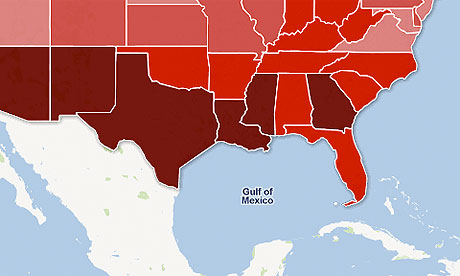
US poverty map. Click image to explore the data
 

Meanwhile, a Washington Post investigation found
"since the 1970s, median pay for executives at the nation's largest companies has more than quadrupled, even after adjusting for inflation, according to researchers. Over the same period, pay for a typical non-supervisory worker has dropped more than 10%"
.
What about taxes? The 400 wealthiest households paid $19.6bn in taxes in 2008 - the latest year we have data. That's 1.9% of all the income tax the IRS collects. If you are in the top tax bracket, your tax rate is 35%. But it doesn't quite work like that.
Imagine you are a billionaire and your income comes mostly from investments. Imagine you are Warren Buffet. You would end up paying a tax rate of under 20%. In fact, Buffett paid 17.4% tax last year. This is the "effective" tax rate.

If you earn between $100,000 and $200,000 you will be paying up to 25% effective tax rate - and that's before payroll taxes kick in. The 400 richest tax returns surveyed by the IRS paid just 18.1% in 2008.

Is it the 99% v the 1% What do you think?

You can read the animation's complete script below - and download the data for yourself.


Download the data

DATA: download the full spreadsheet

More open data

Data journalism and data visualisations from the Guardian

World government data

Search the world's government data with our gateway

Why Republicans Are Acting So Crazy

by SAM SMITH
 
Not every change in national policy and events is announced with a new conference or presidential speech.

A case in point is the rapid rise of apparent mental instability in the Republican Party. You used to just disagree with Republicans; now you have to worry whether your children will be safe in their proximity.

Historians may peg 2008 – with Sarah Palin chosen to run for vice president – as the beginning of the GOP breakdown. But in the past year things have moved from individually ridiculous to generally irrational.

The explanations vary. David Sirota, for example, calls it sadism, but where did it come from and why so suddenly?
 
The best rule of thumb is to follow the money.

And that, rather quickly, takes you back to a little over a year ago to January 21, 2010 when the Supreme Court declared that corporations were free to buy our elections at will. As Justice Stevens noted in his dissent:
At bottom, the Court’s opinion is thus a rejection of the common sense of the American people, who have recognized a need to prevent corporations from undermining self government since the founding, and who have fought against the distinctive corrupting potential of corporate electioneering since the days of Theodore Roosevelt. It is a strange time to repudiate that common sense. While American democracy is imperfect, few outside the majority of this Court would have thought its flaws included a dearth of corporate money in politics.”
Of course, as Stevens suggested, the ability of corporados to buy politicians was already well underway. Twelve years earlier, for example, I had given a speech at a rally at the US Capitol in which I said:
My final objection [private campaign financing] is biologic. Elections are for and between human beings. How do you tell when you’re dealing with a person? Well, they bleed, burp, wiggle their toes and have sex. They register for the draft. They register to vote. They watch MTV. They go to prison and they have babies and cancer. Eventually they die and are buried or cremated.
“Now this may seem obvious to you, but there are tens of thousands of lawyers and judges and politicians who simply don’t believe it. They will tell you that a corporation is a person, based on a corrupt Supreme Court interpretation of the 14th Amendment from back in the robber baron era of the late 19th century — a time in many ways not unlike our own.
“Before this ruling, everyone knew what a person was just as everyone knew what a bribe was. States regulated corporations because they were legal fictions lacking not only blood and bones, but conscience, morality, and free . .
Corporations say they just want to be treated like people, but that’s not true. Test it out. Try to exercise your free speech on the property of a corporation just like they exercise theirs in your election. You’ll find out quickly who is more of a person. We can take care of this biologic problem by applying a simple literary solution: tell the truth. A corporation is not a person and should not be allowed to be called one under the law.
Further, you don’t always need to buy a politician directly, as Source Watch explained:
In an April 9, 2009 article, Lee Fang reports that the principal organizers of Tea Party events are Americans for Prosperity and Freedom Works, two “lobbyist-run think tanks” that are “well funded” and that provide the logistics and organizing for the Tea Party movement from coast to coast. Media Matters reported that David Koch of Koch Industries was a co-founder of Citizens for a Sound Economy, the predecessor of FreedomWorks. David Koch was chairman of the board of directors of CSE. CSE received substantial funding from David Koch of Koch Industries, which is the largest privately-held energy company in the country, and the conservative Koch Family Foundations, which make substantial annual donations to conservative think tanks, advocacy groups, etc. Media Matters reported that the Koch family has given more than $12 million to CSE (predecessor of FreedomWorks) between 1985 and 2002. .
Media Matters also lists the Sarah Scaife Foundation as having given a total of $2.96 million in funding to FreedomWorks. The Sarah Mellon Scaife Foundation is financed by the Mellon industrial, oil, and banking fortune. The Claude R. Lambe Foundation, also controlled by the Koch family, has donated more than $3 million to Americans for Prosperity.
That said, there is a moment when confusion turns into chaos or assault turns into murder. For the American political system that moment was the Supreme Court decision on corporations a year ago. Historians – if such people are permitted to exist in the future – will probably see this as one of the great tipping points in the collapse of America.

Further, what has happened in the last year – including the Tea Party surge in the 2010 election – is not so much the result of an intrinsic mental breakdown in the GOP as it is the conscious selection of candidates who would once have been considered absurd, but now can be safely used to carry out corporatist goals because the public no longer has the power to defeat the money.

A Scott Walker or Paul LePage can say and do anything that their campaign contributors want because it is assumed by the latter that money now inevitably trumps public will.

Yes, Scott Walker may be a sadist and Paule LePage a dumb bully, but they are merely tools of those who fund them. All they have to do is be pluto pimps for the corporate agenda.

This is scheme wouldn’t work so well if their funders mainly wanted something, but what they really want is the absence of something -namely a government that might stand in their way. So long as Walker and LePage are destroying things, their backers are quite content.

These Republicans are wrecking trucks for the big businesses that want to tear down the neighborhood we call America.

It’s working for them right now. Whether it will continue to do so remains to be seen. For example, for the working class to even think about supporting Republicans is an idea only about three decades old.

A short list of constituencies that Republicans have recently offended include supporters of 9/11 responders, the AARP, Americorps, black men, cchildren with pre-existing health conditions, college students, cops, disabled people, aarthquake warnings, employed women, EPA, ethnically mixed couples, gays, ill people who need medical marijuana, immigrants and their children, jobless people, journalists, latinos, Medicaid recipients, Methodists, minimum wage workers, the National Endowment for the Arts, the National Institutes of Health, the National Science Foundation, NPR & PBS, the Postal Service, public school students, public workers, scientists, supporters of separation of church and state, Social Security recipients, state workers, and women generally.

That’s not a bad base around which to build an electoral rebellion.

Liberals could rediscover the working class and start showing it some respect in their policies. Issues could become more important than icons in our politics. Youth could rediscover their collective power once they turn off Facebook and their Ipods. The drive for a constitutional amendment ending corporate personhood could become a major issue.

And, as I noted at the Capitol back in 1999:
The people who work in the building behind us have learned to count money ahead of votes. It is time to chase the money changers out of the temple. But how? After all, getting Congress to adopt publicly funded campaigns is like trying to get the Mafia to adopt the Ten Commandments as its mission statement. I would suggest that while fighting this difficult battle there is something we can do starting tomorrow. We can pull together every decent organization and individual in communities all over America — the churches, activist organizations, social service groups, moral business people, concerned citizens — and begin drafting a code of conduct for politicians. We do not have to wait for any legislature. If we do this right, if we form true broad-based coalitions of decency, then the politicians will ignore us only at their peril.
At root, dear friends, our problem is that politicians have come to have more fear of their campaign contributors than they have of the voters. We have to teach politicians to be afraid of us again. And nothing will do it better than a coming together of a righteously outraged and unified constituency demanding an end to bribery of politicians, whether it occurs before, during, or after a campaign.
In the meanwhile, it is best to keep in mind that the Republicans destroying our land are doing so not so much because of some new mental problems. They had them before and you just didn’t hear about them.

They are tearing down the nation because their problems are extremely valuable to the corporados who have put them into office and don’t want government to work at all.

Our battle, thus, is not with Walker and LePage but with the big bucks that put them where they are. Follow the money.

Our Fuck You System of Government


Anti-Occupy Crackdowns Highlight Lack of Services
Broke? Can’t afford rent? We don’t give a crap.

Governments are supposed to fulfill the basic needs of their citizens. Ours doesn’t pretend to try.

Sick? Too bad.

Can’t find a job? Tough.

Forget “e pluribus unum.” We need a more accurate motto.

We live under a fuck you system.

Got a problem? The U.S. government has an all-purpose response to whatever ails you: fuck you.

During the ’80s I drove a yellow taxi in New York. Then, as now, there were no public restrooms in the city. At 4 in the morning, with few restaurants or bars open, the coffee I drank to stay awake posed a significant challenge.

It was—it is—insane. People pee. People poop. As basic needs go, toilets are as basic as it gets. Yet the City of New York, with the biggest tax base of any municipality in the United States, didn’t provide any.

So I did what all taxi drivers did. What they still do. I found a side street and a spot between two parked cars. It went OK until a cop caught me peeing under the old elevated West Side Highway, which later collapsed due to lack of maintenance. Perhaps decades of taxi driver urine corroded the support beams.

“You can’t do that here,” said the policeman.

“Where am I supposed to go?” I asked him. “There’s aren’t any restrooms anywhere in town.”

“I know,” he replied before going to get his summons book from his cruiser.

The old “fuck you.” We create the problem, then blame you for the results.

I ran away.

In recent days American mayors have been ordering heavily armed riot police to attack and rob peaceful members of encampments allied with Occupy Wall Street.

Like NYC, which won’t provide public restrooms but arrests public urinators, government officials and their media allies use their own refusal to provide basic public services to justify raids against Occupations.

In the middle of the night on November 15th NYPD goons stormed into Zuccotti Park in lower Manhattan. They beat and pepper-sprayed members of Occupy Wall Street and destroyed the books in their library. Citing “unsanitary conditions,” New York’s billionaire mayor, Michael Bloomberg, then told reporters: “I have become increasingly concerned…that the occupation was coming to pose a health and fire safety hazard to the protesters and to the surrounding community.”

Four days before the police attack The New York Times had quoted a city health department statement worrying about the possible spread of norovirus, vomiting, diarrhea and tuberculosis: “It should go without saying that lots of people sleeping outside in a park as we head toward winter is not an ideal situation for anyone’s health.”

So why don’t they give the homeless some of the thousands of abandoned apartment units in New York?

Anyway, according to the Times: “Damp laundry and cardboard signs, left in the rain, have provided fertile ground for mold. Some protesters urinate in bottles, or occasionally a water-cooler jug, to avoid the lines at [the few] public restrooms.

Of course, there’s an obvious solution: provide adequate bathroom facilities—not just for Occupy but for all New Yorkers. But that’s off the table under New York’s fuck you system of government.

Doctors noted a new phenomenon called “Zuccotti cough.” Symptoms are similar to those of “Ground Zero cough” suffered by 9/11 first responders.

Zuccotti is 450 feet away from Ground Zero.

Which brings to mind the fact that the collapse of the World Trade Center towers released 400 tons of asbestos into the air. It was never cleaned up properly. Could Occupiers be suffering the results of sleeping in a should-have-been-Superfund site for two months?

We’ll never know. As under Bush, Obama’s EPA still won’t conduct a 9/11 environmental impact study.

Sick? Wanna know why? fuck you.

One of the authorities’ most ironic complaints about the Occupations is that they attract the mentally ill, drug users and habitually homeless.

To listen to the mayors of Portland, Denver and New York, you’d think the Occupiers beamed in bums and nutcases from outer space.

When mentally disabled people seek help from their government, they get the usual answer: fuck you.

When people addicted to drugs—drugs imported into the U.S. under the watchful eyes of corrupt border enforcement officers—ask their government for help, they are turned away. fuck you again.

When people who lost their homes because their government said “fuck you” to them rather than help turn to the same government to look for safe shelter, again they are told: “fuck you.”

And then, after days and years and decades of shirking their responsibility to provide us with such staples of human survival as places to urinate and defecate and sleep, and food, and medical care, our “fuck you” government has the amazing audacity to blame us, victims of their negligence and corruption and violence, for messing things up.

Which is why we are finally, at long last, starting to say “fuck you” to them.

Nationwide Police Crackdowns on Occupy Movement Coordinated among Mayors, FBI, DHS


Oakland Mayor Jean Quan let slip in an interview with the BBC that she had been on a conference call with the mayors of 18 cities about how to deal with the Occupy Wall Street movement. That is, municipal authorities appear to have been conspiring to deprive Americans of their first amendment rights to freedom of assembly and freedom to petition the government for redress of grievances.

Likewise, A Homeland Security official let it slip in a phone interview that the FBI and the Department of Homeland Security had been strategizing with cities on how to shut down OWS protests. The FBI is said to have advised using zoning ordinances and curfew regulations, and to stage the crackdown with massive police force at a time when the press was not around to cover the crackdown.

Wonkette suggests that the PATRIOT Act is implicated here, but I’m not sure how that works. Actually the techniques discussed are standard for US police forces in dealing with peaceful protests (the only routine technique missing is that of putting saboteurs among the protesters who cause destruction and create an image of them as violent.

What these two reports show is a high-level conspiracy to deprive Americans of their constitutional right to protest peacefully.

When will we see Occupy Wall Street protesters hooded, dressed in orange jump suits, and sent to Guantanamo for military trials? When you let the government act without regard for the rule of law toward foreigners suspected of terrorism, you open yourself to be treated the same way if the rich decide to sic their police on you (it is mostly their police). This is why a rule of law has to be maintained. Anything less ratchets toward tyranny.

+++++++

Homeland Security Coordinated 18-City Police Crackdown on Occupy Protest

National Coordination Goes Against Protection of Local Accountability

Oakland Mayor Jean Quan said that 18 cities coordinated police crack downs on Occupy protests.

Wonkette reports that Homeland Security likely organized the crack downs:
Remember when people were freaking out over the Patriot Act and Homeland Security and all this other conveniently ready-to-go post-9/11 police state stuff, because it would obviously be just a matter of time before the whole apparatus was turned against non-Muslim Americans when they started getting complain-y about the social injustice and economic injustice and income inequality and endless recession and permanent unemployment? That day is now, and has been for some time. But it’s also now confirmed that it’s now, as some Justice Department official screwed up and admitted that the Department of Homeland Security coordinated the riot-cop raids on a dozen major #Occupy Wall Street demonstration camps nationwide yesterday and today. (Oh, and tonight, too: Seattle is being busted up by the riot cops right now, so be careful out there.)
Rick Ellis of the Minneapolis edition of Examiner.com has this, based on a “background conversation” he had with a Justice Department official on Monday night:
Over the past ten days, more than a dozen cities have moved to evict “Occupy” protesters from city parks and other public spaces. As was the case in last night’s move in New York City, each of the police actions shares a number of characteristics. And according to one Justice official, each of those actions was coordinated with help from Homeland Security, the FBI and other federal police agencies.
[...]
According to this official, in several recent conference calls and briefings, local police agencies were advised to seek a legal reason to evict residents of tent cities, focusing on zoning laws and existing curfew rules. Agencies were also advised to demonstrate a massive show of police force, including large numbers in riot gear. In particular, the FBI reportedly advised on press relations, with one presentation suggesting that any moves to evict protesters be coordinated for a time when the press was the least likely to be present.
***
(And for those who are understandably doubtful about Examiner.com as a news source, here’s an AP story from a couple hours ago that verifies everything except the specific mention of DHS coordination.)
Yves Smith notes:
The 18 police action was a national, coordinated effort. This is a more serious development that one might imagine. Reader Richard Kline has pointed out that one of the de facto protections of American freedoms is that policing is local, accountable to elected officials at a level of government where voters matter. National coordination vitiates the notion that policing is responsive to and accountable to the governed.

Occupy Protesters Prepare for Day of 'Solidarity' Across US


Series of events planned to support evicted Zuccotti Park activists by highlighting growing inequality and need for jobs
by Paul Harris in New York 
Supporters of the Occupy movement are gearing up for a national day of protest and direct action across America, taking in dozens of events from New York to Chicago to Los Angeles.

Thursday has been declared a day of "solidarity" with the Occupy Wall Street activists in New York after their camp in lower Manhattan's Zuccotti Park was raided and dismantled by police. But it is also aimed at highlighting several of the movement's broader aims in terms of income inequality and a desperate need for job creation in America's floundering economy.

The Occupy movement, which began two months ago with the occupation of Zuccotti Park, has since spread to scores of cities and towns across the country, with varying success. It has often rejuvenated left-leaning political activists but also brought down a heavy police response, frequently at the behest of city mayors.

In recent days, police evictions and crackdowns on protesters in New York, Seattle, Berkeley, Portland and other places have caused widespread condemnation of alleged heavy-handedness by police.

In New York, protesters are planning actions all day in each of the city's five boroughs. A potential early flashpoint will be a rally planned to begin at 7am that will target Wall Street itself, as the protesters seek to disrupt the operations of the New York Stock Exchange before the ringing of the opening bell that signals the start of trading at 9.30am.

Since the protests began, Wall Street has become a virtual permanent protest zone, ringed by steel fences and heavily policed. Later actions are planned to take place across the city's subway system, as marchers will enter at 16 different stations and begin protesting.

Finally, the day will end with a rally at Foley Square, near New York's Town Hall, and then a march to the Brooklyn Bridge, where hundreds of protesters were arrested in a previous headline-grabbing mass action.

Bridges will be the focus of some actions in other cities too. In Boston, Detroit, Washington DC, Portland and Seattle, protesters, some allied with union workers and community groups, will march on high-profile bridges in order to highlight the problem of America's crumbling and underfunded infrastructure.

"We don't want to make this about police and protesters," said Stephen Squibb, an organiser with Occupy Boston, whose group will target the city's North Washington Street bridge. "It is about jobs and other things. That has been our message for two months and we are going to keep saying it," he added.

The range of activities across America spans a spectrum from the dramatic to the small-scale, including teach-ins, rallies and direct actions aimed at banks and corporations. In Portland, Oregon, protesters plan to target a city bridge and then try to organise flashmobs to go to local banks. In Detroit, protesters are marching from their camp downtown to the city's municipal centre, where they aim to highlight the brutal impact of government cuts on ordinary citizens.

"Poor and middle-class people can't afford this. The rich are using austerity because they don't want to pay more in taxes," said Todd Brady, a Detroit organiser.

Elsewhere, protesters in Atlanta will hold events targeting two major corporations in the form of Home Depot and Verizon. In Las Vegas, protesters have vowed to set up an early morning encampment outside a federal building downtown and stay until police remove them. In Chicago, a major rally is planned with local union workers and community groups.

In Memphis, a "midnight march" is planned through the city centre. In Phoenix, local members of the movement are targeting the city's light rail network during the morning rush hour. They then plan to hold a flashmob that will protest at a secret target in the city's business district.

Occupy activists in Phoenix said that the action showed the movement was taking hold, even in conservative areas of the US. "There is a discontent that moves beyond party lines as more people get involved," said a local Phoenix organiser, Diane D'Angelo.

Occupy supporters across the country also believe that the recent crackdowns, especially in New York, have rejuvenated the movement despite the evictions and loss of equipment.

"It is just what the movement needed. It was like throwing rocks on a hornets' nest," Squibb said.

Occupy Dallas Raided & Shut Down in Nationwide Crackdown


It's far from over.--jef


City Manager orders raid of OccupyDallas camp
by Michael Prestonise • November 17, 2011
 
Police officers in riot gear raided the OccupyDallas camp early Thursday morning after City Manager Mary Suhm rescinded the agreement with protesters and ordered evictions.

Members of the camp who have been protesting for over 42 days were given no notice from the city before police strategically surrounded them.

In an excessive show of force, mounted officers on horseback trotted onto the scene while police sport utility vehicles lined the streets. Jonathan Winocour, the lawyer working with OccupyDallas, was sent a fax at 11:46 p.m. from the City Attorney’s office informing him of the city’s intention to forcibly remove the peaceful protesters. Minutes after Winocour relayed the message to protesters, the members of the media were warned to leave by police loudspeaker. They were relocated across the street while the police loudspeaker issued a statement to the remaining OccupyDallas members. The protesters were given 20 minutes to collect their personal property and vacate the park.

After the 20 minute deadline had expired, police officers carrying shields lined the sidewalk and began moving into the camp. They searched each tent before arresting those who had chosen to stay. In total, 17 protesters were arrested for refusing to leave the park.

The raid on the camp comes less than 24 hours after Winocour met with city officials who assured him that there were no plans to evict the protesters. Protesters were warned by members of the media that police officers were being briefed and prepared for the raid on the camp. OccupyDallas advisor Glynn Wilcox was shocked to discover that City Manager Suhm failed to notify Mayor Rawlings and the members of the City Council of the police action. The raid comes on a day which has been planned as a National Day of Action across the country.

+++++


Police Crackdowns on Occupy Protests from Oakland to New York Herald the "New Military Urbanism"

After a wave of raids across the country in which police in riot gear broke up Occupy Wall Street encampments and arrested protesters, Oakland Mayor Jean Quan acknowledged in an interview with the BBC that she participated in a conference call with officials from 18 cities about how to deal with the Occupy movement. As police forces violently crack down on protests across the United States and Europe, we look at the increasing influence of military technology on domestic police forces. Stephen Graham is professor of Cities and Society at Newcastle University in the U.K. His book is Cities Under Siege: The New Military Urbanism.

"What the Occupy movement is so powerful at is demonstrating that by occupying public spaces around the world, and particularly these extremely symbolic public spaces, it’s reasserting that the city is the foundation space for democracy," Graham says.

Sunday, November 6, 2011

Economic Future Is Dark as Fake Economic Recovery Consists Only of Low-Paying Jobs

(Many of you out there think we're just going through a rough patch but that things will eventually go back to the way they used to be. Dream on. The way things were is a bygone era. Those days are gone and they aren't coming back. Things are going to get a whole lot worse before ever getting better, and they won't get better until many things have changed. And those wealthy controllers of the economy won't go down without a fight, either. Zbigniew Brzezinski, the Democrat's "snake in the grass" (whose Republican counterpart is Henry Kissinger), was recently quoted saying "in earlier times, it was easier to control one million people than to physically kill one million people; today, it is infinitely easier to kill one million people than to control one million people." If that isn't a rather ominous warning to those of us protesting against the corruption of the wealthy, then nothing is. 

Life is not going to go back the way it was, it's going to get a whole lot worse for everyone who isn't a billionaire (even millionaires will suffer). You might have a lot of money now, but you might as well spend all of it before it gets taken away from you. Your heirs won't see a dime of your fortune, no matter how much you leave to them. It's OK to be afraid, in fact, it's quite natural.--jef)


The current "recovery" is actually a deepening deficit of good jobs.
By Annette Bernhardt, AlterNet
Posted on November 6, 2011

Major newspapers last week reported a trend that won’t come as a surprise to working Americans:  incomes are falling.  In fact, median household income, adjusted for inflation, has fallen faster since the recession "ended" (and the "depression" began--jef) than during the recession itself.  Analysts point to high unemployment and weak economic growth as the culprits, but that is only part of the story.

Just as the country struggles to confront a seemingly insurmountable jobs deficit, America’s chronic low-wage problem is reasserting itself with a vengeance.  Here are three ways to understand just how severe the problem is.

First, the current recovery is actually deepening our deficit of good jobs. During the Great Recession, the jobs we lost were concentrated in mid-wage occupations like paralegals, health technicians, administrative assistants and bus drivers, making $15 to $20 an hour.  But so far in this weak recovery, employment growth has almost completely come from low-wage occupations like retail workers, office and stock clerks, restaurant staff and child care aids – most making $8 to $10 an hour.  There has been barely minimal growth in mid-wage occupations, and net losses in those that pay higher.

In part, this unbalanced growth is a byproduct of the Great Recession.  The financial crash and bursting of the housing bubble caused big job losses in construction, finance, insurance and real estate, and these better-paying industries are having a harder time coming back than low-wage industries such as retail trade, restaurants, temp agencies, and nursing homes.

But there are also other factors at work, such as the long-standing decline in manufacturing and outmoded telecommunications industries (again, better-paying sectors).  The slashing of state and local public jobs has also continued unabated during the recovery, dragging down middle-class employment.

Second, the paychecks of workers in low-wage occupations are shrinking.  While real wages for the average American worker have been essentially flat (adjusted for inflation) since the start of the recession, wages for Americans in low-wage occupations have actually declined by 2.3 percent. That’s a troubling pattern for jobs that are also growing the fastest.

Finally, job quality was already a problem in the U.S. labor market even before the Great Recession began.  From 2001 through 2008, low-wage and high-wage occupations grew significantly more than mid-wage occupations.  In fact, mid-wage occupations constituted only 6 percent of net job gains during this period, continuing the increase in economic inequality in America that dates all the way back to the late 1970s. 

The U.S. has struggled to respond to these trends.  The failure to pass a strong enough stimulus package in 2008, the endless fights to continue unemployment benefits, the debt ceiling debacle that  imposed fiscal austerity when government should be investing in the economy – this dysfunction in our politics has done significant harm.  Even House Majority Leader Eric Cantor acknowledges that there is too much income disparity in the United States (He does have to get re-elected and say the "right" things for his campaign in a district that is suffering like the rest of the country, after all...--jef). Yet the recent unveiling of President Obama’s American Jobs Act gave us only a brief glimpse of sensible policy debate before it, too, disappeared into the same vortex of take-no-prisoners politics.

In this context, the problem of low-wage work and declining wages doesn’t even register on the radar screen.  

Putting aside the abysmal political context for a moment, it is clear that the U.S. needs to work on dual fronts and tackle both job creation and job quality.  There are plenty of ideas out there:
  • rebuilding and modernizing America’s infrastructure, 
  • incubating green jobs sectors, 
  • creating universal pre-K, 
  • sending more fiscal relief to the states to avoid lay-offs, and more.  

We can also strengthen the wage floor by raising the minimum wage and putting more resources towards fighting wage theft, an endemic problem in low-wage service industries.

All are win-win solutions, but the politics at the federal level aren’t even close to being there.
There are rays of hope, however, in our states and cities.  The bipartisan U.S. Conference of Mayors is calling for quick investment in infrastructure, small business, manufacturing, trade and tourism to create jobs. Renewed activism, like the Wisconsin and Occupy Wall Street protests, is advancing calls for job creation, living wages and a strong safety net for the unemployed.  The immigrant community has become a powerful voice for workers’ rights, increasingly winning anti-wage theft campaigns.  And diverse coalitions have successfully fought back attempts to weaken state minimum wage laws, as they launch campaigns to raise the minimum wage in more than half a dozen states.

The question, of course, is will it be enough – enough to pierce the bubble of insanity that is holding American politics hostage and put jobs and wages squarely on the front burner of domestic policy.  The answer to this question has enormously high stakes, not just for avoiding a second recession, but for the long-term project of building a competitive, sustainable, and just America.

U.S. Military Official: We Are Concerned Israel Will Not Warn Us Before Iran Attack


Senior U.S. military official tells CNN U.S. 'increasingly vigilant' over military developments in Iran and Israel, says 'absolutely' concerned Israel may attack Iran nuclear facilities. 


U.S. officials are concerned that Israel will not warn them before taking military action against Iran's nuclear facilities, a senior U.S. military official said Friday.

The official, who asked to remain anonymous, told the CNN network that although in the past, U.S. officials thought they would receive warning from Israel if it did take military action against Iran, "now that doesn't seem so ironclad."

The U.S. is "absolutley" concerned that Israel is preparing an attack on Iran’s nuclear facilities, and this concern is increasing, CNN reported the official as saying.

The U.S. has increased its “watchfulness” of Iran and Israel over the past few weeks, U.S. Central and European Commands, which watch Iranian and Israeli developments respectively, are “increasingly vigilant” at this time, according to the official, and a second military official who also spoke with CNN.

The military official emphasized that the U.S is concerned about the risk a strike against Iran could pose for American troops in Iraq and in the Persian Gulf, according to the CNN report.

The official also said that the U.S. does not intend to follow a military action against Iran, CNN said.

This past week, reports have surfaced regarding Israeli military action against Iran. A senior Israeli official said Wednesday that Prime Minister Benjamin Netanyahu and Defense Minister Ehud Barak are trying to muster a majority in the cabinet in favor of military action against Iran.

On Friday, President Shimon Peres said that he believes Israel and the world may soon take military action against Iran. His comments followed

As the drumbeat of reports about possible military action against Iran's nuclear facilities intensified, an International Atomic Energy Agency report, to be released next week is expected to reveal intelligence suggesting Iran made computer models of a nuclear warhead and other previously undisclosed details on alleged secret work by Tehran on nuclear arms, diplomats told The Associated Press on Friday.

The 99%, the 1%, and Class Struggle

 
Between 1979 and 2007, the income share of the top 1% of U.S. households (by income rank) more than doubled, to over 17% of total U.S. income. Meanwhile, the income share of the bottom 80% dropped from 57% to 48% of total income. “We are the 99%,” the rallying cry of the #OccupyWallStreet movement, does a good job at calling attention to the dramatic increase of incomes for those at the very top—and the stagnation of incomes for the majority.

This way of looking at income distribution, however, does not explicitly focus on the different sources of people’s incomes. Most people get nearly all of their incomes—wages and salaries, as well as employment benefits—by working for someone else. A few people, on the other hand, get much of their income not from work but from ownership of property—profits from a business, dividends from stock, interest income from bonds, rents on land or structures, and so on. People with large property incomes may also draw large salaries or bonuses, especially from managerial jobs. Executive pay, though treated in official government statistics as labor income, derives from control over business firms and really should be counted as property income.

Over the last forty years, the distribution of income in the United States has tilted in favor of the wealthy (including business owners, stock- and bondholders, and corporate executives) and against workers. Between the 1940s and 1960s, U.S. workers’ hourly output (“average labor productivity”) and workers’ real hourly compensation both grew at about 3% per year, so the distribution of income between workers and capitalists changed relatively little. (If the size of a pie doubles, and the size of your slice also doubles, your share of the pie does not change.) Since the 1970s, productivity has kept growing at over 2% per year. Average hourly compensation, however, has stagnated—growing only about 1% per year (see figure below). As the gap between what workers produce and what they get paid has increased, workers’ share of total income has fallen, and capitalists’ share has increased. Since income from property is overwhelmingly concentrated at the top of the income scale, this has helped fuel the rising income share of “the 1%.”


The spectacular rise in some types of income—like bank profits or executive compensation—has provoked widespread outrage. Lower financial profits or CEO pay, however, will not reverse the trend toward greater inequality if the result is only to swell, say, profits for nonfinancial corporations or dividends for wealthy shareholders. Focusing too much on one or another kind of property income distracts from the fact that the overall property-income share has been growing at workers’ expense.

Workers and employers—whether they like it or not, recognize it or not, prepare for it or not—are locked in a class struggle. Employers in the United States and other countries, over the last few decades, have recognized that they were in a war and prepared for it. They have been fighting and winning. Workers will only regain what they have lost if they can rebuild their collective fighting strength. In the era of globalized capitalism, this means not only building up labor movements in individual countries, but also creating practical solidarity between workers around the world.

A labor resurgence could end workers’ decades-long losing streak at the hands of employers and help reverse the tide of rising inequality. Ultimately, though, this struggle should be about more than just getting a better deal. It should be—and can be—about the possibility of building a new kind of society. The monstrous inequalities of modern capitalism are plain to see. The need for an appealing alternative—a vision of a cooperative, democratic, and egalitarian way of life—is equally stark.

Most of the Unemployed No Longer Receive Unemployment Benefits


by Christopher S. Rugaber 
 
 
WASHINGTON — The jobs crisis has left so many people out of work for so long that most of America's unemployed are no longer receiving unemployment benefits.
  
Early last year, 75 percent were receiving checks. The figure is now 48 percent — a shift that points to a growing crisis of long-term unemployment. Nearly one-third of America's 24 million unemployed have had no job for a year or more.

Congress is expected to decide by year's end whether to continue providing emergency unemployment benefits for up to 99 weeks in the hardest-hit states. If the emergency benefits expire, the proportion of the unemployed receiving aid would fall further.

The ranks of the poor would also rise. The Census Bureau says unemployment benefits kept 3.2 million people from slipping into poverty last year. It defines poverty as annual income below $22,314 for a family of four.

Yet for most of the unemployed, a vote in Congress to extend the benefits to 99 weeks is irrelevant. They've had no job for more than 99 weeks. They're no longer eligible for benefits.

Their options include food stamps or other social programs. Nearly 46 million people received food stamps in August, a record total. That figure could grow as more people lose unemployment benefits.

So could the government's disability rolls. Applications for the disability insurance program have jumped about 50 percent since 2007.

"There's going to be increased hardship," said Wayne Vroman, an economist at the Urban Institute.

The number of unemployed has been roughly stable this year. Yet the number receiving benefits has plunged 30 percent.

Government unemployment benefits weren't designed to sustain people for long stretches without work. They usually don't have to. In the recoveries from the previous three recessions, the longest average duration of unemployment was 21 weeks, in July 1983.

By contrast, in the wake of the Great Recession, the figure reached 41 weeks in September. That's the longest on records dating to 1948. The figure is now 39 weeks.

"It was a good safety net for a shorter recession," said Carl Van Horn, an economist at Rutgers University. It assumes "the economy will experience short interruptions and then go back to normal."

Weekly unemployment checks average about $300 nationwide. If the extended benefits aren't renewed, growth could slow by up to a half-percentage point next year, economists say.

The Congressional Budget Office has estimated that each $1 spent on unemployment benefits generates up to $1.90 in economic growth. The CBO has found that the program is the most effective government policy for increasing growth among 11 options it's analyzed.

Jon Polis lives in East Greenwich, R.I., one of the 20 states where 99 weeks of benefits are available. He used them all up after losing his job as a warehouse worker in 2008. His benefits paid for groceries, car maintenance and health insurance.

Now, Polis, 55, receives disability insurance payments, food stamps and lives in government-subsidized housing. He's been unable to find work because employers in his field want computer skills he doesn't have.

"Employers are crying that they can't find qualified help," he said. But the ones he interviewed with "weren't willing to train anybody."

From late 2007, when the recession began, to early 2010, the number of people receiving unemployment benefits rose more than four-fold, to 11.5 million.

But the economy has remained so weak that an analysis of long-term unemployment data suggests that about 4 million people have used up 99 weeks of checks and still can't find work.

Contributing to the smaller share of the unemployed who are receiving benefits: Some of them are college graduates or others seeking jobs for the first time. They aren't eligible. Only those who have lost a job through no fault of their own qualify.

The proportion of the unemployed receiving benefits usually falls below 50 percent during an economic recovery. Many have either quit jobs or are new to the job market and don't qualify.

Today, the proportion is falling for a very different reason: Jobs remain scarce. So more of the unemployed are exhausting their benefits.

Federal Reserve Chairman Ben Bernanke has noted that the long-term unemployed increasingly find it hard to find work as their skills and professional networks erode. In a speech last month, Bernanke called long-term unemployment a "national crisis" that should be a top priority for Congress.

Lawmakers will have to decide whether to continue the extended benefits by the end of this year. If the program ends, nearly 2.2 million people will be cut off by February.

Congress has extended the program nine times. But it might balk at the $45 billion cost. It will be the first time the Republican-led House will vote on the issue.

Six Reasons to Move Your Money for Bank Transfer Day (2 articles)

(I realize this is a day late but it's a good article...--jef)


Kristen Christian didn't know she was tapping into a wellspring of consumer discontent. She just knew she was fed up with her "too big to fail" bank's treatment of its customers. So she created a Facebook event called Bank Transfer Day and invited 500 of her contacts to move their money to credit unions. The response went viral.

Within weeks, Bank Transfer Day swelled to nearly 70,000 participants. Credit Union Times reported that several large credit unions were experiencing record account openings and funds transfers. Kristen's event had given thousands of unhappy bank customers a solution, and a day of action: November 5th, 2011.

Despite all the ruckus, 70,000 is only a fraction of the big banks' customer base. Many people have been with the same bank for most of their adult lives, and aren't likely to move their savings without a few good reasons, of which "my bank is evil" may not be the most convincing.

With that in mind, here are a few solid arguments for moving your money out of a for-profit bank and into a not-for-profit institution like a credit union. Making the move might be the smartest choice for your wallet as well as your conscience.

1. Share Responsibility for Your Money
Credit unions are cooperative financial institutions, collectively owned by their members. When you join a credit union, you gain the power to vote on how the union's funds are invested. Each member has one vote, regardless of how much money they have invested. Want to get involved on a more significant level? Any member can be elected to the volunteer Board of Directors, which makes decisions on interest rates, fees and other matters that directly affect members.

Andrew Schrage, a 25-year old Brown graduate in economics and editor of Money Crashers, looks forward to making the switch. "What bank customer wouldn't also want to be a part owner in their bank? A setup like this can significantly reduce any conflicts of interest or potential for moral hazard to play a role."

Think that sounds too good to be solvent? The World Council of Credit Unions reports that there are over 49,000 credit unions in 97 countries, with over 184 million combined members. In the United States, credit unions are guaranteed by the National Credit Union Share Insurance Fund, which is backed by the U.S. Government and has a higher insurance fund capital ratio than the FDIC.

2. Contribute to Your Community
You can easily search for credit unions with offices in your area. Here in Reno, a local search turns up a credit union for Nevada educators, one for electrical union members, one for Whirlpool employees and several for local residents. Most credit unions are specific to either a geographic region or to a professional or cultural group, giving you the ability to invest in your community's interests simply by participating.

A regional credit union, for example, can choose to invest in local business — or in services that benefit the community. No instances of banks buying other, failed institutions here; just a group of like-minded individuals putting money toward their common interests.

3. Share The Wealth
A Community Development Financial Institution (CDFI) is a bank, credit union, lender or fund that provides credit and services to underserved communities. For example, OneUnited Bank is African-American owned and focuses its efforts on serving and developing urban communities. The Center for Community Self-Help, on the other hand, provides services to low-wealth, rural and minority individuals seeking home and business loans.

If you join a CDFI, you may not see monetary returns on your investment. Rather, your participation helps provide a better future to someone in need.

Solidarity economy activist and organizer Mira Luna believes that investing in your community ultimately has greater benefit than saving your money in banks:
"A sustainable and healthy community is the best investment as long as you plan to stay: You will have a more joyful, healthy and abundant place to live. Rather than bottling up energy and hoarding it in bank accounts, community currencies ... facilitate the flow of energy and wealth in a community more locally, without leakage to outside corporations that spend their money elsewhere."
If you're looking to invest in people directly, you might also be interested in peer-to-peer and microlending sites like Kiva, Prosper or LendingClub. With LendingClub, for example, you can make loans to credit-worthy individuals in your local area that save them money and earn you a lot more than a savings account at a big bank.

For more information, see Five Community-Driven Alternatives to Banks.

4. Save Money
In October, Bank of America announced a new $5 fee for debit card purchases. For many of their customers, including Andrew Schrage, this was "the straw that broke the camel's back." Rising fees over the years have left customers feeling that their bank was trying to make them pay more than their share.

Karen Hawkins, a New York Times bestselling author and Master of Political Science, found the increase in fees infuriating partially because of bank executives' high salaries.
"The head of my soon-to-be-old bank made over 20 million in compensation last year. The head of the credit union I'm moving to made around $350,000. Which is now charging huge fees? Not the credit union."
Overall, credit unions tend to have lower fees, often offering fee-free accounts, along with higher interest rates and lower loan rates. If your money is tight, odds are you'll be better off at a credit union.

Don't just leap blindly and expect lower fees at all credit unions, however. Fee structures can vary; do your research before you switch.

5. Get Better Service
This one depends on how you define "service." Many credit unions don't provide widespread ATM access, online bill pay and other useful options you may use regularly. For some people, losing those privileges can be a major inconvenience.

That said, banks' attitude toward their individual customers can be irksome. Karen Hawkins recently discovered that when she made an online transfer between her accounts after 6 p.m., it didn't register until the following day.
"When I went to the bank and spoke to their one staff person about this unfortunate change, I mentioned that when I purchase something from my grocery store, the charge goes through right away, so why couldn't I transfer between my own accounts and have it be immediate. The staff person said, 'They're a bigger account so we have a different agreement with them.' I can't tell you how angry that made me."
Hawkins also notes that her bank tellers are under pressure to sell her new services. "I can't go through the drive-through line without a pitch of some sort."
For Andrew Schrage, poor service has been an ongoing issue.
"I am tired of being treated like a number rather than a person by my current bank. ... If someone is going to be watching over my money for me, I'd at least like to feel like they care about me as a person. I have not had this feeling with my current bank in a long time."
Shareable's Beth Buczynski recently closed her account at Wells Fargo after discovering that, unless she opted into two new account services, she would be charged a $15 "service fee." "I closed my checking and credit card accounts with WF later that week. During the appointment, the 'personal banker' never once asked me why I had chosen to close my accounts or whether I was satisfied with my experience as a customer."

For Beth, the difference between Wells Fargo and her credit union is night and day: "They know my name, and always ask me how my day is going. They never try to force me into buying new products or opening new accounts, because they're not a business."

6. Make A Statement
Ultimately, an act of protest may be one of the lesser reasons you decide to switch. But for many, it's the spark that has ignited their passion.

Kristen Christian certainly intended to make a statement when she started Bank Transfer Day. "The final straw came with the announcement of new monthly fees for any customers with less than $20,000 in combined accounts. It's apparent this new policy directly targets the impoverished and working class," she said in an interview. "If you don't believe in a company's practices or feel that a company's practices are unethical, then, very simply, you should not have money with that company."

Karen Hawkins agrees. "It's time we took a stand for our rights as consumers ... Our economy is in shambles from the mess made by big banks. I support capitalism and I don't mind people making decent money. I DO mind a business paying obscene amounts to their top few people while charging me and my business more and more for fewer and fewer services."

Andrew Schrage hopes Bank Transfer Day will communicate a clear message: "The American public is no longer going to tolerate unethical business practices or unfair fee hikes by our nation's big banks."

Ready to join the movement? Switching banks isn't a simple process, but it's not overly complicated either. Fearless Revolution's Field Guide to Closing Your Bank Account can give you all the information you need to proceed — including the hot tip that to complete the process by 11/05, you should start today.

And for some alternatives to Credit Unions see Five Community-Driven Alternatives to Banks.

+++++++


Why Bank Transfer Day Is Only the Beginning of Something Huge
The movement to make sure our money serves our own values rather than the bottom line of huge banks will only gain energy as small victories accumulate.
By Andrew Leonard, Salon
Posted on November  6, 2011
On Oct. 9, Kristen Christian, a 27-year-old art gallery owner in Los Angeles, created a Facebook page urging her friends to move their money out of the big banks on Nov. 5. The suggestion hit a nerve. By Nov. 4, 77,015 “friends” had declared their intention to “attend” Bank Transfer Day.

That doesn’t necessarily mean that 77,015 people will be pulling all their money out of the likes of Chase, Citibank, Wells Fargo and Bank of America all at once. Saturday is hardly an ideal day to get banking business done, and the process of switching over one’s account to a new bank or credit union is not something that can be accomplished — yet — with a flip of a switch. (Detailed advice on how to change your banking account can be found here.)

And of course, clicking your intent to do something on Facebook is a far cry from actually, well, doing it.

It’s also not clear that the big banks will take a big hit from Bank Transfer Day. The usually sensible economics commentator Felix Salmon goes so far as to assert that “the big banks are blithely unconcerned about people withdrawing their funds on Saturday … I’m not kidding myself that doing so is going to harm the big banks at all.”

In purely numerical terms, Salmon might be right, but there’s a larger sense in which he is almost surely wrong. The simple fact that one ordinary citizen using social media tools can start a grass fire of protest that captures massive media attention and connects hundreds of thousands of people to useful information is an encouraging sign of where our society is headed. Every single person who actually goes ahead with a switch of banks is casting a potent vote in the long-range democratization of finance. Even if the banks shrug it off, people who go ahead and change their bank will probably feel better about themselves. Just because it’s a psychotherapeutic cliché doesn’t mean it’s wrong: Taking action is empowering.

And something is clearly happening here. According to a press release from the Credit Union National Association, “at least 650,000 consumers across the nation have joined credit unions in the past four weeks.”

CUNA estimates that credit unions have added $4.5 billion in new savings accounts. More than four in every five credit unions experiencing growth since Sept. 29 attributed the growth to consumer reaction to new fees imposed by banks, or a combination of consumer reactions to the new bank fees plus the social media-inspired Bank Transfer Day.

$4.5 billion here, $4.5 billion there, and pretty soon you are talking about real money, even for JPMorgan-Chase. In all of 2010, credit unions added only 600,000 new customers. But even more telling has been the decision by the big banks to abandon their plans to institute fees for debit-card use. Whatever the reasons for their capitulation, it’s hard to describe that about-face as representing a “blithe disregard” for how their customers are feeling.

Tracing out the cause-and-effect connections here are tricky. Bank overreach, Occupy Wall Street and Bank Transfer Day are all feeding into and reinforcing each other. If Bank of America hadn’t announced plans to charge a $5-a-month fee for debit card use and Occupy Wall Street hadn’t pointed an accusing finger at the financial sector with such a powerful media-amplified voice, Kristen Christian’s Bank Transfer Day might never have advanced beyond her own family and friends.

But now the genie is out of the bottle. Because it doesn’t stop on Nov. 5. The movement to go local, go independent, and make sure that our money serves our own values rather than the bottom line of huge banks will only gain energy as word spreads, and small victories accumulate.

Oh, and in the time it took to write this post, another 200 people decided to attend Bank Transfer Day. Inch by inch …

Some Disturbing Truths about Rick Perry's Texas


I’m at sea this week -- literally, for once -- and learning helpful nautical stuff. For example, the old, three-mile limit for territorial waters was established in 1702 as the maximum distance a cannon ball could reach when fired from shore.

It’s even more useful to gain some distance from political events back on the mainland. Much of the week before this was spent chairing an international meeting of writers from a dozen or so countries. Combined, seeing ourselves as others see us, both experiences are revelatory.

One theme that prevails is a general mystification over many Americans’ propensity for the outright rejection of anything that’s not instantly comprehended. Just yesterday, talking with a couple from Calgary, the Canadians expressed their incredulity that relatives in the States were so vehemently opposed to President Obama’s health care and jobs programs "when they haven’t even bothered to read anything about them."

For another, you realize yet again how bizarre our system of campaigns and elections seems when viewed by those from abroad -- even though these days the rest of the world isn’t exactly the picture of mental health either. Something like our media frenzy over the harassment charges swirling around Herman Cain -- mired as those accusations appear to be in years of hubris and egotism on his part and our consuming national neurosis when it comes to all things involving sex or race -- seems distinctly odd.

Whether or not the Rick Perry campaign is behind any of the leaks surrounding Herman Cain’s alleged improprieties, the distraction certainly made the Texas governor, as the website Talking Points Memo reported, the "luckiest presidential candidate in the universe this week." Up to now, the governor has been experiencing the most dramatic crash from electoral hero to goat since Tennessee’s Fred Thompson ran his presidential campaign’s pick up truck off the road four years ago.

The Cain scrutiny helped draw attention from Perry’s plummeting poll numbers and his wacky address last Friday night at that dinner held by New Hampshire’s Cornerstone Action, a group of social conservatives with a notoriously anti-gay agenda. The speech came off more like Open Mike Night at Chuckles Comedy Club than High Noon on Inauguration Day 2013.

(You can see the highlights here: http://www.youtube.com/watch?feature=player_embedded&v=7M4gz97Y9W8.)


In the words of Jon Stewart, "Best-case scenario, that dude's hammered. Worst-case scenario, that is Perry sober, and every time we've seen him previously, he's been hammered." I prefer to think that Perry decided, "What the hell, this campaign’s going nowhere, might as well let it all hang out." Or maybe he suffers from a case of premature election burn-out, like Robert Redford’s character in 1972 movie The Candidate, reeling from one too many iterations of his stump speech, blathering: "Can't any longer play off black against old, young against poor. This country cannot house its houseless, feed its foodless," and so on.

Of course, these are idle distractions from what we really should be paying attention to: candidates’ positions on the issues and their prior track records as business leaders or officeholders. And blahblahblah, I can hear you tuning out now. Luckily, though, when it comes to Rick Perry at least, in the tradition of such greats of journalism as Ronnie Dugger and Molly Ivins, we continue to have fine investigative reporting coming out of the state of Texas.  Reporters there care -- even when you don’t. They’ve been covering Perry and his stewardship as governor with an intensity as white hot as Tiger Beat’s recording of the day-to-day tribulations of Justin Bieber. Certainly, ounce for ounce, Perry has greater entertainment value.

The non-profit, non-partisan Texas Tribune, for example, features on its webpage an exhaustive "Perrypedia," which offers the latest on all things Rick. The publication recently noted that "Perry’s presidential campaign hinges on one overarching message: that states perform best when left to their own devices and federal regulators should butt out. Yet during his decade-long tenure in the governor’s office, Perry and his staff repeatedly downplayed the severity of abuse and neglect allegations at Texas’ state-run institutions for the disabled -- until conditions became so dire that the U.S. attorney general was forced to intervene."

Two years after that Justice Department investigation found violations of civil rights and avoidable deaths, "a Texas Tribune review of facility monitoring reports and employee disciplinary records shows mistreatment is still relatively commonplace. And though there’s been some evidence of improvement, the state’s federally designated disability watchdog group Disability Rights says that halfway into the five-year settlement agreement, not even a quarter of its requirements have been met."

A couple of months ago, the Houston Chronicle ran a terrific, four part series, "Perry’s Texas," examining the deteriorating condition of the state’s infrastructure during the governor’s tenure. And the October 22 edition of the Austin American-Statesman took a closer look at Perry’s time as state agriculture commissioner during the 1990s. The paper’s Laylan Copelin reported, "Over his eight years as Texas' farmer-in-chief, Perry oversaw a loan guarantee program with so many defaults that the state had to stop guaranteeing bank loans to startups in agribusiness and eventually bailed out the program with taxpayer money.

"The state auditor panned Perry's claims of creating jobs and criticized Perry and his fellow board members at the Texas Agricultural Finance Authority for not following their own lending guidelines...

"Even as the first alarms were sounded, Perry defended the program, saying no taxpayer money was at risk, blaming others and claiming he had fixed it.

"It only got worse."

Guaranteeing risky business loans with public money is a familiar tune -- all together, let me hear you say Solyndra. But instead of solar energy schemes, during Perry’s watch, "Entrepreneurs lined up for money to spin cotton into yarn, process meats, develop cotton insulation, market canna bulbs to wholesale nurseries and sell pinto beans as a ready-to-eat frozen meal, to name a few."

Forewarned is forearmed. These and other reports from Texas journalists present Rick Perry as the poster boy for conservative humorist and essayist P.J. O’Rourke famous description of Republicans as "the party that says government doesn't work and then they get elected and prove it."

Unsensational as it may be to all but the wonkiest, more attention to all candidates’ public records serves us far better than the latest private gossip and innuendo. Sorry, the salt air must be going to my head. Land ho.

Drugs R Us

by SAUL LANDAU
 
 
Americans have descended into a legal drug culture, while simultaneously retaining the “illegal” one – at great expense. But the government responds by denying the evidence its own agencies produce.

Last month, a funding “highlights” of the Office of National Drug Control Policy (ONDCP) showed how the Obama administration had decided to emphasize again its focus on law enforcement–not treatment.

For FY 2011, Obama allocated $15.5 billion, more than 3.5 percent more than last year for law enforcement. Treatment allocation barely rose.

Given the Administration’s belief in the law of supply and demand — when there’s demand, there’s a supply — Obama must have gone into a drug-induced stupor for continuing to fund the National Youth Anti-Drug Media Campaign. $66 million goes to a so-called drug czar to supervise the production and distribution of ads (see an example: http://www.youtube.com/watch?v=l9B-h_bU-uI). The ads claim smoking pot can lead to rape. But the ads don’t mention the flood of alcohol commercials on TV and radio, showing how you get babes by buying them beers and extolling the virtues of their products. But, they caution, “DRINK responsibly.” The ads don’t compare drunk driving deaths to high-on-marijuana deaths; or rape due to drinking with sexual aggression caused by marijuana highs! Alcohol wins, hands down.

The pharmaceutical companies pour out their propaganda for mood-altering drugs; some far more powerful than marijuana. Surprised? Why should Obama’s drug policy deal with reality? It’s easier to follow Bush’s priorities. Cops combined with slogans address a major social issue.

In American reality tens of millions of people use drugs – legal or illegal – for a variety of reasons. Around the country stress levels have risen. Thanks to the recession – now enjoying its fourth year – and pharmaceutical companies’ propaganda, doctors get to prescribe more downer pills. Even the ever-ridiculous New York Post related the “limp economy” to decline in sex desire. “Men’s libidos have gone the way of the Dow as struggles with economy-related stress, depression and anxiety are at an all-time high, experts say.

“With Wall Street woes worsening and job security shaky, men have bailed out of the bedroom and women are reporting a citywide sexual recession.

“The couple, who once hit the hay three to four times a week, has had a romp only once since the economy went soft.”

The Post’s “marriage therapists” and sexperts concluded that men’s libidos have fallen off following their income drop.” (Susannah Cahalan, Stefanie Cohen and Angela Montefinise, November 30, 2008)

More scientifically, the CDC reported antidepressant usage rose 400% since 1988. And doctors routinely prescribe such remedies for patients complaining of feeling depressed. These mood-altering drugs have become “the most frequently used by people ages 18-44,” according to a CDC report. (Janice Lloyd, USA TODAY, Oct. 18, 2011)

Most doctors who dispense downers don’t see their patients regularly to insure they’re not suicidal. Yet, the prescribed pills can produce drastic mood changes when patients decrease, stop taking or increase doses.

The CDC reported that more than “Eleven percent of Americans ages 12 years and older took antidepressants during the 2005-08 study period.” 12,637 participants  told of their prescription-drug use and antidepressant use, and about symptoms and interactions with doctors and shrinks.

Some mental health pros in the study pointed to job losses and home foreclosures as causes for the increase in people using legal ant-depressants. Even non-shrinks know that getting laid off makes you feel lower than a cockroach. But why drugs as remedy for economic disorder?

“These drugs can be very helpful for people who need them,” says psychologist Elaine Ducharme. “People should expect to be depressed after a layoff” but, she added, “they should not be put on a drug, though, unless they have an acute problem.” (Lloyd, USA TODAY)

The popularity of the anti-depressants relates also to aggressive pharmaceutical companies’ ad campaigns citing benefits of the drugs.
(See Pfizser’s Pristiq promo video:  http://www.pristiq.com/pristiq_serotonin_norepinephrine.aspx)

“Marketing,” pushing a product for profit to meet a supposed human need, has become the ubiquitous center of American culture. The messages pound the brain from all media forms. Shit disguised as sugar sells. Deceit and fraud masquerade as trendy. “You need,” the ad tells you, the most important person in the world, “to buy something to improve your hair, skin, shoes, sex life, car, home or mortgage payment.”

That notion should make anyone miserable. Women between 40 to 59 fare worse. The USA story stated that 25% of those women take antidepressants. More discouraging, an October 25 NYT story reported that children now spend more time than ever watching TV– lots of ads, few books.

The country’s common value center, a reason to cohere, has devolved into shopping, watching sports on TV, occasionally mowing a lawn or washing a car

Politicians affirm love of country and support for troops. But Americans watch TV, and hope to win a lottery, instead of conversing with family and friends. They vicariously associate themselves with celebrities and game show stars. Worse, they confuse advertising-provoked desires for immediate needs.

Some of those occupying cities had used pills to assuage bad feelings after not finding jobs, or getting laid off. Noww they use energy creatively. They also watch cops, representing a declining free enterprise system (civilization), pepper-spray and beat them Where, they asked, was the country God had blessed? Or was police behavior just part of a failed, drug-policy acid trip?