Wednesday, August 18, 2010

America's Surrender to the Spectacle of Terror

States of Paralysis
By  Henry A. Giroux - TruthOut
08-17-2010
"When our fears have all been serialized, our creativity censured, our ideas "marketplaced," our intelligence sloganized, our strength downsized, our privacy auctioned; when the theatricality, the entertainment value, the marketing of life is complete, we will find ourselves living not in a nation but in a consortium of industries, and wholly un-intelligible to ourselves except for what we see as through a screen darkly." -Toni Morrison(1)
As the link between the media and corporate power becomes more integrated, the visual theater of terror mimics the politics of the "official" war on terror. Echoing the discourse of the "official" war on terror, the violence of extremist groups as well as state-sanctioned and corporate violence are understood almost exclusively within the discourse of moral absolutes pitting good against evil. Whether it is former President George W. Bush's claim, "You are either with us or against us,"(2) or Osama bin Laden's injunction, "You are either a believer or an infidel,"(3) this is a repressive binary logic that not only comes from the mouth of too many politicians, but also saturates the media.

Within the current spectacle of politics, fear and the rhetoric of terror prevail. Obama's press secretary, Robert Gibbs, lashes out at leftist critics suggesting they are both losers and drug users. As Glenn Greenwald points out, Gibbs seems to be in denial over a number of substantive criticisms of the Obama administration raised by the left, including the fact they have "done so little about crisis-level unemployment, foreclosures and widespread economic misery," exhibited an "endless devotion to Wall Street," expanded "a miserable, pointless and unwinnable war that is entering its ninth year.... claimed the power to imprison people for life with no charges and to assassinate American citizens without due process, intensified the secrecy weapons and immunity instruments abused by his predecessor, ... found all new ways of denying habeas corpus.... granted full-scale legal immunity to those who committed serious crimes in the last administration [and] failed to fulfill - or affirmatively broken - promises ranging from transparency to gay rights.(4)

Many of these claims are also backed up by a recent ACLU report, which, as Jameel Jaffer, deputy legal director of the ACLU, states:
So, some of the places we point to in the report include the endorsement of indefinite detention for some of the people who are now held at Guantánamo, the failure to hold accountable the people who endorsed torture. The last administration built a framework for torture, but this administration, we say in the report, is building a framework for impunity. Allowing those senior officials who endorsed torture to get away with it leaves torture on the table as a permissible policy option, if not for this president, then for the next president.(5)
In spite of the seriousness of such claims, the possibility of genuine criticism coming from the left is dismissed by Gibbs through character assassination and the false and disabling lens of the friend/enemy distinction. The message is clear: any sort of criticism is to be associated with an unjustifiable attack, and any response must be directed toward a newly constituted enemy.

Sarah Palin shares the same culture of fear stage with Ben Quayle - son of former Vice President Day Quayle - who is running for Congress in Arizona. Palin titillates her audiences with a lock-and-load metaphor and carries her militant rhetoric to new extremes on her Facebook page, which "now carries a map featuring 20 gun sights, one for each of the Democrats targeted this year by her political action committee SarahPAC."(6) Quayle, who tells his audiences, "someone has to go to Washington and knock the hell out of the place,"(7) engages in mode of address that devalues reasoned debate and dialogue in favor of feeding an apocalyptic desire for destruction, fear and militarism.

Just as the necessity of fighting terror has become the central rationale for war by the Bush administration and the Obama regime, a visual culture of fear and humiliation has emerged, made ubiquitous by commercial television, the Internet and 24-hour cable news shows devoted to representations of the everyday violence, ranging from the spectacle of spousal abuse, extreme sports, reality TV and the ongoing pornographic violence of war that is fed to the public by "in bed" news reporters nightly.

The visual theater of terror, fear and humiliation aestheticizes politics while celebrating the glory and spectacle of a permanent war machine. At the same time, raw violence becomes stylized as it is integrated into audio-visual spectacles that shock and massage the mind and emotions with a theatricality of power and a steady regimen of fear, violence and vengeance. If the media are to be believed, every aspect of life, as Brian Massumi has argued, increasingly appears as "a workstation in the mass production line of fear."(8)

The spectacle of terror and fear has become America's chief source of entertainment, and not only requires a new conception of politics, pedagogy and society; it also raises significant questions about the new media and its centrality to democracy. Image-based technologies have redefined the relationship among the ethical, political and aesthetic. While "the proximity is perhaps discomforting to some, ... it is also the condition of any serious intervention"(9) into what it means to connect cultural politics to matters of political and social responsibility. This is especially true at a time when, as Frank Rich has pointed out, "We live in a culture where accountability and responsibility are forgotten vales."(10) The spectacle of terror and raw violence as entertainment along with the conditions that have produced it do not sound the death knell of democracy, but demand that we "begin to rethink democracy from within these conditions."(11)

How might we construct a cultural politics based on social relations that enable individuals and social groups to rethink the crucial nature of pedagogy, agency and social responsibility in a media-violence-saturated global sphere? How can we begin to address these new technologies within a democratic cultural politics that challenges religious fundamentalism, neoliberal ideology, militarism and the cult of mindless violent entertainment?

Such a collective project requires a politics that is in the process of being invented, one that has to be attentive to the new realities of power, global social movements and the promise of a planetary democracy. At stake here are both modes of critical education and public spheres that develops those modes of knowledge and skills needed to critically understand the new visual and visualizing technologies and their attendant screen culture, not simply as new modes of communication, but as structural forces and educational tools capable of expanding critical citizenship, animating public life and extending democratic public spheres.

It would be a mistake to simply align the new media exclusively with the forces of domination and commercialism, or what Allen Feldman calls "total spectrum violence."(12)


Instead, what has to be stressed is the complex role of the new media within the larger political, social and communicative landscape. It is too easy either to overly romanticize the new image-based technologies or to simply dismiss them as new sources of oppressive control. Whether we are talking about the Internet, the emergence of powerful social media networks or the new digital technologies, what we cannot pretend is that these new information technologies represent a new utopia.

In fact, they are technologies supported by a formative culture that carries both the residues of dominant power and the possibilities of new forms of resistance. Even within the spectacle of terror, there are hints of structural forces and elements of resistance that could be used for emancipatory rather than oppressive purposes.

Historically, both the spectacle of the 9/11 bombings and the beheading videos that followed, communicated far more than grisly acts of terror and atrocity. They also "point[ed] to ... a new structural feature of the international state system: that the historical monopoly of the means of destruction by the state is now at risk."(13)

When Defense Secretary Robert Gates denounced the web site WikiLeaks for disclosing 75,000 classified documents about the Afghanistan war, he was not simply arguing that a security leak had taken place that might jeopardize state secrets, he was also implicitly acknowledging what the administration did not want the public to know. In this case that the leaks made public both the distortions and misrepresentations the government has used to defend the war. The buried order of politics in his condemnation of WikiLeaks is that the leak laid bare what Ray McGovern calls rightly the "brutality and fecklessness of the U.S.-led war in Afghanistan" as well as making visible serious questions about the billions of dollars wasted in such a shameful and unnecessary war.(14) Similarly, such leaks not only revealed the power of the Internet and screen culture to challenge official power, they also indicted a fourth estate that has largely been bought and sold by corporate and political power.

At the same time, terrorist spectacles harbor great danger to both humanity and the fate of democracy. In complex ways, they illustrate how important it is to engage in struggles to defend democracy in part through attempts to reclaim the social media, public values, public spheres and the new emerging screen culture from the death-provoking, zombie politics of both state-sanctioned and stateless terrorists.(15)

The spectacle of terror, with its recognition of the image as a key force of social power, makes clear that cultural politics is now constituted by a plurality of sites of resistance and social struggle, offering up new ways for progressives to conceptualize how the media might be used to create alternative public spheres, as in, for instance, pirate radio, alternative film production, new interactive forms of communication, and so on.

Theorists such as Thomas Keenan, Mark Poster, Douglas Kellner and Jacques Derrida are right in suggesting that the new electronic technologies and media publics "remove restrictions on the horizon of possible communications"(16) and, in doing so, suggest new possibilities for engaging the media as a democratic force both for critique and for positive intervention and change. The spectacle of terror and its expanding culture of fear and cruelty, if examined closely, provide some resources for rethinking how the political is connected to particular understandings of the social; how distinctive modes of address are used to marshal specific identities, memories and histories; and how certain pedagogical practices are employed to mobilize a range of affective investments around images of trauma and suffering.

A democratic defense of the social and public values also has to be waged on another front, currently dominated by a market-driven discourse, by asking hard questions concerning not only how to imagine the basic elements of a social democracy, but also what it would mean to expand the reach of democratic values by placing limits on markets and the drive for efficiency, profits and privatization.

Equally important, a defense of common social goods, substantive equality, public services, redistribution of wealth, collective protection against risk, racial and economic justice, public ownership and critical education has to take place at a time when democracy is being endlessly invoked as a justification for the culture of fear. Any viable democracy requires informed citizens with access to information that enables them to govern rather than simply be governed. By reasserting a notion of democracy that rejects the concept of passive citizenry, it will be possible to resurrect the concept of an expansive social contract that views economic equality and difference as inseparable from political democracy.

Democracy implies an experience in which power is shared; dialogue is connected to involvement in the public sphere; competency is linked to intervention; and education enables a public capacity to deal with and respect differences that expand the range of values, capacities and social forms that inform public life.

Politicians now act as if a public and informed citizenry is irrelevant to politics itself. How else to explain the egregious call by Republicans for tax cuts for the rich and the cutting of social benefits for the millions of Americans who are unemployed, homeless, lack food and are suffering unimaginable hardships. House Minority Leader John Boehner denounces the Obama administration's $26 billion state-aid bill to save the jobs of 300,000 teachers and other public employees as irresponsible, claiming it is a "bailout to the teachers unions"(forgetting that the teachers' unions have no love for Obama's educational policies). At the same time, he calls for cutting the deficit and the taxes of the rich. This is a version of zombie politics where the living dead feed off the ailing, democratic polity.

Fear and terror are cultural constructs deeply embedded in diverse sites and locations in American culture. They now shape the cultural apparatus that haunts our dreams and destroys our political landscape.

Central to a rethinking of cultural politics is the issue of pedagogy both as a structural formation and as a moral and political practice. Pedagogy is now primarily public, no longer restricted to traditional sites of learning such as the school, family or place of worship. Diverse material contexts and institutional forces, such as conservative foundations in the United States, fund new sites for the dissemination of knowledge, ranging from radio, cable and television stations to high-speed Internet connections offering magazine and newspaper sites.(17) Think-tanks vie with pirate radio stations, alternative online zines and blogs. These diverse pedagogical sites also organize "personal and public structures of attention" within specific circuits of power as part of their attempt to reach distinct audiences.(18)

The combination of new technologies and diverse modes of circulation and interaction is mediated, in turn, through various interpretative communities, which both situate texts and confer meanings in ways that cannot be specified in advance. Meanings are received, but they are not guaranteed and posit an important terrain of struggle. And, while public pedagogy is the outgrowth of new public technologies,(19) the particular forms and ideologies it produces are almost always open to interpretation and resistance.
Roger Simon has suggested that there is a need for various individuals and groups to develop pedagogical practices, which encourage a form of attentiveness that enables audiences to engage in a dialogue with the stories told by spectacles of terror and fear, regardless of their source.(20) Such a pedagogy would reject the anti-intellectualism, the fear of critical dialogue and the general indifference to the stories of others that are embedded in the pedagogy of the spectacle.

In addressing what kind of pedagogical work is performed by the spectacle of terror and the culture of fear and cruelty, audiences would analyze, first, how their own gaze might be aligned with the insidious modes and bodies of power that participate in images of destruction, humiliation and fear; second, what is at stake in their attraction, expanding upon the highly individuated response solicited by the spectacle.

The experience of the spectacle must be critically examined by analyzing the power relations and institutions that make up its social networks, modes of storytelling. Crucial here is how the spectacle works to eliminate memory, history and reduce public issues to private concerns. How does the spectacle and the formative culture that support it, whether in the world of newspapers, television, the Internet, and other forms of public pedagogy undercut those modes of power, contexts and relations that can address a public rather than a merely private sensibility?

The spectacle of terror currently resonates with the entrenched spirit of social Darwinism, endemic to neoliberalism and the contemporary racial backlash. The spectacle of cruelty, consumption and terror paralyzes critical agency through the regressive retreat into privatized worries and fears and powerfully undermines all notions of dialogue, critical engagement and historical remembrance.(21) Against such a spectacle, there is the need for modes of critical education and social movements that value a culture of questioning, view critical agency as a condition of public life and reject voyeurism in favor of the search for justice.

The screen culture, which now envelopes our lives through a vast array of technologies ranging from smart phones to computers to televisions are is inextricably linked to how we understand ourselves and our relationship to others within a democratic global public sphere. But it also contributes to policies such as the racist laws being enacted in Arizona and other states, which exemplify the power of fear and the appeal to terror to short circuit any appeal to reason, justice and freedom. The cultural front is one of our most important pedagogical sites and it must be rethought, appropriated and used to reject the dystopian, anti-intellectual and often racist vision at work in the spectacle of terror and culture of fear and, in doing so, provide a language of both criticism and hope as a condition for rethinking the possibilities of the future and the promise of global democracy itself.

As Tony Judt reminds us in "Ill Fares the Land," we need a new language, a new way to think about politics, one that rejects the current cruel and zombie-like discourse reproduced endlessly by the rich and powerful, regardless of whether they are located in government or in the corporate world.

We need to begin from somewhere other than a market-driven language. We need to start from a discourse that imagines democracy in its most productive forms and what it would take to resist those forces that undermine it while imagining the policies, institutions, values and social relations that would give it substantive meaning. We need to rethink a new future out of the currently dismal present.

The discourse of the market privileges the needs and interests of the powerful and enshrines profit margins over human and environmental needs, while ignoring the vital concerns of those who need jobs, housing, public services, social protections, decent public schools, health care and a life with dignity and justice.

Arguing for tax cuts for the rich while cutting social services in the name of deficit reduction is a prime example of the discourse of injustice and privilege that now is touted as common sense in the political arena. This is really the discourse that accompanies a culture of cruelty and terror. Put differently, we need a language born out of critique and possibility - one that rejects the discourse of the rich, powerful and corporate elites while envisioning new kind of society in which wealth, freedom and justice benefit the common god and expand the rights and entitlements that provide a life of dignity to everyone.

Finally, any viable political and pedagogical struggle against the spectacle of terror and fear must work diligently to rescue the promise of a radical democracy from the clutches of religious, market and militaristic fundamentalists who have hijacked a once-rich social imagination, reducing politics to the rabid discourse of neoliberal individualism, the utterly sectarian impulses of the authoritarian values of a newly energized militarism.

Although the spectacle of terror and fear connects directly to affairs of state through the new media, any politics that matters will have to engage both the culture of the image and screen and those material relations of power and institutions on local, national and global levels that deploy information technologies.

Under the shadow of a growing authoritarianism, the spectacle of terror gives meaning to public life primarily through the modalities of xenophobia, violence and fear and, in doing so, makes shared irresponsible and unwarranted fears the condition of unity and surrendering dissent and freedom the condition of agency. Any effective challenge to the spectacle of terror and fear must embrace those strategies and movements willing to raise "democracy and politics to the global level at which capital seeks and enjoys its freedom from human ideas of decency and justice."(22)

This suggests that any viable oppositional politics must get beyond the growing isolation of intellectuals from the activist movements that are developing both within America and across the globe. As Stanley Aronowitz points out, a global politics cannot afford to ignore the new possibilities arising from the 1999 demonstrations by students and workers in Seattle, the "subsequent mass demonstrations at Quebec, Genoa and Spain against the key institutions of global capital and the development of the World Social Forum, whose location in Brazil's Porto Alegre was symbolic of a global shift, as both an attempt to create a new civil society and a post-9/11 continuation of the protests."(23) Integrating a global perspective and reclaiming the social as part of a broader democratic imaginary means drawing attention to the realities of power and authority and locating across multiple and diverse spaces and borders what Edward Said calls "the energy of resistance ... to all totalizing political movements and institutions and systems of thought."(24)

What can be learned from the democratic relations that are being developed in places such as Northern?(25) What is to be learned from the new South Africa as it mediates the legacy, torture and abuses of apartheid through the forging of a new state, legal system and set of social relations?(26) What is to be critically appropriated from oppositional cultures and their use of the new media as part of a large attempt to keep democracy alive? What might it mean to address the spectacle of terror and fear as part of a broader attempt to make education more political by developing social relations grounded in a sense of power, history, memory, justice, ethics and hope, all of which would be seen as central to connecting the new media to democratic struggles both in the US and abroad?

The spectacle of terror and fear has developed a singular focus of communication and control, in part because of the atrophy of public discourse. The central challenge here is to develop new forms of solidarity, new institutions and new public spheres in order to not only address the conditions of authoritarianism and various fundamentalisms, which increasingly generate a culture of fear and insecurity, but also provide new ways of dealing with and defusing the experiences of fear, threat and terror. Such a challenge points to the necessity of providing the public with an expanded vision and a productive sense of the common good, a new language for what it means to translate private considerations into public concerns and a deeply felt concern with how power can work in both the symbolic and material realms to produce vocabularies of critique and possibility in the service of a substantive and inclusive global democracy.
Footnotes:


1. Toni Morrison, "Racism and Fascism," The Nation 260:21 (May 29, 1995), p. 760.

2. President George W. Bush, "President Welcomes President Chirac to the White House," White House News Release, November 6, 2001, available online.

3. Adnan R. Kahn, "Piety and Profits," MacLeans.ca, December 27, 2004, availableonline.

4. Glenn Greenwald, "Robert Gibbs Attacks the Fringe Losers of the Left," Salon.com (August 10, 2010). Online here.


5. Amy Goodman, "As Gibbs Attacks Progressive Critics, ACLU Says Obama White House Enshrining Bush-Era Policies," Democracy Now!, (April 12, 2010). Online here.

6. Huffington Post, "Sarah Palin's PAC Puts Gun Sights On Democrats She's Targeting In 2010," (March 24, 2010). Online here.

7. Cited in Gail Collins, "More American Idols," New York Times (August 11, 2010), p., A31.

8. Brian Massumi, "Preface," in "The Politics of Everyday Fear," ed. Brian Massumi (Minneapolis: University of Minnesota Press, 1993), p. viii.

9. Thomas Keenan, "Mobilizing Shame," The South Atlantic Quarterly 103:2/3, (Summer 2004), p. 447. Keenan explores the relationship between ethics and responsibility in even greater detail in his "Fables of Responsibility," (Stanford: Stanford University Press, 1997). 

10. Frank Rich, "No One is to Blame for Anything," New York Times (April 11, 2010), p. Wk10

11. Jacques Derrida cited in Michael Peters, "The Promise of Politics and Pedagogy in Derrida," Review of Education/Pedagogy/Cultural Studies (in press).

12. Allen Feldman, "On the Actuarial Gaze: from 9/11 to Abu Ghraib," Cultural Studies 19:2 (March 2005), p. 212.

13. Retort (Ian Boal, T.J.Clark, Joseph Matthews and Michael Watts), "Afflicted Powers - the State, the Spectacle and September 11," New Left Review 27, (May/June 2005), p. 17.

14. Ray McGovern, "WikiLeaks Bombshell Docs Paint Afghan War as Utter Disaster - Will We Finally Stop Throwing Money and Lives at This Catastrophe?," AlterNet, (July 29, 2010). Online here.

15. I take this up in more detail in "Zombie Politics and Culture in the Age of Casino Capitalism," (New York: Peter Lang Publishing, forthcoming).

16. Jürgen Habermas, "Theory of Communicative Action," Vol. 2. "Lifeworld and System: A Critique of Functionalist Reason," trans. Thomas McCarthy (Cambridge, UK: Polity Press, 1987), p. 390.

17. Lewis H. Lapham, "Tentacles of Rage - The Republican Propaganda Mill, A Brief History," Harper's Magazine, September 2004, pp. 31-41.

18. Sharon Sliwinski, "A Painful Labour: Responsibility and Photography," Visual Studies 19, no. 2 (2004): 148.

19. Dilip Parameshwar Gaonkar and Elizabeth A. Povinelli, "Technologies of Public Forms: Circulation, Transfiguration, Recognition," Public Culture 15, no. 3 (2003): 385-397.

20. See Roger I. Simon, Mario DiPaolantoni and Mark Clamen, "Remembrance as Praxis and the Ethics of the Inter Human," Culture Machine, (October 24, 2004). Online here.


21. Some excellent sources on neoliberalism are Pierre Bourdieu, "Acts of Resistance," (New York: Free Press, 1989); Noam Chomsky, "Profit over People: Neoliberalism and the Global Order," (New York: Seven Stories Press, 1999); Zygmunt Bauman, "The Individualized Society," (London: Polity Press, 2001); Colin Leys, "Market Driven Politics," (London: Verso, 2001); Jean and John Comaroff, eds., "Millennial Capitalism and the Culture of Neoliberalism," (Chicago: University of Chicago Press, 2001); Doug Henwood, "After the New Economy," (New York: The New Press, 2003); Kevin Phillips, "Wealth and Democracy: A Political History of the American Rich," (New York: Broadway, 2003); Paul Krugman, "The Great Unraveling: Losing Our Way in the New Century," (New York: W.W. Norton, 2003); David Harvey, "The New Imperialism," (New York: Oxford University Press, 2003); Lisa Duggan, "The Twilight of Equality: Neoliberalism, Cultural Politics and the Attack on Democracy," (Boston: Beacon Press, 2003); Henry A. Giroux, "Against The Terror of Neoliberalism," (Boulder: Paradigm Publishers, 2008).

22. Daniel Leighton, "Searching for Politics in an Uncertain World: Interview with Zygmunt Bauman," Renewal: A Journal of Labour Politics 10, no. 1 (Winter 2002): 14.

23. Stanley Aronowitz, "The Retreat to Postmodern Politics," Situations 1, no. 1 (April 2005), p. 43.

24. Edward W. Said, "Power, Politics and Culture: Interviews With Edward W. Said," ed. Gauri Viswanathan (New York: Vintage Books, 2001), p. 65.

25. I want to thank Roger Simon for this suggestion. 

26. Some of the most important work on South Africa and postcolonialism can be found in various essays by John and Jean Comaroff. See, for example, John L. Comaroff and Jean Comaroff, "Nurturing the Nation: Aliens, Apocalypse and the Post Colonial State," Journal of South African Studies 27, no. 3 (September 2001): 627-651; John L. Comaroff and Jean Comaroff, "Cultural Policing in Postcolonial South Africa," (Chicago: American Bar Federation, 1999); John L. Comaroff and Jean Comaroff, "Reflections on the Colonial State, in South Africa and Elsewhere: Factions, Fragments, Facts and Fictions," Social Identities 4, no. 3 (October 1998): 321-361; and John L. Comaroff and Jean Comaroff, eds., "Civil Society and Political Imagination in South Africa," (Chicago: University of Chicago Press, 1999).

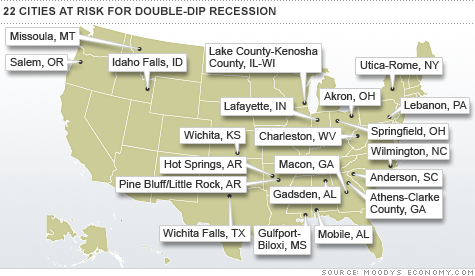
22 cities in danger of a double-dip recession

map_recession_cities2.gif
By Hibah Yousuf, staff reporter | August 17, 2010

NEW YORK (CNNMoney.com) -- The chance of a national double-dip recession is hotly debated amid an increasing number of signs that the economic recovery is losing pace, but the risk is particularly troublesome on a local level.

A new report from Moody's Economy.com singled out 22 cities that are at risk of slipping back into a recession in as early as three months. To come to this conclusion, the economists considered dwindling progress in employment, housing starts, home prices and industrial production. (See the map above for the full list.)

"With chances of a national double-dip recession now estimated at about one in four, several metro areas will probably experience their own downturns in the first half of 2011," said economist Andrew Gledhill, author of the report. The at-risk cities are spread across the country, though more than half of the cities are in the South, and five are concentrated in the Midwest.

Private sector hiring has been tapering off in recent months compared to the start of the year, triggering Moody's to boost its forecast for a national double-dip from a 20% chance to 25% chance.

What's a double dip? No one really knows.

In the 22 identified metro areas, Gledhill said private sector hiring is particularly sluggish, increasing the chances of a slowdown.

Without a substantial pick-up in hiring, Gledhill said the number of cities in danger of a double-dip recession could grow, possibly reaching the triple-digits.

"There was a time when all 384 metro areas were in a recession. We probably won't get to that point again, but given the growing risk of another national recession, we're on the lookout for more metro areas that will be weakening substantially on several levels over the next six months to a year," Gledhill said.

He added that a handful of metro areas, particularly those that are industrial economies, are also suffering from a recent falloff in manufacturing.

Obama Amplifies Bush Education Policy

This is How a Tipping Point Feels
By Anthony Cody on August 15, 2010

We are accustomed to discussing education issues as if they were a realm of their own, with Arne Duncan (and maybe Bill Gates) as the biggest players. We debate policies like merit pay and charter schools, and sometimes reference the influence of economic and social factors, but we sometimes lose sight of the larger political context that is driving these policies.

Things are getting ready to shift.

It is said that education policy is like a pendulum. It tends to swing from one extreme to another. In the 1970s, when the progressive social movements peaked, we had the rise of desegregation, whole language instruction and constructivism, with a great emphasis on student-centered instruction. The past decade the pendulum has swung way back to the other extreme, with the rise of test-driven accountability and pre-digested curriculum.

How educational leaders have responded to this is very instructive. Diane Ravitch is a fascinating case study. She genuinely believed that we could drive improvement in our schools through tough standards and high-stakes tests, and actively promoted these methods. As the decade unfolded and evidence accumulated that this was not working as intended, the honest historian in her forced a change of stance, and she has become a sharp critic. She is a bellwether.

It is a fascinating, frustrating and exciting time, this tipping point we are approaching. The broader political setting is hugely important. We are two years into an administration that made fantastic promises to an America hungry for change. "We are the people we have been waiting for." Obama and his electioneers tapped into every hopeful beat of our hearts. We would bring the troops home from Iraq, close Guantanamo, stop the phone tapping, rein in corporate greed, and inspire the world with a more humane foreign policy.

In education, we were told we would enter a new era of "mutual responsibility," stop spending the year preparing for bubble tests, and stop blaming teachers for all the problems in our schools. We thought we would have a leader smart enough to understand that slogans and profiteers will not be our saviors, and that local leadership at the school and community level is the wellspring of school improvement.

But here we are, approaching the two year mark. At first, we were dismayed, when cruel practices of NCLB were extended. Did they not understand what they were doing? Could they not see this was not consistent with our shared vision? So we wrote, we organized on Facebook, we lobbied, and we spoke by phone with the Secretary himself. It has become clear they know exactly what they are doing, and nothing we say matters.

Teachers are not alone in this feeling. The chance to rein in corporate salaries has been squandered, and companies who received billions in bailout funds have showered their executives with billions in bonuses. The hedge fund managers - heavy investors in charter schools, by the way, have invested in politicians as well, and our system remains rigged in their favor. The war in Iraq, which Obama pledged to end this summer, drags on endlessly, and Afghanistan may well do to the American empire the same thing it did to the Soviets. A mixed blessing, perhaps, but a colossal waste of lives and resources.

Diane Ravitch is gaining company. Washington Post columnist Dana Milbank, not a radical by any means, just filed a column that describes the situation this way:
...if Duncan really wants to stop the biggest bully in America's schools right now, he'll have to confront his boss, President Obama. In federal education policy, the president and his education secretary have been the neighborhood toughs -- bullying teachers, civil rights groups, even Obama's revered community organizers.

Milbank points out what many of us have been saying for months.
Obama has taken the worst aspect of Bush's No Child Left Behind education law -- an obsession with testing -- and amplified it.
Obama has expanded the importance of standardized testing to determine how much teachers will be paid, which educators will be fired and which schools will be closed -- despite evidence that such practices are harmful. In the process, he's offended just about all the liberals involved in or advocating for education without gaining much support from conservatives.

One must assume that Obama has made a Clintonesque political calculation. Faced with tremendous pressure from an alliance of corporate-sponsored education reform organizations and their allies in the media, Obama chose the easy way. He appointed an education secretary who would advance their agenda, apparently assuming that this was a battle he did not need, given all his other troubles.

But those of us working in the schools are not concerned about political calculations. We are trying to make sense of a society that has abandoned those in poverty in every meaningful dimension, and dropped even the pretense of desegregating our schools, and yet expects teachers to close the achievement gap all by ourselves.

Some of us are pendulum-pushers, and some are pendulum-riders. A curious thing has happened as we approach this tipping point. Even as evidence accumulates and is documented by honest scholars such as Ravitch, the "education reformers" are becoming more desperate to shore up their collapsing project. They are very smart, and have incredible resources at their disposal. Even in the midst of an economic crisis, they have marshaled billions of dollars to purchase people's energy. The Race to the Top was ingenious, and so well-timed, as to put maximum pressure on states struggling with impossible revenue shortfalls. So now we have new projects within the education reform effort. There is money for the "new and better" assessments that will solve all the problems we had before with those "bad" assessments. There is money for teacher pay, so long as it is tied to test scores. Those who buy this (or are bought) increasingly insist this trend is irreversible, and "resistance is futile," as a certain queen once asserted.

Those of us who have a name as teacher leaders may even be offered opportunities on these projects, and may have to do some soul searching and investigation, to be sure we can live with the results that our work may yield.

We who are pendulum pushers are hanging on, holding our ground, and continuing to push back. The time has come for the pendulum to start moving the other way.

With an actual pendulum, it is gravity that eventually wins out over the momentum of the device. In the case of education policy, as with corporate banditry and endless war, we cannot wait for the laws of physics to do the job. We need to be pushing, slowing the swing, and pushing it towards a new direction. As Malcolm Gladwell pointed out in The Tipping Point, there are moments when ideas catch hold and begin to spread almost like a virus. There is some combination of outrage and hope that crystallizes into social change. I hope these ideas are infectious. It is about time for this pendulum to swing.

Gulf oil spill still a threat to seafood, JAMA study indicates

By Fred Tasker | The Miami Herald | Tuesday, August 17, 2010

The Gulf of Mexico oil spill still poses threats to human health and seafood safety, according to a study published Monday by the peer-reviewed Journal of the American Medical Association.

The report comes two days after President Obama and members of his family swam in the Gulf at Panama City Beach and ate fish caught there, and hours after this year's commercial shrimping season officially kicked off along the Louisiana coast.

Federal officials disputed the new report and said ongoing testing is aggressive and sufficient to protect public health.

In the short term, study co-author Gina Solomon voiced greatest concern for shrimp, oysters, crabs and other invertebrates she says are have difficulty clearing their systems of dangerous polycyclic aromatic hydrocarbons (PAHs) similar to those found in cigarette smoke and soot. Solomon is an MD and public health expert in the department of medicine at the University of California at San Francisco.

In the longer term, she expressed worries about big fin fish such as tuna, swordfish and mackerel, saying levels of mercury from the oil might slowly increase over time by being consumed by fish lower in the food chain and becoming concentrating in the larger fish.

As time goes on, she said, doctors may be warning pregnant women and children to strictly limit the amount of such fish they eat. Some of the fish had relatively high levels of mercury even before the oil spill, she said.

"It's like iron filings to a magnet," she said. "Several years from now the concentration will go up in fish at the top of the food chain -- tuna, mackerel, swordfish."

Solomon said she based her new report on studies from past oil spills including the Exxon Valdez event off Alaska in 1989, plus her own monitoring of current Gulf data from the National Oceanographic and Atmospheric Administration, the Environmental Protection Agency and the Food and Drug Administration. She also is a member of the Natural Resources Defense Council (NRDC), which calls itself "the nation's most effective environmental action group." Solomon's co-author is Sarah Janssen, MD, a staff scientist with the NRDC.

FDA officials disagreed with Solomon's fears about PAHs.

"We don't agree that's currently a problem,'' said Vicki Seyfert-Margolis, from the office of the chief scientist of the FDA. She said federal officials have a "mussel watch'' program to test for such contamination in all shellfish, and so far it has not found any problems.

As each Gulf area is reopened for fin fish harvest, she said, officials are testing shellfish separately, approving various species only as studies are completed, she said.

For example, shrimp harvesting was reopened off Pensacola on Monday, she said.

Crabs and oysters take longer to test and clear because people eat the entire animal including the liver, where toxins can accumulate, while almost no one eats the liver of a fish, she said.

Seyfert-Margolis agreed that testing must continue for fin fish to make sure toxins don't build up in the future. Such testing will begin if similar early problems come up in the mussel-watch program, she said.

"We have the ability to test it in fin fish. We can study it as long as necessary,'' she said.

Concerning the human effects of the oil spill, Solomon says: "The good news is that the levels of benzene, the most dangerous chemical from oil, have been quite low. It's not likely there's a long-term risk from inhaled vapors for coastal residents.''

She went on: "For oil workers it might be a different story. The people out there deploying boom and burning the oil have been exposed to higher levels of vapor.''

She decried the lack of studies of long-term health effects of past spills such as the Exxon Valdez accident. But she said that on Tuesday the National Institutes of Health will announce a long-term health study of 20,000 Gulf workers and residents.

She pointed to a study of 858 cleanup workers in the 2002 oil spill by the tanker Prestige off the coast of Spain that found DNA damage, although Spanish health officials have said it was not permanent.

On Aug. 10, another 5,144 square miles of Gulf waters were reopened to commerecial and recreational finfish fishing by NOAA, the EPA and the FDA. It reduced the part of the Gulf still closed to 22 percent, from a peak of 37 percent.

NOAA said chemical analysis of 153 fin fish including grouper, snapper, tuna and mahi mahi found contaminants ``well below the levels of concern.'' Also, fish and shellfish harvested from areas unaffected by the closures are considered safe to eat, the FDA said.

"We are confident that Gulf fish from this area is safe to eat,'' said NOAA administrator Jane Lubchenco at the time.

Over the weekend, FDA tests also cleared shrimp from Louisiana's Barataria Bay, making possible the opening of shrimping season there, the Associated Press said. Crabs and oysters, the slowest to metabolize toxins, have not yet been cleared. NOAA will continue sampling, including at dockside.

"We're not going anywhere,'' said Lubchenco.

"I'm not disputing the reopenings,'' Solomon said. ``Many areas of the Gulf are quite likely safe for fishing. But what's true now might change in the future.''

Ronald Kendall, chairman of Texas Tech University's Department of Environmental Toxicology, agreed that PAHs can be a problem.

"They can accumulate in shellfish, and some can be carcinogenic. On the other hand, they are testing a lot for them.''

Kendall tested a small sample of shellfish from the Louisiana coast with gas chromatography on Monday for the ABC News program Good Morning America and said he found all to be clean.

But he added that, while oysters are stationary, shrimp can move about. And so can oil.

"So we must continue to monitor this very closely. Shellfish may be clear now, but in two months maybe not, depending on how the oil moves. You can't just test once and stop. There's a lot of oil in the Gulf, and we don't know where it all is.''

Kendall also agreed that toxins could build up in large fin fish.

"That's another reason we need to keep testing.'' Asked about the Obamas swimming and eating fish in Panama City, Solomon said: ``There are areas along the Gulf Coast that are safe for swimming and fishing. They were in one area that's considered safe. But people all across the Gulf Coast shouldn't assume that if it's safe where the president swam, it's safe where they live.''

People should avoid waters with any trace of oil, she said.

"Use your own eyes. If you see tar balls, oily sheen, don't go in the water. If you're eating fish, make sure they come from an area that's open for fishing and you get it from a reputable fish market or restaurant. If there's any oily smell, don't eat it.''

In her report, Solomon cites a 2002 study in the peer-reviewed journal Marine Environmental Research of the effects of the Exxon Valdez oil spill that concluded: "Our data show that 10 years after the spill, nearshore fishes within the original spill zone were still exposed to residual hydrocarbons. All biomarkers [for contaminants] were elevated in fish collected from sites originally oiled, in comparison to fish from unoiled sites.''

Lead author of the Exxon Valdez study was Stephen Jewett of the School of Fisheries & Ocean Sciences at University of Alaska.

Tuesday, August 17, 2010

Pentagon warning over China military build-up over Taiwan

(...and in another lame attempt to justify their enormous budget by manufacturing enemies out of current trade partners: see Venezuela, Iraq, Iran, Afghanistan, et al--jef)

***

Pentagon warning over China military build-up
By Agence France-Presse | Tuesday, August 17th, 2010

China is extending its military advantage over Taiwan and increasingly looking beyond, building up a force with the power to strike in Asia as far afield as the US territory of Guam, the Pentagon said.

In an annual report to Congress, the US Defense Department said that China was ramping up investment in an array of areas including nuclear weapons, long-range missiles, submarines, aircraft carriers and cyber warfare.

"The balance of cross-Strait military forces continues to shift in the mainland's favor," the report said.

The Pentagon said China's military build-up on the Taiwan Strait has "continued unabated" despite improving political and commercial relations since the island elected Beijing-friendly President Ma Ying-jeou in 2008.

The report -- which US officials delayed for five months amid strains with China -- covered 2009, before the United States approved a 6.4 billion-dollar arms package for the island in January.

Story continues below...
Taiwan has said it is "closely monitoring" China's mounting defences following news of the US report.

"China has not given up the use of force against Taiwan, and we are closely monitoring China's military developments. We ask the public to be rest assured," Taiwan defence ministry spokesman Yu Sy-tue told AFP.

China considers Taiwan, where the mainland's defeated nationalists fled in 1949, to be territory awaiting reunification, by force if necessary.

However, ties have improved markedly since Taiwan's President Ma Ying-jeou took office in 2008 on a Beijing-friendly platform.

Ma has said that the island will not engage in an arms race with China, despite the threat it poses.

The US military report said China was "already looking at contingencies beyond Taiwan," including through a longstanding project to build a far-reaching missile that could potentially strike US carriers deep in the Pacific.

"Current trends in China's military capabilities are a major factor in changing East Asian military balances and could provide China with a force capable of conducting a range of military operations in Asia well beyond Taiwan," it said.

China's military doctrine has traditionally emphasized the ability to strike within an area extending to Japan's Okinawa island chain and throughout the South China Sea east of Vietnam, the report said.

But Chinese strategists are now looking to expand their reach further to be able to hit targets as far away as Guam, including much of mainland Japan and the Philippines, it said.

China is working on the longer-range precision missile, but probably needs more work on the technical infrastructure to put the weapon into use, an official who helped draft the report said on condition of anonymity.

Japan and Vietnam, which both have historic tensions with China, have reported rising incidents with China's military in recent months.

The report predicted that China may step up patrols in the South China Sea. US Secretary of State Hillary Clinton last month in Vietnam backed open access to the sea, triggering a rebuke by Beijing.

The Pentagon report credited China with becoming slightly more open but reiterated concerns about an overall lack of transparency.

In March this year, China said it was raising its defense budget by 7.5 percent to 532.1 billion yuan -- 77.9 billion dollars at the exchange rate at the time -- breaking a string of double-digit increases.

The Pentagon study was cautious on suggestions that China's military was partaking in national belt-tightening, saying that the spending growth may be lower simply because the forces were at the end of a five-year program.

The Pentagon paper estimated that China's overall military-related spending was more than 150 billion dollars in 2009 when including areas that do not figure in the publicly released budget.

It is still far below the US defense budget, the world's largest, which is more than 700 billion dollars in the fiscal year beginning in October.

President Barack Obama's administration has sought to broaden cooperation with China, which in the last quarter surpassed Japan to be the world's second largest economy after the United States.

But the administration approved the package to Taiwan that included helicopters, missile defenses and mine-sweepers, leading China to break off military exchanges with the United States.

The Pentagon said it wanted dialogue with China to avoid any "miscalculation" between the two militaries.

"We stand prepared to work with the Chinese if they are prepared to work with us," the anonymous official said. "But it only does us so much good to show up to a meeting if we're the only ones that are there."

The Taiwan arms sale did not include F-16 fighter-jets, which the island and many US analysts say are crucial to narrowing the strategic gap with Beijing.

Mazda recalls 300,000 cars (Mazda3 and Mazda5) in US, Canada and Mexico

Problems with power steering on Mazda3 and Mazda5 models could cause crashes
James Meikle
The Guardian, Wednesday 18 August 2010

Mazda is recalling more than 300,000 cars in the US, Canada and Mexico, warning that problems with their power steering could lead to crashes.

The company said repairs were needed to Mazda3 and Mazda5 models built from April 2007 to November 2008, faults that were put right a year ago in Japan. About 215,000 of the cars involved were sold in the US.

Mazda said the vehicles could have a sudden loss of power-steering, making it difficult for the driver to steer and increasing the risk of a crash.

The US National Highway Traffic Safety Administration opened an investigation into steering problems in 2007-2009 Mazda3s in June, citing 33 complaints alleging steering problems, including three crashes.

Mazda told the agency last week it was first informed of similar steering problems in Japan in March 2008 and the company began its own investigation in July 2008.

By summer 2009, it had found that the problem was caused by rust forming inside a high-pressure pipe in the power steering system. Rust particles could then enter the power steering pump and cause it to shut down to avoid overheating.

An "improvement campaign" last summer to repair vehicles was organised in Japan "due to a high occurrence rate of this problem," according to the company's letter to the US agency. It did not issue a recall in North America, instead issuing a technical service bulletin to dealers since the "occurrence rate was low". That included repair procedures for customers who reported steering problems.

Mazda told NHTSA in the letter that in the spring of 2010, "we realised the occurrence rate was increasing in the North American market and then we began to study further field action for the market."

The Mazda action follows trouble with Toyotas in the US, although preliminary findings by the US government suggest the sticking accelerators that prompted a recall might have often been caused by driver error.

Gov't starts talks about new mortgage system

Housing conference likely to focus on continued government role in mortgage market
ALAN ZIBEL | AP News | Aug 17, 2010 07:57 EDT

Talk of shrinking the government's involvement in the mortgage market is growing. Just don't expect action any time soon.

A conference Tuesday at the Treasury Department is the first of many steps toward restructuring the nearly $11 trillion mortgage market. So far, rescuing mortgage giants Fannie Mae and Freddie Mac has cost the government more than $148 billion. That number is expected to grow.

Treasury Secretary Timothy Geithner will address the conference but is not expected to offer an exit strategy Tuesday. The administration has said it won't offer its plan until next year.

Officials are pledging dramatic changes to the structure of Fannie and Freddie, which profited tremendously during good times but burdened taxpayers with losses when the housing market went bust.

"We will not support a return to the system where private gains are subsidized by taxpayer losses," Geithner said in remarks prepared for the conference.

With Republicans likely to pick up seats in Congress in November, however, the Obama administration will need support from both political parties for the changes it proposes.

Reflecting this reality, Geithner will say Tuesday that "the failures that produced the system we have today were bipartisan. The solution must be as well."

Executives and mortgage experts are prepared to tell Obama officials that that the government must stay in the business of backing U.S. mortgages even if Fannie and Freddie disappear someday.

"At the end of the day, the government will still have a very large role to play," said Mark Zandi, chief economist at Moody's Analytics and a panelist at the event. Others include mortgage executives from Bank of America Corp. and Wells Fargo & Co, plus Bill Gross, managing director of bond giant Pimco and Lewis Ranieri, one of the creators of mortgage bonds.

The Obama administration's management of Fannie and Freddie has been under fire for months from Republicans on Capitol Hill. In December, the Treasury Department eliminated a $400 billion cap on how much money it would give the mortgage giants to keep them from failing. Sen. John McCain, R.-Ariz., has called that a "taxpayer-backed slush fund" and called for the support to be wound down.

Many in the mortgage industry say that's not realistic.

"There has to be a game plan," said Paul Leonard, vice president of government affairs at the Housing Policy Council, a mortgage industry group. "You can't just pull the plug on them."

Fannie and Freddie buy mortgages and package them into securities with a guarantee against default. They have ensured that millions of Americans can get home loans — even after the housing market collapsed.

The two mortgage giants, the Federal Housing Administration and the Veterans Administration together backed about 90 percent of loans made in the first half of the year, according to trade publication Inside Mortgage Finance.

At some point the government will have to scale back the level of support it provided the housing and mortgage markets during the recession and financial crisis.

"The government's footprint in the housing market needs to be smaller than it is today," Shaun Donovan, President Barack Obama's housing secretary, said in prepared remarks.

Most of the plans being circulated to reshape the mortgage market call for the government to guarantee that investors who buy mortgage-backed securities receive their money even if borrowers default.

Under this system, Fannie and Freddie could either be returned to private ownership or phased out completely. Fannie and Freddie, or their replacements, would pay the government to insure the loans. That money could be tapped if the housing market collapses.

"A government guarantee is both a desirable and necessary component of the country's housing finance system," wrote John Gibbons, a Wells Fargo & Co. executive vice president, in a letter last month to the Treasury Department.

Drilling Permits for Deep Waters Face New Review

By JOHN M. BRODER | August 16, 2010

WASHINGTON — The Obama administration said Monday that it would require significantly more environmental review before approving new offshore drilling permits, ending a practice in which government regulators essentially rubber-stamped potentially hazardous deepwater projects like BP’s out-of-control well.

The administration has come under sharp criticism for granting BP an exemption from environmental oversight for the Macondo well, which blew out on April 20, killing 11 workers and spewing nearly five million barrels of oil into the Gulf of Mexico.

The more stringent environmental reviews are part of a wave of new regulation and legislation that promises to fundamentally remake an industry that has operated hand-in-glove with its government overseers for decades.

Many oil industry officials worry that the new environmental, safety, technical and financial requirements will drive some companies out of business, discourage future exploration and worsen the nation’s dependence on imported oil. The highly competitive oil industry has always operated under tremendous cost and time pressures; the new rules will most likely slow the development of new wells while raising costs.

Bruce H. Vincent, chairman of the Independent Petroleum Association of America, said the industry feared that the BP accident would be a turning point for oil exploration the way the Three Mile Island nuclear plant accident in 1979 contributed to a virtual 30-year moratorium on nuclear plant construction.

“Let’s hope it’s not our Three Mile Island,” said Mr. Vincent, who is also president of Swift Energy, a midsize oil company based in Houston. “It all depends on whether government adopts the wrong policies in response. The country can’t afford that.”

Drillers are already chafing under a moratorium on deepwater drilling in the gulf and strict new rules on shallow-water wells. The new environmental rules provide a foretaste of what the regulatory climate will be once the moratorium is lifted later this year. The House and Senate are moving legislation that will tighten regulatory standards for offshore drilling and put a higher multibillion-dollar limit on liability for damages from any future oil spill.

The administration is moving on a parallel track. After three months of review of federal environmental law, the White House Council on Environmental Quality on Monday recommended that the Interior Department suspend use of so-called categorical exclusions, which allow oil companies to sink offshore wells based on environmental impact statements for supposedly similar areas, while the department reviews the environmental impact. Permits for the Macondo well were based on exemptions written in 1981 and 1986. The waiver granted to BP in April 2009, as part of the permitting process for the doomed well, was based on the company’s claim that a blowout was unlikely and that if a spill did occur, it would cause minimal damage.

The Interior Department’s Minerals Management Service, recently renamed the Bureau of Ocean Energy Management, Regulation and Enforcement, issued hundreds of these exemptions in recent years to reduce the paperwork burden for oil companies seeking new wells and for government workers. As a result, there was no meaningful plan in place to cope with the BP spill and its impact on aquatic life and gulf shorelines.

The White House and the Interior Department announced in mid-May that they would review all actions taken by the minerals agency under the National Environmental Policy Act, known as NEPA. The law, a foundation of environmental policy enacted after a 1969 oil spill off Santa Barbara, Calif., requires federal agencies to complete a detailed environmental assessment before approving any potentially damaging project like an offshore oil well.

Ken Salazar, the interior secretary, and Michael R. Bromwich, director of the offshore energy service, said Monday that they would conduct a thorough environmental review of all future drilling in the Gulf of Mexico and elsewhere on the Outer Continental Shelf. The moratorium on most deepwater drilling in the gulf will continue as the study proceeds, they said.

The new policy will require much more extensive environmental scrutiny once the moratorium is lifted and will lengthen the process of granting new drilling permits. Under current policy, the agency has only 30 days to decide whether to approve a drilling application, and few are denied. The new policy will also suspend the issuing of automatic exemptions from environmental review for virtually all new wells in the gulf. Such waivers have become common in recent years.

“In light of the increasing levels of complexity and risk — and the consequent potential environmental impacts — associated with deepwater drilling, we are taking a fresh look at the NEPA process and the types of environmental reviews that should be required for offshore activity,” Mr. Salazar said.

An Interior Department spokesman said the agency would not grant environmental waivers for potentially risky wells while the environmental policy was being reviewed, a process that he said would take several months. It was not clear how much time the new policy, when completed, would add to the permit process for new wells.

Mr. Salazar and Mr. Bromwich said drilling in shallow waters would be allowed to continue if operators met certain new safety and environmental standards, like certifying that the blowout protectors in use had been recently inspected and tested.

The Center for Biological Diversity, an environmental group that has drawn attention to the use of categorical exclusions for offshore oil wells, called the new Interior Department policy a step in the right direction.

Bill Snape, senior counsel for the center, said in an e-mail that it should be broadened to include shallow-water wells and wells that have already been granted permits but have yet to be started. Mr. Snape also said that in many instances, the government should produce an environmental impact statement, which is more detailed than the environmental assessment the new policy requires.

Erik Milito of the American Petroleum Institute, the lobby for big oil companies, said the new rules could slow approval of new wells and cost jobs. “We’re concerned the change could add significantly to the department’s workload, stretching the timeline for approval of important energy development projects with no clear return in environmental protection,” Mr. Milito said.

Representative Nick J. Rahall II, Democrat of West Virginia and chairman of the House Natural Resources Committee, said the White House report highlighted one of many problems with the Interior Department’s regulation of offshore drilling.

He called for enactment of his bill, the Consolidated Land, Energy and Aquatic Resources Act, to change the agency and tighten oversight of oil operations. It would eliminate the use of categorical exclusions for all exploration and development wells.

“I applaud Secretary Salazar for the steps he is taking,” Mr. Rahall said, “but permanent reform requires passage of my Clear Act, which would put the last nail in the coffin to the practice of allowing Big Oil to jam through offshore drilling projects with minimal review.”

Glenn Beck not laughing, says "Stewart’s act has grown ‘tired’"

Stewart calls out Beck's inconsistent rhetoric about NYC Islamic center; Beck and crew complain it was only "mildly similar in a different context"
By David Edwards and Ron Brynaert
Tuesday, August 17th, 2010

"That joke isn't funny anymore," Morrissey once sang for The Smiths. But that's because it hit "too near the bone."

Just a few months ago, Glenn Beck called a Jon Stewart impersonation of himself "hilarious," but on his Tuesday morning radio show, the pundit who used to call himself a "clown" ripped into the Comedy Central host for letting his act grow "tired."

Referring to Monday's Daily Show, Huffington Post's Katla McGlynn blogs that "the best part of the segment was when Stewart caught Glenn Beck in a huge contradiction."
The first clip showed Beck doubting Rauf's "moderate" stance due to statements he made after 9/11 saying America didn't "deserve" the attacks, but that American policies were "accessories to the crime."

"What kind of scheming, America-hating, extremist monster would say something so evil?" Stewart asked, before cutting to a clip of Beck saying LITERALLY the same thing as Rauf, just three months earlier. "What will he think tomorrow?"
Media Matters noted Beck's radio show response:
After playing Stewart's recent skewering of Beck's hypocrisy for attacking Rauf over comments strikingly similar to comments Beck himself made in April, Beck asked, "Does Jon Stewart not understand the difference between that last statement and the statement from the imam that happened two days after 9-11?" Beck gave no indication what actually distinguished Rauf's comments from Beck's, aside from their temporal proximity to September 11, 2001.

And it truly is difficult to find any difference beyond the semantic.
Beck: "When people said they hate us, well, did we deserve 9-11? No. But were we minding our business? No. Were we in bed with dictators and abandoned our values and principles? Yes. That causes problems."

Rauf: "I wouldn't say the United States deserved what happened on 9-11, but the United States' policies were an accessory to the crime that happened."
After not explaining the "difference" between his statement and "the statement from the imam" that Beck apparently sill finds appalling, Beck asked, "Does [Stewart] understand that I didn't hire someone to work for me that also went out and made statements like, 'The Jews are responsible," and 'If the - if Americans knew the Jews, they would do what Hitler tried to do to the Jews?'"
Jeremy Holden at Media Matters adds, "Beck's sidekick Stu Burguiere went on to say that Stewart 'has become dull,' and characterized Stewart's criticism as a 'boring, lazy, tired effort.'"

At worst, the statements were "mildly similar in a different context," Team Beck agreed.

This video is from Comedy Central's The Daily Show, broadcast Aug. 16, 2010.


The following audio clip from Beck's radio show is from Media Matters:

Paul Craig Roberts: America is Truly being Destroyed by Design

(First, let me explain that I think Dr. Paul Craig Roberts knows what he's talking about. He was once Under Secretary of the Treasury for the Reagan Administration, publisher of the Wall Street Journal, and an economist of note for 40+ years. He was one of the few economists who predicted the MBS/CDO/derivatives cause of the current financial crisis back in 2004. The man knows his stuff. Alex Jones means well, I think. But his message often gets lost in his emotional outbursts and tirades in which he insults and batters his listeners with derisive comments. But I think he means well, usually.--jef)

***


Mankind Is Using Up Global Resources Faster Than Ever

The growing world population and increasing consumption has pushed the world into ‘eco-debt’ a month earlier this year, according to the latest statistics on global resources.
by Louise Gray | Monday, August 16, 2010 by the Telegraph/UK

Think tank the New Economics Foundation (NEF) look at how much food, fuel and other resources are consumed by humans every year. They then compare it to how much the world can provide without threatening the ability of important ecosystems like oceans and rainforests to recover.

This year the moment we start eating into nature's capital or ‘Earth Overshoot Day' will fall on 21st August, a full month earlier than last year, when resources were used up by 23rd September.

Andrew Simms, Policy Director at NEF, blamed increased consumption.

He said people in developing countries like China are consuming more meat and demanding cars and other energy-intensive goods. Even with green developments and energy efficiency, rich countries are also consuming more as individuals demand the latest technology, food fad or car.

He explained that the earlier humans use up Earth's resources, the more strain is put on resources, forcing up fuel prices and driving climate change. Ultimately ecosystems like fisheries and even the Earth's climate system will suffer and future generations will experience food shortages and rising global temperatures.

Mr Simms called for a transition to a more sustainable way of living to prevent poverty and starvation in the future.

"The banking crisis taught us the danger of a system that goads us to live beyond our means financially," he said. "A greater danger comes from a consumer culture and economic policy that pushes us to live beyond our means ecologically."

'Why Can't We Say No?' Pittsburgh City Councilman Pushes Back Against Marcellus Drilling

In Test for Municipal Self-Government, Pittsburgh Councilman Pushes for Gas Drilling Ban
by Joe Smydo | Tuesday, August 17, 2010 by Pittsburgh Post-Gazette

Pittsburgh City Councilman Doug Shields today plans to unveil legislation to ban natural gas drilling in the city, saying he's wants to test a municipality's right to self-government, even if that means inviting a legal challenge from the drilling industry.

"Why can't we say no? Why is it that local authorities, the local government, can't make that determination?" Mr. Shields said Monday, the same day that the University of Pittsburgh reported a surge in the number of Allegheny County property owners who have leased land for oil and gas exploration.

Since 2003, about 35,400 acres -- about 7 percent of the county's land area -- have been leased, mostly for Marcellus Shale exploration, according to the University Center for Social and Urban Research. The number of new leases jumped from 30 in 2003 to 273 in 2008 to 1,153 last year, researchers said.

In Pittsburgh, only 362 acres, or about 1 percent of the city's land area, is under lease, Bob Gradeck, research project manager, said. Yet a flurry of leasing in East End neighborhoods has led to an outpouring of concern about river pollution and other potential problems in recent months.

City Councilman Patrick Dowd, who in June introduced legislation to impose operating and safety requirements on gas producers, said the city law department told him a drilling ban likely would not withstand a legal challenge. But Mr. Shields said it's worth attempting a ban and asserting the city's right to protect itself from what he described as a potentially harmful industry.

Mr. Shields has talked about a ban since June. His bill was written with the help of Ben Price, projects director for the Franklin County-based Community Environmental Legal Defense Fund, a nonprofit law firm that says it provides free or reduced-cost services to communities facing environmental threats.

Pennsylvania's Oil and Gas Act gives the state the authority to regulate those industries. But a ban is not a regulation, Mr. Price said, suggesting that distinction opens the door for Mr. Shields' legislation.

Governments long have struggled in legal fights to ban strip clubs and firearms, but those debates involved thorny First and Second Amendment issues, Mr. Price and Mr. Shields said. They noted that Pennsylvania municipalities, while lacking authority to regulate liquor sales within their borders, may elect to go dry and ban them altogether.

Mr. Price also said a municipality has the fundamental right and "police powers" to protect its residents' safety and welfare.

Kathryn Klaber, president and executive director of the Marcellus Shale Coalition, a Cecil-based trade group, said the city would have a difficult time barring landowners' development of their mineral rights.

"I really believe that city of Pittsburgh residents -- those who are paying taxes to support the city budget and certainly the landowners who own their mineral rights -- deserve a much broader discussion about what the industry would mean to their pocketbooks and to the future of Pittsburgh," she said.

Mr. Shields' bill has the support of state Sen. Jim Ferlo, D-Highland Park, who has introduced legislation that would impose a one-year statewide moratorium on new drilling so officials could ponder tighter regulations. He said Mr. Shields' bill would face a significant legal hurdle but believes that the city could make a compelling case.

The bill may face an uphill battle even among other city officials.

Mr. Dowd said attempts to impose a ban might interfere with more practical steps the city could take to protect residents, such as his bill's proposed requirement that production companies develop emergency management plans.

Mayor Luke Ravenstahl also opposes a ban, in part because drilling would create jobs, tax revenue for the state and spinoff revenue -- such as earned-income tax -- for the financially strapped city, his spokeswoman, Joanna Doven said. At the same time, she said, Mr. Ravenstahl understands concerns about potential hazards.

"What the mayor is focusing on is balancing the two," she said, noting the city is "going to prepare for any possible" pollution, well fires or other risks.

Mr. Gradeck said the university researchers spent months developing a database and interactive map of oil and gas leases, documenting what he called a "pretty dramatic increase" in leasing activity. The map is available at www.ucsur.pitt.edu/thepub.php.

The amount of land leased in the city is small compared with municipalities in other parts of Allegheny County, Mr. Gradeck said. In West Deer, for example, 4,348 acres -- about 23.6 percent of the township's land area -- has been leased since 2003, he said.

Ms. Klaber said the 7 percent leasing rate in Allegheny County is much smaller than in other Pennsylvania counties. Citing the especially modest lease holdings in the city, Ms. Klaber said drilling there is not imminent.

"We have time to establish a more healthy dialogue" with city leaders, she said.

Court Halts California Gay Marriage

Tuesday, August 17, 2010

LOS ANGELES – Gay couples in California scrapped wedding plans Tuesday after a court halted same-sex unions until the completion of an appeals process expected to end up in the US Supreme Court.

A week after a landmark decision overturned a ban on gay marriage, the Ninth Circuit Court of Appeals granted a motion for a stay of the order, effectively reinstating the ban.

Further appeal proceedings are now scheduled to take place the week of December 6 in San Francisco.

The ruling halted an anticipated rush of gay marriages after Judge Vaughn Walker last week ruled same-sex weddings could begin again on August 18, allowing a week for the court of appeals to consider the issue.

Opponents of gay marriage argued in their appeal that same-sex unions are prohibited most places in the United States and abroad because marriage is intended to serve a societal interest.

"California, 44 other states, and the vast majority of countries throughout the world continue to draw the line at marriage because it continues to serve a vital societal interest," the appeal said.

The challenge argued that the purpose of marriage is for members of the opposite sex "to channel potentially procreative sexual relationships into enduring, stable unions for the sake of responsibly producing and raising the next generation."

Opponents of gay marriage in California also argue that the state's voters made their intentions known by supporting the 2008 ballot initiative known as Proposition 8 that imposed the ban on same-sex unions.

"California voters spoke clearly on Prop. 8, and we're glad to see their votes will remain valid while the legal challenges work their way up through the courts," Andy Pugno, an author of the ballot initiative, said in a statement.

But the ruling was a bitter blow for gay couples and their supporters.

"We are extremely disappointed that loving same-sex couples will have to wait to marry, and that we are once again being denied our fundamental rights," said Equality California Executive Director Geoff Kors in a statement.

"However, we are optimistic for a favorable ruling, and we're hopeful that same-sex couples will be able to marry as soon as possible."

Some 18,000 gay and lesbian couples tied the knot between May and November 2008 when gay marriage was briefly allowed by the state of California.

Currently only the states of Connecticut, Iowa, Massachusetts, New Hampshire and Vermont, as well as the US capital Washington, recognize gay marriage.

Both California Governor Arnold Schwarzenegger and state Attorney General Jerry Brown filed motions last Friday demanding same-sex marriages be allowed after Walker ruled that the California referendum that barred same-sex marriage was discriminatory and therefore violated the US Constitution.

Schwarzenegger praised Walker's decision, saying it would "provide all Californians the liberties I believe everyone deserves."

But the ruling drew howls of condemnation from conservative opponents of same-sex marriage, who alleged that Walker -- who is gay -- had allowed his ruling to be influenced by his own sexual orientation.

Opponents of same-sex unions also argued it was inappropriate to reinstate marriage rights until the appeals process had run its course.

"If the trial court's decision is eventually reversed, refusing to stay the decision will senselessly create legal uncertainty surrounding any same-sex unions entered while the appeal is pending, "said Jim Campbell, a lawyer for the Alliance Defense Fund, a socially conservative grouping.

Proposition 8 passed with a 52 percent majority in November 2008, only six months after California's Supreme Court overturned a previous ban on same-sex weddings, sending gays and lesbians flocking to marry.

Legal experts believe the case is almost certain to end up before the US Supreme Court in around two years, once appeals hearings in lower courts have run their course.

Government Report on Gulf Oil Spill Inaccurate, Scientists Say at Least 79% of Oil Still in the Sea

(I'm shocked! You mean, the govt. lied? Shame!--jef)

***

by Sean Alfano | Tuesday, August 17, 2010 by The New York Daily News

Think the Gulf oil spill is over? Think again, say some scientists.

Researchers from the University of Georgia called a recent government report "inaccurate" on Monday for claiming that three-quarters of the oil leaked from BP’s blown-out underwater well had either been collected, evaporated or burned off.

Instead, the scientists say nearly 79% of the oil still remains in the Gulf of Mexico in some form.

"One major misconception is that oil that has dissolved into water is gone and, therefore, harmless," said Charles Hopkinson, a marine scientist who headed the study, told the Wall Street Journal. "The oil is still out there, and it will likely take years to completely degrade."

A second study, conducted by a team at the University of South Florida, says dispersants used to break up the massive spill has pushed the oil to the bottom of the ocean floor.

"The dispersant is moving the oil down out of the surface and into the deeper waters, where it can affect phytoplankton and other marine life," said John Paul, a USF marine microbiologist told CNN.

The April 20 explosion of the BP-leased Deepwater Horizon rig triggered the worst offshore oil spill in U.S. history, spewing more than 200 million gallons of oil into the Gulf, the government reported.

Eleven rig workers died in the blast.

According to the report filed by the National Oceanic and Atmospheric Administration and the Department of the Interior two weeks ago, 33% of the oil from the spill was collected, skimmed from the surface, burned or dispersed.

About 25% naturally evaporated and 16% dispersed into "microscopic droplets," the report said.

Meanwhile, the government’s point man for the oil spill, retired Coast Guard Adm. Thad Allen, said Monday he is not sure when the "bottom kill" for the exploded well will begin, but that once it does, it will take up to a week to complete.

Congress Members Deliver Smackdown to Google and Verizon over Net Neutrality (2 stories)

by Preston Gralla | Tuesday, August 17, 2010 by ComputerWorld

Four Democratic congressmen have joined together to denounce a Google-Verizon proposal that they believe will spell the death of net neutrality. They've written to the head of the FCC, asking that he act soon, and not allow "two large communications companies with a vested interest in the outcome" to decide the Internet's future.

The congressmen are all on the House Energy and Commerce committee --- Ed Markey (D-MA), Mike Doyle (D-PA), Jay Inslee (D-WA), and Anna Eshoo (D-CA). Markey has a long-time interest in telecommunications issues, is the author of H.R. 3458, the Internet Freedom Preservation Act and has long been a leading voice for net neutrality.

The Congressmen wrote the letter to Julius Genachowski, the chairman of the FCC. They're asking the FCC to act now to preserve net neutrality, and specifically criticize key points of the Google-Verizon proposal. (You can download the letter as a PDF here.)

As I've written in a previous blog, the Google-Verizon proposal would hasten the death of net neutrality in several ways. First is that the companies are asking that wireless service be excluded from net neutrality rules.

The congressmen, in no uncertain terms, disagree. They write:

"Exclusion of wireless services from open Internet requirements could widen the digital divide by establishing a substandard, less open experience for traditionally underserved regions and demographic groups that may more often need to access or choose to access the Internet on a mobile device. Moreover, such inconsistent principles could confuse consumers, who would have different and uneven experiences depending solely on the connection that their devices might use to reach the Internet. An Internet framework excluding wireless from important consumer safeguards could impede attainment of national broadband goals, while lessening the potential for wireless platforms to serve unserved and underserved areas."

The other part of the proposal that would help kill net neutrality is a vague broad loophole for "additional or differentiated services" or managed services that providers might want to offer. What are these managed services? No one seems to know.

The congressmen take dead aim at that as well. They warn that "Broad 'managed services' exceptions would swallow open Internet rules" and go on to say:

"An overbroad definition of the proposed 'managed services" category would sap the vitality and stunt the growth of the Internet...By undermining competition and the value of the open Internet, managed services could have significantly negative consequences for consumers and commercial enterprise."

The congressmen want the FCC to establish rules to guarantee that there will be net neutrality and an open Internet. They take direct aim at Google and Verizon, writing that:
"Rather than expansion upon a proposal by two large communications companies with a vested interest in the outcome, formal FCC action is needed."

Why are the congressmen asking the FCC to act, and to act now? Because they know that Congress won't act. As ars technica points out, "Congress has been quite direct in saying that it has no plans to act." That's because Republican are against a net neutrality proposal, and a number of Democrats are against it as well. So as a practical matter, there simply aren't enough votes to pass a net neutrality law.

So now it's up to the FCC. Will Google and Verizon be able to trump that agency? The answer will go a long way toward determining whether the Internet stays open or not.

***

Democrats push for FCC power over Internet 
by Declan McCullagh  |  August 17, 2010

A group of four Democratic politicians claims that a
 proposal announced last week by Google and Verizon does not give the federal government enough authority to regulate the Internet.

The companies' Net neutrality proposal does not grant the Federal Communications Commission sufficient "oversight authority" and should permit the agency to slap new regulations on wireless services, the politicians said in a letter on Monday.

It was addressed to FCC chairman Julius Genachowski, a fellow Democrat, who has been left in an awkward position after a federal appeals court slapped down the agency's attempt to punish Comcast.

Since that ruling, liberal interest groups have been lobbying Genachowski for a new set of regulations, even though a majority of members of the U.S. Congress has opposed the idea. The Google-Verizon framework--which is not formal legislation but instead is a set of concepts--represents the companies' attempt to craft a workable compromise and bring some finality to the often-chaotic discussions of what regulations could be imposed on tomorrow's Internet.

Monday's letter, drafted by Rep. Ed Markey, a Massachusetts Democrat, says the idea of curbing FCC authority over wireless services "could widen the digital divide by establishing a substandard, less open experience for traditionally underserved regions and demographic groups that may more often need to access or choose to access the Internet on a mobile device."

"The FCC must have oversight authority for broadband access services," the letter said.

It also was signed by Anna Eshoo, whose district includes Palo Alto, Calif., Mike Doyle of Pennsylvania, and Jay Inslee of Washington state.

Because of the breadth of opposition in Congress to new, wide-ranging Net neutrality rules, the letter is intended to be mostly symbolic by lending visible support to a Democrat-controlled FCC. (Some Republicans already have been proposing preemptive legislation to halt what they call an FCC power grab.)

A secondary effect likely will be to rally the special interest groups that have been vocal in condemning the Google-Verizon proposal. Joel Kelsey, political adviser for Free Press, worries that it might "transform the free and open Internet into a closed platform like cable television," and activist groups (including some that refocused their anti-war protesting) showed up in front of the Googleplex last week.

How Not to Stop Smoking

Suppressing thoughts of smoking just increases the likelihood you’ll light up later on
By Tom Jacobs, Miller-McCune.com
Posted on August 16, 2010

Over the past 25 years, a series of studies have found suppressing unwanted thoughts is not only ineffective, but counterproductive. Try to not think of a white bear, and chances are the creature will come roaring into your mind.

In 2007, British psychologist James Erskine applied this dynamic to diet. He reported women instructed not to think about chocolate consumed more of the high-calorie treat when offered it, and suggested this rebound effect may explain the failure of so many dieters to lose weight over the long term.

Now, in a paper recently published in the journal Psychological Science, he and two colleagues provides evidence that thought suppression can also sabotage attempts to quit smoking.

Their study featured 85 regular cigarette smokers (42 men and 43 women). While 70 percent of them had attempted to quit smoking at some point, none were actively attempting to do so at the time of the experiment.

Each day for three weeks, participants recorded the number of cigarettes they smoked that day, as well as their stress level. One week into the experiment, one-third of the smokers were asked to “try not to think about smoking. If you do happen to have thoughts about smoking this week, please try to suppress them.” Another third were instructed to think about smoking as frequently as possible during the week. The final third received neither instruction.

During that second week, “the suppression group smoked considerably less than both the expression group (those encouraged to think about smoking) and the control group,” the researchers reported. But the situation reversed itself in Week Three, as those in the suppressed-thoughts group smoked considerably more than those in the other two categories.

“This suggests that in the short term, suppression may be effective in reducing unwanted behavior,” Erskine and his colleagues write. “This may explain a troublesome aspect of thought suppression — that individuals perceive the strategy as beneficial.”

Which it is — but only until the rebound hits.

Those in the suppression group reported higher stress levels in Week Two than those in the other two groups, but the researchers found this effect was not responsible for the increase in Week Three smoking. Rather, the results appear to reflect a pure bounce-back effect: The white bear returns, carrying a carton of Pall Malls.<

In the researchers’ view, these results “suggest that thought suppression may be more harmful than previously believed,” especially for struggling addicts. So if you’re craving a cigarette, let the image of that glowing cylinder linger in your mind until it fades away on its own. Pushing it aside only makes it more likely you’ll light up later.

Film Shows How Bush Admin Lies Marred Legacy of Pat Tillman

The "Tillman story," tells the struggle his family went through to learn the truth about Tillman's death and how political leaders covered-up the real story
By Rory O'Connor, MediaChannel.org
Posted on August 16, 2010


Of the many lies George W. Bush told us about the wars in Iraq and Afghanistan, some were larger but none worse than that told about the death of Pat Tillman.

In 2004 – just after Bush’s invasion of Iraq, ostensibly in search of those non-existent weapons of mass destruction — Tillman became a military-and media-manufactured symbol of duty, sacrifice, patriotism and heroism. But the truth about Tillman’s life is much more complex, and his death ultimately far more heroic, than the convenient, self-serving lie served up by the military and then sent out by our ever-gullible media.

Tillman, a truly remarkable young man who walked away from a multi-million dollar contract as a professional football player to enlist as in the Army Rangers after the 9/11 attacks, is the subject of The Tillman Story, a moving documentary directed by Amir Bar-Lev that opens in theatres in New York and Los Angeles this week. Although the film rightly tells the story of Pat Tillman’s remarkable life, it also focuses on a parallel Tillman story, that of the struggle his family went through to learn the truth about Tillman’s death from “friendly fire” and the ongoing cover-up of how and why our military and political leaders lied in order to exploit his heroism for propaganda purposes.

Tillman was on his second tour of duty when he was killed in Afghanistan — a victim of “fratricide,” inadvertently killed by his own troops during an ill-fated expedition. Our leaders should have told the truth — namely, that Corporal Tillman’s death was a senseless accident coupled with incompetence. Instead they lied — to all of us, but most despicably to his family – rewrote the details of his death, awarding Tillman a posthumous Silver Star, America’s third-highest military decoration, and turned the tragedy into an opportunity to promote their endless and unpopular wars.

Why did they lie? No doubt it began because at the time of Tillman’s death, in April 2004, the Bush war machine was roiled by a number of negative images that threatened to adversely affect public perception of the war in Iraq. Remember those haunting photographs and videos of the bodies of American contractors strung up in Fallujah? Can you ever forget the searing images depicting abuse by U.S. soldiers working as guards in the Abu Ghraib prison? Adding the news that American soldiers had gunned down a celebrated NFL star certainly wouldn’t help the war effort… So Pat Tillman was recast, in death, as a war hero and lesson to us all.

The Tillman Story excels in teaching us other lessons, however — not only about Corporal Pat Tillman, but also about his remarkable family, led by his indefatigable mother Dannie. It shows the arduous journey his family undertook to find the truth about what happened and to have someone held accountable not only for their son’s death but also for the added insult of its use as a propaganda tool. Handed a massive, confusing box of intelligence records — thousands of pages of documents about her son’s death – Dannie Tillman patiently dug through the voluminous material to uncover the roots of a carefully coordinated cover-up. Her efforts, along with that of Tillman’s father and other family members and friends, eventually forced a Congressional hearing into the matter. As the film dramatically demonstrates in its stunning climax, however, the ultimate fix was in… and although the many obvious lies and cover-ups can be tracked up to and even well beyond such military brass as the recently fired general Stanley McChrystal, in the end no one among the higher-ups was ever found blameworthy or even responsible for lying to the Tillman family and the nation.

In lieu of presenting a hagiography, Director Bar-Lev does an excellent job of humanizing Tillman and offering a multi-dimensional look at his actual character. Scenes with Tillman’s family as they lovingly describe his character and his close, funny and frequently profane relationship with two brothers (the film is unfortunately and unfairly burdened with an “R” rating as a result) along with testimony from family friends and fellow soldiers paint a clear portrait of who Tillman really was — warts and all. As Bar-Lev points out, Pat Tillman was no “paragon of moral certitude; he was curious and tried to see things from every possible point of view.” That impulse is what the director attempts to give back to his subject, after he had been dehumanized and exploited for political gain by America’s leaders, aided and abetted as usual by the complicit cheerleaders of the national news media.

“I hope the story of Tillman tells us that heroism and humanity are not contradictory and heroism is complex,” Bar-Lev told Documentary magazine. “‘Hero’ is a problematic word that says a lot more about the people using it than the person they’re speaking about….

“I knew there were myths around his death,” Bar-Lev added, “but what began to intrigue me was when we found out there were equally as many myths about his life.”

“Ultimately, what I would want to have happen is just the truth,” Pat’s youngest brother Richard told ESPN.com. “At the end of the day, Pat deserves the truth. This isn’t about our family. This isn’t about the Tillmans. This is about Pat Tillman. And he deserves the truth, period. He sacrificed so much for his country, and then the government turns around and uses him for propaganda. That is totally unacceptable.”